
Planning applications rarely fail because the architecture is weak on paper. More often, they stall because one practical question hasn’t been answered convincingly enough: how will people, vehicles, deliveries, refuse trucks, cyclists and emergency services actually get in, out and around the site safely?
That is where highway and traffic engineering consultants become central to planning success. We’re not just talking about traffic counts and neat drawings. We’re talking about the technical evidence that shows a proposal can operate in the real world, fit local policy, and avoid creating unacceptable impacts on the surrounding highway network. For architects, planners, surveyors, developers, lawyers and local authorities, that evidence can make the difference between a straightforward approval and months of avoidable back-and-forth.
In 2026, expectations are only getting sharper. Local validation checklists are more specific, transport policy is more sustainability-led, and highway authorities want robust, proportionate assessments rather than vague assurances. Whether a scheme needs a concise Transport Statement or a full Transport Assessment with modelling, the role of the consultant is to turn a site’s transport constraints into a workable planning strategy.
Below, we break down what highway and traffic engineering consultants do, when their input is needed, and how to choose the right team for your project.
What Highway And Traffic Engineering Consultants Do

Highway and traffic engineering consultants assess how development interacts with the transport network, then translate that into evidence, design and strategy that planning officers and highway authorities can actually rely on.
At the broadest level, the job covers four linked tasks: understanding existing conditions, forecasting likely impacts, designing safe and workable access arrangements, and justifying the proposal against policy and technical standards. That sounds tidy. In practice, it can involve site visits, traffic surveys, collision review, junction modelling, visibility checks, parking analysis, internal layout review and negotiation with the local highway authority.
We typically start by asking a few simple questions. What kind of trips will the development generate? At what times? Can the local network absorb them? Is the proposed access safe? Will larger vehicles turn properly? Does the layout support walking, cycling and servicing as well as private cars? Those answers shape everything that follows.
For smaller schemes, the output may be a concise note or statement showing that impacts are limited and acceptable. For larger or more sensitive sites, it may involve detailed modelling, mitigation proposals and a package of drawings. Either way, the aim is the same: to prove that the scheme is not just desirable in planning terms, but deliverable on the ground.
That overlap between transport evidence and development design is why experienced highway and traffic engineering consultants are usually involved well before submission, not after objections land.
How Their Work Supports Planning Applications

Planning is evidence-led, and transport is one of the clearest areas where unsupported assumptions get challenged fast. Highway and traffic engineering consultants support planning applications by providing that evidence in a form local authorities can test.
A good transport submission does more than say a scheme will be fine. It demonstrates, with data and method, that the development is safe, practical and policy-compliant. That might include traffic survey information, trip generation based on recognised databases, future year traffic growth, queue or capacity analysis, access geometry, visibility splays, parking provision and sustainable travel measures.
The value here is partly technical and partly strategic. Technically, we show whether a junction operates within acceptable limits, whether a visibility splay can be achieved, or whether a refuse vehicle can turn on site. Strategically, we help frame the planning case so the right amount of information is submitted at the right stage. Too little detail invites objections. Too much irrelevant analysis can waste time and budget.
This is especially important when schemes sit on constrained urban sites, near busy A-roads, or in areas where councils are sensitive to school-run peaks, town-centre servicing or existing parking stress. In those cases, a robust transport narrative can de-risk the application before it reaches committee.
Used properly, transport evidence doesn’t sit in isolation. It strengthens layout decisions, supports design revisions and helps the wider consultant team present a coherent proposal. That broader relationship is reflected in practical guidance on Traffic Engineering and Transportation, where transport planning is treated as part of development strategy rather than a late technical add-on.
Transport Statements, Transport Assessments, And Travel Plans Explained
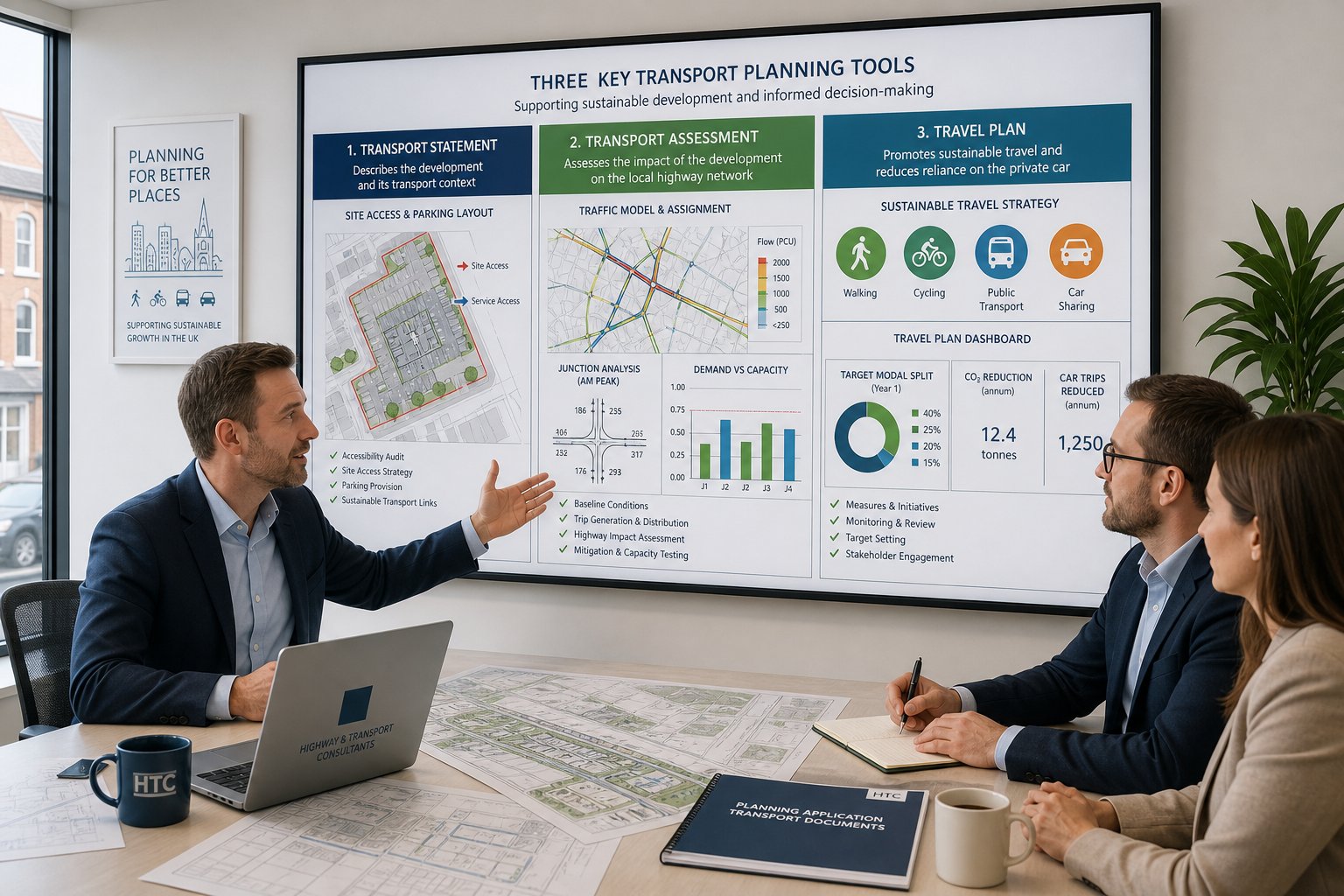
These three documents are often mentioned together, but they do different jobs.
A Transport Statement (TS) is usually prepared for smaller developments with limited transport impact. It sets out the existing highway context, describes the proposal, reviews access and parking, and explains why the scheme is unlikely to create severe transport effects. It is proportionate by design. The point is not to over-engineer the submission, but to provide enough evidence for a highway authority to be comfortable.
A Transport Assessment (TA) goes further. It is typically required for larger schemes, sensitive locations, or uses likely to generate meaningful peak-time demand. A TA may include traffic surveys, trip generation and distribution, assignment, future year scenarios, junction modelling, accident analysis, mitigation testing and detailed active travel review. If a TS says “the effects are modest”, a TA shows exactly how and why that conclusion is reached.
A Travel Plan (TP) is different again. It focuses less on highway capacity and more on behaviour. It sets out measures to encourage walking, cycling, public transport use, car-sharing and sometimes phased monitoring or targets after occupation. Councils often expect Travel Plans for schools, offices, larger residential schemes and mixed-use sites because mode share matters just as much as junction performance.
The skill lies in choosing the right tool. A proportionate TS can be stronger than an unfocused TA, and a practical Travel Plan often helps address policy concerns around sustainability. For projects where scope is uncertain, early advice from Traffic Engineering Consultants: What can stop teams from either under-submitting or producing far more than the authority will realistically need.
When A Development Needs Highway And Traffic Input

Not every application needs a long technical report, but many more sites need transport input than clients first assume. The trigger is rarely just project size. Often, it is the combination of scale, access arrangement, location and local authority expectation.
If a scheme proposes a new access onto the public highway, alters an existing junction, increases trip generation materially, or relies on a constrained site layout, highway input is usually sensible from the start. The same applies where parking is tight, servicing is awkward, pedestrian connections are poor, or there is a history of local concern about traffic conditions.
And timing matters. We often see the most expensive transport problems emerge not because they were technically complex, but because they were left too late. A seemingly minor change in building position can affect visibility: a revised parking court can compromise refuse tracking: an access width that works architecturally may fail on adoptability or emergency access grounds.
For that reason, bringing transport advice into feasibility and pre-app stages tends to save more than it costs. It can protect site capacity, reduce redesign, and give planning consultants and lawyers a clearer evidential base when negotiating conditions or obligations.
Typical Triggers From Local Authorities
Most local authorities set out transport thresholds in validation checklists, supplementary guidance or standing advice. These vary, but the pattern is familiar. Certain numbers of dwellings, floorspace thresholds, parking provision levels or trip-intensive land uses often trigger a TS, TA or Travel Plan.
Authorities may also ask for transport evidence where a site is on or close to a classified road, near a congested junction, within a town centre, beside a school, or in an area with known road safety issues. Even a relatively modest proposal can attract scrutiny if local circumstances are sensitive.
Peak timing matters too. Schools, supermarkets, drive-thrus, logistics uses and healthcare sites can raise concerns that go beyond raw daily trip numbers because their demand is concentrated at the busiest times of day. In those cases, transport evidence needs to be precise rather than generic.
Common Project Types That Require Advice
Residential development is the obvious category, ranging from small infill schemes to strategic housing sites. But it is far from the only one. Retail parks, foodstores, roadside uses, employment schemes, industrial units, offices, schools, universities, hospitals, leisure venues and stadia all commonly need highway and traffic input.
Mixed-use sites are often the trickiest because they combine different trip profiles, servicing needs and parking patterns. A residential-led scheme with ground-floor commercial space, for example, may look simple until delivery activity, disabled access, cycle storage and refuse strategy are tested together.
The same is true for urban brownfield sites. They may benefit from sustainable locations, but constrained frontages, nearby junctions and existing kerbside pressure can make transport justification more involved than on a larger edge-of-settlement plot. In those cases, input from Traffic Flow Management specialists can complement wider planning work where network operation is a key concern.
Core Services Provided During The Planning Process

The planning process is rarely linear, and transport support usually needs to adapt as a scheme evolves. Good consultants do not just write a report at the end: they provide staged input that helps shape a scheme from first appraisal through to determination and, in some cases, implementation.
Typical services include pre-purchase constraint reviews, access feasibility testing, pre-application submissions, scoping discussions with highway authorities, traffic surveys, trip forecasting, transport report preparation, junction modelling, parking and servicing review, and support during negotiation of planning conditions or obligations. On schemes in England and Wales, that may also extend to technical input on Section 106 or Section 278 matters where off-site highway works are proposed.
What matters most is proportionate sequencing. Early on, the key question may be whether a site is developable in principle. Later, the focus may shift to the specific geometry of an access, the wording of a Travel Plan monitoring clause, or whether a mitigation package is sufficiently evidenced.
At ML Traffic, that practical sequencing is part of the value: concise reporting, fast turnaround, and advice tailored to local authority thresholds can prevent teams from spending weeks pursuing the wrong level of detail. It’s one reason clients often draw on Highway Design Consultants: How when access design and planning evidence need to move together rather than in separate silos.
Junction Capacity, Access Design, And Visibility Reviews
This is where transport planning becomes very tangible. We assess whether the proposed access can physically and safely connect to the surrounding network, and whether the nearby junctions can accommodate development traffic without unacceptable delay or risk.
Capacity analysis is typically carried out using recognised software suitable for the junction type, whether priority, signalised or roundabout control. The purpose is not simply to generate numbers, but to understand how the network behaves in peak conditions and whether mitigation is required.
Access design then deals with geometry: widths, radii, gradients, tie-ins, pedestrian crossing points and relationships to existing features such as trees, walls, street lighting or bus stops. Visibility reviews sit alongside this, checking whether drivers can see and be seen over the required distances. Many applications run into difficulty here, especially on constrained frontage sites or roads with higher approach speeds.
A well-evidenced visibility review can resolve objections early. A weak one tends to prolong them.
Swept Path Analysis, Parking Layouts, And Servicing Strategy
These services answer a very practical question: can the site work day to day, not just in theory?
Swept path analysis uses vehicle tracking software to test how cars, refuse vehicles, fire appliances, delivery vans and HGVs move through the layout. It shows whether they can enter, turn, load and exit without overrunning kerbs, conflicting with parked vehicles or relying on unrealistic manoeuvres. On tight urban sites, this can be the difference between a defendable layout and one that falls apart under scrutiny.
Parking layout review goes beyond counting spaces. We assess bay sizes, aisle widths, disabled provision, EV charging, cycle parking, visitor demand and the relationship between parking and building entrances. Poor parking design creates knock-on problems quickly: blocked aisles, unsafe reversing, inaccessible bays and pressure on surrounding streets.
Servicing strategy covers deliveries, refuse collection and operational movements. Councils want confidence that these can happen safely and efficiently, particularly where loading may affect pedestrians, neighbours or the public highway. On more technical schemes, support from Traffic Modelling Consultants: can sit alongside swept path and servicing work where internal operation and external network impacts need to be tested together.
How Consultants Work With Architects, Planners, And Developers
The best transport outcomes usually come from collaboration, not handovers. Highway and traffic engineering consultants work most effectively when they are part of the design conversation early enough to influence layout, frontage treatment, parking strategy and site operation before plans harden.
With architects, we often review access geometry, tracking constraints, level relationships, bin collection strategy, active travel links and how parking sits within the overall place-making concept. That can mean nudging a building line, widening a turning head, protecting visibility splays or improving pedestrian priority without undermining design quality.
With planning consultants and town planners, the focus is slightly different. We help align transport evidence with local policy, validation requirements and likely authority concerns. A scheme may be technically workable but still need a more convincing planning narrative around sustainability, accessibility or town-centre impact. That narrative matters.
For developers, the priorities are often programme, cost and risk. They need to know whether a site is likely to attract highway objections, what level of reporting is required, whether off-site works are probable, and how transport issues might affect yield or phasing. Honest advice is essential here. Sometimes the right answer is that the current layout is pushing too hard.
Where projects involve region-specific expectations or local authority nuance, area familiarity can help too. For example, teams working in the West Midlands may value input from highway design consultants who understand how local review standards and officer expectations play out in practice.
What Makes A Good Highway And Traffic Engineering Consultant
A good consultant does more than produce technically correct documents. They combine engineering judgement, planning awareness and commercial realism.
First, they need a strong grasp of the standards and guidance that underpin decisions: DMRB where relevant, Manual for Streets, TSRGD, local parking standards, local validation requirements and authority-specific design preferences. But knowledge of standards alone is not enough. The real skill is understanding when a site-specific departure can be justified and when it cannot.
Second, experience matters. Consultants who have worked on similar development types tend to spot issues earlier: a school site’s peak accumulation problem, a drive-thru’s stacking risk, a residential courtyard’s servicing pinch point, a logistics site’s gate set-back requirement. Those lessons do not always appear neatly in guidance notes: they come from seeing what highway authorities actually challenge.
Third, they need to communicate clearly. Planning teams, clients and officers do not want opaque reporting padded with jargon. They want auditable evidence, clear assumptions and conclusions that can survive scrutiny.
And finally, they should be pragmatic. Development is a balancing exercise between safety, capacity, sustainability, design quality and viability. The strongest consultants know how to defend what is workable, revise what is weak, and keep the process moving. Broader technical literacy across Traffic Engineering: Your field is often a good sign that advice will be grounded rather than narrowly procedural.
How To Choose The Right Consultant For Your Project
Start with fit, not just price. A consultant who understands your type of scheme, your authority area and your likely planning pathway will usually save far more time than they cost.
Look first at relevant project experience. Have they worked on comparable residential, retail, education, employment or mixed-use developments? Can they show examples of Transport Statements, Transport Assessments or Travel Plans that reflect the level of complexity you need? Better still, can they explain how they handled objections, design revisions or mitigation discussions?
Then test capability. Not every consultant offers the same range of services in-house. If your project may require junction modelling, access design, swept path tracking, Road Safety Audit liaison or Travel Plan monitoring, make sure the team can cover that scope competently and on programme.
Communication style matters more than many clients expect. You want concise reporting, prompt responses, and advice that is direct about both opportunity and risk. If the early conversation is vague, the report often will be too.
Professional standing is worth checking as well. Chartered status, relevant CIHT or ICE affiliations, and familiarity with local authority process all point in the right direction, though they should support judgement rather than substitute for it.
Finally, ask how they scope work. Good consultants tailor inputs to local thresholds and project context. They do not default to the largest report possible, and they do not gamble on under-submitting either. That balance is usually the clearest marker of a team that knows what planning success actually looks like.
Conclusion
Highway and traffic engineering consultants sit at the point where design ambition meets operational reality. They test whether a development can be accessed safely, serviced properly, accommodated on the surrounding network and supported in policy terms. In planning, that is rarely a side issue.
For architects, planners, developers, surveyors, lawyers and local councils, the practical value is straightforward: robust transport input reduces uncertainty. It helps teams identify constraints early, shape better layouts, answer highway authority concerns with evidence, and avoid preventable delays.
In 2026, that role is only becoming more important. Expectations around safety, sustainability, active travel and proportionate evidence are rising, while planning timetables remain tight. The right consultant does not just produce a report: they help make the scheme more deliverable.
And that, eventually, is why transport advice matters so much. A well-prepared planning application is not simply persuasive on paper. It works when the drawings, the evidence and the real-world operation all line up.
Frequently Asked Questions about Highway and Traffic Engineering Consultants
What is the role of highway and traffic engineering consultants in planning applications?
Highway and traffic engineering consultants provide technical evidence to show a development can be accessed and operated safely and efficiently, supporting planning applications by aligning proposals with local transport policy and technical standards.
When is it necessary to involve highway and traffic engineering consultants in a development project?
Consultants are typically needed when a project creates new or altered highway access, materially increases trip generation, involves constrained site layouts, or lies near sensitive locations such as busy junctions or accident-prone areas.
What are the differences between a Transport Statement, Transport Assessment, and Travel Plan?
A Transport Statement summarises transport impacts for smaller schemes, a Transport Assessment provides a detailed analysis including modelling for larger or sensitive sites, and a Travel Plan focuses on encouraging sustainable travel behaviours with measures and monitoring.
How do highway and traffic engineering consultants collaborate with architects and planners?
They work early with architects to influence site layout and access design, and coordinate with planning consultants to ensure transport evidence aligns with policy and authority expectations, helping produce coherent, deliverable proposals.
What services do highway and traffic engineering consultants provide during the planning process?
Services include pre-application advice, transport surveys, trip forecasting, junction modelling, access design, parking and servicing reviews, report preparation, and support for planning conditions and legal agreements like Section 106 or 278.
How can I choose the right highway and traffic engineering consultant for my project?
Choose a consultant with experience in your project type and local area, verified capabilities in required services such as modelling and access design, clear communication, relevant professional qualifications, and a balanced approach to scoping work proportionate to planning requirements.