
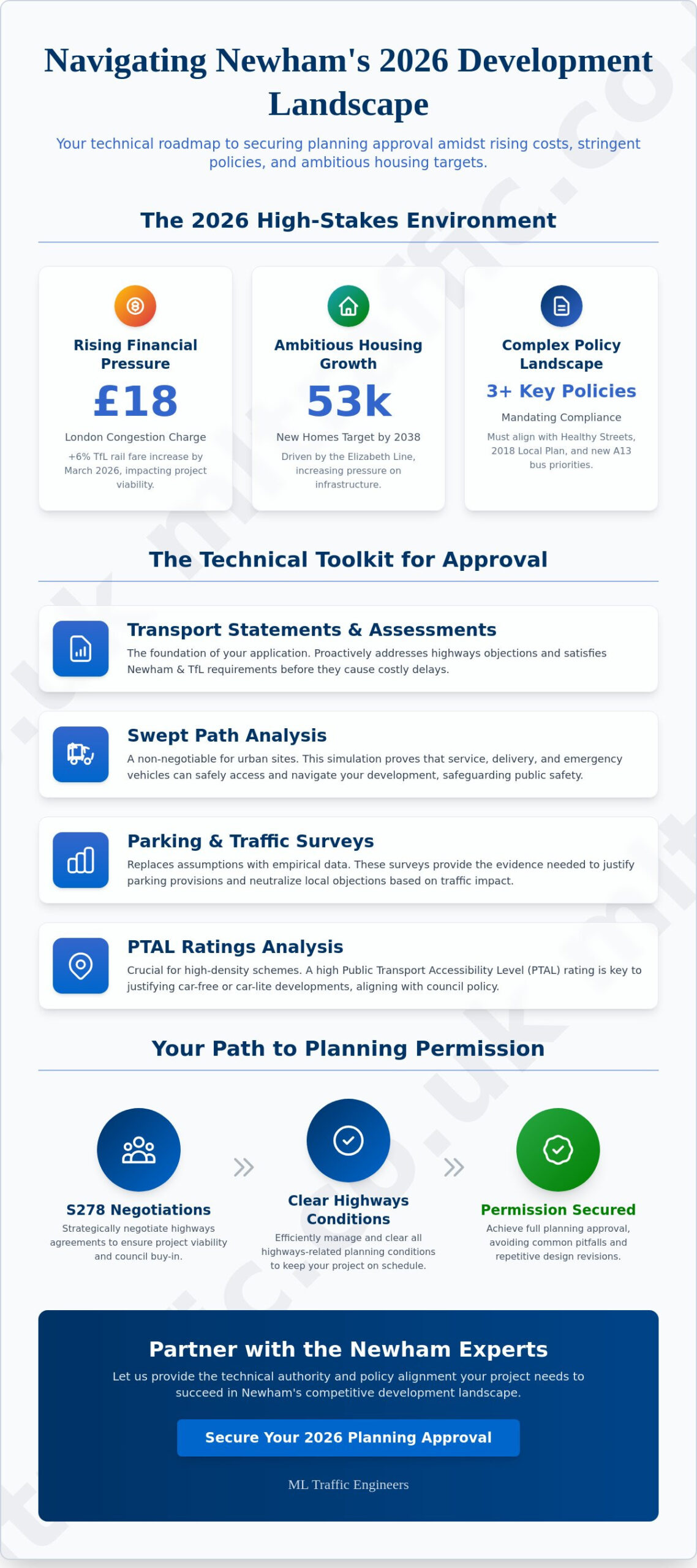
With the London Congestion Charge rising to £18 and TfL rail fares increasing by 6% in March 2026, the financial and regulatory stakes for Newham developments have never been higher. You’re likely facing intense pressure to align with the Mayor’s Healthy Streets objectives while navigating the 2018 Local Plan policies that remain in force during the current examination period. Many developers find that highways objections lead to costly delays and repetitive design revisions. Engaging expert Transport Planning Consultants Newnham is the most effective way to address these technical challenges early in the application process.
We understand that managing complex London-specific transport policies, such as the latest bus priority measures on the A13, can feel like a moving target. This article provides a clear roadmap for securing your 2026 planning approvals through technical precision and policy alignment. You’ll learn how to leverage data-driven Transport Statements, Swept Path Analysis, and detailed Parking Surveys to satisfy council requirements. We’ll also cover the essential steps for successful S278 negotiations and the clearance of highways-related planning conditions to keep your project on schedule.
Key Takeaways
- Gain insights into Newham’s 2026 development landscape and the impact of the Elizabeth Line on high-density residential planning.
- Learn the technical requirements for successful submissions, including the role of Swept Path Analysis and PTAL ratings in urban environments.
- Discover how Transport Planning Consultants Newnham use empirical Traffic Surveys to neutralize local objections and provide data to highways authorities.
- Explore the strategic process for negotiating with Newham Council to clear highways-related conditions and avoid common planning pitfalls.
- Understand how a fully-managed approach to Transport Assessments and Travel Plans ensures consistent compliance with evolving London-specific regulations.
The Role of Transport Planning in Newham’s 2026 Development Landscape
Newham is currently the epicenter of East London’s high-density regeneration, with Stratford and Canning Town serving as primary hubs for mixed-use growth. This rapid expansion places immense pressure on the borough’s infrastructure, particularly along the critical A13 and A406 corridors. Effective transport planning is no longer optional; it’s the foundation of any successful planning application in this region. Developers must account for the A13’s evolving traffic patterns and the increased demand for sustainable connectivity to avoid highways objections.
The Elizabeth Line has fundamentally altered Newham’s development potential, driving the borough’s target to deliver between 51,425 and 53,784 new homes by 2038. As Transport Planning Consultants Newnham, we recognize how this shift creates a high-stakes environment where precision is a functional necessity. You need technical authority to balance these ambitious housing targets against the strict highways requirements set by Newham Council. We provide the data-driven advice required to manage these logistical pressures from the initial assessment through to project completion.
Navigating Newham Council’s Local Plan and Transport Policies
While a new Local Plan was submitted in July 2025 and remains under examination, the 2018 Local Plan policies are still the primary legal framework for 2026 applications. These policies prioritize reducing private vehicle dependency to improve local air quality. In high PTAL areas, Newham Council increasingly mandates car-free or car-lite developments. Your project must also align with the £1,167,000 allocated for the 2026/27 Safer Corridors and Neighbourhoods program. Additionally, the A13 bus priority order (GLA/2026/0004) coming into force in 2026 will change access slip road permissions at Canning Town, requiring updated technical surveys for nearby sites.
Why Transport Statements are Essential for Newham Applications
Determining whether your project needs a Transport Statement or a full Assessment depends on specific size thresholds and local triggers. In areas like East Ham and Beckton, even smaller residential schemes often require a formal report due to existing parking stress. A robust Transport Statement prevents costly delays by addressing highways objections before they reach the committee stage. Our team manages the technical surveys and assessments needed to clear highways-related planning conditions efficiently. We focus on providing a policy-compliant document that satisfies both the borough and Transport for London requirements.
Technical Requirements: From Swept Path Analysis to PTAL Ratings
Technical precision is the cornerstone of any successful planning application in East London. For projects within the London Borough of Newham, the technical toolkit must address specific spatial constraints and high-density requirements. As Transport Planning Consultants Newnham, we prioritize data accuracy to reduce regulatory pressure on our clients. This technical lexicon is essential for communicating with local authorities and adhering to the professional standards advocated by the Transport Planning Society. Our approach ensures that every design iteration meets the rigorous safety and functional benchmarks expected by council highways officers.
Swept Path Analysis is a computer-aided simulation of vehicle movement. It allows us to visualize how specific vehicles navigate a proposed site layout. In high-stakes urban environments, this simulation acts as a vital guardian of public safety by ensuring that emergency and service vehicles can operate without obstruction. By identifying potential conflicts during the design phase, we help developers avoid the high costs of post-submission revisions.
Ensuring Access with Swept Path Analysis (SPA)
Newham’s urban fabric, particularly in areas undergoing intense regeneration like Stratford, often features tight site boundaries and complex street furniture. We use SPA to prove that fire tenders and refuse vehicles can access and exit a site safely in forward gear. We model these movements using the standard London 12.2m refuse vehicle template to ensure full compliance with Newham’s waste management requirements. This level of detail prevents design errors before the first brick is laid. If you are currently refining a site layout, our team can provide detailed Swept Path Analysis to validate your access strategy and secure technical approval.
Understanding PTAL and Sustainable Transport Links in Newham
Public Transport Accessibility Level (PTAL) is a standard method used across London to grade the connectivity of a specific location. In Newham, your site’s PTAL rating directly dictates the maximum number of parking spaces permitted under the London Plan and the borough’s Local Plan. Sites located near major interchanges such as West Ham, Plaistow, or Royal Victoria typically achieve high PTAL scores. These high ratings often necessitate a car-lite or car-free approach to align with the council’s sustainability mandates. We analyze existing infrastructure and planned improvements to provide a clear accessibility profile for your development. This proactive analysis ensures your application meets the professional integrity required for 2026 approvals.
Data-Driven Success: Parking and Traffic Surveys in East London
Empirical data serves as the ultimate shield against anecdotal objections from local residents during the planning process. In high-density boroughs like Newham, community groups often cite a perceived lack of parking to block new developments. Without technical evidence, these objections can stall your project indefinitely. As Transport Planning Consultants Newnham, we manage the full lifecycle of data collection to provide a factual basis for your application. This approach aligns with the official government guidance on Transport Assessments, which emphasizes the need for proportionate and robust evidence to support development proposals.
Our team understands that precision is a functional necessity in the London regulatory environment. We don’t just collect numbers; we provide the technical authority required to justify your project’s impact on the local highway network. By delivering comprehensive Traffic Surveys, we reduce the logistical and regulatory pressures on developers, ensuring a smoother path toward 2026 approvals.
Applying the Lambeth Methodology to Newham Parking Surveys
The Lambeth Methodology is the industry-recognized standard for conducting parking stress tests across London. We utilize this framework to assess overnight parking demand within a 200-meter walking distance of a site. In residential areas like Beckton, these surveys are typically conducted between 00:30 and 05:30 on two separate weekday nights. This specific timing ensures we capture the peak demand for resident parking, providing a credible snapshot of local capacity.
Interpreting these results is critical for your planning submission. If the data shows that parking stress exceeds 85%, planners may require specific mitigation strategies or a transition to car-lite development. We provide detailed Parking Surveys for London Planning Applications to help you navigate these technical thresholds. Our reports present clear, indisputable data that reduces the risk of highways-related refusals.
Traffic Data Collection for High-Density Developments
Busy corridors like the A13 require a sophisticated mix of Manual and Automated Traffic Counts (ATC). ATC sensors provide continuous data over seven days, capturing volume and speed trends that a manual count might miss. For sites near the Royal Docks, junction turning counts are essential to identify existing bottlenecks and peak-hour constraints. This data doesn’t just support your statement; it informs the entire design of your scheme.
Accurate traffic data is also a prerequisite for our Swept Path Analysis services in London. By understanding the real-world flow of traffic, we can simulate vehicle movements more effectively. This integrated approach ensures that your technical simulations work in tandem to satisfy Newham’s highways department. We prioritize precision at every stage to ensure your development remains safe, compliant, and ready for execution.
Overcoming Highways Objections and Securing Planning Permission
Negotiating with Newham Council’s highways department requires a sequential and highly organized approach. Highways objections are often the primary cause for planning refusals in East London. As Transport Planning Consultants Newnham, we act as a vital bridge between your development goals and the borough’s strict regulatory standards. We understand the unique pressures placed on the A13 and A406 corridors, where traffic volume and safety are constant priorities. Our role is to provide the technical authority needed to address these concerns before they lead to costly delays.
Professional integrity is essential when presenting impact mitigation strategies to the council. We don’t just identify problems; we propose actionable solutions that satisfy both the developer and the highways officer. This collaborative process ensures that your Transport Assessment London remains a robust and defensible document throughout the consultation period. By maintaining a focus on precision and adherence to standards, we reduce the logistical pressures on your project team.
Addressing Junction Capacity and Traffic Impact
Junction capacity analysis protects local road safety by ensuring that new developments do not create hazardous levels of congestion or impede emergency vehicle response times. We model traffic flow at key intersections across Newham to prevent local network saturation. This modelling is particularly critical for sites near the Canning Town intersection or the Royal Docks, where existing capacity is already limited. When our analysis identifies potential bottlenecks, we develop comprehensive mitigation strategies. These may include physical road improvements or the implementation of Travel Plan incentives to encourage sustainable transport choices. Addressing these impacts early reduces the risk of highways-related objections and demonstrates a clear commitment to civic responsibility.
Negotiating S278 Agreements and Highway Design
Securing planning permission is often just the first step in the regulatory journey. If your development requires off-site works on the public highway, you’ll need to negotiate a Section 278 agreement. These agreements are legally binding and require technical designs that meet the rigorous standards of Newham’s highways officers. We manage the transition from initial planning approval to the detailed Highway Design S278 & S38 phase. Our team ensures that every design adheres to industry benchmarks and legislative requirements. This precision is a functional necessity to avoid delays during the technical approval process. We prioritize constant accessibility and rapid response to keep your project moving forward. If you’re facing highways objections or need support with your submission, contact our expert consultants to secure your 2026 planning approval.
ML Traffic Engineers: Your Comprehensive Partner in Newham
Securing planning approval in East London’s high-pressure environment requires more than just technical data; it demands a partner who understands the urgency of development cycles. We position ourselves as a dependable, highly organized expert for developers who cannot afford delays. As Transport Planning Consultants Newnham, we provide a consistent sense of readiness through our commitment to 24/7 availability for urgent planning deadlines. This constant accessibility ensures that unexpected highways queries don’t derail your submission timeline. We take immense pride in our adherence to standards, acting as a vital guardian of public safety while reducing the regulatory pressure on your team.
Choosing a single-source partner for surveys, analysis, and reporting streamlines the entire application process. We manage full project lifecycles from initial inception to final approval, ensuring that data collected during a Parking Survey flows seamlessly into your Transport Statement. This integrated approach eliminates the communication gaps that often occur when using multiple providers. Our technical authority allows us to provide expert testimony and support throughout the entire project lifecycle, ensuring your development remains compliant with evolving 2026 standards.
Our Rapid Response Approach to Technical Reporting
The East London property market moves at a relentless pace. We meet these demands by prioritizing clarity and the rapid delivery of information. Our rapid response approach isn’t just about speed; it’s about the technical excellence required to satisfy Newham’s highways officers on the first attempt. We manage all liaison with the highways authority on your behalf, removing the logistical burden from your shoulders. Our team uses a direct and functional structure in every report to ensure readers grasp the scope of the offering quickly. This efficiency is a hallmark of our brand promise, allowing you to focus on construction while we handle the regulatory complexities.
Fully Managed Transport Solutions from Inception to Approval
Our service begins with initial site feasibility and continues through to the delivery of policy-compliant London Travel Plans. We’ve successfully navigated the intricate regional regulations of Newham and surrounding boroughs, securing approvals for high-density residential and mixed-use schemes. These success stories stem from our ability to pair technical lexicon with tailored support for every client. We understand that every site has unique constraints, from PTAL limitations to complex access requirements. By providing an all-encompassing, fully-managed service, we act as a comprehensive partner rather than a simple survey provider. If you’re ready to move your project forward with precision and reliability, contact ML Traffic for a professional fee proposal today.
Secure Your 2026 Planning Approval with Technical Authority
Success in Newham’s high-density development landscape depends on the ability to transform complex regulatory requirements into actionable technical data. We’ve explored how empirical evidence from Parking Surveys and Traffic Surveys neutralizes anecdotal objections. We also highlighted the necessity of Swept Path Analysis to ensure safe site access for emergency and refuse vehicles. These technical foundations don’t just support your application; they protect your project from the high costs of design revisions and planning delays.
Founded in 2014 with deep London expertise, ML Traffic Engineers provides the precision required to navigate the borough’s strict highways standards. We are specialists in Transport Statements and technical simulations with a proven track record of successful applications within the London Borough of Newham. As your dedicated Transport Planning Consultants Newnham, we manage the full lifecycle of highways liaison to reduce your regulatory burden. Our team delivers the data-driven reports you need to clear planning conditions efficiently.
Contact ML Traffic Engineers for expert Transport Planning in Newham and secure a policy-compliant submission today. We look forward to helping you move your development from the planning stage to successful execution.
Frequently Asked Questions
Do I need a Transport Statement for a small development in Newham?
You typically need a Transport Statement if your development falls below the threshold for a full Assessment but still impacts the local highway. Newham Council often requires these reports for residential schemes in areas with high parking stress or near busy junctions. Providing this document early helps prevent highways objections and demonstrates that your project complies with the 2018 Local Plan requirements.
How long does it take to complete a Transport Assessment in East London?
A standard Transport Assessment usually takes four to six weeks to complete from the initial site visit to the final report. This timeline accounts for the necessary data collection, such as seven day traffic counts or overnight parking surveys. As Transport Planning Consultants Newnham, we prioritize a rapid response approach to meet urgent planning deadlines and keep your project on schedule.
What is the Lambeth Methodology and why is it used in Newham?
The Lambeth Methodology is the industry standard for conducting parking stress surveys across London. Newham highways officers require this specific framework to assess the available on-street parking capacity within a 200 meter radius of your site. It provides the empirical data needed to prove that a new development won’t lead to local network saturation or compromise road safety for existing residents.
Can a Travel Plan help secure planning permission for a site with low parking?
Yes, a Travel Plan is an essential tool for securing permission for car-lite or car-free developments. It outlines specific incentives and measures to encourage residents to use public transport, cycling, and walking. This document directly supports the Mayor’s Transport Strategy and helps satisfy Newham’s sustainability targets by reducing the overall dependency on private vehicles for daily travel.
How much does a Swept Path Analysis cost for a Newham project?
The cost of a Swept Path Analysis depends on the complexity of the site layout and the number of vehicle types modeled. We provide tailored fee proposals for each project to ensure you only pay for the technical precision your specific application requires. This approach ensures that your technical designs meet the rigorous standards of Newham’s highways officers without unnecessary expenditure.
What happens if my development exceeds Newham’s parking standards?
Exceeding parking standards often results in a formal highways objection and can lead to a planning refusal. In these cases, you must provide a robust Transport Assessment to justify the provision through site specific data and impact mitigation strategies. We help developers navigate these challenges by aligning their schemes with the latest London Plan mandates and borough specific policies.
Do you provide traffic surveys for sites near the Elizabeth Line?
We conduct comprehensive Traffic Surveys near all major transport hubs, including Elizabeth Line stations like Stratford and Custom House. These surveys capture the increased pedestrian and vehicle flow patterns unique to these high density areas. Our data-driven approach ensures that your development accounts for the specific infrastructure pressures found within the borough’s most active regeneration zones.
How do ML Traffic Engineers handle urgent highways objections from the council?
We utilize a rapid response protocol to address highways objections immediately upon receipt. Our team of Transport Planning Consultants Newnham reviews the technical basis of the objection and provides a defensible rebuttal or a revised design strategy. This constant accessibility reduces the regulatory pressure on developers and ensures that projects move toward execution without avoidable delays.

Article by
Michael Lee
Transport planner with over 35 years’ experience.
Disclaimer
The content on mltraffic.co.uk, including all technical articles, guides, and resources, is provided for general informational and educational purposes only. It is not intended to constitute professional advice in traffic engineering, transportation planning, development approvals, or any other technical or legal field.
While ML Traffic Engineers makes every reasonable effort to ensure the accuracy, completeness, and timeliness of the information published, we do not provide any warranties or representations (express or implied) regarding its reliability, suitability, or availability for any particular purpose. Any reliance you place on the content is strictly at your own risk.
In no event shall ML Traffic Engineers, its directors, employees, authors, or affiliates be liable for any direct, indirect, incidental, special, consequential, or punitive damages (including, without limitation, loss of profits, data, or business opportunities) arising out of or in connection with the use of, or inability to use, any information provided on this website.
The articles and guides on this site are not a substitute for engaging a qualified, professional traffic engineer to assess your specific project requirements. For tailored advice, compliance assessments, or traffic engineering services, please contact a competent professional.
This disclaimer may be updated from time to time without notice. By accessing or using this website, you agree to be bound by the most current version of this disclaimer.