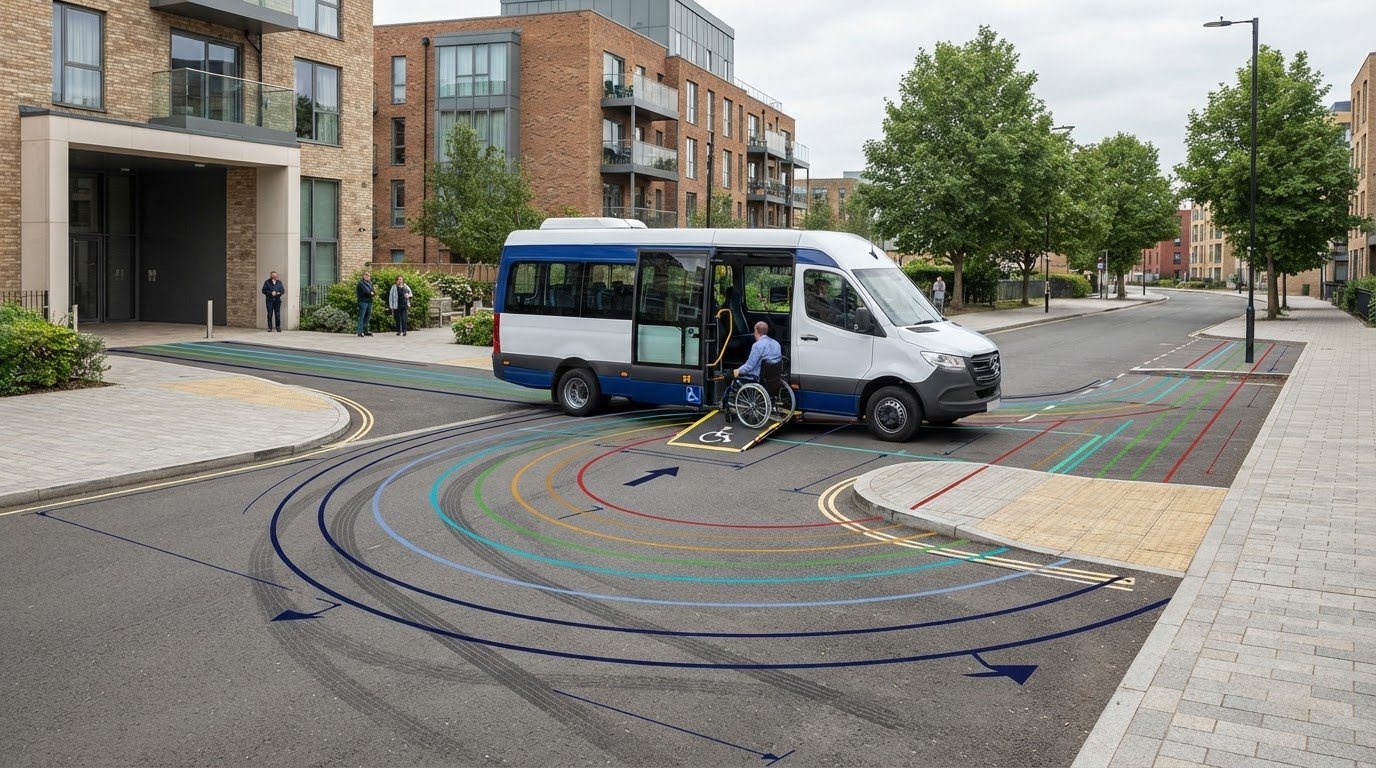
Can a disabled access vehicle reach your site, manoeuvre where it needs to and leave again, while preserving space for passengers to board? Swept path analysis for disabled access vehicles tests whether a specific vehicle can make defined movements through a proposed layout. A turning path alone, however, won’t show whether there’s enough room to deploy a ramp or lift and support accessible boarding.
A layout can look workable on plan but prove impractical in use. The result depends on testing the right vehicle dimensions and representative manoeuvres for the development, then interpreting the drawing in context. Vehicle movement and accessible boarding are related design considerations, but they are not the same assessment.
This UK guide explains what a swept path drawing can demonstrate, what it can’t prove, and which vehicles and movements to consider. It also covers how to review project-specific evidence for design discussions and, where relevant, transport planning documentation and planning submissions.
Key Takeaways
- Swept path analysis for disabled access vehicles tests whether a chosen vehicle can follow defined routes through entrances, turning areas, drop-off points and exits.
- Start with current site drawings, then select the vehicle and manoeuvres that reflect the project’s actual access conditions.
- Use tracking results to assess vehicle movement alongside separate checks for boarding space, pedestrian routes and operational needs.
- Before relying on a drawing, review its vehicle, route, dimensions, assumptions and clarity, and consider the relevant local planning and highway authority expectations.
- Test access while the layout is still being developed to identify constraints early and inform design coordination or planning discussions.
What does swept path analysis for disabled access vehicles demonstrate?
Swept path analysis for disabled access vehicles is a drawing-based assessment of how a selected vehicle manoeuvres along a specified route. It can test whether the vehicle can enter a site, turn in a designated area, reach a drop-off point and leave without its tracked path conflicting with fixed features shown on the plan.
The assessment focuses on vehicle movement. On its own, it doesn’t show whether passengers have enough space to board or alight, whether a ramp or lift can be deployed, or whether the pedestrian route is accessible. Those needs require separate design consideration. Overall suitability depends on the project’s intended use, the chosen vehicle, the site geometry and relevant planning or highway authority requirements.
For an introduction to vehicle tracking tools, watch this overview of Autodesk Vehicle Tracking:
Which vehicles might a project need to assess?
The design vehicle should reflect how the site will actually be used. Depending on the development, this could be a wheelchair accessible vehicle (WAV), an accessible minibus or another vehicle expected to serve the building. Dimensions and manoeuvring characteristics vary, so a generic “disabled access vehicle” template won’t represent every scenario. Vehicle tracking software can assess different vehicle types; Swept Path Analysis Software provides background on how these tools are used to check vehicle movements.
Consider the whole journey, not just the entrance. A vehicle may need to approach a drop-off area, turn or wait, then exit. Selecting a template that reflects the intended vehicle and its use makes the drawing more meaningful.
What does the swept path drawing show?
A drawing can show the vehicle body outline, wheel paths, direction of travel and sequence of manoeuvres. This helps the design team identify potential conflicts with boundaries, parked vehicles or street furniture. The drawing’s value depends on the information supplied, including an accurate site layout and clear vehicle assumptions.
The drawing tests the stated route and conditions, not every possible real-world situation. Changes to the layout, vehicle or manoeuvre may affect the result. ML Traffic Engineers UK prepares project-specific swept path analysis to assess access feasibility and provide technical evidence for design discussions.
How is a disabled access vehicle swept path assessment prepared?
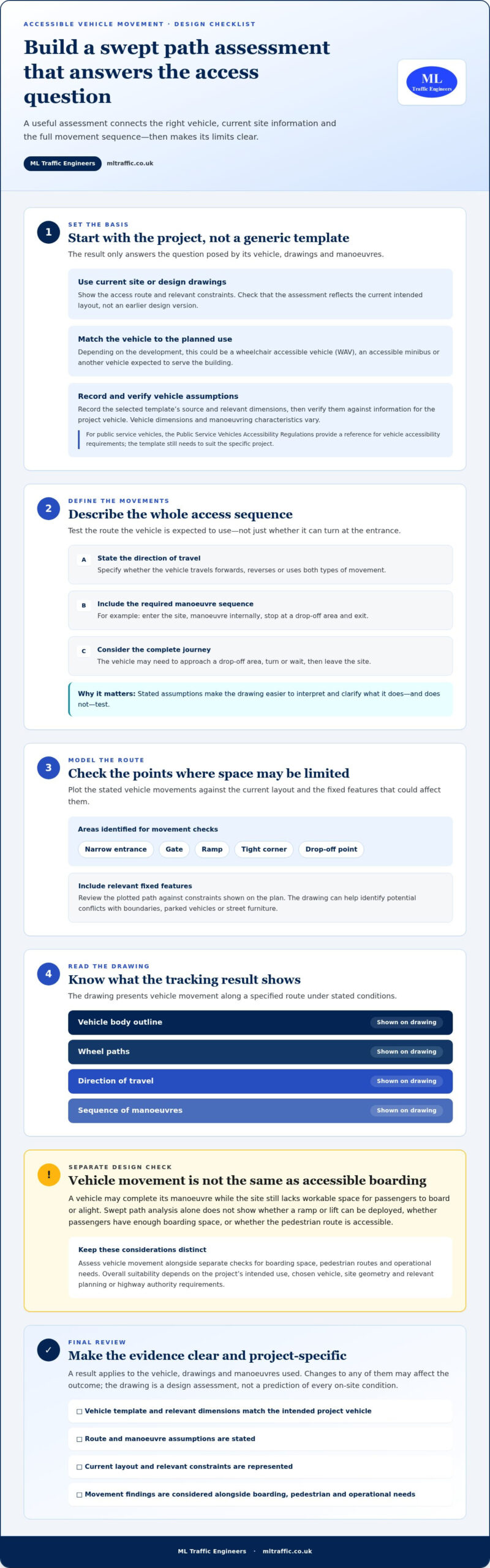
A useful assessment follows a clear sequence: review the site information, select a representative vehicle, define the movements to test, model them against the layout, then review and present the results. Each step affects the next. If the drawings are outdated or the vehicle assumptions don’t match the intended use, the output may not answer the design question.
Selecting the vehicle and movement assumptions
Start with the facility’s planned use and the vehicles expected to serve it. A wheelchair accessible vehicle used for passenger drop-off may require a different assessment from an accessible minibus serving a community facility. Record the selected template’s source and relevant dimensions, then verify them against information for the project vehicle. For public service vehicles, the Public Service Vehicles Accessibility Regulations provide a reference for vehicle accessibility requirements. The assessment still needs a vehicle template suited to the specific project.
Define whether the vehicle is expected to travel forwards, reverse or use both types of movement. Include the sequence required by the brief, such as entering, manoeuvring internally, stopping at a drop-off area and exiting. Stating these assumptions makes the drawing easier to interpret and clarifies what it does and doesn’t test.
Modelling the complete access sequence
Use current site or design drawings that show the access route and relevant constraints. Model movements where space may be limited, such as at a narrow entrance, gate, ramp, tight corner or drop-off point. Include fixed features that could affect vehicle movement, and make sure the test reflects the current intended layout rather than an earlier design version.
The analyst reviews the plotted vehicle path against those features. If the vehicle cannot complete a required movement within the available space, the drawing can help pinpoint where the layout needs further consideration. This is a design assessment, not a prediction of every on-site condition. The result remains specific to the vehicle, drawings and manoeuvres used.
For more context on software and drawing workflow, see this AutoTURN swept path analysis guide. A project-specific swept path analysis for disabled access vehicles can provide clear technical evidence for design coordination. Find out about swept path analysis for development projects.
How should you compare vehicle tracking results with accessible site needs?
A vehicle may complete its manoeuvre on the drawing while the site still lacks workable space for passengers to board, alight or continue along an accessible route. Read tracking results as one part of the design evidence, not as proof of inclusive access or a safe operating plan. Swept path analysis for disabled access vehicles tests the vehicle’s movement envelope under stated assumptions; it doesn’t assess every activity around the vehicle.
| Design consideration | What to assess |
|---|---|
| Vehicle movement | Body outline, wheel paths, turning clearance and any encroachment during the tested manoeuvre. |
| Boarding and alighting | Space beside the stopping position for a passenger to use a ramp or lift and transfer between the vehicle and the site. |
| Pedestrian route | Whether people can move between the drop-off area, entrance and onward facilities without the vehicle path obstructing their route. |
| Operations | How the vehicle stops, whether it needs to reverse, and how parked vehicles or site features may affect the intended movement. |
Separate the swept path from the access journey
Turning clearance shows whether the selected vehicle can follow the modelled route. Boarding space is a separate requirement. For example, a vehicle could reach a drop-off bay but leave insufficient room beside it for a ramp to be deployed. The pedestrian route beyond that bay also needs its own review. DfT guidance on disabled access for taxis addresses passenger access responsibilities in that context. Site design should also consider applicable inclusive design guidance, including BS 8300-1:2018 for the external environment and the DfT’s Inclusive Mobility guidance.
Use constraints to inform design choices
A plotted overlap, tight turn or need to reverse is a prompt for investigation, not automatically a compliance finding. Check what the drawing represents: the selected vehicle, assumed parked-car positions, fixed features and exact route can all affect the result. An omitted obstruction or a different vehicle may change the apparent clearance.
Compare possible layout revisions using the same vehicle and movement assumptions. This helps show whether a change, such as adjusting a turning area or drop-off position, improves vehicle movement without compromising boarding space or the pedestrian route. Review the drawing alongside the wider design information before deciding whether the arrangement meets the project’s access needs.
What should a UK design team check before relying on the analysis?
Before using swept path analysis for disabled access vehicles in a design review or planning submission, check that the drawing answers the project’s specific access question. A clear result depends on a suitable vehicle, an accurate layout and stated movement assumptions. Treat the drawing as technical evidence for the manoeuvres shown, not as proof of full inclusive access compliance.
A practical drawing review checklist
Review the drawing and supporting information together. Confirm that it identifies:
- Vehicle: the selected vehicle and the source of its template or dimensions.
- Movement: the route, direction of travel and whether the manoeuvre uses forward movement, reversing or both.
- Site plan: the latest design layout, including relevant boundaries and fixed obstructions such as gates, columns or street furniture.
- Assumptions: any conditions that affect the test, such as the position of parked vehicles.
- Clarity: legible paths and labels, with limitations explained rather than left in unexplained technical notation.
If any of these details are unclear or out of date, the drawing may not represent the design being reviewed. Resolve discrepancies between the tracking plan and architectural or site drawings before relying on the result.
Check national guidance and local expectations
National guidance provides context, but the relevant planning and highway authority may set project-specific submission expectations. Check the current requirements for the site’s location, including the type of drawing or vehicle information requested. Guidance should only be cited where its scope applies: BS 8300-1:2018 addresses the external environment, while the Department for Transport’s Inclusive Mobility guide provides guidance on access to pedestrian and transport infrastructure. Confirm that the editions and recommendations remain current for the project.
Coordination matters when the vehicle route, passenger drop-off, accessible entrance and pedestrian circulation appear across different drawings. Transport, access and architectural teams can align assumptions and identify gaps, such as a tracking plan that shows vehicle clearance but not the space needed for boarding or an unobstructed route. A swept path assessment can support wider transport planning documentation, but it doesn’t determine planning approval.
ML Traffic Engineers provides project-specific swept path analysis based on the proposed layout and intended vehicle movements. Read about swept path analysis support.
When should a project commission disabled access vehicle swept path analysis?
Commission swept path analysis while the site layout is still being developed, before access geometry and building positions become difficult to change. Early testing can reveal whether the proposed vehicle route is workable and give the design team time to consider alternatives. A separate disabled access vehicle assessment is most useful when the vehicles expected to use the site or the complexity of their movements makes manoeuvrability a design question.
Project situations that may benefit from early testing
Early assessment can be useful where a proposed layout includes a constrained entrance, limited internal turning space, a designated drop-off point or a tight route to the exit. It can also help where a vehicle needs to pass a gate, negotiate a corner or manoeuvre within a compact site. Identifying a constraint while options are still open can inform layout discussions before the design is finalised.
Consider testing when the access arrangement is being planned, and revisit the assessment if design changes affect the route, turning area or stopping position. A revised building layout or parking arrangement can alter the space available to manoeuvre. The assessment should reflect the current design and the vehicle movements relevant to the project, rather than rely on an earlier drawing.
From swept path drawings to wider planning evidence
Project-specific swept path analysis for disabled access vehicles can provide technical evidence for design coordination and planning discussions. Its findings may help the team understand whether a proposed access arrangement needs further consideration, and can inform associated transport documentation where relevant. A drawing remains evidence of the vehicle movements tested. It doesn’t establish full disabled access compliance or guarantee planning approval.
ML Traffic Engineers prepares swept path analysis for development projects, focusing each assessment on the proposed layout, selected vehicle and required movements. Where a project also needs a Transport Statement or Transport Assessment, movement findings can contribute to the wider transport planning picture.
For developments with a defined access route or constrained manoeuvring area, read about swept path analysis for vehicle access.
Plan access with clear evidence
Good access design starts with testing the movements a site is expected to accommodate. Swept path analysis for disabled access vehicles can show whether a selected vehicle can follow a defined route, but its value depends on accurate vehicle information, current drawings and clearly stated assumptions.
Use the findings alongside separate consideration of boarding space, pedestrian routes and inclusive access. Also consider the relevant local planning and highway authority expectations. Together, these steps give the design team clearer evidence to discuss constraints and refine the layout before it is finalised.
ML Traffic Engineers provides transport planning and traffic engineering services, including swept path analysis and planning documentation for development projects. The consultancy tailors the assessment to the site and proposed movements. The analysis can inform design discussions and support wider transport documentation where relevant, but it doesn’t guarantee planning approval or establish full accessibility compliance on its own.
For a project-specific assessment, contact ML Traffic Engineers about your swept path analysis requirements. Clear evidence can help your team assess the proposed movements and coordinate the next design decisions.
Frequently Asked Questions
Is swept path analysis required for disabled access vehicles?
There isn’t a universal requirement for swept path analysis for disabled access vehicles on every development. Whether it’s needed depends on the site, intended vehicle movements, access constraints and planning or highway authority expectations. A project-specific assessment can provide useful evidence where manoeuvrability is a design issue. For projects across Greater London, Manchester, Birmingham, the West Midlands, Liverpool, Surrey, East Sussex, West Sussex, Hampshire, Berkshire and Buckinghamshire, consider the relevant authority’s current requirements and applicable guidance.
What vehicles should be included in a disabled access vehicle swept path analysis?
Choose a vehicle that reflects the development’s intended use and access needs. Depending on the project, this might be a wheelchair accessible vehicle or an accessible minibus. Don’t assume one generic template represents every vehicle. Record the template source, relevant dimensions and movement assumptions, then compare them with the vehicle expected to serve the site. This keeps the assessment focused on a realistic design scenario.
Does swept path analysis prove that a site is fully accessible?
No. It demonstrates whether a specified vehicle can complete specified movements under the assumptions used in the assessment. On its own, it doesn’t assess accessible boarding and alighting space, the full pedestrian route, inclusive design or operational safety. Treat vehicle tracking as one part of a coordinated design review. Consider other access requirements separately, so successful manoeuvring isn’t mistaken for proof that every aspect of the site is accessible.
Can a disabled access vehicle turn around on a restricted site?
It depends on the vehicle’s dimensions, available site geometry, obstructions and the manoeuvre being tested. A swept path drawing can assess a defined turn and show potential conflicts with boundaries or fixed features. It can’t guarantee performance under every real-world condition. Test the vehicle and current layout together, including the intended approach and exit, to understand whether the proposed route accommodates the required movements.
What information is needed for a disabled access vehicle swept path assessment?
Provide current site or design drawings, details of the relevant vehicle or a verified template, the intended access movements and known obstructions. Clear information about the route and assumptions helps the design team interpret what the drawing demonstrates. Depending on the site’s complexity and assessment scope, further details may be needed. Outdated plans or unverified vehicle data can make the results less representative of the proposed design.
When should swept path analysis be completed during design?
Consider testing vehicle access while the layout can still be adjusted, then review the assessment against the latest design information. Early analysis may identify turning or access constraints before they become harder to resolve through design changes. Timing depends on the project programme and the evidence expected by the relevant planning or highway authority. Reassess if later changes affect the route, turning area or vehicle movements.
Is swept path analysis the same as an accessible parking assessment?
No. Swept path analysis tests how a vehicle moves along a defined route, while accessible parking and boarding involve other design considerations. Both may relate to the same site, but they answer different questions. A coordinated review should consider vehicle manoeuvring alongside parking arrangements, space for passengers to board or alight, and the pedestrian route to the destination. A turning result alone doesn’t establish that these other needs are met.

Disclaimer
The content on mltraffic.co.uk, including all technical articles, guides, and resources, is provided for general informational and educational purposes only. It is not intended to constitute professional advice in traffic engineering, transportation planning, development approvals, or any other technical or legal field.
While ML Traffic Engineers makes every reasonable effort to ensure the accuracy, completeness, and timeliness of the information published, we do not provide any warranties or representations (express or implied) regarding its reliability, suitability, or availability for any particular purpose. Any reliance you place on the content is strictly at your own risk.
In no event shall ML Traffic Engineers, its directors, employees, authors, or affiliates be liable for any direct, indirect, incidental, special, consequential, or punitive damages (including, without limitation, loss of profits, data, or business opportunities) arising out of or in connection with the use of, or inability to use, any information provided on this website.
The articles and guides on this site are not a substitute for engaging a qualified, professional traffic engineer to assess your specific project requirements. For tailored advice, compliance assessments, or traffic engineering services, please contact a competent professional.
This disclaimer may be updated from time to time without notice. By accessing or using this website, you agree to be bound by the most current version of this disclaimer.