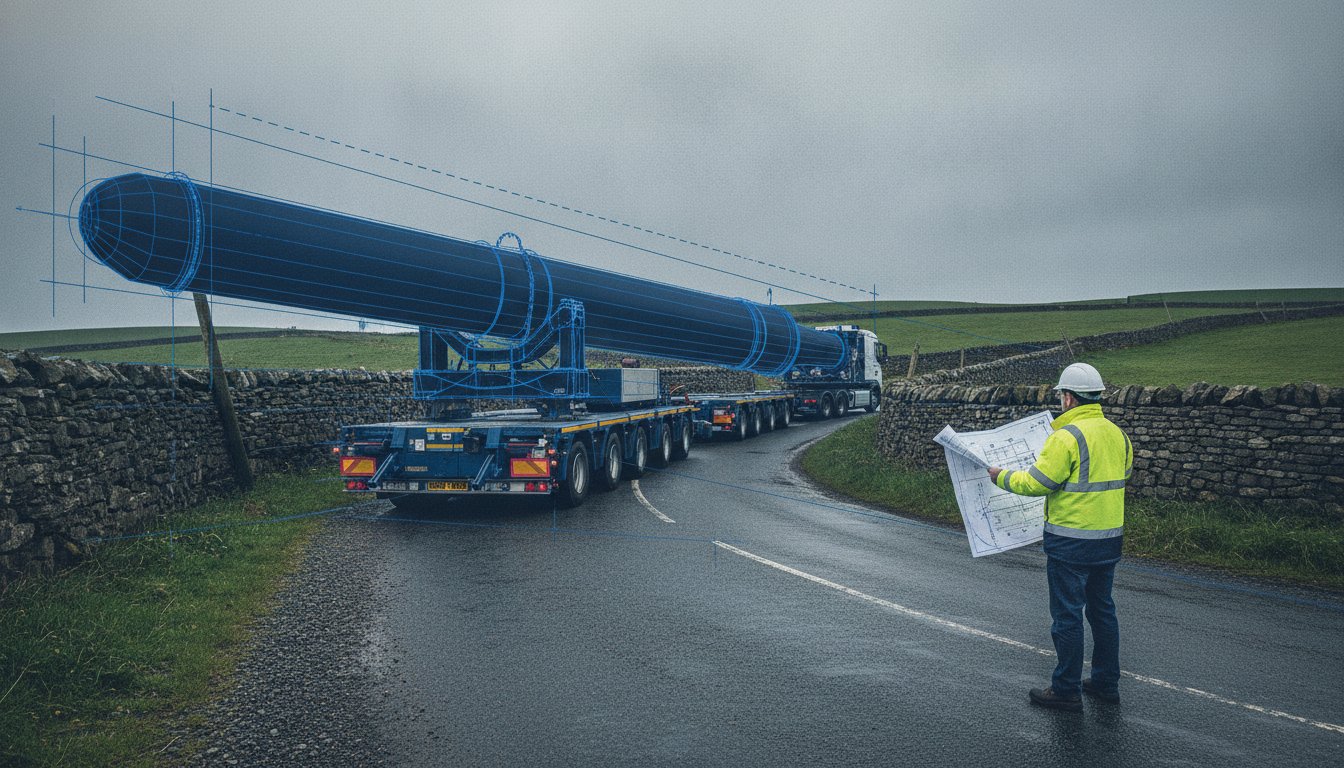
A single 80-metre turbine blade manoeuvring through a tight rural junction in the UK isn’t just a logistical challenge; it’s a high-stakes operation where a five-centimetre miscalculation can derail a multi-million pound project. You understand that the bridge between a theoretical route and a viable 2026 deployment is built on technical precision. Utilizing specialist swept path analysis for wind turbine delivery is the only way to transform these logistical risks into verified certainties. The fear of costly mid-construction showstoppers or planning application delays due to transport objections is a reality for many developers managing the complexities of Abnormal Indivisible Loads (AILs).
By implementing precision modelling, you can proactively mitigate these risks and secure planning permission with zero transport-related conditions. This guide explores how specialist software provides the technical authority needed to satisfy local highway authorities and overcome statutory hurdles. You’ll discover how clear, actionable route access reports verify project feasibility from the outset, providing your hauliers with the confidence to execute deliveries safely. We’ll outline the essential steps to turn complex logistical hurdles into a streamlined, approved transport strategy that protects both your timeline and your budget.
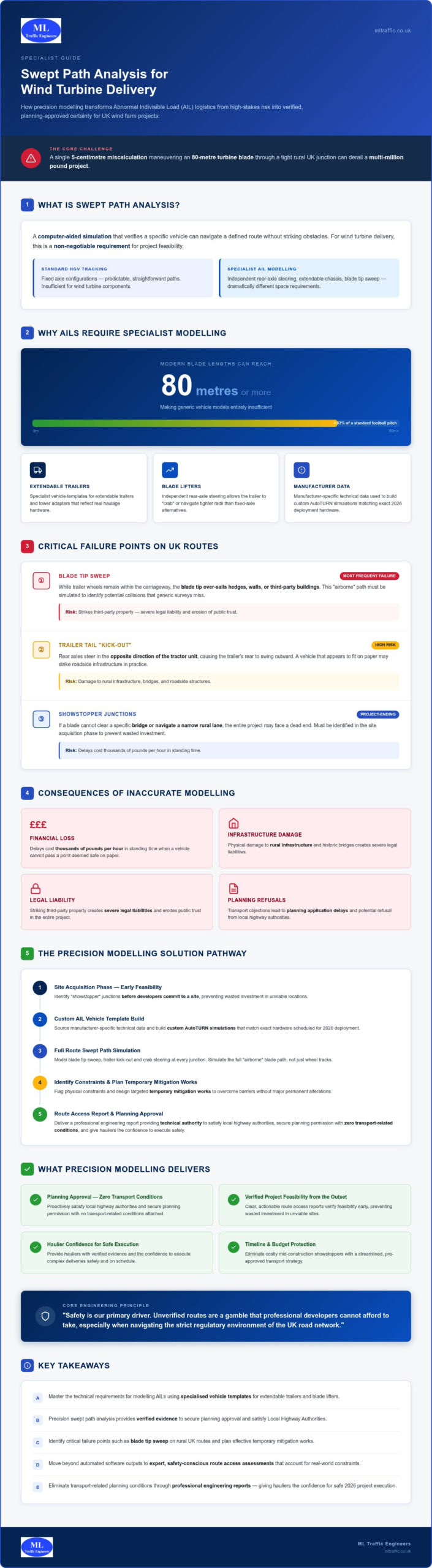
Key Takeaways
- Master the technical requirements for modelling Abnormal Indivisible Loads (AILs) using specialised vehicle templates for extendable trailers and blade lifters.
- Discover how precision swept path analysis for wind turbine delivery provides the verified evidence needed to secure planning approval and satisfy Local Highway Authorities.
- Identify critical failure points, such as blade tip sweep on rural UK routes, and learn how to plan effective temporary mitigation works.
- Reduce project risk by moving beyond automated software outputs to expert, safety-conscious route access assessments that account for real-world constraints.
- Gain the haulier confidence required for successful 2026 project execution by eliminating transport-related planning conditions through professional engineering reports.
The Role of Swept Path Analysis in Wind Turbine Logistics
Swept path analysis is a computer-aided simulation used to verify that a specific vehicle can navigate a defined route without striking obstacles. In the context of large-scale renewable energy infrastructure, this technical exercise is a non-negotiable requirement for project feasibility. Wind turbine components qualify as Abnormal Indivisible Loads (AILs) under UK law because they cannot be transported in smaller sections without significant structural compromise. Modern wind turbine components and dimensions, with some blades now reaching 80 metres or more, demand a level of precision that standard HGV tracking simply cannot provide.
Traditional heavy goods vehicles follow predictable paths based on fixed axle configurations. In contrast, specialized swept path analysis for wind turbine delivery must account for trailers with independent rear-axle steering and extendable chassis. These vehicles possess unique steering characteristics that dramatically alter the space required at junctions. Precision modelling ensures that these complex movements are documented and verified long before a single component arrives at a UK port.
Why Feasibility Hinges on Precision
Identifying “showstopper” junctions early in the site acquisition phase prevents wasted investment in unviable locations. If a blade cannot clear a specific bridge or navigate a narrow rural lane, the entire project may face a dead end. ML Traffic Engineers UK integrates SPA into broader Transport Assessments to ensure every junction is scrutinized before developers commit to a site. This level of technical authority reduces the risk of planning refusals and ensures the local highway authority remains satisfied with the proposed delivery strategy from the outset.
The Consequences of Inaccurate Modeling
Errors in the planning stage lead to catastrophic failures during the delivery phase. If a vehicle cannot pass a point that was previously deemed safe on paper, the resulting delays cost thousands of pounds per hour in standing time. Beyond financial loss, inaccurate modelling poses a physical threat to rural infrastructure. Striking a third-party property or damaging a historic bridge creates severe legal liabilities and erodes public trust in the project. Safety is our primary driver. Unverified routes are a gamble that professional developers cannot afford to take, especially when navigating the strict regulatory environment of the UK road network.
Modeling Abnormal Indivisible Loads (AILs): Technical Requirements
Modeling Abnormal Indivisible Loads (AILs) requires moving beyond standard vehicle profiles. We utilize specialized templates for extendable trailers, tower adapters, and blade lifters to reflect the physical reality of modern haulage. This technical precision is vital because wind turbine components don’t follow standard HGV tracking patterns. Professional swept path analysis for wind turbine delivery must account for the unique steering geometry of these vehicles, particularly independent rear-axle steering which allows the trailer to “crab” or navigate tighter radii than a fixed-axle alternative.
The “Blade Tip” maneuverability is the most frequent point of failure on narrow UK roads. While the trailer wheels might remain within the carriageway, the blade tip often over-sails hedges, walls, or third-party buildings. We simulate this “airborne” path to identify potential collisions that generic surveys miss. We also model the “kick-out” of the trailer tail. This occurs when the rear axles steer in the opposite direction of the tractor unit, causing the trailer’s rear to swing outward. Without accounting for this swing, a vehicle that appears to fit on paper may strike roadside infrastructure in practice.
Customizing Vehicle Templates for 2026 Turbine Models
Modern blades often exceed 80 metres in length, making generic vehicle models insufficient. We source manufacturer-specific technical data to build custom AutoTURN simulations that match the exact hardware scheduled for your 2026 deployment. This level of detail is a prerequisite for successful wind energy development and infrastructure planning. For extreme terrain or narrow village corridors, we simulate blade lifters. These specialized trailers can tilt the blade up to 60 degrees, allowing the load to pass over obstacles rather than through them.
The 3D Element: Vertical Swept Path Analysis
Ground clearance is as critical as lateral space. Low-slung trailers frequently “ground out” on hump-backed bridges or steep gradients common in regions like Cornwall. Vertical swept path analysis assesses the trailer’s underside against the road’s longitudinal profile to prevent these showstoppers. We also model the vertical height of the load to ensure clearance under overhanging utility lines and trees. If your project requires this level of technical verification, our specialists can provide comprehensive swept path analysis to secure your delivery route. This proactive approach ensures the trailer does not ground out or strike overhead obstacles during transit.
Overcoming Planning Hurdles with Route Access Assessments
Securing planning permission for renewable energy projects in England requires more than just a proposed route. It demands rigorous technical evidence that satisfies both National Highways and Local Highway Authorities (LHAs). In this regulatory environment, swept path analysis for wind turbine delivery serves as the primary evidence within your Transport Statement or Assessment. It moves the conversation from speculative theory to verified engineering, proving that Abnormal Indivisible Loads (AILs) won’t compromise road safety or infrastructure integrity.
Statutory consultees often raise concerns regarding the cumulative impact of multiple wind farm deliveries on a single strategic route. If several projects are scheduled for 2026, planners need assurance that the road network can handle the combined volume without structural degradation. When the analysis identifies a need for physical route modifications, we facilitate the technical approval process for S278 and S38 agreements. This ensures that any temporary or permanent highway works meet the strict standards required by UK law.
Navigating Local Highway Authority (LHA) Objections
LHAs typically demand a minimum safety clearance margin, often 0.5 metres, between the vehicle’s swept path and fixed roadside obstacles. Meeting this requirement is essential to avoid automatic objections. We provide multi-layered CAD drawings that offer visual proof of these clearances at every critical junction. These drawings illustrate the exact relationship between the load and the existing environment, which is vital for addressing public safety concerns and defining traffic management strategies during the delivery window.
The Route Access Report (RAR)
A professional Route Access Report (RAR) is the document that makes your project planning ready. It synthesises the findings of the swept path analysis into a clear, actionable strategy for the planning committee. A robust RAR must include detailed junction assessments, identified constraints, and proposed mitigation measures. This report forms the technical bridge to your Construction Traffic Management Plan (CTMP). At ML Traffic Engineers UK, we focus on producing reassuring, professional reports that build trust with planning officers, helping you eliminate transport-related planning conditions and move toward a successful project launch.
Identifying Physical Constraints and Temporary Mitigation Works
Accurate swept path analysis for wind turbine delivery depends entirely on the quality of the base map. We utilize detailed topographic surveys to ensure every kerb line, telegraph pole, and building frontage is accounted for within the digital model. This high-resolution data allows us to distinguish between minor obstacles and project-ending constraints. While a generic map might suggest a route is clear, our precision modeling often reveals hidden conflicts that require immediate attention before a planning application is submitted. We focus on identifying these bottlenecks early to prevent costly delays during the construction phase.
Common Logistical Constraints in the UK
Street furniture such as bollards, directional signs, and traffic islands are the most frequent hurdles encountered on the UK road network. While these are often seen as minor inconveniences, they require formal removal and reinstatement plans that must be agreed upon with the local authority. Third-party land is another critical factor. Identifying where a blade tip over-sails a private boundary is essential for securing legal access or “over-sail” rights. We also assess structural constraints, checking the load-bearing capacities of culverts and bridges along the route. Ensuring the chosen path can support the extreme gross vehicle weight of an AIL is a fundamental safety requirement that we verify through our technical reporting.
Designing Effective Mitigation Solutions
Once constraints are identified, we design targeted mitigation strategies to ensure safe passage. Temporary widening of junctions using heavy-duty trackway or gravel can provide the necessary clearance without requiring permanent alterations to the highway. This distinction is vital for planning, as temporary works are often viewed more favourably by local communities and councils. Alternatively, employing blade lifter technology allows the load to navigate tight radii by tilting the component over existing obstacles like hedges or walls. This technology reduces the need for intrusive ground works and simplifies the regulatory approval process. We also coordinate with utility companies to manage overhead line height adjustments, ensuring tower sections don’t strike low-hanging cables.
Common mitigation measures include temporary surfacing, street furniture removal, and vegetation management.
If you need to identify potential bottlenecks and secure your 2026 delivery route, book a specialist swept path analysis to safeguard your project’s feasibility and timeline.
Why Professional Traffic Engineering is Critical for Wind Farm Success
Professional traffic engineering bridges the gap between digital simulation and operational reality. While software provides the framework, the true value lies in the expert interpretation of those outputs. A computer program identifies a collision, but an engineer determines the most viable mitigation strategy to keep the project moving. By choosing a specialist approach to swept path analysis for wind turbine delivery, you ensure that every manoeuvre is scrutinized by a professional who understands the high-stakes nature of UK renewable energy infrastructure. Technical authority is essential when defending a route access report before a planning committee or during a public inquiry. We integrate these technical findings into a comprehensive transport planning strategy that protects your project’s timeline and reputation.
Reducing Logistical Uncertainty
We provide hauliers with a digital dry run of the delivery route, simulating the exact vehicle and load dimensions scheduled for 2026. This process identifies potential conflicts before they manifest on-site, allowing for the optimization of the route to minimize community disruption and cost. Our active voice capability means ML Traffic Engineers UK manages the entire process, from the initial survey to final approval. This comprehensive oversight eliminates communication gaps and ensures that the technical requirements discussed in previous sections are translated into actionable field plans. We take pride in our precision, ensuring that “near enough” never puts your project at risk.
Partnering with ML Traffic Engineers UK
Founded in 2014, ML Traffic Engineers UK acts as the guardian of project feasibility. We specialize in AutoTURN simulations and maintain a deep understanding of the intricate regional regulations within the UK planning system. Our reports carry the technical authority required to withstand rigorous scrutiny from statutory consultees. This professional integrity is a cornerstone of our service, offering you peace of mind in a strictly regulated environment. We view our role as a vital partner in your project’s success, ensuring public and worker safety through adherence to industry benchmarks. Beyond logistical planning, developers often seek expert guidance from providers like The Energy Desk on business energy procurement UK to manage the operational costs of their renewable energy assets. If you’re ready to secure your transport strategy, we recommend starting with a site feasibility review to identify any immediate logistical risks.
Securing Your 2026 Delivery Route
Securing planning approval for renewable energy infrastructure requires technical precision that leaves no room for ambiguity. By utilizing specialist swept path analysis for wind turbine delivery, you transform complex logistical challenges into a verified, manageable strategy. You’ve seen how expert interpretation of AutoTURN simulations identifies physical constraints early, allowing for targeted mitigation that satisfies Local Highway Authorities. This proactive approach eliminates the risk of costly delays and ensures your project remains compliant with UK regulatory standards.
ML Traffic Engineers UK provides the technical authority needed to navigate the high-stakes environment of AIL transport. Our specialist AutoTURN operators deliver comprehensive Route Access Reporting backed by a proven track record with UK Local Highway Authorities. We manage the full project lifecycle to ensure your site remains feasible from inception to completion. Take the next step in safeguarding your project’s timeline and budget.
Request a Swept Path Analysis Quote for Your Wind Project and ensure your 2026 delivery schedule is built on a foundation of engineering certainty.
Frequently Asked Questions
What is the maximum length of a wind turbine blade for standard UK road delivery?
Modern wind turbine blades frequently exceed 80 metres in length for 2026 deployments. Under UK law, any load exceeding 18.65 metres is classified as an Abnormal Indivisible Load (AIL). These components require specialized extendable trailers and often need police or private escorts. Precise modeling is vital because these dimensions push the physical limits of the UK’s rural road network, particularly in regions like Cornwall where narrow lanes are common.
Do I need a topographic survey before conducting swept path analysis?
A topographic survey is essential for providing the accurate base map required for technical modeling. While OS data might suffice for standard cars, it lacks the precision needed to verify 80-metre blade clearances. A topographic survey captures exact kerb positions, telegraph poles, and building frontages. This high-resolution data ensures our swept path analysis for wind turbine delivery is grounded in physical reality rather than theoretical estimates.
How does swept path analysis account for the “over-sail” of turbine blades?
We model the blade as a separate 3D entity within the simulation rather than just a vehicle chassis. This allows the software to track the airborne path of the load as it swings over third-party land or roadside vegetation. Identifying these over-sail areas is critical for securing legal access agreements. Our reports clearly distinguish between the wheel path and the load path to ensure complete transparency for highway authorities.
What is the typical safety margin required by UK highway authorities for AILs?
Local Highway Authorities in England typically demand a minimum safety clearance of 0.5 metres from any fixed obstacle. In more restricted or sensitive environments, authorities might request a larger margin to account for driver error or uneven road surfaces. Our technical drawings explicitly highlight these clearance zones. Providing this visual proof helps reduce the risk of planning objections and demonstrates a commitment to public and worker safety.
Can swept path analysis be used to justify temporary road widening on third-party land?
Yes, SPA serves as the primary technical justification for any required highway modifications. If the analysis proves a load cannot navigate a junction without striking a boundary, the report provides the evidence needed to negotiate temporary widening or street furniture removal. This documentation is vital for S278 agreements. It allows developers to prove that the proposed works are a functional necessity for the project’s successful delivery.
How long does it take to complete a route access assessment for a wind farm?
A comprehensive route access assessment for a wind farm typically takes between two and four weeks to complete. This timeline accounts for initial site surveys, custom vehicle template creation, and rigorous junction modeling. Complex routes with multiple showstopper points may require additional time for technical interpretation and mitigation design. We prioritize efficiency and accuracy to ensure your planning submission remains on schedule for 2026 project deadlines.
Is swept path analysis required for both the delivery and the return of empty trailers?
Yes, we recommend modeling both the delivery of the components and the return journey of the empty trailers. While empty trailers are shorter, they often utilize different rear-steering configurations or follow alternative return routes to avoid congestion. Ensuring the return journey is also verified prevents unforeseen logistical issues. This comprehensive approach provides hauliers with total confidence and satisfies the requirements of a robust Construction Traffic Management Plan.
What software does ML Traffic Engineers use for turbine delivery simulations?
ML Traffic Engineers utilizes industry-standard AutoTURN software for all technical simulations. This software allows us to build manufacturer-specific vehicle templates that reflect the exact steering geometry of modern turbine haulage equipment. By using AutoTURN, we provide the technical authority required by National Highways and local councils. This ensures that every swept path analysis for wind turbine delivery we produce meets the strict regulatory standards of the UK planning system.

Disclaimer
The content on mltraffic.co.uk, including all technical articles, guides, and resources, is provided for general informational and educational purposes only. It is not intended to constitute professional advice in traffic engineering, transportation planning, development approvals, or any other technical or legal field.
While ML Traffic Engineers makes every reasonable effort to ensure the accuracy, completeness, and timeliness of the information published, we do not provide any warranties or representations (express or implied) regarding its reliability, suitability, or availability for any particular purpose. Any reliance you place on the content is strictly at your own risk.
In no event shall ML Traffic Engineers, its directors, employees, authors, or affiliates be liable for any direct, indirect, incidental, special, consequential, or punitive damages (including, without limitation, loss of profits, data, or business opportunities) arising out of or in connection with the use of, or inability to use, any information provided on this website.
The articles and guides on this site are not a substitute for engaging a qualified, professional traffic engineer to assess your specific project requirements. For tailored advice, compliance assessments, or traffic engineering services, please contact a competent professional.
This disclaimer may be updated from time to time without notice. By accessing or using this website, you agree to be bound by the most current version of this disclaimer.