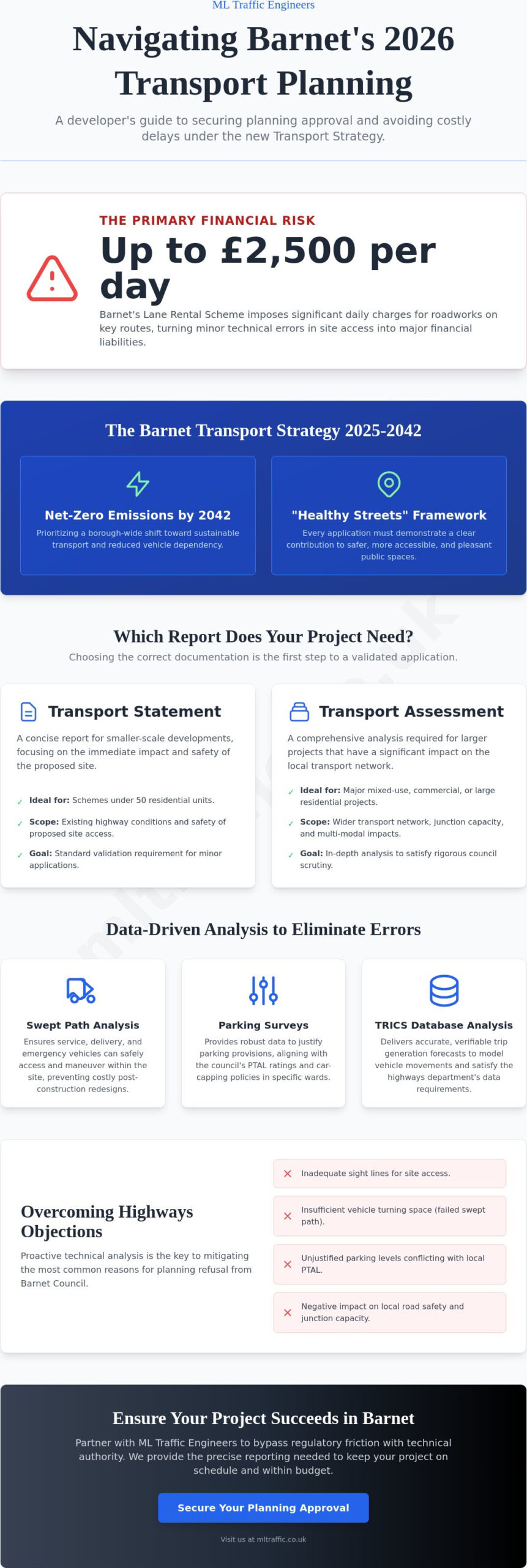
With Barnet’s Lane Rental Scheme now imposing charges of up to £2,500 per day for roadworks on key routes, a minor technical error in your site access design is no longer just a delay; it’s a major financial risk. You likely recognize that bridging the gap between Barnet’s suburban parking needs and its urban sustainability goals is the primary hurdle for any 2026 development. The borough’s 2025-2042 Transport Strategy has raised the bar for compliance, making highways department delays a common and costly reality for developers who lack precise technical data.
By partnering with expert Transport Planning Consultants Barnet, you can navigate these complex requirements with technical authority and professional reassurance. We provide the exact reporting needed to bypass regulatory friction, ensuring your project remains on schedule and within budget. This guide explores how to secure validated planning applications using professional parking surveys, transport statements, and Swept Path Analysis that satisfy the council’s rigorous standards from the very first submission.
Key Takeaways
- Understand how the Barnet Transport Strategy 2025 – 2042 influences planning requirements for both minor and major development projects.
- Learn to differentiate between Transport Statements and Transport Assessments to ensure your application meets specific borough standards.
- See how Transport Planning Consultants Barnet use Swept Path Analysis and Parking Surveys to eliminate costly design errors before they reach the highways department.
- Identify the most common reasons for highways-related refusals in Barnet and learn technical methods for mitigating impact on local road safety.
- Discover how comprehensive Travel Plans and Traffic Surveys demonstrate your project’s alignment with the borough’s shift toward sustainable transport.
Transport Planning in Barnet: Navigating 2026 Development Requirements
The London Borough of Barnet has entered a rigorous new phase of urban development guided by the “Barnet Transport Strategy 2025 – 2042.” This policy framework integrates transportation planning directly into the borough’s growth strategy, prioritizing a shift toward net-zero emissions by 2042. For developers, this means every planning application must now demonstrate a clear contribution to “Healthy Streets” while acknowledging the borough’s unique suburban layout. Precision in technical reporting is the only way to avoid the delays currently affecting the highways department.
Engaging Transport Planning Consultants Barnet early in your project lifecycle is no longer just a recommendation; it’s a financial necessity. The introduction of the Lane Rental Scheme in April 2026, which can charge up to £2,500 per day for works on busy roads, has significantly increased the stakes for site access and infrastructure delivery. You need technical authority to ensure that your development’s impact on the highway is accurately modeled and mitigated before the first brick is laid.
Why Barnet is a Unique Planning Environment
Barnet presents a complex gradient of accessibility that requires a tailored approach for every site. Areas like Hendon or Finchley often feature higher Public Transport Accessibility Level (PTAL) ratings, which the council uses to support car-free residential schemes. In contrast, locations near High Barnet maintain a higher degree of suburban car dependency. In 2026, the council views car-capped developments as a middle ground, requiring robust data to justify any parking provision. Our team understands these regional nuances, ensuring your project aligns with the specific PTAL expectations of your ward.
When to Engage a Transport Consultant
Identifying “showstopper” highways issues during the pre-application stage prevents costly redesigns and missed deadlines. We provide the essential Transport Statements and Assessments required for validation of both residential conversions and new builds. Beyond the initial application, we assist in negotiating Section 106 and Section 278 agreements with Barnet Highways. This proactive involvement ensures that your technical reports meet the January 2026 updated fee schedule requirements and pass the council’s rigorous safety benchmarks without unnecessary revisions.
Essential Reports: Transport Statements and Assessments for Barnet
Securing planning approval in Barnet requires technical documentation that aligns with both national standards and local borough priorities. As experienced Transport Planning Consultants Barnet, we use the TRICS database to provide accurate trip generation forecasts for every project. This data allows us to predict exactly how many vehicle movements your site will generate during peak morning and afternoon hours. It ensures that highway capacity assessments are based on verifiable data, which is essential for passing the scrutiny of Barnet’s highways department. Reliable data is the foundation of a successful application, especially when navigating the borough’s evolving infrastructure requirements.
Transport Statement vs. Assessment: Which Do You Need?
The type of report you need depends primarily on the scale of your development. For smaller residential schemes, usually those under 50 units, a Transport Statement is the standard validation requirement. This report focuses on existing highway conditions and the safety of your proposed site access. Larger mixed-use or commercial projects require a comprehensive Transport Assessment. This involves a deeper analysis of the wider transport network and junction capacity. The GOV.UK guidance on Transport Assessments and Statements provides the national framework, but Barnet’s local plan adds specific layers regarding PTAL ratings and suburban connectivity. You can find more detail on these requirements in our Transport Assessment London guide. If you’re currently preparing a planning application, our team can help you identify the correct reporting path to avoid validation delays.
The Importance of Travel Plans in 2026
Travel Plans have become a non-negotiable tool for meeting Barnet’s environmental targets. With the council aiming for net-zero by 2042, developments must actively discourage unnecessary car trips. We design Travel Plans that offer practical solutions for schools, offices, and residential blocks. These documents outline how you’ll incentivize walking and cycling through improved infrastructure or car-sharing schemes. Since bus passenger numbers in the borough have reached 208,000 trips per day, integrating your site with local transit is a priority. We also include monitoring and management strategies to help you meet council conditions long after the construction phase is complete. This proactive approach reduces the risk of enforcement action and demonstrates your commitment to the borough’s long-term sustainability goals. For a tailored review of your site’s requirements, explore what we do to support North London developers.
Data-Driven Accuracy: Parking Surveys and Swept Path Analysis
Precision in technical reporting is the difference between a validated application and a costly refusal. In the London Borough of Barnet, planning officers require more than just estimates; they demand empirical evidence that your development won’t compromise local road safety or parking availability. By providing definitive data early in the process, Transport Planning Consultants Barnet help you avoid the expensive design revisions that often follow a highways department objection. Our approach focuses on the two most critical technical hurdles: parking stress and vehicle maneuverability.
Modern car park designs in Barnet must also account for evolving infrastructure needs, specifically the integration of electric vehicle (EV) charging stations. As the borough moves toward its 2042 net-zero goal, your parking layout must be both functional and future-proof. We ensure your designs meet the latest technical standards found in Barnet Council’s official highways and transport policies, balancing space efficiency with regulatory compliance.
Conducting Barnet-Compliant Parking Surveys
If your project is located within one of Barnet’s many Controlled Parking Zones (CPZs), you’ll likely face scrutiny regarding ‘overspill’ parking. We use the Lambeth Methodology to conduct overnight parking stress tests, providing a transparent snapshot of street capacity. This is particularly vital in high-density areas like Finchley or Golders Green, where existing parking pressure is high. By surveying during both peak and off-peak hours, we provide a robust justification for your proposed parking provision. This data-driven evidence reassures planning officers that your development won’t negatively impact the quality of life for existing residents.
Mastering Swept Path Analysis (SPA)
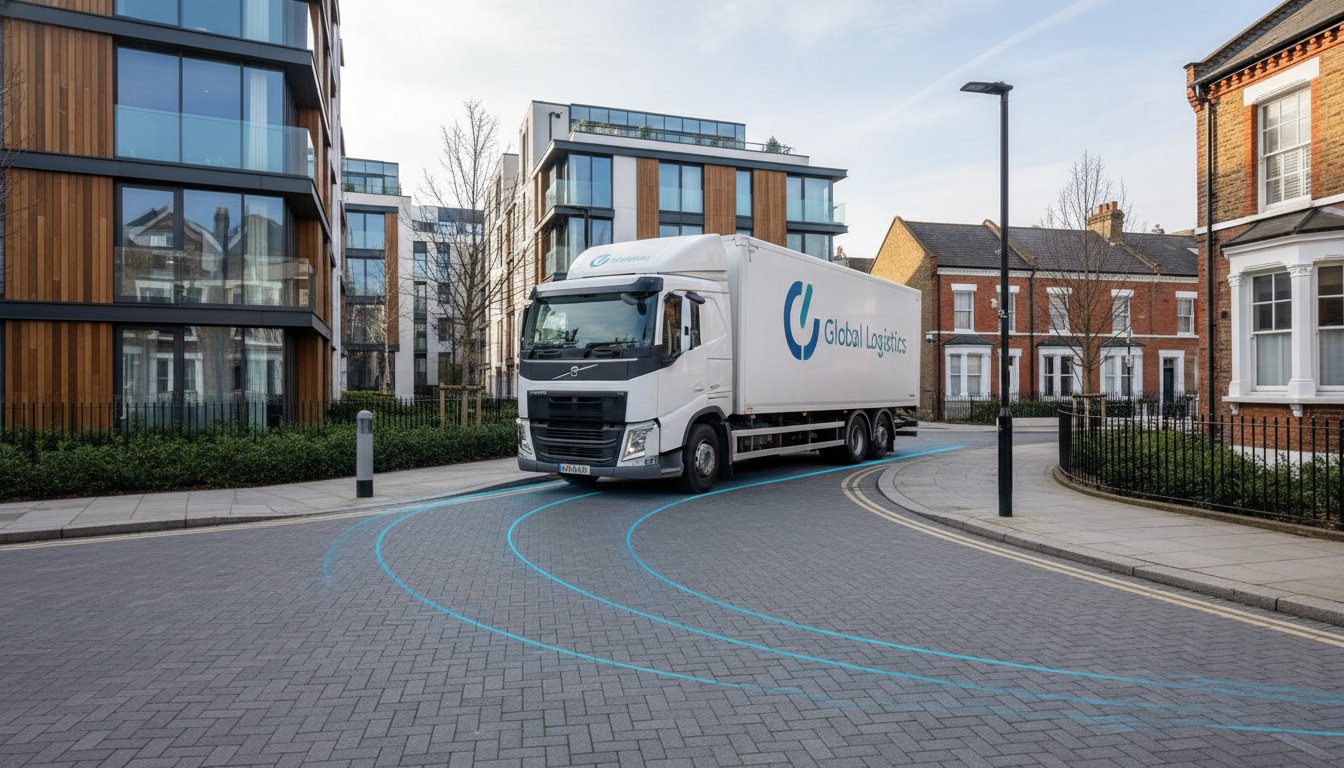
Tight North London sites often present significant challenges for large vehicle access. We provide specialized Swept Path Analysis services to prove that your site can safely accommodate refuse trucks and emergency fire tenders. Using industry-standard simulation software, we model the exact turning circles of these vehicles against your proposed site entrance geometry. Common SPA errors, such as failing to account for vertical clearances or using incorrect vehicle dimensions, frequently lead to planning refusals. We eliminate these risks by providing precise, color-coded plots that demonstrate safe passage. This technical authority ensures your site layout is optimized for safety and operational efficiency from the outset.
Our team remains ready to support your project with the technical precision required for 2026 approvals. If you’re concerned about site access or parking objections, explore our resources to understand how data can protect your planning timeline.
Overcoming Highways Objections from Barnet Council
Barnet Council’s highways department acts as a critical gatekeeper for all local development. Objections regarding junction capacity, road safety, or parking provision can stall a project for months, leading to significant financial loss. Most highways-related refusals in the London Borough of Barnet stem from a perceived “unacceptable impact” on the existing network. As experienced Transport Planning Consultants Barnet, we understand that these objections are often based on theoretical models that don’t account for site-specific nuances. Our role is to provide the technical authority needed to challenge these assumptions with empirical evidence.
A robust technical report is your best defense when presenting before a planning committee. We use detailed Traffic Surveys to demonstrate that your development’s impact on local junction capacity is negligible. By engaging with Barnet highways officers during the pre-application phase, we identify potential friction points early. This proactive negotiation allows us to adjust site access designs or parking strategies before they become formal grounds for refusal. Technical precision ensures that your application remains defensible and aligned with the council’s safety benchmarks.
Addressing Road Safety and Visibility Splay Issues
Road safety is a primary concern for the council, especially given Barnet’s 48% reduction in deaths and serious injuries over the past decade. Ensuring safe egress and ingress for new driveways on busy A-roads requires meticulous visibility splay analysis. We conduct pedestrian safety audits for developments near high-traffic town centres like North Finchley or Edgware. Our reports prove that your project maintains safe sightlines and doesn’t compromise the safety of vulnerable road users. If your site presents access challenges, we use Swept Path Analysis to optimize the geometry, ensuring that even large vehicles can enter and exit without creating hazards.
Justifying Parking Deviations
Barnet often enforces strict parking standards, but deviations are possible with the right justification. We leverage Public Transport Accessibility Level (PTAL) ratings to argue for lower-than-standard parking ratios in well-connected areas. When a site has high PTAL scores, we use this data to support car-capped or car-free developments. To further mitigate concerns about local parking stress, we often integrate car club memberships into our comprehensive Travel Plans. This strategy demonstrates a commitment to reducing car dependency while satisfying the council’s requirements for sustainable transport. If you are facing a parking-related objection, our technical services can provide the data needed to secure a favorable decision.
We remain available to help you navigate these regulatory hurdles with precision and speed. If you need to respond to a highways objection or prepare for a pre-application meeting, explore our technical resources for guidance on Barnet-specific planning success.
Partnering with ML Traffic Engineers for Barnet Success
Developers in North London require a technical partner who understands the high stakes of the 2026 regulatory environment. ML Traffic Engineers provides the precision and technical authority needed to navigate the London Borough of Barnet’s complex highways landscape. We manage the full project lifecycle, supporting your development from initial feasibility studies through to the final completion of Section 278 agreements. Our team understands that in a high-stakes planning environment, there is no room for technical error or regulatory delay. We deliver results through a combination of specialized industry knowledge and a client-focused approach.
As leading Transport Planning Consultants Barnet, we maintain a constant sense of readiness to address the logistical and regulatory pressures facing our clients. We recognize the unpredictable nature of infrastructure projects and the urgency required to meet planning deadlines. Our commitment to rapid technical report delivery ensures that your project remains on schedule, even when facing unexpected highways objections. We take pride in our role as a dependable partner, providing the technical lexicon and professional business support necessary for a successful planning outcome.
Our Technical Expertise in North London
We possess a deep familiarity with Barnet Council’s specific highways preferences and local policy nuances. This regional expertise allows us to produce high-quality Transport Statements and Assessments that align perfectly with the council’s expectations. Our data collection process is comprehensive and rigorous, utilizing advanced Traffic Surveys and Parking Surveys to provide a solid foundation for every report. We don’t rely on generic data; we gather site-specific evidence to justify your development’s impact and parking provision. This level of technical detail is what separates a successful application from one that faces repeated delays.
Streamlining Your Planning Process
Our professional, safety-conscious approach is designed to reduce the regulatory pressure on your team. We act as an expert liaison with highways authorities, negotiating technical points with clarity and authority. This proactive management style prevents minor issues from escalating into major planning hurdles. We invite you to visit our resources page for additional developer guidance and technical insights into the North London planning process. By choosing ML Traffic Engineers, you are securing a partner dedicated to precision, adherence to standards, and the rapid delivery of information. Request a tailored quote for your Barnet planning application today to ensure your project benefits from our specialized technical support.
Secure Your 2026 Planning Approval in Barnet
Success in the London Borough of Barnet requires a technical approach that prioritizes precision over estimates. You’ve seen how the 2025-2042 Transport Strategy and the 2026 Lane Rental Scheme have increased the complexity of highways compliance. Securing your development’s future depends on providing validated technical data, from robust parking surveys to accurate Swept Path Analysis. These reports don’t just satisfy regulatory requirements; they act as your primary defense against costly planning delays and highways objections. Partnering with experienced Transport Planning Consultants Barnet ensures your submission is technically sound from the outset.
As an expert London-based consultancy established in 2014, ML Traffic Engineers offers a deep understanding of Barnet Council’s specific highways policies. We provide the technical authority needed to manage your project’s full lifecycle with confidence. Our comprehensive SPA and parking survey capabilities ensure your site access designs are both safe and efficient. Don’t let regulatory friction stall your progress. Get a professional quote for your Barnet transport reports today and take the first step toward a validated application. We’re ready to help you achieve your development goals with unwavering reliability.
Frequently Asked Questions
Do I need a Transport Statement for a small residential development in Barnet?
You generally require a Transport Statement for residential developments that fall below the threshold for a full assessment, typically schemes under 50 units. This report is a standard validation requirement for the London Borough of Barnet. It proves that your project won’t negatively impact local road safety or highway capacity. Our team ensures these statements address the specific access requirements of North London’s road network.
How does Barnet Council determine the required number of parking spaces?
Barnet Council calculates parking requirements based on the Public Transport Accessibility Level (PTAL) of your site and the standards set in the London Plan. Sites with high PTAL ratings, such as those near major transport hubs in Hendon or Finchley, often face pressure to adopt car-free or car-capped models. We use precise data to justify your proposed parking provision, balancing council targets with the practical needs of suburban residents.
What is a Swept Path Analysis and why does Barnet Highways ask for it?
Transport Planning Consultants Barnet use Swept Path Analysis to simulate the movement of specific vehicles, such as a 12m refuse truck or a fire tender, within your site layout. Barnet Highways requires this technical data to ensure that emergency and service vehicles can enter, turn, and exit your site safely without mounting curbs or striking buildings. Providing this analysis early prevents costly design revisions during the planning process.
How long does it take to complete a parking survey in North London?
A standard parking survey usually requires data collection over two separate weekday nights to satisfy the Lambeth Methodology. We conduct these surveys during the early morning hours, typically between 00:30 and 05:30, to capture peak residential parking stress. Once the field data is collected, our engineers process the results into a technical report within a few business days to meet your submission deadlines.
Can a transport consultant help if my application has already been refused?
We can assist by providing the technical evidence needed to overcome specific highways objections mentioned in your refusal notice. By conducting fresh Traffic Surveys or refining your site access design through Swept Path Analysis, we can address the council’s concerns directly. This technical authority is often the key to securing approval through a resubmission or a planning appeal.
What is the difference between a Transport Assessment and a Transport Statement in Barnet?
The primary difference lies in the scale of the development and the depth of the required analysis. A Transport Statement is for smaller projects with lower trip generation, focusing on immediate site access and local impact. A Transport Assessment is a comprehensive document for major developments, requiring detailed modeling of the wider transport network and junction capacity across the borough.
How much does a transport planning consultant cost for a Barnet project?
Professional fees for transport planning depend on the specific technical requirements of your project and the number of surveys needed for validation. A complex mixed-use site requiring extensive traffic counts and junction modeling will have different requirements than a small residential conversion. We recommend requesting a tailored quote to ensure your fee reflects the exact scope of reporting required for your Barnet planning application.
What are Barnet’s requirements for Electric Vehicle (EV) charging in new developments?
Barnet requires new developments to align with the London Plan standards, which typically mandate a percentage of “active” charging points and “passive” provision for future expansion. This ensures that your car park design is future-proof and supports the borough’s transition to net-zero emissions. We integrate these technical specifications into your parking layout to ensure full compliance with current environmental and planning policies.

Article by
Michael Lee
Transport planner with over 35 years’ experience.
Disclaimer
The content on mltraffic.co.uk, including all technical articles, guides, and resources, is provided for general informational and educational purposes only. It is not intended to constitute professional advice in traffic engineering, transportation planning, development approvals, or any other technical or legal field.
While ML Traffic Engineers makes every reasonable effort to ensure the accuracy, completeness, and timeliness of the information published, we do not provide any warranties or representations (express or implied) regarding its reliability, suitability, or availability for any particular purpose. Any reliance you place on the content is strictly at your own risk.
In no event shall ML Traffic Engineers, its directors, employees, authors, or affiliates be liable for any direct, indirect, incidental, special, consequential, or punitive damages (including, without limitation, loss of profits, data, or business opportunities) arising out of or in connection with the use of, or inability to use, any information provided on this website.
The articles and guides on this site are not a substitute for engaging a qualified, professional traffic engineer to assess your specific project requirements. For tailored advice, compliance assessments, or traffic engineering services, please contact a competent professional.
This disclaimer may be updated from time to time without notice. By accessing or using this website, you agree to be bound by the most current version of this disclaimer.