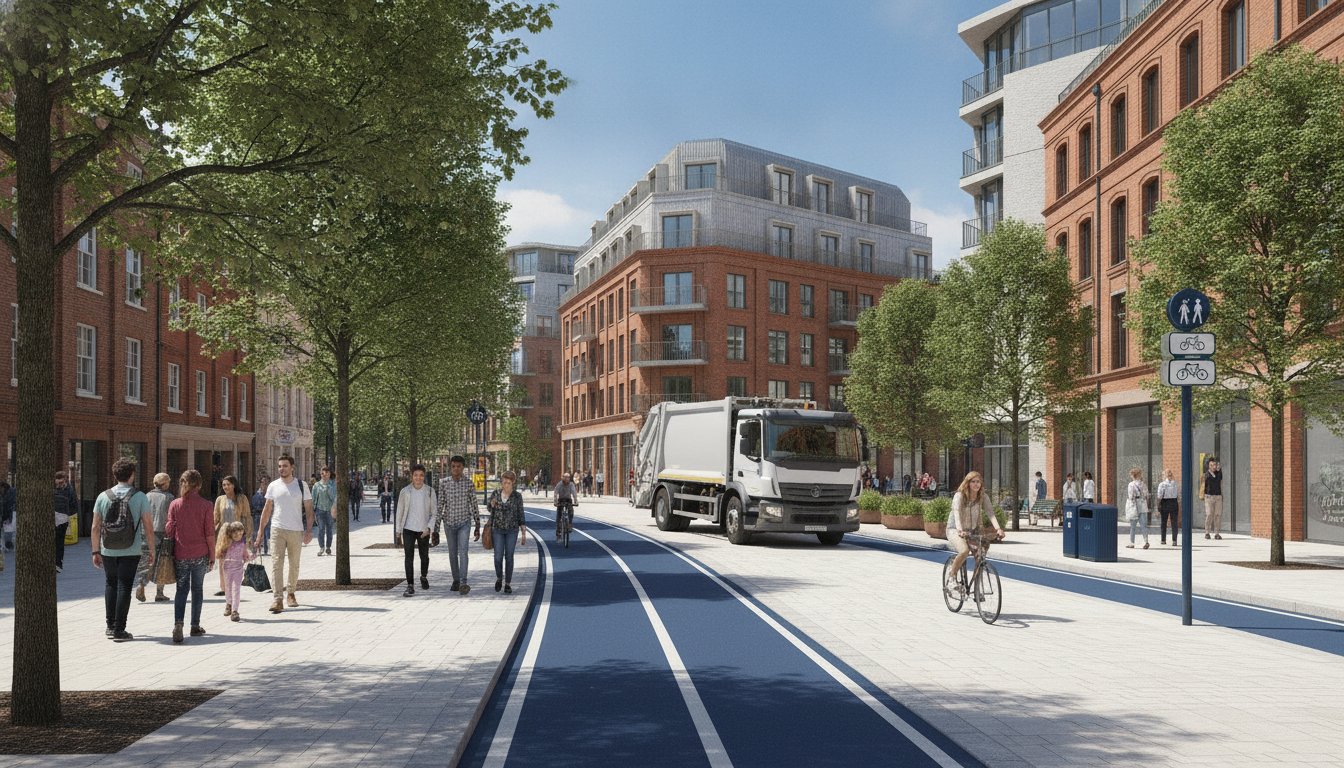
Designing a street that prioritises human health shouldn’t be a technical gamble that ends in a planning refusal from Active Travel England. Securing a successful transport assessment birmingham in 2026 requires more than just an aesthetic vision; it demands precise technical evidence that satisfies both council planners and highway engineers. You’re likely feeling the pressure as the push for active travel often clashes with the practicalities of refuse vehicle access. It’s a common frustration to see a visionary layout stalled because a standard 12-metre bin lorry can’t navigate a “healthy” corner without mounting the kerb.
This guide provides the technical roadmap you need to master the Streets for a Healthy Life framework. We’ll show you how to bridge the gap between creative design and the rigid requirements for highway adoption. You’ll learn how to pass Swept Path Analysis without widening roads and how to navigate Birmingham City Council’s interpretation of Building for a Healthy Life metrics. We’ll explore the logistics of securing Section 38 and 278 agreements, ensuring your development meets the 2026 standards for safety and sustainability while avoiding costly delays. This is your professional blueprint for turning regulatory hurdles into a clear path for project approval.
Key Takeaways
- Align your development with the latest Birmingham Local Plan requirements by mastering the transition from vehicle-first to people-centric street geometry.
- Resolve technical conflicts between narrow healthy street designs and essential service vehicle access through advanced Swept Path Analysis and data-led validation.
- Master the exact data requirements for a transport assessment birmingham to ensure your healthy street designs meet the latest 2026 planning criteria.
- Gain a clear technical roadmap for securing Section 38 and 278 adoption for innovative layouts that prioritise filtered permeability and active travel infrastructure.
Understanding the Streets for a Healthy Life Framework in Birmingham
The 2026 planning landscape for Transport in Birmingham is defined by a rigorous, health-led engineering approach. The Streets for a Healthy Life (SfHL) guide acts as the technical arm of Building for a Healthy Life (BfHL), turning design vision into the hard data required for a transport assessment birmingham. Birmingham City Council (BCC) has formalised this shift, prioritising street geometry that encourages active travel over traditional car-first design. This transition is no longer optional for developers looking to secure planning consent in the West Midlands.
Active Travel England (ATE) now serves as a high-authority statutory consultee for all significant Birmingham developments. They scrutinise every layout to ensure it aligns with national and local active travel standards. Traditional highway layouts often relied on wide carriageways and high-speed junctions. Healthy street typologies instead use filtered permeability and narrow living streets to create safer environments. These designs must still accommodate service vehicles, which is where technical precision becomes vital for passing council inspections.
To better understand the evolving infrastructure in the city, watch this helpful video:
The Link to Building for a Healthy Life (BfHL)
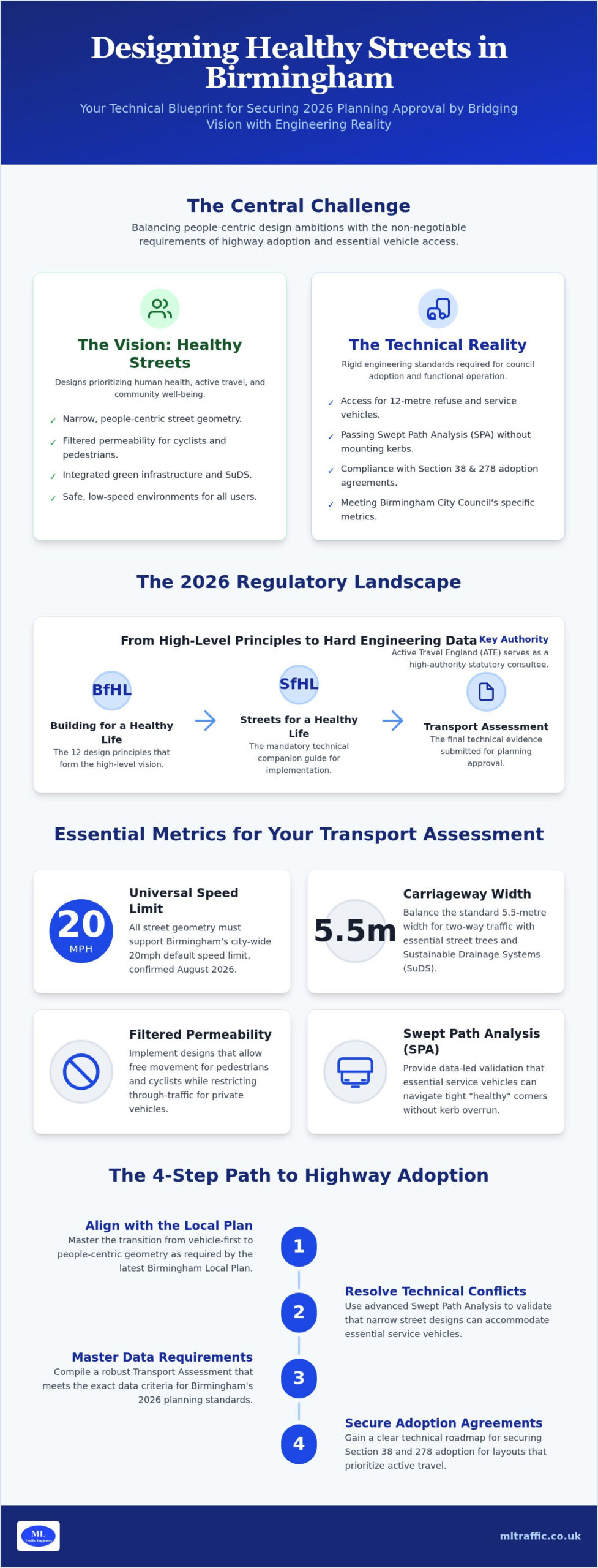
Translating the 12 BfHL principles into physical dimensions requires a deep understanding of Birmingham’s specific adoption standards. You need to move from subjective design scores to technical engineering compliance that stands up to council scrutiny. Streets for a Healthy Life serves as the mandatory technical companion guide that validates design scores with engineering data in 2026 planning applications. At ML Traffic Engineers UK, we provide the technical reporting needed to bridge the gap between architectural intent and highway adoption requirements. Our comprehensive support ensures your design metrics are defensible during the planning process.
Statutory Requirements for Birmingham Developers
The National Model Design Code sets the baseline, but the Birmingham Development Plan adds local layers of complexity. Securing Homes England funding in the West Midlands now depends on proving “Healthy Streets” compliance. Your transport assessment birmingham must also account for the city’s universal 20mph speed limit policy, which was confirmed on 23 August 2026. These regulations ensure that new infrastructure supports the city’s goal of reaching a population of 1.25 million by 2031. Additionally, developers must factor in the 4.99% increase in highways-related charges implemented in April 2026. Failure to demonstrate these healthy street metrics often leads to immediate objections from ATE, stalling the project at the consultation stage.
Technical Metrics: Translating Design Goals into Birmingham Data
Successful planning approval in 2026 hinges on your ability to convert “healthy” design concepts into defensible engineering data. A transport assessment birmingham must now go beyond simple traffic counts. It needs to prove that your street geometry supports the city’s 20mph default limit while maintaining operational efficiency. This involves precise calculations for street widths. You must balance a 5.5-metre carriageway width for two-way traffic against the need for integrated street trees and Sustainable Drainage Systems (SuDS). These features aren’t just decorative; they’re essential components of the official transport assessment guidance published by the council.
Filtered permeability is another technical requirement. It allows pedestrians and cyclists to move freely while restricting through-traffic for private vehicles. To calculate modal shift potential, we use specific typologies that reflect Birmingham’s goal of reducing car dependency. Integrating SuDS into technical cross-sections requires careful planning of underground services. This ensures that tree pits and drainage channels don’t conflict with utility corridors or the 2026 requirements for mandatory EV charging infrastructure.
Junction Design and Pedestrian Priority
Reducing corner radii is a primary method for slowing traffic. In a Birmingham context, a 4-metre or 6-metre radius is often preferred over traditional 10-metre curves. This forces vehicles to turn slowly, which significantly improves safety for people crossing. However, you must provide evidence that refuse vehicles can still navigate these “tight” junctions. Continuous footways across side roads are now a standard expectation. They provide a clear visual signal that pedestrians have priority, which is a key metric in modern transport assessments.
Active Travel Infrastructure Specifications
Your design must strictly adhere to LTN 1/20 standards. This means providing segregated cycle lanes with a minimum width of 1.5 to 2.0 metres depending on peak hour volumes. Connectivity to the Birmingham Cycle Revolution network is vital. High-density developments also require technical metrics for secure, accessible cycle storage. We often recommend using Swept Path Analysis to verify that these cycle facilities don’t impede service vehicle movements. This technical bridge ensures your innovative design remains functional and adoptable under Section 38 agreements.
Evidencing Compliance in Your Birmingham Transport Assessment
Structuring a transport assessment birmingham requires a dedicated “Healthy Streets” chapter that functions as an evidence-led engineering document. This section must move beyond descriptive design goals to provide technical validation. We document the results of the Walking, Cycling and Horse-riding Assessment and Review (WCHAR) to satisfy Active Travel England’s statutory requirements. Your report should clearly demonstrate how the proposed site layout aligns with the long-term strategic objectives of the Birmingham Transport Plan. This involves mapping out specific pedestrian desire lines and proving that priority is maintained at every internal junction.
A robust Travel Plan acts as the operational counterpart to your physical infrastructure. It details how the Streets for a Healthy Life framework will be managed post-occupation. This includes the provision of micromobility hubs, which align with the new regional micromobility contract expected in January 2026. By documenting these measures within the main assessment, you create a cohesive technical case that reduces the logistical pressures of the planning process.
The Role of the Transport Statement in Birmingham
For smaller schemes, a Transport Statement must still carry the technical weight of a larger assessment. We integrate the 12 BfHL principles directly into the executive summary to give planning officers immediate confidence in the scheme’s compliance. Proving site accessibility through non-car modes is essential; we use local accessibility scoring to demonstrate that residents don’t need a private vehicle for daily essentials. If you’re managing projects across different metropolitan areas, you might find our Transport Statement London: A Developers Buying Guide for 2026 useful for comparing regional standards.
Data-Driven Validation with TRICS
TRICS data provides the empirical foundation for justifying lower parking ratios in people-centric designs. We select comparable Birmingham sites that already feature high-quality active travel infrastructure to predict trip generation reductions accurately. If your development is situated near the A45 cycleway construction, due to start in September 2026, we can justify a significant modal shift in our reporting. Using parking surveys also helps support car-free or low-car strategies in high-density areas. This data-led approach ensures your transport assessment birmingham stands up to rigorous council scrutiny.
Overcoming Technical Conflicts: SPA and Birmingham Highway Adoption
The “Narrow Street Paradox” remains a significant hurdle for developers in 2026. While the Streets for a Healthy Life framework demands human-scale geometry and tree-lined avenues, Birmingham City Council waste management teams require unimpeded access for 12-metre refuse vehicles. This tension often creates a deadlock during the transport assessment birmingham process. If your design prioritises aesthetics without technical validation, you risk a planning refusal or, more commonly, a design that planners approve but highway engineers refuse to adopt. We bridge this gap by using data-led evidence to prove that safety and placemaking can coexist.
Negotiating Section 38 and 278 agreements in Birmingham has become more financially sensitive. With the minimum fee for a Section 278 technical approval rising to £15,348 in 2026, “getting it right first time” is a commercial necessity. We advocate for designs that avoid over-engineered, wide-radius junctions. Instead, we use precise tracking to show how service vehicles can navigate tighter spaces at lower speeds, which directly supports the city’s default 20mph policy. This approach ensures your development remains functional without sacrificing the “green” metrics that Active Travel England demands.
Advanced Swept Path Analysis for Birmingham
We use AutoTURN to create high-fidelity simulations of fire tenders and refuse vehicles within restricted residential layouts. This level of detail is a prerequisite for any modern transport assessment birmingham. Our modelling accounts for the physical presence of street trees, rain gardens, and integrated SuDS features that traditional tracking might overlook. A standard UK refuse vehicle typically requires a minimum clear width of 3.1 metres on straight sections and significantly more on bends to operate safely within a healthy street layout. For a deeper look at our methodology, read our AutoTurn Swept Path Analysis: A Practical Guide for Planning Applications in 2026.
Bridging the Planning and Adoption Gap
A common pitfall for Birmingham projects is the disconnect between planning consent and highway adoption. Designs featuring “Placemaking” materials, such as high-quality block paving or integrated planters, often face resistance from adoption teams concerned about long-term maintenance costs. We facilitate early engagement with Birmingham City Council engineers to ensure your materials and geometry meet their specific adoption standards from the outset. This proactive strategy prevents the need for costly post-consent design changes. If your current layout is facing objections regarding vehicle tracking or adoptability, request a technical design review to secure your project’s future.
Securing Approval with ML Traffic Engineers
ML Traffic Engineers acts as your technical partner in a high-stakes regulatory environment. We manage the full project lifecycle, ensuring every street dimension and junction radius aligns with the Streets for a Healthy Life framework. Our role is to provide the precision required to secure a successful transport assessment birmingham. We deliver an all-encompassing service that includes initial design reviews, technical reporting, and ongoing support through the planning process. By positioning ourselves as a technical bridge, we allow you to focus on the creative vision while we handle the rigid highway adoption requirements.
Navigating statutory consultations with Active Travel England (ATE) requires a dependable expert. We use specialized industry terminology and data-led evidence to address ATE’s concerns before they become formal objections. Our technical reporting services provide the reassurance that your development meets both local and national active travel benchmarks. We understand the intricate regional regulations so that you don’t have to. This proactive approach reduces the logistical pressure on your team and ensures a smoother path to approval in the 2026 planning cycle.
Why Technical Precision Matters in 2026
Planning delays in the West Midlands are increasingly expensive. A single design failure in your transport assessment birmingham can lead to months of lost time and mounting fees. Our team maintains a constant state of readiness to provide rapid technical turnarounds for your reports. This commitment to professional excellence mirrors our approach across the UK, which you can explore in our Transport Assessment London: The Developer’s 2026 Guide to Planning Success. Precision isn’t just a goal; it’s a functional necessity in the current planning landscape. We take immense pride in our adherence to standards and our ability to pass complex Swept Path Analysis tests without compromising your design.
Next Steps for Your Birmingham Development
Our team is available to conduct a preliminary access and layout review for your site. This early engagement identifies potential conflicts between healthy street goals and vehicle tracking requirements before they reach the council. You can engage ML Traffic Engineers for your Birmingham Transport Statement and Travel Plan to ensure a cohesive technical narrative throughout your application. We provide a fully-managed service from inception to completion. Contact us directly to receive a bespoke quote for your residential or commercial project. We are ready to act as your comprehensive partner in achieving planning success.
Securing Your Development’s Future in Birmingham
The transition to health-led street design in 2026 represents a fundamental shift in the West Midlands planning landscape. Mastering the Streets for a Healthy Life framework is no longer a choice; it’s a technical requirement for project viability. Success depends on your ability to bridge the gap between creative placemaking and rigid highway adoption standards using precise, defensible data. By resolving the conflicts between narrow street geometry and service vehicle access during the design phase, you protect your scheme from costly delays and statutory objections.
ML Traffic Engineers provides the technical authority needed to deliver a successful transport assessment birmingham. We are specialists in Active Travel England compliance and provide expert Swept Path Analysis for even the most restricted residential layouts. Our team delivers fast-turnaround Transport Assessments that ensure your site remains functional and adoptable. Don’t leave your planning approval to chance in this high-stakes environment. Request a Technical Review of Your Birmingham Street Design today to secure your project’s future. We are ready to act as your dependable partner in achieving professional excellence.
Frequently Asked Questions
What is the Streets for a Healthy Life technical companion guide?
Streets for a Healthy Life acts as the mandatory technical companion to Building for a Healthy Life (BfHL). It provides specific engineering metrics for street dimensions, junction designs, and visibility splays. While BfHL provides the high-level design framework, this guide ensures that your site layout is adoptable by Birmingham City Council. It bridges the gap between architectural vision and the rigid technical requirements of modern highway engineering.
Is Streets for a Healthy Life a mandatory requirement for Birmingham planning?
Yes, it is effectively mandatory for any development seeking planning consent in 2026. Birmingham City Council and Active Travel England use this framework to assess compliance with the Birmingham Development Plan. Your layout must demonstrate that it prioritises people-centric geometry over private vehicle storage. Failure to meet these standards often results in a refusal during the statutory consultation phase, especially for residential schemes.
How does Active Travel England use this guide during Birmingham consultations?
Active Travel England (ATE) serves as a statutory consultee for significant developments. They use the guide to audit your site layout against national LTN 1/20 standards. They specifically look for high-quality cycle infrastructure, continuous footways, and filtered permeability. If your design does not provide technical evidence of compliance, ATE will likely issue an objection, which can stall your planning application for several months.
Can I meet healthy street standards while still allowing refuse vehicle access?
You can achieve this balance by using advanced Swept Path Analysis (SPA). We model the movements of a standard 12-metre refuse vehicle to prove it can navigate narrow, tree-lined streets without mounting kerbs. This technical validation allows you to keep corner radii tight for pedestrian safety while satisfying the council’s waste management requirements. It prevents the need for over-engineered, wide junctions that encourage higher vehicle speeds.
How do I evidence compliance with Building for a Healthy Life (BfHL) in my report?
Include a dedicated technical chapter within your transport assessment birmingham. This section must use empirical data to validate each of the 12 BfHL principles. We document pedestrian desire lines, cycle infrastructure widths, and the results of a Walking, Cycling and Horse-riding Assessment and Review (WCHAR). Providing data-led evidence instead of subjective scores significantly reduces the risk of receiving a statutory objection from Active Travel England.
What is the difference between a Transport Statement and a Healthy Streets Assessment?
A Transport Statement is the primary planning document required for smaller developments to prove they have a negligible impact on the network. A Healthy Streets Assessment is a specific technical audit contained within that statement. It focuses exclusively on how the design encourages active travel. While the statement covers overall trip generation, the assessment ensures the physical street geometry meets the 2026 health and safety standards.
Does the guide apply to small-scale residential developments in Birmingham?
The guide applies to any scheme that requires a transport assessment birmingham or statement. Even small-scale infill sites must demonstrate how they integrate with the city’s wider active travel goals. Birmingham’s goal to reach a population of 1.25 million by 2031 necessitates that every new development reduces car dependency. Planners will scrutinise small sites to ensure they provide secure cycle storage and safe pedestrian access points.
How much does a technical healthy street audit cost for a planning application?
Fees for technical audits depend on the scale and complexity of your residential or commercial project. While we don’t provide fixed costs for professional traffic engineering services, developers must account for Birmingham City Council’s statutory fees. In 2026, the council charges £1,732 for a pre-application review for schemes of up to 25 units. Section 278 technical approval fees also start at a minimum of £15,348 for infrastructure works.

Disclaimer
The content on mltraffic.co.uk, including all technical articles, guides, and resources, is provided for general informational and educational purposes only. It is not intended to constitute professional advice in traffic engineering, transportation planning, development approvals, or any other technical or legal field.
While ML Traffic Engineers makes every reasonable effort to ensure the accuracy, completeness, and timeliness of the information published, we do not provide any warranties or representations (express or implied) regarding its reliability, suitability, or availability for any particular purpose. Any reliance you place on the content is strictly at your own risk.
In no event shall ML Traffic Engineers, its directors, employees, authors, or affiliates be liable for any direct, indirect, incidental, special, consequential, or punitive damages (including, without limitation, loss of profits, data, or business opportunities) arising out of or in connection with the use of, or inability to use, any information provided on this website.
The articles and guides on this site are not a substitute for engaging a qualified, professional traffic engineer to assess your specific project requirements. For tailored advice, compliance assessments, or traffic engineering services, please contact a competent professional.
This disclaimer may be updated from time to time without notice. By accessing or using this website, you agree to be bound by the most current version of this disclaimer.