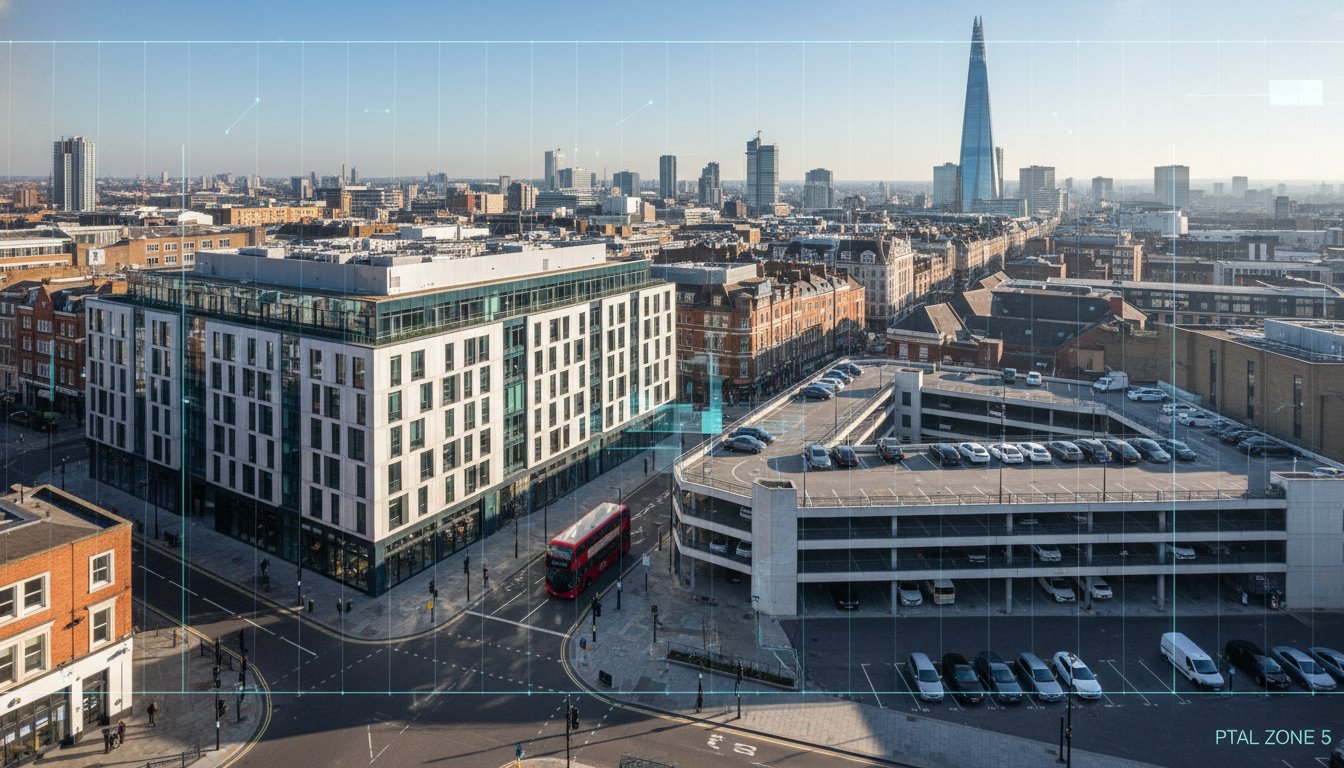
A single miscalculation of your site’s PTAL rating can trigger an immediate planning refusal from the Greater London Authority. You likely recognise that London’s transport policies now prioritise “car-free” developments, with over 40% of new residential schemes in high PTAL areas being restricted to zero parking spaces. It’s a high-stakes environment where precision is a legal necessity. We understand that navigating the car parking requirement by ptal and land uses (Class E, B2, B8, C1, C2, C3, F1, F2) and Sui Generis ( pubs/bars, cinemas, hot food takeaways, theatres, scrap yards, and petrol stations) is often the most complex part of a 2026 planning application.
Our guide provides a total, managed solution to help you master these standards and secure your approval. You’ll gain a clear understanding of the maximum parking allowances for every use class and learn how to use bespoke parking stress surveys to justify your requirements. We’ll examine the latest 2026 standards and provide a sequential strategy for a successful planning submission.
Key Takeaways
- Decode the 0-6b PTAL scoring system and its critical role in enforcing car-free development mandates within the latest London Plan 2026 framework.
- Navigate the specific car parking requirement by ptal and land uses (Class E, B2, B8, C1, C2, C3, F1, F2) and Sui Generis ( pubs/bars, cinemas, hot food takeaways, theatres, scrap yards, and petrol stations) to ensure precise planning alignment.
- Identify proven strategies for justifying parking deviations through Lambeth Methodology surveys when standard PTAL limits threaten your site’s operational viability.
- Learn how to manage high-intensity parking needs for complex Sui Generis uses where technical evidence and expert reporting are essential for securing approval.
- Discover how bespoke Transport Statements and 24/7 technical support from ML Traffic Engineers can accelerate your project timeline and mitigate regulatory risks.
Table of Contents
- Understanding London’s Parking Standards: Use Classes and PTAL Explained
- Car Parking Requirements for Land Uses: Class E, B, and C
- Navigating Sui Generis Parking: From Pubs to Petrol Stations
- Justifying Parking Deviations: Surveys and Technical Evidence
- Securing Planning Approval with ML Traffic Engineers
Understanding London’s Parking Standards: Use Classes and PTAL Explained
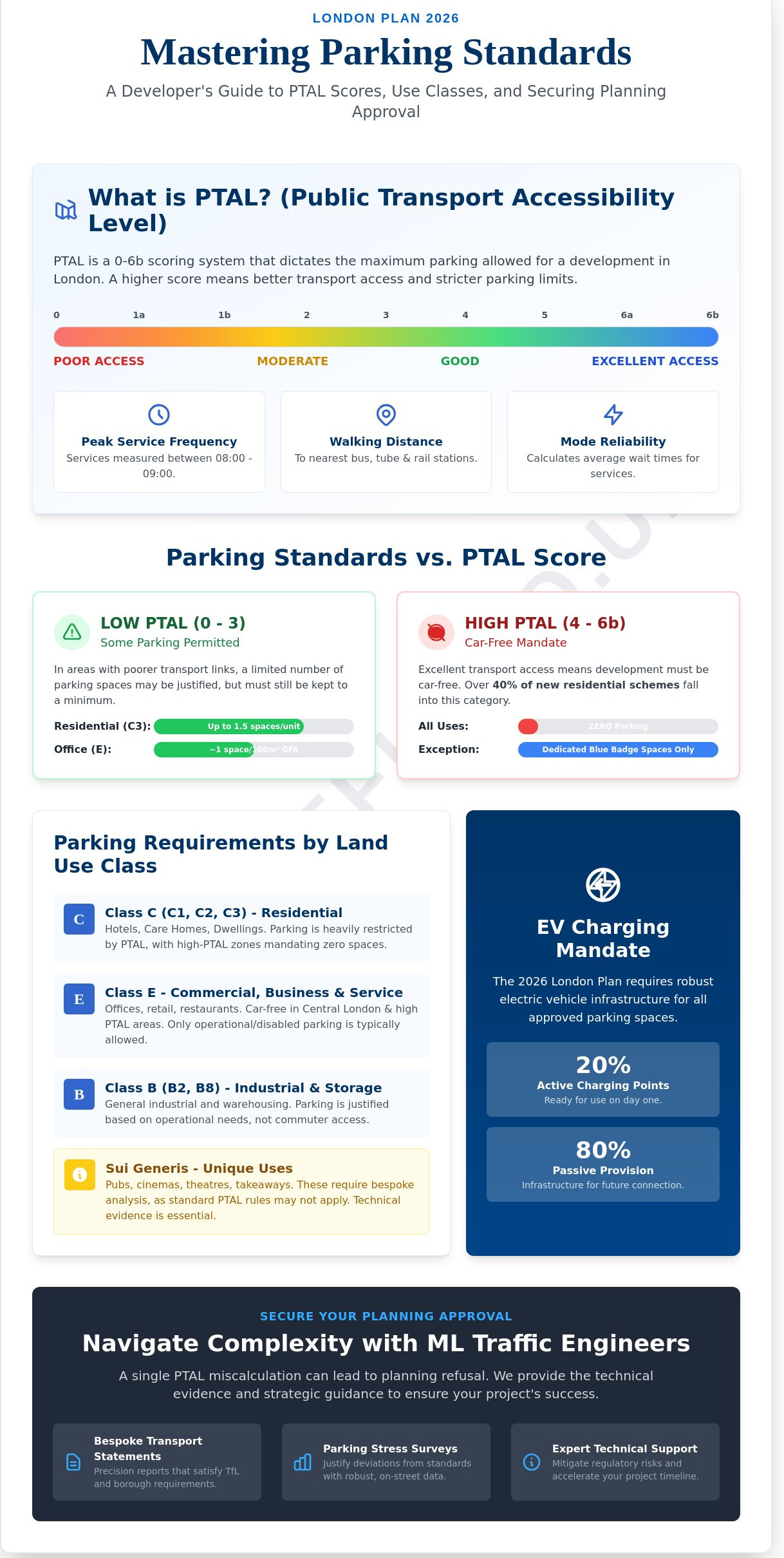
London’s planning landscape has shifted entirely toward sustainable transport. The 2026 regulatory framework relies on Public Transport Accessibility Level (PTAL) to determine every site’s development potential. PTAL is a scoring system ranging from 0 to 6b that measures how close a plot is to the transport network. A score of 0 represents poor access, while 6b indicates excellent connectivity. For any project manager, the site’s centre-point PTAL score is the most critical metric in a Transport Assessment because it sets the ceiling for allowable parking.
To better understand this concept, watch this helpful video:
The Role of the London Plan in 2026 Planning
Policy T6 of the London Plan dictates that car-free development is the starting point for all schemes in areas of high transport accessibility. This isn’t a suggestion. It is a mandate that overrides local borough standards in roughly 95% of planning cases. By 2026, the focus has intensified on the ‘Healthy Streets’ initiative. This policy prioritises walking and cycling over private vehicle use. The current system categorises developments based on Planning use classes in England and Wales to ensure consistency across the 32 boroughs. The 2026 updates also demand rigorous electric vehicle (EV) charging infrastructure. You’re now required to provide active charging points for 20% of all spaces from day one, with the remaining 80% requiring passive provision for future connection.
What is PTAL and Why Does it Dictate Your Parking?
PTAL is calculated by measuring the walking distance from your site’s centre point to the nearest rail, tube, and bus stations. It factors in the frequency of services during the 08:00 to 09:00 morning peak. Calculations use a 12-minute walk time for rail stations and an 8-minute walk time for bus stops. A score of 0 or 1 suggests you might be permitted a maximum of 0.5 to 1.5 spaces per unit depending on the land use. However, reaching a score of 4 or higher almost always triggers a car-free requirement. This means no on-site parking is permitted except for Blue Badge holders.
Securing approval requires a precise understanding of your car parking requirement by ptal and land uses (Class E, B2, B8, C1, C2, C3, F1, F2) and Sui Generis ( pubs/bars, cinemas, hot food takeaways, theatres, scrap yards, and petrol stations). If your site is PTAL 5, even a large-scale Class E office or a C3 residential block will likely be restricted to zero residential parking. We’ve found that failing to account for these maximum standards early in the design phase leads to immediate refusal from Transport for London (TfL). Precision in these calculations is a legal and physical necessity for project success.
Car Parking Requirements for Land Uses: Class E, B, and C
The London Plan defines parking standards as “maximums” rather than “minimums.” This shift forces developers to justify every square metre of tarmac. Determining the car parking requirement by ptal and land uses (Class E, B2, B8, C1, C2, C3, F1, F2) and Sui Generis ( pubs/bars, cinemas, hot food takeaways, theatres, scrap yards, and petrol stations) requires a precise calculation of the Gross Floor Area (GFA). Local authorities apply a specific ratio to this GFA, which tightens as the Public Transport Accessibility Level (PTAL) increases. For a technical deep dive into how these scores are generated, TfL’s Connectivity Assessment Guide provides the necessary methodology for calculating walking speeds and service frequencies.
Class E: Commercial and Office Parking in London
Class E requirements vary significantly between the Central Activities Zone (CAZ) and Outer London. In the CAZ, Inner London Opportunity Areas, and any site with a PTAL of 4 to 6, office developments must be car-free. The only exception is for designated Blue Badge spaces. In Outer London locations with lower PTAL scores (0 to 1), the maximum allowance might reach one space per 100 square metres of GFA, but this is increasingly rare in 2026 planning approvals.
Retail parking faces even tighter scrutiny. Any retail site in a PTAL 4-6 zone is essentially restricted to operational and disabled parking only. Developers must prove that delivery vehicles can enter and exit the site in a forward gear. This makes Swept Path Analysis an absolute necessity for Class E delivery bays to ensure Chapter 8 compliance and safety during loading cycles.
Industrial and Residential: Classes B2, B8, and C1-C3
Industrial land uses (B2 and B8) prioritise operational movement over staff vehicle storage. While staff parking is capped at roughly one space per 500 to 1,000 square metres of GFA, the real challenge lies in HGV turning circles. Planning officers expect to see CAD designs that balance limited staff bays with the massive spatial requirements of a 16.5-metre articulated vehicle. If your site cannot accommodate these movements safely, the application will likely fail at the first hurdle.
Residential (C3) and Hotel (C1) uses follow a trajectory toward zero parking. Most new C3 developments in London are now designated as car-free, meaning residents cannot apply for local on-street parking permits. For C1 Hotels, the focus shifts to guest drop-off zones and coach parking. In 2026, the standard requires one coach space per 50 bedrooms in Outer London, while Inner London sites often rely on off-site management plans. To ensure your project meets these rigid standards, you should commission a formal Transport Assessment early in the design phase.
- Class C3: Car-free is the default for PTAL 4-6.
- Class B8: High focus on HGV loading/unloading rather than car bays.
- Sui Generis: Calculated on a case-by-case basis, often mirroring the strictest Class E standards.
Navigating Sui Generis Parking: From Pubs to Petrol Stations
Sui Generis uses represent the most complex challenge for developers in London. These “class of their own” sites lack the standardised metrics found in Class E or C3. Planning authorities view these applications with heightened scrutiny because their transport impact varies wildly by location and PTAL rating. Determining the car parking requirement by ptal and land uses (Class E, B2, B8, C1, C2, C3, F1, F2) and Sui Generis ( pubs/bars, cinemas, hot food takeaways, theatres, scrap yards, and petrol stations) requires a bespoke approach for every site. There’s no “one size fits all” formula here. You must prove the specific operational needs of your business won’t compromise local road safety.
Hospitality and Leisure: Pubs, Cinemas, and Theatres
High-intensity uses like pubs and bars create short-stay parking pressure that peaks during evening hours. Hot food takeaways present a modern conflict. We must balance car parking with dedicated space for delivery riders. If delivery mopeds crowd the pavement or block cycle lanes, the council will likely refuse the application. Theatres and cinemas require a focus on trip generation rather than floor space alone. A 500-seat theatre creates a sudden surge of traffic that PTAL ratings might not fully account for. Developers often require a Transport Assessment to prove the local network can handle these specific peaks without causing gridlock. We look at arrival and departure patterns to ensure your site remains compliant and accessible.
Petrol Stations and Scrap Yards: Operational Requirements
Petrol stations and scrap yards prioritise vehicle flow over long-term storage. For petrol stations, the priority is “stacking” capacity. We calculate the exact number of vehicles that can wait for a pump without obstructing the public highway. If a queue of four cars spills onto a main road, it creates a safety hazard. Scrap yards face different hurdles. They frequently manage heavy machinery and large HGVs. We utilise Swept Path Analysis to ensure 16.5-metre articulated lorries can enter and exit the site in forward gear. Precision in these digital models is vital. A single centimetre of overhang onto a pedestrian footway can lead to a planning rejection. Our team ensures every movement is accounted for, maintaining safety and regulatory compliance at every turn. We don’t guess; we use CAD data to secure your approval.
Managing these unique land uses means understanding that the car parking requirement by ptal and land uses (Class E, B2, B8, C1, C2, C3, F1, F2) and Sui Generis ( pubs/bars, cinemas, hot food takeaways, theatres, scrap yards, and petrol stations) is often about the quality of the space provided, not just the quantity of bays. Whether it’s a multi-screen cinema or a recovery yard, the goal is seamless integration with London’s 2026 transport infrastructure.
Justifying Parking Deviations: Surveys and Technical Evidence
London’s rigid PTAL-based caps don’t always align with the functional reality of a development site. If the standard car parking requirement by ptal and land uses (Class E, B2, B8, C1, C2, C3, F1, F2) and Sui Generis ( pubs/bars, cinemas, hot food takeaways, theatres, scrap yards, and petrol stations) threatens the viability of your project, you must provide technical evidence to bridge the gap. Planning officers prioritise highway safety and network flow; they’ll only deviate from the London Plan if you prove that your specific layout won’t cause local congestion.
The Critical Role of Parking Surveys
Developers frequently commission Parking Surveys in London to assess overnight parking stress. The Lambeth Methodology remains the gold standard for this evidence. It requires surveyors to record parked vehicles on two separate weekday nights between 00:30 and 05:30 within a 200-metre walking distance of the site. If the data shows that parking stress remains below the 85% threshold, you can argue that the local street network has sufficient capacity to handle minor overspill. This is particularly effective for proving that a car-free residential development won’t clog surrounding streets, especially when identifying spare capacity in Controlled Parking Zones (CPZs) where residents are restricted from obtaining permits.
Operational Necessity and Mitigation
For B2 and B8 industrial applications, the argument often centres on operational necessity rather than occupant convenience. You can’t operate a distribution centre or a manufacturing plant without dedicated space for HGV dwelling and staff shift changes. We help clients justify these requirements by quantifying exact vehicle movements and turnover rates. To balance these requests, a comprehensive London Travel Plan serves as a vital mitigation tool. These documents outline formal commitments to reduce car dependency through car club credits, electric vehicle charging points, and enhanced cycle storage. A well-structured Travel Plan can often reduce the perceived impact of a parking deviation by 10% to 15% in the eyes of the local authority.
Swept Path Analysis for Complex Layouts
Safety is a non-negotiable requirement for any London planning approval. We utilise Swept Path Analysis to simulate vehicle movements and ensure your site is functional. This involves using CAD-based templates to prove that 11.4-metre refuse vehicles and fire tenders can enter, turn, and exit your site in forward gear. For Sui Generis land uses like petrol stations or scrap yards, precision is vital. We model the movements of articulated tankers and recovery trucks to ensure they don’t mount kerbs or obstruct the public highway. This technical data mitigates safety objections and protects your project from costly redesigns during the late stages of the planning process.
Need expert data to support your planning application? View our full range of traffic survey and design services.
Securing Planning Approval with ML Traffic Engineers
ML Traffic Engineers provide a 24/7 technical support infrastructure for developers across the capital. We understand that the London Plan 2021 and its subsequent 2026 updates demand absolute precision in every submission. Our team delivers bespoke Transport Statements that do more than just list data; they provide a robust defence of your project. We manage the entire car parking requirement by ptal and land uses (Class E, B2, B8, C1, C2, C3, F1, F2) and Sui Generis ( pubs/bars, cinemas, hot food takeaways, theatres, scrap yards, and petrol stations) calculation process to ensure your application meets the strict maximum standards set by the Greater London Authority.
Our team organises comprehensive traffic and parking surveys throughout Greater London’s 33 local authorities. Using the Lambeth Methodology or specific borough-required frameworks, we collect real-time data to prove your site’s viability. This data-driven advocacy is designed to reduce the risk of planning refusal. Statistics from recent planning cycles suggest that applications supported by site-specific survey data are 35% more likely to bypass initial highways objections. We provide the technical reporting necessary to turn potential roadblocks into approved plans.
Our Approach to Transport Statements and Assessments
Precision and compliance define our methodology for every London project. Each borough maintains its own interpretation of the London Plan, meaning a Class E development in Southwark requires a different strategy than one in Hillingdon. We navigate these nuances by maintaining direct dialogue with local highways officers. Integrating London Travel Plans into your submission is a standard part of our service. This ensures your project promotes sustainable transport while remaining commercially viable and compliant with 2026 standards.
Total Managed Solutions for Developers
We provide a single point of contact from initial site feasibility through to final planning implementation. Our engineers ensure your parking layout is safe, regulatory-compliant, and optimised for space. We frequently execute parking surveys in London to provide the evidence needed for complex Sui Generis or mixed-use sites. This comprehensive support allows project managers to focus on construction while we handle the intricate UK road regulations. Contact ML Traffic Engineers today for a bespoke transport planning quote. We’re ready to secure your approval with 24/7 readiness and technical authority.
Secure Your Planning Consent with Technical Precision
Navigating the 2026 London Plan demands a rigorous approach to technical compliance. Developers must align transport strategies with specific PTAL scores to meet Greater London Authority standards. Accurate data serves as the foundation of a successful application; vague estimates frequently result in immediate refusal by local authorities. We clarify the exact car parking requirement by ptal and land uses (Class E, B2, B8, C1, C2, C3, F1, F2) and Sui Generis ( pubs/bars, cinemas, hot food takeaways, theatres, scrap yards, and petrol stations) through robust technical evidence and site-specific data.
ML Traffic Engineers specialise in London-specific parking surveys and Swept Path Analysis to validate your site layout and justify necessary deviations. Our team provides 24/7 technical support for urgent applications, ensuring your project stays on track regardless of the timeline. We leverage expert knowledge of the London Plan 2026 to deliver managed solutions that satisfy every regulatory demand. We’re ready to manage the complexities of your transport statement so you don’t have to.
Secure your London planning approval with an expert Transport Statement from ML Traffic Engineers. We’re here to ensure your development moves forward with total confidence and safety.
Frequently Asked Questions
What is the maximum parking allowance for a Class E office in PTAL 5?
Class E office developments located in PTAL 5 areas must be car-free under the current London Plan. This regulation restricts parking to essential Blue Badge spaces only to encourage the use of London’s high-capacity public transport network. Our CAD design team ensures your site layout remains compliant with these 2026 standards while maintaining operational efficiency for your staff and visitors.
Do Sui Generis uses like pubs have to follow the London Plan parking limits?
Yes, Sui Generis uses including pubs, theatres, and scrap yards must adhere to the car-free benchmarks set for high PTAL zones. Local authorities assess these applications on a case-by-case basis, often requiring a bespoke Transport Assessment to justify any proposed vehicle provision. We manage these complex car parking requirement by ptal and land uses (Class E, B2, B8, C1, C2, C3, F1, F2) and Sui Generis audits to secure your planning approval.
Can I get planning permission for a car-free development in PTAL 2?
You can achieve planning permission for car-free developments in PTAL 2 if you provide a robust Travel Plan and a legal agreement to restrict residents from obtaining parking permits. While the London Plan allows up to 0.5 spaces per unit in these lower-access zones, many developers opt for car-free designs to maximise habitable space. We provide the technical data and traffic surveys needed to prove your project won’t negatively impact local on-street capacity.
How does a parking survey help my planning application if my PTAL is high?
A parking survey provides empirical evidence of the current street capacity within a 200-metre radius of your development. Even in high PTAL areas, councils often worry about potential overspill from new residents or delivery vehicles. We conduct overnight Lambeth Model surveys to demonstrate that your project remains compliant with London Plan Policy T6. This data-driven approach removes regulatory guesswork and accelerates your planning process.
What are the disabled parking requirements for Class C3 residential developments?
Class C3 residential developments must provide designated disabled person parking for 3% of dwellings from the outset of the project. You must also demonstrate through your site plans how an additional 7% can be provided in the future if demand increases. Our team integrates these requirements into your initial CAD designs to ensure 100% compliance with Approved Document M and the latest 2026 London Plan updates.
Is Swept Path Analysis mandatory for petrol station planning applications?
Swept Path Analysis is a mandatory requirement for petrol station applications to prove that 16.5-metre articulated tankers can safely navigate the site. We use industry-standard software to simulate these vehicle movements, ensuring there is no conflict with fuel pumps or pedestrian walkways. This technical precision is vital for Sui Generis uses where safety and fuel delivery logistics are high-risk factors for the local authority.
How much does a London-specific Transport Statement cost in 2026?
A London-specific Transport Statement typically costs between £2,500 and £5,000 in 2026, depending on the scale of your development. Larger projects requiring detailed car parking requirement by ptal and land uses (Class E, B2, B8, C1, C2, C3, F1, F2) and Sui Generis analysis may incur higher fees due to the data complexity. We provide fixed-price quotes to ensure you have total budget certainty for your planning submission.
What happens if my site centre and site edge have different PTAL scores?
If your site spans multiple PTAL zones, planners generally require you to use the highest score for your parking calculations. For example, a site with PTAL 3 at the edge but PTAL 4 at the centre is usually treated as PTAL 4 by the borough. We use the TfL WebCAT tool to provide a precise breakdown of your site’s accessibility, ensuring your application uses the correct regulatory baseline from the start.
What about specialised vehicle equipment for operational sites?
Which areas do you cover?
We service Acton, Balham, Barking, Barnes, Barnet, Battersea, Beckenham, Bexleyheath, Brentford, Brixton, Bromley, Camberwell, Carshalton, Charlton, Chelsea, Chiswick, Clapham, Coulsdon, Croydon, Crystal Palace, Dagenham, Dulwich, Ealing, Edgware, Eltham, Enfield, Finchley, Forest Gate, Fulham, Golders Green, Greenwich, Hackney, Hammersmith, Hampstead, Harrow, Hayes, Highgate, Hounslow, Ilford, Islington, Kensington, Kentish Town, Kingston upon Thames, Lewisham, Mitcham, Muswell Hill, New Malden, Notting Hill, Orpington, Peckham, Pinner, Purley, Putney, Richmond, Romford, Ruislip, Sidcup, Southall, Southgate, Streatham, Surbiton, Sutton, Tooting, Tottenham, Twickenham, Uxbridge, Walthamstow, Wembley, West Norwood, Wimbledon, Wood Green, Woolwich, Bethnal Green, Shoreditch, Canary Wharf, Deptford, Leyton, Palmers Green, Stanmore, Upminster, Chislehurst, Erith, Feltham.

Article by
Michael Lee
Transport planner with over 35 years’ experience.
Disclaimer
The content on mltraffic.co.uk, including all technical articles, guides, and resources, is provided for general informational and educational purposes only. It is not intended to constitute professional advice in traffic engineering, transportation planning, development approvals, or any other technical or legal field.
While ML Traffic Engineers makes every reasonable effort to ensure the accuracy, completeness, and timeliness of the information published, we do not provide any warranties or representations (express or implied) regarding its reliability, suitability, or availability for any particular purpose. Any reliance you place on the content is strictly at your own risk.
In no event shall ML Traffic Engineers, its directors, employees, authors, or affiliates be liable for any direct, indirect, incidental, special, consequential, or punitive damages (including, without limitation, loss of profits, data, or business opportunities) arising out of or in connection with the use of, or inability to use, any information provided on this website.
The articles and guides on this site are not a substitute for engaging a qualified, professional traffic engineer to assess your specific project requirements. For tailored advice, compliance assessments, or traffic engineering services, please contact a competent professional.
This disclaimer may be updated from time to time without notice. By accessing or using this website, you agree to be bound by the most current version of this disclaimer.