
Expanding our specialized infrastructure support from our established hubs in London, High Wycombe, and Slough, we are now assisting developers with the rigorous 2026 requirements in the West Midlands. With Birmingham’s population forecast to reach 1.25 million by 2031, the city council has implemented a £308 million Transport and Highways Delivery Programme that demands absolute technical precision. For developers, a transport statement Birmingham is now a vital strategic document rather than a simple administrative task; this is especially true following the 4.99% fee increase for highways-related charges in April 2026.
We understand you need a robust report that passes council scrutiny on the first attempt to avoid the high costs of planning delays. This guide provides the clear guidance on site access and parking feasibility needed to secure your planning approval while minimizing potential Section 106 and 278 contribution costs. We will preview the essential data requirements for 2026, from navigating the Clean Air Zone to meeting new active travel benchmarks. Our goal is to reduce your regulatory pressure through precision-led reporting and unwavering reliability.
Key Takeaways
- Learn how to determine if your project needs a concise transport statement Birmingham or a full Transport Assessment based on your development’s scale.
- Understand the technical integration of TRICS database modeling and baseline infrastructure analysis to predict traffic movements.
- Identify how to address Birmingham’s Clean Air Zone (CAZ) mandates by incorporating sustainable pedestrian and cycling infrastructure.
- Master the submission workflow, from initial site feasibility mapping to strategic scoping with Birmingham City Council highway officers.
- Discover how precision-led Swept Path Analysis and Parking Surveys reduce regulatory friction and minimize Section 106 financial obligations.
Table of Contents
-
What is a Transport Statement for Birmingham Planning Applications?
-
Technical Requirements: What Your Birmingham Statement Must Include
What is a Transport Statement for Birmingham Planning Applications?
While our technical teams operate extensively across London, High Wycombe, and Slough, we apply the same rigorous standards to every transport statement Birmingham submission. Within the local planning framework, a Transport Statement is a technical report required for developments that don’t meet the high traffic thresholds of a full Transport Assessment (TA). It serves as a concise evaluation of a project’s impact on the highway network. This requirement is anchored in the National Planning Policy Framework (NPPF), which dictates that local decisions must account for sustainable movement and safety. By applying universal transportation planning principles, we ensure your project aligns with both national standards and the specific expectations of Birmingham City Council highway officers.
To understand the existing infrastructure and network connectivity that your report must analyze, watch this helpful video:
When is a Transport Statement Required in Birmingham?
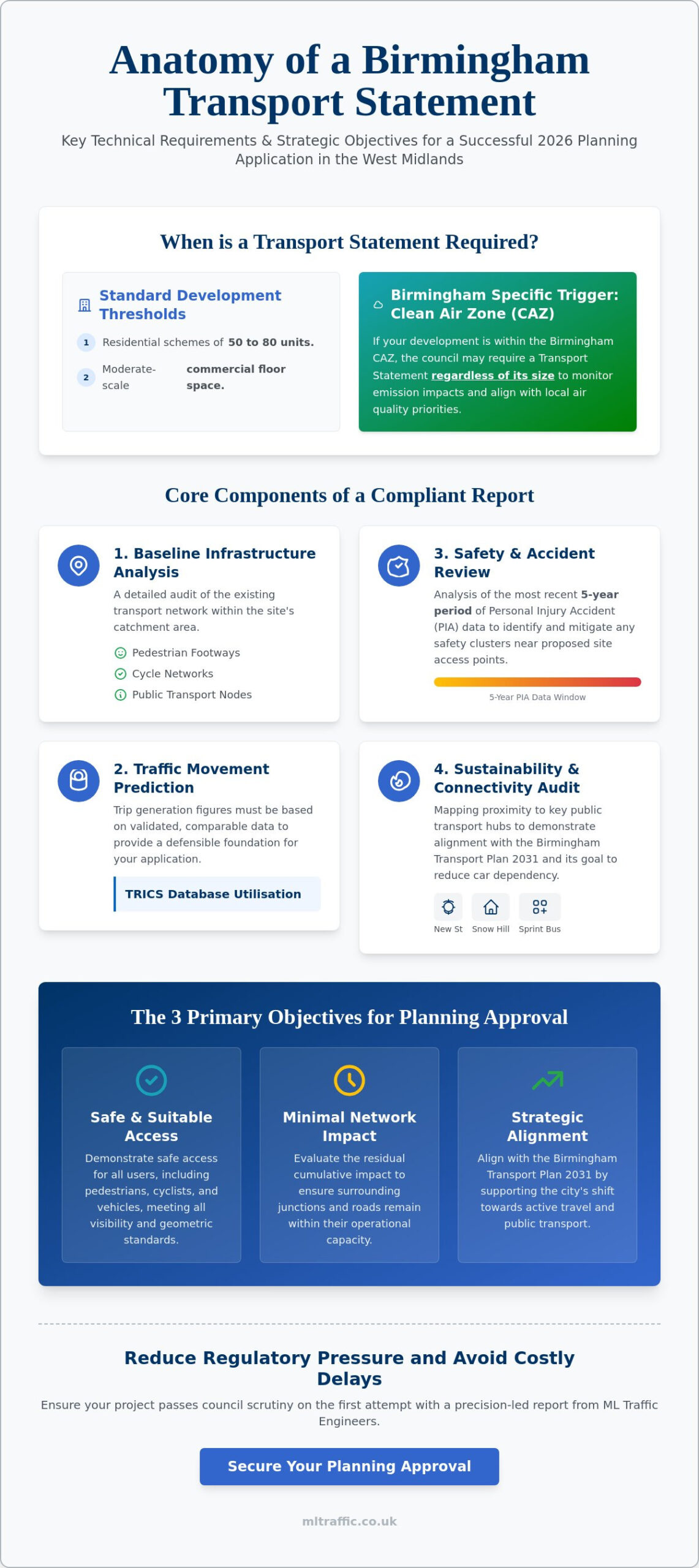
Thresholds for a Statement typically involve residential schemes between 50 and 80 units or commercial floor space of a moderate scale. However, the unique environmental requirements of the West Midlands often trigger the need for a report on much smaller sites. If your development is situated within the Birmingham Clean Air Zone (CAZ), the council may require a TS regardless of unit count to monitor emission impacts. We recommend checking the Birmingham Local Plan for site-specific requirements. Local policies often prioritize air quality and congestion management, making early technical scoping essential for sites that might otherwise fall below national thresholds.
The Core Objectives of Your Statement
Your transport statement Birmingham must achieve three primary goals to secure planning approval. First, it must demonstrate safe and suitable access for all road users, including pedestrians and cyclists. Second, we evaluate the residual cumulative impact on the surrounding road network to ensure junctions remain within capacity. Finally, the document must align with the Birmingham Transport Plan 2031. This strategic document emphasizes a transition toward a carbon-neutral network. If your scheme doesn’t actively support the city’s shift toward public transport and active travel, it faces a high risk of highway authority objection during the technical review phase.
Technical Requirements: What Your Birmingham Statement Must Include
Applying the same technical precision we utilize for developments in London, High Wycombe, and Slough, our reports for the West Midlands adhere strictly to UK government guidance on Transport Assessments. A professional transport statement Birmingham begins with a detailed baseline analysis of existing infrastructure. We document all pedestrian footways, cycle networks, and public transport nodes within a specified catchment area. To predict traffic movements, we utilize the TRICS database. This ensures your trip generation figures are based on validated data from comparable urban schemes, providing a defensible foundation for your planning application.
Safety and sustainability are core components of the 2026 technical requirements. Your statement must include a review of Personal Injury Accident (PIA) data covering the most recent five-year period. This identifies any safety clusters near your site that could impact proposed access points. Furthermore, we conduct a sustainability audit to map proximity to Birmingham New Street, Snow Hill, and the expanding Sprint bus network. This audit aligns your project with the Birmingham Transport Plan 2031 objectives of reducing car dependency. Demonstrating high levels of connectivity is essential for securing approval in a city focused on carbon-neutral growth.
Swept Path Analysis for Tight Urban Sites
Many redevelopment sites feature narrow street patterns and restricted access points similar to those we manage in congested London boroughs. We use Swept Path Analysis to simulate the movement of refuse vehicles and emergency tenders. This technical proof is vital for proving that your site layout is functional and safe. Without this simulation, highway officers may object based on perceived maneuvering difficulties. Our analysis ensures your design works on paper before you commit to construction, preventing the need for expensive post-submission revisions.
Parking Provision and Birmingham Standards
Navigating Birmingham City Council’s maximum parking standards requires a strategic approach. For sites with high public transport accessibility, we often justify reduced parking provision to meet sustainability goals. By 2026, all new developments must also integrate EV charging infrastructure to comply with local network requirements. If your project faces parking constraints, we can conduct detailed Parking Surveys to establish current levels of street stress. This data-driven approach allows us to justify your parking strategy and reduce regulatory friction during the planning process.
Addressing Birmingham’s Specific Transport Challenges
Developers in 2026 must align their transport statement Birmingham with the city’s aggressive decarbonisation targets. The Birmingham Clean Air Zone (CAZ) remains a central pillar of this strategy. Revenue from the CAZ is continuously reinvested into the city’s transport network, meaning the council expects developers to prove their schemes won’t degrade air quality. For commercial sites, this requires robust delivery strategies that account for vehicle compliance within the zone. It’s not just about the vehicles; it’s about reducing the total number of trips through smarter logistics and site management.
Major infrastructure projects like HS2 and the Curzon Street redevelopment are radically altering the city’s transport topography. These changes create a ripple effect across the inner ring road and the A38. A professional report must evaluate how your site integrates with these massive shifts. If your project sits near these major hubs, your statement needs to address long-term network capacity and connectivity. We focus on mitigating traffic impact on the A38 by promoting public transport expansion, such as the Midland Metro network and the new Sprint rapid transit buses. This ensures your development remains viable as the city’s infrastructure evolves.
The Shift Toward Low-Traffic Neighbourhoods (LTNs)
Birmingham’s commitment to Low-Traffic Neighbourhoods significantly influences site access strategies. The council prioritises reallocating road space to pedestrians and cyclists over private motorists. When we draft your transport statement Birmingham, we develop strong "modal shift" arguments. These arguments demonstrate how your development supports high-density urban living without increasing local congestion. We do this by integrating high-quality cycle storage and direct pedestrian links to local transit stations. Prioritising these non-car modes is often the only way to secure council support in restricted zones where car access is intentionally limited.
Section 106 and 278 Negotiations
A precise technical report is your strongest tool in financial negotiations. Birmingham City Council uses Section 106 and 278 agreements to fund infrastructure improvements. However, a well-drafted statement can prevent you from paying for network issues your development didn’t cause. We specialise in negotiating S278 agreements for off-site highway improvements. By providing granular data on trip generation and impact, we ensure that your required contributions remain proportional to your project’s actual footprint. Avoiding common pitfalls in S106 transport clauses can save your project significant capital during the technical approval phase.
The Workflow: Preparing Your Statement for Submission
A successful transport statement Birmingham follows a strict chronological path. Skipping steps or failing to agree on parameters with highway officers often leads to expensive revisions. The process begins with initial site feasibility and transport constraints mapping. We look for physical barriers, visibility issues, or existing traffic orders that might restrict access. Once the site’s potential is clear, we move to scoping the assessment with Birmingham City Council highway officers. This ensures the study area and methodology meet their specific expectations before you commit to full reporting.
Following the scoping agreement, we initiate data collection. This includes parking surveys and traffic counts designed to capture current network behavior. Our technical team then performs the analysis, drafting the Transport Statement to address safety, sustainability, and capacity. The final step is a rigorous review before submission as part of your planning portal package. This sequential workflow ensures every claim in your report is backed by defensible data.
The Scoping Process with Birmingham Highway Officers
Scoping is the most critical phase for risk mitigation. In 2026, Birmingham City Council charges £1,732 for pre-application reviews for schemes up to 25 units. We recommend including a detailed scoping note that outlines your proposed trip generation methodology and the specific junctions you intend to analyze. Agreeing on the study area early prevents the council from requesting additional junction modeling midway through the planning process. Having experienced transport planning consultants lead these talks ensures technical terms align with local policy, reducing the likelihood of highway authority objections.
Data Collection and Surveys
Accuracy in data collection is paramount. Birmingham requires data to be current, typically collected within the last three years, to reflect the post-CAZ traffic environment. We use a mix of Automated Traffic Counts (ATCs) for long-term flow data and manual turning counts for specific junction behavior. Parking surveys must follow the council’s approved methodology, often requiring overnight observations to establish a true baseline of local parking stress. This precision prevents the council from dismissing your findings as outdated or unrepresentative.
If you are ready to begin your project’s technical assessment, you can secure our professional transport planning services to ensure your data meets Birmingham’s 2026 standards.
Why ML Traffic Engineers for Your Birmingham Project?
Choosing the right technical partner is the difference between immediate planning approval and costly, time-consuming resubmissions. At ML Traffic Engineers, we provide a precision-led approach that ensures every transport statement Birmingham we produce meets 2026 statutory standards. We understand that the 4.99% increase in highways-related charges and the £15,348 minimum fee for Section 278 technical approvals leave no room for error. Our reports are built on defensible data and rigorous analysis, designed specifically to satisfy the scrutiny of Birmingham City Council highway officers.
We deploy a client-focused strategy that reduces regulatory pressure on developers and architects. By managing the technical complexities of your application, we allow you to focus on the broader aspects of your development. Our team is equipped to handle the full range of required services, including:
-
Detailed Transport Statements and full Transport Assessments.
-
Technical Swept Path Analysis to verify site accessibility for emergency and service vehicles.
-
Comprehensive Parking Surveys that align with local maximum standards.
-
Robust Travel Plans and Traffic Surveys to support sustainable urban integration.
We recognize the fast-moving nature of the West Midlands construction sector. Our readiness and commitment to rapid response ensure we meet tight planning deadlines with unwavering reliability. We don’t just provide data; we provide a fully-managed service that moves your project from initial inception to final council negotiations.
A Dependable Partner for West Midlands Infrastructure
Our experience in navigating the intricate regional regulations of the West Midlands makes us a vital partner for your project. We understand how the Birmingham Transport Plan 2031 impacts private site access and how to frame modal shift arguments that win council support. We take immense pride in our professional integrity and adherence to industry benchmarks. As your technical consultant, we act as a guardian of project safety and compliance, ensuring your site design is functional and safe for all road users. You can explore our previous project types to see how we manage full lifecycles for various residential and commercial schemes.
Get Your Birmingham Transport Statement Quote
We provide direct, active support for all residential and commercial planning applications across the city. Whether you are navigating the complexities of the Clean Air Zone or need to justify reduced parking provision in a high PTAL area, our team is ready to discuss your site’s specific transport needs today. We focus on providing clarity and rapid information delivery to keep your project on track. Accuracy in your initial submission prevents the need for expensive post-submission revisions.
Request a professional Transport Statement quote for your Birmingham project and secure the technical expertise required for 2026 planning success.
Secure Your 2026 Planning Approval with Technical Precision
Birmingham’s evolving infrastructure requires a proactive approach to technical planning. Successfully securing your 2026 approval depends on aligning your site with the city’s sustainable network goals and navigating specific Clean Air Zone requirements. A professional transport statement Birmingham must translate complex traffic data into a strategic argument for urban integration while minimizing your Section 106 and 278 contribution costs. Precision in the early stages prevents highway authority objections that can derail your project timeline.
ML Traffic Engineers has been delivering planning success since 2014. Our specialized expertise in Swept Path Analysis and TRICS data ensures your report stands up to rigorous council scrutiny. As professional members of the Chartered Institution of Highways and Transportation (CIHT) and the Institute of Highway Engineers (IHE), we maintain the highest standards of technical excellence. We manage the full project lifecycle from initial feasibility to final submission so you don’t have to navigate these logistical pressures alone.
Ready to move your development forward? Contact ML Traffic Engineers for a Birmingham Transport Statement Quote today. We are prepared to help you navigate the city’s complex regulatory landscape with confidence.
Frequently Asked Questions
How much does a Transport Statement cost in Birmingham for 2026?
The cost of a technical report varies depending on the scale of the development and the complexity of the required data. Developers must also budget for Birmingham City Council’s statutory fees, such as the £1,732 charge for pre-application advice on minor schemes. For a precise quote tailored to your site’s specific constraints, you should consult with our technical team directly.
What is the difference between a Transport Statement and a Transport Assessment?
A Transport Statement is a concise report for smaller developments with limited traffic impact. In contrast, a Transport Assessment (TA) is a comprehensive document required for major projects that generate significant movement. While a Statement focuses on immediate site access and local infrastructure, a TA involves extensive junction modeling and a wider analysis of the regional road network.
Can I write my own Transport Statement for a Birmingham application?
While you can technically draft your own document, it’s not recommended for professional planning applications. Birmingham highway officers require technical data, such as TRICS trip generation and accident analysis, that must meet industry benchmarks. Reports that lack professional precision or fail to use recognized methodologies often face immediate objections, leading to expensive delays and potential planning refusal.
How long does it take to produce a professional Transport Statement?
The production timeline typically spans several weeks, depending on the speed of data collection and council scoping responses. This period allows for site visits, traffic counts, and the technical drafting of the report. Starting the process early ensures your transport statement Birmingham is fully verified and ready for submission alongside your main planning portal application package.
Does a Transport Statement guarantee planning permission?
A technical report doesn’t guarantee approval, but it provides the defensible evidence needed to overcome highway authority objections. It proves that your development won’t compromise public safety or road efficiency. By demonstrating that the residual cumulative impact is acceptable under the NPPF, you provide the council with the technical justification required to support your scheme’s transport strategy.
Will I need a Travel Plan in addition to my Transport Statement?
The requirement for a Travel Plan depends on the scale and use class of your development. Birmingham City Council often requests these for projects that exceed specific trip generation thresholds to encourage sustainable commuting. We identify these requirements during the initial scoping phase to ensure all necessary documents are prepared to satisfy the council’s local planning conditions.
What happens if Birmingham City Council highway officers object to the Statement?
If an objection is raised, we immediately review the technical grounds provided by the highway authority. This process often involves gathering additional data or performing a more detailed Parking Survey to address specific concerns. We act as your technical representative, negotiating with the council to find a viable design solution that maintains safety while securing your planning approval.
Do I need a Swept Path Analysis for a small driveway access in Birmingham?
A Swept Path Analysis is frequently required if the access serves larger vehicles or is located on a narrow street. In dense urban areas like Digbeth, the council may request this proof to ensure vehicles can enter and exit the site in a single movement. It provides the visual certainty that your transport statement Birmingham needs to prove the access is functional.
Which areas do we cover?
We service Acocks Green, Alum Rock, Ashted, Aston, Aston Cross, Austin Village, Balsall Heath, Balti Triangle, Bartley Green, Beech Lanes, Billesley, Birches Green, Birchfield, Birmingham Chinatown, Boldmere, Bordesley, Bordesley Green, Bournbrook, Bournville, Brandwood End, Brindleyplace, Bromford, Browns Green, Buckland End, California, Camp Hill, Castle Vale, Chad Valley, Churchfield, Cofton Common, Cotteridge, Deritend, Digbeth, Doe Bank, Driffold, Druids Heath, Duddeston, Eastside, Edgbaston, Erdington, Falcon Lodge, Five Ways, Four Oaks, Fox Hollies, Frankley, Garretts Green, Gib Heath, Gilbertstone, Glebe Farm, Gosta Green, Gravelly Hill, Great Barr, Greet, Grimstock Hill, Gun Quarter, Hall Green, Hamstead, Handsworth, Handsworth Wood, Harborne, Harts Green, Haslucks Green, Hawkesley, Hay Mills, High Heath, Highgate, Highter’s Heath, Hill Hook, Hill Wood, Hockley, Hodge Hill, Jewellery Quarter, Kents Moat, Kings Heath, Kings Norton, Kingstanding, Kitts Green, Ladywood, Lea Hall, Lee Bank, Ley Hill, Lifford, Little Bromwich, Lodge Hill, Longbridge, Lozells, Lyndon Green, Maney, Maypole, Minworth, Mere Green, Moor Green, Moseley, Nechells, New Frankley, New Oscott, Newtown, Northfield, Old Oscott, Over Green, Peddimore, Park Hall, Pelham, Perry Barr, Perry Beeches, Perry Common, Pheasey, Pype Hayes, Queslett, Quinton, Reddicap Heath, Rednal, Ridgacre, Rotton Park, Roughley, Rubery, Saltley, Sarehole, Selly Oak, Selly Park, Shard End, Sheldon, Shenley Fields, Shenley Green, Short Heath, Showell Green, Small Heath, Smithfield, Soho, Southside, South Yardley, South Woodgate, Sparkbrook, Sparkhill, Springfield, Spring Vale, Stechford, Stirchley, Stockfield, Stockland Green, Streetly, Sutton Coldfield, The Leverrets, Theatreland, Thimble End, Tile Cross, Tower Hill, Tudor Hill, Turves Green, Tyburn, Tyseley, Vauxhall, Wake Green, Walker’s Heath, Walmley, Ward End, Warstock, Washwood Heath, Wells Green, Weoley Hill, Weoley Castle, West Heath, Westside, Wiggins Hill, Whitehouse Common, Winson Green, Witton, Woodcock Hill, Woodgate, Wylde Green, Yardley, Yardley Wood.

Disclaimer
The content on mltraffic.co.uk, including all technical articles, guides, and resources, is provided for general informational and educational purposes only. It is not intended to constitute professional advice in traffic engineering, transportation planning, development approvals, or any other technical or legal field.
While ML Traffic Engineers makes every reasonable effort to ensure the accuracy, completeness, and timeliness of the information published, we do not provide any warranties or representations (express or implied) regarding its reliability, suitability, or availability for any particular purpose. Any reliance you place on the content is strictly at your own risk.
In no event shall ML Traffic Engineers, its directors, employees, authors, or affiliates be liable for any direct, indirect, incidental, special, consequential, or punitive damages (including, without limitation, loss of profits, data, or business opportunities) arising out of or in connection with the use of, or inability to use, any information provided on this website.
The articles and guides on this site are not a substitute for engaging a qualified, professional traffic engineer to assess your specific project requirements. For tailored advice, compliance assessments, or traffic engineering services, please contact a competent professional.
This disclaimer may be updated from time to time without notice. By accessing or using this website, you agree to be bound by the most current version of this disclaimer.