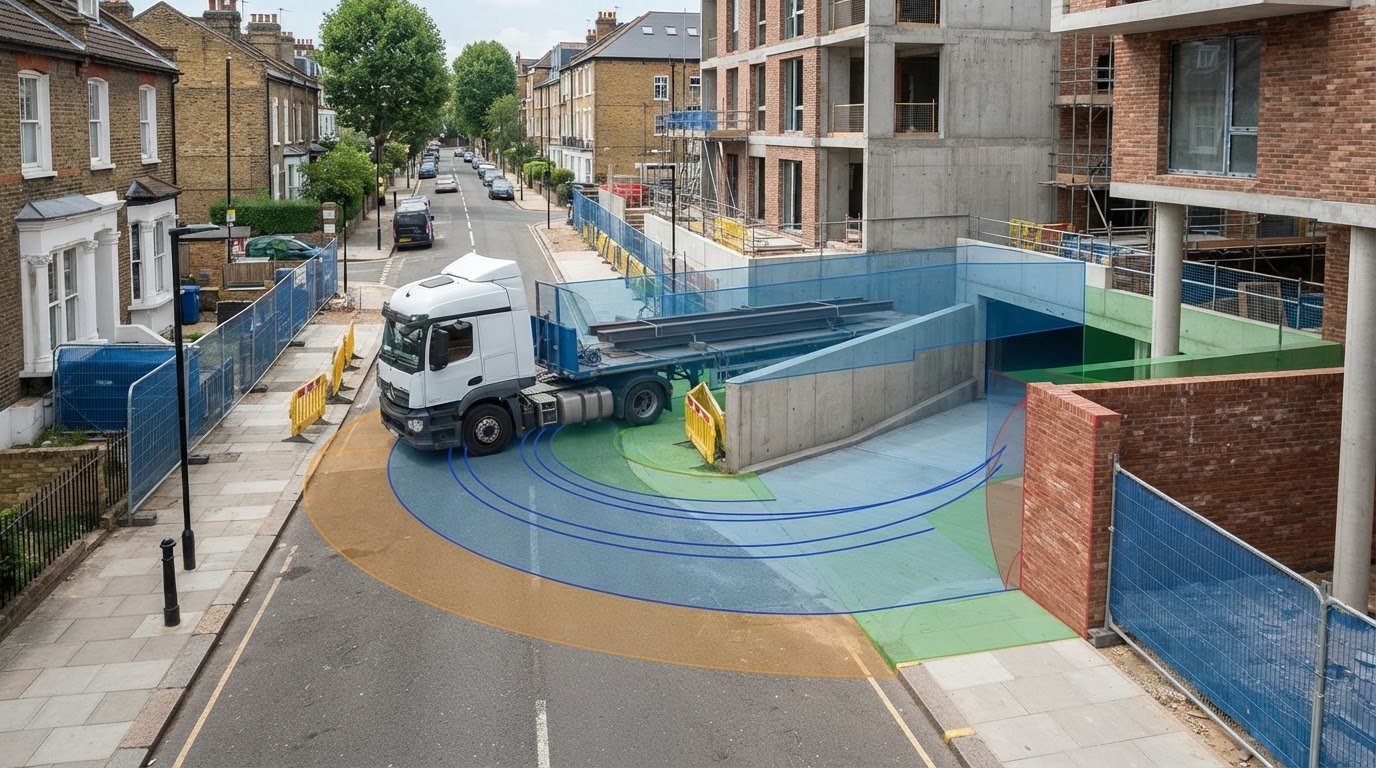
What if a basement ramp fits on the plan but the vehicle using it cannot make the turn? Swept path analysis for basement construction access tests the vehicle’s full journey, from the approach outside the site through the entrance, down the ramp and around any internal turning area. It models the selected vehicle’s path and swept envelope to identify potential conflicts with walls, columns, corners and other fixed obstacles.
A tight basement layout can leave little room to address a problem once the design is advanced. The assessment is useful only when it reflects the intended vehicle and accurate project information. This guide explains which parts of the route to test, what drawings and vehicle assumptions to prepare, and how to identify geometric issues early enough to inform design discussions.
It also explains how a project-specific review can reflect the local planning context and how access findings may support a wider Transport Statement or Transport Assessment. ML Traffic Engineers UK provides Swept Path Analysis for development access feasibility, drawing on senior staff with over 35 years of traffic engineering experience.
Key Takeaways
- Distinguish a vehicle’s wheel track from the wider space its body occupies when assessing clearances.
- Use swept path analysis for basement construction access to test each movement, including entry, ramp descent, positioning and exit.
- Choose design vehicles to match the movement being assessed, and distinguish construction-phase needs from those of the completed development.
- Provide coordinated basement drawings and clear vehicle assumptions so the assessment can identify potential conflicts early.
- A project-specific review can relate access findings to the local planning context and, where relevant, a wider Transport Statement or Transport Assessment.
Why basement construction access needs a full swept path test
A ramp can appear wide enough on a plan yet leave a vehicle unable to negotiate the turn at its foot. Swept path analysis for basement construction access assesses whether a defined vehicle can manoeuvre along a proposed route, using the supplied design information. It examines more than whether the vehicle’s wheels stay within the roadway or ramp.
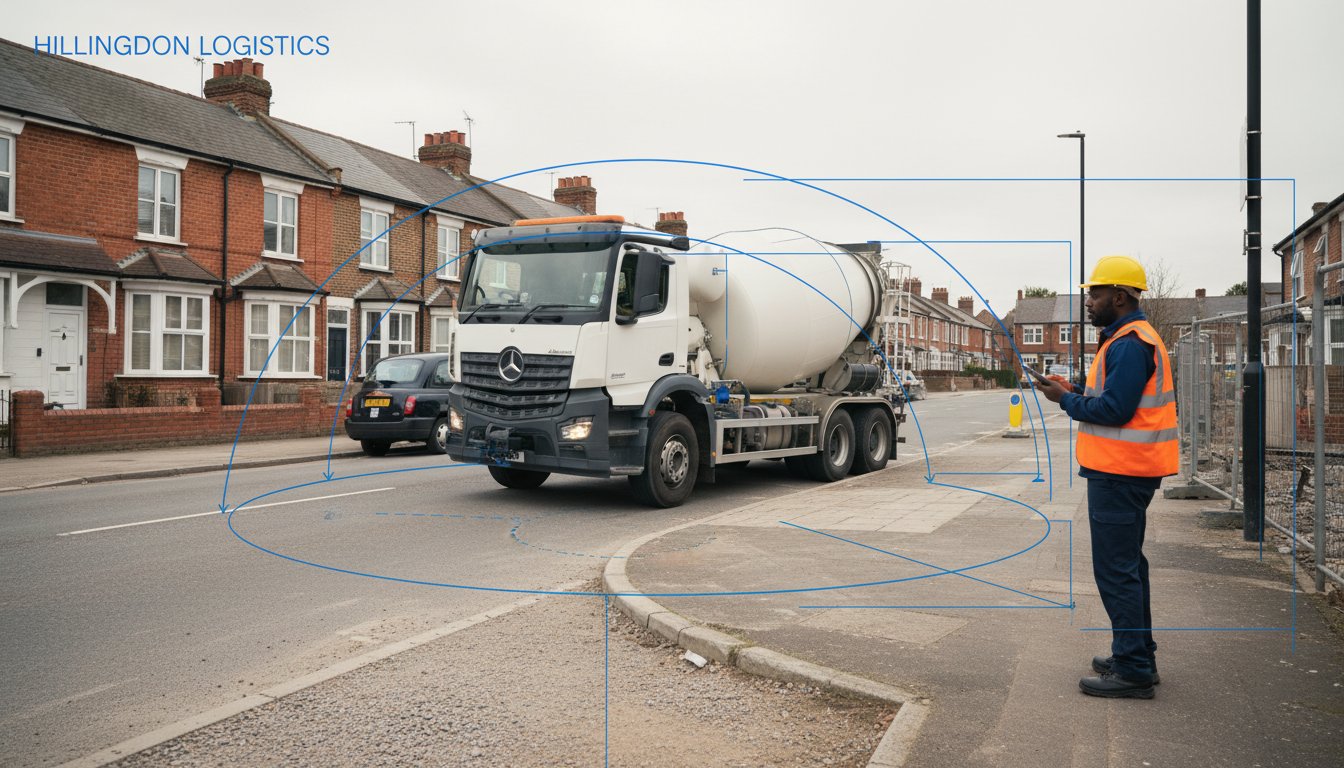
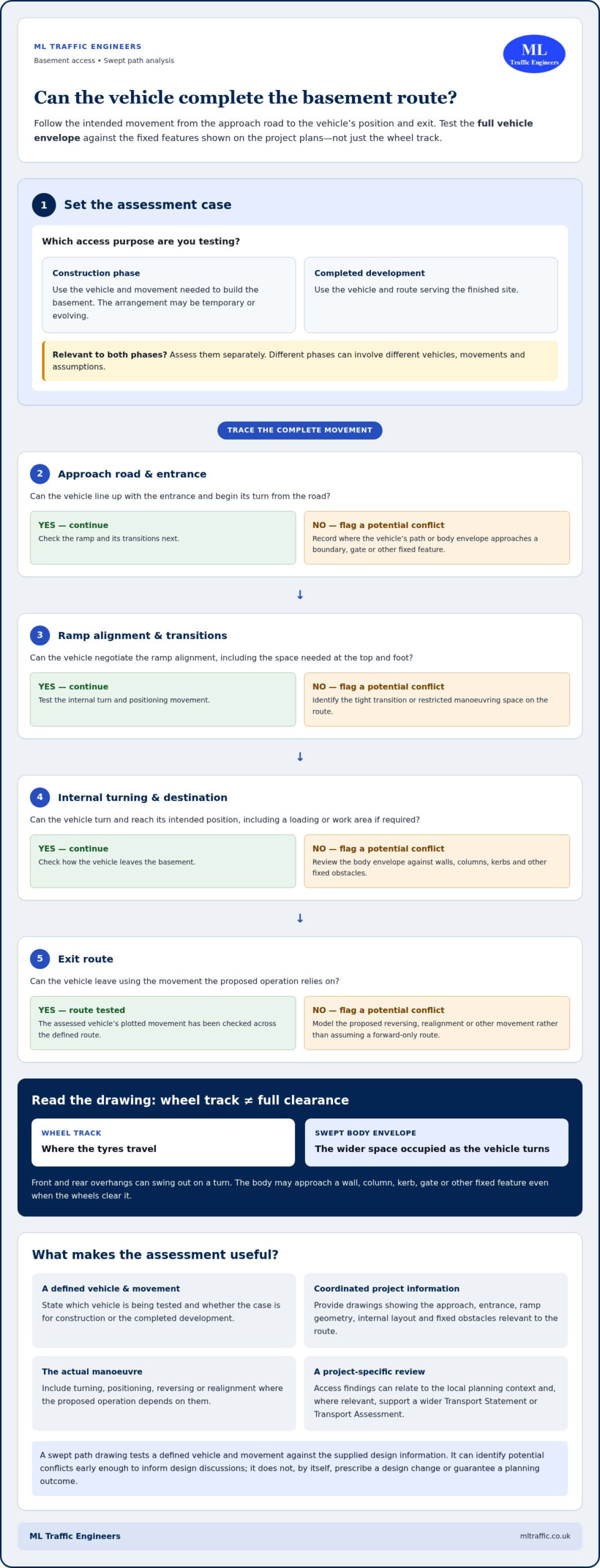
The wheel track shows where the tyres travel. The vehicle’s body follows a wider envelope because its front and rear overhangs can swing out as it turns. That envelope may approach a wall, column, kerb, gate or other fixed feature even when the wheels clear it. In an enclosed basement, limited headroom, narrow ramps and restricted turning areas can make each part of the movement relevant to the assessment.
The scope should match the access purpose. Construction-phase access may involve vehicles needed to build the basement, while access for the completed development concerns vehicles serving the finished site. These can involve different movements and vehicle assumptions. If both phases matter, assess them separately rather than treating one vehicle path as evidence that every vehicle can use the route.
What does a swept path drawing show at basement access?
A swept path drawing plots the assumed vehicle as it moves through the proposed route, not just at the entrance. Depending on the assessment brief, it can show the approach, entry, ramp descent, turning and exit. The plotted body envelope helps reveal where overhang may approach walls, columns or kerbs. The result tests a defined vehicle and movement against the plans and other design information provided.
Specialist tools can model vehicle movements. AutoTrack (swept path analysis software) is one example. For a basement, the value lies in applying the assessment to the actual route and its constraints. A line showing wheel movement alone cannot show the full clearance picture.
Why assess access before the basement design is fixed?
Early testing can expose a tight turn or potential conflict while the layout is still being developed. The design team can consider the finding before relying on a route that only appears workable in plan. The analysis provides evidence about the vehicle movement assessed. It does not, by itself, prescribe a design change or guarantee a particular planning outcome.
In basement access design, swept path analysis tests whether an assumed vehicle’s full manoeuvring envelope can follow the proposed route without conflicting with features shown on the plans. The usefulness of that test depends on clear vehicle assumptions and coordinated information, including the entrance, ramp geometry, internal layout and fixed obstacles. A project-specific guide to swept path analysis for planning applications provides related context for understanding how vehicle movements are assessed.
How construction vehicles move through a basement access route
A useful route assessment follows the vehicle from the approach road to its intended position, then considers how it leaves. The entrance is only one part of that journey. A vehicle may clear the site boundary but encounter a tight transition at the top of the ramp, need additional space at the ramp foot, or lack room to turn within the basement.
For swept path analysis for basement construction access, describe the actual movement being tested. Construction-phase vehicles may use a temporary or evolving arrangement, while vehicles serving the completed development may follow a different route or have different dimensions. Treat these as distinct assessment cases where both are relevant. One vehicle’s movement does not establish that another can use the same layout.
Which parts of the basement route should be tested?
Set out the route in sequence and identify where the vehicle changes direction, negotiates a transition or needs room to align with its destination. Include the approach road and entrance, ramp alignment and transitions, internal turning area, destination point and exit route where they form part of the project question.
Review the route against the features shown on the drawings, including boundary walls, columns, kerbs, gates and other fixed obstacles. If a vehicle must enter a loading or work area, assess the movement into that position as well as the route to reach it. Match the level of detail to the access question. Reaching the basement entrance is not necessarily the end of the journey.
- Approach and entry: Consider how the vehicle lines up with the entrance and begins its turn from the road.
- Ramp and transition: Examine changes in alignment and the available manoeuvring space at the top and foot of the ramp.
- Internal movement: Include turning, positioning and exit movements that the proposed operation relies on.
How do reversing and tight turns affect the assessment?
Show the manoeuvre as proposed. If the vehicle needs to reverse into or out of a position, model that movement rather than assuming it can travel forwards throughout. A turn may bring the body’s front or rear overhang closer to an obstacle than the wheel track suggests, so review the full vehicle envelope against the available clearances along the route.
Restricted sightlines or limited space can also make the sequence of movements relevant. For example, a vehicle may need to pause, realign or reverse where the ramp meets an internal turning area. Include these operational details in the brief and drawings when they affect the movement being assessed.
The assessment demonstrates the defined vehicle movement against the supplied design information. It does not establish that every possible site operation, vehicle or traffic interaction has been tested. A clear route brief helps keep the analysis focused. ML Traffic Engineers UK provides traffic engineering support tailored to the project and its planning context.
What design vehicle and basement details make the analysis useful?
A swept path assessment is only as relevant as the vehicle and movement it represents. For swept path analysis for basement construction access, define the access question first: is the test for a vehicle needed during construction, for servicing the completed development, or for both? A vehicle selected for one purpose should not be treated as a stand-in for another with different dimensions or manoeuvring needs.
Set out the intended vehicle and route with the project team, then provide plans showing the geometry the vehicle must negotiate. Where construction and operational access both matter, identify each as a separate case. This makes the assessment’s scope clear and helps prevent a result for one movement being applied to another.
How should the design vehicle match the project?
Select the vehicle to reflect the movement being assessed, using project information rather than an unsupported assumption or generic template. A construction vehicle accessing a work area may have a different purpose and route from a vehicle serving the completed development. Record the relevant vehicle assumptions and manoeuvre for each case so the assessment can test the intended scenario.
| Assessment case | Information to define |
|---|---|
| Construction phase | The vehicle required for the construction-related access question, its approach and route, and the position it needs to reach. |
| Completed development | The vehicle serving the finished site, the access route it will use, and any internal positioning or exit movement being assessed. |
These categories describe different assessment purposes, not fixed vehicle types. The project brief should identify the actual vehicle assumptions and movements to be tested. If a vehicle or route changes as the design develops, review the assessment basis against the updated information.
Which basement drawings and constraints should be reviewed?
Provide a coordinated base plan that makes the full route legible, from the entrance and ramp through internal circulation to the turning area and intended destination. Include dimensions and levels where available, together with the ramp alignment, transitions and relevant approach geometry. Use drawings with a suitable scale and dimensions for assessing the movement, rather than relying on visual estimates from an unclear or incomplete plan.
Show fixed features that could affect vehicle movement, including walls, columns, kerbs, gates and other obstructions. If a feature is absent from the drawing, it cannot be reliably considered in the plotted assessment. Check that the information describes the same design layout and that key dimensions and levels are consistent across the supplied plans.
Vehicle assumptions and base-plan accuracy shape what a swept path assessment can show: the result tests the defined vehicle against the geometry represented in the supplied drawings. Clear inputs make the findings more useful for design discussion and keep conclusions tied to the specific movement and layout assessed.
Reviewing Basement Access Results and Conflicts
A swept path drawing is evidence of a defined movement, not a general approval of the whole basement layout. Review it in sequence: establish what has been tested, trace the vehicle envelope through each constrained area, then record any conflicts with the design features shown. This keeps the discussion specific and makes it easier for the project team to identify what needs further attention.
How should a project team read the swept path output?
Start by checking the vehicle, direction of travel, manoeuvre and route shown on the drawing. Then follow the plotted envelope through the entrance, along the ramp and around internal obstacles. Compare it with the features shown, not just the wheel track. Keep the result within its scope: a drawing demonstrates the movement modelled against supplied information, not movements, conditions or obstructions it does not represent.
- Confirm the assumptions. Verify that the vehicle and movement match the access question, including whether the route is for entry, exit, reversing or internal positioning.
- Trace the full manoeuvre. Follow the vehicle from its start point through each change in direction. Do not focus only on the entrance or the tightest-looking turn.
- Review the vehicle envelope. Check the body path against entrance edges, ramp boundaries, walls, columns, kerbs, gates and other fixed features represented on the plans.
- Note the constrained locations. Record where the envelope approaches or conflicts with a feature, and identify the route segment and movement involved.
- Separate findings from assumptions. Distinguish clearances demonstrated on the drawing from details that were not shown or movements outside the assessment scope.
This sequence helps the team communicate a finding precisely. For example, “the vehicle envelope approaches the column during the turn at the ramp foot” identifies a location and movement for design discussion. It is more useful than a broad statement that the basement access is too tight. The practical AutoTURN swept path analysis guide offers further context on interpreting vehicle movement drawings.
What can the design team do when a movement conflicts?
First, identify the exact conflict and the assumptions behind it. The design team can then discuss potential layout revisions, such as changing the route geometry or the arrangement of an obstruction. These are design considerations, not guaranteed solutions. Assess any revision using updated project drawings and agreed vehicle assumptions so the result reflects the design being considered.
Findings can support access-feasibility discussions and inform planning evidence, but they do not guarantee planning approval. Keep the assessment clear about what was tested and what it demonstrates. For project-specific swept path analysis for basement construction access, discuss your access requirements with ML Traffic Engineers UK.
How ML Traffic Engineers UK supports basement access assessment
ML Traffic Engineers UK provides Swept Path Analysis to assess proposed vehicle movements and support development access feasibility. For a basement project, the work focuses on the defined route, vehicle assumptions and design information, providing technical evidence for access discussions. The assessment is tailored to the project and its local planning context, rather than relying on a generic route or vehicle scenario.
The consultancy takes a hands-on approach to each project. Every senior staff member has over 35 years of traffic engineering experience. ML Traffic Engineers UK works across Greater London, Manchester, Birmingham, the West Midlands, Liverpool, Surrey, East Sussex, West Sussex, Hampshire, Berkshire and Buckinghamshire, where assessments can be tailored to the relevant local planning context.
What information helps scope a basement access assessment?
A clear brief helps define what the assessment needs to demonstrate. Set out the access question, vehicle, movement and intended destination, then provide the latest available drawings so the analysis reflects the current proposal. Include relevant dimensions, levels and fixed constraints along the route. ML Traffic Engineers UK tailors its review to the project information and local planning context, keeping the assessment focused on the movement under consideration.
- Access question: Explain whether the review concerns construction-phase access, the completed development, or both.
- Vehicle and movement: Identify the vehicle assumptions and whether the proposed manoeuvre involves entry, reversing, turning, positioning or exit.
- Design information: Supply drawings showing the entrance, ramp, internal route, destination and relevant walls, columns, kerbs, gates or other fixed features.
- Project context: Note the planning stage and any relevant local access or drawing requirements identified for the project.
These inputs establish the assessment’s scope and make its findings easier to interpret alongside the proposed design. If the layout or vehicle assumptions change, updated information can inform a further review of the movement.
What are the next steps for a UK development project?
First, establish whether the project needs a focused access drawing or whether vehicle access forms part of wider transport planning documentation. A specific basement manoeuvre may call for a targeted assessment. Where a broader review of transport effects is relevant, a guide to Transport Assessments for London development explains the wider planning context. The appropriate scope depends on the project and its planning requirements.
For a focused review, bring together the access question, vehicle assumptions and current design drawings. ML Traffic Engineers UK can tailor Swept Path Analysis to assess the proposed movements and support development access feasibility, with the findings considered alongside the design and local planning context.
Discuss your basement access requirements with ML Traffic Engineers UK.
Set the next design decision in motion
Make the access question clear while the basement layout is still being developed. Identify the vehicle movement that needs testing and align the assessment with the current design information. If the proposal changes, updated drawings and assumptions help ensure any further review relates to the layout now under consideration.
Use swept path analysis for basement construction access to inform design discussions, not as a substitute for project-specific planning judgement. Clear evidence of the movement assessed can help the project team focus on the relevant access issue and consider it alongside the wider development proposal.
ML Traffic Engineers UK takes a hands-on approach, tailoring its assessment to the project and local planning context. Its senior staff each have over 35 years of traffic engineering experience. For support with your proposed basement access, discuss your access requirements with ML Traffic Engineers UK.
Start with a clearly defined movement and the latest available design information. That gives your team a sound basis for the next design discussion.
Frequently Asked Questions
What is swept path analysis for basement construction access?
It is a technical assessment of how a selected vehicle moves through a proposed basement access layout. The review can test a defined route, such as entering from the site approach, descending a ramp and turning towards a destination. Its conclusions apply to the vehicle and manoeuvre represented, not every vehicle that might use the site. This makes it useful for discussing a specific access question with the design team.
Can swept path analysis show whether a construction vehicle can enter a basement?
Yes. It can test whether a defined construction vehicle movement can be accommodated by the access geometry shown in the project information. The brief should describe the intended approach and manoeuvre, such as entering forwards or reversing to reach a work area. The result is evidence about that tested movement. It does not establish how every site operation will be managed or resolve matters beyond the drawing’s scope.
What information is needed for a basement swept path assessment?
Provide the current access and basement drawings, the vehicle and movement to be assessed, and relevant dimensions, levels and fixed constraints. Identify the drawing revision and make clear which layout represents the current proposal. If plans show different arrangements, specify which one applies to the assessment. This helps avoid interpreting a result against superseded geometry or assumptions that no longer match the design.
Does swept path analysis check ramp gradients and headroom?
Not by itself. A plan-view swept path drawing focuses on vehicle movement across the layout shown; it should not be read as verification of vertical clearance or ramp gradients. For example, a plotted route may indicate that a vehicle can turn in plan without establishing whether its height is compatible with the available clearance. Treat vertical geometry as a separate design consideration, supported by the relevant project information and checks.
Can swept path analysis test a vehicle reversing into a basement?
Yes. A reversing manoeuvre can be modelled if it is part of the access question and the route is clearly defined. The assessment brief should identify where the vehicle starts, where it needs to finish and which direction it travels during the manoeuvre. This is useful when the intended position requires a turn or reverse movement. The result applies only to that vehicle and movement, not untested operating arrangements.
When should basement access be assessed during design?
Assess it while the access layout is still being developed, when findings can inform design discussion. Timing depends on the stage of the proposal and the drawings available. Local planning context can differ across Greater London, Manchester, Birmingham, the West Midlands, Liverpool, Surrey, East Sussex, West Sussex, Hampshire, Berkshire and Buckinghamshire. If the geometry changes, base any further assessment on the revised design.
Is a swept path drawing the same as a construction logistics plan?
No. A swept path drawing illustrates and tests a defined vehicle movement against a proposed layout. A construction logistics plan addresses broader arrangements associated with construction, so one document should not be treated as a substitute for the other. For example, a movement drawing may show whether a vehicle can negotiate a basement entrance, but it does not set out wider site logistics. The project’s planning requirements determine what supporting documents are relevant.

Disclaimer
The content on mltraffic.co.uk, including all technical articles, guides, and resources, is provided for general informational and educational purposes only. It is not intended to constitute professional advice in traffic engineering, transportation planning, development approvals, or any other technical or legal field.
While ML Traffic Engineers makes every reasonable effort to ensure the accuracy, completeness, and timeliness of the information published, we do not provide any warranties or representations (express or implied) regarding its reliability, suitability, or availability for any particular purpose. Any reliance you place on the content is strictly at your own risk.
In no event shall ML Traffic Engineers, its directors, employees, authors, or affiliates be liable for any direct, indirect, incidental, special, consequential, or punitive damages (including, without limitation, loss of profits, data, or business opportunities) arising out of or in connection with the use of, or inability to use, any information provided on this website.
The articles and guides on this site are not a substitute for engaging a qualified, professional traffic engineer to assess your specific project requirements. For tailored advice, compliance assessments, or traffic engineering services, please contact a competent professional.
This disclaimer may be updated from time to time without notice. By accessing or using this website, you agree to be bound by the most current version of this disclaimer.