Tag: DfT Guidance

  • Guidance on Transport Assessment: Navigating DfT and PPG Standards in 2026

    Guidance on Transport Assessment: Navigating DfT and PPG Standards in 2026

    Relying on the archived 2007 DfT guidance for your planning application in 2026 is a guaranteed route to a formal refusal. Many developers still struggle to identify exactly when is a transport assessment required uk because the transition from old “predict and provide” models to modern “vision-led” standards has completely rewritten the regulatory landscape. With the August 17, 2026, NPPF update now in full effect, the thresholds for statutory consultation with National Highways and Active Travel England have shifted significantly. Precision in these early stages is a functional necessity to prevent your project from stalling at the first hurdle.

    It’s understandable to feel concerned about the specific level of detail your site requires, especially when local authorities are increasingly setting their own stricter benchmarks. This article ensures you master current PPG planning standards to secure a successful submission without the risk of costly Highway Authority objections. We provide a clear breakdown of the 2026 statutory requirements, including the 250-unit threshold for Active Travel England and the latest car-free mandates for high PTAL areas. You’ll learn how to align your technical data with modern safety and sustainability targets to maintain a seamless project lifecycle from inception to completion.

    Key Takeaways

    • Transition from outdated DfT mythology to the 2026 NPPF framework to ensure your project aligns with the latest vision-led planning policies.
    • Clarify exactly when is a transport assessment required uk by evaluating residential and commercial thresholds alongside local “Sensitive Area” triggers.
    • Master the core components of a submission, from establishing a robust transport baseline to integrating advanced Swept Path Analysis for site layout approval.
    • Adhere to 2026 technical standards for sustainable travel, including 100% active electric vehicle charging points and integrated active travel infrastructure.
    • Leverage expert insights on London-specific challenges and National Highways negotiations to avoid costly delays and secure a successful planning outcome.

    The Evolution of DfT Guidance on Transport Assessment

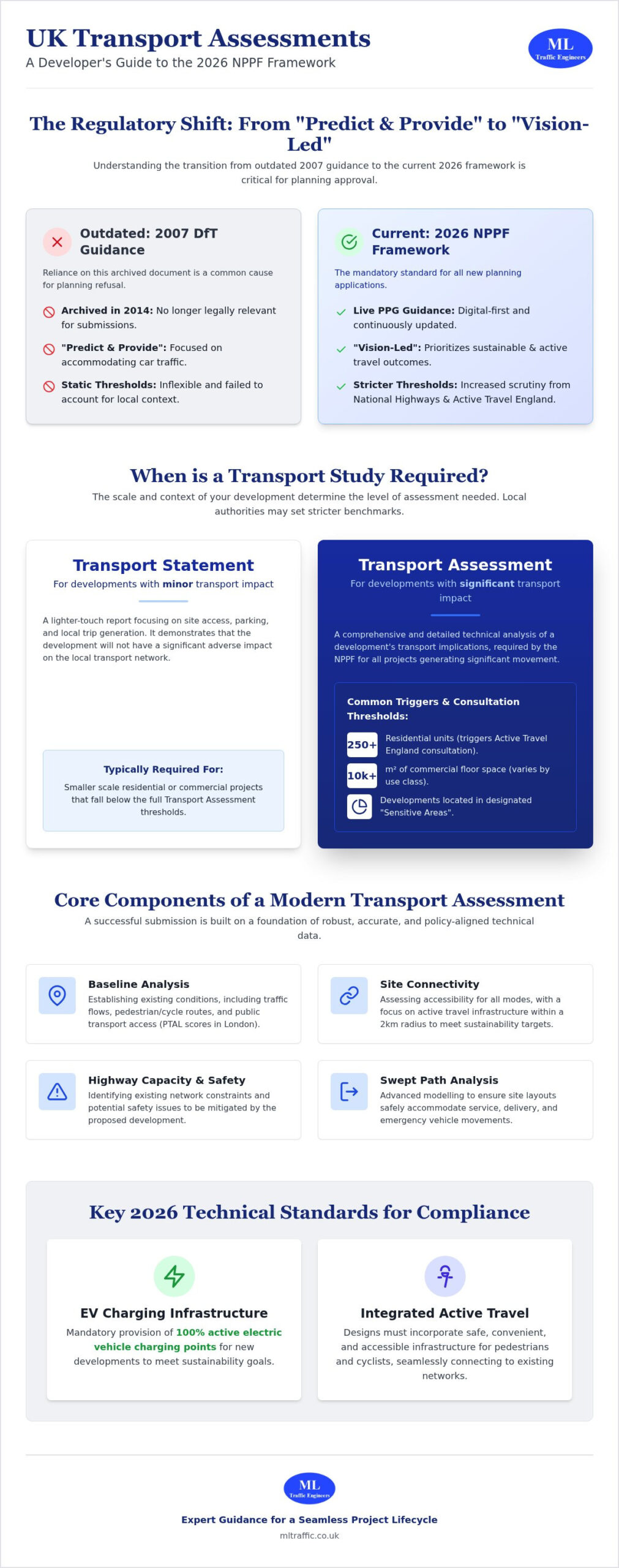
    Many developers still search for the 2007 “Guidance on Transport Assessment” PDF as their primary reference. It’s a mistake that can lead to immediate planning refusal. That document was officially archived in 2014 and replaced by a digital-first approach within the Planning Practice Guidance (PPG). Understanding this shift is the first step in answering when is a transport assessment required uk for your specific site. This modern transportation planning framework prioritizes sustainable outcomes over simple road capacity, reflecting a high-stakes environment where precision is a functional necessity. ML Traffic Engineers UK provides the technical authority required to manage these full project lifecycles from inception to completion.

    To better understand how a strategic approach to these assessments impacts your project performance, watch this video:

    Archived 2007 DfT Guidance vs. Modern PPG

    The 2007 DfT document provided static, rigid thresholds that often failed to account for regional nuances. While it offered a clear technical checklist, it didn’t adapt to the rapid changes in urban mobility or environmental standards. In 2014, the government moved to the web-based PPG format to ensure guidance remains “live” and responsive to policy changes. Developers in 2026 must use the “Travel Plans, Transport Assessments and Statements” section of the PPG. This transition ensures your project aligns with current expectations from Local Highway Authorities and National Highways. It also reduces the regulatory pressure on your team by providing a clear, updated roadmap for compliance.

    The Role of the National Planning Policy Framework (NPPF)

    The NPPF is the primary engine behind transport planning decisions in England. The August 17, 2026, update introduced stricter decision-making policies that prioritize “Active Travel” over private car use. Identifying when is a transport assessment required uk depends heavily on the NPPF mandate that all developments generating significant amounts of movement must be supported by a technical study. This update also changed consultation thresholds. For instance, National Highways must now be consulted for any development requiring a full assessment, removing the old “non-minor” distinction. Our team at ML Traffic Engineers UK manages this entire process, ensuring your Transport Assessment meets these rigorous national standards. This is particularly critical for complex sites, where a Transport Assessment in London must also navigate specific TfL requirements. We bridge the gap between policy and approval so you don’t have to manage the technical lexicon alone.

    Core Components of a Modern Transport Assessment

    A modern Transport Assessment is a technical document that demonstrates a development’s compatibility with the existing infrastructure. It moves beyond simple traffic counts to provide a holistic view of movement. Determining when is a transport assessment required uk is only the first step. The success of your submission depends on the depth and accuracy of the baseline data provided to the decision-makers. Technical authority is a functional necessity in this high-stakes environment to ensure your project doesn’t face unnecessary delays.

    Baseline Analysis and Site Connectivity

    Every assessment begins by establishing the current transport baseline. In London, this involves calculating Public Transport Accessibility Level (PTAL) scores to determine the appropriate intensity of development. Outside the capital, we review pedestrian and cycle infrastructure within a 2km radius to ensure the site supports active travel goals. We identify existing highway capacity and safety issues through comprehensive Traffic Surveys. A report that doesn’t account for local congestion is likely to be challenged. This ensures the data is current, as submissions using counts more than 36 months old are likely to face rejection.

    Trip Generation and the TRICS Database

    TRICS is the industry-standard database used to predict trip rates for new developments based on comparable historical data. We select comparable sites with precision to ensure the data accurately reflects your specific development’s geography and land use. It’s vital to select sites that share similar demographic profiles and transport links. Modern assessments must factor in multi-modal travel patterns. They account for how residents or employees will actually move in a sustainable environment. This technical lexicon is essential for answering when is a transport assessment required uk for non-standard land uses where simple thresholds may not apply.

    Impact Assessment and Mitigation

    We use industry-leading software like Junctions 10 and LinSig to model the impact of new trips on the local network. This process identifies potential bottlenecks before they become planning hurdles. Following the official UK Government guidance, we propose mitigation strategies that are strictly proportionate to the scale of the impact. These may include physical highway improvements or “soft” measures like bespoke Travel Plans. Our expert team manages these technical requirements so you can focus on the broader project delivery. Professional transport assessment services ensure that your application remains compliant with the latest 2026 standards.

    Transport Assessment vs. Transport Statement: Which Do You Need?

    Choosing between a Transport Assessment and a Transport Statement is a decision that dictates your planning timeline and budget. Determining when is a transport assessment required uk involves more than just checking a static list of numbers. The decision depends on the anticipated “significance” of the development’s impact on the highway network. While a Transport Statement is sufficient for smaller schemes with limited transport implications, a full Transport Assessment is mandatory for larger projects that require detailed junction modelling and mitigation analysis. This distinction is critical because the scope of work for a full assessment is far more extensive, often taking several weeks longer to complete and requiring a higher level of technical investment. The cost and time implications are significant, with data collection expenses alone seeing a 15% increase in the 24 months leading up to August 2026.

    Thresholds and Scoping with Local Authorities

    In London, the 2026 threshold for a full Transport Assessment is generally set at 80 residential units or 2,500 square meters of commercial floor space. However, local Highway Authorities often exercise discretion in “Sensitive Areas,” such as Air Quality Focus Areas or congested town centres. In these locations, a full assessment may be triggered for developments as small as 30 to 40 units. This variability is why early scoping meetings with National Highways or TfL are vital. These discussions allow us to agree on the parameters of the study before technical work begins, ensuring compliance with the latest UK government guidance on transport assessments. For smaller projects within the capital, our Transport Statement London: A Developer’s Guide provides a clear roadmap for navigating these local requirements.

    The Consequences of Under-Assessing Impact

    Submitting a Transport Statement when a full Assessment was required is a common cause of project delays. It frequently leads to “holding objections” from statutory consultees like Active Travel England, who, as of August 2026, focus on residential schemes of 250 units or more. If the Highway Authority deems the submitted information insufficient, they’ll refuse the application or demand a complete resubmission of technical data. This isn’t just a matter of paperwork; it involves additional traffic counts and complex modelling that can add months to your timeline. We help you avoid these pitfalls during the pre-application stage by precisely identifying when is a transport assessment required uk for your specific site. Our expert team bridges the gap between old DfT mythology and modern PPG reality, ensuring your submission is right the first time. This proactive approach reduces regulatory pressure and secures your planning path.
    Guidance on Transport Assessment: Navigating DfT and PPG Standards in 2026

    Technical Best Practices for 2026 Planning Applications

    Securing a successful planning outcome requires more than just identifying when is a transport assessment required uk. It demands technical precision in the execution of site layouts and parking strategies. Modern standards, particularly following the August 2026 NPPF updates, place heavy emphasis on a “vision-led” approach. This means your technical data must prove that the development prioritizes sustainable travel while maintaining absolute operational safety. Precision is a functional necessity in this high-stakes environment to avoid costly delays from the Highway Authority during the final stages of the planning cycle.

    Swept Path Analysis: Proving Manoeuvrability

    Swept Path Analysis (SPA) is now a non-negotiable component of the DfT and PPG framework for site layouts. We use AutoTURN software to simulate the movements of 12-metre refuse vehicles and fire tenders within your proposed scheme. This process identifies geometry issues before they lead to a formal Highway Authority objection. Proving that emergency and service vehicles can safely navigate your site is a functional necessity for modern approvals. For a deeper look at these technical requirements, read our Practical Guide to Swept Path Analysis.

    Parking Standards and Sustainable Transport

    Parking provision in 2026 is strictly regulated to discourage private car use in urban centres. In London, developments in areas with a PTAL score of 4 or higher are now mandated to be car-free. Where parking is permitted, 100% of those spaces must include active electric vehicle charging points. We justify these provisions through detailed Parking Surveys and the Lambeth methodology. This data-driven approach ensures your parking strategy aligns with the latest Manual for Streets guidance and local policy requirements while reducing regulatory pressure.

    The Travel Plan Synergy

    The Transport Assessment must work in synergy with a bespoke Travel Plan. While the assessment identifies the potential impact, the Travel Plan provides the long-term mitigation strategy. It sets realistic targets for shifting residents away from the private car toward active travel modes like cycling and walking. This relationship is vital for answering when is a transport assessment required uk for mixed-use sites where mode shift is a primary planning condition. Our London Travel Plans Guide explains how to integrate these documents for maximum impact.

    Contact ML Traffic Engineers UK to manage your full project lifecycle from technical assessment to planning approval.

    Securing Approval with ML Traffic Engineers UK

    ML Traffic Engineers UK provides the technical authority required to navigate the complexities of modern UK planning. Since our founding in 2014, we’ve bridged the gap between old policy mythology and the rigorous demands of the current 2026 framework. Determining when is a transport assessment required uk is only the first step in our comprehensive partnership. We manage the entire technical lexicon and regulatory pressure so you don’t have to. Our team understands that in high-stakes environments, precision isn’t just a goal; it’s a functional necessity for project success. We take pride in our adherence to industry benchmarks and our role as a guardian of public safety.

    A Fully-Managed Transport Consultancy Service

    We handle the full lifecycle of your project, from initial scoping with the Highway Authority to final post-submission negotiations. This fully-managed approach reduces the logistical burden on your team and ensures constant availability during the planning process. We specialize in navigating the unique challenges of London Borough planning and TfL requirements. Our expertise also extends to developments near the Strategic Road Network, where we act as your expert navigator with National Highways. By integrating advanced analysis early in the process, we identify potential bottlenecks before they become costly objections. Review Our Project Types and Experience to see how we manage diverse site constraints.

    Contact ML Traffic Engineers UK for a Transport Assessment Quote

    Ready to start your 2026 planning application? The August 17, 2026, NPPF update has made early consultation more critical than ever. This proactive approach ensures you never have to guess when is a transport assessment required uk for a complex site. We provide tailored advice based on your site’s specific constraints and local policy nuances. Whether you need a Transport Assessment, a Transport Statement, or a Travel Plan, our response is rapid. Our commitment to industry benchmarks is non-negotiable. We view our role as a reliable partner that understands intricate regional regulations so you don’t have to.

    Request a Consultation with ML Traffic Engineers UK today to secure your development’s future.

    Secure Your Planning Approval with Technical Precision

    Navigating the transition from archived DfT documents to the current PPG and NPPF 2026 standards is essential for any successful development. You now understand that when is a transport assessment required uk depends on both national thresholds and specific local triggers. Precision in early scoping and technical data collection prevents costly delays from the Highway Authority. ML Traffic Engineers UK has provided specialized transport planning expertise since 2014, bridging the gap between policy and approval for developers across the UK. Our team delivers comprehensive technical reports and advanced Swept Path Analysis to ensure your site layout meets every regulatory benchmark.

    We manage complex TRICS data integration and Highway Authority negotiations so you don’t have to. Don’t let regulatory pressure stall your progress or lead to a planning refusal. Get a Professional Transport Assessment Quote Today and move your application forward with confidence. We’re ready to act as your dependable partner in securing a seamless planning outcome. Your project deserves the technical authority that only an experienced specialist can provide.

    Frequently Asked Questions

    Is the 2007 DfT Guidance on Transport Assessment still valid?

    The 2007 DfT Guidance is no longer valid as it was officially archived in 2014. Developers must now adhere to the Planning Practice Guidance (PPG) and the National Planning Policy Framework (NPPF), which receive regular digital updates. This shift ensures that transport planning reflects modern sustainability goals rather than just road capacity. Using outdated 2007 standards in 2026 will likely result in a formal planning refusal from the Highway Authority.

    What is the difference between a Transport Assessment and a Transport Statement?

    A Transport Assessment is a comprehensive report for developments with significant transport implications, requiring detailed junction modelling and mitigation strategies. In contrast, a Transport Statement is a simpler document for smaller schemes with limited impact. Determining when is a transport assessment required uk versus a statement depends on whether the development exceeds specific local or national thresholds. These triggers include residential unit counts or commercial floor space totals defined by the local planning authority.

    When is a Transport Assessment required for a planning application?

    A Transport Assessment is required when a development is expected to generate significant transport movements or impacts on the local highway network. National thresholds generally start at 50 to 80 residential units, but local authorities often set lower triggers in congested “Sensitive Areas.” Identifying when is a transport assessment required uk involves early scoping with National Highways or Transport for London. This step confirms the specific requirements for your site and avoids costly late-stage revisions.

    How much does a Transport Assessment cost in 2026?

    The cost of a Transport Assessment varies based on the development’s scale, the complexity of junction modelling required, and the extent of data collection. Technical factors like the number of junctions analyzed and the requirement for multi-modal surveys influence the final fee. Because data collection costs increased by 15% in the 24 months leading to August 2026, we recommend requesting a tailored quote. This ensures the pricing reflects your site’s specific planning constraints and technical needs.

    Who prepares a Transport Assessment for a development?

    Qualified transport engineers or specialized consultancies prepare these assessments to ensure technical accuracy and regulatory compliance. The process requires expertise in industry software like LinSig or Junctions 10 and access to the TRICS database for trip generation. Professional preparation is a functional necessity to navigate negotiations with Highway Authorities. Engaging an expert who understands the August 2026 NPPF updates ensures that your submission stands up to rigorous statutory scrutiny and reduces overall project risk.

    What happens if my Transport Assessment shows a “severe” impact?

    If an assessment identifies a “severe” residual impact, the developer must propose robust mitigation measures to offset the effect on the highway network. This might include physical junction improvements or “soft” measures like a comprehensive Travel Plan. Under the NPPF, planning permission can be refused if the transport impacts remain severe after mitigation. We work to identify these risks early, allowing for design adjustments that maintain project viability while ensuring public and worker safety.

    Do I need a Travel Plan if I have already completed a Transport Assessment?

    Yes, a Travel Plan is almost always required alongside a Transport Assessment for larger developments. While the assessment identifies the potential traffic impacts, the Travel Plan serves as the long-term management strategy to encourage sustainable travel and reduce car dependency. This synergy is a core requirement for modern UK planning approvals. It demonstrates a clear commitment to “Active Travel” and helps satisfy local authority targets for mode shift and carbon reduction in 2026.

    How long does it take to produce a Transport Assessment for a planning submission?

    Producing a full Transport Assessment typically takes between four and eight weeks. This timeline includes the initial scoping with local authorities, commissioning traffic surveys, and performing complex technical modelling. Delays can occur if surveys are required during specific school term-times or if the Highway Authority requests additional junction analysis. Starting the process during the pre-application stage is the most efficient way to ensure your report is ready for a timely and successful submission.

    Michael Lee

    Article by

    Michael Lee

    Transport planner with over 35 years' experience.

    Disclaimer

    The content on mltraffic.co.uk, including all technical articles, guides, and resources, is provided for general informational and educational purposes only. It is not intended to constitute professional advice in traffic engineering, transportation planning, development approvals, or any other technical or legal field.
    While ML Traffic Engineers makes every reasonable effort to ensure the accuracy, completeness, and timeliness of the information published, we do not provide any warranties or representations (express or implied) regarding its reliability, suitability, or availability for any particular purpose. Any reliance you place on the content is strictly at your own risk.
    In no event shall ML Traffic Engineers, its directors, employees, authors, or affiliates be liable for any direct, indirect, incidental, special, consequential, or punitive damages (including, without limitation, loss of profits, data, or business opportunities) arising out of or in connection with the use of, or inability to use, any information provided on this website.
    The articles and guides on this site are not a substitute for engaging a qualified, professional traffic engineer to assess your specific project requirements. For tailored advice, compliance assessments, or traffic engineering services, please contact a competent professional.
    This disclaimer may be updated from time to time without notice. By accessing or using this website, you agree to be bound by the most current version of this disclaimer.

  • Guidance on Transport Assessment Thresholds UK: 2026 Developer’s Manual

    Guidance on Transport Assessment Thresholds UK: 2026 Developer’s Manual

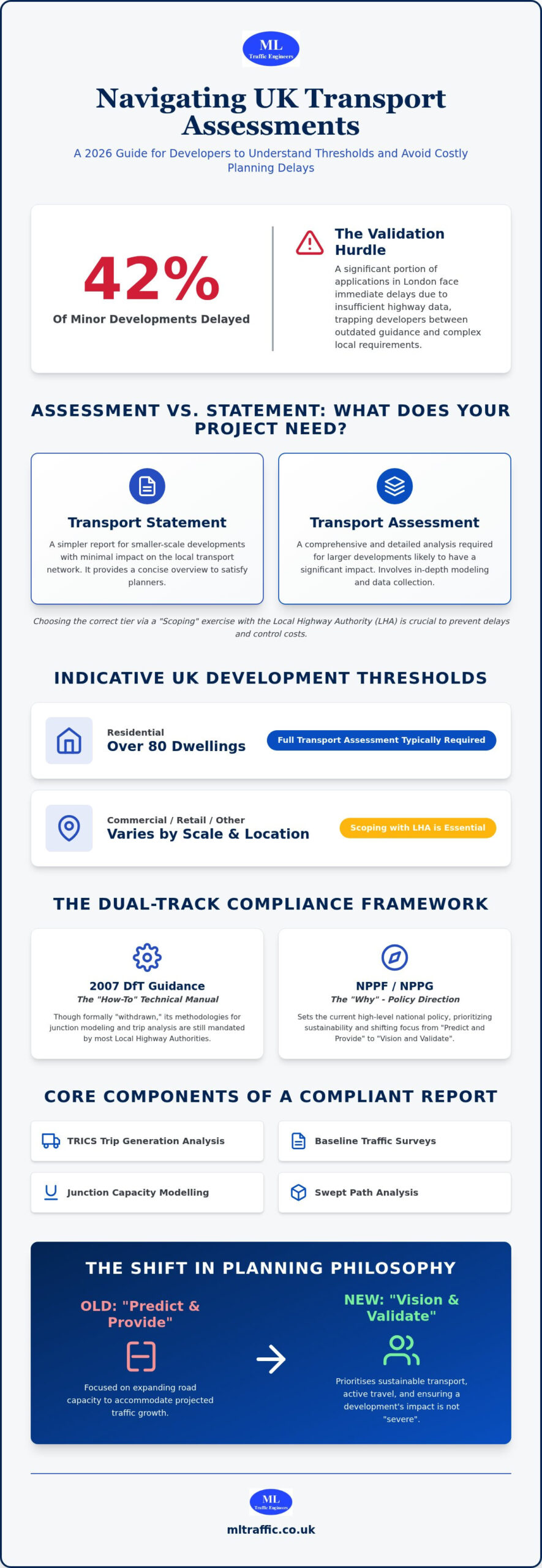
    Did you know that 42% of minor development applications across London boroughs face immediate delays at the validation stage because of insufficient highway data? It’s a frustrating reality for developers who find themselves caught between the “withdrawn” 2007 DfT guidance and the nuanced requirements of the current National Planning Practice Guidance. Understanding the specific transport assessment thresholds uk planners expect is no longer about following a static checklist; it’s about navigating a landscape where local authorities hold significant discretionary power.

    You likely recognize that a “one size fits all” approach leads to over-engineered reports that inflate project costs or, worse, insufficient data that stalls your application for months. This 2026 manual provides the clarity you need to move forward with confidence. We’ll break down the latest triggers for full assessments versus simpler statements, including the specific 80-unit residential threshold in London and the “vision-led” shift in the delayed NPPF. By the end of this guide, you’ll know how to secure a professional report that passes council scrutiny the first time while keeping your technical documentation proportionate to your project’s impact.

    Key Takeaways

    • Recognise why the 2007 DfT Guidance remains the essential technical framework for Local Highway Authorities despite its formal withdrawal.
    • Understand the specific transport assessment thresholds uk local authorities use to determine if your project requires a full Assessment or a simpler Statement.
    • Identify the mandatory components of a compliant report, including TRICS trip generation analysis and baseline traffic surveys.
    • Leverage technical data such as Swept Path Analysis to justify your site design and meet statutory requirements efficiently.
    • Manage the project lifecycle from initial scoping to final negotiation to prevent validation delays and minimise technical reporting costs.

    What is the DfT Guidance on Transport Assessment in 2026?

    The Department for Transport (DfT) Guidance on Transport Assessment (GTA) remains the foundational technical framework for transport planning across the United Kingdom. Although the original 2007 document was formally “withdrawn” by the government, its technical methodologies are still mandated by the majority of Local Highway Authorities. This guidance provides the specific analytical tools required to determine if a project meets the transport assessment thresholds uk planners monitor for validation. Without this framework, there would be no consistent way to measure a development’s impact on highway safety and network capacity.

    To better understand how these technical assessments fit into the wider planning framework, watch this helpful video:

    In 2026, the industry has shifted away from the traditional “Predict and Provide” model toward “Vision and Validate” strategies. This approach prioritises sustainable transport outcomes and active travel infrastructure over simple road capacity expansion. The primary technical goal of any modern report is to demonstrate that a development’s residual cumulative impact is not “severe.” Under current planning law, “severe” is the specific legal benchmark that determines whether a highway authority will object to your application. ML Traffic Engineers UK uses these DfT principles to ensure that every technical submission is robust enough to withstand legal and planning scrutiny.

    The Evolution from 2007 DfT Standards to NPPF

    The National Planning Policy Framework (NPPF) and National Planning Practice Guidance (NPPG) have streamlined reporting requirements, but they lack the granular engineering detail found in the 2007 GTA. This is why professional consultants still rely on the older guidance for junction modelling and trip distribution. While the NPPG sets the policy direction, the GTA provides the technical “how-to” that keeps the road network functional. This dual-track approach ensures that your project complies with both high-level sustainability goals and ground-level safety requirements, providing a reassuring path to approval.

    Why Thresholds Matter for Your Planning Application

    Identifying the correct reporting tier is essential for avoiding unnecessary technical work and inflated consultancy fees. If you incorrectly identify the level of reporting required, you risk receiving a “Regulation 25” request for further information. These formal demands for data can stall a project for weeks or months while additional surveys are gathered. ML Traffic Engineers UK identifies the correct transport assessment thresholds uk planners expect during the pre-application phase. This ensures your submission aligns with local borough or county-wide policies from the start, preventing the validation delays that frequently derail development timelines.

    Indicative Transport Assessment Thresholds for UK Developments

    Determining the correct transport assessment thresholds uk local authorities apply is the most critical step in your pre-application strategy. While national guidelines exist, these figures are indicative rather than absolute. The actual requirement often hinges on a “Scoping” exercise where we negotiate the scale of reporting with the Local Highway Authority (LHA). This prevents you from paying for a full Assessment when a leaner Statement would suffice. Our team uses the Department for Transport’s Transport Analysis Guidance (TAG) to align technical methodologies with council expectations from day one.

    Thresholds are generally based on the land-use class and the physical scale of your proposed development. Residential schemes usually require a full Transport Assessment once they exceed 80 dwellings. However, in sensitive areas or congested urban centres, this threshold can drop significantly. For instance, our London Transport Assessment guide highlights that some boroughs require full reporting for as few as 30 to 40 units if the site sits within an Air Quality Focus Area. Commercial and retail projects generally face triggers between 1,000sqm and 2,500sqm of gross floor area.

    Common Triggers for Transport Statements vs. Assessments

    A Transport Statement is typically sufficient for smaller sites, such as residential developments between 30 and 50 dwellings. These reports focus on localised impacts and immediate site access. A full Assessment becomes mandatory for larger schemes or any project impacting the strategic road network. You should be aware that a council might “upgrade” a Statement to a full Assessment in high-congestion zones. This usually happens if the development is expected to generate between 30 and 50 vehicle movements during peak hours, regardless of the unit count. If you’re unsure which tier applies to your site, our transport planning services can provide an initial scoping opinion.

    Land-Use Specific Threshold Examples

    The type of activity on-site dictates the level of scrutiny. Retail developments (A1/A3) have varying triggers; a food retail outlet often requires a full Assessment at a lower floor area than a non-food warehouse because of higher trip frequencies. For office spaces (B1), square footage isn’t the only metric. Planners look closely at employee density and the resulting pressure on local public transport hubs. Industrial sites (B2/B8) focus heavily on HGV movements. In these cases, the LHA prioritises swept path requirements and delivery scheduling over simple car trip counts to ensure the local network remains safe and functional.

    Core Components of a DfT-Compliant Transport Report

    A DfT-compliant report must be precise to withstand the scrutiny of Local Highway Authority officers. Every successful submission begins with a detailed baseline of existing site conditions. We examine the current transport network, identifying existing bottlenecks and safety records within the immediate vicinity. This evidence base is essential for determining how your project fits within the established transport assessment thresholds uk planners use to judge impact. We follow the Planning Practice Guidance for Transport Assessments to ensure every technical chapter aligns with national standards.

    Trip generation analysis is the technical heart of the report. Using the latest TRICS database standards for 2026, we calculate the expected volume of vehicle, pedestrian, and cycle movements. This isn’t just about cars; we must demonstrate a holistic understanding of how people will access your site. We audit sustainable travel options, assessing the quality of walking and cycling routes and calculating Public Transport Accessibility Level (PTAL) scores. If our analysis identifies potential network stress, we develop a robust mitigation strategy. This ensures your planning application remains viable by addressing negative impacts before they become grounds for refusal.

    The Critical Role of the Scoping Note

    We never start a full report without first securing a Scoping Note. This allows us to negotiate the study area with the Highway Authority, ensuring we only model the junctions that truly matter. We agree on the appropriate software for the task, whether that’s ARCADY for roundabouts, PICADY for priority junctions, or LinSig for traffic signals. The Scoping Note serves as the formal technical agreement that prevents redundant work and ensures the council accepts our methodology from the outset.

    Trip Generation and Modal Split

    TRICS data allows us to predict trip volumes based on real-world surveys from similar developments. We refine these “standard” rates by applying local factors, such as high PTAL ratings in urban centres. This process, known as modal split analysis, determines the percentage of users arriving by each transport mode. Travel Plan consultants are often brought in at this stage to introduce measures that actively reduce car dependency. By shifting trips toward walking or cycling, we can often lower the predicted traffic impact enough to meet local policy requirements.

    Guidance on Transport Assessment Thresholds UK: 2026 Developer’s Manual

    Technical Methodologies: Moving Beyond the Guidance

    Technical precision is the only way to prove a site functions safely once you’ve identified the relevant transport assessment thresholds uk local authorities require. Meeting these benchmarks involves more than just interpreting policy; it requires empirical data that demonstrates your design is viable. We follow a logical, sequential process to build this evidence base. Our methodology ensures that even if your development sits just below major transport assessment thresholds uk, the technical data remains robust enough to withstand planning committee scrutiny. This process moves from initial baseline surveys to advanced digital simulations and junction capacity modelling.

    Swept Path Analysis: Proving Design Feasibility

    A critical component of any modern submission is proving that essential vehicles can navigate your site without conflict. We use Swept Path Analysis to ensure refuse trucks, fire tenders, and delivery vehicles can enter, turn, and exit safely. Swept Path Analysis is a digital simulation of vehicle movement used to prevent costly physical redesigns by identifying potential collisions with kerbs or buildings before construction begins. This technical rigor is especially important for multi-use developments where HGV movements must coexist with pedestrian zones. By providing this data early, we reduce the regulatory pressure on your team and ensure the Local Highway Authority (LHA) remains satisfied with your site layout.

    Traffic and Parking Surveys

    Accurate data collection is the foundation of a successful report. We determine whether your site requires Manual Classified Counts (MCC) to identify specific vehicle types and pedestrian movements, or Automated Traffic Counts (ATC) for 7-day volume and speed data. This choice depends on the specific concerns of the LHA regarding local network stress. In sustainable urban locations, we use this data to justify lower parking provision, aligning with modern “car-free” planning mandates. For residential projects, we strictly adhere to the “Lambeth” or “Bentley” methodologies for parking surveys. These industry benchmarks ensure that our findings on overnight parking stress are accepted as a reliable basis for decision-making.

    Secure your project’s future and avoid validation delays by requesting a professional traffic survey or swept path analysis from our expert team today.

    ML Traffic Engineers UK provides the technical rigor needed to satisfy DfT standards in 2026. We manage the entire project lifecycle from the first scoping note to the final LHA negotiation. Our reports are decision-ready. This proactive approach minimizes technical queries that often stall developers at the validation stage. We understand that a rejected statement can stall a project for up to 16 weeks. We balance technical compliance with a commercial understanding of project viability. Our team ensures your documentation is proportionate to the development’s impact, reducing unnecessary technical overhead while maintaining safety standards.

    Expert Reporting for UK Developers

    We specialize in the preparation of Transport Statements and Assessments for all development scales. Since our founding in 2014, we’ve built deep expertise in UK planning law and regional highway requirements. We ensure your project adheres to the latest 2026 industry benchmarks and safety standards. Navigating the transport assessment thresholds uk planners use requires a tailored approach rather than a generic template. We use technical data, such as Swept Path Analysis, to justify lower-tier reporting where appropriate. This saves you from unnecessary consultancy fees while maintaining full regulatory compliance. View our Transport Statement buying guide for smaller sites to see how we streamline the process for minor developments.

    Get Started on Your Transport Assessment

    Contact our team for a preliminary review of your site’s specific transport triggers. We identify the exact transport assessment thresholds uk authorities will apply to your specific land-use class. Our integrated survey services provide the data foundations your application needs to succeed. We handle everything from TRICS data collection to complex junction modelling and Travel Plan coordination. This comprehensive support means you don’t have to manage multiple technical vendors or worry about conflicting data. We act as your dependable expert partner, ensuring every report passes council scrutiny the first time. Contact ML Traffic Engineers UK today for expert guidance on your transport assessment and secure your project’s timeline with reliable data.

    Securing Your Project Timeline with Technical Precision

    Successfully navigating the transport assessment thresholds uk local authorities demand is about balancing technical evidence with strategic negotiation. You now understand that a “vision-led” approach, supported by accurate TRICS modelling and Swept Path Analysis, is essential for bypassing validation delays and minimising technical reporting costs. These rigorous methodologies ensure your site design is safe, functional, and compliant with both national and local policy frameworks.

    Since 2014, ML Traffic Engineers UK has acted as a vital partner for developers across England. We provide the technical authority needed to satisfy statutory requirements while maintaining a clear focus on your project’s commercial viability. By managing the full project lifecycle from initial scoping to final negotiation, we reduce the regulatory pressure on your team and ensure every report is decision-ready for the planning committee.

    Secure your planning approval with a DfT-compliant Transport Assessment from ML Traffic Engineers UK.

    With the right technical foundations in place, you can move forward with confidence that your development meets every safety and sustainability benchmark required for a successful outcome.

    Frequently Asked Questions

    Is the 2007 DfT Guidance on Transport Assessment still valid in 2026?

    The 2007 DfT Guidance is formally withdrawn, but its technical methodologies remain the industry standard for most Local Highway Authorities in 2026. Planners still expect reports to follow its rigorous structure for junction modelling and trip distribution. It provides the mathematical foundation that modern NPPF policies lack, ensuring technical consistency across different UK regions and providing a reliable framework for developers.

    What is the specific threshold for a Transport Assessment for a residential site?

    Residential developments typically require a full Assessment once they exceed 80 units, though this varies significantly by borough. In sensitive urban areas or Air Quality Focus Areas, the transport assessment thresholds uk planners apply can drop to as few as 30 to 40 dwellings. You should always consult the local highway authority’s specific policy during the pre-application phase to confirm the required reporting tier.

    Can a Transport Statement be rejected if the development is below the threshold?

    Yes, a council can reject a Transport Statement or demand an “upgrade” to a full Assessment if the site’s impact is deemed significant. This often occurs if a development generates more than 30 vehicle movements during peak hours or sits near a congested junction. Insufficient highway data is a leading cause of validation delays, even for projects that fall below indicative national thresholds.

    How long does it take to prepare a DfT-compliant Transport Assessment?

    Preparation usually takes between four and eight weeks, depending on the complexity of the required traffic surveys. This timeline includes the initial scoping period with the local authority, data collection, and technical modelling. Factoring in the time needed for Manual Classified Counts or 7-day Automated Traffic Counts is essential for maintaining your project’s overall delivery schedule and avoiding last-minute delays.

    Do I need a Travel Plan if my development requires a Transport Assessment?

    Most developments that trigger a full Transport Assessment also require a Travel Plan to promote sustainable transport. This document outlines specific measures to reduce car dependency, such as cycle parking or public transport incentives. Integrating these reports ensures your application meets the sustainability criteria set out in the National Planning Policy Framework and aligns with local borough environmental goals.

    What happens if the assessment shows a ‘severe’ impact on the local road network?

    If an assessment identifies a “severe” impact, you must propose a robust mitigation strategy to resolve the issue. This might involve junction improvements, site access redesigns, or financial contributions toward local infrastructure. Failure to mitigate a severe residual cumulative impact is a primary ground for refusal under current UK planning laws, making technical precision and early mitigation planning vital for success.

    What is the TRICS database and why is it required for transport reporting?

    TRICS is the national standard system for trip generation analysis, providing data from thousands of established sites across the UK. It allows engineers to predict how many vehicle, pedestrian, and cycle trips a new development will generate based on similar existing land uses. Using the latest 2026 TRICS version is a non-negotiable requirement for any report to be accepted by a Local Highway Authority.

    How much does a professional Transport Assessment cost for a UK developer?

    The cost of a professional report depends on the scale of the development and the complexity of the required technical surveys. A full Assessment for a major scheme involves higher technical overhead than a simple Statement due to the extensive junction modelling and data collection involved. We recommend requesting a site-specific quote to ensure your technical documentation is correctly sized for the transport assessment thresholds uk councils enforce.

    Michael Lee

    Article by

    Michael Lee

    Transport planner with over 35 years' experience.

    Disclaimer

    The content on mltraffic.co.uk, including all technical articles, guides, and resources, is provided for general informational and educational purposes only. It is not intended to constitute professional advice in traffic engineering, transportation planning, development approvals, or any other technical or legal field.
    While ML Traffic Engineers makes every reasonable effort to ensure the accuracy, completeness, and timeliness of the information published, we do not provide any warranties or representations (express or implied) regarding its reliability, suitability, or availability for any particular purpose. Any reliance you place on the content is strictly at your own risk.
    In no event shall ML Traffic Engineers, its directors, employees, authors, or affiliates be liable for any direct, indirect, incidental, special, consequential, or punitive damages (including, without limitation, loss of profits, data, or business opportunities) arising out of or in connection with the use of, or inability to use, any information provided on this website.
    The articles and guides on this site are not a substitute for engaging a qualified, professional traffic engineer to assess your specific project requirements. For tailored advice, compliance assessments, or traffic engineering services, please contact a competent professional.
    This disclaimer may be updated from time to time without notice. By accessing or using this website, you agree to be bound by the most current version of this disclaimer.

  • DfT Transport Assessment Guidance: Key Aspects

    DfT Transport Assessment Guidance: Key Aspects

    Relying on the withdrawn 2007 standards is one of the fastest ways to guarantee a planning refusal in 2026. It’s understandable if you feel overwhelmed by the transition to the current Planning Practice Guidance and local authority expectations. Mastering the official Guidance on Transport Assessment published by the Department for Transport is essential for any developer who needs to meet the National Planning Policy Framework standards updated on February 7, 2025. Technical precision during the pre-application phase prevents expensive logistical bottlenecks and regulatory delays during the decision-taking process.

    This article simplifies the complexities of transport documentation so you can move forward with confidence. You’ll learn how to distinguish between a “lighter-touch” Transport Statement and a full Transport Assessment based on indicative local authority thresholds. We provide a definitive checklist of required content, helping you manage the project lifecycle from initial data collection to final planning approval. By the end, you’ll know exactly how to secure professional reports that satisfy statutory requirements and protect your project’s timeline from unnecessary scrutiny.

    Key Takeaways

    • Navigate the transition from the 2007 guidance to current 2025 NPPF standards to ensure your development remains compliant with the latest regulatory framework.
    • Determine if your project needs a comprehensive technical report or a simplified submission by following the official Guidance on Transport Assessment published by the Department for Transport.
    • Master the core requirements for auditing existing transport networks, including site access, parking provision, and internal site layouts.
    • Learn how to identify and mitigate “severe” transport impacts through strategic Travel Plans and physical network improvements.
    • Build a data-driven strategy that aligns with 2026 Net Zero targets to achieve faster planning approval from local highway authorities.

    The Evolution of DfT Guidance on Transport Assessments

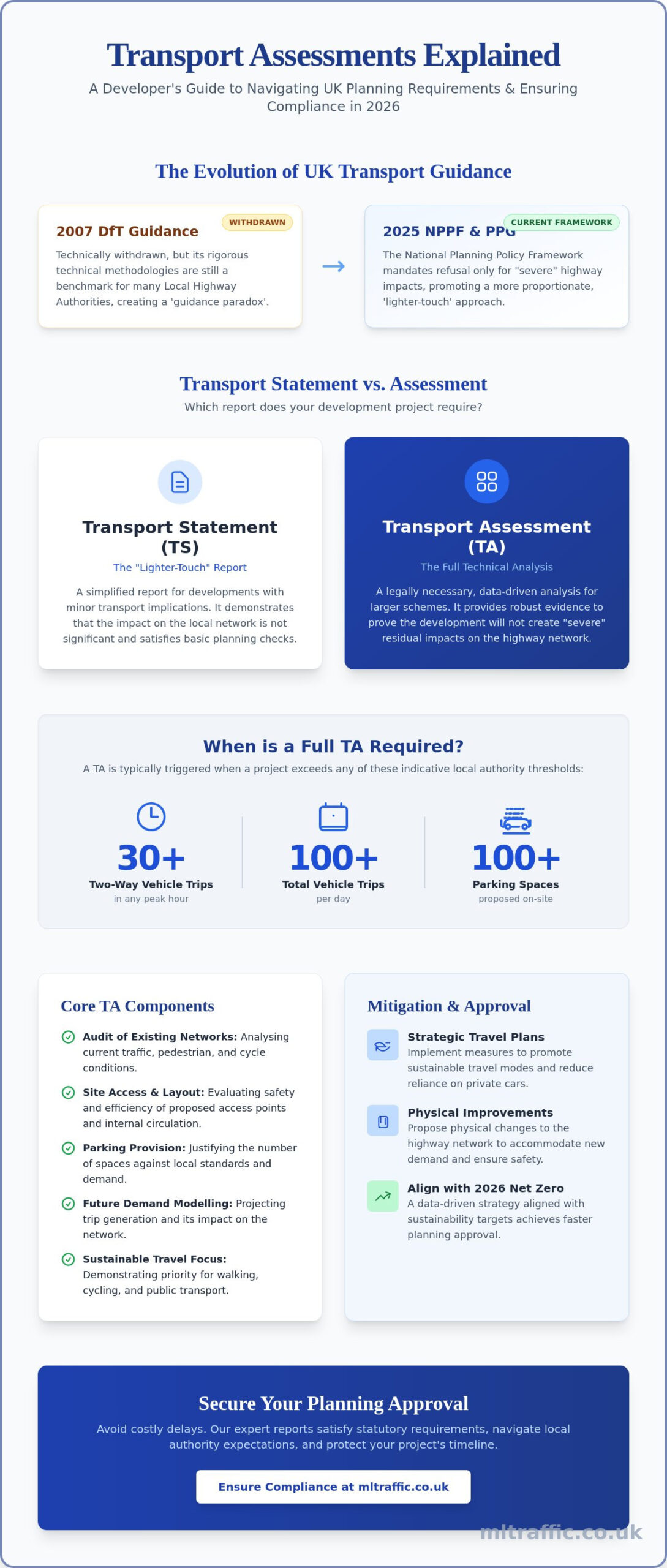
    A Transport Assessment (TA) serves as the primary technical mechanism for evaluating the impact of a proposed development on the highway network. It isn’t just a paperwork exercise; it’s a rigorous, data-driven report required by local planning authorities to ensure public safety and network efficiency. Central to this process is the Guidance on Transport Assessment published by the Department for Transport, which provides the framework for identifying how a project affects local infrastructure and the wider community.

    The regulatory environment shifted significantly in 2014 when the Department for Transport technically withdrew the comprehensive 2007 guidance, moving toward the Planning Practice Guidance (PPG). This transition aimed to make the transportation planning process more proportionate. However, the National Planning Policy Framework (NPPF), last updated on February 7, 2025, remains the ultimate authority. It mandates that development should only be prevented on highway grounds if there’s an unacceptable impact on highway safety or if the residual cumulative impacts on the road network would be severe.

    To better understand this concept, watch this helpful video:

    Understanding the Guidance Paradox

    The industry currently operates under a paradox. While the official 2007 Guidance on Transport Assessment published by the Department for Transport was archived, its technical methodologies remain the gold standard for traffic modelling and data analysis. Local highway authorities frequently expect the depth of detail found in the legacy document, even though current PPG suggests a “lighter touch.” ML Traffic Engineers bridges this gap by applying modern PPG principles while maintaining the technical rigour demanded by local officers. We navigate these conflicting expectations to ensure your Transport Assessments meet both statutory requirements and local preferences without unnecessary delays.

    The Purpose of the Assessment for Developers

    For a developer, the assessment is a strategic tool rather than a hurdle. It identifies potential capacity issues before they become grounds for refusal. A compliant report demonstrates a clear priority for sustainable travel modes, such as walking and cycling, over private car use. This alignment with government policy is crucial for securing approval. By auditing existing conditions and projecting future demand, we help clients mitigate safety risks early in the design phase. This proactive approach reduces the likelihood of expensive post-submission redesigns or the rejection of planning applications due to insufficient transport data.

    Transport Statements vs. Assessments: Determining Your Requirements

    A Transport Statement (TS) is a simplified report designed for developments with limited transport implications. In contrast, a full Transport Assessment (TA) is a legal necessity for larger schemes to prove that the development won’t create “severe” residual impacts on the highway. The Current Government Guidance on Transport Assessments clarifies that the level of detail in these documents must always be proportionate to the scale and complexity of the project. Understanding which path to take is the first step in ensuring your planning application isn’t stalled by technical objections.

    Adhering to the Guidance on Transport Assessment published by the Department for Transport is vital when negotiating with Local Highway Authorities (LHAs). While the LHA makes the final determination on a case-by-case basis, certain indicative thresholds usually trigger a full assessment. These typically include developments generating 30 or more two-way vehicle movements in any peak hour, projects generating 100 or more movements per day, or any site proposing 100 or more parking spaces. If your project falls below these levels, a Transport Statement is often sufficient to satisfy the planning officer.

    Threshold Analysis for 2026 Developments

    Gross Floor Area (GFA) often serves as the initial trigger for residential, retail, and industrial sites. However, modern planning focuses heavily on cumulative impact. Even if your site falls below standard thresholds, an assessment might be required if the local junction is already operating near capacity. For example, a small residential development in a congested urban centre may require a full TA where a similar site in a rural area would only need a Statement. It’s about the sensitivity of the local network, not just the physical size of your building.

    The Scoping Process: Avoiding Unnecessary Work

    Early engagement through a formal scoping exercise prevents wasted resources on irrelevant data collection. During this stage, you must agree on the “Study Area” with the highway authority to determine exactly which junctions require modelling. You’ll also define “Assessment Years,” typically comparing the opening year against a 5 or 10-year post-completion horizon to account for long-term traffic growth. Getting these details right from the start is essential for a smooth planning journey.

    You can learn more about our Transport Planning and Assessment Reports to see how we handle these technical negotiations. Our team ensures that the scope of work is strictly limited to what’s necessary for compliance, saving you both time and professional fees. If you’re currently preparing a planning submission, securing an early agreement on the scope is the most reliable way to prevent expensive revisions later in the process.

    DfT Transport Assessment Guidance: Key Aspects

    Core Components of a Compliant Transport Assessment

    A robust planning submission relies on a logical sequence of evidence. The Guidance on Transport Assessment published by the Department for Transport mandates a clear audit of the existing transport network before any modelling begins. This involves evaluating current safety records, public transport accessibility, and infrastructure capacity within the study area agreed upon during the scoping phase. Without a precise baseline, the local highway authority cannot accurately measure the impact of your proposed development.

    Predicting future traffic flows requires the use of the TRICS database. This industry-standard tool allows us to calculate trip generation based on data from comparable sites across the country. We don’t just guess numbers; we use verified data to model how many vehicle, pedestrian, and cycle movements your site will produce. This analysis forms the foundation of junction capacity tests. We examine the Ratio of Flow to Capacity (RFC) to ensure no local junction becomes overloaded, keeping your project in line with NPPF safety standards.

    Detailing the internal layout involves more than just drawing parking bays. We must demonstrate that site access is positioned to maintain visibility splays and that pedestrian routes don’t conflict with heavy vehicle movements. Precision during this stage reduces the risk of the local highway authority requesting expensive redesigns after you’ve already submitted your application. It’s about proving that the site is functional from day one.

    Technical Data and Traffic Surveys

    Accurate Parking Surveys are essential when justifying reduced car provision in urban areas. These surveys prove that existing street capacity can handle any potential overspill, preventing objections based on local congestion. We also conduct comprehensive Traffic Surveys to establish real-time baseline flows. High-quality data prevents local councils or residents from challenging the validity of your technical report during the public consultation phase.

    Swept Path Analysis: Proving Site Feasibility

    Adhering to the Guidance on Transport Assessment published by the Department for Transport ensures that your swept path analysis meets the rigorous safety standards expected by statutory consultees. Our Essential Guide to Swept Path Analysis explains how digital modelling verifies vehicle manoeuvrability. We use specific templates for fire tenders and refuse vehicles to secure technical approval from highway officers. If a large vehicle can’t safely enter and exit your site in a forward gear, the layout will likely face a swift planning refusal.

    Mitigation Strategies and Travel Planning

    If your technical analysis identifies capacity or safety issues, you must propose robust mitigation strategies. The National Planning Policy Framework (NPPF) specifies that planning permission should only be refused on highways grounds if the residual cumulative impacts on the road network are severe. The Guidance on Transport Assessment published by the Department for Transport provides the technical foundation for determining which mitigation measures are proportionate to the scale of your development. Our role is to ensure these measures are technically feasible and cost-effective before they’re formalised in legal agreements.

    Mitigation often involves a combination of physical infrastructure and management strategies. Physical works, such as junction improvements or the installation of new pedestrian crossings, are typically secured through Section 278 agreements. Financial contributions toward wider network improvements or public transport enhancements fall under Section 106 obligations. Negotiating these agreements requires a high level of technical precision. We provide the data necessary to ensure that the scope of these works remains directly related to the impact of your site, preventing unnecessary financial overreach.

    Sustainable Mitigation Measures

    Modern planning policy prioritises active travel over traditional road widening. We design mitigation packages that focus on improving walking and cycling routes to reduce the need for car-based trips. This includes integrating electric vehicle (EV) charging infrastructure and high-quality cycle storage into the initial site design. For a deeper dive into the technical requirements for infrastructure delivery, see our guide on Navigating Highway Design S278 & S38. These sustainable measures often carry more weight with planning officers than simply adding road capacity.

    Effective Travel Plans for Planning Success

    A Travel Plan is a long-term management strategy that accompanies your assessment to promote sustainable transport. It must include SMART targets for modal shift, such as reducing single-occupancy vehicle trips by a specific percentage over five years. Local authorities now demand clear monitoring and enforcement mechanisms to ensure these targets are met. You can find more detail in our London Travel Plans: The Essential Guide. A well-structured plan acts as a safeguard, providing the council with the confidence that the development’s impact will be managed effectively throughout its lifecycle.

    Our team specializes in delivering compliant documentation that bridges the gap between technical assessment and practical mitigation. If you’re facing potential objections due to traffic impact, contact us for expert Transport Assessment and Travel Plan services to secure your planning approval.

    Securing Planning Approval with ML Traffic Engineers

    Success in modern planning requires more than just submitting a technical report. It demands a data-driven strategy that anticipates the scrutiny of local highway officers. By following the Guidance on Transport Assessment published by the Department for Transport, we provide the technical evidence needed to overcome objections before they stall your project. Our approach focuses on precision. We eliminate the guesswork that often leads to planning delays or expensive requests for further information. We ensure every data point stands up to rigorous cross-examination by statutory consultees during the public consultation phase.

    The 2026 planning landscape has evolved significantly. Net Zero and Vision Zero targets are no longer optional considerations; they’re central to how assessments are judged by local authorities. Planners now prioritize developments that actively contribute to decarbonization and absolute road safety. We integrate these mandates into every report, proving through rigorous analysis that your project aligns with the latest government standards. This proactive alignment reduces the logistical and regulatory pressures on your team, allowing you to focus on the broader aspects of your development while we handle the technical complexities.

    The ML Traffic Advantage: Accuracy and Speed

    We manage the full project lifecycle. From the initial scoping meeting with the Local Highway Authority (LHA) to final technical approval, our team provides constant support and unwavering reliability. This “inception to completion” philosophy ensures that the transport strategy remains consistent even as the site design evolves. We understand the specific nuances of London-specific policies and regional England requirements. Our experts act as a reliable partner, managing intricate regional regulations so you don’t have to. You can explore our project types and expertise to see how we’ve secured approvals across diverse residential and commercial sectors.

    Ensuring Regulatory Compliance in 2026

    Adhering to the latest “Decarbonising Transport” mandates is a non-negotiable foundation of our work. We use the Guidance on Transport Assessment published by the Department for Transport to frame our safety and capacity arguments. Our technical authority reduces your project risk by providing a shield against regulatory pressure. We don’t just provide a document; we act as your professional representative in high-stakes negotiations with highway officers. Our focus on providing an all-encompassing, fully-managed service ensures that your transport documentation is resilient, compliant, and ready for immediate action.

    Get a Transport Assessment Quote for your project today to ensure your submission meets every statutory requirement and accelerates your timeline to planning approval.

    Streamline Your Planning Journey with Expert Transport Documentation

    Navigating the modern planning landscape requires a technical partner who understands the nuances of regulatory change. You’ve seen how the shift from legacy standards to the current NPPF requires a precise application of the Guidance on Transport Assessment published by the Department for Transport. Identifying the correct thresholds for your development and implementing robust mitigation strategies are the primary ways to avoid costly planning delays and technical objections.

    Since 2014, ML Traffic Engineers has delivered over a decade of planning success for developers across England and London. We specialize in high-precision Swept Path Analysis and TRICS modelling to ensure every report meets the strictest highway authority standards. Our deep understanding of regional transport policy allows us to reduce your project risk and accelerate approval timelines. Contact ML Traffic Engineers for a DfT-compliant Transport Assessment to secure your project’s future. We’re ready to help you turn complex technical requirements into a successful planning outcome.

    Frequently Asked Questions

    Is the 2007 Guidance on Transport Assessment still valid in 2026?

    Technically, the 2007 document was withdrawn and replaced by Planning Practice Guidance (PPG) in 2014. However, local highway authorities still rely on its detailed technical frameworks for traffic modelling and data presentation. Most professionals treat the 2007 methodologies as the industry standard for high-stakes technical reports today.

    What is the difference between a Transport Assessment and a Transport Statement?

    A Transport Statement is a simplified report for developments with minor transport impacts, while a Transport Assessment is a comprehensive technical study for larger projects. Statements focus primarily on local site access and safety. Assessments require deeper analysis of junction capacity and wider network impacts over a 5 to 10-year horizon.

    How do I know if my development requires a Transport Assessment?

    The requirement depends on the scale of your project and specific local planning authority thresholds. Typically, any development generating over 30 two-way vehicle movements in a peak hour requires a full report. You should refer to the Guidance on Transport Assessment published by the Department for Transport to determine if your specific land use triggers this necessity.

    What is the “Study Area” in a Transport Assessment?

    The Study Area is the specific geographic region where the development’s traffic impact is measured. This usually includes the site access points and any local junctions that might experience a significant increase in traffic. You must agree on this area with the Local Highway Authority during the initial scoping stage to avoid wasted modelling effort.

    Can a Transport Assessment be used to justify zero parking on a site?

    Yes, an assessment can justify low or zero parking by proving high public transport accessibility and utilizing detailed parking surveys. We use data to show that any potential overspill won’t negatively affect local road safety or capacity. This evidence is crucial for developments in dense urban centers where car-free living is prioritized.

    How long does it take to prepare a DfT-compliant Transport Assessment?

    Preparation time varies based on the complexity of the site and the need for fresh traffic surveys. A standard report often takes several weeks to complete, accounting for data collection, modelling, and authority scoping. Engaging an expert early ensures that the technical analysis stays on track with your planning submission deadlines.

    What happens if my Transport Assessment shows a negative impact on traffic?

    If the assessment identifies a negative impact, you must propose mitigation measures to reduce the effect to an acceptable level. Under the NPPF, planning refusal only occurs if the residual cumulative impacts are severe. Mitigation might include physical junction improvements or enhanced sustainable travel options secured through Section 106 or Section 278 agreements.

    Do I need a separate Travel Plan if I have a Transport Assessment?

    Larger developments usually require a Travel Plan alongside the main assessment. While the assessment identifies the technical impact, the Travel Plan serves as a long-term management strategy to encourage sustainable transport modes. The Guidance on Transport Assessment published by the Department for Transport suggests integrating these documents to provide a complete picture of site accessibility.

    Michael Lee

    Article by

    Michael Lee

    Transport planner with over 35 years’ experience.

    Disclaimer

    The content on mltraffic.co.uk, including all technical articles, guides, and resources, is provided for general informational and educational purposes only. It is not intended to constitute professional advice in traffic engineering, transportation planning, development approvals, or any other technical or legal field.
    While ML Traffic Engineers makes every reasonable effort to ensure the accuracy, completeness, and timeliness of the information published, we do not provide any warranties or representations (express or implied) regarding its reliability, suitability, or availability for any particular purpose. Any reliance you place on the content is strictly at your own risk.
    In no event shall ML Traffic Engineers, its directors, employees, authors, or affiliates be liable for any direct, indirect, incidental, special, consequential, or punitive damages (including, without limitation, loss of profits, data, or business opportunities) arising out of or in connection with the use of, or inability to use, any information provided on this website.
    The articles and guides on this site are not a substitute for engaging a qualified, professional traffic engineer to assess your specific project requirements. For tailored advice, compliance assessments, or traffic engineering services, please contact a competent professional.
    This disclaimer may be updated from time to time without notice. By accessing or using this website, you agree to be bound by the most current version of this disclaimer.