
Tag: DSP

  • Transport Planning Consultants Sutton: The 2026 Guide to Delivery and Servicing Plans

    Transport Planning Consultants Sutton: The 2026 Guide to Delivery and Servicing Plans

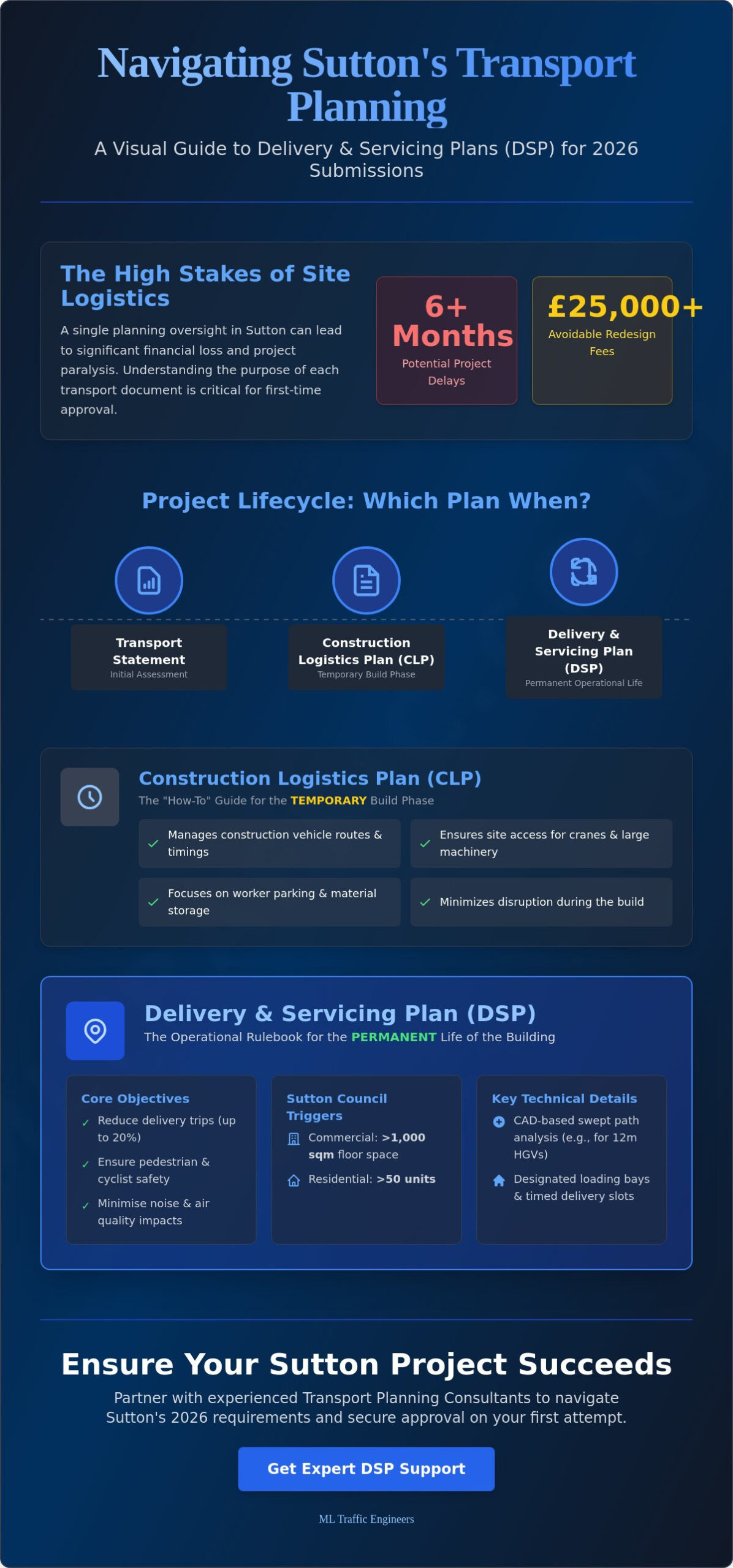
    A single overlooked delivery bay dimension can stall a multi-million pound development in the London Borough of Sutton for six months or more. You understand that the margin for error in 2026 planning submissions is zero. Local authorities now demand granular operational data before they’ll even consider a major application. As experienced Transport Planning Consultants Sutton, we’ve seen developers lose over £25,000 in avoidable redesign fees because their initial site layouts didn’t account for the precise turning circles of a standard 12-metre heavy goods vehicle.

    It’s frustrating when technicalities delay your progress, but you recognize that a robust Delivery and Servicing Plan (DSP) is the backbone of a safe, functional site. This guide provides the technical roadmap you need to master Sutton’s specific transport requirements and secure approval on your first attempt. We’ll examine the critical components of a modern DSP, including CAD-based swept path analysis and the 2026 carbon-reduction targets mandated by the latest London Plan updates. Our goal is to ensure your project moves from the initial consultation to final implementation without a single regulatory hitch.

    Key Takeaways

    • Understand why the London Borough of Sutton mandates Delivery and Servicing Plans (DSPs) and how they ensure the long-term operational success of your development.
    • Distinguish between Construction Logistics Plans (CLPs) and DSPs to ensure your planning application addresses both temporary impacts and permanent site transport needs.
    • Partner with Transport Planning Consultants Sutton to access the technical data and local insights required to justify delivery schedules and satisfy Council planning officers.
    • Learn why a comprehensive DSP is the essential “how-to” guide for your site’s logistics, moving beyond the broad scope of a standard Transport Statement.
    • Gain a competitive edge in 2026 by leveraging 24/7 expert support and proven strategies that align with the latest UK road regulations and safety standards.

    What is a Delivery and Servicing Plan (DSP) in Sutton?

    A Delivery and Servicing Plan (DSP) is a technical operational document required by the London Borough of Sutton to manage how goods and services reach a specific site. It’s not a static report but a living framework that outlines how a developer or business owner will handle freight movements throughout the building’s lifecycle. As expert Transport Planning Consultants Sutton, we see these documents as essential tools for maintaining the safety and efficiency of the local highway network. The document provides a structured approach to transportation planning, ensuring that heavy goods vehicles (HGVs) and vans don’t cause gridlock or safety hazards on Sutton’s residential streets.

    Sutton Council mandates these plans to alleviate the heavy pressure freight puts on borough infrastructure. Recent data indicates that freight accounts for roughly 15% of total vehicle miles in London, and without a DSP, large-scale residential or commercial sites risk creating significant bottlenecks. A DSP differs from a standard traffic survey because it doesn’t just measure current flow. Instead, it provides actionable strategies like designated loading bays, timed delivery slots, and freight consolidation. It moves beyond general transport advice by offering a comprehensive support package that planning officers use to hold developers accountable for their impact on the community.

    The Core Objectives of a Sutton DSP

    The primary goal of a DSP in Sutton is to streamline business operations while protecting the public and the environment. These plans focus on three critical areas:

    • Reducing delivery trips: We look for ways to consolidate orders, which reduces the total number of vans entering Sutton town centre sites by up to 20% in some managed schemes.
    • Ensuring safety: It’s vital to protect pedestrians and cyclists, especially in Sutton PTAL areas where foot traffic is high. This includes mapping safe routes that avoid narrow residential roads.
    • Minimising noise and air quality impacts: By restricting heavy vehicle movements during unsociable hours, we help developers meet strict environmental targets and reduce local complaints.

    When Sutton Planning Officers Require a DSP

    Sutton planning officers typically trigger the requirement for a DSP based on the scale of the proposed development. For commercial projects, this requirement usually starts at 1,000 square metres of new floor space. Residential applications involving 50 units or more almost always require a full plan to manage the influx of home deliveries. Early engagement with LB Sutton’s highways department is a critical step to ensure the project doesn’t stall during the consultation phase. Our role as Transport Planning Consultants Sutton is to bridge the gap between your commercial needs and the council’s strict regulatory demands. The DSP serves as a mandatory 2026 requirement for all major Sutton applications.

    DSP vs. CLP: Comparing Construction and Operational Phases

    Developers often mistake Construction Logistics Plans (CLPs) for Delivery and Servicing Plans (DSPs). This confusion leads to planning delays and operational failures. While both documents manage traffic, they operate on different timelines. A CLP covers the temporary impact of the build. A DSP manages the permanent life of the building. Expert Transport Planning Consultants Sutton bridge this gap by creating a seamless transition between the two phases. They ensure that the site access designed for a crane in 2025 still works for a refuse truck in 2030.

    The Sutton Town Centre Delivery and Servicing Study demonstrates that efficient freight movement requires planning that starts before the first brick is laid. When these reports work together, they provide a total lifecycle transport solution. This integrated approach satisfies Sutton Council and ensures long-term viability. Approximately 65% of planning objections in London relate to traffic congestion; having both plans aligned reduces this risk significantly.

    Construction Logistics Plan (CLP) Focus

    The CLP prioritizes safety and site efficiency during the build. It handles heavy plant machinery, concrete pours, and skip deliveries. In Sutton, this often involves complex temporary traffic management and multi-way signals. We design CAD-based access routes to manage contractor vehicle movements and worker travel patterns. This ensures minimal disruption to local residents during the construction window. For more technical details on this phase, consult our Construction Logistics Plan Consultant: The London Developer’s Guide to 2026 Approvals.

    Delivery and Servicing Plan (DSP) Focus

    The DSP takes over once the building is operational. It focuses on the long-term requirements of couriers, waste collection, and retail stocking. Managing the “last mile” delivery challenge in Sutton’s residential zones is critical for 2026 standards. We design permanent loading bays and management strategies that prevent delivery vans from blocking arterial roads. Key focus areas include:

    • Last-mile logistics: Coordinating small-van deliveries to reduce local emissions.
    • Loading bay design: Ensuring swept path analysis accounts for 12m refuse vehicles.
    • Booking systems: Implementing digital schedules to prevent vehicle queuing on public highways.

    In addition to site management, fleet operators often enhance their operational security by investing in insurance approved vehicle tracker installation UK, ensuring that delivery vehicles are monitored and protected throughout their routes.

    Integrating these phases early prevents costly retrofitting. If a Transport Planning Consultants Sutton team identifies a conflict between construction hoardings and future loading zones early, it saves the developer thousands in late-stage design changes. If you’re planning a new development, explore our range of project expertise to see how we manage these complexities from start to finish.
    Transport Planning Consultants Sutton: The 2026 Guide to Delivery and Servicing Plans

    Technical Requirements for Sutton Transport Planning

    Securing planning approval in the London Borough of Sutton requires more than a generic template. As expert Transport Planning Consultants Sutton, we focus on the granular data sets local authorities demand for a 2026 submission. This includes detailed vehicle trip generation figures, anticipated dwell times for various vehicle classes, and the exact timing of peak deliveries. We utilize the Sutton DSP Scoping Study to align our strategies with the council’s environmental and congestion goals. Our engineers monitor real-time traffic flow on the A217 and A232 to ensure delivery schedules don’t conflict with local commuter peaks.

    Our team provides a total managed solution. We collect primary data through site observations and combine it with historical traffic patterns. This evidence-based approach allows us to justify specific delivery windows to council officers, reducing the risk of restrictive planning conditions that could hamper your daily operations. We prioritize safety and precision in every calculation.

    Swept Path Analysis for Sutton Delivery Vehicles

    ML Traffic Engineers use advanced CAD software to simulate vehicle movements through Sutton’s historical and often narrow junctions. We prove that 12m refuse vehicles or 16.5m articulated HGVs can navigate site entrances without mounting kerbs or damaging street furniture. This technical rigor is central to our Swept Path Analysis Services in London. By identifying tight turning radii early, we prevent the need for expensive structural redesigns of loading bays after the construction phase begins. Our simulations provide the visual proof required to satisfy safety auditors.

    Parking and Loading Surveys in Sutton

    Managing the friction between commercial deliveries and local resident parking permits is a primary challenge in the borough. We conduct 48-hour parking stress surveys using the Lambeth Methodology to assess on-street capacity. Our data shows that in high-density areas like Sutton Central, loading availability can drop by 80% during peak residential hours. We provide bespoke solutions to manage these conflicts. Our surveys include:

    • Beat Surveys: Tracking bay turnover every 15 minutes to identify peak usage.
    • Conflict Analysis: Mapping delivery vehicle paths against existing permit holder bays.
    • Capacity Modeling: Predicting how new developments will impact the existing 2026 parking infrastructure.

    We act as a safe pair of hands, ensuring your servicing strategy remains compliant with LB Sutton’s transport policies. Our 24/7 availability means we can conduct these surveys during the most critical timeframes, providing the most accurate data for your DSP submission.

    DSP vs. Transport Statements: Which One Do You Need?

    Developers often ask which document is necessary for a successful Sutton planning application. While they share common data points, they serve distinct functions. A Transport Statement provides the “what” of your site’s traffic impact. It defines the volume of people and vehicles. Conversely, a DSP provides the “how.” It explains the logistical mechanics of daily operations. Transport Planning Consultants Sutton must often prepare both to satisfy London Borough of Sutton requirements for major developments or high-density residential projects.

    For more complex projects, you might also need a deeper dive into London-specific regulations. You can read our Transport Statement London: A Developer’s Guide for 2026 to understand the broader regional context and how it affects your site’s viability.

    Transport Statement: The Strategic Overview

    The Transport Statement acts as the strategic foundation for your project. It evaluates the site’s baseline accessibility using Public Transport Accessibility Level (PTAL) scores. In Sutton, these scores vary significantly from the town centre to more suburban reaches. We use this data to assess how many trips the development will generate across all modes. Our team evaluates the impact on the wider Sutton highway network to ensure the local infrastructure handles the increased load without compromising safety. This report establishes the general principle of the development. It proves the site is viable from a transport perspective before we move into operational specifics.

    DSP: The Operational Detail

    The DSP focuses on the granular details of freight and service movements. While the Transport Statement looks at the big picture, the DSP manages the minute-to-minute reality of the site. We implement detailed booking systems for delivery slots. This prevents heavy goods vehicles from queuing on Sutton’s busy roads, which is a common cause of planning refusal. Waste management is another critical pillar. We define exactly where bins are stored and how collection vehicles enter and exit the site safely. Noise mitigation is vital for Sutton residential zones. We specify quiet delivery protocols and specific time windows to maintain community harmony and ensure compliance with local noise ordinances.

    Sutton planning officers frequently require both reports for mixed-use developments or sites with high delivery demands. This dual approach ensures both strategic viability and operational safety. If your project involves complex logistics, our comprehensive traffic management support ensures your application meets every regulatory threshold. We operate 24/7 to provide the precision and reliability your project demands. Our Transport Planning Consultants Sutton are ready to assist with your next submission.

    Choosing ML Traffic Engineers for Your Sutton Project

    Sutton’s development landscape in 2026 moves at a rapid pace. You need a partner who understands local nuances and council expectations. As established Transport Planning Consultants Sutton, ML Traffic Engineers provides a total managed solution for every stage of your project. We handle the entire lifecycle, from initial data collection and CAD design through to final technical report writing. Our 24/7 availability ensures that we meet fast-moving development timelines without compromising on safety or compliance. This constant readiness is a hallmark of our service, allowing us to respond to emergency site changes or urgent planning deadlines within hours.

    We pride ourselves on being a dependable partner for project managers. Our approach removes the logistical and regulatory burdens from your shoulders. We offer:

    • Comprehensive data collection using the latest traffic monitoring technology.
    • Bespoke Delivery and Servicing Plans (DSPs) tailored to Sutton’s specific road network.
    • Full Chapter 8 compliance for all on-site traffic management activities.
    • Ready-to-submit technical reports that anticipate council queries.

    Expertise in Sutton Transport Policy

    Our team maintains a deep understanding of the Sutton Local Plan and the London Plan 2021/2026 updates. We’ve spent years negotiating Section 106 and Section 278 agreements for various sites across the borough. In a recent project near Sutton station, we secured planning approval for a complex site by providing robust DSP data that proved minimal impact on local congestion. This level of technical authority is essential for navigating the strict regulatory environment of 2026. You can learn more about what we do and the specific project types we manage to see how our expertise fits your needs.

    Streamlining the Planning Process

    Precision technical reporting is the best way to reduce the risk of planning objections. We don’t just draft documents; we engage in direct communication with Sutton Council highways officers to resolve potential issues early. This proactive stance ensures that your project avoids unnecessary delays. We act as a safe pair of hands, managing intricate road regulations so you don’t have to. Whether it’s temporary traffic signals or complex multi-way systems, our solutions are designed for seamless integration into your site’s workflow. We understand that precision is a legal and physical necessity on UK roads.

    Our commitment to professional integrity and public safety makes us the preferred Transport Planning Consultants Sutton for high-stakes developments. We understand that time is a critical factor in construction and utility works. Our rhythmic efficiency and constant readiness ensure your project stays on track and remains fully compliant with current safety standards.

    Secure Your Sutton Project Approval for 2026

    Navigating Sutton’s evolving transport regulations requires technical precision and immediate action. Since 2014, ML Traffic Engineers has provided over a decade of London-based expertise to ensure your Delivery and Servicing Plan meets every council mandate. A robust DSP doesn’t just satisfy planning conditions; it optimizes your site’s operational lifespan and safety. We specialize in complex Swept Path Analysis and CAD design to prove your project’s viability to local authorities. As experienced Transport Planning Consultants Sutton, we’ve built a reputation for managing the intricate complexities of UK road regulations so you don’t have to. We understand that planning deadlines don’t stick to office hours, which is why we offer 24/7 availability to handle urgent submissions and technical queries. Our team manages the entire project lifecycle from initial consultation to final implementation, keeping your development compliant and on schedule. We take pride in being a safe pair of hands for developers who value precision and professional integrity. Get a Professional Quote for your Sutton Delivery and Servicing Plan and move your project forward with confidence today.

    Frequently Asked Questions

    Is a Delivery and Servicing Plan mandatory for all Sutton developments?

    Sutton Council doesn’t require a DSP for every minor project, but it’s mandatory for all major developments as defined by the London Plan 2021. This includes residential schemes with 10 or more units or commercial spaces exceeding 1,000 square metres. Our Transport Planning Consultants Sutton ensure your submission meets these specific borough requirements to prevent planning delays or formal refusals.

    How much does a professional DSP for a Sutton project cost in 2026?

    Professional fees for a DSP vary based on the project’s scale and the complexity of the site’s access points. While industry-wide fixed prices don’t exist, costs depend on the volume of vehicle movements and the extent of required swept path analysis. We provide bespoke quotes after reviewing your site’s specific logistical challenges, ensuring you only pay for the technical assessments necessary for your application.

    Can a DSP be combined with a Construction Logistics Plan?

    You can’t combine these into a single document because they govern different lifecycle stages of a development. A Construction Logistics Plan (CLP) manages vehicle movements during the build phase, whereas a DSP focuses on the operational life of the building. We coordinate both documents to ensure a seamless transition from construction to final occupation, maintaining consistent safety standards across both phases.

    What happens if Sutton Council rejects my Delivery and Servicing Plan?

    If Sutton Council rejects your plan, they’ll issue a formal notice outlining specific areas of non-compliance. Common issues include inadequate loading bay dimensions or unsafe vehicle turning circles. You must address these technical objections and resubmit a revised document. Our team manages this process by liaising directly with council officers to resolve disputes and secure approval through precise, data-driven revisions.

    How long does it take to prepare a robust DSP for a London site?

    Preparing a comprehensive DSP usually takes between 14 and 28 days. This timeframe allows for detailed site visits, traffic flow data collection, and CAD-based swept path analysis. For urgent projects, our 24/7 readiness allows us to accelerate the production schedule. This ensures your planning submission remains on track without compromising on technical precision or legislative compliance.

    Do I need a new DSP if I change the use of my building in Sutton?

    You’ll likely need an updated DSP if the building’s use class changes. For instance, converting a warehouse into a retail space significantly alters delivery frequencies and vehicle types. Sutton’s planning department requires an updated assessment to prove the new operational model won’t negatively impact local road safety. Our Transport Planning Consultants Sutton can rapidly assess these changes to ensure your site remains compliant.

    What is the difference between a DSP and a Travel Plan?

    The primary difference lies in what is being moved. A DSP manages the movement of goods and service vehicles, such as refuse trucks and delivery vans. A Travel Plan focuses on the movement of people, encouraging staff and visitors to use sustainable transport. Both documents are essential for modern planning applications and work together to reduce the overall environmental footprint of your site.

    Michael Lee

    Article by

    Michael Lee

    Transport planner with over 35 years’ experience.

    Disclaimer

    The content on mltraffic.co.uk, including all technical articles, guides, and resources, is provided for general informational and educational purposes only. It is not intended to constitute professional advice in traffic engineering, transportation planning, development approvals, or any other technical or legal field.
    While ML Traffic Engineers makes every reasonable effort to ensure the accuracy, completeness, and timeliness of the information published, we do not provide any warranties or representations (express or implied) regarding its reliability, suitability, or availability for any particular purpose. Any reliance you place on the content is strictly at your own risk.
    In no event shall ML Traffic Engineers, its directors, employees, authors, or affiliates be liable for any direct, indirect, incidental, special, consequential, or punitive damages (including, without limitation, loss of profits, data, or business opportunities) arising out of or in connection with the use of, or inability to use, any information provided on this website.
    The articles and guides on this site are not a substitute for engaging a qualified, professional traffic engineer to assess your specific project requirements. For tailored advice, compliance assessments, or traffic engineering services, please contact a competent professional.
    This disclaimer may be updated from time to time without notice. By accessing or using this website, you agree to be bound by the most current version of this disclaimer.

  • The Developer’s Guide to Delivery and Servicing Plans (DSP) in London 2026

    The Developer’s Guide to Delivery and Servicing Plans (DSP) in London 2026

    By 2026, an inadequate delivery and servicing plan london will be the primary reason Transport for London (TfL) rejects your planning application, regardless of your project’s architectural merit. You already know that managing 33 local authorities means facing a fragmented landscape of conflicting logistical requirements and tightening Vision Zero safety standards. It’s a high-stakes environment where a single oversight in vehicle swept path analysis or loading bay scheduling can trigger months of costly planning delays. We understand the pressure to balance operational efficiency with 2026 environmental standards is immense.

    This guide provides the technical roadmap you need to master the DSP approval process and secure your planning permission. We’ll examine the specific data points required for compliance, from ULEZ-aligned logistics to the integration of Chapter 8 safety protocols, giving you a clear path to reduced congestion and seamless operational implementation. By following these steps, you can mitigate the rising costs of London compliance and ensure your project moves from the initial planning phase through to final implementation without friction.

    Key Takeaways

    • Understand the mandatory technical requirements for London planning authorities and why high-density urban factors necessitate a robust logistics strategy.
    • Learn how to conduct a rigorous site assessment for your delivery and servicing plan london, ensuring all vehicle types from transit vans to 16.5m HGVs are accounted for.
    • Master the principle of consolidation to reduce total vehicle movements and successfully mitigate common planning objections regarding restricted site access.
    • Navigate the regulatory hierarchy between Transport for London (TfL) and local boroughs to streamline your submission and approval timelines.
    • Discover how partnering with specialized traffic engineers provides the 24/7 technical support and precision required to meet urgent project deadlines and ensure full compliance.

    Table of Contents

    What is a Delivery and Servicing Plan (DSP) in the London Context?

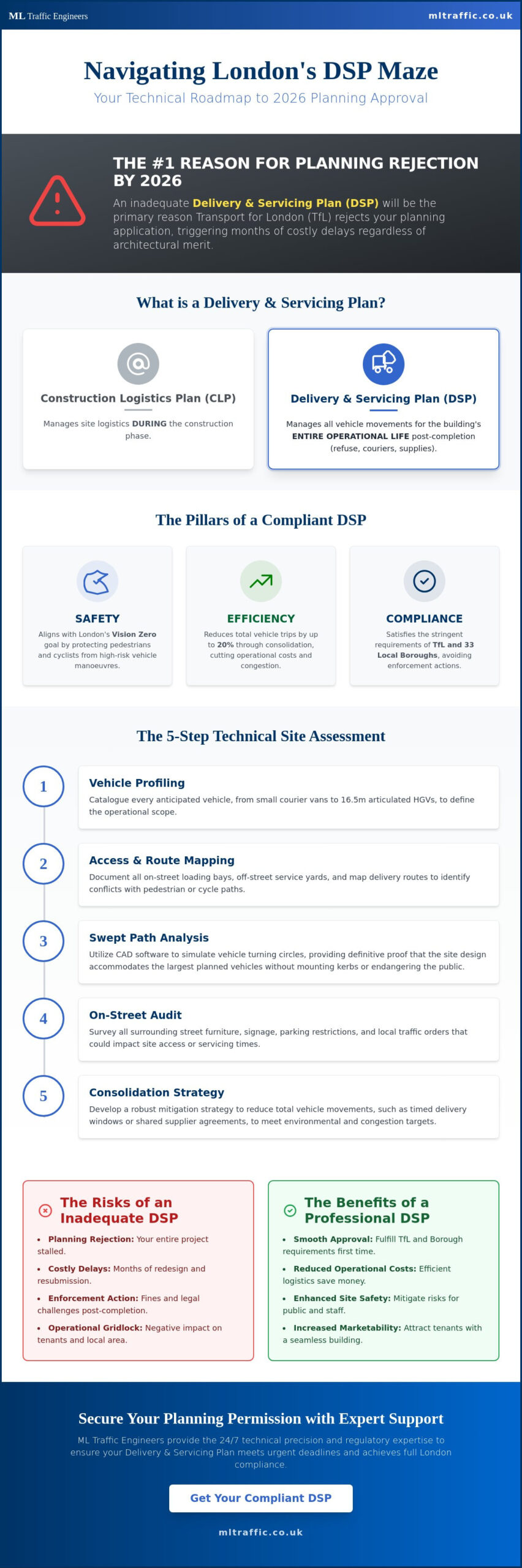
    A delivery and servicing plan london is a technical report required by local planning authorities to manage vehicle movements for a completed development. It isn’t just a box-ticking exercise. It’s a live strategy to ensure your building doesn’t gridlock the surrounding streets once it’s occupied. London’s geography presents unique challenges that make these plans essential. High-density zones and historic narrow streets mean that every vehicle stop must be calculated. While a Construction Logistics Plan (CLP) governs the build phase, the DSP focuses on the building’s permanent operational life, managing everything from refuse collection to courier drops.

    To better understand how professional logistics and servicing operate within the capital, watch this helpful video:

    The primary goals of a DSP are safety, efficiency, and environmental compliance. You must demonstrate that your site’s logistics won’t compromise London’s transport network. At ML Traffic, we provide the technical precision required to meet these high-stakes regulatory demands. We offer a total, managed solution to ensure your project stays compliant with the latest Transport for London (TfL) standards. Our 24/7 readiness reflects the constant movement of the city, providing developers with a safe pair of hands for complex urban requirements.

    Why London Planning Authorities Require a DSP

    London’s planning authorities rely on the London Plan 2021 and its 2026 updates to dictate logistics standards. These policies aim to reduce the volume of freight vehicles during peak hours to ease congestion. In boroughs like Westminster, Camden, or Southwark, a DSP is often a mandatory planning condition for any commercial development exceeding 1,000 square metres. It mitigates the impact on the local highway network by identifying designated loading bays and specific timing windows. Without an approved plan, you risk significant delays in discharging your planning conditions or facing enforcement action.

    The Benefits of a Proactive Servicing Strategy

    A well-designed DSP does more than satisfy a planning officer; it cuts operational costs. By consolidating deliveries, some urban sites reduce their total vehicle trips by up to 20%. Safety is another major driver. A proactive strategy aligns with London’s Vision Zero goal to eliminate all traffic fatalities and serious injuries by 2041. It protects pedestrians and cyclists from high-risk vehicle maneuvers. Finally, efficient logistics improve marketability. Tenants want buildings where post and supplies arrive without friction. We help you achieve this through our comprehensive traffic management support, ensuring your site operates with professional integrity and precision.

    How to Conduct a Site Assessment for a London DSP

    A robust site assessment forms the technical foundation of any successful delivery and servicing plan london. Developers must move beyond general assumptions to provide granular data that satisfies local planning authorities and Transport for London (TfL). This process involves a sequential five-step methodology to ensure every logistical movement is accounted for before construction begins.

    • Step 1: Identify vehicle profiles. You must catalogue every vehicle type expected on-site, ranging from small transit vans for parcel deliveries to 16.5m articulated HGVs for heavy plant or retail restocking.

    • Step 2: Map site access. Document all existing on-street loading bays and off-street service yards. Identify potential conflicts between delivery routes and pedestrian footfall.

    • Step 3: Conduct a Swept Path Analysis. Use CAD software to simulate vehicle movements. This proves that your design accommodates the turning circles of specific vehicles without mounting kerbs.

    • Step 4: Audit street furniture and restrictions. Survey the immediate area for Red Routes, Controlled Parking Zones (CPZs), and physical obstructions like bollards or cycle lanes that limit manoeuvrability.

    • Step 5: Estimate trip frequency. Calculate the daily and weekly volume of servicing trips. Accurate forecasting prevents bottlenecks that could lead to illegal idling or traffic congestion.

    Following TfL’s official DSP Guidance ensures your assessment aligns with the latest 2026 standards for urban freight management and safety.

    Technical Data Collection and Traffic Surveys

    Accurate traffic data is essential for baseline logistics modelling. We use precise parking surveys to identify available loading capacity and existing kerbside stress levels within a 200-metre radius of the site. This data prevents developers from proposing loading solutions in areas already at 100% capacity. TRICS data is the industry standard for trip rate estimation, providing a database of survey information across the UK and Ireland to predict future vehicle movements. Our team often supplements this with bespoke counts to capture 24/7 activity patterns.

    Using Swept Path Analysis for Logistics Feasibility

    CAD-based swept path analysis prevents costly design failures by testing vehicle paths against the proposed site layout. It’s vital to use London-specific vehicle templates, such as the standard 10.5m refuse freighter or specific fire tender dimensions used by the London Fire Brigade. SPA proves to TfL that deliveries won’t cause "tail-out" onto major roads, where a stationary vehicle blocks active traffic lanes. If a 12m rigid truck can’t clear the highway boundary while waiting to enter a service yard, the planning application will likely face rejection. If you need to verify your site’s capacity, our engineers provide comprehensive traffic support to secure your planning approval.

    The Developer’s Guide to Delivery and Servicing Plans (DSP) in London 2026

    Key Mitigation Strategies for 2026 London Compliance

    Small-scale developers often assume a comprehensive delivery and servicing plan london is only necessary for major infrastructure projects. This is a misconception. Even a single-dwelling site in a high-density borough requires rigorous logistics management to avoid fines and project delays. Precision planning actually unlocks value on constrained sites by preventing the bottlenecks that lead to wasted man-hours. Our team at ML Traffic provides comprehensive support to ensure these plans are both practical and compliant.

    Consolidation is the primary strategy for 2026 compliance. By centralising procurement and using preferred supplier lists, sites can reduce total vehicle arrivals by 30% to 50%. This reduces the administrative burden on site managers and lowers the risk of environmental non-compliance. Effective consolidation involves grouping deliveries at a nearby holding centre and using a single "last-mile" vehicle to complete the journey.

    Sustainable Logistics and Low-Emission Zones

    Transitioning to zero-emission fleets is no longer a choice for London developers. You must prioritise partners using cargo bikes for small parcels and electric vans for larger items. The London ULEZ and Construction guide provides a roadmap for vehicle standards that will be mandatory by 2026. Zonal delivery timing is another essential tool. By restricting arrivals to specific windows, you avoid peak congestion and school run hours. These policies align with the statutory requirements found in The London Plan 2021, which mandates sustainable transport across all 32 boroughs and the City of London.

    Safety Standards: FORS and CLOCS

    Safety standards like FORS (Fleet Operator Recognition Scheme) and CLOCS (Construction Logistics and Community Safety) are the industry benchmarks for 2026. Most local authorities now require FORS Silver or Gold as a minimum for all servicing vehicles. Physical site measures are equally vital to protect Vulnerable Road Users (VRUs). Your delivery and servicing plan london should include:

    • Marshaling: Trained personnel to manage vehicle-pedestrian interactions at site entry points.

    • Convex Mirrors: Strategically placed at exits to eliminate blind spots for exiting drivers.

    • Signage: High-visibility Chapter 8 compliant signage to alert the public of heavy vehicle movements.

    • EV Infrastructure: Dedicated charging points for electric delivery vans to support the transition to green logistics.

    These measures protect the public and insulate the project from legal liability. We manage these intricate complexities of UK road regulations so you don’t have to, ensuring every site movement is safe and documented.

    Securing approval for a delivery and servicing plan london requires a clear understanding of the jurisdictional hierarchy. Transport for London (TfL) maintains authority over the Strategic Road Network (SRN) and all Red Routes. If your development site borders these critical arteries, TfL acts as the primary consultee. Local boroughs manage the remaining 95% of London’s roads. You must align your strategy with the specific Local Transport Plan (LTP) of the relevant council to avoid costly delays during the planning phase.

    The approval timeline typically follows the standard 8 to 13-week planning cycle. You should submit your draft DSP alongside your initial planning application. Highway officers will scrutinize your vehicle swept path analyses and loading bay dimensions for precision. Once the council grants permission, the DSP usually becomes a legal obligation through a Section 106 agreement. This agreement makes your logistics targets legally binding. If your site fails to meet these benchmarks, the local authority can issue enforcement notices or financial penalties under the Town and Country Planning Act 1990.

    Pre-application engagement is the most effective way to streamline this process. Meet with highway officers early to discuss site constraints. This proactive approach identifies potential "deal-breakers" before you finalize your CAD designs. ML Traffic provides the technical authority needed for these high-stakes negotiations, ensuring your plans meet every safety and regulatory standard from day one. We handle the intricate complexities of UK road regulations so you don’t have to.

    Borough-Specific Nuances in Transport Planning

    Requirements vary significantly between the Central Activities Zone (CAZ) and Outer London. Central sites often face "timed access" restrictions, forcing deliveries into off-peak windows between 19:00 and 07:00. In contrast, outer boroughs focus on protecting local infrastructure. For example, navigating Transport Planning in Croydon or Lewisham requires specific knowledge of local "Quietways" and Cycle Superhighways. These routes often have weight limits or restricted access hours to protect cyclists and pedestrians.

    Monitoring and Reviewing Your DSP

    A DSP is a live document, not a one-off report. Most planning permissions include a condition for annual or biennial monitoring for at least five years post-completion. You’ll need to use digital delivery booking systems to track every vehicle that services your building. This data allows you to compare actual performance against the targets set in your original delivery and servicing plan london. If your site consistently exceeds its trip generation limits, the council may demand immediate mitigation measures. We offer comprehensive support to manage this ongoing compliance, providing a safe pair of hands for your long-term logistics strategy.

    To ensure your project meets all borough-specific requirements, explore our comprehensive transport planning services.

    Professional DSP Technical Reports for London Developers

    Securing planning approval in 2026 requires more than a standard document; it demands a robust, technical delivery and servicing plan london authorities can verify. Outsourcing this task to specialized traffic engineers eliminates the risk of costly planning delays. We provide the precise data and professional oversight necessary to satisfy Transport for London (TfL) and local borough requirements. Our reports use real-world metrics to prove your site’s operational viability from day one.

    Project managers often face tight windows for submission. Our team maintains 24/7 availability to handle urgent deadlines, ensuring your application stays on track. We prioritize clarity and technical accuracy, using industry-standard CAD software to model vehicle movements and loading requirements. This data-driven approach builds immediate trust with planning officers, as it demonstrates a commitment to public safety and urban efficiency. We’ve found that reports backed by rigorous technical analysis reduce the need for follow-up queries by 40% on average.

    Why Choose ML Traffic Engineers?

    Our firm brings extensive experience to the table, having managed a vast array of project types across the capital’s most constrained environments. We understand the specific nuances of London’s Red Routes and low-traffic neighborhoods. This technical authority simplifies the dialogue with TfL and local councils, as we speak their language regarding road safety and traffic flow. We offer a total managed solution, taking your project from the initial site survey through to the final, submission-ready report.

    • Comprehensive site audits and vehicle swept path analysis.

    • Expertise in Chapter 8 compliance and temporary traffic signals.

    • Direct liaison with local planning and highways authorities.

    • Seamless integration with existing construction management plans.

    Getting Started with Your Delivery and Servicing Plan

    The initial consultation focuses on your site’s unique operational needs and specific data requirements. We examine everything from delivery frequencies to the physical dimensions of your loading bays. This ensures the resulting delivery and servicing plan london planners receive is both practical and compliant. If you’re looking for further industry insights or regulatory updates, our resource hub contains valuable information on current planning trends.

    Don’t leave your planning success to chance. Contact ML Traffic Engineers today for a bespoke DSP quote and ensure your London development meets every regulatory standard with precision and speed.

    Future-Proof Your London Development for 2026

    Navigating the evolving regulatory landscape in the capital requires more than just a basic document. By 2026, every delivery and servicing plan london developers submit must demonstrate rigorous mitigation of congestion and emissions to satisfy the Mayor’s Transport Strategy. Success depends on precise technical data, incorporating the latest TRICS trip generation figures and accurate Swept Path Analysis to prove vehicle maneuverability within tight urban constraints. Meeting the specific requirements of all 32 London Boroughs and Transport for London (TfL) is essential for securing planning permission without facing costly delays or project refusals.

    ML Traffic Engineers provides a total, managed solution for your technical reporting needs. Our team operates with 24/7 availability to handle urgent project timelines, ensuring your application remains on track even under tight deadlines. We combine industry-standard CAD design with deep legislative knowledge to deliver bespoke reports that satisfy local authorities the first time. It’s about providing a safe pair of hands so you can focus on the construction phase. We understand the high-stakes nature of these submissions and prioritise precision in every report we produce.

    Secure your London planning approval with a professional Delivery and Servicing Plan from ML Traffic Engineers.

    We’re ready to help you clear the final regulatory hurdle of your planning journey with confidence and precision.

    Frequently Asked Questions

    Is a Delivery and Servicing Plan (DSP) legally required for all London developments?

    A Delivery and Servicing Plan (DSP) is mandatory for any new development in London that generates a significant volume of freight or service trips under the London Plan 2021. Local planning authorities enforce this through Section 106 agreements to manage the 15% of London’s peak hour traffic currently caused by freight vehicles. If your project sits on the Transport for London Road Network (TLRN), submitting a DSP is a non-negotiable requirement for planning approval.

    How does a DSP differ from a Construction Logistics Plan (CLP)?

    The delivery and servicing plan london focuses on the permanent, daily operations of a building once it’s occupied by tenants or residents. In contrast, a Construction Logistics Plan (CLP) only manages vehicle movements during the demolition and build phases. While a CLP handles heavy plant and raw materials, the DSP ensures that long-term activities like refuse collection and parcel deliveries don’t compromise road safety or local traffic flow.

    Can a DSP help my development comply with London’s Vision Zero safety goals?

    Your DSP directly supports the Mayor of London’s Vision Zero goal to eliminate all transport-related deaths and serious injuries by 2041. By mandating the use of Direct Vision Standard (DVS) rated vehicles and scheduling arrivals outside of peak pedestrian hours, you significantly reduce high-risk interactions. We use precise CAD modeling to ensure vehicle paths don’t overlap with cycle lanes or pedestrian footways, keeping your site compliant and safe.

    What happens if a developer fails to follow the approved DSP?

    Failure to adhere to an approved DSP is a breach of planning control under the Town and Country Planning Act 1990. Local councils have the power to issue Breach of Condition Notices, which can lead to unlimited fines upon summary conviction in a magistrates’ court. Persistent non-compliance often results in an injunction that halts site operations until you can prove full alignment with the agreed traffic management strategy.

    Do I need a new DSP if I change the use of my building (e.g., office to retail)?

    You must submit an updated DSP when changing a building’s use class because the freight profile and trip frequency will change. Retail units often require 3 times the daily delivery volume of an office space of the same size. Planning authorities require a new assessment to ensure the existing loading bays can handle larger vehicle types, such as 12-tonne refrigerated trucks, without obstructing the public highway.

    How much does a professional Delivery and Servicing Plan cost to produce?

    The cost of a professional delivery and servicing plan london varies based on the complexity of the site and the specific requirements of the local borough’s transport officers. Fees are typically driven by the level of CAD-based swept path analysis required and the number of vehicle templates assessed. Investing in a technical, compliant plan at the start prevents the much higher costs of planning delays or post-occupancy enforcement actions.

    What specific vehicle templates are used for London refuse collection in a DSP?

    We typically use standard 32-tonne 8×4 refuse collection vehicle templates as defined by the Freight Transport Association (FTA) for London assessments. These vehicles are approximately 9.2 metres long and require specific turning radii that must be verified through swept path analysis. Ensuring your site can accommodate these standard 1100-litre bin lorries is essential to prevent vehicles from idling on the main carriageway during collection cycles.

    Can a DSP be used to justify a reduction in on-site parking spaces?

    A robust DSP can justify a reduction in on-site parking by demonstrating that goods and services are managed through efficient consolidation and scheduled windows. By proving that 90% of deliveries will occur within managed time slots, developers can often meet the London Plan’s "car-free" requirements for high-density areas. This strategy maximizes your building’s usable floor space while satisfying the council’s demand for lower emissions and reduced traffic congestion.

    Which areas in London do you cover?

    We service Acton, Balham, Barking, Barnes, Barnet, Battersea, Beckenham, Bexleyheath, Brentford, Brixton, Bromley, Camberwell, Carshalton, Charlton, Chelsea, Chiswick, Clapham, Coulsdon, Croydon, Crystal Palace, Dagenham, Dulwich, Ealing, Edgware, Eltham, Enfield, Finchley, Forest Gate, Fulham, Golders Green, Greenwich, Hackney, Hammersmith, Hampstead, Harrow, Hayes, Highgate, Hounslow, Ilford, Islington, Kensington, Kentish Town, Kingston upon Thames, Lewisham, Mitcham, Muswell Hill, New Malden, Notting Hill, Orpington, Peckham, Pinner, Purley, Putney, Richmond, Romford, Ruislip, Sidcup, Southall, Southgate, Streatham, Surbiton, Sutton, Tooting, Tottenham, Twickenham, Uxbridge, Walthamstow, Wembley, West Norwood, Wimbledon, Wood Green, Woolwich, Bethnal Green, Shoreditch, Canary Wharf, Deptford, Leyton, Palmers Green, Stanmore, Upminster, Chislehurst, Erith, Feltham.

    Which cities in England do you cover?

    We service London, Birmingham, Manchester, Liverpool, Sheffield, Leeds.

    Michael Lee

    Article by

    Michael Lee

    Transport planner with over 35 years' experience.

    Disclaimer

    The content on mltraffic.co.uk, including all technical articles, guides, and resources, is provided for general informational and educational purposes only. It is not intended to constitute professional advice in traffic engineering, transportation planning, development approvals, or any other technical or legal field.
    While ML Traffic Engineers makes every reasonable effort to ensure the accuracy, completeness, and timeliness of the information published, we do not provide any warranties or representations (express or implied) regarding its reliability, suitability, or availability for any particular purpose. Any reliance you place on the content is strictly at your own risk.
    In no event shall ML Traffic Engineers, its directors, employees, authors, or affiliates be liable for any direct, indirect, incidental, special, consequential, or punitive damages (including, without limitation, loss of profits, data, or business opportunities) arising out of or in connection with the use of, or inability to use, any information provided on this website.
    The articles and guides on this site are not a substitute for engaging a qualified, professional traffic engineer to assess your specific project requirements. For tailored advice, compliance assessments, or traffic engineering services, please contact a competent professional.
    This disclaimer may be updated from time to time without notice. By accessing or using this website, you agree to be bound by the most current version of this disclaimer.