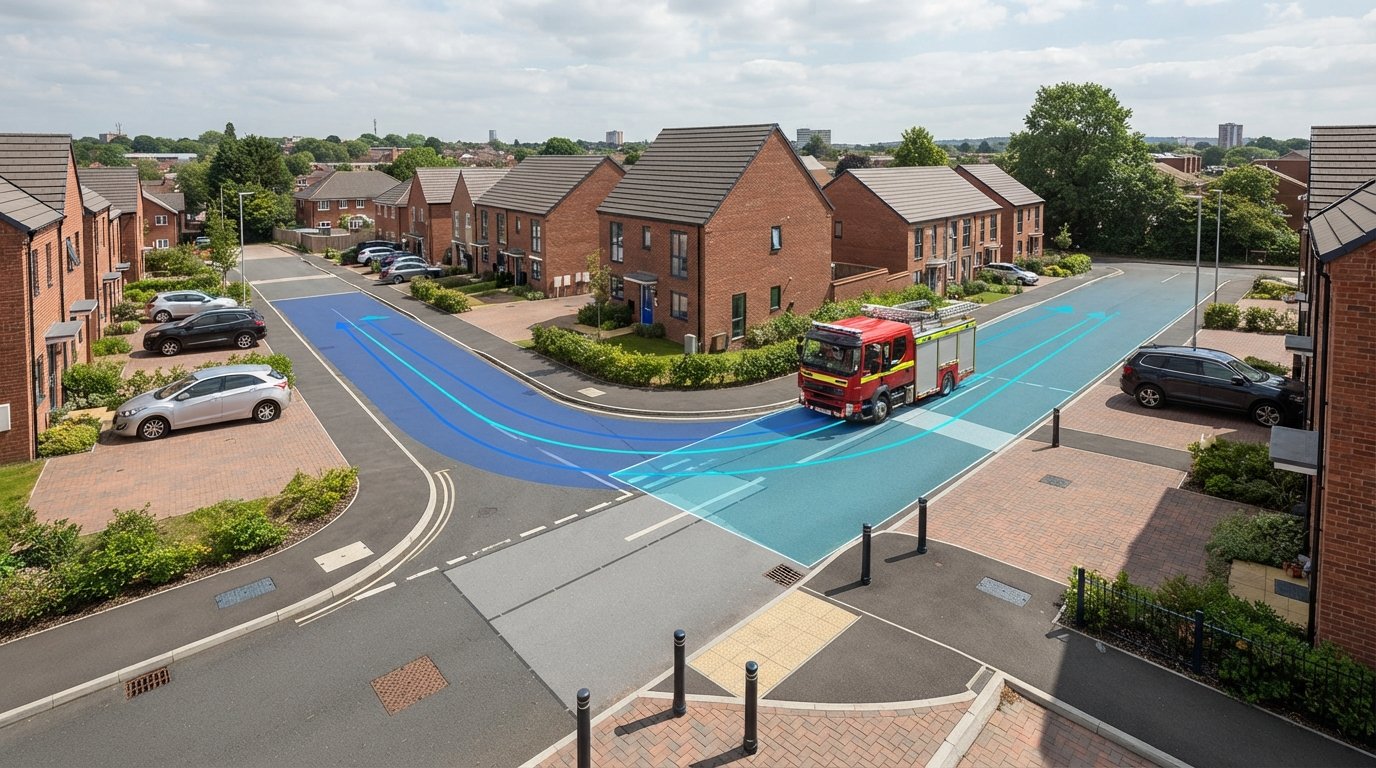
A single geometric error in your site layout can trigger an immediate planning refusal, regardless of how innovative your architectural vision looks on paper. As local authorities tighten safety protocols for 2026, mastering the fire tender swept path analysis requirements UK has become a critical milestone for every developer. You’re likely feeling the pressure to maximize every square metre of a site while facing conflicting advice from different local vehicle templates. It’s a difficult balance to strike when the safety of future residents and the commercial viability of your project are both on the line.
We understand that technical compliance shouldn’t come at the expense of your design’s integrity. This guide provides the precise technical standards and regulatory insights needed to secure planning approval with confidence. You’ll gain a clear understanding of the differences between Manual for Streets and Building Regulations, alongside the specific vehicle dimensions required for modern fire tenders. We’ll walk through the process of creating a robust technical report that satisfies the Fire Service and the Local Planning Authority. By the end of this guide, you’ll know how to create a site layout that’s both 100% compliant and space-efficient.
Key Takeaways
- Identify the precise 2026 vehicle dimensions, including the standard 11.2m to 11.4m length, required to ensure your site layout accommodates modern fire appliances.
- Master the fire tender swept path analysis requirements UK to effectively bridge the gap between high-density urban design and mandatory emergency access standards.
- Discover how to balance “place-making” aesthetics with rigid safety requirements by correctly applying Manual for Streets guidance alongside local highway templates.
- Understand why industry-standard AutoTURN simulations are now essential for providing the geometric certainty demanded by Local Planning Authorities.
- Learn how a professional technical report serves as a vital bridge between your architectural vision and the stringent safety requirements of the Fire Authority.
What is Fire Tender Swept Path Analysis and Why is it Mandatory?
Swept Path Analysis (SPA) is the digital calculation of the horizontal space required by a vehicle as it executes a specific manoeuvre. In the context of fire tender swept path analysis requirements UK, this process is a non-negotiable safety protocol. It ensures that emergency appliances can reach every part of a development without being obstructed by tight corners, parked cars, or narrow pinch points. Precision is vital because fire tenders are among the largest and least manoeuvrable vehicles permitted on residential roads.
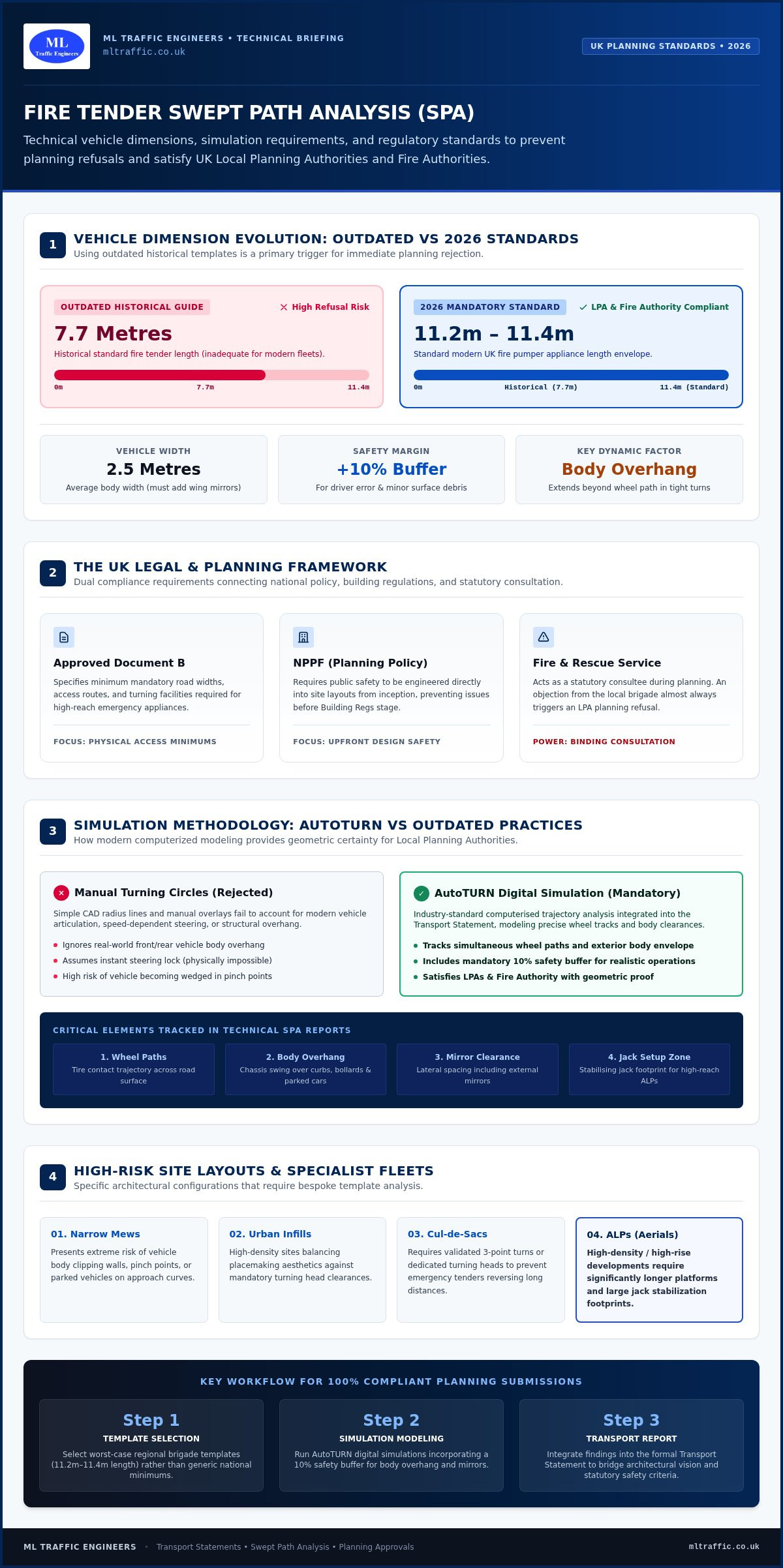
Modern Local Planning Authorities (LPAs) have moved away from accepting manual “turning circle” drawings or simple radius lines. They now demand precise, computerised simulations that account for both wheel paths and body overhang. Providing this data is a core component of a Transport Statement, which serves as technical evidence that your site layout is functionally safe. Without a validated SPA, an application faces a high probability of immediate rejection on the grounds of public safety. LPAs cannot risk approving a layout where an emergency vehicle might become wedged or unable to turn.
The Legal Framework: Building Regs Part B and NPPF
The requirement for fire access is rooted in Approved Document B of the Building Regulations. This document specifies the minimum road widths and turning facilities needed for high-reach appliances, such as aerial platforms. While Building Regs often apply later in the project lifecycle, the National Planning Policy Framework (NPPF) requires safety to be designed in from the outset. The local Fire and Rescue Service acts as a statutory consultee during the planning process. For developers seeking to integrate advanced safety infrastructure, scaitecsecurity.uk provides expert design and installation of electronic fire systems. They will review your SPA to ensure that their crews can operate effectively in an emergency. If the geometry doesn’t work, the Fire Service will object, and the LPA will likely follow suit.
Certain site layouts carry a higher risk of failing fire tender swept path analysis requirements UK. If your project includes narrow mews, tight urban infills, or complex cul-de-sacs, a standard “one-size-fits-all” approach won’t work. Relying on generic vehicle templates is a common pitfall. Modern fire tenders vary significantly in size; using an outdated or undersized template leads to a layout that is physically unworkable. The financial impact of a planning refusal is significant. Redesigning a site after the layout has been finalised often leads to a loss of developable space and substantial delays. Precision at the planning stage is the only way to de-risk your investment.
Technical Requirements: UK Fire Tender Dimensions for 2026
Precision in your site layout begins with using the correct vehicle data. For 2026, relying on outdated templates is a primary cause for planning rejection. While some historical guides suggest a length of 7.7m, modern fire tender swept path analysis requirements UK demand much larger specifications. A standard fire pumper now typically measures between 11.2m and 11.4m in length. Widths average 2.5m, but your analysis must account for wing mirrors and the significant body overhang that occurs during tight turns.
To ensure a robust submission, digital simulations should incorporate a 10% safety margin. This buffer accounts for real-world variables like driver error or minor surface debris. Without this tolerance, a layout that works on a screen might fail in practice, leading to a safety objection from the Fire Authority. It’s vital to remember that these vehicles don’t just need to drive through; they need enough space to deploy equipment and operate safely in high-pressure scenarios.
Common Vehicle Templates Used in SPA
Architects often start with the ‘Home Office’ standard template, but local brigades frequently maintain their own bespoke dimensions. For high-density or high-rise developments, you must also model specialist appliances like Aerial Ladder Platforms (ALPs). These vehicles are significantly longer and require larger setup areas for their stabilising jacks. Using the ‘worst-case’ vehicle template for your specific region is the safest strategy to de-risk your project. If you’re unsure which template to use, our team can help you select the correct vehicle profile for your simulation.
Understanding Turning Radii and Clearance
A critical distinction in swept path analysis is the difference between kerb-to-kerb and wall-to-wall turning circles. The kerb-to-kerb radius tracks the path of the wheels, while the wall-to-wall radius accounts for the body of the vehicle. In tight urban settings, the body overhang often creates the most significant constraint. According to Manual for Streets guidance, road width on straight sections should be at least 3.7m for fire access, but this must increase on bends to accommodate the vehicle’s sweep.
Vertical clearance is equally vital. Your report must confirm that balconies, archways, and overhanging trees provide at least 4.0m of clear height to prevent structural damage or access delays. Ensuring these technical details are correct before submission is the only way to avoid costly redesigns. If you need a professional to verify these clearances, ML Traffic Engineers UK can provide the detailed analysis required to satisfy highway officers.
Manual for Streets vs. Local Highway Standards
The transition from vehicle-led design to place-making has fundamentally altered how we approach residential road geometry. While national policy through the Manual for Streets encourages reduced speeds and increased pedestrian priority, developers must still satisfy the rigid fire tender swept path analysis requirements UK. This creates a technical tension. Local Highway Authorities often maintain their own design guides that may conflict with the more flexible national framework. Navigating this gap requires a data-driven approach to ensure that safety isn’t sacrificed for aesthetics.
Early engagement with transport planning consultants allows you to identify these friction points during the initial site layout phase. It’s far more cost-effective to adjust a kerb line on a digital drawing than to face a planning refusal because the Fire Service deems a corner “unworkable”. A professional SPA acts as the evidence base that bridges the gap between local preferences and national standards.
Designing for ‘Place’ Without Compromising Safety
Manual for Streets supports the use of reduced carriageway widths, often as narrow as 3.7m, provided that the overall street geometry allows for emergency vehicle movement. By using precise SPA, we can justify tighter corner radii that discourage speeding while still providing 100% compliance. In recent Low Traffic Neighbourhood (LTN) designs, this approach has been vital. We use simulations to prove that fire tenders can navigate through filtered permeability points, ensuring that “quiet” streets remain accessible during emergencies. This level of detail removes the subjective “opinion” from highway safety assessments.
S278 and S38 Agreement Implications
The geometry of your emergency access routes has a direct impact on the road adoption process. For roads to be adopted under Highway Design S278 & S38 agreements, they must pass a rigorous Technical Approval process. Council engineers will scrutinise your SPA to ensure the layout meets fire tender swept path analysis requirements UK before they accept any future maintenance liability. If the analysis is flawed, the council may refuse adoption, leaving you with the ongoing costs of a private road network. Precision at the design stage ensures a smooth handover to the local authority.
Conducting the Analysis: Software, Methodology, and Pitfalls
Precision in the simulation phase is what separates a successful application from a costly refusal. We use AutoTURN Swept Path Analysis as the industry standard to model these complex movements. While 2D drawings were once sufficient, modern fire tender swept path analysis requirements UK now frequently necessitate 3D multi-vehicle simulations. These advanced models allow us to layer the vehicle’s path directly onto topographical surveys and proposed site plans. This ensures that every millimetre of clearance, including wing mirrors and body overhang, is accounted for in the final report.
A common pitfall in DIY drawings is neglecting the physical limits of the vehicle and the driver. For example, Home Office guidance typically recommends that fire tenders shouldn’t be required to reverse more than 20m. Simulations that rely on excessive reversing or “perfect” steering angles are often flagged by highway officers as unworkable. Our analysis integrates real-world steering lock constraints to provide a simulation that the Fire Service can actually trust.
The Step-by-Step SPA Methodology
A rigorous methodology is essential for a report that stands up to technical scrutiny. Our process follows three distinct stages to ensure accuracy:
- Vehicle Selection: We identify the correct appliance template, often consulting directly with local brigades to ensure the modern 11.4m “worst-case” scenario is used where required.
- Full Manoeuvre Simulation: We model both inbound and outbound paths. This includes assessing the turn-in from the existing public highway and any internal turning heads.
- Conflict Analysis: We map the vehicle’s sweep against street furniture, lighting columns, and allocated parking bays to identify potential strike points before they become a problem on-site.
Designing Smart: Overrun Areas and Hidden Solutions
When site constraints are extreme, we look for geometric solutions that don’t compromise the development’s density. Using mountable kerbs or reinforced “grasscrete” surfaces allows a fire tender to overrun a landscaped area during an emergency without damaging the vehicle or the infrastructure. This approach effectively widens the turning path while maintaining the visual appeal of a narrow, “place-focused” street.
Junction design is another critical area. Hammerhead or turning tee junctions must be sized specifically for the 2026 fire tender dimensions mentioned in previous sections. We also provide clear strategies for managing on-street parking to ensure fire routes remain clear 24/7. If you need a validated simulation for a complex layout, request a professional swept path analysis to ensure your design is functionally safe and planning-ready.
Securing Approval: The Role of a Professional Transport Engineer
Professional validation is the final safeguard against planning refusal. While earlier sections detailed the geometric standards, the application of these rules requires an expert transport engineer to interpret and defend the results before statutory consultees. Highway officers frequently challenge self-produced drawings because they often lack the technical rigour needed to satisfy the Fire Authority’s operational standards. A professional report from ML Traffic Engineers UK provides a clear audit trail of assumptions, vehicle data, and safety tolerances, transforming a simple drawing into a robust planning document.
By utilizing integrated Swept Path Analysis Services, developers can move from design uncertainty to geometric confidence. We manage the full technical lifecycle, ensuring that the 10% safety margins and specific regional dimensions discussed previously are correctly applied. This proactive approach reduces the regulatory pressure on your team and ensures that safety is never a barrier to your development’s progress or commercial viability.
From Concept to Planning Success
Technical success starts at the feasibility stage. Identifying potential access constraints before the site layout is frozen is far more efficient than attempting to fix a layout after a planning objection. We provide the technical evidence required to navigate complex negotiations with Local Highway Authorities, particularly when site-specific constraints make standard templates difficult to apply. This expert “proof” is a core element of successful Transport Assessments. We act as the bridge between your architectural vision and the statutory requirements, providing the LPA with the confidence that the site remains safe and functionally sound.
Why Precision Matters in 2026
The UK planning environment in 2026 is defined by increased scrutiny on fire safety protocols. Following recent regulatory updates, the margin for error in emergency access has effectively vanished. LPAs now prioritise digital-first submissions where every turn and clearance is verified through high-fidelity simulation. Failing to meet the fire tender swept path analysis requirements UK at this stage can lead to indefinite delays, loss of land value, and significant financial penalties. Contact ML Traffic Engineers UK today to ensure your fire tender SPA is fully compliant and ready for technical approval.
Securing Your Development’s Approval through Technical Precision
Mastering the fire tender swept path analysis requirements UK is no longer an optional design exercise; it’s a fundamental requirement for planning success in 2026. By using the correct 11.4m vehicle templates and accounting for modern safety margins, you protect your development from costly redesigns and safety objections. We’ve explored how balancing place-making with rigid access standards requires technical precision and early-stage simulation to satisfy both the Fire Service and Local Planning Authorities.
Our team provides the technical authority needed to bridge the gap between an architect’s vision and regulatory compliance. As S278 and S38 compliance specialists, we utilize expert AutoTURN simulations to deliver precise results with a fast turnaround for your planning deadlines. Don’t let a geometric error compromise your site’s potential. We’re ready to help you navigate these intricate regulations so you can move forward with confidence.
Get a Professional Swept Path Analysis Quote for Your Site
Frequently Asked Questions
Is swept path analysis a mandatory requirement for all UK planning applications?
Swept path analysis isn’t mandatory for every minor application, but it’s a standard requirement for any project involving new roads or changes to existing access. Local Planning Authorities and Fire Authorities demand this technical evidence to verify that emergency vehicles can reach the development safely. For residential schemes and high-density urban infills, providing these simulations is often a condition of validation to ensure compliance with national safety standards and local highway policies.
What is the minimum width required for a fire tender access road in the UK?
According to Approved Document B of the Building Regulations, the minimum width for a fire tender access road on straight sections is 3.7m. However, this width must increase significantly at bends and junctions to accommodate the vehicle’s turning sweep. Meeting the fire tender swept path analysis requirements UK involves demonstrating that these widened sections are geometrically sufficient for the specific appliance used by the local brigade, including clearances for wing mirrors and body overhang.
Can I use a generic ‘standard vehicle’ template for my fire access analysis?
Using a generic template is a common reason for planning delays. While national standards exist, local Fire and Rescue Services often operate bespoke appliances with unique wheelbases and turning capabilities. For 2026 submissions, we recommend using regional vehicle data that reflects the “worst-case” scenario for your specific site location. This precision ensures that your analysis is robust enough to satisfy statutory consultees who prioritise operational reality over theoretical generic models.
What happens if my site layout doesn’t meet the standard fire tender turning circle?
Failing to meet turning circle requirements usually results in an immediate objection from the Fire Authority and subsequent planning refusal. If your layout is constrained, we can often identify technical solutions such as mountable kerbs, “grasscrete” overrun areas, or reconfigured parking layouts. These adjustments allow the vehicle to navigate the site without requiring a total redesign. Early technical intervention is the most effective way to de-risk the project and maintain developable space.
How much does a professional fire tender swept path analysis cost?
The cost of a professional analysis varies depending on the complexity of the site and the number of manoeuvres required for the simulation. Factors such as the inclusion of specialist appliances like Aerial Ladder Platforms also influence the final fee. Rather than relying on industry averages, we provide tailored quotes based on your specific project requirements. This ensures you receive a comprehensive technical report that meets all statutory standards without paying for unnecessary additional simulations.
Does the Fire and Rescue Service need to see the swept path analysis drawings?
Yes, the local Fire and Rescue Service acts as a statutory consultee for most major planning applications. They review the swept path analysis drawings to confirm their crews can access every part of the development and have sufficient space to operate equipment. Providing clear, computer-generated simulations reduces the likelihood of an objection. A professional report demonstrates that you’ve proactively addressed their operational needs, which significantly streamlines the technical approval process.
What is the difference between a fire tender and an aerial ladder platform in SPA?
A standard fire tender is a pumper appliance used for general firefighting, whereas an Aerial Ladder Platform (ALP) is a specialist vehicle for high-reach operations. ALPs are significantly longer and require much larger turning radii. Crucially, an ALP simulation must also account for the deployment of stabilising outriggers, which consume additional horizontal space. Understanding these differences is vital for high-rise developments where both vehicle types must be modelled to ensure full site access.
How far can a fire engine reverse according to UK building regulations?
Approved Document B states that fire tenders shouldn’t be required to reverse more than 20m. If a road exceeds this length, you must provide a suitable turning facility, such as a hammerhead or turning circle. Our simulations verify that these turning heads are correctly sized for modern appliances. Designing out excessive reversing manoeuvres is a key part of meeting the fire tender swept path analysis requirements UK and securing support from the Fire Authority.

Disclaimer
The content on mltraffic.co.uk, including all technical articles, guides, and resources, is provided for general informational and educational purposes only. It is not intended to constitute professional advice in traffic engineering, transportation planning, development approvals, or any other technical or legal field.
While ML Traffic Engineers makes every reasonable effort to ensure the accuracy, completeness, and timeliness of the information published, we do not provide any warranties or representations (express or implied) regarding its reliability, suitability, or availability for any particular purpose. Any reliance you place on the content is strictly at your own risk.
In no event shall ML Traffic Engineers, its directors, employees, authors, or affiliates be liable for any direct, indirect, incidental, special, consequential, or punitive damages (including, without limitation, loss of profits, data, or business opportunities) arising out of or in connection with the use of, or inability to use, any information provided on this website.
The articles and guides on this site are not a substitute for engaging a qualified, professional traffic engineer to assess your specific project requirements. For tailored advice, compliance assessments, or traffic engineering services, please contact a competent professional.
This disclaimer may be updated from time to time without notice. By accessing or using this website, you agree to be bound by the most current version of this disclaimer.