
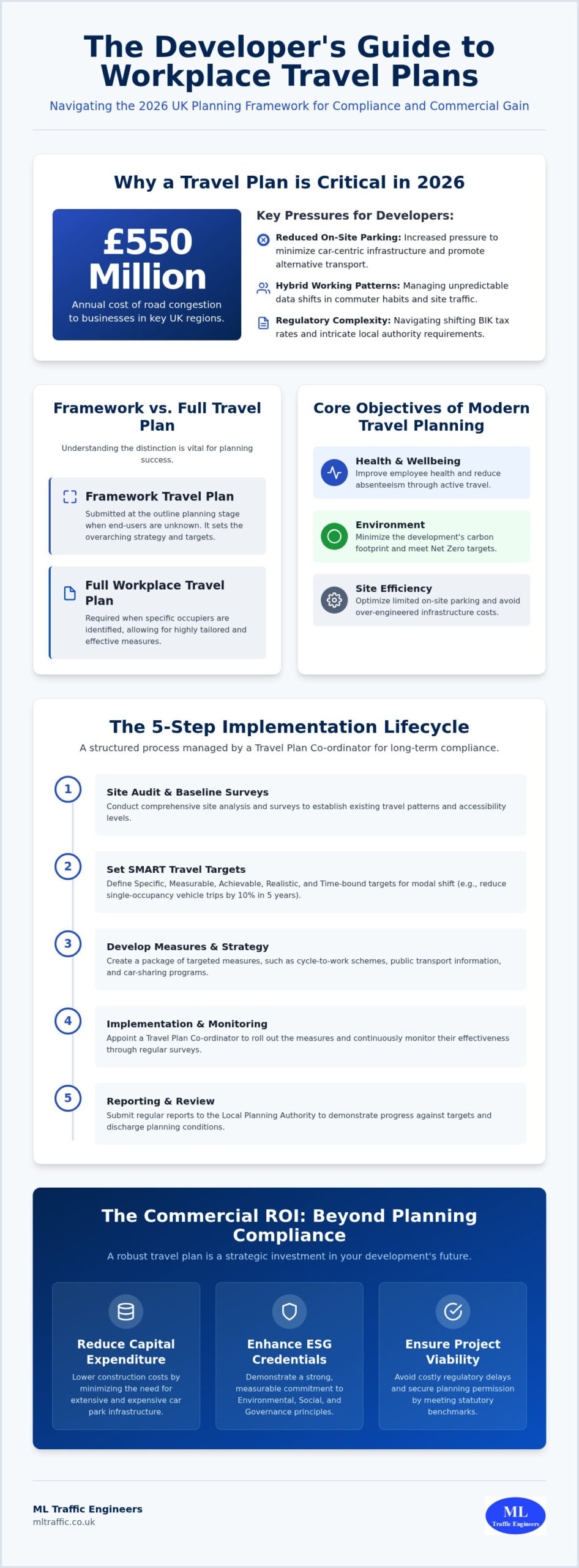
With road congestion costing businesses in regions like Surrey an estimated £550 million annually, the financial burden of car-centric development has reached a breaking point. For developers in 2026, a robust workplace travel plan isn’t just a checkbox for compliance. It’s a critical tool for mitigating these costs and securing planning permission under the revised National Planning Policy Framework. You’re likely facing increased pressure to reduce on-site parking while managing the unpredictable data shifts caused by hybrid working patterns.
We recognize that navigating local authority requirements and shifting BIK tax rates can feel like a regulatory minefield that threatens your project timelines. This guide simplifies the process. It shows you how to leverage data-driven strategies to improve site accessibility and boost your ESG credentials. We’ll examine the 2026 regulatory landscape, provide a step-by-step implementation framework, and detail how to integrate traffic surveys to ensure your submission meets every statutory benchmark. You’ll gain the technical clarity needed to manage the full project lifecycle and deliver a sustainable, accessible development.
Key Takeaways
- Understand how a workplace travel plan acts as a strategic management tool to reduce single-occupancy vehicle trips and secure planning approval.
- Navigate the updated 2026 National Planning Policy Framework (NPPF) and Section 106 requirements to avoid costly regulatory delays.
- Learn to set SMART travel targets based on site audits and baseline surveys for high-precision reporting.
- Master the five-step implementation lifecycle managed by a Travel Plan Co-ordinator to maintain long-term statutory compliance.
- Discover how sustainable transport strategies reduce capital expenditure on car park construction and improve site ESG credentials.
What is a Workplace Travel Plan and Why is it Essential?
A What is a Travel Plan? serves as a long-term management strategy that coordinates a package of measures to encourage sustainable transport. In the context of a commercial development, a workplace travel plan aims to reduce the volume of single-occupancy vehicle trips by staff and visitors. It isn’t a static document. It’s a dynamic framework that evolves based on real-world data and shifting commuter habits. By prioritizing site accessibility through non-car modes, developers ensure their projects remain viable and compliant with local authority expectations.
Understanding the distinction between a Framework Travel Plan and a Full Workplace Travel Plan is vital for planning success. A Framework Plan is typically submitted at the outline planning stage when end-users are unknown. It sets the overarching strategy and targets. Conversely, a Full Plan is required when specific occupiers are identified, allowing for tailored measures. In 2026, these plans are essential for meeting stringent Net Zero targets and demonstrating a commitment to carbon reduction within the built environment.
To better understand how these strategies integrate into your development project, watch this helpful video:
The Core Objectives of Modern Travel Planning
Modern travel planning focuses on three pillars: health, environment, and efficiency. Promoting active travel modes like walking and cycling directly improves employee wellbeing and reduces absenteeism. From an environmental perspective, a workplace travel plan minimizes a business’s carbon footprint by shifting reliance away from fossil-fuel vehicles. Additionally, managing limited on-site parking capacity through sustainable alternatives optimizes site efficiency. This prevents the need for over-engineered, expensive car park infrastructure.
Who Needs a Workplace Travel Plan?
Local Planning Authorities (LPAs) across England generally mandate these plans for developments that exceed specific thresholds. A common benchmark involves sites with 50 or more employees or those expected to generate significant traffic impact. However, size isn’t the only factor. Small sites located in Air Quality Management Areas (AQMAs) or sensitive urban centers often require a plan to mitigate congestion. Local authorities view these documents as non-negotiable tools for protecting public safety and maintaining road network performance. Utilizing expert travel plan consultants ensures your submission aligns with these intricate regional regulations.
Navigating the 2026 UK Planning Framework and NPPF
Securing planning permission in 2026 requires a precise understanding of the National Planning Policy Framework (NPPF). Following the significant reforms finalized in the summer of 2026, the framework places even greater weight on sustainable development and carbon reduction. A workplace travel plan is no longer a secondary consideration; it’s a primary requirement for any development expected to generate significant transport demand. This strategic approach is a core component of Transport Assessment London: The Developer’s 2026 Guide to Planning Success, where we detail the intersection of traffic modelling and policy compliance.
Early engagement with Local Highway Authorities is essential to identify site-specific concerns before they become roadblocks. Most authorities use Section 106 agreements to legally mandate the delivery, monitoring, and funding of travel plan measures. These agreements often include financial penalties or “remedial measures” if the development fails to meet its agreed modal shift targets. By involving experts early, you can negotiate realistic targets that reflect the actual accessibility of your site.
Statutory Requirements and Planning Conditions
A workplace travel plan serves as a critical document to discharge planning conditions. It carries significant legal weight within the UK planning system. If a developer fails to implement the agreed measures, the Local Planning Authority (LPA) has the power to halt development or refuse occupation. We’ve seen increased scrutiny in 2026 regarding modal shift targets. If your site doesn’t reach its target for reduced car use, you might be required to fund additional local infrastructure, such as new cycle lanes or subsidized bus services. Aligning your development with these benchmarks ensures a smoother path to approval. You can rely on our specialized transport planning support to manage these intricate regional regulations.
Regional Variations Across England
While the NPPF provides a national baseline, regional variations are significant. In London, Transport for London (TfL) sets rigorous standards that often exceed national requirements, focusing heavily on the “Healthy Streets” approach. Outside the capital, county standards vary. For instance, some counties mandate a plan for any business with 50 or more employees, while others use a lower threshold in Air Quality Management Areas. A “one size fits all” template usually fails because it doesn’t account for local bus frequency, cycle path connectivity, or specific Borough-level transport policies. Tailored, data-driven plans are the only way to satisfy local highway officers who understand their specific network’s constraints.
Key Components of an Effective Workplace Travel Plan
An effective workplace travel plan relies on a robust, data-driven foundation. We begin with comprehensive site audits and baseline travel surveys to understand current movement patterns. Without this evidence, targets aren’t merely guesswork; they’re indefensible during planning appeals. We apply the “SMART” approach to ensure every target is Specific, Measurable, Achievable, Realistic, and Timed. This precision allows developers to demonstrate to Local Highway Authorities exactly how they’ll achieve the necessary modal shift. Designing these access points effectively requires technical accuracy, often involving Autoturn Swept Path Analysis to ensure that sustainable transport infrastructure, such as bus turning circles or cycle lane widths, is physically viable on-site.
Data Collection: Surveys and PTAL Ratings
Parking surveys provide the critical evidence base for reducing car dependency. By measuring existing demand, we justify lower parking ratios to planning officers, which significantly reduces your capital expenditure on infrastructure. Central to this is the Public Transport Accessibility Level (PTAL) rating. This metric grades a location based on its proximity to the public transport network. A high PTAL rating allows for more ambitious travel plan targets and fewer on-site parking spaces.
In 2026, survey methodology must adapt to the “mid-week hump” caused by hybrid working. Baseline data collected on a Friday no longer reflects peak site pressure. We now utilize multi-day surveys to capture the volatile occupancy levels typical of flexible working patterns. This ensures your travel plan remains realistic even as employee habits shift. With 50% of adults now expressing a desire to walk or cycle more according to the 2026 Sustrans Index, your data must reflect this latent demand for active travel rather than relying on outdated pre-hybrid models.
Strategic Infrastructure and Promotional Measures
Successful plans balance “carrot” incentives with “stick” restrictions. Physical infrastructure serves as the primary incentive. This includes secure, covered cycle storage, high-quality shower facilities, and dedicated EV charging points to support the 4% BIK rate for electric vehicles in the 2026/27 tax year. Management and information measures complete the strategy:
- Management: Car-pooling schemes, season ticket loans, and formalized flexible working policies to spread peak demand.
- Information: Digital real-time transit displays in lobbies and bespoke travel information packs for every new employee.
Parking restrictions, such as permit-only zones or workplace parking levies, act as the “stick” to discourage single-occupancy car trips when viable alternatives exist. By integrating these measures, you create a site that’s both accessible and compliant with modern environmental standards.
Implementation: The Role of the Travel Plan Co-ordinator
Implementation begins with the formal appointment of a Travel Plan Co-ordinator (TPC). A designated individual serves as the primary point of contact for the Local Planning Authority (LPA) throughout the development’s operational life. Managing the full workplace travel plan lifecycle involves five distinct stages: Appointment, Launch, Monitoring, Reporting, and Review. This structured approach ensures that the sustainable transport measures proposed during the planning phase translate into measurable results on the ground. Precision is vital.
Surveys and traffic counts provide the evidence needed to track progress against baseline data. Data collection captures the actual travel habits of employees, while automated counts provide objective numbers on vehicle movements at site access points. If a site doesn’t meet its agreed modal shift targets by the end of year three, the LPA will trigger “Remedial Measures.” These pre-agreed actions, such as additional financial contributions to local bus services or enhanced cycling incentives, bring the site back into compliance. Avoiding these costly escalations requires proactive management.
Managing the 5-Year Monitoring Cycle
Most planning authorities require a five-year monitoring period to ensure long-term behavioral change. Annual Monitoring Reports (AMR) are produced each year to document the workplace travel plan performance. Technical documentation compares current travel data against the original targets and identifies any necessary adjustments to the strategy. Maintaining employee engagement over this multi-year period is a significant challenge. It’s a complex task. Digital transit updates and active travel challenges help keep sustainability at the forefront of the workplace culture. While these initiatives focus on transport, other tools can help maintain overall team spirit; for example, you can check out My FPL Mini-League to automate engagement through fantasy football recaps.
Acting as a technical liaison, the TPC negotiates with the LPA to ensure targets remain realistic as site conditions evolve. External factors often impact site accessibility, and the TPC presents the evidence needed to adjust targets accordingly. Outsourcing this role to a specialized transport consultancy reduces the logistical pressure on your internal team. Transport professionals understand the nuances of regional regulations and provide the data-driven reporting needed to satisfy high-stakes planning conditions. See how expert support strengthens planning applications in 2026 to ensure your project remains compliant from inception to completion.
Our team manages the full TPC lifecycle to protect your development from regulatory risk. Explore our comprehensive travel plan services today.
The Commercial ROI: Beyond Planning Compliance
Viewing a workplace travel plan solely as a regulatory hurdle ignores its significant commercial potential. For developers, the primary financial benefit lies in the reduction of capital expenditure required for expansive car park construction. Every parking bay eliminated through effective sustainable travel measures represents a direct saving in construction and maintenance costs. By optimizing land-use efficiency, you can increase development density or allocate space to higher-value amenities that drive better yields. It’s a strategic shift that moves capital from asphalt to assets.
Future-proofing is another critical commercial consideration. As urban emissions standards tighten across England in 2026, car-centric sites risk becoming stranded assets with limited appeal to premium tenants. A certified travel plan demonstrates that a development is prepared for the transition to low-carbon transport. It also boosts ESG (Environmental, Social, and Governance) credentials, which are increasingly vital for securing institutional investment and favorable financing terms. Precision in these plans ensures long-term viability in a rapidly changing regulatory landscape.
Reducing Infrastructure and Maintenance Costs
The branding benefits of being a “Sustainable Employer” are substantial in the 2026 recruitment market. While we’ve noted the employee preference for active travel, the corporate value lies in talent acquisition. Developments that facilitate these preferences through high-quality cycle storage and shower facilities attract and retain top-tier talent more effectively than those that don’t. There is also a documented link between active travel and employee health.
The UK Chief Medical Officer recommends daily physical activity to improve worker wellbeing. Employees who walk or cycle to work typically have lower rates of absenteeism and higher productivity levels. By investing in a robust travel strategy, businesses secure a healthier, more engaged workforce. To secure these benefits for your next project, Contact ML Traffic Engineers UK to develop a bespoke Workplace Travel Plan tailored to your site’s specific requirements.
Securing Your Development’s Sustainable Future
A workplace travel plan serves as the mechanism for this transition, protecting your project from the high costs of car-centric infrastructure while satisfying the latest statutory requirements. We have seen how integrating sustainable transport measures moves a development beyond mere compliance into high-value site optimization. This strategic approach ensures your project remains accessible and competitive as urban emissions standards continue to tighten across England.
Navigating these intricate regional regulations requires a partner who understands the high stakes of transport planning. Since 2014, ML Traffic Engineers UK has provided UK-wide coverage with specialized London expertise, securing planning approvals through rigorous technical reporting. We manage the full project lifecycle, from initial traffic surveys to ongoing Travel Plan Co-ordinator roles. Our team is ready to reduce your logistical and regulatory pressures with precision and unwavering reliability.
Don’t let regulatory delays or non-compliance stall your progress. Get Expert Help with Your Workplace Travel Plan to ensure your site meets every statutory benchmark. We look forward to helping you deliver a high-performing, sustainable development that stands the test of time.
Frequently Asked Questions
Is a workplace travel plan a legal requirement in the UK?
A workplace travel plan becomes a legal requirement when it’s mandated through a Section 106 agreement or as a specific planning condition. Local Planning Authorities (LPAs) use these documents to manage traffic impact and ensure developments align with the National Planning Policy Framework (NPPF). Failure to produce a plan for sites exceeding local thresholds can result in the refusal of planning permission or legal enforcement action once the site is operational.
How much does a workplace travel plan cost to produce?
The cost to produce a plan varies based on the development’s scale and the complexity of the required technical surveys. Factors influencing the total investment include the number of baseline surveys needed, the depth of the site audit, and whether the role of the Travel Plan Co-ordinator is outsourced. Developers should view this as a strategic investment that reduces long-term infrastructure costs by justifying a reduction in expensive on-site parking construction.
What is the typical duration of a travel plan monitoring period?
Most Local Highway Authorities mandate a monitoring period of five years from the date of first occupation. This timeframe allows for the collection of longitudinal data to ensure behavioral changes are sustained. During this cycle, the Travel Plan Co-ordinator submits Annual Monitoring Reports (AMR) to the LPA. These reports compare current travel habits against the baseline targets set during the initial application phase to verify that the development remains in full compliance.
Can a travel plan help reduce the number of parking spaces I need to provide?
A robust plan provides the evidence base needed to justify a reduction in on-site parking provision. By implementing high-quality active travel infrastructure and car-pooling schemes, you demonstrate that the site can operate effectively with fewer bays. This reduction is particularly effective in areas with high PTAL ratings. Lowering your parking ratio directly decreases capital expenditure on surfacing, drainage, and lighting for expansive parking areas while improving land-use efficiency.
What happens if my workplace travel plan fails to meet its targets?
If monitoring data shows that a development has missed its modal shift targets after three years, the LPA typically triggers pre-agreed remedial measures. These actions often involve additional financial contributions toward local transport improvements or enhanced promotional incentives for staff. In severe cases of non-compliance, legal enforcement of Section 106 obligations can occur. Proactive management helps identify these risks early and allows you to adjust strategies before costly penalties or enforcement actions apply.
Who is responsible for implementing the measures in a travel plan?
The developer remains responsible for the initial physical measures, such as cycle storage and EV charging points. Once the site is operational, the responsibility for day-to-day management often shifts to the occupier or a designated Travel Plan Co-ordinator (TPC). The TPC acts as the central liaison between the site users and the local authority. They ensure that information packs are distributed and that monitoring surveys are conducted according to the agreed statutory schedule.
How do hybrid working patterns affect travel plan surveys in 2026?
In 2026, hybrid working necessitates a shift from single-day surveys to multi-day data collection. Traditional mid-week peaks are more pronounced as staff consolidate their office days, meaning that survey data must capture maximum occupancy levels rather than a weekly average. Accurate reporting ensures that your workplace travel plan targets remain realistic. This approach also ensures that the site’s sustainable transport infrastructure is sized correctly for peak demand days rather than outdated pre-hybrid models.

Disclaimer
The content on mltraffic.co.uk, including all technical articles, guides, and resources, is provided for general informational and educational purposes only. It is not intended to constitute professional advice in traffic engineering, transportation planning, development approvals, or any other technical or legal field.
While ML Traffic Engineers makes every reasonable effort to ensure the accuracy, completeness, and timeliness of the information published, we do not provide any warranties or representations (express or implied) regarding its reliability, suitability, or availability for any particular purpose. Any reliance you place on the content is strictly at your own risk.
In no event shall ML Traffic Engineers, its directors, employees, authors, or affiliates be liable for any direct, indirect, incidental, special, consequential, or punitive damages (including, without limitation, loss of profits, data, or business opportunities) arising out of or in connection with the use of, or inability to use, any information provided on this website.
The articles and guides on this site are not a substitute for engaging a qualified, professional traffic engineer to assess your specific project requirements. For tailored advice, compliance assessments, or traffic engineering services, please contact a competent professional.
This disclaimer may be updated from time to time without notice. By accessing or using this website, you agree to be bound by the most current version of this disclaimer.