What if the technical report designed to secure your venue’s future is the primary reason for a planning refusal? Generic traffic assessments often fail to account for the intense “event-day” surges that trigger local opposition and council scrutiny. If you’re concerned about resident pressure regarding noise or the uncertainty of peak-hour modelling, your caution is well-founded. A specialized function centre transport assessment is the only way to prove your venue won’t cause traffic chaos during its most critical operating hours.
We understand the pressure of navigating the National Planning Policy Framework (NPPF) and complex local borough standards across England. In this high-stakes environment, technical precision is a functional necessity to protect your investment and secure your site’s future. This article provides a clear roadmap to mastering these technical requirements. You’ll learn how to produce a robust report that satisfies the Highway Authority, addresses specific parking and access requirements, and ultimately minimises your planning risk through proactive risk management. We’ll move straight to the core methodologies you need to ensure your application stands up to the strictest regulatory standards.
Key Takeaways
- Understand why a technical function centre transport assessment is essential for evaluating the impact of guest surges and service vehicles on the local road network.
- Learn how to utilise TRICS database modelling and modal split analysis to provide accurate trip generation data for high-capacity event dates.
- Discover how Swept Path Analysis and visibility splay design prove your site can safely accommodate large vehicles and emergency access.
- Identify effective mitigation strategies, including bespoke Travel Plans, to reduce environmental impact and satisfy Highway Authority requirements.
- Gain a clear understanding of the regulatory hurdles involved in securing planning permission for high-impact venues across England.
What is a Function Centre Transport Assessment?
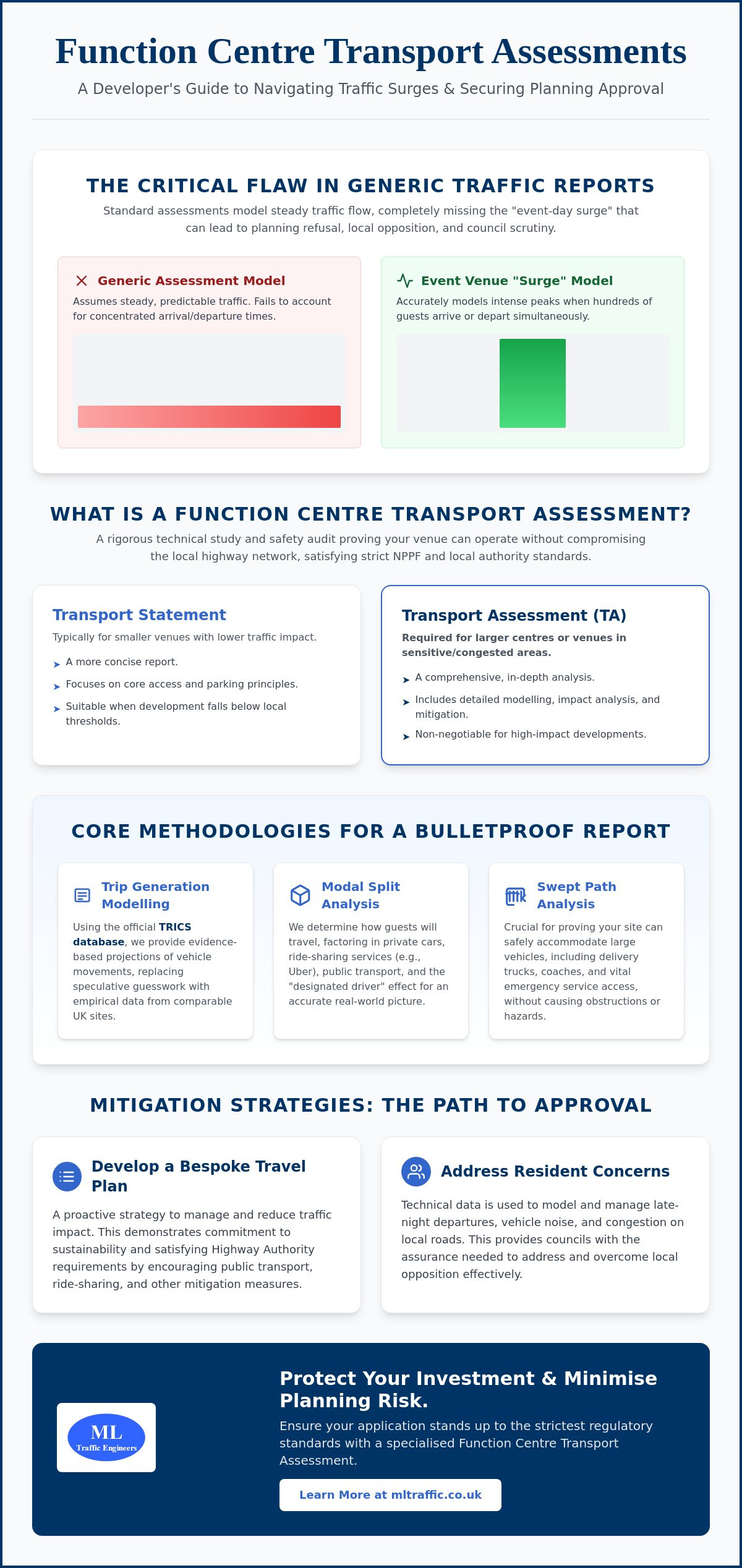
A function centre transport assessment is a rigorous technical study required for planning applications involving event-based developments across England. This document evaluates how guests, staff, and logistics vehicles interact with the existing highway network. It’s not just a formality; it’s a safety and capacity audit. We use these reports to demonstrate that your venue can operate without compromising the efficiency or safety of local roads. This technical authority is essential to satisfy the strict requirements of local planning authorities.
Depending on the scale of your project, you may need either a Transport Statement or a full assessment. While statements are typically for smaller venues, larger centres require a comprehensive Transport Assessment. This ensures complete compliance with the National Planning Policy Framework (NPPF) and specific local borough standards. Precision here is a functional necessity to avoid costly planning delays and regulatory pushback.
To better understand how these technical principles are applied in a real-world planning scenario, watch this case study:
When is a Transport Assessment Mandatory?
Local Highway Authorities typically set thresholds based on Gross Floor Area (GFA) or the expected volume of vehicle movements. If your venue exceeds these limits, a TA becomes a non-negotiable requirement. However, even small venues might need a full assessment if they’re located in sensitive or highly congested areas. The Trip generation data usually dictates the depth of the study. We recommend early engagement with the council to agree on the report’s scope. This proactive approach reduces regulatory pressure and ensures the final report meets every benchmark.
The Unique Traffic Profile of Event Venues
Function centres differ significantly from standard residential or commercial developments because they create a “surge” effect. This occurs when high volumes of guests arrive or depart within very short windows, often coinciding with the start or end of a ceremony. A generic traffic report won’t capture this nuance. Your function centre transport assessment must specifically model these peak periods to prove the site entrance and local junctions can handle the load. We also account for late-night departures and the associated noise impact. Managing these movements is vital to address resident concerns regarding safety and congestion on local roads after hours.
Trip Generation and Modelling for Event Spaces
Modelling traffic for event spaces requires a departure from standard daily averages. A function centre transport assessment must focus on the “peak-surge” characteristic of events. Unlike a supermarket where flow is steady, a wedding or corporate gala creates concentrated arrival and departure windows. We analyze these windows to ensure the local infrastructure doesn’t buckle under sudden pressure. This precision is a functional necessity for protecting your investment and maintaining road safety.
Using the TRICS Database for Accuracy
Planning officers require evidence-based projections. We utilise the TRICS database to provide this validated baseline for every project. By selecting comparable sites based on venue capacity and geographic location, we accurately predict vehicle movements. TRICS prevents speculative traffic claims by replacing guesswork with empirical data from established UK sites. This technical authority is essential when presenting your case to the Highway Authority. Accuracy in this phase reduces the logistical and regulatory pressures on your development team.
Developing a Robust Modal Split
A modal split determines exactly how guests travel to your site. We don’t just assume every guest arrives in a private car. We factor in the “designated driver” effect and the significant rise in ride-sharing services. For venues with high PTAL ratings, we adjust the data to reflect superior public transport accessibility. If your venue is part of a larger hotel or resort, we account for “linked trips” where guests are already staying on-site. This level of detail reduces the perceived impact on the road network and strengthens your planning application. You can explore our technical resources to see how these data sets are compiled.
We specifically target the “Peak Hour” impacts. For most function centres, this isn’t the Monday morning rush. It’s usually Friday evenings or Saturday afternoons. Our modelling calculates parking accumulation to ensure every vehicle has a designated space. This prevents overspill onto surrounding public streets, which is a primary concern for local residents. Precision in these calculations is a non-negotiable foundation of our work. By demonstrating a clear understanding of these peaks, you minimise the risk of planning refusal based on local traffic concerns. Our team remains ready to manage these complex project lifecycles from inception to completion, which may include advising on the use of professional transport partners like JAF Executive Travels to streamline guest arrivals and minimize site congestion.
Access Design and Swept Path Analysis
A robust function centre transport assessment must prove the site entrance can safely accommodate a sudden influx of vehicles. We don’t just look at the numbers; we look at the geometry. Visibility splays are critical to ensure safe egress onto the public highway, especially when large event crowds leave simultaneously. If the entrance design is flawed, you risk queuing back onto main roads, which is a major red flag for planning officers. Our designs prioritise internal circulation to keep the public highway clear and safe at all times.
Swept Path Analysis for Coaches and HGVs
Logistics for event venues involve more than just passenger cars. We use Swept Path Analysis to model the movements of 12m or 15m coaches. This ensures that large vehicles can enter, turn, and exit the site in a forward gear. Standard turning circles often fail because they don’t account for the unique overhangs of modern event coaches or the tight delivery schedules of catering trucks. We also model emergency fire tenders to guarantee site safety. Precision in these simulations is a functional necessity to prevent operational bottlenecks once the venue opens.
Parking Strategy and Junction Capacity
A successful parking strategy avoids the pitfalls of both under-provision and over-provision. If you provide too few spaces, you face pressure from local residents regarding street congestion. If you provide too many, you might clash with council sustainability targets. We determine the optimum number of spaces by cross-referencing your venue’s capacity with our previously discussed trip generation data. This tailored approach reduces the logistical and regulatory pressures on the applicant.
To assess the impact on the wider network, we use junction modelling software like Junctions 9, PICADY, and ARCADY. These tools allow us to predict delays and capacity issues at the site entrance during peak event hours. We also integrate electric vehicle (EV) charging points into the layout to ensure compliance with 2026 building regulations. Balancing vehicle access with pedestrian safety is the final piece of the puzzle. We design clear footways and crossing points to separate guest movements from vehicle flow. This comprehensive approach is a hallmark of a high-quality function centre transport assessment, providing the technical authority needed to secure planning permission.
Mitigating Impact Through Travel Planning
A technical function centre transport assessment is incomplete without a strategy to manage guest behaviour. While physical design handles the flow, a bespoke Travel Plan targets the source by reducing single-occupancy car journeys. We develop these plans to align with local sustainability goals and to satisfy the rigorous demands of the Highway Authority. This proactive approach reduces the logistical and regulatory pressures on the developer while ensuring a safer environment for the local community.
One of the most significant hurdles in securing planning permission is addressing the noise and light pollution caused by late-night vehicle movements. Residents often fear that a new venue will transform a quiet street into a congested thoroughfare. We mitigate these impacts through operational management plans that dictate how traffic enters and exits the site during sensitive hours. By implementing sustainable transport incentives, such as shuttle buses from nearby rail hubs or secure cycle storage, we lower the total vehicle count. If you need a comprehensive strategy to secure your site’s future, our travel plan consultants are ready to assist with your application.
Event Day Management Plans
Managing a high-volume event requires on-site coordination. We specify the use of banksmen or traffic marshals to oversee guest arrivals and ensure that vehicles don’t queue onto the public highway. Pre-booking systems act as a vital traffic management tool, allowing operators to communicate arrival instructions and parking availability to guests before they depart. A robust operational management plan provides the documented assurance required to neutralise resident fears regarding late-night congestion and noise. This level of organization demonstrates a commitment to professional integrity and public safety.
Sustainable Access and PTAL Ratings
We leverage Public Transport Accessibility Level (PTAL) ratings to justify lower on-site parking provision where appropriate. If a site has excellent rail or bus links, we argue for a shift toward sustainable access, reducing the physical footprint of the development. Modern planning also mandates “Active Travel” considerations, requiring safe, well-lit walking and cycling routes for guests and staff. These commitments often form part of a Section 106 legal agreement, making the Travel Plan a binding document for the developer. By integrating these elements into your function centre transport assessment, you provide a sequential and logical path to planning approval. Our team manages full project lifecycles to ensure these commitments are both practical and achievable.
Partnering with ML Traffic Engineers UK for Planning Success
Securing planning permission for a high-impact venue requires a partner who understands the intricate regional regulations and the specific operational pressures of the event industry. ML Traffic Engineers UK specialises in navigating complex Transport Assessments for venues where precision is a functional necessity. Our team brings technical authority to every project, ensuring that your function centre transport assessment stands up to the most rigorous Highway Authority scrutiny across England.
We maintain a proven track record of negotiating with local authorities to overcome common planning hurdles. This experience allows us to anticipate potential objections before they become roadblocks. Our comprehensive approach covers the full project lifecycle, moving from initial feasibility studies to post-planning monitoring. We focus on precision data collection, including tailored Parking Surveys and Traffic Counts that reflect the actual peak-hour conditions of your specific site. This dedication to accuracy reduces the logistical and regulatory pressure on our clients and provides a clear path to approval.
Our Technical Precision
We use industry-leading software to deliver high-quality Swept Path Analysis and junction modelling. Our reports are clear, professional, and designed to minimise “Request for Further Information” (RFI) delays. By providing a robust technical foundation from the start, we help you avoid the cycle of costly revisions. We handle the full project lifecycle for various project types, ensuring that every assessment meets the benchmarks required by modern building regulations. Our role isn’t just as a service provider; we act as a vital guardian of public safety and professional integrity.
Get Your Transport Assessment Quote
Early engagement is the most effective way to prevent design revisions later in the planning process. We recommend an initial site review and scoping session with our senior engineers to identify potential challenges early. This proactive strategy ensures that your site layout is optimised for both vehicle access and pedestrian safety from day one. Contact ML Traffic Engineers UK today to discuss your project requirements. We remain ready to provide a professional, safety-conscious function centre transport assessment that secures your venue’s future. Our commitment to constant availability and unwavering reliability makes us the dependable partner you need for planning success.
Secure Your Venue’s Future with Technical Precision
Securing planning permission for a high-impact event space requires a shift from generic traffic modelling to specialized event-day analysis. By prioritising precise trip generation and robust swept path analysis, you address the primary concerns of local authorities and residents alike. A comprehensive function centre transport assessment ensures your venue operates safely while meeting all legislative benchmarks. It’s the most effective way to minimise planning risk and prove your site’s viability.
We bring technical authority to every project as members of the Chartered Institute of Highways & Transportation. Our team specialises in London and England planning regulations, utilising industry-standard tools like TRICS and AutoTurn to deliver reports that withstand the strictest scrutiny. We manage the full project lifecycle so you can focus on your venue’s success. Request a Quote for Your Function Centre Transport Assessment today to move your project forward with confidence. Your vision for a premier event space is within reach when it’s backed by expert engineering.
Frequently Asked Questions
Do I need a Transport Statement or a Transport Assessment for my function centre?
The requirement depends on the scale of your development and local planning thresholds. Smaller venues with lower trip generation typically require a Transport Statement. Larger developments or those in sensitive areas need a full function centre transport assessment. We review your venue’s capacity and gross floor area against local borough standards to determine the correct technical path for your application.
How much does a function centre transport assessment cost?
Fees are determined by the complexity of the site and the specific requirements set by the Highway Authority. Costs depend on whether your project needs junction modelling, multi-day traffic surveys, or complex swept path simulations. We provide tailored quotes after an initial site review. This ensures the scope of work matches the regulatory demands of your project without including unnecessary technical studies.
Will the council refuse my wedding venue application if local roads are narrow?
Narrow roads aren’t an automatic trigger for refusal if we can demonstrate safe operation. We use technical data to prove that passing places and managed arrival windows maintain highway safety. A robust operational management plan often overcomes physical constraints. By staggering guest arrivals and using trained banksmen, we show the council that your venue won’t cause local gridlock or safety hazards.
How is “peak traffic” calculated for an event venue?
We calculate peak traffic by identifying the specific “surge” periods unique to your venue’s schedule. Unlike office blocks, function centres see peaks on Friday evenings or Saturday afternoons. We use the TRICS database to compare your site with similar UK venues. This allows us to predict guest, staff, and service vehicle movements with high precision during your most intense operating windows.
Can a Travel Plan really help me get planning permission?
A bespoke Travel Plan is a vital tool for mitigating transport impacts and meeting sustainability targets. It proves to planning officers that you’re actively reducing single-occupancy car journeys. By proposing shuttle buses, car-sharing incentives, or cycle storage, you address concerns about parking overspill. This proactive strategy often neutralises resident objections and demonstrates a commitment to professional integrity and public safety.
What is Swept Path Analysis and why does my event venue need it?
Swept Path Analysis is a technical simulation that tracks the movement of vehicles through your site layout. Your venue needs this to prove that 15m coaches, catering trucks, and emergency fire tenders can navigate safely. It ensures that large vehicles can enter and exit in a forward gear without striking kerbs or buildings. Precision in these simulations is a functional necessity for site safety.
How do I handle parking requirements for a function centre in a town centre?
Town centre venues can often justify reduced on-site parking by leveraging high PTAL ratings and nearby public infrastructure. We conduct a parking survey to identify available capacity in local car parks within an acceptable walking distance. This approach aligns with modern “Active Travel” requirements. It allows you to maximise your development’s floor area while still satisfying the council’s parking standards.
What happens if the Highway Authority objects to my transport assessment?
An objection triggers a technical negotiation phase where we address the Authority’s specific concerns. We might provide additional junction modelling or suggest minor highway improvements to mitigate the perceived impact. Our team remains ready to defend your function centre transport assessment through evidence-based analysis. We maintain a professional dialogue with authorities to find practical solutions that secure your planning permission.

Disclaimer
The content on mltraffic.co.uk, including all technical articles, guides, and resources, is provided for general informational and educational purposes only. It is not intended to constitute professional advice in traffic engineering, transportation planning, development approvals, or any other technical or legal field.
While ML Traffic Engineers makes every reasonable effort to ensure the accuracy, completeness, and timeliness of the information published, we do not provide any warranties or representations (express or implied) regarding its reliability, suitability, or availability for any particular purpose. Any reliance you place on the content is strictly at your own risk.
In no event shall ML Traffic Engineers, its directors, employees, authors, or affiliates be liable for any direct, indirect, incidental, special, consequential, or punitive damages (including, without limitation, loss of profits, data, or business opportunities) arising out of or in connection with the use of, or inability to use, any information provided on this website.
The articles and guides on this site are not a substitute for engaging a qualified, professional traffic engineer to assess your specific project requirements. For tailored advice, compliance assessments, or traffic engineering services, please contact a competent professional.
This disclaimer may be updated from time to time without notice. By accessing or using this website, you agree to be bound by the most current version of this disclaimer.