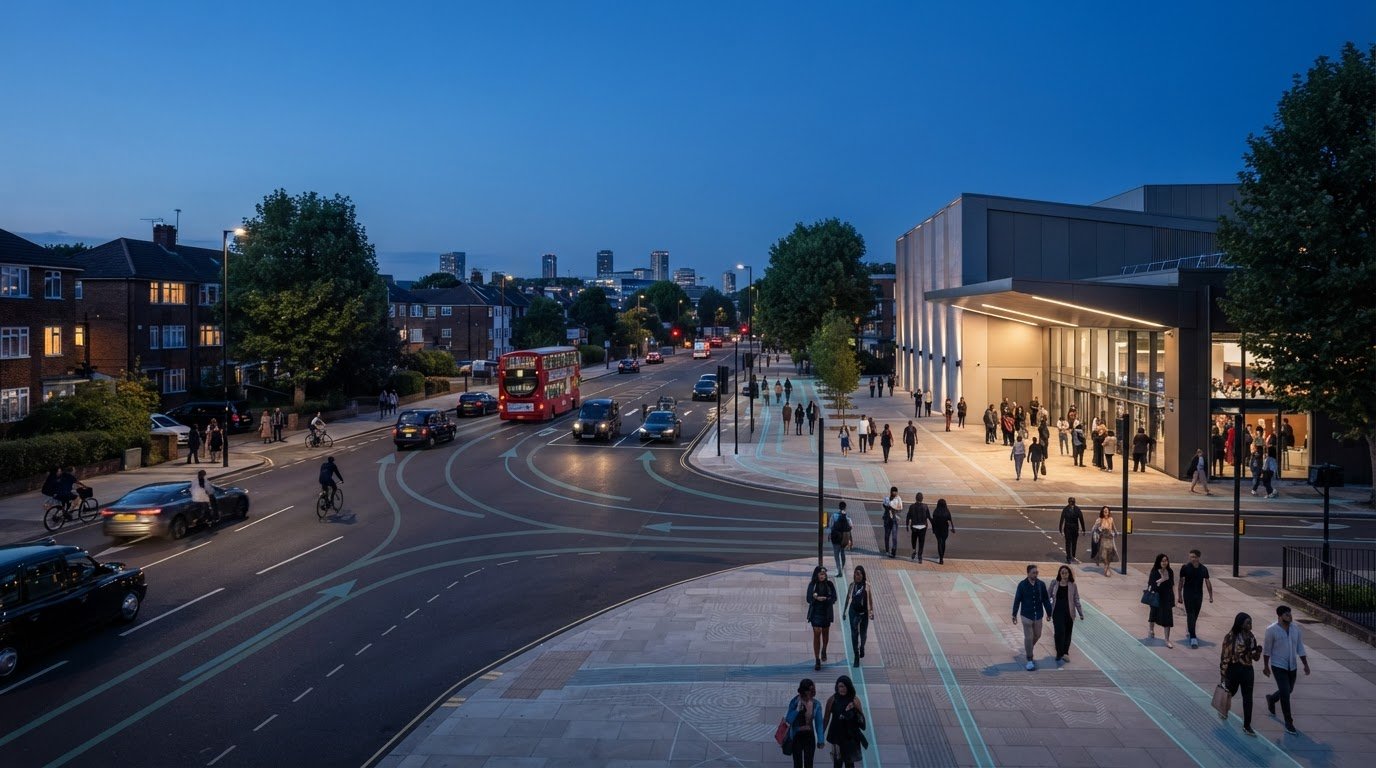
Could the same venue create very different transport impacts on a weekday and during a sold-out evening event? A transport assessment for events venue in Waltham Forest should start with event-specific evidence, not generic traffic assumptions. Attendance, event schedules and visitor travel choices can all affect access, parking, servicing and public transport.
It’s understandable to be unsure what the planning authority will expect, especially when different event formats can produce different travel patterns. The right scope depends on the venue, its location and its likely transport effects. A proportionate assessment can organise relevant evidence for a planning submission, but it cannot guarantee a particular planning decision.
This guide explains what a venue-focused Transport Assessment should examine, when a Transport Statement may be more appropriate, and what site, event and travel information can help. It also covers surveys and other supporting evidence, the importance of current Waltham Forest guidance, and what to consider when appointing a transport consultant. Use it to prepare for a scope discussion and planning application.
Key Takeaways
- Match the report type and level of detail to the proposal and its likely transport effects, then check the scope against current authority guidance.
- A transport assessment for events venue in Waltham Forest should use evidence about the site, event programme and existing travel conditions, not generic assumptions.
- Compare event scenarios by timing and attendance. Assess access, parking, servicing and travel by public transport, walking and cycling in the context of the specific site.
- Before commissioning work, clarify the proposal, agree the assessment scope and ask how relevant evidence will be gathered and analysed.
- Traffic surveys, parking surveys and swept path analysis may support a venue planning application when relevant to the agreed scope.
When does an events venue in Waltham Forest need a transport assessment?
A venue proposal doesn’t automatically require the same transport report as every other venue. The appropriate scope depends on what’s proposed and the likely effects on the surrounding transport network. A transport assessment for events venue in Waltham Forest should be scoped to the actual site and operating plans, not selected using an assumed attendance or trip threshold.
A Transport Assessment examines how a development may affect travel and access, providing evidence to inform the planning decision. A Transport Statement usually provides a more focused account where transport effects are more limited. Neither report type should be chosen by name alone. Consider the venue’s access, event scale, location and operating pattern, along with current authority guidance and the information needed to assess likely effects.
Transport assessment forms part of the wider transportation planning process, which considers how people and goods move through a network. For a venue, that means looking beyond vehicle movements to how the proposal connects with different travel options and the local context.
Transport Assessment or Transport Statement for a venue proposal?
An early scoping discussion can help establish the proportionate level of assessment before evidence is commissioned. Relevant factors may include venue capacity, event types and frequency, arrival and departure patterns, access design, parking provision and proximity to public transport. No single attendance figure determines the answer in every case. For broader background on assessment content, see this London Transport Assessment guide.
Which local authorities and transport bodies may be relevant?
The London Borough of Waltham Forest is the local planning context, so check its current planning guidance and validation requirements for the specific application. Highway consultation may involve the authority responsible for roads affected by the proposal, which can vary by route or access point. Check whether Transport for London or another transport body has a relevant interest in the site or network instead of assuming the same consultees apply to every venue.
Before settling the scope, prepare a clear description of the proposal and identify:
- Where the venue and its access points are located.
- How events will operate, including expected timings and attendance patterns.
- Which nearby routes and transport options may be affected.
Confirm relevant guidance and highway responsibilities early. This gives the assessment a defined purpose and helps avoid collecting evidence that doesn’t address the planning questions for the site.
What evidence should a Waltham Forest venue transport assessment use?
A useful assessment starts with a clear picture of the venue proposal and the transport conditions around it. Bring together:
- Site details: location, site plans, access points, parking and servicing arrangements.
- Proposal details: capacity, event types and frequency, operating hours, and any proposed changes to the site.
- Event travel information: expected attendance, arrival and departure profiles, staffing needs and likely travel patterns.
- Existing conditions: relevant traffic flows, parking occupancy, access constraints, and available public transport, walking and cycling routes.
A Transport Assessment is evidence-led analysis of how a proposed development may affect the transport network and how those effects relate to the site and its users. For an events venue, forecasts should reflect the actual programme rather than assume every event generates the same travel demand. The report should identify its data sources and assumptions, explain gaps or limitations in the available information, and flag details that remain provisional.
Local context matters. Take account of current borough policy and guidance, including Waltham Forest’s Local Implementation Plan, while checking which requirements apply to the specific planning proposal.
What venue and event information should the client prepare?
Provide the latest available site plans and a schedule covering capacity, event types, frequency and operating hours. Add expected arrival and departure patterns, staffing requirements, parking provision and your best estimate of how visitors may travel. Mark unconfirmed figures and plans as provisional. This makes assumptions visible and helps the assessment team consider how changes to the proposal could affect the analysis.
When are traffic or parking surveys useful?
Surveys can help establish existing conditions when published information or initial evidence doesn’t answer the planning questions. Depending on the site, proposal and authority feedback, this could include traffic flows, parking occupancy or observations of access conditions. The assessment should explain why each survey is relevant and how its results inform the analysis. Determine the survey type and timing for the project rather than copying an assumed standard.
Clear evidence lets the reader trace how the assessment moves from observed conditions to event-specific forecasts. For a planning submission, ML Traffic Engineers UK prepares Transport Assessments, Transport Statements and supporting traffic or parking surveys where they fit the agreed scope.
How should the assessment analyse event traffic, parking, and travel choices?
Event impacts depend on timing, travel choices and site context. A sound assessment tests realistic event scenarios rather than relying on one average day or assuming every visitor travels in the same way. Compare event start and finish times, attendance profiles and event frequency, then consider how those patterns could coincide with ordinary peak-hour demand or other nearby activities.
How do event arrival and departure peaks affect the analysis?
Map expected arrivals and departures against the event schedule and relevant local network conditions. A performance with a concentrated arrival period may create a different pattern from an event with staggered entry or a gradual exit. If events could overlap with one another or nearby activities, explain how this is reflected in the scenarios. Keep observed survey evidence separate from forecasts and professional assumptions, so readers can tell what was measured and what was modelled.
Trip-generation tools such as TRICS may help estimate development trips when the method and available comparison sites are suitable. For an events venue, comparators should reflect relevant characteristics such as use and operating pattern. Generic matches may not represent event peaks. State the source, explain why the sites are comparable and note any limitations. Check the latest applicable guidance before relying on a particular method.
How should parking, public transport, and active travel be considered?
Assess parking demand against the venue’s supply and access arrangements, including whether event demand could affect surrounding streets. Consider public transport connections and the routes people would use to walk or cycle, while recognising that practical choices depend on the site and audience. Don’t assume one travel mode suits everyone. Identify location-specific constraints and test whether the proposal’s travel assumptions are credible.
Review servicing at the site too. Consider how service vehicles reach and use the venue, and whether their movements could coincide with visitor arrivals or departures. The aim is to understand how different transport needs interact, rather than assessing each in isolation.
A Travel Plan may support measures to encourage appropriate travel choices and provide a framework for monitoring, where relevant to the proposal. Its role should follow from the assessment’s findings, not depend on broad, untested promises. For more on this planning document, see the guide to Travel Plans for planning applications.
How can you choose the right assessment scope and consultant?
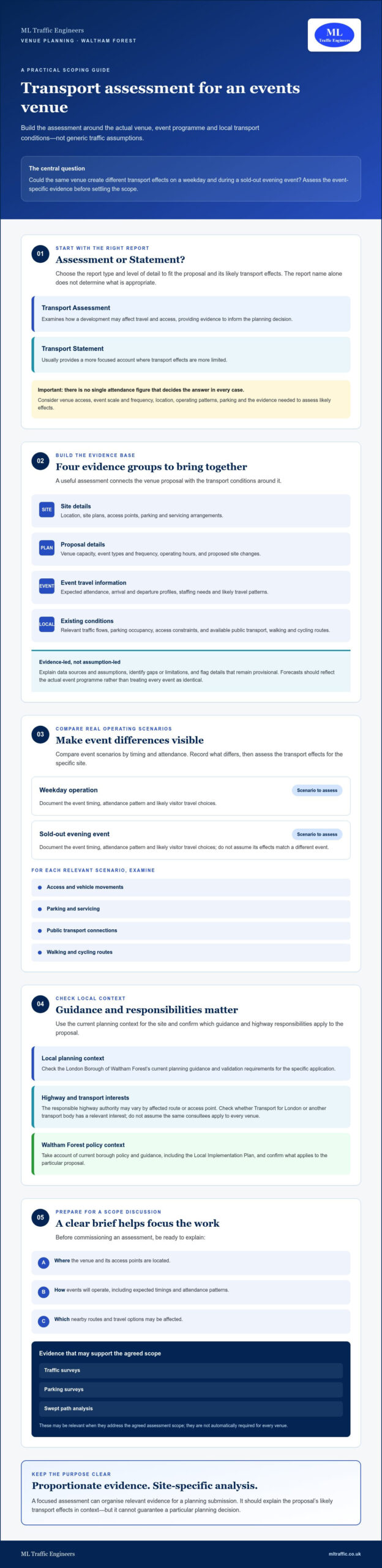
Start with a defined proposal, not a request for a report chosen before its purpose is clear. For a transport assessment for events venue in Waltham Forest, use this sequence to make decisions and responsibilities easier to track:
- Confirm the proposal: assemble the site location and plans, event and operating details, planning status, and relevant authority correspondence.
- Check current guidance: review Waltham Forest’s requirements and identify which highway authority or transport bodies may need to be consulted.
- Agree the scope: establish whether a Transport Assessment or Transport Statement is appropriate and whether supporting evidence is needed.
- Gather information: confirm who will provide site, event and operational data, and whether traffic or parking surveys should be considered.
- Review assumptions: make sure forecasts, data sources, limitations and unresolved details are recorded clearly.
A consultant should explain how the proposed work addresses the planning questions, not simply list standard outputs. Ask about experience preparing transport reports for planning, collecting or analysing relevant data, and addressing requirements for comparable proposals. The aim is a proportionate, evidence-based scope, not the largest possible report.
What should you confirm before requesting a proposal?
Share the site plans and location, proposed capacity, event types and operating pattern, planning status, and any correspondence with the council or highway authority. Ask the consultant to set out the recommended report type, potential survey needs, deliverables, client inputs and dependencies. The proposal should identify anything unknown or provisional so both parties can see which assumptions may need review as the scheme develops.
Which services may support the venue assessment?
A Transport Assessment or Transport Statement can provide transport evidence for a planning application. Depending on the site and agreed scope, traffic or parking surveys may establish existing conditions, while swept path analysis may help examine vehicle movements at the site. These services aren’t automatic requirements. Their relevance should be explained in relation to the proposal. See the consultant’s transport planning services for an overview of its stated work.
If the assessment identifies a role for a Travel Plan, clarify its purpose, proposed measures and any monitoring expectations. The London Travel Plans guide provides further context on how this document may support a planning application.
Before appointing a consultant, confirm the scope, outputs and responsibilities in writing. Discuss your venue transport assessment requirements with ML Traffic Engineers UK as a potential provider of Transport Assessments, Transport Statements, Travel Plans and relevant supporting surveys.
How ML Traffic Engineers UK can support an events venue planning application
A well-scoped transport report brings together the venue proposal, relevant data and transport analysis for a planning application. ML Traffic Engineers UK prepares Transport Assessments, Transport Statements and Travel Plans. The appropriate document depends on the proposal and its likely transport effects, so consider the scope against the site, event programme and current authority guidance.
Supporting evidence can be tailored to the project. Traffic or parking surveys may help establish existing conditions where relevant, while swept path analysis may examine vehicle movements within or accessing the site. These aren’t automatic additions to every commission. The scope should explain why each is needed and how it will inform the planning documentation.
For a transport assessment for events venue in Waltham Forest, clear assumptions matter as much as the report type. Identify the sources of event schedules, attendance information and travel forecasts, and make provisional details and limitations visible. No assessment can guarantee planning permission or a particular authority response. Its role is to present relevant evidence and analysis for consideration of the proposal.
What information helps start an assessment discussion?
Prepare the venue address, a description of the proposal, available site plans, event types and operating details, plus any correspondence with the planning authority or highway authority. Note known questions about access, parking, servicing or public transport. If design or operating decisions are still open, flag them rather than treating them as confirmed. This gives the project review a clear basis for identifying information gaps and discussing a suitable scope.
What happens after the initial project review?
The next step is to clarify the report scope and whether supporting surveys or analysis may be relevant. The agreed work can then organise the available site and event evidence into planning documentation, making sources, assumptions and outstanding information clear. The scope should also set out expected outputs, client inputs and any responsibilities to coordinate as the proposal develops.
To discuss a venue proposal, share the location, available plans, event details and current planning stage with ML Traffic Engineers UK. This provides a starting point for considering appropriate transport evidence without presuming a fixed scope or outcome.
Take the next step towards a well-supported venue application
The right transport evidence depends on the venue, its event programme and the surrounding network. A proportionate assessment should make its assumptions clear and consider how event timing and travel choices may affect access, parking and other transport options. Confirm the scope against current authority guidance before commissioning surveys or analysis.
For a transport assessment for events venue in Waltham Forest, ML Traffic Engineers UK can prepare Transport Assessments, Transport Statements and Travel Plans, with traffic surveys and parking surveys where relevant to the agreed scope. The consultancy supports projects in Greater London, Manchester, Birmingham, the West Midlands, Liverpool, Surrey, East Sussex, West Sussex, Hampshire, Berkshire and Buckinghamshire. No report can guarantee a planning outcome, but clear, project-specific evidence gives an application a sound basis for consideration.
Start with the venue location, available plans, event details and planning stage. Discuss your venue transport assessment with ML Traffic Engineers UK to define a practical scope for your proposal.
Frequently Asked Questions
Does an events venue in Waltham Forest need a Transport Assessment?
Not every venue proposal automatically needs a full Transport Assessment. The appropriate response depends on the development, its likely transport effects and current planning guidance. Check requirements with the London Borough of Waltham Forest and, where relevant, the highway authority responsible for affected routes. A transport consultant can review the venue details and help establish whether a Transport Assessment, Transport Statement or other proportionate response may be suitable.
What should a venue Transport Assessment include?
The scope is project-specific, but it may cover the proposal, event schedules, expected travel demand, access, parking, public transport, walking, cycling and servicing. The assessment should explain the evidence and assumptions behind its analysis, including any limits in the available information. For a transport assessment for events venue in Waltham Forest, use the venue’s actual design and operating plans, and check current authority guidance rather than relying on a generic checklist.
How are traffic impacts from events assessed?
Event traffic analysis considers factors such as event timing, likely arrival and departure patterns, existing network conditions and expected travel choices. Survey data and recognised trip-generation sources may inform forecasts when appropriate to the proposal. The report should distinguish observed evidence from forecast scenarios and professional assumptions. It should explain why the scenarios suit the venue and disclose relevant limitations, so the planning authority can understand how the conclusions were reached.
Is a parking survey needed for an events venue planning application?
Not necessarily. Whether a parking survey is useful depends on the site, proposal, available evidence and questions raised by the relevant authority. A survey may help establish existing parking conditions or inform an assessment, but it isn’t automatically required for every venue. Before commissioning one, clarify its purpose, the area to be covered and suitable survey timing with the consultant, taking account of the planning questions the evidence needs to address.
Can a Transport Statement be enough instead of a Transport Assessment?
Yes, a Transport Statement may be appropriate for some proposals, but no universal rule determines the report type for every venue. Consider the development’s scale and characteristics, likely transport effects and current authority guidance. An early scope review can help identify proportionate documentation and whether supporting evidence, such as traffic or parking surveys, may be relevant. Confirm the proposed scope with the planning authority where appropriate.
What information should I give a transport consultant for a venue assessment?
Provide the site address, available plans, proposal description, expected venue capacity, event frequency and operating hours. Include known access and parking arrangements, relevant planning correspondence and existing survey information, if available. Outline expected arrival and departure patterns and any known public transport or servicing questions. Mark details that aren’t final as provisional. This helps the consultant identify information gaps and explain how assumptions could affect the scope and assessment.
Does a venue Transport Assessment guarantee planning permission?
No. A Transport Assessment provides evidence and analysis about transport matters; it can’t guarantee planning permission or a particular decision. The planning authority considers the full application and relevant planning issues, and may request clarification or further evidence. A well-scoped assessment can help explain the proposal and make its assumptions transparent, but its conclusions aren’t a promise of approval. Keep the report aligned with the submitted scheme and current authority guidance.

Disclaimer
The content on mltraffic.co.uk, including all technical articles, guides, and resources, is provided for general informational and educational purposes only. It is not intended to constitute professional advice in traffic engineering, transportation planning, development approvals, or any other technical or legal field.
While ML Traffic Engineers makes every reasonable effort to ensure the accuracy, completeness, and timeliness of the information published, we do not provide any warranties or representations (express or implied) regarding its reliability, suitability, or availability for any particular purpose. Any reliance you place on the content is strictly at your own risk.
In no event shall ML Traffic Engineers, its directors, employees, authors, or affiliates be liable for any direct, indirect, incidental, special, consequential, or punitive damages (including, without limitation, loss of profits, data, or business opportunities) arising out of or in connection with the use of, or inability to use, any information provided on this website.
The articles and guides on this site are not a substitute for engaging a qualified, professional traffic engineer to assess your specific project requirements. For tailored advice, compliance assessments, or traffic engineering services, please contact a competent professional.
This disclaimer may be updated from time to time without notice. By accessing or using this website, you agree to be bound by the most current version of this disclaimer.