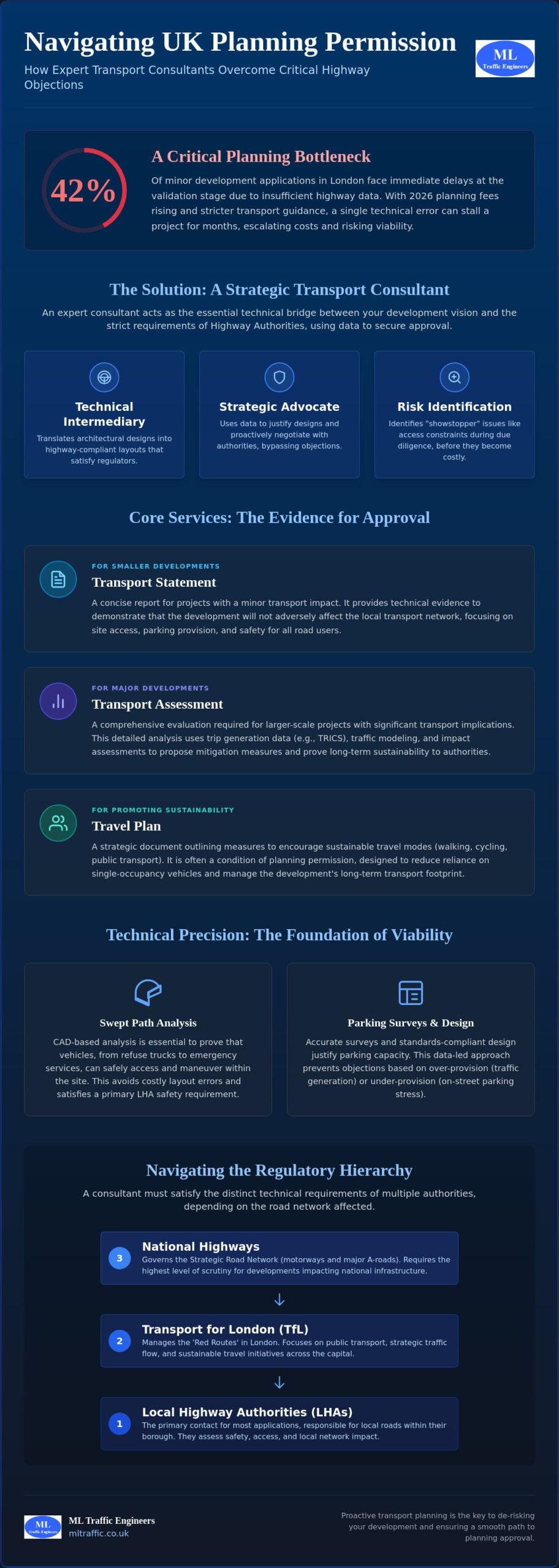
42% of minor development applications in London face immediate delays at the validation stage due to insufficient highway data. This statistic highlights a critical vulnerability in modern site development. In 2026, where planning fees have risen by 3.8% and statutory Local Transport Plan guidance is more stringent than ever, a single technical error in your submission can stall a project for months. Hiring an expert transport planning consultant is no longer just about generating reports. It’s about deploying a strategic negotiator who uses technical data to bypass highway authority objections before they even arise.
You likely understand the frustration of receiving a late-stage objection regarding swept path analysis or parking capacity. These technical hurdles aren’t just inconvenient; they’re expensive. This guide will show you how an expert consultant navigates the current regulatory requirements to secure planning permission through precise Transport Statements and Assessments. We’ll examine the specific technical standards that satisfy highway authorities and ensure your site layout remains functional for vehicle access from day one.
Key Takeaways
- Understand how a transport planning consultant acts as a strategic advocate, translating complex site data into technical arguments that satisfy Local Highway Authorities.
- Identify the specific thresholds for Transport Statements and Assessments to ensure your application aligns with the latest 2026 statutory guidance.
- Learn why CAD-based Swept Path Analysis and accurate Parking Surveys are the essential foundations for proving site viability and avoiding layout errors.
- Navigate the regulatory hierarchy by understanding the distinct technical requirements of local boroughs, Transport for London (TfL), and National Highways.
- Evaluate consultancy partners based on their technical software capabilities and their readiness to provide rapid support for urgent planning deadlines.
What Is a Transport Planning Consultant and Why Do You Need One?
A transport planning consultant serves as the vital technical link between a proposed development and the regulatory framework of the Local Highway Authority (LHA). Their primary objective is to demonstrate that a project’s impact on the local transport network is acceptable, safe, and sustainable. To understand the broader context of this field, it’s helpful to review What is Transportation Planning? and how it shapes infrastructure development. These professionals don’t just fill out forms; they act as strategic intermediaries who resolve the friction between a developer’s vision and the strict requirements of public safety and traffic flow.
In 2026, the stakes for developers are higher than ever. With the publication of new statutory guidance for Local Transport Plans (LTPs) in April 2026, authorities now require more rigorous data on long-term viability and sustainability. Attempting to secure planning permission without a dedicated professional often leads to immediate rejection at the validation stage. This is because modern planning departments demand evidence-backed solutions rather than optimistic assumptions about vehicle movement and site access.
To better understand this concept, watch this helpful video:
Proceeding with a site purchase or architectural design without a transport feasibility study is a significant financial risk. Minor errors in site layout can lead to “showstopper” objections from authorities like Transport for London (TfL) or National Highways. By the time these issues are identified in a formal application, the cost of redesigning or renegotiating can exceed the original consultancy fee by a wide margin. A proactive transport planning consultant identifies these risks before they become expensive liabilities.
The Bridge Between Design and Approval
Architects focus on aesthetics and internal utility, but a consultant ensures those designs work for the real world. They translate architectural visions into highway-compliant layouts that accommodate specific vehicle movements. During pre-application discussions, the consultant acts as your technical advocate. They justify why a specific design is safe for your site, providing the data needed to overturn generic objections that often stall standard applications.
When to Engage a Consultant in the Project Lifecycle
Early engagement is the only way to protect your investment. Waiting until the final submission stage is a common mistake that leads to unnecessary delays. You should involve a consultant during the due diligence phase before land purchase. Identifying access constraints or parking limitations early allows you to integrate a robust transport strategy directly into the initial site masterplan. For more details on navigating these requirements, see our 2026 guide to transport assessments. This proactive approach ensures your project is built on a foundation of technical accuracy.
Core Services: Transport Statements, Assessments, and Travel Plans
A transport planning consultant produces three core documents to satisfy UK planning requirements: Transport Statements, Transport Assessments, and Travel Plans. These reports provide the technical evidence needed to prove that a development won’t negatively impact local traffic flow or safety. All submissions must align with official government transport analysis guidance to ensure they stand up to the scrutiny of highway officers and statutory bodies. Each document serves a distinct purpose based on the scale of your project and its potential impact on the surrounding infrastructure.
Transport Statement vs. Assessment: Which Do You Need?
Determining which report is required depends on the development’s scale and its projected trip generation, often calculated using TRICS data. In London, for example, a Transport Statement London is generally sufficient for residential developments under 50 units or commercial spaces under 1,000 square meters. Once you exceed 80 residential units or 2,500 square meters of commercial floor space, authorities typically mandate a full Transport Assessment.
Thresholds vary by location. In “Sensitive Areas” like Air Quality Focus Areas, a full assessment might be required for as few as 30 units. Scoping the report with a highway officer before submission is a non-negotiable step. This pre-application engagement prevents the high costs of technical errors in site layout. A professional transport planning consultant manages this negotiation to ensure the technical reporting remains cost-effective while meeting every local requirement. If you’re unsure which category your project falls into, reviewing our relevant project types can provide clarity on typical requirements.
The Role of the Travel Plan in 2026
Travel Plans have moved from optional add-ons to essential requirements for satisfying climate emergency mandates and the April 2026 Local Transport Plan guidance. These documents outline the strategy for encouraging walking, cycling, and public transport use over private vehicle trips. In 2026, local sustainability targets are more aggressive. A Travel Plan must include measurable monitoring and management commitments that extend long after planning permission is granted.
These plans often involve ongoing coordination with the local council to ensure the development hits its modal shift targets. Engaging Travel Plan Consultants early in the process ensures that these sustainability commitments are realistic and don’t place an undue operational burden on the future site management. This proactive planning reduces the regulatory pressure on your development team by providing a site layout that actually works for all transport modes.
Technical Precision: Swept Path Analysis and Parking Surveys
Data collection serves as the non-negotiable foundation of any defensible transport report. In 2026, where data collection costs have increased by 15% over the last 24 months, precision is a functional necessity to avoid expensive revisions. A transport planning consultant uses technical surveys to transform a subjective site layout into an objective, safe environment that satisfies highway authority scrutiny. Relying on outdated manual calculations is no longer acceptable; modern authorities demand digital-first submissions that utilize industry-standard simulation software.
The transition to digital data collection methods allows for real-time traffic monitoring and more accurate trip generation models. This technological shift ensures that the evidence presented in your Transport Statement or Assessment is grounded in current reality rather than historical averages. By providing high-fidelity data, you reduce the logistical and regulatory pressures on your development team, ensuring a smoother path through the validation process.
Swept Path Analysis: Proving Site Feasibility
Swept Path Analysis (SPA) is the technical process of simulating vehicle movement within a site using CAD software. It’s often the deciding factor in whether a highway officer approves a site layout. The “Fire Tender Test” is perhaps the most critical application of SPA. It proves that emergency vehicles can reach every building on the site without being obstructed by tight corners or narrow access points. This isn’t just a planning requirement; it’s a fundamental safety benchmark.
Similarly, refuse vehicle maneuvering is a major point of contention for local councils. If your site layout cannot accommodate the turning circle of a standard refuse truck, your waste collection strategy will fail, leading to an immediate objection. Utilizing AutoTURN Swept Path Analysis allows your transport planning consultant to identify these constraints during the design phase. This proactive intervention ensures that your site remains functional for essential services from the moment it’s occupied.
Parking Surveys and the Lambeth Methodology
In high-density or “zero-parking” zones, justifying your parking provision is a complex technical challenge. Parking Surveys provide the empirical evidence needed to overcome objections regarding overspill parking or insufficient capacity. The Lambeth Methodology has become the standardized approach for assessing overnight parking stress. It provides a clear, repeatable framework that highway officers trust, measuring the available kerbside capacity within a specific radius of your development.
This survey data is essential for supporting Public Transport Accessibility Level (PTAL) arguments. If you’re proposing a development with limited parking, you must prove that the local street network can absorb any potential overspill and that the site’s accessibility justifies the reduction. High-quality survey data removes the guesswork from these negotiations, positioning your project as a well-planned contribution to the local area rather than a burden on existing infrastructure.
Navigating the Planning Process: LHAs, TfL, and Statutory Bodies
A transport planning consultant acts as your primary technical advocate during the complex negotiation phase of a planning application. They don’t just submit reports; they manage the relationship between your project and the various statutory bodies that have the power to block it. In 2026, the regulatory landscape is tiered. Local Boroughs manage local road networks, while Transport for London (TfL) oversees the Strategic Road Network (SRN) and larger developments. National Highways maintains authority over motorways and trunk roads. Each body operates under different technical standards, such as the Design Manual for Roads and Bridges (DMRB) for national routes or specific local borough design codes.
Managing the “Highway Objection” is where a consultant provides the most value. When a highway officer raises a technical query regarding trip generation or junction capacity, your consultant provides a data-backed response to prevent a project stall. This rapid response capability is essential for maintaining momentum. Instead of accepting a generic refusal, an expert consultant uses technical evidence to negotiate a middle ground that satisfies safety requirements without compromising site viability.
Effective Pre-Application Engagement
Investing in pre-application advice from the highway authority is a strategic necessity. This stage allows your consultant to set the “Terms of Reference” for the entire project. By agreeing on the scope of the Transport Statement or Assessment early, you avoid the high cost of report revisions later in the process. Establishing this rapport with statutory consultees ensures that when the formal application is submitted, the highway officers are already familiar with the technical justifications for your site layout. This proactive approach significantly reduces the risk of unexpected delays at the validation stage.
Dealing with Section 278 Agreements
If your development requires physical changes to the public highway, you will likely enter into a Section 278 (S278) agreement. This legal mechanism allows developers to fund and execute works on the existing highway, such as new site access points or junction improvements. A transport planning consultant justifies the scale and necessity of these off-site works to ensure you aren’t over-committing to unnecessary infrastructure costs. They also manage Section 38 (S38) agreements for any new roads within the site that you intend the council to adopt.
For a detailed breakdown of technical compliance and legal requirements, refer to our Highway Design S278 & S38 guide. Securing these agreements early prevents late-stage legal hurdles that can delay the commencement of construction. To ensure your project meets every regulatory benchmark from the outset, consider our comprehensive transport planning services for your next development.
Choosing the Right Transport Consultancy Partner
Selecting a transport planning consultant is a decision that directly impacts your project’s timeline and budget. In 2026, where planning fees have risen and technical scrutiny is at an all-time high, you cannot afford a partner who learns on your time. The right consultant must possess a combination of local regulatory knowledge, advanced technical software capabilities, and a proven track record of negotiating with highway authorities. While large multi-disciplinary firms offer a broad range of services, they often lack the agility required for niche development projects. Independent, boutique consultancies provide the dedicated focus needed to navigate specific regional hurdles without the overhead of global operations.
The “ML Traffic Difference” is built on precision and readiness. Founded in 2014, ML Traffic Engineers UK brings over a decade of specialist experience to every project. This longevity in the UK market means we understand the historical context of local road networks and the evolving priorities of statutory bodies. We don’t just produce reports; we provide a fully-managed service that takes a project from initial feasibility through to final approval. This comprehensive support reduces the regulatory pressure on developers, allowing you to focus on the broader aspects of your site’s delivery.
Specialist Knowledge vs. General Engineering
A common mistake is assuming a general civil engineer can handle transport planning. While they understand infrastructure, a dedicated transport planning consultant specializes in the nuances of trip generation, regional parking standards, and the specific technical lexicon used by highway officers. These are distinct disciplines. A specialist anticipates the concerns of the highway officer before they issue a formal objection, providing the technical evidence needed to justify deviations from standard designs or defending a site’s parking provision in highly constrained urban environments.
The Importance of Rapid Response
In the fast-moving environment of UK infrastructure, timing is everything. A delay in responding to a “Regulation 25” request for further information can stall a planning committee decision by months. We prioritize constant accessibility and rapid response capabilities to ensure your deadlines are met. You won’t be passed down to a junior trainee; you get direct communication with senior consultants who own the project outcome. This accountability ensures that technical reporting is both accurate and delivered with the urgency your project demands.
Precision in technical data is your best defense against planning delays. Whether you require a detailed Transport Assessment or a CAD-based Swept Path Analysis, our team is ready to provide the evidence needed for a successful application. Contact ML Traffic Engineers UK today for a project-specific transport strategy review and ensure your site layout is optimized for both approval and long-term functionality.
Secure Your Planning Permission with Technical Precision
Navigating the 2026 planning landscape requires more than just submitting paperwork; it requires a strategic partner who understands the technical demands of highway authorities. By engaging an expert transport planning consultant early in your project lifecycle, you identify potential access constraints before they become costly delays. Precision in technical reporting, from Swept Path Analysis to standardized Parking Surveys, remains the most effective way to satisfy statutory consultees like TfL and local boroughs. These data-driven insights don’t just secure approval; they ensure your site layout works for every vehicle type from day one.
ML Traffic Engineers UK has provided this technical authority since 2014. With over a decade of planning success, we specialize in London and UK-wide transport planning regulations. Our team delivers a comprehensive suite of technical surveys to ensure your site layout is safe, functional, and fully compliant with the latest statutory guidance. We manage the full project lifecycle so you don’t have to navigate the regulatory pressure alone. Take the first step toward a faster planning approval today.
Request a Quote for Your Transport Statement or Assessment
We’re ready to help you secure your next planning approval with confidence and technical excellence.
Frequently Asked Questions
What is the difference between a transport consultant and a highway engineer?
A transport planning consultant focuses on the strategic and regulatory aspects of a development, specifically how it integrates with the existing network. They manage the impact assessments and policy compliance required for planning permission. In contrast, a highway engineer typically focuses on the physical design, structural integrity, and construction of the road infrastructure itself. While their roles overlap during the design phase, the consultant is your primary advocate during the planning process.
When is a Transport Statement required for a planning application in the UK?
A Transport Statement is typically required for smaller-to-medium developments that don’t meet the threshold for a full assessment. In London, this generally applies to residential projects with fewer than 50 units or commercial spaces under 1,000 square meters. However, local authorities have the discretion to request one for smaller sites in sensitive areas. It serves as a concise report demonstrating that the development’s transport impact is minimal and acceptable.
How much does it cost to hire a transport planning consultant?
The cost of hiring a professional depends entirely on the project’s scale, the complexity of the site access, and the specific requirements of the Local Highway Authority. Fees are typically structured based on the technical depth required, such as whether the project needs a simple Statement or a comprehensive Assessment with extensive data collection. Developers should request a project-specific fee proposal once the scope of work has been agreed upon with the local council.
Can a transport consultant help with a planning appeal?
Yes, a consultant plays a critical role in the planning appeal process by providing expert technical evidence to rebut highway-related reasons for refusal. They analyze the authority’s objections and use data, such as traffic surveys or visibility assessments, to prove the development is safe and compliant. Their involvement often involves preparing a Statement of Common Ground or acting as an expert witness during a public inquiry or hearing.
What is Swept Path Analysis and do I really need it?
Swept Path Analysis is a CAD-based simulation that tracks the path of a vehicle as it maneuvers through a site layout. It’s almost always required for any development where large vehicles, such as refuse trucks or fire tenders, must enter and turn around. Without this analysis, you risk a highway objection because the authority cannot verify that emergency or service vehicles can access the buildings safely without striking curbs or structures.
How long does it take to prepare a Transport Assessment?
Preparing a full Transport Assessment usually takes between four to eight weeks, though this timeline depends heavily on the speed of data collection. If the project requires new traffic surveys or junction modeling, the process can take longer. Early engagement with a transport planning consultant ensures that data collection begins immediately, preventing technical reports from becoming a bottleneck in your overall planning application timeline.
What is the TRICS database and why is it used?
TRICS is the industry-standard database used to predict the number of trips a new development will generate. It contains thousands of surveys from existing sites across the UK and Ireland. Consultants use this data to provide a defensible estimate of how many vehicles, cyclists, and pedestrians will visit your site. Highway officers rely on TRICS data because it provides a consistent, evidence-based methodology for assessing a development’s impact on the local network.
How does a transport consultant help with Section 278 agreements?
A consultant helps with Section 278 agreements by justifying the scale of any required off-site highway works and ensuring the technical design meets local standards. They negotiate with the authority to ensure the scope of works is proportional to the development’s impact. By providing accurate technical drawings and safety justifications, they help move the legal agreement forward, allowing you to start construction on the public highway without unnecessary delays.

Disclaimer
The content on mltraffic.co.uk, including all technical articles, guides, and resources, is provided for general informational and educational purposes only. It is not intended to constitute professional advice in traffic engineering, transportation planning, development approvals, or any other technical or legal field.
While ML Traffic Engineers makes every reasonable effort to ensure the accuracy, completeness, and timeliness of the information published, we do not provide any warranties or representations (express or implied) regarding its reliability, suitability, or availability for any particular purpose. Any reliance you place on the content is strictly at your own risk.
In no event shall ML Traffic Engineers, its directors, employees, authors, or affiliates be liable for any direct, indirect, incidental, special, consequential, or punitive damages (including, without limitation, loss of profits, data, or business opportunities) arising out of or in connection with the use of, or inability to use, any information provided on this website.
The articles and guides on this site are not a substitute for engaging a qualified, professional traffic engineer to assess your specific project requirements. For tailored advice, compliance assessments, or traffic engineering services, please contact a competent professional.
This disclaimer may be updated from time to time without notice. By accessing or using this website, you agree to be bound by the most current version of this disclaimer.