
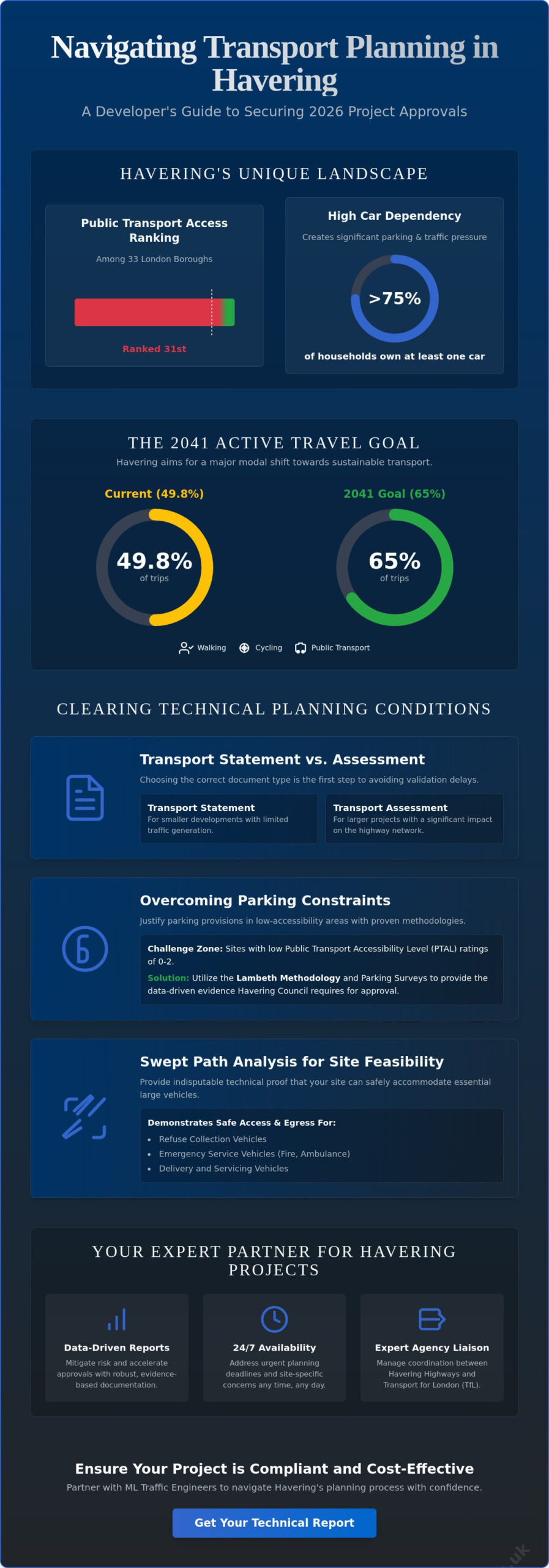
Havering ranks 31st out of 33 London boroughs for public transport access, yet over 75% of households still own at least one car. This creates a high-stakes environment where a single parking overspill objection can stall a multi-million-pound project for months. Engaging expert Transport Planning Consultants Havering ensures your site design meets the 2026-2041 Active Travel Strategy while respecting the borough’s suburban reality. Whether you’re navigating the £261 dropped kerb fee or calculating parking for PTAL 0-2 zones, you need technical authority to back your proposal.
You’ve likely faced the frustration of unclear requirements for Transport Statements or objections regarding refuse vehicle access. We understand that precision is a legal necessity for your 2026 approvals. This guide provides the roadmap to navigate Havering Council’s technical expectations, ensuring your site access is validated and your documentation is cost-effective. You’ll learn how to utilize Swept Path Analysis and Parking Surveys to clear planning conditions and avoid the financial impact of the new lane rental scheme.
Key Takeaways
- Identify the specific development thresholds that dictate whether your project requires a concise Transport Statement or a comprehensive Transport Assessment.
- Navigate Havering’s PTAL variations and utilize the Lambeth Methodology to secure parking approvals in low-accessibility zones.
- Ensure site feasibility through Swept Path Analysis, providing the technical proof planners require for refuse and emergency vehicle access.
- Expert Transport Planning Consultants Havering deliver data-driven reports that mitigate risk and accelerate the 2026 planning approval process.
- Leverage 24/7 availability for urgent traffic surveys and technical documentation to maintain project momentum and meet regulatory deadlines.
Navigating Transport Planning in the London Borough of Havering
Navigating transport planning in the London Borough of Havering requires a dual focus on urban Romford and the semi-rural fringes of Upminster and Ockendon. The Havering Local Plan 2016-2031 sets a clear framework for how development must integrate with existing infrastructure to prevent gridlock. For developers, the transportation planning process is the mechanism used to prove that a project is sustainable and safe. Expert Transport Planning Consultants Havering provide the technical data required to satisfy both Havering Highways and Transport for London (TfL) requirements, ensuring that site access designs are validated before the first brick is laid.
Havering Highways manages local road safety and parking standards, while TfL maintains authority over the strategic Red Route network. A professional consultant manages these separate expectations to prevent conflicting requirements from stalling your approval. This coordination is vital for Romford’s regeneration projects where multi-modal access is a priority. We act as a safe pair of hands, translating complex road regulations into actionable site designs.
Havering’s Unique Transport Landscape
The borough presents a stark contrast in infrastructure. Romford’s high-density urban core requires intense focus on active travel and public transport connectivity. Conversely, developments near the A12 and A127 corridors must account for high-speed traffic flow and safe site egress. The 2026 planning cycle emphasizes the new Active Travel Strategy, which aims for 65% of trips to be made via walking, cycling, or public transport by 2041. This is a significant increase from the current 49.8%. Transport Planning Consultants Havering help you bridge this gap with data-driven site analysis that satisfies these modern sustainability targets.
When to Appoint a Transport Planning Consultant
Don’t wait for a “Request for Further Information” (RFI) to halt your progress. Engaging a consultant during the pre-application stage identifies “showstoppers” like inadequate visibility splays or parking overspill issues early. Whether you’re planning a residential conversion or a commercial change of use, technical compliance is non-negotiable. At ML Traffic Engineers, we provide bespoke transport solutions to ensure your site design is both safe and compliant. Our team remains available 24/7 to address urgent planning deadlines or sudden site-specific concerns, providing a constant sense of readiness for your project.
Transport Statements vs. Assessments: Havering Requirements
Havering Council applies specific thresholds to determine the level of technical scrutiny required for a planning application. Generally, smaller developments that generate limited traffic require a Transport Statement. Larger projects that significantly impact the local highway network trigger a full Transport Assessment. Identifying the correct document early prevents costly delays during the validation phase. Experienced Transport Planning Consultants Havering ensure your submission meets these standards from the outset. These requirements align with Havering’s Local Implementation Plan (LIP), which prioritizes safety and the reduction of congestion across the borough’s road network.
In Romford, which is a designated Air Quality Management Area (AQMA), the council demands rigorous, data-driven reporting. Planners examine how your site contributes to the borough’s target of achieving a 65% modal shift toward sustainable travel by 2041. Transport Planning Consultants Havering provide the technical authority needed to demonstrate that your project won’t compromise local air quality or traffic flow. By presenting clear trip generation data, we alleviate council concerns before they turn into formal objections. High-quality reporting is often the difference between a swift approval and a protracted planning battle.
Transport Statement Components for Havering
A Transport Statement focuses on the immediate impact of your site. It includes a thorough analysis of local transport links, such as proximity to the Elizabeth Line or local bus routes. We use the TRICS database to provide accurate trip generation estimates based on comparable sites. This ensures your data is defensible during council reviews. We handle the entire process, from initial site visits to final report submission. You can find more about our specific report preparation details in our What We Do section.
Full Transport Assessments for Major Developments
Major developments require deeper technical analysis. This involves junction capacity modeling to assess how additional traffic affects local intersections, such as key points along the A12 or A127. We integrate these findings with regional London transport strategies to ensure long-term viability. These assessments are critical for projects that exceed the thresholds outlined in Department for Transport guidance. For a more detailed look at the technical depth required for these reports, see our guide on Transport Assessment London.
Securing the right technical documentation is a vital step in your project’s lifecycle. If you’re unsure which report your project needs, contact our expert engineers for a preliminary site review to keep your timeline on track.
Overcoming Parking Constraints: Lambeth Methodology & PTAL Ratings
Havering presents a unique challenge for developers because it sits on the edge of Greater London. While the London Plan pushes for car-free developments, Havering’s car ownership rate exceeds 75% in most wards. This discrepancy often leads to council objections regarding parking overspill. Expert Transport Planning Consultants Havering bridge this gap by providing robust data that justifies parking levels based on actual local demand rather than generic regional averages. Public Transport Accessibility Level (PTAL) ratings in Zone 6 don’t always reflect the car dependency found in areas like Upminster or Collier Row. A PTAL score of 2 in Havering requires a different justification than the same score in a central borough.
When you propose a development with lower parking provision than the standard 1 to 2 spaces per unit, you must prove the local streets can handle the displaced demand. We use the Lambeth Methodology to conduct these assessments. This framework is the industry standard for quantifying parking stress. It provides a clear, defensible snapshot of street capacity that council officers and local councillors can’t easily dismiss. In areas with PTAL 0-2, the council expects 1 space for a 1-bedroom unit and up to 2 spaces for larger dwellings. Deviating from these 2026 standards requires technical authority to avoid an immediate refusal.
Conducting Parking Surveys in Romford and Hornchurch
A standard parking survey covers a 200-metre walkable radius around your site. We conduct these surveys during peak residential demand, typically between 00:30 and 05:30 on two separate weekday nights. This captures the “worst-case” scenario for parking stress. Our team ensures every legal parking space is accounted for, providing a precise percentage of current occupancy. This level of detail is essential for developments in Romford or Hornchurch, where competition for kerbside space is intense. We deliver validated data that stands up to the most rigorous council scrutiny.
Justifying Parking Deviations to Havering Council
Havering Council often raises concerns about “overspill” impacting existing residents. To counter this, we combine our on-site survey data with the latest car ownership statistics for your specific ward. This dual-layered approach proves whether your proposed parking allocation is realistic for the 2026 planning cycle. If you’re looking for technical examples of how we’ve secured approvals through data, our Parking Surveys resources offer a deeper look at our methodology. By using precise technical reports, Transport Planning Consultants Havering help you avoid the delays associated with parking-related planning refusals.
Securing approval for a low-car development depends on the quality of your technical evidence. Don’t let a generic report jeopardize your project. Our specialists are ready to provide the data-driven support your site requires.
Swept Path Analysis: Ensuring Site Feasibility in Havering
Havering planners require technical certainty that your site layout functions in the real world. Swept Path Analysis (SPA) provides this through digital simulations of vehicle movements. It’s the primary tool we use to prove that fire tenders and refuse vehicles can enter, turn, and exit your site without mounting kerbs or striking structures. Transport Planning Consultants Havering utilize specialized CAD software to plot these movements against your site plan. This technical rigour is essential for 2026 approvals. Without it, your application risks an immediate “Request for Further Information” or a refusal based on highway safety concerns. You can see how we apply these simulations across various project types to secure planning success.
Our engineers use standard UK vehicle templates to ensure accuracy. This includes the 11.2m fire tender and local refuse collection vehicles. By simulating the “worst-case” manoeuvre, we identify potential conflicts before they become expensive construction problems. This precision reflects our commitment to safety and regulatory compliance.
Solving Access Issues in Tighter Romford Sites
Romford’s urban core often involves constrained site entrances and narrow access roads. We use CAD-based SPA to validate site entrance geometries during the design phase. This proactive approach prevents costly redesigns after you’ve submitted your application. If a 11.2m fire tender cannot make the turn into your development, the London Fire Brigade will object. Our engineers identify these conflicts early, allowing you to adjust boundary walls or kerb radii before they become showstoppers. For a deeper dive into these technical requirements, read our guide on Swept Path Analysis Services in London.
Refuse and Service Delivery Planning
Havering’s refuse collection vehicle (RCV) requirements are strict. Planners demand proof that these vehicles can safely manoeuvre within your site boundary to avoid reversing onto the public highway. We simulate the specific turning circles of the borough’s standard RCVs to ensure your turn-around areas are adequate. This is particularly vital for cul-de-sac developments or gated communities. Expert Transport Planning Consultants Havering provide the colour-coded drawings that reduce the risk of “unacceptable impact on highway safety” refusals. Our simulations provide the safe pair of hands you need to navigate these regulatory hurdles.
Securing site feasibility is a non-negotiable step for your 2026 planning application. To ensure your site entrance meets all safety standards, book your swept path analysis with our technical team today.
Why Partner with ML Traffic Engineers for Your Havering Project?
ML Traffic Engineers deliver a total, managed solution for developers navigating the complexities of the London Borough of Havering. We understand that precision is both a physical and legal necessity in modern traffic management. As expert Transport Planning Consultants Havering, we eliminate the regulatory burden by managing the entire lifecycle of your project’s transport requirements. Whether you’re navigating the 2026 lane rental scheme or addressing complex parking justifications in Romford, we act as your dependable partner. Our 24/7 availability ensures that urgent planning deadlines or emergency site surveys never stall your project. We don’t just provide raw data; we provide the technical authority required to secure your 2026 approvals.
Our approach balances technical authority with a customer-centric focus. We aim to alleviate the logistical pressures that often accompany major developments. By positioning ourselves as a safe pair of hands, we ensure that your site analysis is data-driven and defensible. This commitment to precision and compliance is what sets us apart in the high-stakes environment of London planning. We take pride in our professional integrity and our role as guardians of public and worker safety.
Our Technical Expertise in London
Our technical expertise extends to the preparation of Travel Plans that align with the borough’s long-term sustainability goals. These documents are vital for meeting Havering’s target of a 65% modal shift toward active travel by 2041. We also provide comprehensive support for Section 278 (S278) and Section 38 (S38) agreements, facilitating efficient liaison with highway authorities. This ensures that all proposed highway works meet strict safety and design standards from the outset. For a detailed breakdown of how these documents support your planning application, consult our London Travel Plans Guide. We ensure every report is Chapter 8 compliant and reflects our high standard of formal excellence.
Get Started on Your Havering Development
Starting your transport planning early is the most cost-effective way to avoid council objections and parking overspill concerns. We offer a rapid turnaround on Swept Path Analysis and Transport Statements to keep your development timeline on track for 2026. Our technical consultation identifies potential “showstoppers” before they become legal or physical roadblocks during the construction phase. We understand intricate UK road regulations so you don’t have to. Our seamless integration of data collection and professional reporting provides a clear path to planning success. Contact ML Traffic Engineers for a Havering Transport Quote today and benefit from our unwavering reliability and organized expertise.
Secure Your 2026 Havering Planning Approval Today
Havering’s transition toward the 2041 Active Travel targets means the 2026 planning cycle is more rigorous than ever. Success requires more than just meeting basic requirements; it demands technical precision and data-backed justifications. By utilizing specialist CAD-based Swept Path Analysis and the Lambeth Methodology, you provide the council with the certainty they need to grant approval. Expert Transport Planning Consultants Havering act as your safe pair of hands, ensuring every report aligns with the latest Havering Highways and TfL standards.
We provide 24/7 emergency and urgent project availability to keep your development on track. Our team handles the intricate technical liaison so you don’t have to. Don’t let a parking overspill objection or a site access query derail your timeline. Secure your project’s future with professional documentation and expert site analysis that stands up to scrutiny. Precision isn’t just a goal; it’s a legal and physical necessity for your site’s success.
Request a Technical Transport Consultation for Your Havering Project to ensure your site is ready for the next phase of development. We look forward to helping you achieve a seamless planning outcome.
Frequently Asked Questions
Do I need a Transport Statement for a small residential development in Romford?
Yes, most residential developments in Romford require a Transport Statement if they don’t meet the higher thresholds for a full Assessment. Because Romford is a designated Air Quality Management Area, planners scrutinize even small sites for their impact on local congestion. Our Transport Planning Consultants Havering provide the specific trip generation data required to satisfy these local environmental and highway safety standards.
What is the PTAL rating for my site in Havering and why does it matter?
PTAL stands for Public Transport Accessibility Level, ranging from 0 (worst) to 6b (best). It dictates the maximum and minimum parking spaces allowed for your site under the London Plan. In Havering, where many areas are PTAL 0-2, you must provide more car parking than in Central London to prevent local overspill. We use current 2026 TfL data to verify your site’s exact rating.
How long does a parking survey take to complete in Havering?
A standard parking survey typically takes two separate weekday nights to complete. We conduct these between 00:30 and 05:30 to capture the peak residential parking stress as required by the Lambeth Methodology. Once the data collection is finished, our engineers process the results into a professional report within 5 to 7 working days to meet your planning deadline.
Will Havering Council accept a parking survey from any consultant?
Havering Council only accepts surveys that demonstrate technical rigour and adhere to recognized standards like the Lambeth Methodology. Reports must be defensible and based on accurate, on-site data collection rather than estimates. We ensure every survey is conducted by trained technicians and validated by experienced engineers to minimize the risk of council objections or requests for further information.
Is Swept Path Analysis required for fire tender access on private drives?
Yes, Swept Path Analysis is mandatory for demonstrating that a 11.2m fire tender can safely access and turn within private drives. Building Regulations Part B and London Fire Brigade standards require functional access for emergency vehicles. We use CAD-based simulations to prove your site layout works, preventing a refusal based on safety grounds during the 2026 planning cycle.
What happens if my development exceeds Havering’s parking standards?
If your development exceeds the maximum parking standards, you’ll likely face objections from TfL or council officers aiming for a 65% modal shift to sustainable travel. In these cases, you must provide a robust justification or a comprehensive Travel Plan to mitigate the impact. We analyze local car ownership statistics and census data to build a technical case for your specific parking allocation.
Can ML Traffic Engineers help with Section 278 agreements in London?
We provide the essential technical documentation and highway authority liaison required for Section 278 (S278) agreements. While we don’t manage physical road construction, our engineers ensure your site access designs and traffic impact reports meet the legal standards for works on the public highway. This coordination is vital for projects involving new junctions or improved pedestrian crossings in Havering.
How much does a Transport Statement typically cost for a Havering project?
The cost of a Transport Statement depends on the specific scale and complexity of your project. Factors such as the number of residential units or the requirement for additional traffic surveys influence the final price. For an accurate, no-obligation quote tailored to your Havering development, we recommend contacting our technical team for a consultation to avoid overpaying for unnecessary documentation.

Article by
Michael Lee
Transport planner with over 35 years’ experience.
Disclaimer
The content on mltraffic.co.uk, including all technical articles, guides, and resources, is provided for general informational and educational purposes only. It is not intended to constitute professional advice in traffic engineering, transportation planning, development approvals, or any other technical or legal field.
While ML Traffic Engineers makes every reasonable effort to ensure the accuracy, completeness, and timeliness of the information published, we do not provide any warranties or representations (express or implied) regarding its reliability, suitability, or availability for any particular purpose. Any reliance you place on the content is strictly at your own risk.
In no event shall ML Traffic Engineers, its directors, employees, authors, or affiliates be liable for any direct, indirect, incidental, special, consequential, or punitive damages (including, without limitation, loss of profits, data, or business opportunities) arising out of or in connection with the use of, or inability to use, any information provided on this website.
The articles and guides on this site are not a substitute for engaging a qualified, professional traffic engineer to assess your specific project requirements. For tailored advice, compliance assessments, or traffic engineering services, please contact a competent professional.
This disclaimer may be updated from time to time without notice. By accessing or using this website, you agree to be bound by the most current version of this disclaimer.