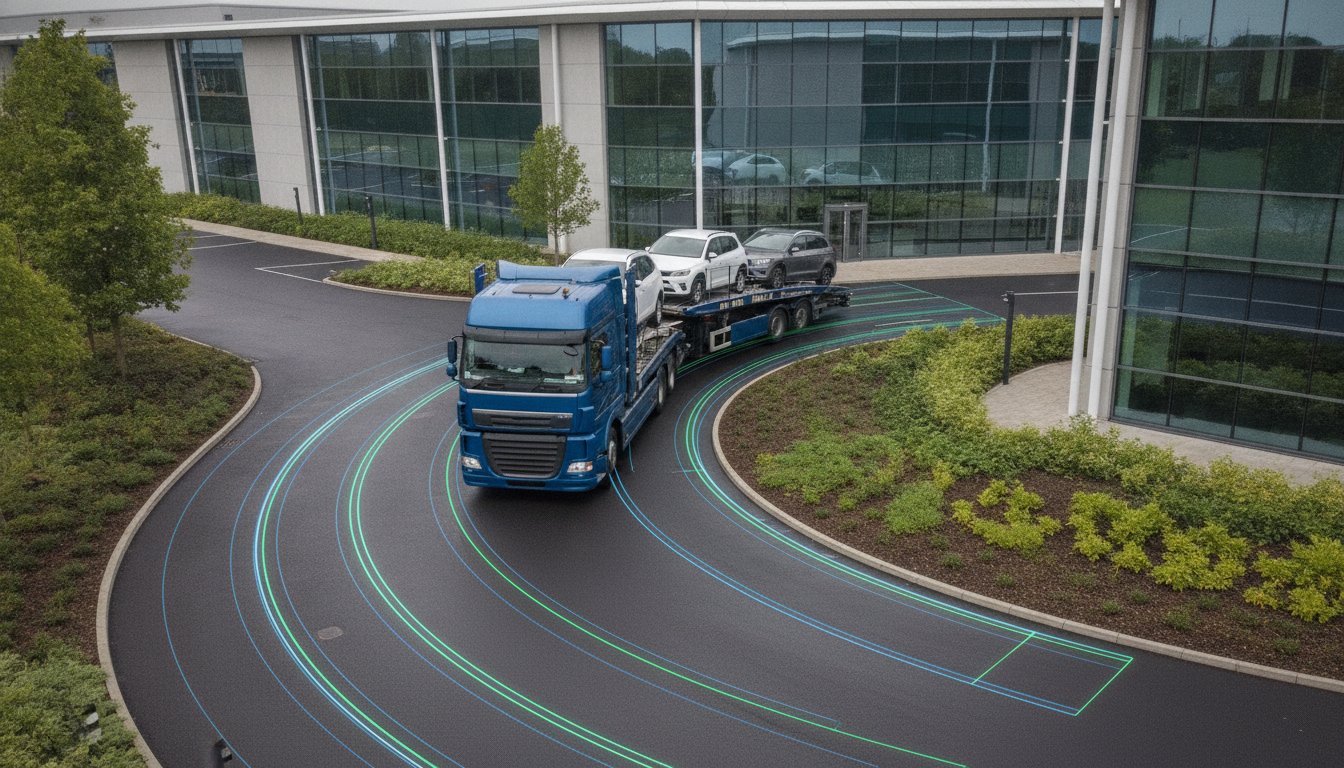
Using a standard HGV template for your automotive development is the fastest way to ensure a planning rejection from the Local Highway Authority. While a typical semi-trailer has a 2.04-metre front overhang, a car transporter’s unique geometry extends to 4.19 metres from the kingpin axis. This discrepancy means generic simulations fail to account for the actual swing of the vehicle. If your swept path analysis for car transporters UK doesn’t reflect these specific legal dimensions, you risk costly site redesigns or complete project failure.
We understand that navigating the Road Vehicles (Construction and Use) Regulations 1986 is a high-stakes task where precision is a functional necessity. You need a layout that maximizes every square metre of land without compromising on safety or operational flow. This guide helps you master the technical requirements for car transporter maneuverability to secure site approval for UK automotive developments. We will detail the essential vehicle templates for 2026, the software standards for Transport Statements, and the exact methodology required to satisfy highway officers the first time around.
Key Takeaways
- Learn why the unique 18.75m length and significant front swing of car transporters make standard HGV templates insufficient for accurate planning.
- Understand how to integrate a precise swept path analysis for car transporters UK into your Transport Statement to meet National Planning Policy Framework requirements.
- Identify design standards for gate widths and entrance radii that allow for seamless vehicle movement while maximizing available site area.
- Discover how to position dedicated unloading zones to maintain site safety and prevent interference with customer parking or pedestrian routes.
- Master the technical documentation process using industry-standard AutoTURN software to avoid planning delays and expensive post-construction modifications.
Understanding Swept Path Analysis for Car Transporters in the UK
Swept Path Analysis (SPA) is a computer-aided simulation that maps the precise movement of a vehicle through a site. It’s a technical requirement for any development involving heavy logistics. For automotive sites, a professional swept path analysis for car transporters UK is vital. It proves that these oversized vehicles can enter and exit without striking street furniture or mounting kerbs. We use this data to validate site layouts before ground is even broken.
Multiple stakeholders rely on these technical drawings. Planning officers use them to ensure public safety. Highway engineers check them to prevent damage to the road network. Architects need them to maximize the usable space on a tight site. The primary goal is demonstrating safe ingress and egress. If your drawings don’t show clear passage without encroaching on footways, your application will likely face delays or rejection.
To better understand how these simulations function in a digital planning environment, watch this demonstration of the technology:
What is a Swept Path?
A swept path represents the total “envelope” of space a vehicle occupies during a specific manoeuvre. It’s more than just a turning circle. You must distinguish between the wheel path, which tracks the tyres, and the body swept path, which accounts for the front and rear overhangs. Car transporters require significantly larger safety margins than standard rigid vehicles. Using advanced vehicle swept path analysis software ensures these margins are calculated with millimetre precision, protecting both the vehicle and the site infrastructure.
Why Transporters are Unique
Car transporters are a special case in traffic engineering because they don’t behave like standard HGVs. Their geometry is complex. A transporter semi-trailer can have a kingpin-to-rear length of 12.5 metres, but it’s the front swing that creates the most risk. The distance from the kingpin axis to the front can be up to 4.19 metres, which is nearly double the 2.04 metres found on a standard articulated lorry. This creates a massive “sweep” that can easily strike nearby objects if the site isn’t designed correctly. Their low-ground clearance also makes them sensitive to vertical changes in the road surface. ML Traffic Engineers uses specialized AutoTURN software to model these multi-articulated templates accurately, ensuring your site remains functional for all expected vehicle types.
The Unique Geometry of Car Transporters: Why Standard HGV Templates Fail
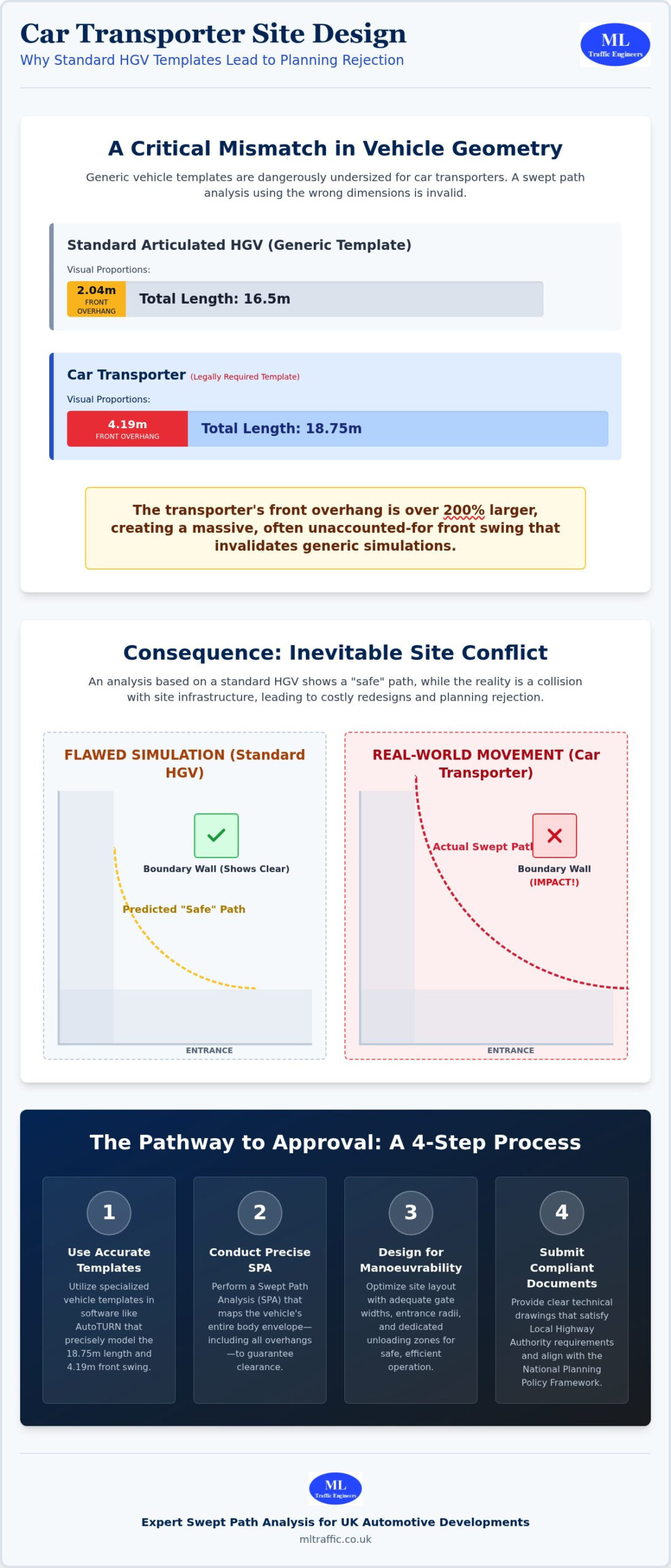
Relying on generic vehicle templates is a common pitfall in site design that leads to immediate technical objections. While a standard articulated lorry typically follows standard UK HGV dimensions of 16.5 metres, a car transporter often reaches a total length of 18.75 metres. This difference of over two metres fundamentally changes how the vehicle interacts with a site layout. If your swept path analysis for car transporters UK uses an undersized template, the resulting drawings will be technically flawed and likely rejected by highway officers during the consultation phase.
The primary risk lies in the specific front swing and rear kick-out characteristics that define these vehicles. As established, the 4.19-metre front overhang is nearly double that of a standard HGV. During a tight turn, this section swings wide, creating a massive arc that can strike boundary walls or street furniture. ML Traffic Engineers UK uses AutoTURN software to create bespoke vehicle profiles that reflect these exact dimensions, ensuring that every simulation represents real-world conditions rather than a theoretical average that fails to account for these extreme sweeps.
Articulation and Pivot Points
The coupling point of a transporter dictates its entire turning circle and determines how much space is required for safe passage. Semi-trailers pivot at the kingpin, but many UK car carriers utilize drawbar configurations with multiple articulation points. These multi-articulated vehicles behave differently during low-speed manoeuvres, often exhibiting a pronounced cut-through effect on tight UK junctions. This effect occurs when the rear axles follow a significantly tighter path than the tractor unit, requiring wider entrance radii to prevent the trailer from mounting the kerb. To ensure your technical drawings meet these rigorous standards, you can review our practical guide to AutoTURN simulations.
Overhangs and Loading Ramps
Loading ramps and top decks add another layer of complexity to site planning that standard templates ignore. During on-site manoeuvres, extended ramps increase the effective length of the vehicle, creating a rear kick-out that can sweep across adjacent parking bays or pedestrian walkways. Sloped dealership entrances also present vertical clearance challenges. Because car transporters have exceptionally low ground clearance, they are prone to grounding out on steep transitions or sudden changes in gradient. ML Traffic Engineers UK prioritizes worst-case scenario modelling as the gold standard for UK planning. This approach accounts for the vehicle at its maximum extension and lowest clearance, providing a safety-conscious design that protects your infrastructure from day one. For precise technical support with your site layout, contact the experts at ML Traffic Engineers UK to secure a reliable assessment.
Navigating UK Planning Requirements for Vehicle Manoeuvrability
A professional swept path analysis for car transporters UK isn’t just a supporting document; it’s the technical backbone of your formal submission. Under the National Planning Policy Framework (NPPF), developers must prove that safe and suitable access is achievable for all site users. For automotive developments, this requires a detailed simulation within a Transport Statement or Assessment. These documents provide the necessary evidence that your site can handle high-frequency logistics without compromising the surrounding road network.
The choice of design standards often dictates the success of an application. “Manual for Streets” usually applies to urban dealership environments where pedestrian interaction is frequent. Conversely, the “Design Manual for Roads and Bridges” (DMRB) governs larger logistics hubs near trunk roads. We provide technical drawings in standard 1:200 or 1:500 scales, featuring precise tracking overlays. These overlays show the exact path of the tractor unit and trailer, ensuring that the proposed geometry accommodates the vehicle’s full range of motion.
Local Highway Authority Expectations
Council officers prioritize the protection of public infrastructure and pedestrian safety. They scrutinize drawings for “kerb strikes” where the vehicle body or wheels overhang onto the footway. Another critical requirement is the demonstration of two-way flow. Officers need to see if a car transporter can safely pass an oncoming vehicle on the access road. If the simulation shows the transporter straddling both lanes, the authority may mandate a wider road design. For developers working in the capital, our Transport Statement London Guide details the specific requirements unique to the city’s constrained road network.
Common Reasons for Planning Refusal
Inadequate manoeuvrability data is a frequent cause of planning delays. Rejections often occur when a site layout fails to provide sufficient clearance for emergency vehicles while a transporter is in its unloading position. Blocking the public highway during reversing manoeuvres is another major red flag for highway officers. Finally, using inaccurate vehicle templates that don’t account for the 18.75-metre length and 4.19-metre front swing of modern car carriers will lead to immediate technical failure. Precision in these drawings is a functional necessity to avoid costly redesigns after a site is built.
Best Practices for Designing Car Dealerships and Logistics Hubs
Translating technical dimensions into a functional site layout requires strategic spatial planning. For 11-car transporters, optimizing gate widths and entrance radii is the first step in preventing structural damage. While a standard 10-metre radius might suffice for smaller HGVs, car carriers often require bespoke adjustments to account for their extended 18.75-metre length. A precise swept path analysis for car transporters UK allows you to define the exact footprint required for safe movement, ensuring that gates and boundaries are positioned with millimetre accuracy.
Dedicated unloading zones are a non-negotiable requirement for modern site safety. These zones must operate independently of customer parking and pedestrian thoroughfares to avoid operational conflicts. Incorporating turning heads is equally vital; this ensures transporters can exit the site in a forward gear, which is a primary requirement for most Local Highway Authorities in England. You must also account for vertical geometry. Car transporters feature exceptionally low belly-clearance, meaning even minor gradient changes at entrance thresholds can cause grounding. We model these transitions in 3D to ensure the site remains accessible under all loading conditions.
Dealership Access and Forecourt Layout
In high-value retail environments, every square metre of display space counts. Squeezing the swing space required for deliveries often leads to planning rejections or operational gridlock. We use SPA to justify narrower access roads through precision engineering, proving to officers that the vehicle remains within its designated envelope. This data-driven approach allows for a layout that maximizes commercial potential without compromising on logistics. You can see how we apply these principles across various ML Traffic Project Types to achieve planning success.
Logistics and Distribution Centres
Logistics hubs face the challenge of high-frequency transporter movements and multi-vehicle operations. Site capacity must be proven through simulations that show multiple transporters can navigate the yard simultaneously. Safety is paramount, requiring clear segregation between heavy vehicle paths and pedestrian routes. A robust swept path analysis for car transporters UK provides the evidence needed to satisfy the Health and Safety Executive (HSE) and local planners that your facility can operate at peak capacity without risk. To ensure your site design meets these rigorous technical standards, request a professional swept path analysis from ML Traffic Engineers UK today.
Expert Swept Path Analysis Services by ML Traffic Engineers UK
ML Traffic Engineers UK streamlines the technical documentation process to ensure your automotive development moves from concept to construction without regulatory friction. Our workflow begins with your CAD site plans, which we import into industry-standard AutoTURN software. We then apply bespoke vehicle profiles that reflect the exact 18.75-metre length and 4.19-metre front swing of modern car carriers discussed in previous sections. This meticulous approach produces a high-fidelity swept path analysis for car transporters UK that forms the technical core of your Transport Statement or Assessment. By integrating these services, we provide a unified evidence base that demonstrates site functionality to even the most demanding highway authorities.
Why Precision Matters in 2026
Planning authorities across England have significantly increased their scrutiny of vehicle access over the last decade. In 2026, a generic HGV simulation is no longer sufficient to secure approval for specialized automotive sites. Professional SPA drawings act as a universal language that builds immediate trust with Highway Officers. They show that you’ve considered the high-stakes environment of heavy logistics and have prioritized public safety. We understand that planning deadlines are often tight and unpredictable. Our team maintains a commitment to rapid turnaround times, ensuring you have the technical proof required to meet your submission dates without delay.
Securing Your Planning Approval
Our technical analysis serves as a vital safeguard against the risk of planning refusal or expensive post-construction modifications. We identify potential pinch points early in the design phase, allowing for minor adjustments that prevent major logistical failures later. While we provide nationwide coverage across the UK, we possess deep expertise in navigating the unique constraints of metropolitan areas. For developers working in high-density urban environments, our Swept Path Analysis Services London page offers specific insights into securing approval within the capital’s complex road network.
ML Traffic Engineers UK stands ready to act as your dependable technical partner throughout the full project lifecycle. We take immense pride in our adherence to industry benchmarks and our ability to reduce the regulatory pressure on our clients. Whether you’re developing a single dealership or a national logistics hub, our expert simulations provide the precision your project demands. Contact our team today to discuss your site requirements and receive a project-specific fee proposal for your next swept path analysis for car transporters UK.
Secure Your Automotive Development Success
Precision is a non-negotiable requirement for automotive site design. Standard HGV templates simply don’t account for the unique 18.75-metre length and extreme front swing of specialized car carriers. Failing to model these movements accurately leads to kerb strikes, operational bottlenecks, and avoidable planning rejections. A professional swept path analysis for car transporters UK provides the technical certainty needed to satisfy Local Highway Authorities while maximizing your site’s commercial potential.
ML Traffic Engineers brings over 10 years of transport planning expertise to your project. We deliver specialized AutoTURN vehicle simulations that support planning applications across England, ensuring your site is both safe and functional. Our team is ready to help you navigate intricate regional regulations with ease. Request a Swept Path Analysis Quote from ML Traffic Engineers to secure your project’s approval. We’re committed to your success through technical excellence and unwavering reliability.
Frequently Asked Questions
What is the standard size of a car transporter for SPA in the UK?
A standard articulated car transporter in the UK typically measures up to 18.75 metres in total length. For a precise swept path analysis for car transporters UK, we model a semi-trailer with a maximum kingpin-to-rear length of 12.5 metres. A critical dimension is the front overhang, which can extend 4.19 metres from the kingpin axis. These specific legal dimensions ensure the simulation reflects the vehicle’s true turning envelope.
Do I need a swept path analysis if my dealership already exists?
You generally require an updated analysis if you are submitting a planning application for site alterations, building extensions, or changes to access arrangements. Even for established dealerships, Local Highway Authorities in England often demand proof that modern, larger transporters can still safely manoeuvre without overrunning footways. Providing a current simulation helps mitigate the risk of enforcement action or planning delays during site upgrades.
Can a car transporter reverse into a site from a main road?
Reversing from a main road is strongly discouraged by UK highway authorities due to significant safety risks and potential traffic disruption. Planning officers almost always require site layouts that allow transporters to enter and exit in a forward gear. If your site is constrained, we use swept path analysis to design internal turning heads or dedicated unloading zones that facilitate safe, forward-facing movements, ensuring compliance with local safety benchmarks.
What software is used for car transporter swept path analysis?
ML Traffic Engineers utilizes industry-standard AutoTURN software to perform high-precision simulations. This tool is the benchmark for UK planning applications because it allows for the creation of bespoke vehicle profiles. Unlike generic templates, AutoTURN enables us to model the complex multi-articulation and specific front-swing characteristics of modern car carriers. This ensures the technical drawings we produce for your Transport Statement are accurate and reliable.
How much clearance is required between the vehicle and the kerb in a simulation?
While there is no single statutory figure, a safety margin of 300mm to 500mm between the vehicle’s body envelope and the kerb line is standard practice in England. This buffer accounts for driver error and minor variations in vehicle positioning. In a professional swept path analysis for car transporters UK, we demonstrate that the vehicle can complete its manoeuvre without any part of the body or wheels striking street furniture or mounting the footway.
Will the council accept a simulation using a standard 16.5m articulated lorry template?
It’s highly unlikely that a council officer will accept a standard 16.5-metre articulated lorry template for an automotive development. Car transporters have a unique geometry, specifically a much larger front overhang and a total length reaching 18.75 metres. Using an undersized template is a technical error that often leads to immediate planning refusal. We provide bespoke simulations that reflect the actual vehicles servicing your site to build trust with the authority.
What information do I need to provide for a swept path analysis quote?
To provide an accurate fee proposal, we require a scaled site layout plan, ideally in AutoCAD (DWG) format. You should also specify the largest vehicle expected to service the site, such as an 11-car transporter. Details regarding the intended access points and any specific unloading zones help us tailor the analysis. This information allows our engineers to assess the complexity of the project and provide a rapid response for your planning deadline.
How long does it take to produce a car transporter SPA report?
We prioritize rapid turnaround times to help you meet strict planning submission deadlines. Once we receive your CAD site plans and vehicle requirements, we typically produce the technical drawings and supporting report within 3 to 5 working days. Our efficient workflow, utilizing the latest AutoTURN software, ensures you receive precise, professional documentation without unnecessary delays. This readiness allows your project to progress through the planning system with technical confidence.

Disclaimer
The content on mltraffic.co.uk, including all technical articles, guides, and resources, is provided for general informational and educational purposes only. It is not intended to constitute professional advice in traffic engineering, transportation planning, development approvals, or any other technical or legal field.
While ML Traffic Engineers makes every reasonable effort to ensure the accuracy, completeness, and timeliness of the information published, we do not provide any warranties or representations (express or implied) regarding its reliability, suitability, or availability for any particular purpose. Any reliance you place on the content is strictly at your own risk.
In no event shall ML Traffic Engineers, its directors, employees, authors, or affiliates be liable for any direct, indirect, incidental, special, consequential, or punitive damages (including, without limitation, loss of profits, data, or business opportunities) arising out of or in connection with the use of, or inability to use, any information provided on this website.
The articles and guides on this site are not a substitute for engaging a qualified, professional traffic engineer to assess your specific project requirements. For tailored advice, compliance assessments, or traffic engineering services, please contact a competent professional.
This disclaimer may be updated from time to time without notice. By accessing or using this website, you agree to be bound by the most current version of this disclaimer.