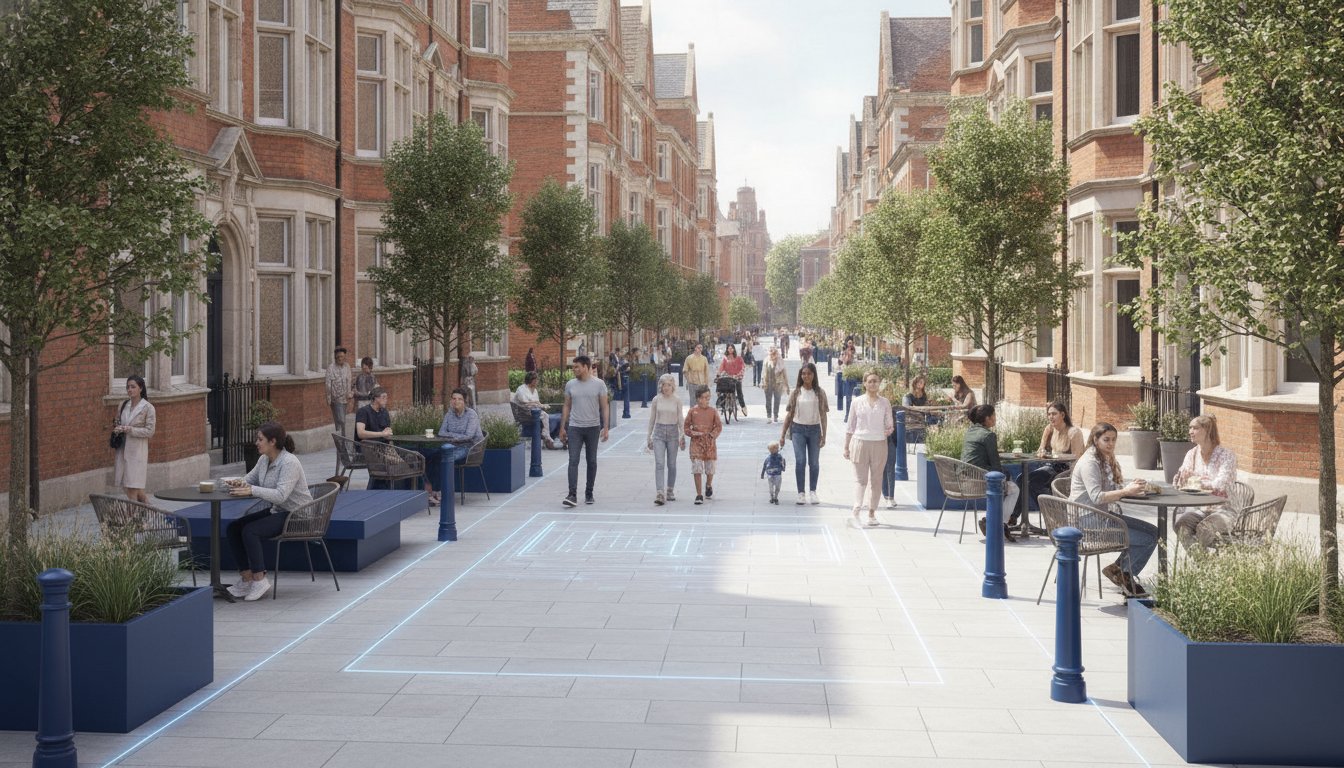
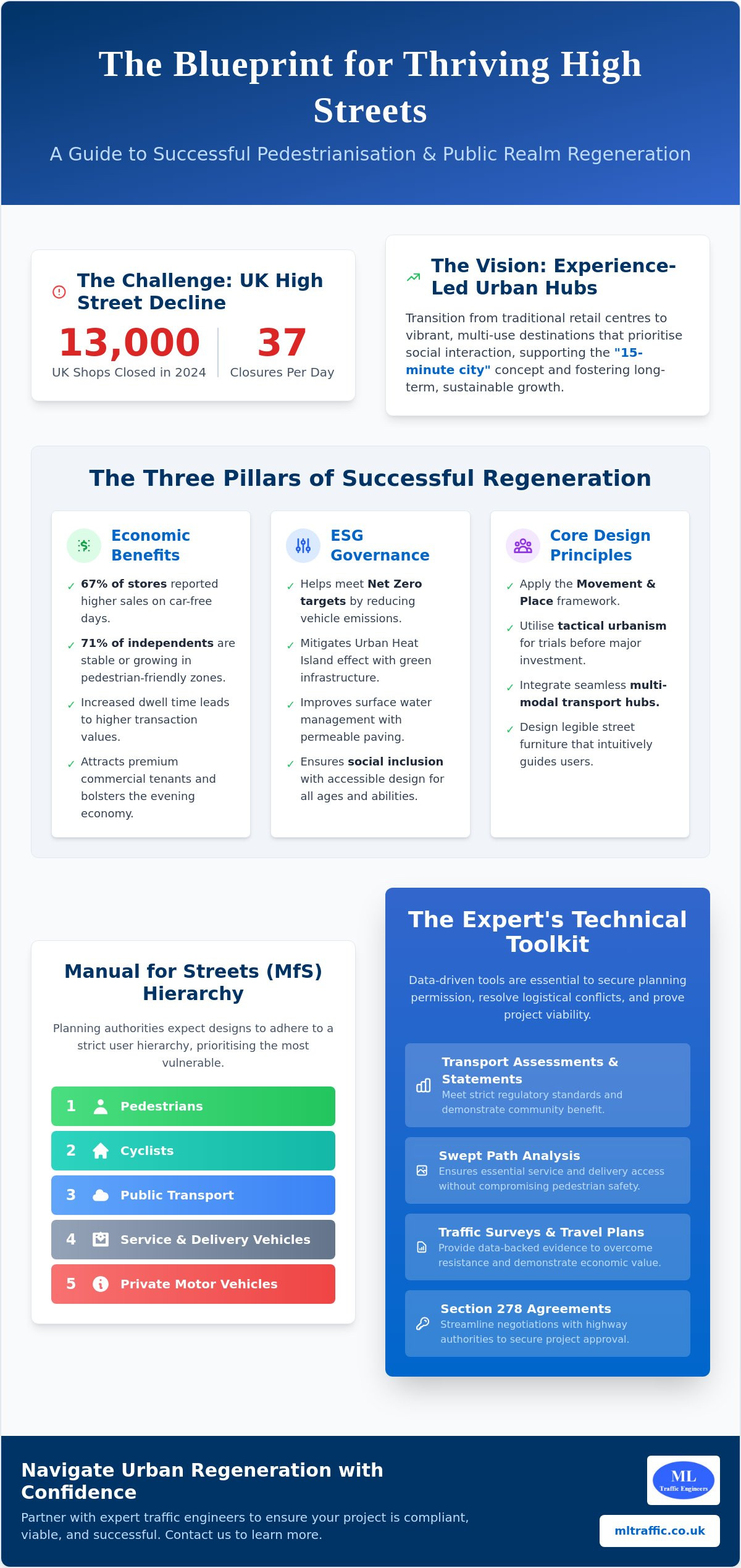
With nearly 13,000 UK shops closing in 2024 at a rate of 37 per day, the survival of town centres depends on more than just aesthetic upgrades. Effective pedestrianisation high street public realm design and regeneration requires a precise balance between creating inviting spaces and maintaining the logistical integrity of the surrounding urban network. It’s not enough to simply remove cars; you must ensure the scheme remains accessible, compliant, and economically viable for all stakeholders.
You’ve likely faced resistance from local businesses worried about car-free schemes or concerns that traffic will simply displace into residential zones. These logistical pressures are significant, but they shouldn’t stall progress. This article explains how to transform declining high streets into thriving, pedestrian-first spaces while navigating technical complexities like Section 278 negotiations and traffic displacement. We’ll explore how data-driven tools, including Swept Path Analysis and professional Transport Assessments, provide the evidence needed to secure planning permission and increase property value. You’ll gain a clear roadmap for creating a safe, accessible urban environment that meets the latest government standards and supports long-term growth.
Key Takeaways
- Understand why successful high street regeneration in 2026 relies on transitioning from traditional retail centres to diverse, experience-led urban hubs.
- Master the technical complexities of pedestrianisation high street public realm design and regeneration to ensure your scheme balances increased footfall with efficient traffic management.
- Resolve logistical conflicts by using timed delivery windows and Swept Path Analysis to maintain essential service access without compromising pedestrian safety.
- Streamline the planning process by leveraging professional Transport Statements and Travel Plans to meet strict regulatory standards and secure S278 agreements.
- Use precise Traffic Surveys to provide the data-backed evidence needed to overcome political resistance and demonstrate the long-term economic value of your project.
High Street Regeneration: Why Pedestrianisation is Essential in 2026
Urban regeneration in 2026 isn’t about simple cosmetic fixes; it focuses on the strategic repurposing of the public realm to combat the decline of traditional retail. Pedestrianisation serves as the primary mechanism for this shift. By transforming vehicle-dominated corridors into pedestrian zones, local authorities and developers create “experience hubs” that prioritize social interaction over mere transactions. This approach directly supports the “15-minute city” concept, where residents access essential services within a short walk or cycle. Successful planning applications now frequently rely on this model to demonstrate community benefit and long-term sustainable growth.
To better understand the global standards for these projects, watch this helpful video:
The Economic Case: Beyond the Pedestrian Pound
The link between footfall and retail spend is well-documented. On a traffic-free day in September 2025, 67% of Oxford Street stores reported higher sales. When people feel safe and comfortable, they stay longer. Increased dwell time directly correlates with higher transaction values in hospitality and retail. For developers, high-quality public realm design attracts premium commercial tenants who value long-term stability and access to high-quality maintenance; for reliable heating and gas services, check out Plumbing & Boilers London. Data from the Voices of Retail 2026 report shows that 71% of independent retailers are now stable or growing. These businesses thrive in environments where pedestrianisation high street public realm design and regeneration are prioritized, as it creates a destination rather than just a thoroughfare. This shift also bolsters the evening economy, turning quiet retail streets into vibrant hospitality zones after 6:00 PM.
Environmental and Social Governance (ESG) in Urban Design
Modern regeneration must address Net Zero targets. Removing cars reduces local emissions and allows for the installation of green infrastructure. This helps mitigate the “Urban Heat Island” effect through strategic planting and permeable paving, which also manages surface water runoff. Social inclusion is equally vital. A compliant public realm must be accessible to all ages and abilities. This level of technical precision is essential when preparing a Transport Statement for a new development. It proves that the scheme isn’t just aesthetic; it’s a functional, inclusive, and environmentally responsible piece of infrastructure that meets modern ESG benchmarks.
Core Principles of Successful Public Realm Design
Successful pedestrianisation high street public realm design and regeneration starts with the Movement and Place framework. This principle ensures that we don’t treat streets solely as conduits for through-traffic. Instead, we must recognize their function as vital social and commercial destinations. Designers face a choice between tactical urbanism and permanent infrastructure. Temporary trials, such as those used in London’s West End, allow for real-time data collection and community feedback before you commit to significant capital expenditure. Integrating multi-modal transport hubs is equally essential. High streets must accommodate bus priority, cycle storage, and pedestrian flow without creating visual clutter. Street furniture should be legible, meaning its placement and design intuitively guide users through the space without the need for excessive signage.
Adhering to the Manual for Streets (MfS)
Planning authorities expect designs to align with the latest Manual for Streets guidance. The 2026 update reinforces a strict hierarchy of road users that prioritizes pedestrians and cyclists over private motor vehicles. Technical durability is just as important as aesthetics. Paving materials must withstand heavy cleaning equipment and occasional emergency vehicle access while maintaining a premium finish. Designing for Self-Explaining Roads is a key safety strategy. Physical cues, such as narrowed carriageways and raised tables, naturally lower vehicle speeds. This creates a safer environment through engineering rather than relying solely on enforcement or speed limit signs.
Healthy Streets Indicators and Public Realm
The Healthy Streets indicators provide a quantifiable way to measure project success. While developed by TfL, these metrics apply to any UK high street regeneration project. Providing adequate shade, shelter, and places to rest increases stay time and accessibility for elderly or disabled visitors. Noise pollution remains a major barrier to dwell time. Traffic evaporation strategies, where reducing road capacity leads to a reduction in total traffic volume, help encourage modal shifts to walking or cycling. To ensure your design meets these rigorous standards, professional Swept Path Analysis can verify vehicle accessibility within tight urban layouts while protecting pedestrian zones.
Balancing the ‘Pedestrian Pound’ with Essential Servicing Access
The primary objection to pedestrianisation high street public realm design and regeneration usually comes from local retailers asking how deliveries will reach their stores. If a business cannot receive stock, its commercial viability disappears. However, modern urban logistics prove that you don’t need constant vehicle access to maintain a thriving economy. The Build Back Better High Streets strategy highlights that successful schemes must integrate servicing plans that respect both the pedestrian experience and the needs of businesses. By implementing timed access and specific delivery windows, you can ensure that heavy goods vehicles only enter the space during low-footfall hours, typically before 10:00 AM or after 4:00 PM.
Logistics and Servicing Strategies
Innovative logistics are essential for high-density urban environments. Micro-consolidation centres allow large hauliers to drop off goods at a peripheral hub, with the final-mile delivery handled by cargo bikes or small electric vehicles. This reduces the number of large trucks entering the high street while maintaining rapid stock replenishment. We also advocate for multi-functional public spaces. Loading bays can be designed to serve as essential delivery points in the early morning but transition into outdoor seating, parklets, or market stalls during peak trading hours. This dual-use approach ensures that every square metre of the public realm provides maximum value throughout the day.
Technical Validation via Swept Path Analysis
Technical precision is the only way to overcome political and commercial skepticism. We use Swept Path Analysis to simulate the exact movements of refuse trucks and fire tenders within the proposed layout. It’s vital to prove that tight urban radii and new street furniture don’t block emergency vehicle access. Using AutoTurn software, we can model various vehicle classes to ensure the design is safe and compliant with highway standards. SPA prevents costly kerb-side redesigns post-construction by identifying physical constraints during the initial design phase. This data-backed approach provides the reassurance planning authorities need to approve car-free zones. It demonstrates that the scheme is not just a visual improvement, but a functionally sound piece of infrastructure that accommodates essential services without compromise.
Navigating the Planning Process for Pedestrianisation Schemes
Securing planning permission for pedestrianisation high street public realm design and regeneration requires more than a vision; it demands a robust technical evidence base. Local highway authorities prioritize safety and network capacity above all else. You must prove that your scheme won’t cause gridlock on adjacent roads or compromise emergency response times. This starts with conducting comprehensive Traffic Surveys to establish accurate baseline data. Without this foundation, your proposals risk being dismissed during the initial consultation phases by skeptical council officers or local residents.
A professionally prepared Transport Statement is the most critical document in your application. It details how the scheme manages vehicle movements, deliveries, and pedestrian safety. Effective stakeholder management also plays a vital role. You need to align the interests of Business Improvement Districts (BIDs), local residents, and council members who may fear the loss of parking or increased congestion. Providing data-backed reassurance early in the process reduces friction and builds the political will necessary for approval. We bridge the gap between design aspiration and highway reality by providing the precision these authorities demand.
Transport Assessments for Large Scale Regeneration
Smaller schemes usually only require a Statement, but large-scale transformations often trigger the need for a full Transport Assessment. This is necessary when the project significantly impacts the wider road network or involves major changes to traffic flow. You’ll need to use junction modelling to predict traffic displacement and ensure that surrounding intersections can handle the diverted load. For a deeper look at the technical requirements, consult our 2026 Guide to Transport Assessments. This methodology ensures your project stands up to rigorous scrutiny from statutory consultees during the planning journey.
Securing S278 and S38 Agreements
Once you secure planning permission, you must enter into legal agreements with the highway authority. A Section 278 (S278) agreement is required for any works on the existing public highway, such as widening pavements or installing new crossings. Section 38 (S38) agreements cover the adoption of new roads. To minimize delays, your technical audit submissions must be precise and fully compliant with local standards. Errors in these documents can stall construction for months. We manage this entire process, from initial submission to final sign-off, ensuring your designs meet every regulatory benchmark. If you need expert support to navigate these complexities, view our full range of technical services to see how we can assist your project.
Expert Traffic Engineering: Securing Approval for Regeneration
The journey from initial concept to final planning submission requires a sequential approach. It begins with feasibility studies and robust Traffic Surveys to understand existing conditions. From there, we move into technical modelling and the production of formal reports. These documents provide the objective evidence that planning officers require to recommend a scheme for approval. We understand the intricate regional regulations and industry benchmarks, allowing you to focus on the broader goals of your regeneration project while we handle the logistical and regulatory pressures.
Developing a Comprehensive Travel Plan
A data-backed Travel Plan is essential for any modern high street project. It’s not enough to simply remove cars; you must actively encourage sustainable transport modes for both employees and visitors. Effective Travel Plans set measurable targets for modal shift, outlining specific strategies to increase walking, cycling, and public transport use. This reduces the overall pressure on the surrounding road network and supports the long-term viability of pedestrian-first spaces. For a detailed look at how these documents strengthen your application, read our Travel Plan Consultants Guide. This methodology ensures your scheme aligns with the latest sustainable planning requirements for 2026.
Partnering with ML Traffic Engineers UK
We specialize in navigating the complex English planning landscape for pedestrianisation high street public realm design and regeneration. Our team provides tailored technical reporting, from initial Transport Assessments to detailed Swept Path Analysis. We take pride in our precision and adherence to standards, ensuring every project meets the strict criteria set by local highway authorities. Whether you are managing a small-scale town centre improvement or a major city-wide transformation, ML Traffic Engineers UK offers the technical authority and readiness your project demands. We provide an all-encompassing, fully-managed service that guides you through every stage of the planning journey. Contact ML Traffic Engineers UK for a project consultation to discuss how our expertise can secure the future of your development.
Securing the Future of the High Street
Town centre survival now depends on shifting toward experience-led, pedestrian-first environments. This transformation requires a balance between bold urban vision and the technical realities of the highway network. Successful pedestrianisation high street public realm design and regeneration projects use data-backed strategies to overcome stakeholder resistance and ensure long-term commercial viability. By addressing logistical concerns through timed access and micro-consolidation, you can create a space that serves both local businesses and the wider community.
Navigating these technical complexities demands a partner with a deep understanding of regional regulations and safety standards. Our specialist consultants provide the precision needed for S278 and S38 agreements, alongside expert Swept Path Analysis using the latest AutoTurn software. We maintain a proven track record with UK local highway authorities, ensuring your planning application stands up to the most rigorous scrutiny. We reduce the regulatory pressure on your team by managing the full technical lifecycle of your project.
Ready to move from vision to execution? Get Expert Transport Planning Support for Your Regeneration Project. We provide the professional, reliable expertise needed to deliver a safe and compliant urban environment.
Frequently Asked Questions
What is the “Pedestrian Pound” and why does it matter for regeneration?
The “Pedestrian Pound” refers to the total economic expenditure of people who walk, cycle, or use public transport to reach a high street. Data shows that shoppers on foot often visit more frequently and spend more over time than those arriving by car. This matters for regeneration because it provides a commercial justification for removing parking spaces in favour of wider pavements and social areas. High-quality environments encourage visitors to stay longer, which directly increases transaction values for local hospitality and retail businesses.
How does pedestrianisation affect traffic in surrounding residential streets?
Traffic in surrounding areas is managed through either displacement or evaporation. While some vehicles may move to adjacent roads, well-designed schemes often lead to “traffic evaporation,” where the total number of car trips reduces as people switch to active travel. We use junction modelling and Traffic Surveys to predict these shifts accurately. This data allows us to implement mitigation measures that protect residential streets from increased congestion while maintaining the integrity of the urban network.
Is a Transport Statement required for small-scale public realm improvements?
Yes, local highway authorities usually require a Transport Statement for any change that alters the use of a public highway. Even minor improvements, such as installing new seating or narrowing a carriageway, must be assessed for safety and compliance. This document proves to the council that the changes won’t negatively impact road safety or emergency vehicle access. It provides the technical evidence needed to secure planning permission and ensures the scheme meets all statutory requirements.
Can emergency vehicles still access fully pedestrianised high streets?
Emergency vehicles maintain full access through the use of specific design features like removable bollards or reinforced paving. We ensure that the public realm remains permeable for fire tenders and ambulances while remaining car-free for the general public. Swept Path Analysis is used during the design phase to verify that these large vehicles can navigate the proposed layout without being obstructed by street furniture or planting. This ensures that public safety is never compromised by regeneration efforts.
How do businesses receive deliveries in a car-free zone?
Deliveries are managed through timed access windows and designated loading bays. Most schemes allow heavy goods vehicles to enter the pedestrian zone during early morning or late evening hours when footfall is at its lowest. Some modern developments also utilize micro-consolidation centres and cargo bikes for final-mile delivery. This allows shops to stay fully stocked without having large trucks idling in the street during peak trading hours. These logistics strategies are a core part of successful pedestrianisation high street public realm design and regeneration.
What is a Section 278 agreement in the context of high street works?
A Section 278 (S278) agreement is a legal contract between a developer and the local highway authority. It is required whenever a private project involves making permanent alterations to an existing public road or pavement. In high street regeneration, this agreement covers works like installing new paving, changing kerb lines, or adding pedestrian crossings. We manage the technical audit process for these agreements to ensure your designs meet the authority’s strict engineering standards and avoid construction delays.
Does pedestrianisation always lead to an increase in retail sales?
Pedestrianisation leads to sales growth when it is paired with high-quality design and easy accessibility. Simply closing a road to cars isn’t enough; the space must be inviting, safe, and well-connected to public transport. When these conditions are met, the results are significant. For example, during traffic-free trials on Oxford Street in 2025, 67% of retailers reported an increase in sales. The goal is to create a destination that people want to visit for the experience, not just for a specific transaction.
How is Swept Path Analysis used in public realm design?
Swept Path Analysis is a technical simulation used to model the movement of vehicles through a proposed street layout. We use it to verify that refuse trucks, delivery vans, and emergency vehicles can clear new corners and navigate around street furniture. This is a critical step in the design process because it identifies physical constraints before any construction begins. By proving that essential vehicles can still operate, we help developers secure approval from skeptical highway officers and prevent costly redesigns later in the project.

Disclaimer
The content on mltraffic.co.uk, including all technical articles, guides, and resources, is provided for general informational and educational purposes only. It is not intended to constitute professional advice in traffic engineering, transportation planning, development approvals, or any other technical or legal field.
While ML Traffic Engineers makes every reasonable effort to ensure the accuracy, completeness, and timeliness of the information published, we do not provide any warranties or representations (express or implied) regarding its reliability, suitability, or availability for any particular purpose. Any reliance you place on the content is strictly at your own risk.
In no event shall ML Traffic Engineers, its directors, employees, authors, or affiliates be liable for any direct, indirect, incidental, special, consequential, or punitive damages (including, without limitation, loss of profits, data, or business opportunities) arising out of or in connection with the use of, or inability to use, any information provided on this website.
The articles and guides on this site are not a substitute for engaging a qualified, professional traffic engineer to assess your specific project requirements. For tailored advice, compliance assessments, or traffic engineering services, please contact a competent professional.
This disclaimer may be updated from time to time without notice. By accessing or using this website, you agree to be bound by the most current version of this disclaimer.