A single data omission in your transport documentation can stall a High Wycombe development for months, especially as Buckinghamshire Council moves to adopt the rigorous Local Transport Plan 5 in Summer 2026. You likely find that navigating the unitary authority’s evolving highway requirements is a complex, high-stakes task where precision is a functional necessity. This guide ensures your transport statement High Wycombe meets every technical benchmark to secure validation on the first attempt, reducing the regulatory pressure on your project team.
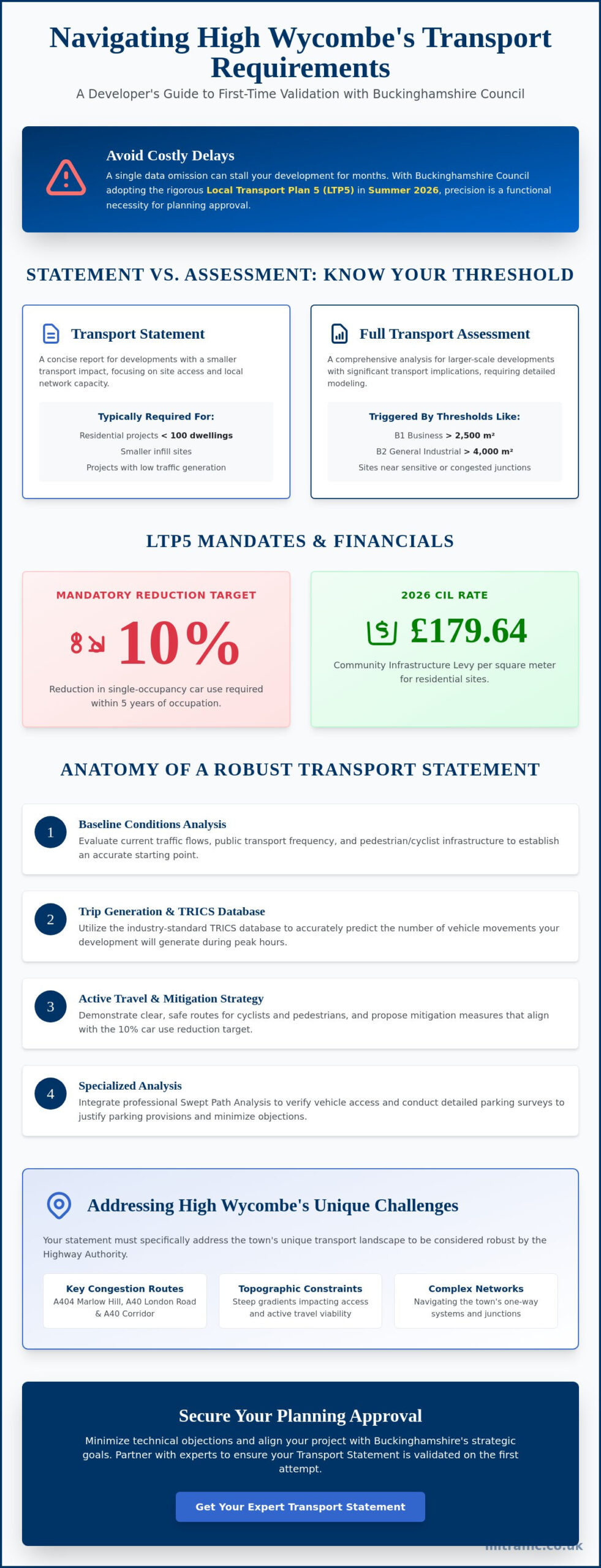
We’ll detail the specific 2026 Community Infrastructure Levy rates, such as the £179.64 per square meter for residential sites, and the exact thresholds for when a full Transport Assessment is required. You’ll gain a clear understanding of how to address the mandatory 10% reduction target for single-occupancy car use and the latest parking standards. This professional overview moves straight to the core requirements, providing a sequential roadmap from initial assessment to final planning approval.
Key Takeaways
- Understand the specific criteria used by Buckinghamshire Council to determine if your project requires a full Assessment or a concise Transport Statement.
- Learn how to utilize TRICS database analysis and baseline road network data to build a robust transport statement High Wycombe developers need for first-time validation.
- Discover strategies for mitigating High Wycombe’s unique topographic constraints and congestion on key routes like the A404 Marlow Hill.
- Identify the critical steps in the pre-application phase to ensure your submission aligns with the latest 2026 Local Transport Plan 5 standards.
- Explore how integrating professional Swept Path Analysis and parking surveys into your statement minimizes technical objections from the Highway Authority.
What is a Transport Statement for High Wycombe Developments?
A Transport Statement is a technical document required by the National Planning Policy Framework (NPPF) for developments that generate relatively low levels of traffic. It focuses on demonstrating that the local road network can safely accommodate the proposed increase in movement without causing detrimental harm. For any project in this region, a transport statement High Wycombe serves as the primary evidence base for Buckinghamshire Council to evaluate the proposal’s impact on safety and congestion.
As the Local Highway Authority (LHA), Buckinghamshire Council uses these statements to ensure that every new access point or parking arrangement meets strict safety standards. This document is a critical part of the broader transportation planning process. It provides a data-driven justification for the development, ensuring that the highway network remains functional for all users while supporting the town’s growth.
To better understand how technical teams evaluate your submission and the collaborative nature of this work, watch this brief overview of the transport planning environment:
Transport Statement vs. Transport Assessment
The distinction between these two documents depends on the scale of your development. Buckinghamshire Council follows specific thresholds to determine the level of detail required. For example, a B1 Business development exceeding 2,500 square meters or a General Industrial (B2) site over 4,000 square meters typically triggers a full Transport Assessment. Smaller infill sites or residential projects below the 100-dwelling mark usually only require a transport statement High Wycombe. Precision is vital here. The Council may upgrade a Statement to a full Assessment if the site sits near a sensitive junction or an area of known high congestion, such as the A40 corridor.
The Legal Framework in Buckinghamshire
Planning decisions in 2026 are governed by the Local Transport Plan 5 (LTP5), which is scheduled for adoption in the summer of 2026. This plan places a heavy emphasis on sustainable growth and reducing transport emissions. Additionally, the High Wycombe 2050 Transport Strategy provides a long-term vision for a low-emission, seamless transport system. Developers must align their proposals with these local strategies to avoid validation delays. Engaging with the LHA during the pre-application stage is the most effective way to confirm which standards apply to your specific site. It reduces the risk of costly revisions later in the planning cycle.
Technical Components of a Robust Transport Statement
A robust transport statement High Wycombe begins with an accurate analysis of baseline transport conditions. It’s not enough to rely on historical data; you must account for the current capacity of the local road network as of 2026. This involves evaluating existing traffic flows, public transport frequency, and the quality of pedestrian infrastructure. According to UK government guidance, the level of detail should be proportionate to the development’s scale. For High Wycombe, this means considering how your site interacts with the town’s complex one-way systems and arterial routes.
Trip generation analysis remains the technical heart of the document. We utilize the TRICS database to predict how many vehicle movements your project will create. By 2026, these models have been refined to reflect permanent shifts in commuter behavior following the pandemic. This data allows us to propose realistic mitigation measures that offset any negative impacts on the highway. We also prioritize active travel. Your statement must demonstrate clear routes for cyclists and pedestrians, aligning with Buckinghamshire’s target to reduce single-occupancy car use by at least 10% within five years of occupation.
Data Collection and Traffic Surveys
High-quality data is the only way to avoid validation delays. We conduct targeted traffic surveys along critical corridors like the A40 London Road and A404 Marlow Hill to capture peak hour fluctuations. Utilising professional Parking Surveys allows us to justify development density by proving that existing street capacity or proposed on-site provision is sufficient. These surveys provide the empirical evidence that planning officers require to approve your parking ratios. Securing accurate data early prevents costly redesigns; you can contact our technical team to determine which surveys your specific site requires.
Swept Path Analysis (SPA) in High Wycombe
High Wycombe’s unique topography presents significant challenges for site access. The town’s steep hills and narrow residential streets require precise Swept Path Analysis to prove that emergency and service vehicles can navigate the site safely. We use digital vehicle templates for fire tenders, refuse trucks, and delivery vans to test every turn and junction. This analysis directly informs your Car Park Design, ensuring that parking bays and access roads are functional rather than just compliant on paper. SPA results often serve as the deciding factor for Highway Authority approval on constrained infill sites.
Finally, the statement must detail site access and visibility splays. We ensure that entry and exit points meet the Manual for Streets standards or the Design Manual for Roads and Bridges (DMRB) where appropriate. Safety is the primary concern for the LHA. By presenting a clear plan for visibility and vehicle priority, we reduce the risk of the council requesting expensive revisions during the application process. Every access point must be vetted for multi-modal safety, ensuring pedestrians and cyclists are protected from vehicle conflicts.
Navigating High Wycombe’s Unique Transport Challenges
High Wycombe’s infrastructure presents distinct hurdles that standard templates often overlook. The A40 London Road and A404 Marlow Hill are notorious bottlenecks that require specific attention during the planning phase. Your transport statement High Wycombe must provide a granular analysis of how your site’s trip generation impacts these corridors. We focus on identifying peak hour vulnerabilities and proposing viable entry strategies that prevent local gridlock, ensuring your project doesn’t face objections from the Highway Authority regarding cumulative impact.
The town’s steep gradients are a significant barrier to active travel, meaning a standard audit isn’t enough for a transport statement High Wycombe. Our technical reports account for these topographic challenges by identifying the most accessible routes and evaluating the feasibility of e-scooter or e-bike integration. This is particularly relevant as the Department for Transport has extended the e-scooter rental trial in Buckinghamshire until May 2026. We ensure your accessibility strategy is realistic rather than just theoretical.
High Wycombe also contains established Air Quality Management Areas (AQMAs). We align your transport strategy with the High Wycombe 2050 Transport Strategy, ensuring your proposal supports the town’s shift toward a low-emission, safe transport system. By addressing air quality and congestion early, we position your development as a contributor to the town’s regeneration goals rather than a logistical burden.
Parking Standards in Buckinghamshire
The 2026 revisions to the Buckinghamshire Countywide Parking Guidance mandate a zone-based approach to vehicle storage. High Wycombe town centre sites, classified as Zone 1, often allow for reduced parking ratios due to high public transport accessibility. Conversely, edge-of-town developments typically require higher provision to prevent overspill. If your design departs from these standards, we use robust survey data to justify the deviation, ensuring the council accepts your rationale without requiring a reduction in unit density.
Sustainable Travel and Public Transport
Proximity to the High Wycombe railway station provides a powerful argument for reduced car dependency in your planning submission. We quantify the benefit of direct rail links to London Marylebone and analyze the frequency of bus services operating from the Eden Bus Station. For developments exceeding 100 dwellings, integrating comprehensive Travel Plans is essential. These plans must target a 10% reduction in single-occupancy car use within five years, a benchmark we support with data-driven incentives and monitoring strategies.
The Planning Submission and Validation Process
The path to a successful planning approval in Buckinghamshire requires more than just submitting technical data. Once you submit your transport statement High Wycombe, it undergoes a rigorous validation check by the council’s planning team. If any mandatory element is missing, such as a recent parking survey or accurate site access plans, the application is rejected on day one. This initial delay can ripple through your entire project timeline, pushing back construction starts and increasing carry costs. We ensure every technical component aligns with the latest 2026 validation requirements to prevent these administrative setbacks.
Engaging with Buckinghamshire Council through pre-application advice is a strategic necessity. This early consultation allows the Highway Authority to flag potential concerns regarding junction capacity or sustainable travel before the formal submission. It creates a collaborative environment where technical objections are resolved in the design phase rather than during the statutory consultation period. When the Highway Authority reviews your final submission, they look for a logical, sequential argument that proves the development is safe and policy-compliant. If you need a robust technical partner to manage this process, you can instruct our team to prepare your submission today.
Section 278 and Section 38 Agreements
A transport statement High Wycombe often identifies the need for physical changes to the existing road network. When your development requires off-site improvements, such as a new junction or footway extension, you must enter into Highway Design S278 & S38 agreements. These legal frameworks govern how private developers perform works on the public highway. In Buckinghamshire, these agreements are high-stakes commitments. They require precise engineering drawings and significant financial bonds. We help you identify these triggers early to ensure your project budget accounts for these infrastructure costs.
Common Pitfalls in High Wycombe Applications
Many applications fail due to inadequate visibility splays, particularly on the town’s steep residential hills. A splay that looks sufficient on a flat map may be obstructed by the natural topography or existing boundary walls in reality. Another frequent error is the failure to account for the cumulative impact of neighboring developments. With the High Wycombe 2050 Transport Strategy in full effect, planning officers scrutinize how your site interacts with other local growth. Relying on outdated TRICS data or failing to update your traffic surveys after the April 2026 fee changes can also lead to immediate technical objections.
Addressing objections is an iterative part of the planning lifecycle. If the Highway Authority raises concerns, we provide rapid, data-driven revisions to resolve the issue. This technical responsiveness is vital for maintaining momentum. Once the council is satisfied, transport-related planning conditions are issued. Discharging these conditions is the final step before your development can proceed. We manage this entire lifecycle, from the first site survey to the final approval, ensuring your project remains on track and fully compliant with regional regulations.
Expert Transport Statements with ML Traffic Engineers UK
Securing a successful planning outcome requires a partner who understands that precision is a functional necessity. We provide the technical authority and regulatory expertise needed to navigate the specific requirements of Buckinghamshire Council. Our team maintains a professional working relationship with local planning officers, ensuring that every transport statement High Wycombe we produce aligns with the town’s unique infrastructure goals for 2026. We don’t just provide data; we deliver a robust evidence base that reduces the logistical and regulatory pressures on your development team.
Our technical support is comprehensive and tailored to the constraints of the Home Counties. ML Traffic Engineers UK manages the delivery of specialized transport statement High Wycombe reports alongside critical sub-services like Swept Path Analysis and Traffic Surveys. By identifying potential highway objections before they reach the statutory consultation phase, we minimize planning risk for both residential and commercial developers. This proactive approach ensures that your project moves from inception to completion without the burden of unexpected technical delays or costly design revisions.
All-Encompassing Transport Planning
We manage the full project lifecycle, providing unwavering reliability from the initial site assessment through to the final discharge of transport conditions. Our team understands the urgency of the industry and the round-the-clock nature of infrastructure planning. Meeting tight deadlines is a core part of our service promise. In the 2026 planning environment, local expertise is a functional necessity. ML Traffic Engineers UK applies deep knowledge of High Wycombe’s road network and parking standards to ensure your submission is validated on the first attempt. Our commitment to precision ensures that every report meets the highest industry benchmarks and legislative requirements.
Request a Quote for Your High Wycombe Project
Getting started with your planning submission is straightforward. We provide site-specific fee proposals that reflect the exact scope of your development. To prepare an accurate quote, we require a basic site plan and a brief description of the proposed use. Whether you need a concise Statement, a detailed Parking Survey, or a complex Swept Path Analysis, we respond with the readiness and clarity your project deserves. You can Contact ML Traffic Engineers UK for a Transport Statement Quote to secure a dependable partner for your next High Wycombe application. We offer the professional integrity and technical support required to safeguard your project’s progress in a strict regulatory environment.
Secure Your High Wycombe Development Approval
Successfully navigating the 2026 planning landscape in Buckinghamshire requires more than just technical data; it demands a strategy that respects the unique constraints of the local highway network. From the steep gradients of the town’s residential hills to the heavy traffic volumes on the A404, every element of your submission must demonstrate a clear understanding of regional priorities. A localized approach ensures that mitigation measures are both practical and acceptable to the Highway Authority, preventing the administrative gridlock that often stalls ambitious projects.
ML Traffic Engineers UK has been at the forefront of this field since 2014, offering over a decade of specialized UK planning experience. We maintain a deep understanding of Buckinghamshire Council’s evolving LHA requirements, specializing in the data-driven Swept Path Analysis and Parking Surveys that planning officers scrutinize most closely. Our role is to act as your technical guardian, ensuring your transport statement High Wycombe is robust, compliant, and ready for immediate validation.
Secure your High Wycombe planning approval with a professional Transport Statement from ML Traffic Engineers UK. We are ready to help you manage the regulatory complexities of your next development with precision and reliability.
Frequently Asked Questions
Do I need a Transport Statement or a Transport Assessment for my High Wycombe project?
The scale of your development determines the required document. For residential projects, a Transport Statement is typically sufficient for sites under 100 dwellings. Larger schemes or commercial developments exceeding specific square footage thresholds, such as 2,500 square meters for business use, usually require a full Assessment. We recommend a pre-application consultation to confirm the exact requirements for your site, as the Local Highway Authority evaluates the potential for significant movement on a case by case basis.
What are the current parking standards for new developments in High Wycombe?
Buckinghamshire’s 2026 guidance emphasizes a shift toward sustainable infrastructure and zone based vehicle storage. While car parking levels depend on your site’s location, all new developments must now meet strict minimums for cycle storage and electric vehicle charging points. These standards ensure that even town centre sites remain functional for modern residents. We use local survey data to justify any necessary departures from these established countywide benchmarks while maintaining safety and accessibility.
How much does a Transport Statement cost for a Buckinghamshire planning application?
The cost of a professional report varies based on the complexity of the site and the required data collection. Factors such as the need for peak hour traffic counts, specialized junction modeling, or detailed site visits influence the final fee. We provide site specific quotes after reviewing your initial site plan and development description. This ensures you receive a transparent, fixed fee estimate tailored to the specific technical demands of your project without hidden costs.
Can a Transport Statement help overcome a planning refusal based on highway safety?
Yes, a robust transport statement High Wycombe can effectively challenge a refusal by providing empirical evidence to counter subjective safety concerns. We often use detailed traffic surveys and visibility analysis to prove that a proposed access point meets national safety standards. By proposing specific mitigation measures, such as junction improvements or improved pedestrian crossings, we can demonstrate that a development will not result in an unacceptable impact on the local highway network.
How long does it take to produce a professional Transport Statement?
Production timelines typically range from two to four weeks depending on the scale of the required data collection. The process involves an initial site visit, conducting traffic or parking surveys, and performing the technical analysis. We prioritize efficiency to meet tight planning deadlines while ensuring every report remains fully compliant with Local Highway Authority standards. Early instruction allows us to capture survey data during neutral weeks, avoiding delays caused by school holidays or local events.
Will I need a Swept Path Analysis as part of my Transport Statement?
Buckinghamshire Council frequently requires Swept Path Analysis for sites with constrained access or internal road networks. This is especially true for residential developments where refuse vehicle tracking is a mandatory validation requirement. We use digital templates to prove that emergency services and delivery vans can enter and turn within the site safely. Including these results in your transport statement High Wycombe significantly reduces the risk of the council requesting a costly redesign after your application is submitted.
What is the role of the TRICS database in my planning application?
TRICS is the industry standard database used to estimate the number of trips a new development will generate. It allows us to compare your project against data from similar established sites across the UK. By selecting comparable locations with similar public transport accessibility, we provide a realistic forecast of vehicle movements. This data driven approach is essential for justifying the impact of your project on the road network and determining if mitigation measures are necessary.
How does Buckinghamshire Council handle sustainable travel requirements in 2026?
In 2026, the council prioritizes the integration of transport and development planning through the Local Transport Plan 5. This includes a strong focus on digital connectivity to reduce the need for travel and the implementation of Travel Plans for larger sites. Developers should note that monitoring fees apply for residential sites of 100 dwellings or more. We ensure your statement highlights high quality pedestrian links and proximity to the Eden Bus Station to meet these aggressive sustainability targets.

Article by
Michael Lee
Transport planner with over 35 years’ experience.
Disclaimer
The content on mltraffic.co.uk, including all technical articles, guides, and resources, is provided for general informational and educational purposes only. It is not intended to constitute professional advice in traffic engineering, transportation planning, development approvals, or any other technical or legal field.
While ML Traffic Engineers makes every reasonable effort to ensure the accuracy, completeness, and timeliness of the information published, we do not provide any warranties or representations (express or implied) regarding its reliability, suitability, or availability for any particular purpose. Any reliance you place on the content is strictly at your own risk.
In no event shall ML Traffic Engineers, its directors, employees, authors, or affiliates be liable for any direct, indirect, incidental, special, consequential, or punitive damages (including, without limitation, loss of profits, data, or business opportunities) arising out of or in connection with the use of, or inability to use, any information provided on this website.
The articles and guides on this site are not a substitute for engaging a qualified, professional traffic engineer to assess your specific project requirements. For tailored advice, compliance assessments, or traffic engineering services, please contact a competent professional.
This disclaimer may be updated from time to time without notice. By accessing or using this website, you agree to be bound by the most current version of this disclaimer.