Tag: highway agreements

  • Section 278 Sustainable Transport in Urban Regeneration

    Section 278 Sustainable Transport in Urban Regeneration

    Your urban regeneration project’s vision for a greener, walkable future will likely fail if the technical Section 278 engineering isn’t aligned with active travel policy from the very first day. It’s a common frustration for developers. While the government’s April 2026 Better Connected strategy pushes for integrated, user-focused networks, the reality often involves high mitigation costs and friction with Local Highway Authorities over rigid design standards. You’re likely feeling the pressure to deliver urban regeneration sustainable transport solutions Section 278 agreements that are future-proofed while managing the technical hurdles of retrofitting sustainable tech into aging urban environments.

    This article provides the clarity you need to master the technical and legal requirements of these complex agreements. We’ll explore how to align your design with the latest Local Transport Plan guidance to secure faster planning approval. You’ll learn how to deliver cost-effective highway works that meet safety benchmarks without compromising on your project’s environmental goals. From managing financial bonds to understanding the latest fee structures in regions like Worcestershire or West Sussex, we’ll ensure your transport infrastructure is ready for the 2041 shift toward active travel.

    Key Takeaways

    • Understand how Section 278 agreements serve as the critical legal framework under the Highways Act 1980 for funding and executing essential highway improvements.
    • Master the technical alignment of urban regeneration sustainable transport solutions Section 278 requirements with the April 2026 “Better Connected” national strategy.
    • Learn to navigate the technical trade-offs between vehicle capacity and active travel safety when retrofitting infrastructure into historic or narrow urban footprints.
    • Explore how integrating Mobility as a Service (MaaS) and shared transport hubs can transform traditional developments into modern, people-centric urban environments.
    • Discover how utilizing professional Transport Assessments and Swept Path Analysis mitigates regulatory friction and accelerates approval from Local Highway Authorities.

    The 2026 Landscape of Urban Regeneration and Transport Planning

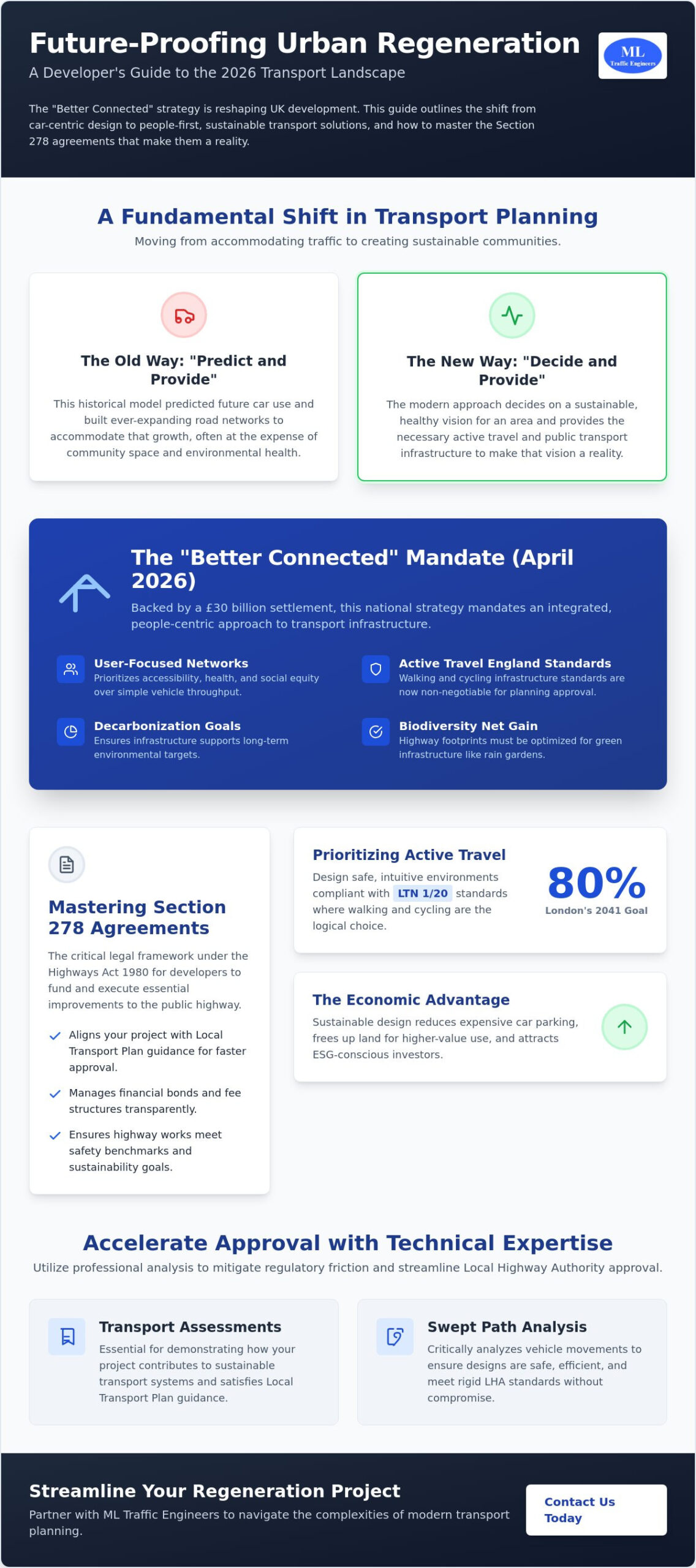
    Transport acts as the structural backbone for any successful urban redevelopment. In 2026, the focus has moved away from simply managing vehicle throughput. Instead, we’re seeing a fundamental shift toward people-centric urban design. Modern projects prioritize accessibility, health, and social equity over traditional traffic flow models. This evolution is driven by the government’s “Better Connected” strategy, published in April 2026, which mandates an integrated approach to how we move within our cities. Backed by a £30 billion settlement, this policy ensures that infrastructure supports economic growth without sacrificing environmental integrity.

    One of the most significant shifts in planning is the move from “Predict and Provide” to “Decide and Provide” strategies. Historically, engineers predicted future car use and built roads to match that growth. Today, we decide on a sustainable vision for the area and provide the infrastructure to achieve it. This proactive stance ensures that urban regeneration sustainable transport solutions Section 278 agreements support long-term decarbonization goals. It’s about creating a destination where residents don’t need to rely on private cars for every journey.

    To better understand the practical skills required for modern urban redevelopment, watch this helpful video:

    Regulatory Drivers in 2026 UK Planning

    Active Travel England now holds significant weight in local planning decisions. Their standards for walking and cycling are non-negotiable for developers seeking approval. Additionally, mandatory biodiversity net gain requirements mean highway footprints must be optimized to allow for green infrastructure like rain gardens and urban trees. These 2026 sustainability targets directly influence the requirements for a Transport Statement. Every submission must now demonstrate how the project contributes to sustainable transport systems to satisfy both local authorities and the updated Local Transport Plan guidance issued in April 2026.

    The Economic Case for Sustainable Transport

    Investing in active travel isn’t just a regulatory hurdle; it’s a sound financial strategy. Reducing the reliance on private vehicles allows developers to minimize or eliminate expensive multi-storey car parking. This reclaimed space can be repurposed for higher-value residential or commercial use. Improved public realms and better connectivity naturally increase land value across the entire site. ESG-conscious investors are also prioritizing schemes that demonstrate a commitment to low-carbon mobility. By integrating robust urban regeneration sustainable transport solutions Section 278 frameworks, you position your project as a low-risk, high-reward asset in a competitive market.

    Sustainable Transport Solutions for Modern Regeneration

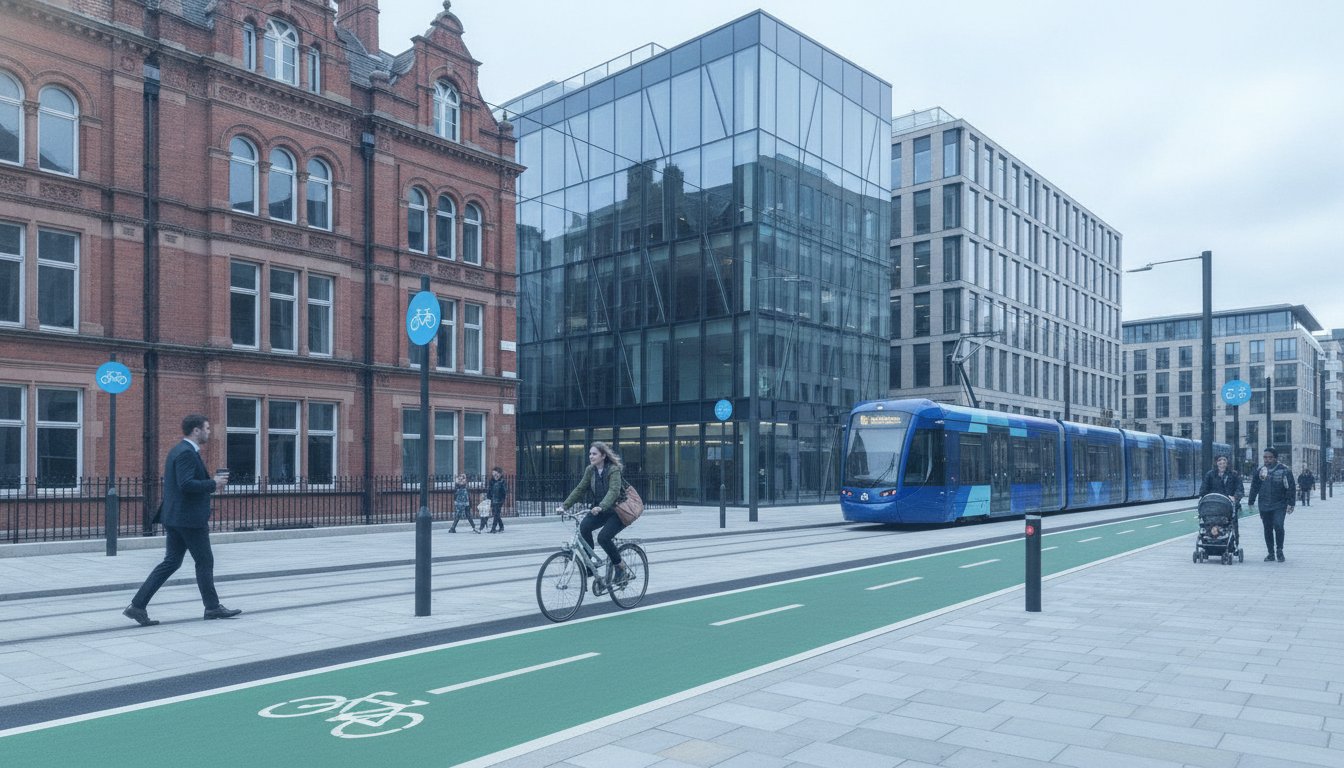
    Success in modern development depends on high-quality active travel infrastructure. London aims for 80% of trips to be made by foot, cycle, or public transport by 2041. To hit these targets, urban regeneration sustainable transport solutions Section 278 must prioritize the user experience. This means moving beyond basic road widening to create environments where active travel is the most logical choice. We design these spaces to be safe, intuitive, and resilient, ensuring they stand up to the demands of a growing urban population while meeting the strict standards of the April 2026 “Better Connected” strategy.

    Active Travel Design Standards

    LTN 1/20 is the benchmark for modern cycle infrastructure. It’s no longer a suggestion; it’s a requirement for securing highway authority approval. We focus on creating segregated lanes that provide physical protection for cyclists. To ensure these designs work in practice, we use Swept Path Analysis to verify that larger vehicles, such as refuse trucks or emergency services, don’t encroach on active travel zones. This technical precision is vital for pedestrian priority zones and the “15-minute city” concept. It allows us to maximize the utility of constrained urban footprints without compromising safety or regulatory compliance.

    Public Transport Connectivity and Hubs

    Multi-modal hubs are the new standard for connected communities. The UITP highlights the role of sustainable transport in urban regeneration as a primary tool for social inclusion and economic growth. Shared mobility is expanding rapidly in the UK, with revenue projected to grow at an annual rate of 10.63% through 2026. Integrating e-scooter and e-bike docking stations directly into your site layout encourages this modal shift. We optimize site layouts to ensure bus priority and rapid transit access are seamless, making public transport the most efficient way to travel.

    Electric Vehicle (EV) infrastructure must go beyond the basic minimum requirements. Modern regeneration projects require scalable charging solutions that anticipate future demand. We also address last-mile logistics by designing dedicated hubs for cargo bikes and electric delivery vans. These solutions reduce the volume of heavy goods vehicles in residential areas, improving air quality and safety. If you’re struggling with site layout constraints or regulatory friction, our team can help you develop a comprehensive Travel Plan to support your planning application and ensure long-term project viability.

    By focusing on these technical details early, you reduce the risk of costly retrofits later. Every urban regeneration sustainable transport solutions Section 278 agreement we support is built on a foundation of precision and adherence to national standards. This approach ensures your project is not only compliant but also future-proofed against the evolving expectations of both local authorities and ESG-conscious investors.

    Understanding Section 278 Agreements in Regeneration Projects

    Under Section 278 of the Highways Act 1980, a developer enters into a legal agreement with the Local Highway Authority (LHA) to fund and execute works on the existing public highway. While Section 38 agreements focus on the adoption of new roads within a development, Section 278 covers the off-site improvements necessary to mitigate the project’s impact. In the context of urban redevelopment, this is often the “make or break” stage. It is where your private vision for a site meets the public infrastructure. If this transition isn’t managed with technical precision, it can lead to significant delays and cost overruns.

    The success of these agreements relies on coordination between three key stakeholders: the developer, the LHA, and the contractor. The developer provides the capital and the vision, while the LHA acts as the guardian of safety and design standards. The contractor must then deliver the physical works within a live urban environment. Balancing these competing interests requires a clear understanding of both legal obligations and engineering requirements. Getting it right ensures that urban regeneration sustainable transport solutions Section 278 frameworks are both viable and safe for the public.

    This technical oversight often extends to material validation, where independent accredited bodies like The Testing Lab PLC provide the necessary testing to ensure all highway components meet the safety and durability standards required for adoption.

    The S278 Process: From Scoping to Adoption

    Technical approval is the first major hurdle in the S278 process. The LHA must sign off on every detail of your sustainable design before work can begin. You’ll also need to account for financial security. For example, Worcestershire County Council requires a financial bond of 110% of the highway works’ cost, while West Sussex County Council demands an upfront fee of 5% of the estimated cost just to process the submission. Beyond the initial build, you’ll likely face “commuted sums” for the ongoing maintenance of non-standard features. Managing the construction phase is equally demanding, as you must maintain safety and access for the existing community while retrofitting new infrastructure.

    Negotiating Sustainable S278 Deliverables

    Negotiation is a critical skill when integrating green infrastructure. LHAs are often risk-averse and may prefer standard materials that are easier to maintain. However, modern regeneration requires a different approach. We work to justify the use of non-standard materials for sustainable drainage systems (SuDS) or rain gardens by demonstrating their long-term functionality. We also advocate for reduced lane widths. By narrowing vehicle lanes, we reclaim vital space for high-quality pedestrian zones and cycle tracks. This approach prioritizes active travel without compromising the network’s overall safety. For a detailed breakdown of these technical nuances, you can view our Highway Design S278 & S38 Guide.

    By addressing these legal and technical complexities early, you reduce the logistical pressure on your team. Our approach focuses on delivering an all-encompassing service that manages the full project lifecycle from inception to adoption. This ensures that your project meets all industry benchmarks and legislative requirements while delivering the high-quality, sustainable outcomes that modern urban environments demand.
    Section 278 Sustainable Transport in Urban Regeneration

    Technical Challenges: Balancing Capacity with Sustainability

    Integrating urban regeneration sustainable transport solutions Section 278 often creates a technical friction point between traditional traffic engineering and modern policy goals. Local Highway Authorities frequently worry that reducing lane widths or installing cycle tracks will lead to congestion. We address these concerns by using data to prove that “green” infrastructure doesn’t cause gridlock. A robust Transport Assessment is your primary tool for this. It provides the evidence needed to show that a shift in modal split actually improves network efficiency by moving more people within the same physical footprint.

    Retrofitting these solutions into historic or narrow urban footprints requires a high level of precision. We don’t just look at vehicle numbers; we analyze the entire movement of the street. This involves simulating how pedestrians and cyclists interact with vehicle flow to ensure safety isn’t sacrificed for speed. By proving that sustainable designs can handle peak demand, we help developers overcome the “predict and provide” mindset that often stalls innovative regeneration projects.

    Junction Design for All Users

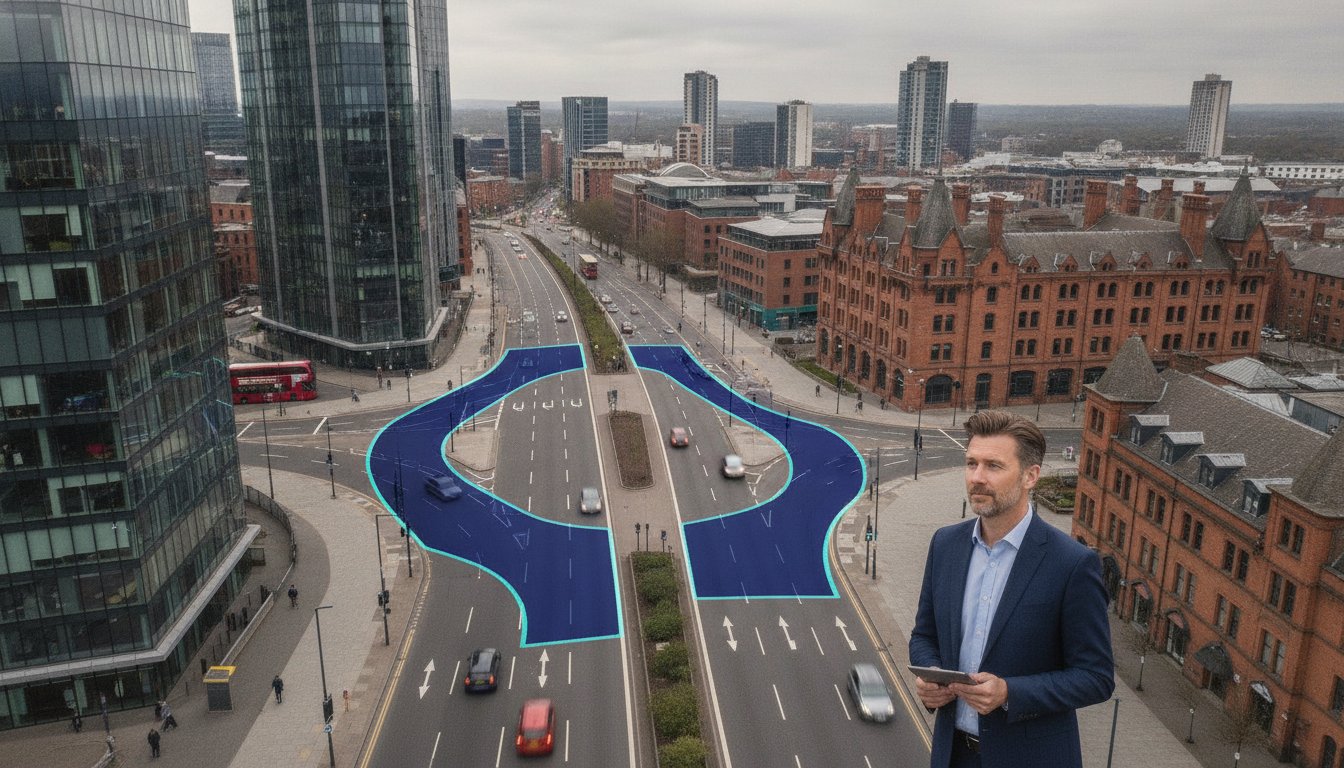
    Modern regeneration demands a move beyond simple signalization toward protected junction designs. These layouts physically separate vulnerable road users from turning vehicles, significantly reducing the risk of collisions. We simulate these complex movements alongside standard vehicle flow to ensure the junction remains functional for everyone. Technical accuracy is non-negotiable here. Swept Path Analysis ensures that even with narrowed carriageways or protected cycle curbs, fire tenders and other emergency vehicles maintain unhindered access through narrow regenerated streets.

    Mitigating the Impact of Reduced Car Parking

    Reducing on-site parking is often essential for maximizing land value and meeting sustainability targets. We use detailed Parking Surveys to justify low-car or car-free developments by demonstrating existing capacity and alternative transport availability. To manage the residual demand, we implement robust Travel Plans that encourage residents and visitors to use active travel or public transport. This isn’t just about policy; it’s about providing technical solutions like car club integration and dedicated EV priority zones that make car-free living a viable reality.

    If you’re facing technical resistance from local authorities regarding your site’s capacity, our team provides the engineering evidence needed to secure approval. Explore our traffic engineering services to see how we streamline the S278 process and protect your project’s timeline.

    Streamlining Your Regeneration Project with ML Traffic Engineers

    Specialized traffic engineering is the most effective way to reduce planning risk and eliminate costly delays. We’ve seen many projects stall because of technical disagreements with Local Highway Authorities over design standards or mitigation costs. Our role is to remove that friction. We manage the entire project lifecycle, from the initial assessment to the final adoption of the highway works. By aligning your project with the April 2026 “Better Connected” strategy from the start, we ensure your urban regeneration sustainable transport solutions Section 278 submission is both robust and defensible.

    Our approach integrates transport planning with detailed engineering design. We bridge the gap between developer ambition and the rigid requirements of highway authorities. Early engagement is vital for success. We represent your interests professionally, ensuring that technical discussions stay focused on viable solutions. We understand the specific financial and technical requirements across different regions. Whether it’s navigating Birmingham’s £15,348 minimum technical fee or managing Worcestershire’s 110% bond requirement, we provide the expert representation you need to protect your project’s timeline and budget.

    Our Comprehensive Technical Support

    Our team delivers every technical component required for a successful application. We produce detailed Transport Statements and Transport Assessments that satisfy the latest 2026 Local Transport Plan guidance. Our Swept Path Analysis and junction modelling services ensure your sustainable designs are technically sound. We don’t just provide data; we provide a clear path to approval. We negotiate directly with LHAs to secure favourable terms, often reducing the long-term burden of commuted sums and additional inspection fees through precise engineering.

    Ready to Transform Your Urban Site?

    Choosing a consultant with deep UK expertise is critical for managing the intricate regulations that govern modern regeneration. We pride ourselves on precision and a strict adherence to industry standards. This commitment ensures your infrastructure is future-proofed, compliant, and safe for the public. We take the logistical and regulatory pressure off your team so you can focus on the broader vision of your development. It’s about delivering a high-quality, sustainable outcome that meets the expectations of both the community and ESG-conscious investors. If you’re ready to move your project forward, contact ML Traffic Engineers for expert S278 support. We’ll provide a tailored quote and a technical strategy that reflects the specific needs of your regeneration scheme.

    Future-Proofing Your Urban Regeneration Projects

    Successful urban redevelopment now requires a proactive approach to highway engineering. The transition to “Decide and Provide” strategies ensures that your project remains viable under the 2026 “Better Connected” framework. Mastering the technical nuances of urban regeneration sustainable transport solutions Section 278 agreements is the difference between a project that stalls and one that sets a new standard for modern living. By prioritizing active travel and high-quality public realms, you create high-value environments that appeal to both residents and ESG-focused investors.

    Precision is a functional necessity in this high-stakes environment. Founded in 2014, ML Traffic Engineers brings extensive UK planning experience to your project. We specialize in Transport Statements and S278 technical reports, providing the professional, safety-conscious approach required to satisfy strict highway authority standards. Secure your planning approval with ML Traffic Engineers’ expert transport planning and ensure your infrastructure is adopted without unnecessary delays. We’re ready to help you navigate these complex regulations with unwavering reliability. Your vision for a sustainable urban future is within reach.

    Frequently Asked Questions

    What is the main difference between a Section 278 and a Section 38 agreement?

    A Section 278 agreement covers modifications to the existing public highway, whereas a Section 38 agreement facilitates the adoption of entirely new roads by the Local Highway Authority. In urban regeneration, S278 is the primary mechanism for integrating new site access points or improving local pedestrian crossings. It ensures that developer-funded works meet the same safety and durability standards as the rest of the public network.

    Do urban regeneration projects always require a full Transport Assessment?

    Not every project requires a full Transport Assessment. The necessity depends on the scale of the development and its projected impact on the local network. Smaller regeneration schemes often only require a Transport Statement to justify their impact. Consulting with a traffic engineer early helps determine which document is necessary to satisfy local planning requirements and avoid unnecessary delays during the application process.

    How does Active Travel England influence Section 278 design in 2026?

    Active Travel England (ATE) enforces strict design standards for any highway works involving walking or cycling. In 2026, ATE acts as a statutory consultee, ensuring that urban regeneration sustainable transport solutions Section 278 agreements comply with LTN 1/20. Failure to meet these high-quality infrastructure standards can lead to a formal objection, effectively blocking planning approval until the technical designs are corrected to meet national benchmarks.

    Can I include sustainable drainage (SuDS) within a Section 278 highway work?

    You can integrate sustainable drainage systems (SuDS) like rain gardens or swales into Section 278 works. These features help manage surface water runoff while contributing to mandatory biodiversity net gain targets. While some authorities were previously hesitant, the 2026 planning landscape prioritizes green infrastructure. To read more about professional drainage maintenance and surveys that ensure these systems remain functional, visit T.M. Drainage. You’ll likely need to provide a commuted sum to cover the long-term maintenance of these non-standard highway features once they’re adopted.

    What are commuted sums in the context of Section 278 agreements?

    Commuted sums are financial contributions paid to the Local Highway Authority to cover the future maintenance of new infrastructure. If your project uses non-standard materials, such as high-quality paving or extensive street planting, the authority requires these funds to ensure they don’t face unexpected costs. These sums are calculated based on the expected lifespan and maintenance frequency of the specific assets provided within the highway.

    How can Swept Path Analysis help secure approval for narrow urban streets?

    Swept Path Analysis provides the technical evidence that large vehicles, like fire tenders or refuse trucks, can safely navigate narrow streets. By simulating these movements, we prove that reduced carriageway widths are safe and functional. This allows developers to reclaim vital road space for wider pavements or cycle lanes, supporting the delivery of urban regeneration sustainable transport solutions Section 278 that prioritize people over cars.

    What happens if a developer fails to complete S278 works as agreed?

    If a developer fails to complete the works to the agreed standard or within the specified timeframe, the Local Highway Authority can intervene. They’ll use the financial bond, which is typically set at 110% of the works’ value, to pay for the completion or rectification of the highway. This protects the public from being left with unfinished or dangerous infrastructure on the existing road network during the regeneration process.

    How long does the Section 278 technical approval process typically take?

    The technical approval process typically takes between three and six months, though complex schemes can take longer. This period includes the initial submission, technical review by the LHA, and any necessary design revisions. Early engagement with highway officers and providing high-quality engineering drawings from the outset are the most effective ways to accelerate this timeline and avoid planning bottlenecks in your project schedule.

    Michael Lee

    Article by

    Michael Lee

    Transport planner with over 35 years' experience.

    Disclaimer

    The content on mltraffic.co.uk, including all technical articles, guides, and resources, is provided for general informational and educational purposes only. It is not intended to constitute professional advice in traffic engineering, transportation planning, development approvals, or any other technical or legal field.
    While ML Traffic Engineers makes every reasonable effort to ensure the accuracy, completeness, and timeliness of the information published, we do not provide any warranties or representations (express or implied) regarding its reliability, suitability, or availability for any particular purpose. Any reliance you place on the content is strictly at your own risk.
    In no event shall ML Traffic Engineers, its directors, employees, authors, or affiliates be liable for any direct, indirect, incidental, special, consequential, or punitive damages (including, without limitation, loss of profits, data, or business opportunities) arising out of or in connection with the use of, or inability to use, any information provided on this website.
    The articles and guides on this site are not a substitute for engaging a qualified, professional traffic engineer to assess your specific project requirements. For tailored advice, compliance assessments, or traffic engineering services, please contact a competent professional.
    This disclaimer may be updated from time to time without notice. By accessing or using this website, you agree to be bound by the most current version of this disclaimer.
  • Transport Planning Guide for Success

    Transport Planning Guide for Success

    With planning fees in England having increased by 3.8% in April 2026, can your project afford a transport objection that forces a costly and time-consuming resubmission? It’s a common frustration for developers when transport planning becomes a barrier rather than a facilitator. The technical complexity of TRICS data and Swept Path Analysis often leads to regulatory delays, while unexpected highway authority requirements can quickly erode your project’s contingency budget. You need a strategy that prioritizes precision and compliance from the very first assessment.

    We recognize that navigating these logistical and regulatory pressures is a high-stakes task. This guide provides the technical authority you need to master the complexities of the planning system and secure your permission. We’ll deliver a clear roadmap of the required documentation, from Transport Statements to Travel Plans, ensuring your site layout is fully optimized for vehicle access. By the end of this article, you’ll understand how to align your submission with the Summer 2026 NPPF updates and eliminate the risk of transport-related objections.

    Key Takeaways

    • Understand how the National Planning Policy Framework influences local requirements to ensure your project aligns with national standards from the outset.
    • Learn the scale-based thresholds used to determine if you’ll require a Transport Statement or a full Transport Assessment.
    • Integrate technical tools like Swept Path Analysis during design. This creates robust applications that are difficult for authorities to challenge.
    • Identify the differences between Section 278 and Section 38 agreements to manage highway works and mandatory sustainability requirements effectively.
    • Choose a transport planning partner with local expertise to secure planning permission and avoid regulatory delays.

    What is Transport Planning in the Context of UK Development?

    Transport planning isn’t just about drawing lines on a map; it’s the critical technical integration of land use and physical infrastructure. In the UK, it serves as the functional blueprint for how people move between homes, workplaces, and essential services. A successful strategy ensures that a new development doesn’t exist in isolation. Instead, it must integrate seamlessly into the existing highway network while maintaining safety and efficiency for all users.

    National policy, specifically the National Planning Policy Framework (NPPF), sets the standard for these requirements. With a significant update to the NPPF expected in Summer 2026, the emphasis on connectivity-led planning is sharper than ever. Local authorities use these national guidelines to judge whether a project is sustainable. If your transport planning strategy fails to demonstrate safety or capacity, the application will likely face a refusal before other design elements are even considered. It’s your first line of defence against costly planning objections.

    To better understand the core principles of this process, watch this helpful overview:

    It’s vital to distinguish between strategic and development-led planning. Strategic planning is typically managed by government bodies to oversee regional infrastructure and long-term network growth. In contrast, development planning is a specialized consultancy service focused on securing permissions for specific sites. This is where precision becomes a functional necessity. We bridge the gap between your commercial goals and the strict regulatory requirements of the Local Highway Authority, ensuring every technical detail is addressed.

    The Core Objectives of a Transport Planning Consultant

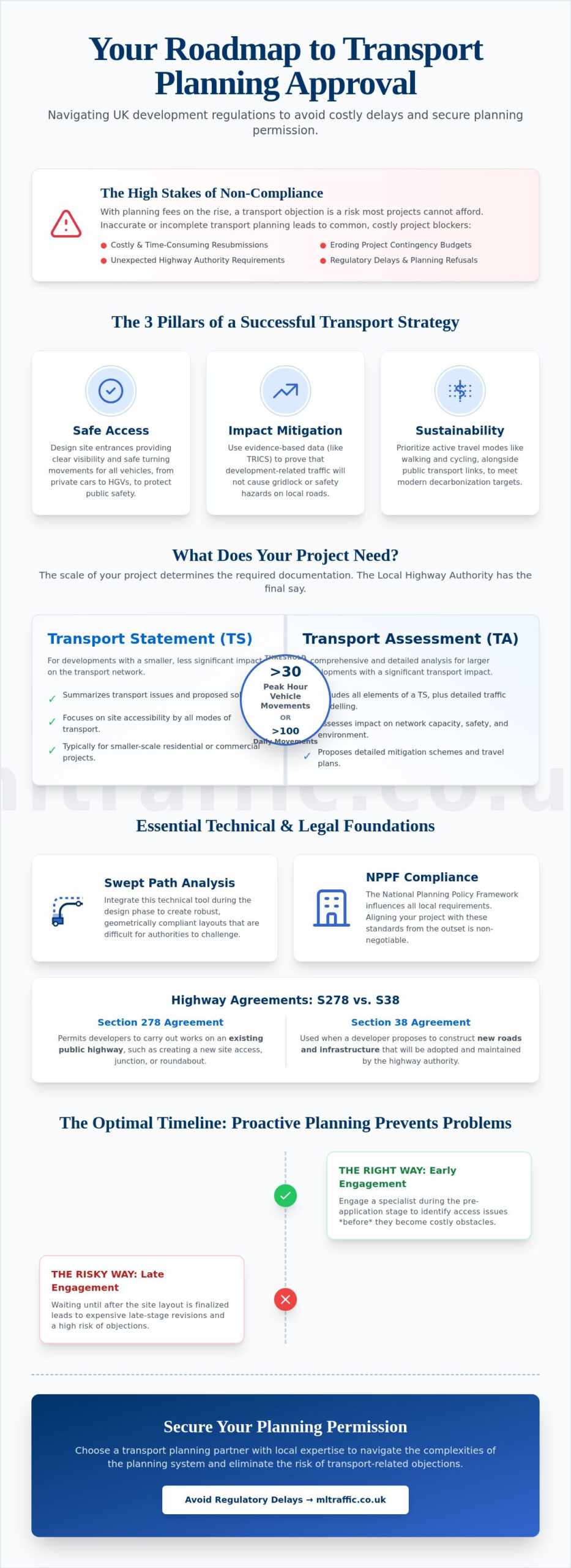
    A consultant’s primary role is to protect the safety of the public and the viability of the project. We focus on three non-negotiable pillars to ensure a site is fit for purpose:

    • Safe Access: We design site entrances that provide clear visibility and safe turning movements for all vehicles, from cars to heavy goods vehicles.
    • Impact Mitigation: We use evidence-based data to prove that development-related traffic won’t cause gridlock or safety hazards on local roads.
    • Sustainability: We prioritize active travel modes like walking and cycling, alongside public transport links, to meet modern decarbonization targets.

    When Should You Engage a Transport Planner?

    Don’t wait until you’ve finalized your site layout to seek expert advice. Engaging a specialist during the pre-application stage allows us to identify “red flag” access issues before they become permanent obstacles. This proactive input informs the initial car park design and site access points. By resolving these technical challenges early, you avoid expensive late-stage design revisions and significantly reduce the risk of a highway authority objection. Early involvement is the most efficient way to manage your project’s long-term costs and timelines.

    Transport Statements vs. Transport Assessments: Which Do You Need?

    Determining whether your development requires a Transport Statement or a full Transport Assessment is a critical first step in the planning process. The decision is primarily based on the scale of the project and the volume of vehicular traffic it’s expected to generate. While national guidelines provide a framework, the Local Highway Authority (LHA) holds the final say on which report is necessary for your specific site. These documents provide the technical evidence base that planning officers use to recommend approval. Producing an accurate, data-driven report is essential for securing Transport for planning permission without facing costly delays or technical objections.

    The thresholds for these reports are often determined by the potential impact on the local road network. A common industry benchmark used by many LHAs suggests that a full assessment is required if a development generates more than 30 vehicle movements in the peak hour or 100 in a single day. However, these figures aren’t fixed. A small development in a sensitive or congested urban area might still trigger the need for a more detailed analysis. This technical nuance is why professional transport planning is a functional necessity for modern developers who want to avoid regulatory friction.

    Transport Statements: For Smaller Scale Developments

    Transport Statements are designed for projects with limited highway impact. Typical examples include small residential schemes, minor retail changes, or office refurbishments. These reports focus on three core areas: the existing site conditions, the safety of the proposed access, and a simplified prediction of trip generation. Even for smaller projects, the requirements can vary significantly by geography. For instance, a Transport Statement London must often adhere to stricter “Healthy Streets” principles compared to regional requirements. We ensure your report meets these specific local standards to streamline the approval process.

    Transport Assessments: For Major Development Projects

    Major developments require a comprehensive Transport Assessment. This is a deep technical analysis of significant traffic impacts and junction capacity across a wider area. We utilize the TRICS database to predict multi-modal trip generation, ensuring the data is robust enough to withstand scrutiny from highway officers. These assessments also address the cumulative impact of your project alongside other developments in the vicinity. Adhering to the professional standards set by the Chartered Institution of Highways and Transportation is essential to ensure your submission is respected by statutory consultees. If you’re unsure which report your project needs, we can help you identify the correct documentation during a pre-application review.

    Technical Analysis: The Foundation of Sound Transport Planning

    Data-driven evidence is the most effective way to overcome subjective objections from local authorities. When a submission relies on rigorous technical analysis, it shifts the conversation from opinion to objective fact. This level of precision is essential in modern transport planning, where every square metre of site layout must be technically justified. By providing quantifiable proof of safety and capacity, you create a robust application that’s far more resilient during the consultation phase. Local authorities are far less likely to challenge a proposal when it’s supported by verified data and industry-standard simulations.

    Our technical approach ensures that your site layout is optimized for both safety and commercial viability. We use evidence to prove the feasibility of essential services, such as fire tender and refuse vehicle access, which are often the first points of scrutiny for highway officers. By addressing these operational requirements through data, we reduce the risk of late-stage design changes that can compromise your project’s timeline or budget.

    Swept Path Analysis (SPA) and Vehicle Manoeuvrability

    We integrate Swept Path Analysis Services directly into the design phase to prevent costly design errors. Using specialized CAD software, we simulate the movement of specific vehicles to ensure they can navigate the proposed layout without incident. This is particularly vital for proving fire tender access and refuse vehicle manoeuvrability. Demonstrating that the largest expected vehicles can turn safely protects pedestrian zones and prevents structural damage to the built environment. It provides the highway authority with the absolute certainty they require regarding site safety and operational efficiency.

    Traffic and Parking Surveys: The Lambeth Methodology

    In high-density urban environments, parking stress is a frequent point of contention for residents and planners alike. We conduct detailed Parking Surveys to establish an accurate baseline of current demand within a 200m radius of your site. Our team utilizes the Lambeth Methodology, which remains the recognized gold standard for London-based surveys. This involves conducting “beat” surveys during peak stress times to measure exactly how much on-street space is available. This data is crucial for justifying parking-light or car-free developments, especially in areas with high Public Transport Accessibility Levels (PTAL). By proving that a development won’t overstrain local street capacity, we remove a major hurdle to your planning approval.

    Technical analysis isn’t just a box-ticking exercise; it’s a strategic tool that optimizes your site’s footprint while ensuring full compliance with safety standards. Whether you’re designing a complex urban infill or a large commercial hub, data-backed transport planning ensures your project is both viable and safe from day one.

    Transport Planning Guide for Success

    Statutory requirements are the legal framework that turns technical designs into physical infrastructure. This phase of transport planning is often where developers encounter the most significant financial and regulatory pressure. Highway officers may request extensive modifications or substantial financial contributions through Section 106 agreements. We help you manage these demands to ensure they remain proportionate to your development’s actual impact. Precision is a functional necessity here. Without a clear understanding of the legal landscape, you risk agreeing to highway works that can compromise your project’s bottom line.

    The most common developer objection we hear is that highway requirements are making a site unviable. This usually happens when authorities demand over-engineered road designs or excessive junction improvements. We counter this by using the precise data from your Transport Assessment to negotiate more cost-effective solutions. By applying the latest standards from the Manual for Streets or the Design Manual for Roads and Bridges, we ensure that every requested modification is technically justified and commercially realistic. If you are facing excessive highway demands, consult our team to review your statutory requirements and protect your site’s viability.

    Section 278 (S278) and Section 38 (S38) Agreements

    Section 278 and Section 38 agreements, governed by the Highways Act 1980, are the standard legal instruments for highway works. A Section 278 agreement is mandatory when you need to modify the existing public highway, such as creating a new site access or improving a nearby junction. Conversely, a Section 38 agreement allows the local highway authority to adopt new roads built within your development. This process ensures the roads are constructed to a specific standard before they become public property. For a comprehensive breakdown of these processes, see our guide on Highway Design S278 & S38.

    Travel Plans: Beyond the Planning Permission

    Travel Plans are critical for reducing the long-term carbon footprint of a development. They move beyond the initial planning submission to influence how residents and staff move daily. Depending on the scale and nature of your project, you may require a Framework, Full, or Workplace Travel Plans. These are living documents that include actionable strategies to promote walking, cycling, and public transport use. Monitoring and management are essential post-occupation. We ensure your plan remains effective and compliant with local targets, preventing future regulatory friction. Our approach focuses on creating realistic targets that genuinely promote sustainability without placing an undue burden on the developer.

    Choosing the Right Transport Planning Partner for Your Project

    Selecting a consultancy isn’t just about technical capability; it’s about finding a partner that understands the nuances of local government. Every Borough or Council has specific highway requirements that aren’t always found in national manuals. Local knowledge allows a consultant to anticipate these preferences, reducing the risk of a “back-to-the-drawing-board” scenario. A combined approach that integrates traffic engineering with transport planning is far more efficient than hiring separate specialists. It ensures that the technical data from your Swept Path Analysis informs the final Transport Statement without any loss of detail or delay.

    Precision is a functional necessity when your project’s timeline is at stake. A “right-first-time” technical report is the most effective way to avoid planning delays and keep your development on track. When local authorities receive a report that is professionally formatted and technically sound, it builds immediate trust. ML Traffic Engineers UK focuses on delivering high-quality documentation that streamlines the what we do process, allowing you to focus on the broader aspects of your development.

    What to Look for in a Transport Consultancy

    • Relevant Experience: Ensure the team has a proven track record with similar project types and scales. This experience is vital for navigating complex urban sites.
    • Responsiveness: You need a partner that can handle urgent pre-application queries and adapt to rapid design changes as they occur.
    • Accreditation: Professional membership in bodies like the Chartered Institution of Highways and Transportation (CIHT) or the Transport Planning Society (TPS) is a non-negotiable sign of quality and adherence to standards.

    How ML Traffic Engineers UK Delivers Planning Success

    We provide expert preparation of Transport Statements and Assessments for projects across England. Our in-house technical capabilities for Swept Path Analysis and Traffic Surveys mean we control the quality and speed of the data collection process. This integrated model allows us to produce safety-conscious reports that Local Authorities trust. We understand the high-stakes nature of infrastructure development and provide the unwavering reliability you need to secure your planning permission. By managing the full project lifecycle from inception to completion, we reduce the logistical and regulatory pressures on your team.

    If you’re ready to secure your site’s access and optimize your layout, contact ML Traffic Engineers UK for a project-specific quote today. Our team is ready to provide the technical authority your project requires.

    Secure Your Planning Approval with Technical Precision

    Effective transport planning transforms regulatory hurdles into strategic design advantages. By integrating data-driven technical analysis and navigating statutory requirements with precision, you eliminate the risk of costly objections. Whether your project requires a detailed Transport Statement or a comprehensive Swept Path Analysis, our team ensures every technical detail aligns with current UK and London-specific regulations. Mastery of these complexities is what separates a stalled application from a successful development.

    Founded in 2014, ML Traffic Engineers UK brings over a decade of planning success to your project. We’re specialists in Transport Statements and Swept Path Analysis, providing the technical authority needed to protect your site’s viability and safety. Our experts understand the intricacies of both UK-wide and London-specific highway regulations, ensuring your submission is robust and reliable from the start. Don’t let highway objections stall your progress when expert support is available.

    Request a Transport Planning Quote for Your Project

    We’re ready to help you secure your planning permission and optimize your site’s accessibility with confidence.

    Frequently Asked Questions

    Is a transport statement the same as a transport assessment?

    No. A Transport Statement is a simplified report for smaller developments with limited highway impact, while a Transport Assessment is a comprehensive technical study for major projects. Local authorities typically require the more detailed assessment if a site generates significant traffic, often over 30 two-way movements in peak hours. We help you identify which document is necessary based on your specific development scale and location.

    When is a swept path analysis required for a planning application?

    A swept path analysis is necessary when you must demonstrate that a specific vehicle can safely manoeuvre through your site or access point. It’s a functional requirement for proving fire tender access, refuse vehicle routing, and delivery bay viability. Planning officers use these simulations to ensure your layout doesn’t create safety hazards or structural damage risks. This analysis is especially critical for tight urban infill projects.

    How much does a transport planning consultant cost in 2026?

    Costs for these services vary based on the project’s technical complexity and the specific documentation required by the local authority. Factors that influence the total fee include the development’s scale, the need for specialized traffic surveys, and the depth of the required transport planning report. Because every site has unique highway constraints, we recommend requesting a project-specific quote to ensure all regulatory requirements are covered accurately.

    Do I need a travel plan for a small residential development?

    Requirements for a travel plan depend on the thresholds set by your Local Planning Authority. While very small schemes often avoid this requirement, many councils now request a “Travel Plan Statement” for minor developments to promote sustainable travel. These documents outline how residents will be encouraged to use cycling, walking, or public transport. We check your local policy during the pre-application stage to prevent unexpected delays.

    What is the TRICS database and how is it used in transport planning?

    TRICS is the industry-standard national system used to predict the number of trips a new development will generate. It contains thousands of survey records from existing sites across the UK. In transport planning, we use this data to provide an evidence-based forecast of how your project will affect the local road network. This objective data is harder for authorities to challenge than subjective estimates, making it vital for successful applications.

    Can a transport planner help with parking survey requirements in London?

    Yes, we specialize in conducting parking surveys using the Lambeth Methodology, which is the recognized standard for most London Boroughs. These surveys measure overnight parking stress within a 200m radius of your site. The results provide the technical evidence needed to justify parking-light or car-free developments. This is particularly important in high PTAL areas where local residents may have concerns about overspill parking on public streets.

    What happens if the Highway Authority objects to my planning application?

    An objection from the Highway Authority often leads to a refusal unless the technical concerns are resolved immediately. We act as your advocate, negotiating with highway officers to address their specific objections through design revisions or additional data. This process might involve providing a more detailed swept path analysis or a revised site access plan. Quick, evidence-based responses are essential to keep your application moving toward a positive recommendation.

    How long does it take to prepare a full Transport Assessment?

    Preparation usually takes between two and four weeks, though this depends on the availability of current traffic and parking data. If your project requires new on-site surveys, the timeline must account for the data collection period. We prioritize efficiency to meet your submission deadlines while ensuring every technical report meets the strict standards of the local authority. Early engagement allows us to identify and resolve potential issues before they impact your schedule.

    Michael Lee

    Article by

    Michael Lee

    Transport planner with over 35 years' experience.

    Disclaimer

    The content on mltraffic.co.uk, including all technical articles, guides, and resources, is provided for general informational and educational purposes only. It is not intended to constitute professional advice in traffic engineering, transportation planning, development approvals, or any other technical or legal field.
    While ML Traffic Engineers makes every reasonable effort to ensure the accuracy, completeness, and timeliness of the information published, we do not provide any warranties or representations (express or implied) regarding its reliability, suitability, or availability for any particular purpose. Any reliance you place on the content is strictly at your own risk.
    In no event shall ML Traffic Engineers, its directors, employees, authors, or affiliates be liable for any direct, indirect, incidental, special, consequential, or punitive damages (including, without limitation, loss of profits, data, or business opportunities) arising out of or in connection with the use of, or inability to use, any information provided on this website.
    The articles and guides on this site are not a substitute for engaging a qualified, professional traffic engineer to assess your specific project requirements. For tailored advice, compliance assessments, or traffic engineering services, please contact a competent professional.
    This disclaimer may be updated from time to time without notice. By accessing or using this website, you agree to be bound by the most current version of this disclaimer.