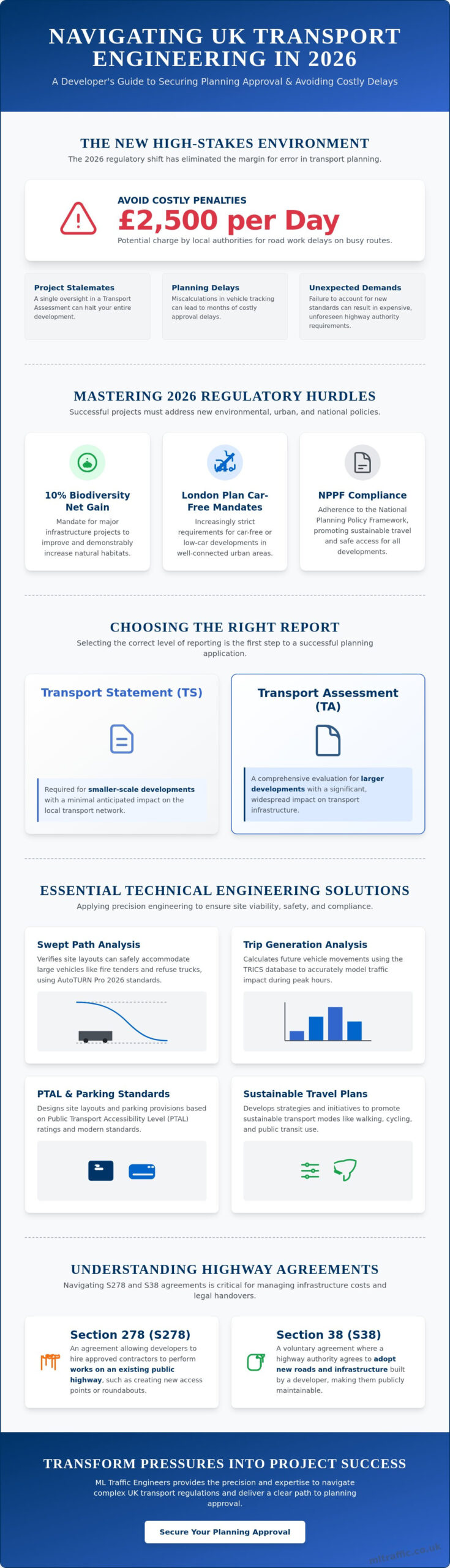
The August 2026 update to the National Planning Policy Framework (NPPF) has fundamentally rewritten the rules for development in England, moving transport from a secondary consideration to the very core of site design. For developers, this shift means that navigating the public sector transport assessment requirements UK authorities now enforce is no longer just a box-ticking exercise; it’s a high-stakes technical challenge where precision is a functional necessity. You’re likely already feeling the pressure of distinguishing between Transport Statements and Assessments while fearing a “severe” impact ruling that could stall your project indefinitely.
We understand that the fear of planning refusal or protracted Section 278 negotiations can jeopardise your delivery timelines. This guide promises to demystify the statutory transport planning landscape, providing you with a clear roadmap to secure approval without unnecessary delays. We’ll examine the transition to a vision-led approach, the new TR1 to TR8 policy structures, and how leveraging precise data from parking surveys and swept path analysis ensures your project meets the 2026 standards. By the end of this article, you’ll have the technical authority needed to manage full project lifecycles from inception to successful planning submission.
Key Takeaways
- Understand how the August 2026 NPPF update shifts transport planning to a vision-led model, requiring integration from the earliest design stages.
- Navigate the public sector transport assessment requirements UK authorities mandate by correctly identifying whether your project needs a Transport Statement or a full Assessment.
- Learn to utilize high-precision data from traffic surveys and swept path analysis to mitigate the risk of “severe” transport impact rulings.
- Establish a clear scoping agreement with the Local Highway Authority during the pre-application phase to prevent costly revisions and Section 278 delays.
- Align your submission with “Healthy Streets” and Vision Zero principles to ensure your development meets modern sustainability and safety benchmarks.
Understanding the Statutory Framework for UK Transport Assessments
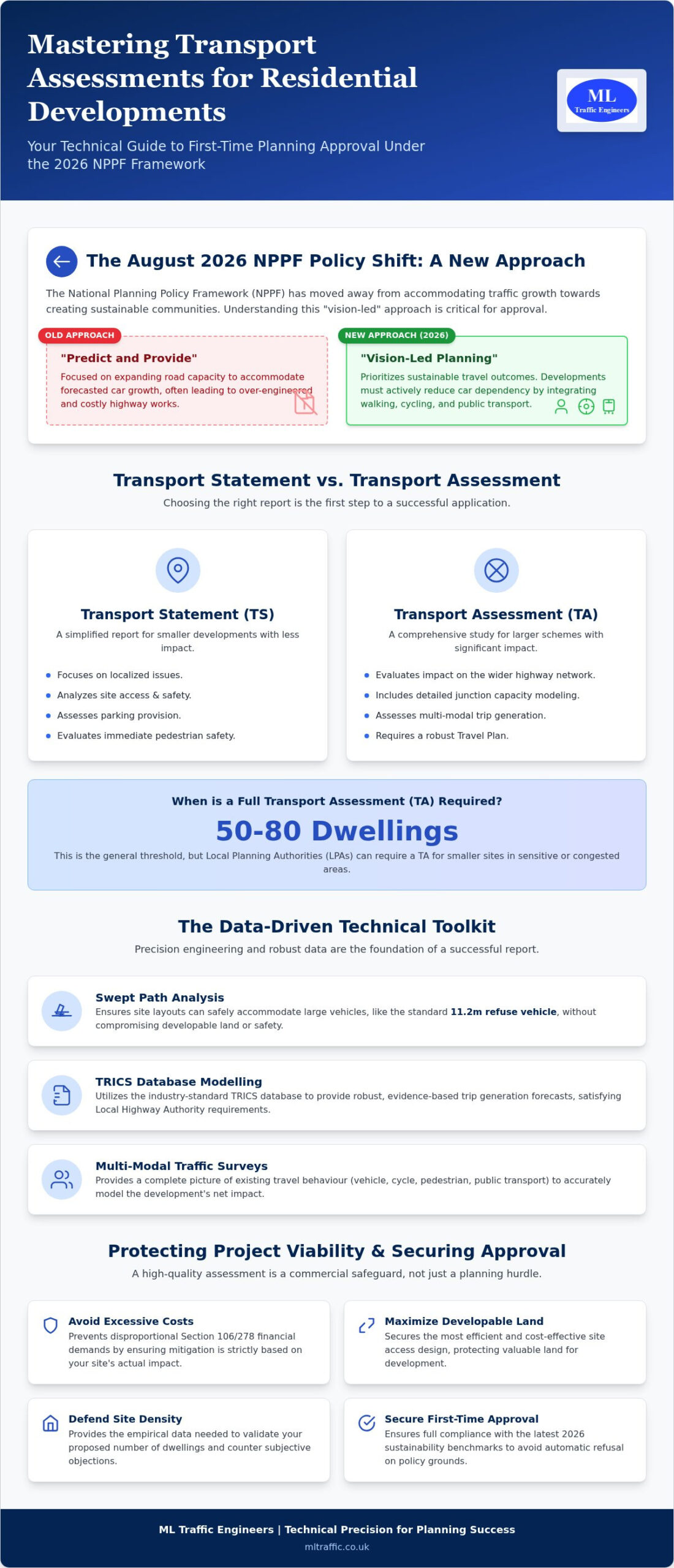
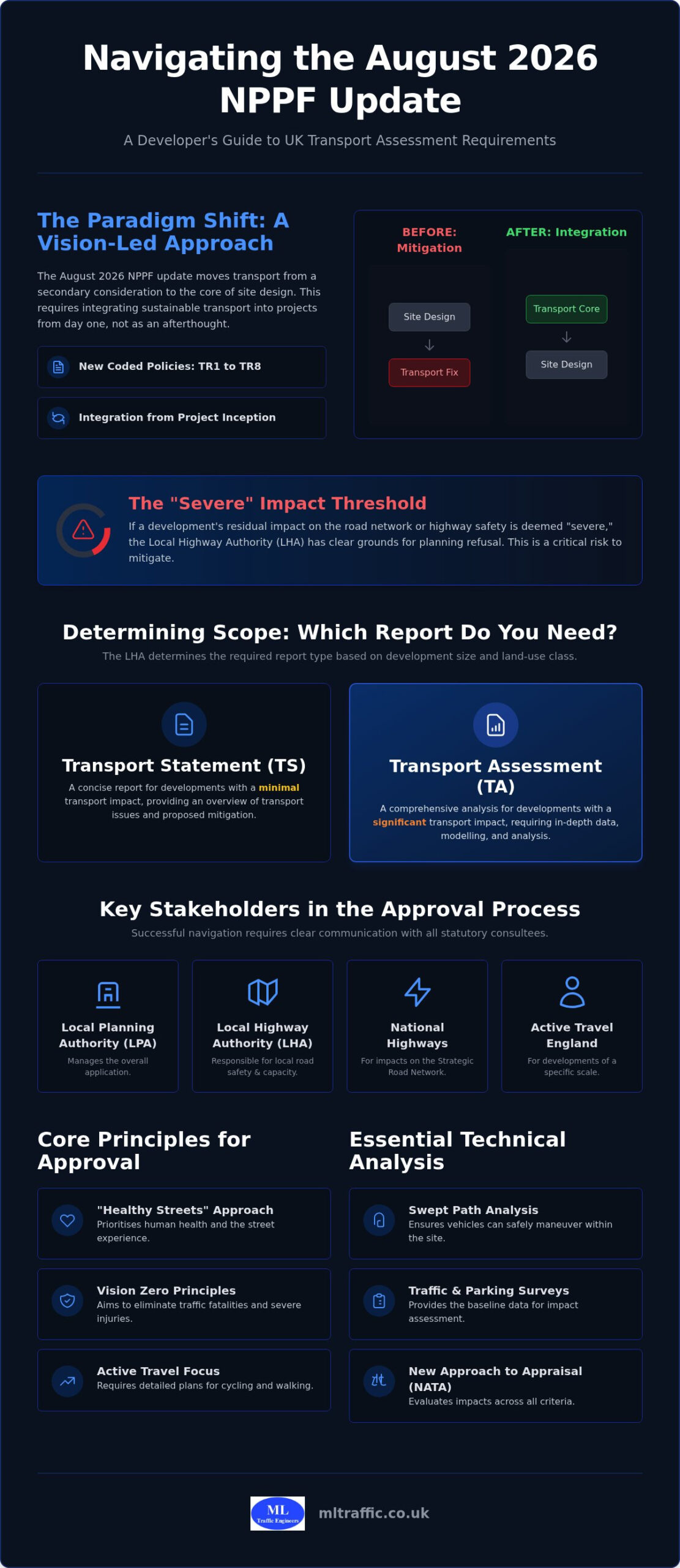
The August 2026 National Planning Policy Framework (NPPF) represents a paradigm shift for infrastructure planning. It replaces previous paragraph-based guidance with a structured set of coded policies, TR1 through TR8. These new standards dictate the public sector transport assessment requirements UK developers must satisfy to secure planning permission. Success depends on aligning with a “vision-led” approach. This requires you to integrate sustainable transport into the design from day one rather than treating it as a post-hoc mitigation measure.
A critical threshold remains the “severe” residual impact on the road network or highway safety. If a development exceeds this limit, the Local Highway Authority (LHA) has clear grounds for refusal. We use the New Approach to Appraisal (NATA) to evaluate these impacts across environmental, social, and economic criteria. This multi-criteria decision framework ensures that every stakeholder, from the developer to National Highways, operates from a verified technical baseline.
To better understand this concept, watch this helpful video:
The relationship between the developer and the LHA is defined during the pre-application phase. This technical dialogue is vital because the Transport Assessment serves as the technical foundation for future Section 278 and Section 38 agreements. National Highways also acts as a statutory consultee for developments near the Strategic Road Network. Key stakeholders in this process include:
- The Local Planning Authority (LPA) who manages the overall application.
- The Local Highway Authority (LHA) responsible for local road safety and capacity.
- National Highways for impacts on the Strategic Road Network.
- Active Travel England for developments of a specific scale.
The Legal Basis: NPPF and Local Transport Plans
Local Transport Plans (LTPs) add specific regional layers to national rules. These plans often require higher standards for density or active travel connectivity than the baseline NPPF. Proving sustainable development requires a holistic strategy that balances vehicle movements with pedestrian safety. The “Healthy Streets” approach is a core requirement for 2026, mandating that developments prioritise human health and the experience of being on the street. This ensures that new infrastructure supports the government’s target of building 1.5 million homes while maintaining public safety.
Why Public Sector Scrutiny is Increasing
Public sector scrutiny is intensifying due to climate emergency declarations and the urgent shift toward active travel. Authorities now expect detailed plans for cycling and walking infrastructure to be the primary focus of any report. This regulatory environment requires a partner who understands intricate regional regulations so you don’t have to. You can rely on the expert policy navigation provided by the team at ML Traffic Engineers UK to ensure your report meets these evolving expectations. Our technical reports are designed to withstand the rigours of public consultation and authority review.
Determining the Scope: Transport Assessment vs. Transport Statement
Identifying the correct report type is the first step in meeting the public sector transport assessment requirements UK authorities demand for planning approval. Local Highway Authorities (LHAs) use land-use classes and development size as primary triggers to determine if a project requires a Transport Statement (TS) or a more comprehensive Transport Assessment (TA). While official government guidance provides a baseline for these thresholds, local plans often introduce stricter regional layers that developers must navigate. Precision at this stage is vital; submitting the wrong document type can lead to immediate delays or requests for additional data mid-application.
A “grey area” often exists for smaller sites that sit just below national thresholds. If a development is located near a sensitive junction, an area with existing capacity issues, or a site with a complex safety history, the LHA may elevate the requirement to a full TA. We recommend a proactive approach to scoping to avoid these surprises. You can explore our technical services to see how we manage these early-stage negotiations with local authorities to lock in the required report scope.
When is a Transport Statement Sufficient?
A Transport Statement is typically reserved for developments with lower anticipated traffic generation. For residential projects, this often applies to sites between 50 and 80 dwellings, though many London boroughs set lower triggers. The report focuses on immediate site access and local highway safety rather than the wider network. It proves that the development won’t breach the “severe” impact threshold at the point of entry. If you’re working on a project in the capital, our Transport Statement London Guide provides specific regional thresholds and buying advice for 2026.
The Scope of a Full Transport Assessment
Large-scale developments or significant traffic generators require a full Transport Assessment. This document extends its analysis beyond the site boundary to evaluate the wider highway network and critical junctions. It requires detailed multi-modal trip generation modelling to predict movements for vehicles, pedestrians, and cyclists. The assessment must demonstrate how the project supports sustainable travel goals and aligns with the 2026 NPPF “vision-led” approach. For a technical deep dive into these requirements, review our Transport Assessment London: Developer’s Guide to ensure your submission is robust and policy-compliant.
Essential Technical Data and Analysis Requirements
Securing planning approval in 2026 requires more than just a well-written report; it demands a robust technical foundation built on verified data. The public sector transport assessment requirements UK authorities enforce now place a heavy emphasis on quantitative evidence over qualitative assumptions. We begin this process by establishing a technical baseline through comprehensive traffic and parking surveys. This data informs the trip generation modelling, where we use the TRICS (Trip Rate Information Computer System) database to predict vehicle movements with high levels of precision. By comparing your site against similar developments across the country, we provide the Local Highway Authority (LHA) with a realistic forecast of how the local network will perform post-completion.
Swept Path Analysis (SPA) Requirements
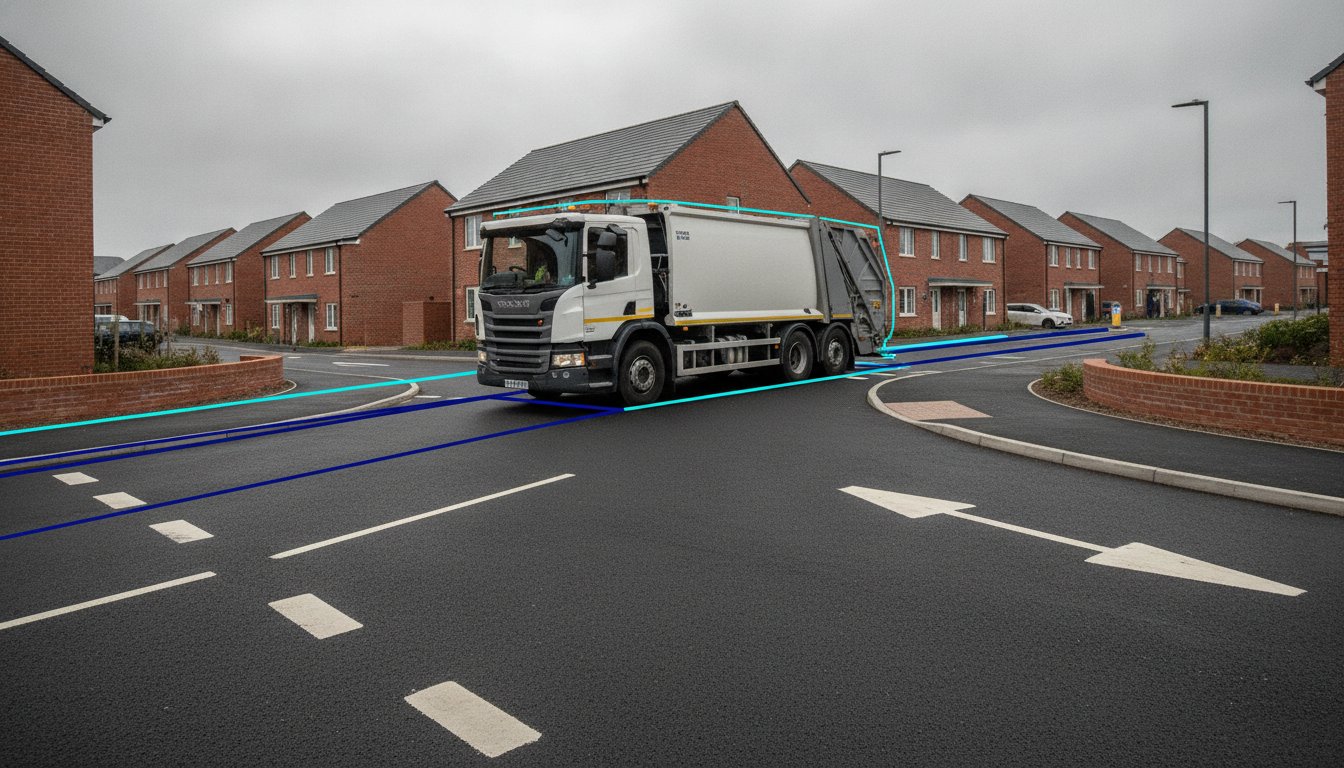
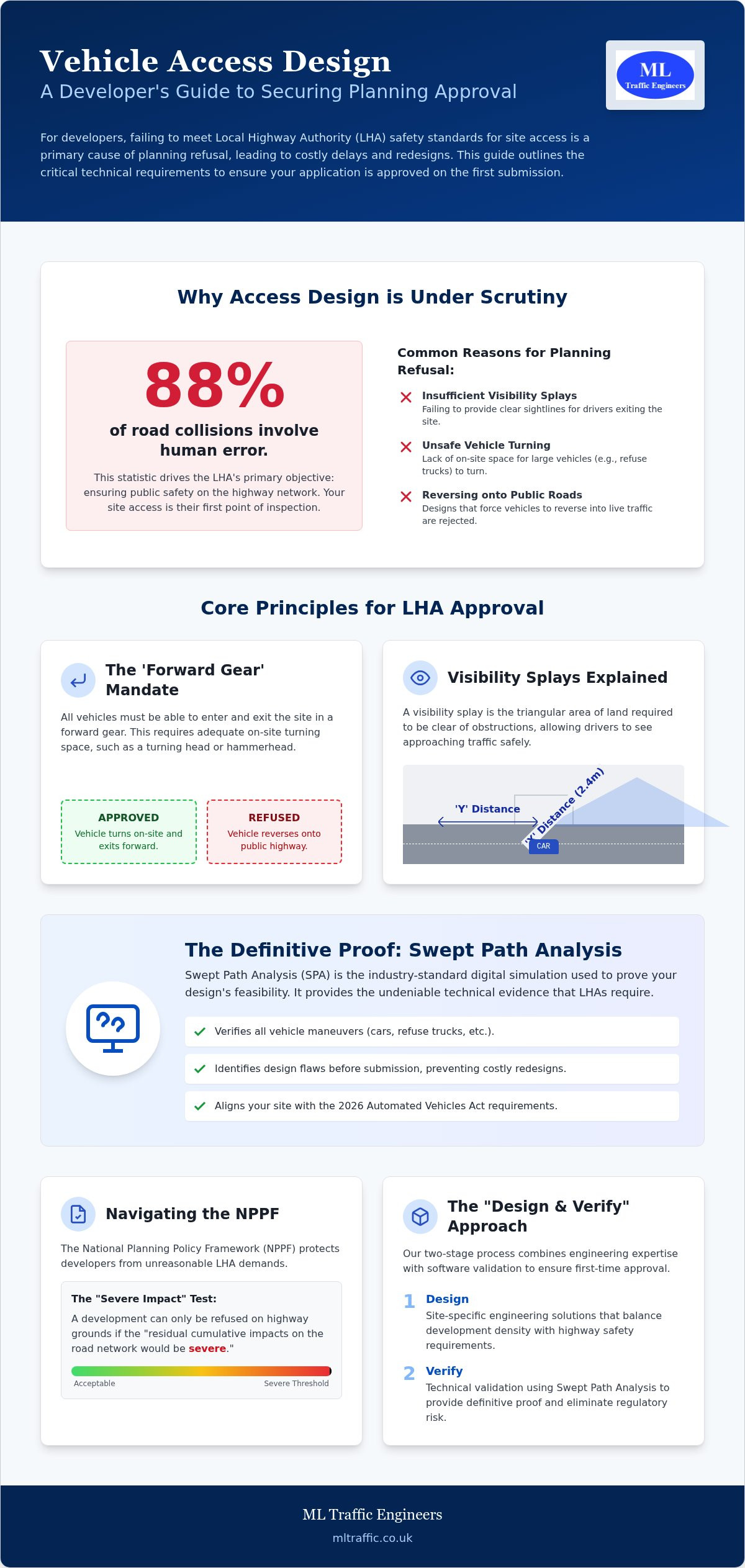
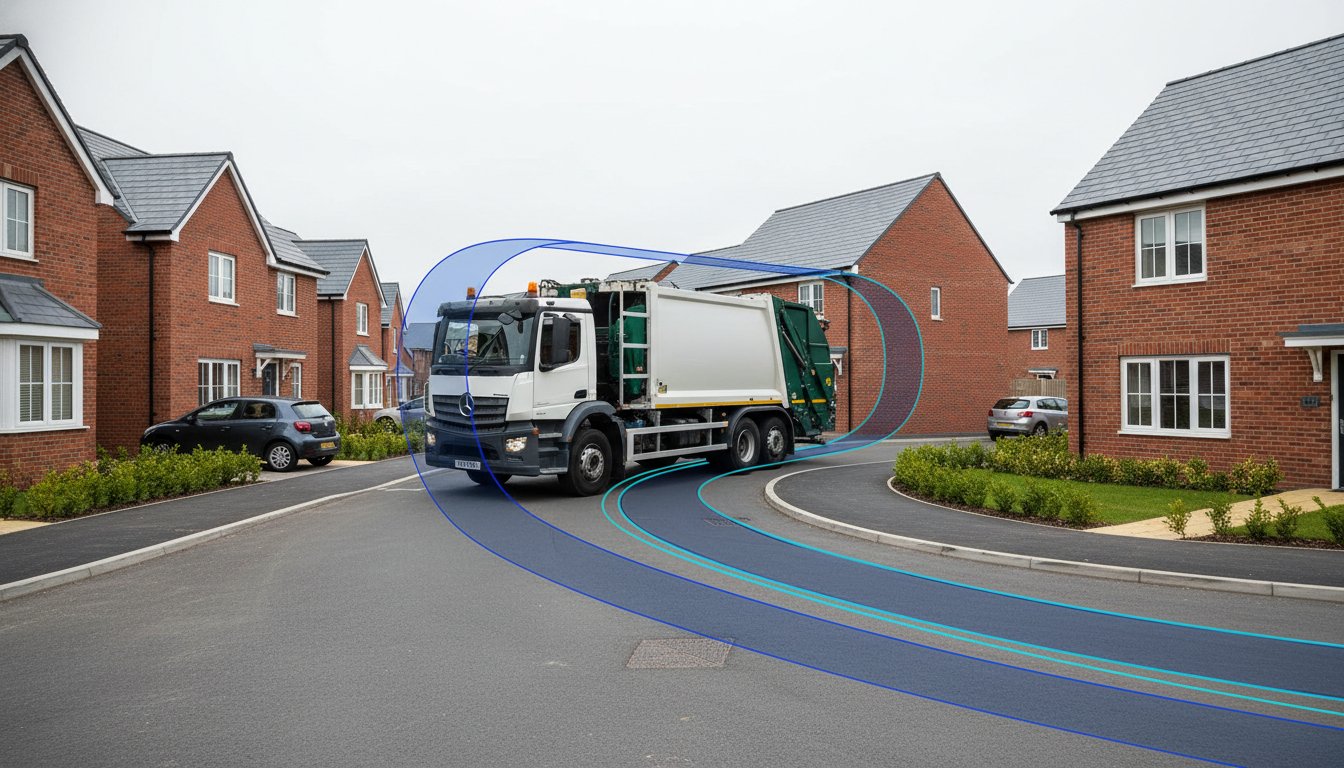
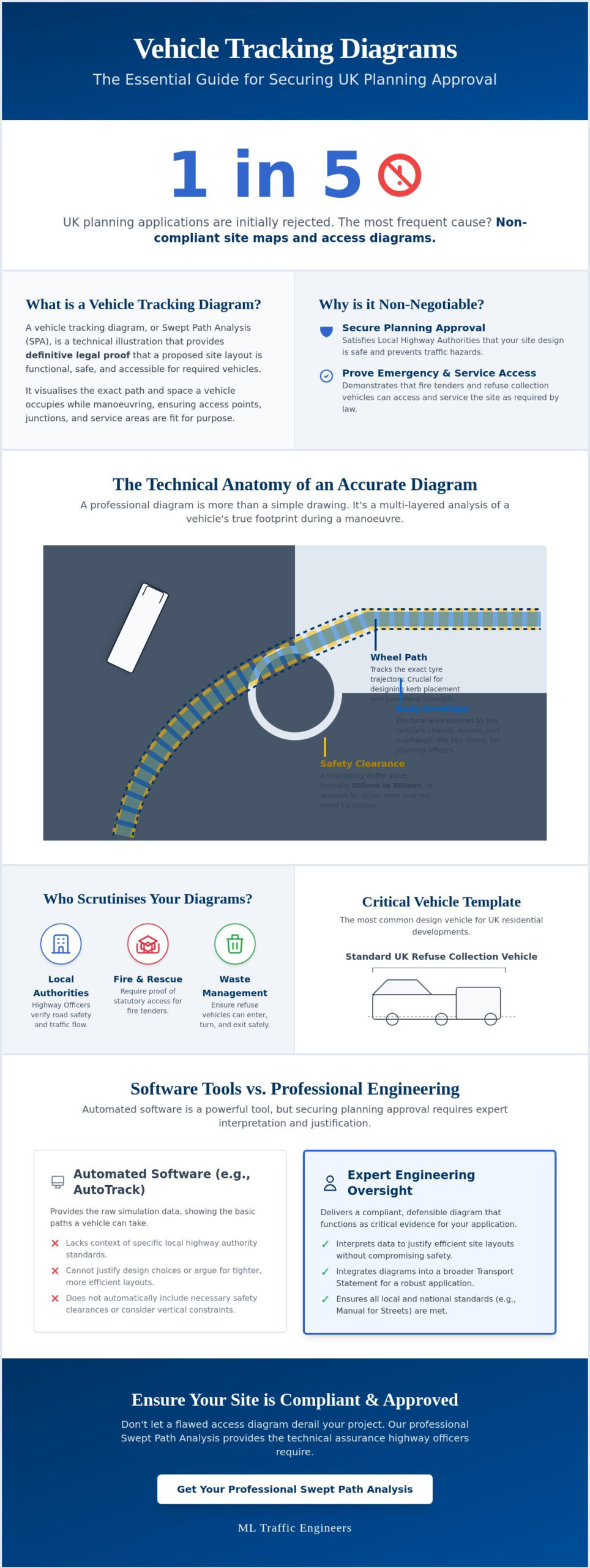
Proving that a site is safe and accessible for all users is a non-negotiable step in the planning process. Swept Path Analysis (SPA) acts as the primary tool for demonstrating vehicle manoeuvrability. We use industry-standard templates to simulate the movement of refuse vehicles, fire tenders, and delivery vans through your proposed layout. This analysis identifies potential pinch points before they become expensive design flaws. Highway officers expect to see that a 11.4-metre refuse truck or a heavy goods vehicle can enter, turn, and exit the site in forward gear. For a detailed breakdown of the software and templates we use, refer to our Practical Guide to Swept Path Analysis.
Traffic and Parking Survey Methodology
Parking provision is often the most contested element of a public sector application. To address this, we conduct parking surveys using the Lambeth Methodology or other LHA-approved formats. These surveys aren’t simple snapshots; they involve rigorous data collection over multiple days to capture peak demand periods. This precision is especially critical in areas with high Public Transport Accessibility Level (PTAL) ratings. If you’re proposing a development with limited parking, you must prove that any potential overspill won’t compromise highway safety or local amenity. The technical precision of our surveys ensures that your submission meets the public sector transport assessment requirements UK planners expect, reducing the risk of refusal based on severe transport impacts.
Navigating the Consultation and Scoping Process
Successful planning submissions are rarely the result of a single document upload. They stem from a proactive, iterative dialogue with the Local Highway Authority (LHA). Understanding the public sector transport assessment requirements UK authorities use to judge sites allows you to control the narrative from the outset. We recommend initiating this dialogue during the pre-application phase. Engaging early identifies potential technical hurdles while the site design remains flexible, reducing the risk of a “severe” impact ruling that could stall your project.
The consultation process is a technical negotiation. It requires a high level of precision to ensure the LHA accepts your baseline assumptions. If you skip this step, you risk the authority rejecting your entire report on the grounds of an inadequate study area or flawed trip generation data. Our role as your technical partner is to manage these intricate regional regulations so you don’t have to. You can contact ML Traffic Engineers UK today to secure a scoping agreement that protects your project from planning delays.
The Scoping Meeting: What to Prepare
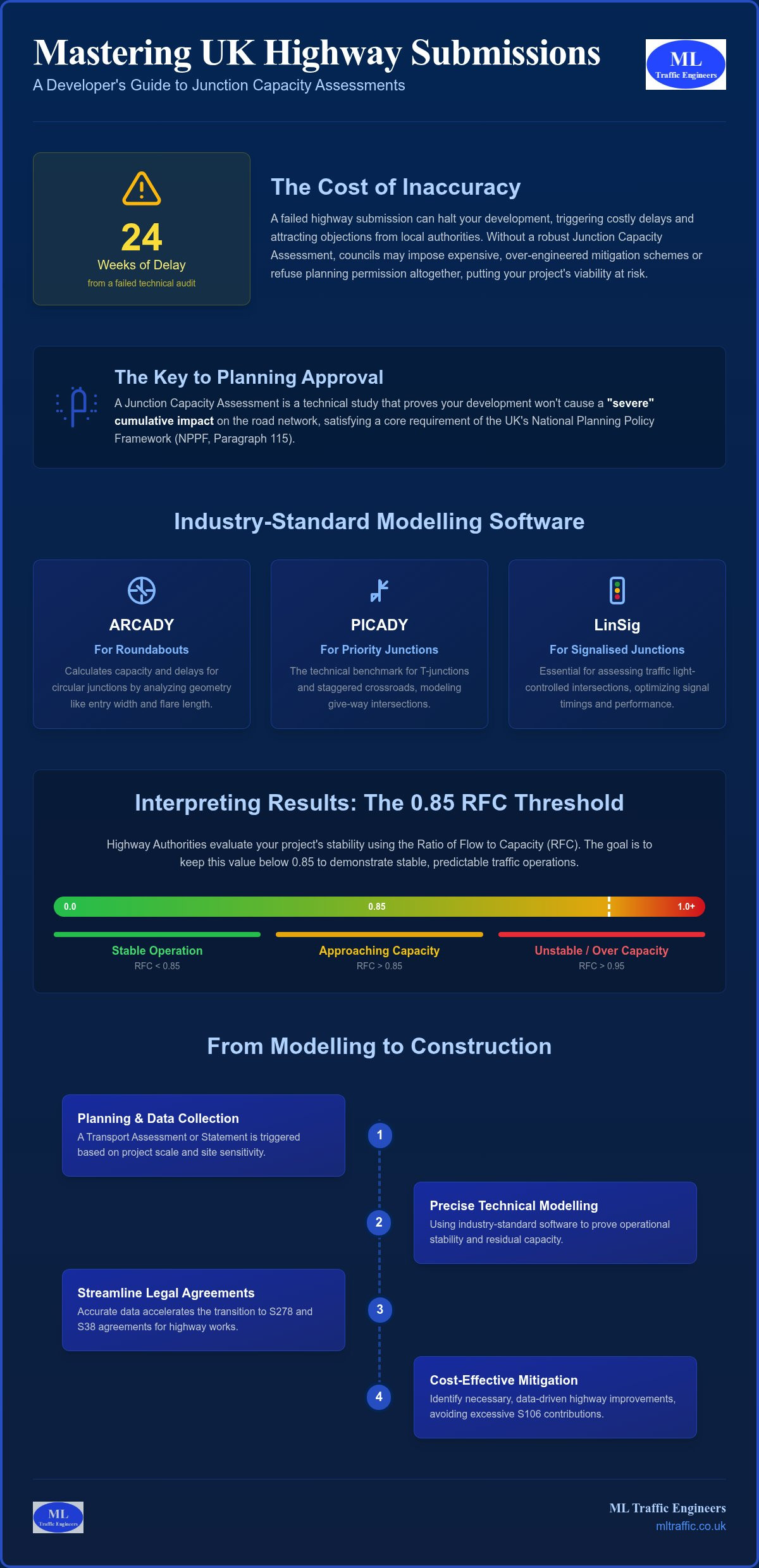
The scoping meeting is the most critical milestone in the pre-application stage. You must present your initial trip generation figures and the specific junctions you intend to model for capacity. This is also the time to agree on the “future growth year” assumptions, which typically look five years beyond the application date for local road networks. We also define the geographical study area to ensure all relevant transport links are included. An agreed scope prevents costly re-modelling later. Once the LHA signs off on these parameters, they cannot easily move the goalposts during the formal review.
Travel Plans as a Mitigation Tool
When a Transport Assessment predicts significant vehicle volumes, a robust Travel Plan serves as your primary mitigation strategy. It shifts the focus from expanding road capacity to managing travel demand. You must set SMART targets (Specific, Measurable, Achievable, Realistic, and Time-bound) to encourage active travel and public transport use. These plans are not “set and forget” documents; they require long-term management and monitoring, often secured through Section 106 agreements. For expert assistance in developing these documents, consult our Travel Plan Consultants Guide. This ensures your mitigation strategy is both policy-compliant and practically achievable.
Securing Approval: How Professional Consultancy Mitigates Risk
The final hurdle in any development is ensuring that the technical findings of your report hold up under the scrutiny of planning committees and statutory consultees. Meeting the public sector transport assessment requirements UK authorities enforce requires more than just submitting a document; it demands a strategy for long-term compliance. “Off-the-shelf” or generic reports often fail because they lack the site-specific precision required to address unique local constraints. A professional consultancy provides the technical authority to defend your site against objections, acting as an expert witness if your project reaches a public inquiry.
Precision in data collection is the primary safeguard against planning refusal. By aligning your project with national policy from the start, you reduce the risk of costly revisions and protracted negotiations. Our team takes pride in adherence to standards, ensuring that every traffic survey and swept path analysis is beyond reproach. This level of detail is essential for developments in high-stakes environments where even a minor error in trip generation modelling can lead to a “severe” impact ruling.
From Assessment to Implementation
A Transport Assessment (TA) isn’t just a planning tool; it’s the technical blueprint for your future highway works. The transition from planning approval to physical implementation relies on the findings within the TA being translated into viable highway designs. This link is vital for securing Section 278 and Section 38 technical approvals. If the mitigation measures proposed in the TA are not physically achievable, the project will face significant delays during the construction phase. We draw on a wide range of ML Traffic Engineers UK project types to ensure that our recommendations are grounded in practical, deliverable engineering solutions.
Choosing a Specialist Transport Consultant
Navigating the specific requirements of individual London boroughs or regional councils requires deep local knowledge. A specialist consultant understands the nuances of regional regulations so you don’t have to. You should ensure your partner utilizes the latest industry software, including AutoTurn for vehicle simulations, TRICS for trip rate analysis, and Junctions 10 for capacity modelling. This technical lexicon, paired with professional business terms, ensures your submission speaks the language of the highway authority.
Reliability is the hallmark of a successful partnership. We position ourselves as a vital guardian of public safety, ensuring that your development integrates seamlessly into the existing infrastructure. For a technical report that satisfies all statutory requirements and minimises your regulatory pressure, contact ML Traffic Engineers UK for a professional Transport Assessment quote.
Securing Planning Success in the 2026 Regulatory Landscape
Mastering the public sector transport assessment requirements UK authorities enforce is the difference between a project that stalls and one that moves straight to implementation. You’ve seen how the 2026 NPPF shift towards a vision-led approach demands higher technical precision from the earliest design stages. By correctly identifying your report scope and securing a formal scoping agreement, you eliminate the risk of costly re-modelling and Section 278 delays. Precision in data collection, specifically through robust swept path analysis and parking surveys, remains your strongest defence against claims of severe highway impact.
ML Traffic Engineers offers the technical authority and local policy expertise needed to navigate these intricate regulations so you don’t have to. As specialists in swept path analysis and parking surveys with a proven track record with UK Local Highway Authorities, we ensure your submission is robust and policy-compliant. Don’t leave your planning success to chance in this high-stakes environment. Request a Professional Transport Assessment Quote from ML Traffic Engineers today. We’re ready to act as your dependable partner, ensuring your development meets every safety and sustainability benchmark.
Frequently Asked Questions
What is the difference between a Transport Assessment and a Transport Statement?
A Transport Statement is a concise report for developments with limited transport implications, focusing on site access and local safety. In contrast, a Transport Assessment provides a comprehensive evaluation for larger projects with significant traffic generation. The public sector transport assessment requirements UK authorities mandate for Assessments include wider network modelling and multi-modal analysis. While a Statement confirms local suitability, an Assessment must demonstrate that the broader infrastructure can support the new demand.
When is a Transport Assessment legally required for a UK planning application?
A Transport Assessment is required when a development is expected to generate significant transport implications. National thresholds often trigger this for residential sites exceeding 80 dwellings or commercial spaces over 2,500 square metres. However, Local Highway Authorities frequently set lower regional triggers. You must consult the August 2026 NPPF policies TR1 to TR8 and your specific local plan to determine the exact requirements for your site before submitting a planning application.
How long does it take to produce a public sector-compliant Transport Assessment?
The timeline for producing a compliant report typically ranges from four to eight weeks. This duration includes the essential pre-application scoping phase, conducting on-site traffic or parking surveys, and performing technical analysis like swept path simulations. Complex sites requiring extensive junction modelling or multi-agency consultation may take longer. Early engagement with a specialist consultant ensures that data collection aligns with current standards, preventing delays during the formal planning review process.
What is a “severe” transport impact under the NPPF?
Under the National Planning Policy Framework, “severe” impact refers to the residual cumulative effect of a development on the road network’s capacity or highway safety. Planning permission should only be refused on transport grounds if these impacts are deemed severe. Demonstrating that your project stays below this threshold requires precise trip generation modelling and junction analysis. Our technical reports provide the robust evidence needed to prove that your site design mitigates these risks effectively.
Is a Travel Plan always required alongside a Transport Assessment?
A Travel Plan is almost always required alongside a full Transport Assessment to manage long-term travel demand. While smaller developments requiring only a Transport Statement might occasionally be exempt, most public sector projects must demonstrate a commitment to sustainable travel. These plans set SMART targets for reducing single-occupancy vehicle trips. They are often secured as a planning condition or through a Section 106 agreement to ensure ongoing monitoring and management.
Can I use a Transport Statement to justify reduced parking on my site?
Yes, you can justify lower parking provision if the report is supported by technical data. We utilize rigorous parking surveys and PTAL (Public Transport Accessibility Level) analysis to prove that reduced parking won’t lead to overspill or safety issues. By applying the Lambeth Methodology, we provide the Local Highway Authority with a precise snapshot of local street capacity. This evidence-based approach is vital for securing approval for high-density developments in well-connected urban areas.
What happens if the Local Highway Authority objects to my Transport Assessment?
An objection from the Local Highway Authority triggers an iterative review and technical negotiation process. We address objections by refining the site design, adjusting the mitigation strategy, or providing additional technical data such as detailed swept path analysis. Most objections are resolved through these technical discussions or by agreeing to infrastructure improvements via Section 278 agreements. Our role is to act as your technical representative, ensuring that all public sector transport assessment requirements UK planners demand are satisfied.
How much does a Transport Assessment cost for a public sector project?
The cost of a Transport Assessment varies significantly based on the project’s scale and the specific surveys required. Factors influencing the price include the complexity of junction modelling, the number of parking surveys needed, and the extent of the study area agreed upon during scoping. Because every public sector site has unique constraints, we provide tailored quotes that reflect the precise technical requirements of your local authority. This ensures you receive a high-quality, policy-compliant report without unnecessary overheads.

Disclaimer
The content on mltraffic.co.uk, including all technical articles, guides, and resources, is provided for general informational and educational purposes only. It is not intended to constitute professional advice in traffic engineering, transportation planning, development approvals, or any other technical or legal field.
While ML Traffic Engineers makes every reasonable effort to ensure the accuracy, completeness, and timeliness of the information published, we do not provide any warranties or representations (express or implied) regarding its reliability, suitability, or availability for any particular purpose. Any reliance you place on the content is strictly at your own risk.
In no event shall ML Traffic Engineers, its directors, employees, authors, or affiliates be liable for any direct, indirect, incidental, special, consequential, or punitive damages (including, without limitation, loss of profits, data, or business opportunities) arising out of or in connection with the use of, or inability to use, any information provided on this website.
The articles and guides on this site are not a substitute for engaging a qualified, professional traffic engineer to assess your specific project requirements. For tailored advice, compliance assessments, or traffic engineering services, please contact a competent professional.
This disclaimer may be updated from time to time without notice. By accessing or using this website, you agree to be bound by the most current version of this disclaimer.