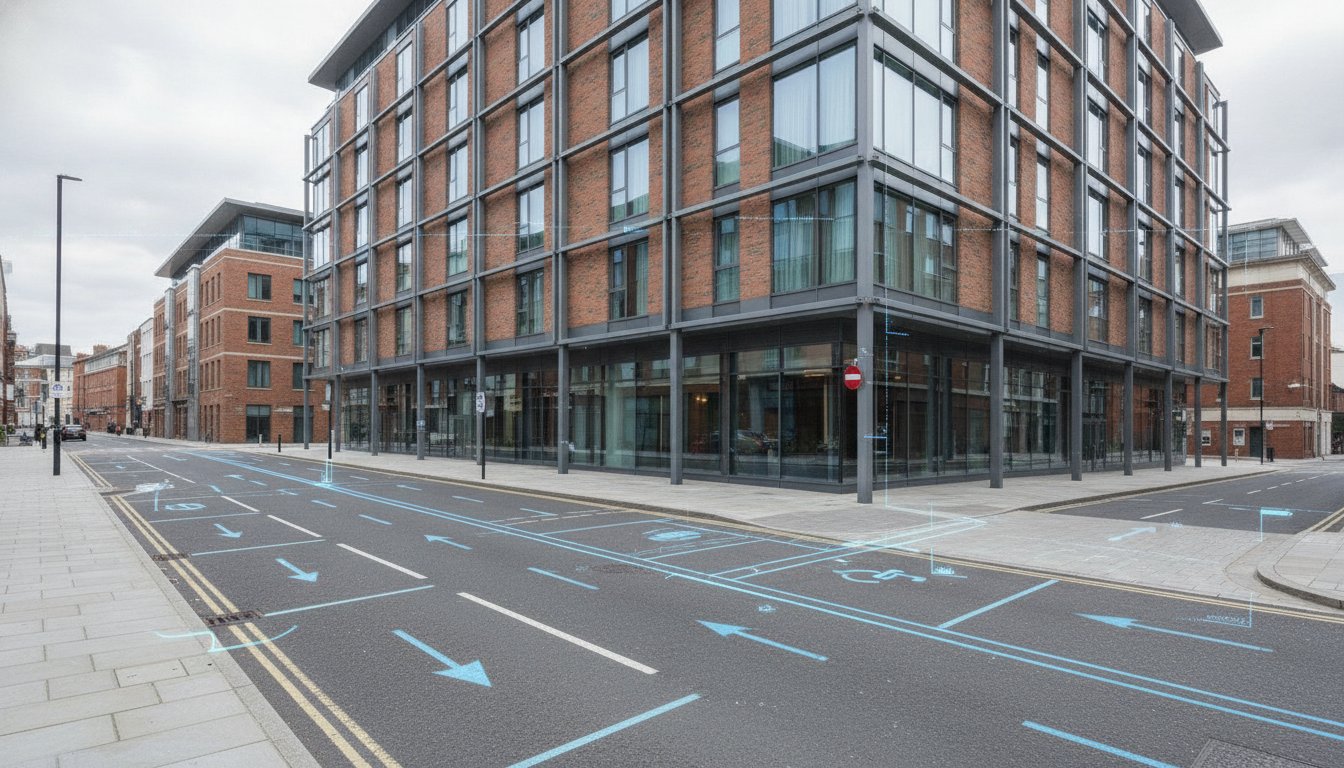
Did you know that 42% of minor development applications face immediate delays at the validation stage because of inadequate highway data? For developers targeting the 2026 tourist season, these early setbacks often stem from a failure to address the new vision-led approach required by highway authorities. Securing a technical transport assessment for mixed-use development involves navigating complex seasonal demand cycles and strict cumulative impact assessments within a 500-metre radius of your site.
It’s frustrating when inaccurate trip forecasting or unexpected parking objections force costly design changes late in the project lifecycle. You deserve a clear path to planning success that prioritises precision and regulatory compliance. This assessment guide provides the technical expertise needed to master the latest planning triggers and TRICS database modelling. We’ll examine how to optimise your internal layout for servicing, meet the updated National Planning Policy Framework standards, and deliver a validated report that withstands rigorous council scrutiny to secure your 2026 planning permission.
Key Takeaways
- Understand how the 2026 shift toward vision-led planning requires a transition from traditional models to secure highway authority validation.
- Identify the technical requirements for a transport assessment for mixed-use development to accurately capture hotel-specific trip rates and seasonal demand.
- Master the integration of mandatory Electric Vehicle (EV) charging infrastructure and Blue Badge accessibility while balancing guest parking needs.
- Discover how robust Travel Plans and active travel facilities can effectively mitigate trip generation figures and reduce highway authority objections.
- Learn how to navigate the pre-application process using precision-led technical reporting to ensure a smooth project lifecycle from assessment to approval.
The Role of a Tourist Hotel Transport Assessment in 2026 Planning
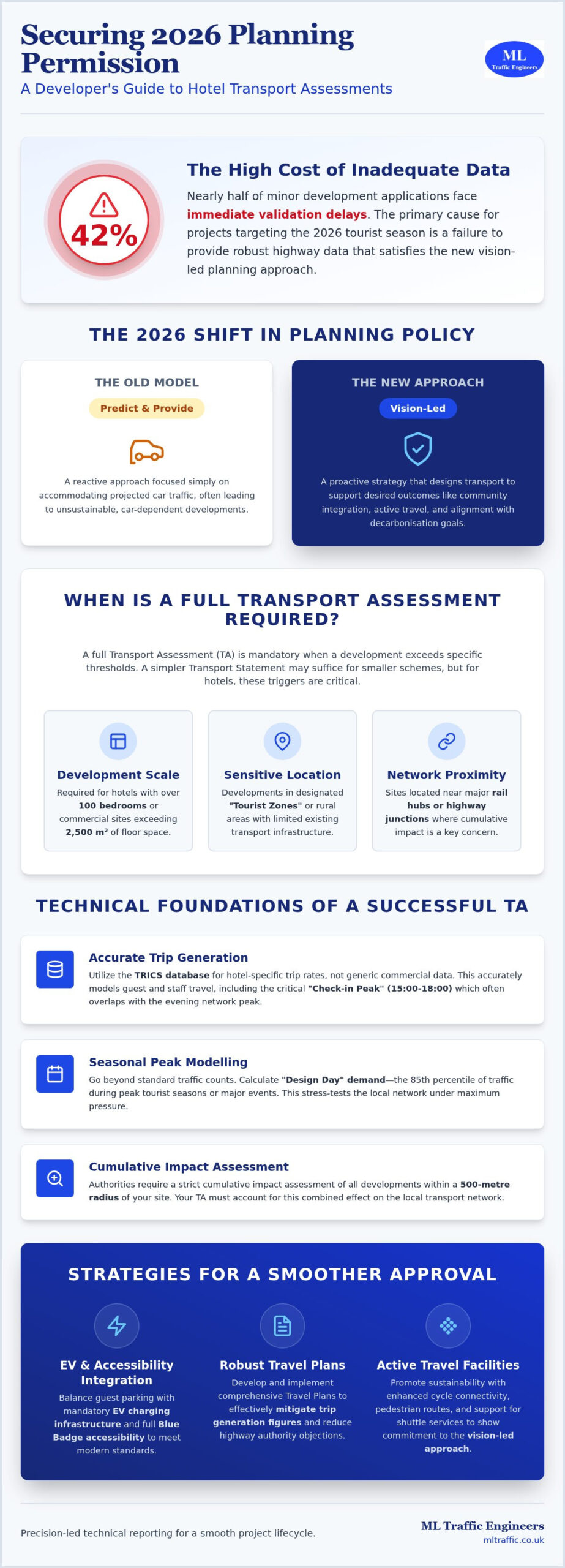
A Transport Assessment (TA) is far more than a supplementary planning document; it’s the technical foundation of your hotel’s feasibility. For any developer, it’s a comprehensive study that quantifies the travel impacts of a proposed site. In 2026, the standard for these reports has evolved. It’s no longer enough to simply count cars. You must now demonstrate how your site integrates with the wider community. A robust transport assessment for mixed-use development acts as primary evidence during the validation process. Without it, 42% of minor applications face immediate delays because of inadequate highway data.
The distinction between a Transport Statement and a full Transport Assessment is critical for your project timeline. A Transport Statement is typically reserved for smaller schemes with limited impact. In contrast, a full Transport Assessment is required when a project reaches specific thresholds, such as 2,500 square metres of commercial floor space. For hotel operators, this document must detail guest arrival patterns, staff shifts, and complex delivery schedules to prove the site is operationally viable.
When is a Full Transport Assessment Required?
Determining whether you need a full TA or a simpler statement depends on several triggers. Local highway authorities often set thresholds based on bedroom count or total floor area. If your hotel exceeds 100 bedrooms, a full assessment is almost certainly mandatory. Location also plays a critical role. Developments in sensitive “Tourist Zones” or rural areas with limited infrastructure require deeper analysis. Proximity to existing rail hubs or major highway junctions can also trigger a scoping requirement. You must account for how your guests will access the site without overwhelming local capacity.
Regulatory Shifts and Policy Alignment
The 2026 update to the National Planning Policy Framework (NPPF) has fundamentally changed how we approach site access. We’ve moved away from the old “Predict and Provide” model. Instead, we now use a “Vision-Led” approach. This means we design the transport strategy to support a specific outcome, such as high-frequency shuttle services or enhanced cycle connectivity. Planners now scrutinise transportation forecasting methods to ensure they align with local decarbonisation goals. You must also satisfy local borough validation lists. These lists often include hotel-specific requirements like coach parking strategies and detailed servicing plans. Aligning your technical reporting with these 2026 standards is the only way to avoid costly planning objections.
Technical Scoping: Trip Generation and Seasonal Demand Forecasting
Accurate trip generation is the technical backbone of any successful transport assessment for mixed-use development. We rely on the TRICS database to extract hotel-specific trip rates, ensuring the data reflects the unique operational profile of a tourist site. Standard commercial trip rates don’t capture the nuances of hotel guest behaviour. For instance, a hotel’s “Check-in Peak” typically occurs between 15:00 and 18:00, which often overlaps with the evening network peak. While official government guidance provides a broad framework for these studies, your scoping must account for multi-modal arrivals, including rail, coach, and private hire vehicles.
We model these patterns to ensure the local highway network can accommodate the additional load without compromising safety. This requires a granular look at guest arrival windows and staff shift patterns. If you’re managing a complex site, our experts can help you determine the most efficient data collection strategy for your planning submission.
Seasonal Peak Modelling for Tourist Destinations
In tourist hotspots, a standard traffic count isn’t sufficient. We calculate “Design Day” demand, which represents the 85th percentile of expected traffic during summer peaks or major local events. This stress-tests the development’s impact when the local network is under the most pressure. Seasonal Demand in 2026 modelling standards refers to the quantifiable fluctuation in trip rates triggered by peak tourism periods or local event cycles, necessitating a stress-test of the local highway network beyond average annual daily traffic. We use specialised software like Junctions 9 or 10 to model how these seasonal spikes impact junction capacity and queue lengths.
Refining Data with Local Traffic Surveys
Sometimes TRICS data doesn’t provide a perfect match for a specific site or location. In these cases, we conduct bespoke Traffic Surveys to gather real-world data. This allows us to analyse the local modal split and justify lower parking ratios based on actual guest behaviour. By integrating local data into your transport assessment for mixed-use development, you provide planners with a more accurate, defensible evidence base. This level of precision reduces the risk of planning objections and ensures your site access remains optimised throughout the project lifecycle.
Solving the Parking and Servicing Puzzle for Hotel Developments
Parking and servicing often represent the most contentious elements of a hotel planning application. Modern hotel developments must navigate a complex web of local parking standards while ensuring guests aren’t left circling local blocks. A professional transport assessment for mixed-use development must demonstrate that guest parking doesn’t compromise local highway capacity. It’s vital to satisfy Blue Badge requirements and the latest EV charging mandates, which now frequently require 20% active provision and 80% passive provision in urban centres. These figures must align with UK government guidance on transport assessments to ensure the site remains future-proofed for 2026 standards.
Coach activity presents a specific technical challenge that generic commercial assessments often overlook. You need dedicated drop-off zones that allow for safe guest egress without blocking the main carriageway. We analyse dwell times and overnight parking requirements to prevent illegal kerbside waiting. If your site cannot accommodate a 15-metre coach internally, we must negotiate off-site solutions with the local authority to avoid immediate planning objections.
Servicing and Delivery Logistics
Your site must function logically for back-of-house operations to remain viable. We model laundry deliveries, food supplies, and refuse collection using 12m rigid vehicles to ensure they can enter and exit in a forward gear. This is where Swept Path Analysis (SPA) becomes a non-negotiable tool for your design team. Our ML Traffic Engineers UK’s Swept Path Analysis Guide provides deeper technical insights into how these internal site layouts should be configured to accommodate emergency access alongside daily servicing.
Mitigating Kerbside Impact
Private hire vehicles (PHV) and taxis create significant kerbside pressure, especially during morning checkout peaks. We design dedicated Pick-Up and Drop-Off (PUDO) zones to prevent tailbacks and protect pedestrian safety at the hotel threshold. Planners are increasingly sensitive to “overspill” parking, where guests might park in residential streets to avoid hotel charges. We use parking surveys of the surrounding area to prove that your development won’t saturate local street capacity. Integrating these findings into your transport assessment for mixed-use development strengthens your case for a lower parking ratio, which can often free up valuable floor space for additional guest rooms.
Sustainable Travel and Travel Plan Integration
A robust Travel Plan is your most effective tool for mitigating high trip generation figures and satisfying the “decide and provide” requirements of modern planning. It shifts the technical focus from vehicle capacity to sustainable accessibility. When we prepare a transport assessment for mixed-use development, we leverage the Public Transport Accessibility Level (PTAL) rating of the site. High PTAL scores in urban centres allow us to argue for significantly reduced parking provision, which directly lowers the development’s impact on the local highway network. We ensure your submission aligns with the 2026 NPPF updates by prioritising active travel over private car use.
Active travel is a core pillar of the current regulatory environment. We don’t just provide cycle racks; we design integrated guest facilities including secure, weather-protected parking and e-bike charging points. For the hotel’s workforce, a dedicated Staff Travel Plan is essential. By incentivising public transport use and car-pooling through formalised schemes, we can reduce staff-related traffic during the critical network peak hours. This demonstrates a proactive approach to highway authorities, reducing the likelihood of objections based on congestion.
Accessibility and Connectivity Audits
We conduct thorough connectivity audits to assess the “last mile” journey from local transit hubs. If a guest arrives at a nearby rail station, the pedestrian route to your hotel must be safe, well-lit, and accessible. Our audits identify infrastructure gaps, such as narrow footways or a lack of dropped kerbs, and we propose targeted improvements to ensure a seamless arrival experience. This level of detail is a functional necessity for securing validation. For developments in the capital, our London Travel Plans Guide provides specific strategies for meeting the stringent requirements of the London Plan and individual borough validation lists.
Implementing Mitigation Measures
Planning approval often depends on your commitment to local infrastructure through financial contributions. We help you negotiate Section 106 or Section 278 agreements that fund highway improvements, bus stop upgrades, or new cycle lanes. Innovative measures like car clubs or private shuttle bus services act as powerful leverage during discussions with highway authorities. These initiatives prove your commitment to the vision-led approach mandated by the 2026 planning standards for any transport assessment for mixed-use development. To ensure your long-term compliance, our Travel Plan Consultants manage the mandatory monitoring and annual reporting required by the council.
If you need to strengthen your planning application through a sustainable transport strategy, contact our Travel Plan consultants today to ensure your project meets every regulatory benchmark.
Securing Planning Approval with ML Traffic Engineers UK
Precision in technical reporting serves as your most reliable defense against planning delays. Highway authorities across England scrutinise every data point within a transport assessment for mixed-use development to ensure safety and capacity aren’t compromised. We prioritise technical authority and regulatory compliance to ensure your submission is watertight from the first day of validation. ML Traffic Engineers UK manages the full project lifecycle, moving from initial data collection to final planning success with unwavering reliability.
Early engagement with Local Highway Authorities is a functional necessity for complex hotel schemes. We lead pre-application discussions to establish a clear technical framework, reducing the logistical pressures on your internal team. This proactive approach ensures that the scoping of your transport assessment for mixed-use development meets the specific expectations of the council. By securing an agreed methodology early, we eliminate the guesswork and provide a clear path toward a positive planning recommendation.
Common Highway Authority Objections
Authorities frequently issue objections based on “Inadequate Information” when reports fail to account for the nuances of hotel operations. We address these concerns by providing granular data on guest arrival patterns and staff shift cycles. We also defend site access visibility and internal layout safety through rigorous technical analysis. ML Traffic Engineers UK pre-empts common council objections by establishing an agreed scoping note with the Highway Authority before the final report is even drafted. This ensures that every potential hurdle, from junction capacity to pedestrian safety, is addressed with evidence-based solutions.
Your Partner for 2026 Planning Success
ML Traffic Engineers UK has a proven track record of delivering technical excellence for hotel and tourist-led developments across England since 2014. We understand the intricate regional regulations that govern site access and sustainable travel in 2026. Our all-encompassing service provides the expert support you need to navigate the complexities of the planning system. If you’re ready to move your project forward, you can request a Transport Assessment Quote to begin the scoping process. The next steps involve a detailed site feasibility study to ensure your development is operationally sound and ready for formal submission. We remain available to support your application throughout the entire consultation period, providing rapid responses to any technical queries from the authority.
Secure Your 2026 Planning Success Today
Navigating the 2026 planning landscape requires more than just meeting minimum standards. It demands a vision-led approach that integrates seasonal demand forecasting with precise internal site logistics. By mastering the technical triggers for a transport assessment for mixed-use development, you ensure your hotel project remains operationally viable and compliant with the latest NPPF updates. Precision in TRICS database analysis and Swept Path Analysis is your best defense against highway authority objections.
ML Traffic Engineers UK brings over a decade of expertise to your project, having supported developers across England since 2014. We specialise in technical reporting that satisfies even the most stringent council validation lists. Our team manages the full lifecycle of your submission, providing the reliability and technical authority needed for complex tourist-led schemes. Contact ML Traffic Engineers UK for a Professional Transport Assessment Quote to begin your feasibility scoping. We’re ready to help you secure a positive planning outcome for your next development.
Frequently Asked Questions
What is the difference between a Transport Statement and a Transport Assessment for a hotel?
The primary difference lies in the scale of the development and the intensity of its traffic impact. A Transport Statement is a simplified report for smaller schemes with minimal impact, whereas a full Transport Assessment is required for major projects, such as those exceeding 2,500 square metres of commercial floor space in London. This more detailed study is a standard requirement for any transport assessment for mixed-use development where hotel guest and staff movements could significantly affect the local highway network.
Do I need a Travel Plan for a small boutique hotel development?
Most local authorities require a Travel Plan for hotel developments to encourage sustainable guest and staff travel. Even for a small boutique site, a Travel Plan acts as a vital mitigation tool to reduce vehicle trips and justify lower parking provision. It’s especially useful in urban areas with high public transport accessibility, as it proves to planners that the development won’t saturate local street capacity or increase kerbside pressure.
How does TRICS data help in predicting hotel traffic in 2026?
TRICS data provides a robust, evidence-based foundation for predicting trip generation by comparing your site with similar operational hotels across the UK. In 2026, we use the latest database versions to align with the “vision-led” planning framework mandated by the updated National Planning Policy Framework. This ensures your trip rates are defensible and reflect modern guest behaviours, such as increased reliance on private hire vehicles and active travel modes rather than private car ownership.
Can I use residential parking standards for my hotel development?
You cannot use residential parking standards for a hotel because the operational profiles and peak demand hours are entirely different. Hotels require specific technical allocations for guest parking, staff shifts, and essential servicing vehicles like laundry trucks. Local highway authorities maintain distinct standards for hotel developments, often including mandatory requirements for Blue Badge spaces and Electric Vehicle charging points that must be addressed to secure validation.
What is Swept Path Analysis and why is it required for hotel planning?
Swept Path Analysis is a digital simulation that tracks the movement and turning circles of specific vehicles through your proposed site layout. It’s a mandatory requirement for hotel planning to prove that coaches, refuse trucks, and emergency vehicles can enter and exit the site in a forward gear. Without this technical verification, planners may object to your site access on the grounds of highway safety or operational inefficiency during the delivery of essential services.
How does seasonal demand affect my transport assessment?
Seasonal demand is a critical factor for tourist hotels because traffic patterns fluctuate significantly during summer peaks or local event cycles. Your assessment must include “Design Day” modelling to prove the local network can handle these spikes without failing. Failure to account for seasonality often leads to objections from highway authorities who are concerned about the cumulative impacts on junction capacity during the busiest times of the tourist season.
What happens if the highway authority objects to my transport assessment?
If an authority objects, you must provide a technical rebuttal or modify your site design to address their specific concerns. Many objections stem from inadequate data or unrealistic trip forecasting, which explains why 42% of minor applications in London experience initial delays at the validation stage. We manage this process by providing additional evidence, such as bespoke parking surveys or refined junction modelling, to resolve disputes and keep your project moving toward approval.
How much does a tourist hotel transport assessment cost in 2026?
The cost of a professional report varies significantly based on the project’s scale, location, and the complexity of the required modelling software. While minor schemes involve lower technical fees, a comprehensive transport assessment for mixed-use development featuring a large hotel requires more intensive data collection and junction capacity analysis. You should consult with a specialist to receive a tailored quote that reflects your specific site requirements and the local authority’s validation list.

Disclaimer
The content on mltraffic.co.uk, including all technical articles, guides, and resources, is provided for general informational and educational purposes only. It is not intended to constitute professional advice in traffic engineering, transportation planning, development approvals, or any other technical or legal field.
While ML Traffic Engineers makes every reasonable effort to ensure the accuracy, completeness, and timeliness of the information published, we do not provide any warranties or representations (express or implied) regarding its reliability, suitability, or availability for any particular purpose. Any reliance you place on the content is strictly at your own risk.
In no event shall ML Traffic Engineers, its directors, employees, authors, or affiliates be liable for any direct, indirect, incidental, special, consequential, or punitive damages (including, without limitation, loss of profits, data, or business opportunities) arising out of or in connection with the use of, or inability to use, any information provided on this website.
The articles and guides on this site are not a substitute for engaging a qualified, professional traffic engineer to assess your specific project requirements. For tailored advice, compliance assessments, or traffic engineering services, please contact a competent professional.
This disclaimer may be updated from time to time without notice. By accessing or using this website, you agree to be bound by the most current version of this disclaimer.