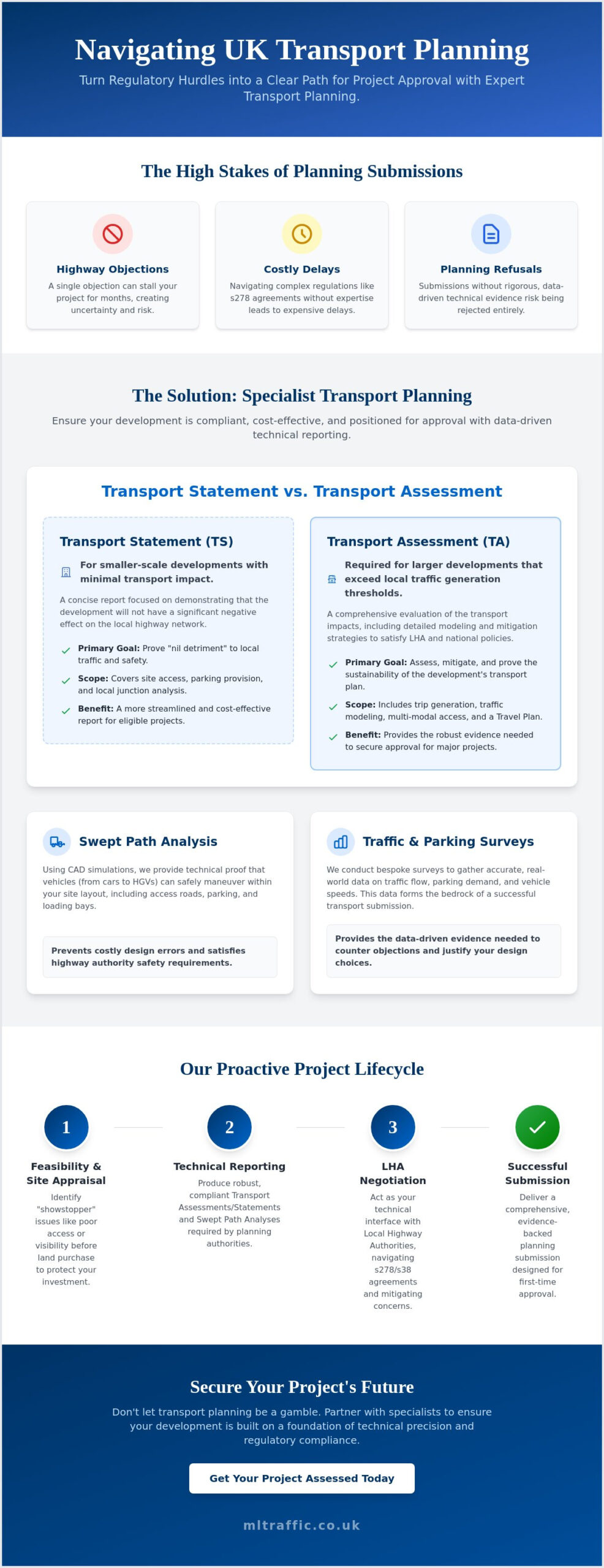
Tag: highway regulations

  • Traffic Impact Assessment: 2026 Developer’s Guide

    Traffic Impact Assessment: 2026 Developer’s Guide

    Did you know that 42% of minor development applications in London face immediate delays at the validation stage simply because they lack sufficient highway data? For developers across the UK, securing a traffic impact assessment for new developments has become a high-stakes hurdle where technical precision is a functional necessity. You’re likely all too familiar with the unpredictable delays from local highway authorities and the soaring costs of unplanned mitigation measures that can derail a project’s budget before it even begins.

    It’s frustrating when regulatory confusion between Transport Statements and full Assessments stalls your progress. This guide provides a clear path to planning approval by mastering the complexities of the 2026 transport planning landscape. We’ll examine the shift toward “vision-led” outcomes in the latest NPPF guidelines and show you how to implement proportionate, cost-effective mitigation strategies. From navigating the recent 3.8% planning fee increase to understanding specific regional thresholds, this comprehensive manual ensures your development remains compliant, reliable, and ready for execution.

    Key Takeaways

    • Establish a clear project scope through early Highway Authority engagement to prevent methodology disputes and validation delays.
    • Identify the specific technical thresholds and regional regulations that determine when you must provide a traffic impact assessment for new developments.
    • Transition from traditional “predict and provide” models to the latest vision-led planning frameworks mandated by the revised 2026 NPPF.
    • Secure planning approval by implementing proportionate mitigation strategies that align with your project’s actual transport footprint.
    • Streamline the planning lifecycle from inception to completion by utilizing expert Transport Assessments and professional data collection.

    Understanding Traffic Impact Assessments in the UK Planning System

    A traffic impact assessment for new developments is a technical study that evaluates how a proposed project will interact with the existing transport network. It serves as a critical bridge between architectural vision and infrastructure reality. Rooted in the discipline of Traffic engineering, these assessments provide Local Highway Authorities (LHAs) with the necessary data to ensure road safety and network efficiency. While the industry often uses the term “Traffic Impact Assessment” (TIA) as a general descriptor, in the UK planning system, it specifically refers to the technical analysis that underpins a formal Transport Statement or a full Transport Assessment.

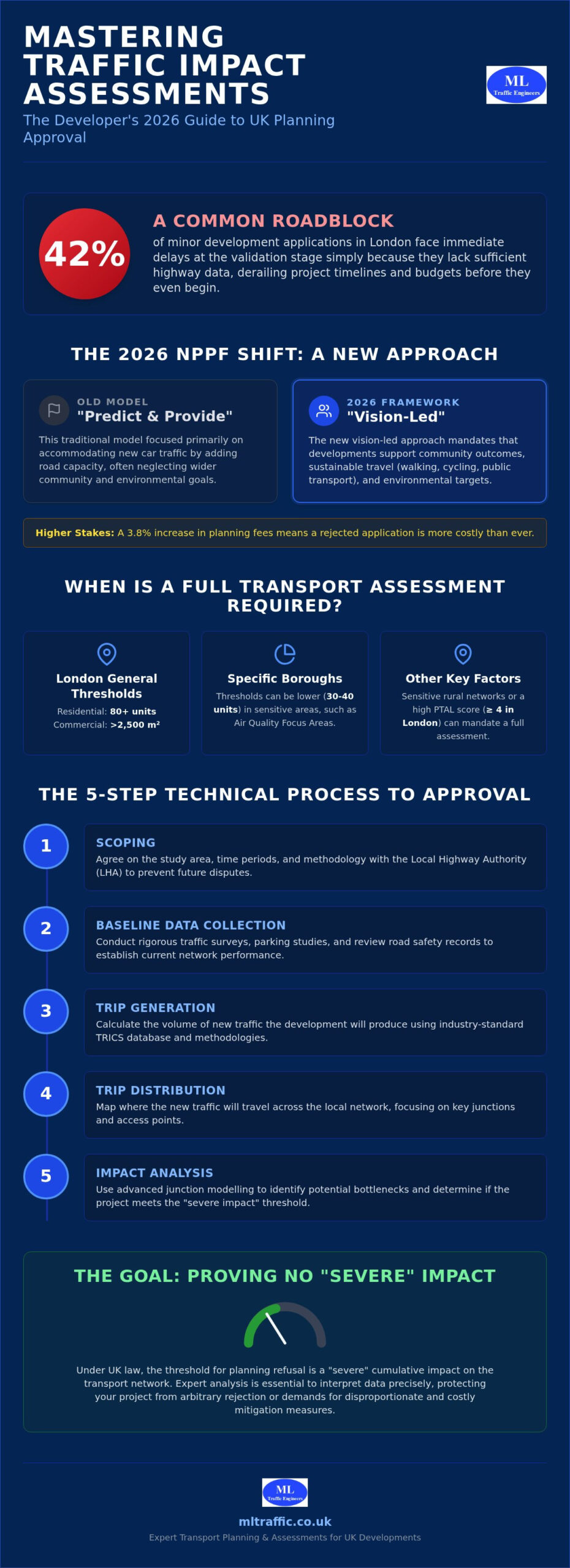
    In 2026, the regulatory environment has shifted significantly. The revised National Planning Policy Framework (NPPF) now prioritizes a vision-led approach over the traditional “predict and provide” model. This means your assessment must demonstrate how a development supports specific community outcomes and sustainable travel rather than just adding road capacity for cars. With planning fees in England having increased by 3.8% as of April 2026, the financial risk of a rejected application is higher than ever. Precision in your initial submission is a functional necessity to avoid the costs of rework and delays.

    The Purpose of a TIA: Beyond Simple Congestion

    Assessments don’t just look at traffic jams. They evaluate road safety and accessibility for all transport modes, including pedestrians, cyclists, and public transport users. LHAs use these reports to gauge the cumulative impact of several developments within a single area, ensuring that the local infrastructure can handle the combined pressure of multiple projects. Under UK law, the threshold for planning refusal is a “severe” impact on the transport network. Defining what constitutes “severe” requires professional precision and expert interpretation of data to protect your project from arbitrary rejection or disproportionate mitigation demands.

    When is a TIA Legally Required?

    Requirements for a traffic impact assessment for new developments vary based on scale and location. In London, a full Transport Assessment is typically required for residential sites with 80 or more units or commercial spaces exceeding 2,500 square metres. However, some boroughs have lowered these thresholds to 30 or 40 units, particularly in Air Quality Focus Areas. Even small developments may require a full study if the local network is sensitive or located in a rural area with limited access. Factors like a site’s Public Transport Accessibility Level (PTAL) score also dictate the scope of the study. Sites with a PTAL score of 4 or higher in London are generally mandated to be car-free, which fundamentally changes the methodology of the assessment.

    The 5-Step Technical Process of a Traffic Impact Assessment

    Conducting a traffic impact assessment for new developments requires a methodical approach to ensure regulatory approval. The 5-Step Technical Process begins long before any data is collected on-site. By following a structured sequence, developers can mitigate the risk of local highway authority objections and avoid costly last-minute redesigns. Precision is a functional necessity at every stage to reduce logistical and regulatory pressures.

    • Scoping: You must first agree on the study area, time periods, and assessment methodology with the Local Highway Authority. This prevents fundamental disagreements later in the planning lifecycle.
    • Baseline Data Collection: Our team conducts rigorous Traffic Surveys and parking surveys to establish the current network performance. We also review existing road safety records to identify any pre-existing issues.
    • Trip Generation: We calculate the volume of new traffic the development will produce using industry-standard databases.
    • Trip Distribution: This stage maps where that new traffic will travel across the local network, focusing on key junctions and access points.
    • Impact Analysis: Using advanced junction modelling, we identify potential bottlenecks. This stage is critical for determining if the project meets the “severe impact” threshold discussed previously.

    Utilising the TRICS Database for Accurate Predictions

    The TRICS database is the national standard for trip generation analysis in the UK. It allows us to predict traffic volumes by comparing your project with data from thousands of established sites across the country. Selecting comparable sites is a high-stakes task that requires technical authority. If the chosen data points don’t align with your development’s specific land use or location, the highway authority will likely reject the findings. We ensure your submission is defensible by filtering for precise variables like site size, regional context, and transport accessibility.

    Swept Path Analysis: Proving Site Feasibility

    A successful traffic impact assessment for new developments must prove that the physical site layout is functional. Swept Path Analysis uses AutoTURN software to simulate the movement of large vehicles, such as refuse trucks and fire tenders, through your proposed roads. This technical simulation prevents the logistical pressure of discovering that a vehicle cannot navigate a turn after construction has begun. By identifying these issues during the assessment phase, we help you avoid expensive post-submission redesigns. Ensuring that emergency services and delivery vehicles have unhindered access is a non-negotiable foundation of safety-conscious planning.

    Transport Statement vs. Assessment: Which One Do You Need?

    Determining the appropriate depth of reporting is the first strategic decision in your planning application. A misstep here causes immediate friction with the Local Highway Authority and can lead to unnecessary expenditure. The distinction between a Transport Statement and a full Assessment is primarily defined by the scale of the project and its anticipated trip generation. Selecting the wrong report type often results in the validation stage delays that currently affect 42% of minor development applications in London as of August 2026.

    In the capital, a London-specific Transport Assessment follows stricter criteria set by individual boroughs and the London Plan. These requirements directly impact project timelines, as the level of data scrutiny is significantly higher than in other regions. Early engagement during the pre-application stage is the only way to confirm which report you need. We manage this dialogue for you to ensure the scope is proportionate to your project’s impact, reducing logistical pressure from the start.

    Criteria for a Transport Statement

    A Transport Statement (TS) is a concise report designed for smaller developments with limited transport implications. Typically, this applies to residential projects between 50 and 80 dwellings, though some local authorities set lower thresholds. The TS focuses on immediate site matters: safe access, adequate parking provision, and links to sustainable travel networks. It is often the most cost-effective route for SMEs because it avoids the complex junction modelling required for larger schemes. Precision remains vital; even a shorter statement must satisfy the highway authority’s safety standards to avoid a recommendation for refusal.

    When a Full Transport Assessment is Mandatory

    Developments exceeding 80 residential units or significant commercial floor space require a full Transport Assessment (TA). This is a comprehensive traffic impact assessment for new developments that explores the cumulative effect on the wider transport network. A TA demands multi-modal analysis, evaluating how the project supports cycling, walking, and public transport integration. In 2026, any TA must be accompanied by a Travel Plan. This supporting document outlines long-term strategies to reduce car dependency and promote sustainable transport. Failing to include a robust Travel Plan is a common reason for application deferral under current NPPF guidelines. We ensure your TA includes all necessary technical data to withstand rigorous scrutiny from highway officers.
    Mitigation Strategies and Section 278 Agreements

    Identifying potential bottlenecks in your traffic impact assessment for new developments is only half the battle. The subsequent stage involves defining “proportionate mitigation.” This principle ensures that you only pay for the infrastructure improvements directly necessitated by your project’s impact. Under the 2026 vision-led NPPF framework, the focus has shifted from simply adding road capacity to creating sustainable, safe environments. This shift allows developers to propose a mix of physical and soft mitigation measures that satisfy the Local Highway Authority (LHA) while protecting project margins.

    Physical mitigation involves tangible changes to the road network, such as installing a new roundabout or widening a junction. These works typically fall under a Section 278 (S278) agreement. Developers must account for the high costs associated with these agreements, including technical approval fees and performance bonds. In regions like Worcestershire, technical approval and inspection fees as of June 2026 reach 8% to 10% of the scheme value. A major variable often overlooked is utility diversions, which can constitute 30% to 50% of the total cost for medium-scale schemes. Soft mitigation, conversely, focuses on behavioral changes, often managed through Section 106 (S106) financial contributions to wider transport infrastructure or the implementation of a Travel Plan.

    Negotiating with Local Highway Authorities

    Securing a fair outcome requires professional representation in LHA meetings. Local authorities often request extensive mitigation that exceeds the actual requirements of the development. Our team uses technical evidence from the assessment phase to challenge unreasonable requests. We ensure that any suggested works are strictly necessary and directly related to your site. A well-scoped TIA can limit a developer’s S106 financial liability by proving that specific off-site infrastructure upgrades are not directly necessitated by the proposed scheme. This technical authority reduces regulatory pressure and prevents budget creep.

    Travel Plans: A Tool for Reducing Physical Mitigation

    Modern planning policy prioritizes sustainable travel over road construction. Travel Plans are strategic documents that promote walking, cycling, and public transport use to reduce the total number of vehicle trips generated by a site. By demonstrating a credible reduction in car use, you can often negotiate a decrease in the required physical road improvements. This is particularly effective for Workplace Travel Plans, where employer-led initiatives like car-sharing or cycle-to-work schemes significantly lower peak-hour traffic. Integrating these “soft” measures into your development strategy is a cost-effective way to achieve compliance without the heavy engineering costs of S278 works. If you need to navigate these complex negotiations, view our full range of transport planning services to see how we can assist.

    Traffic Impact Assessment: 2026 Developer’s Guide

    Securing Approval: Why Expert Transport Planning Matters

    Attempting a DIY traffic impact assessment for new developments is a high-stakes strategy that often leads to planning refusal. Inaccurate baseline data or flawed trip generation models provide Local Highway Authorities (LHAs) with immediate grounds for objection. When technical data is scrutinized by planning officers, even minor discrepancies in survey methodology can invalidate an entire submission. Precision is a functional necessity in this environment to protect your investment and maintain your project timeline.

    ML Traffic Engineers has provided expert transport planning support since 2014. We manage the full project lifecycle from inception to final report, reducing the logistical and regulatory pressures on your team. Our approach balances technical authority with a client-focused strategy. We ensure that every traffic impact assessment for new developments we produce meets the strict industry benchmarks and legislative requirements of the 2026 planning landscape. This commitment to formal excellence acts as a vital guardian of your project’s viability.

    The fast-moving nature of infrastructure development requires a partner with a sense of readiness and urgency. Our team remains constantly available to address sudden requests for additional data or technical clarifications from the LHA. This rapid response capability is a hallmark of our service promise. It ensures that your application doesn’t stall due to administrative bottlenecks or technical queries. By positioning ourselves as a comprehensive partner rather than a simple data provider, we navigate the intricate regional regulations so you don’t have to.

    The ML Traffic Advantage: Precision and Reliability

    Our technical lexicon and professional reporting speak the language of local planning officers. We conduct specialized Traffic Surveys and parking surveys that provide a robust evidence base for your application. This data-driven precision allows us to defend your development against unreasonable mitigation requests. We take pride in our adherence to standards, utilizing our expertise in TRICS database analysis and Swept Path Analysis to deliver tailored reports. This all-encompassing service minimizes the risk of validation delays and strengthens your path to approval.

    Next Steps for Your Development

    Engaging a transport consultant early in the concept stage is the most effective way to streamline the planning process. Early involvement allows us to identify potential transport constraints before they become costly obstacles. We provide bespoke documentation that aligns with your specific site requirements and local authority expectations. To secure expert support for your next project, you can contact ML Traffic Engineers for a comprehensive transport planning review. Our team is ready to provide the technical precision and reliable support your development needs to succeed.

    Securing Your Development’s Future with Technical Precision

    The 2026 planning landscape demands a shift from traditional traffic forecasting to outcome-focused, vision-led strategies. Successfully navigating a traffic impact assessment for new developments requires more than just data collection. It necessitates a deep understanding of regional thresholds and the ability to negotiate proportionate mitigation through formal excellence. By establishing a robust technical baseline early in the concept stage, you protect your project from the validation delays and unpredictable costs that frequently stall UK developments.

    Precision is a functional necessity in transport planning. ML Traffic Engineers provides full project lifecycle management, from initial surveys to final submission, ensuring your reporting speaks the language of local planning officers. Our expertise in TRICS database analysis and junction modelling, combined with specialized knowledge in S278 and S38 highway design, reduces the regulatory pressure on your team. Secure your planning approval with ML Traffic Engineers’ expert transport reports. We remain ready to provide the professional, safety-conscious support required to move your project forward with confidence.

    Frequently Asked Questions

    How much does a Traffic Impact Assessment cost for a new development?

    Costs vary based on project scale, site complexity, and the specific requirements of the Local Highway Authority. A residential scheme with 100 units requires more intensive junction modelling than a small commercial unit. Factors like utility diversion investigations and technical approval fees also influence the total budget. This ensures your budget accounts for all necessary technical surveys and regulatory fees. Requesting a project-specific quote is the most reliable approach.

    How long does it take to complete a Transport Assessment in 2026?

    A typical assessment takes between four to eight weeks to complete, depending on the availability of baseline data. This timeline includes the initial scoping with the highway authority, on-site traffic counts, and technical analysis. Complex projects requiring extensive junction modelling or multi-modal studies may take longer. Early engagement is essential to ensure the final report is ready for the validation stage of your planning application. Precision in timing helps avoid unnecessary logistical pressure.

    Can I get planning permission if the TIA shows a significant increase in traffic?

    Yes, provided the impact is not deemed severe under the National Planning Policy Framework and suitable mitigation is proposed. A traffic impact assessment for new developments identifies these increases so that developers can implement improvements like junction upgrades or Travel Plan initiatives. If the proposed mitigation effectively manages the additional volume, the Local Highway Authority is more likely to support the application. Technical precision in your report is a functional necessity here.

    What is the difference between a Traffic Impact Assessment and a Transport Statement?

    The primary difference lies in the scale of the development and the depth of the required technical analysis. A Transport Statement is a concise report for smaller projects with limited transport implications. A full Assessment is a comprehensive study for larger developments that includes detailed junction modelling. The Local Highway Authority typically sets specific thresholds to determine which report type is necessary for a traffic impact assessment for new developments.

    What data is required for a parking survey in a UK planning application?

    Parking surveys must capture the existing parking demand and capacity within a defined area, usually following the Lambeth Methodology in urban settings. Data includes the total number of available spaces, current occupancy levels during peak hours, and any existing parking restrictions. This information proves that the development’s parking provision is adequate and won’t lead to overspill on the local road network. It’s a non-negotiable foundation for safety-conscious planning and regulatory compliance.

    Do I need a Travel Plan if I already have a Traffic Impact Assessment?

    A Travel Plan is almost always required as a supporting document for a full Transport Assessment in 2026. While the assessment identifies the physical impact of traffic, the Travel Plan outlines long-term strategies to encourage sustainable travel. These documents work together to show how the development will reduce car dependency and align with the latest vision-led NPPF guidelines. Integrating both documents demonstrates a commitment to professional integrity and civic responsibility.

    What happens if the Highway Authority objects to my TIA results?

    If an objection occurs, you must enter technical negotiations to address the authority’s concerns. This often involves providing additional data, refining modelling parameters, or proposing more robust mitigation measures. Professional representation is a functional necessity during these meetings to challenge unreasonable requests with technical evidence. Resolving these objections through expert reporting is critical to securing planning approval and avoiding a formal refusal. Our team remains ready to assist with these urgent requirements.

    Is a Swept Path Analysis always required for residential developments?

    Swept Path Analysis is essential for any development where large vehicles, such as refuse trucks or fire tenders, must navigate the site. While not always mandatory for very small infill projects, most Local Highway Authorities require it to prove site feasibility. This technical simulation ensures that emergency services have unhindered access and prevents the logistical pressure of expensive post-construction redesigns. It remains a hallmark of reliable, safety-conscious site planning that adheres to strict industry benchmarks.

    Michael Lee

    Article by

    Michael Lee

    Transport planner with over 35 years' experience.

    Disclaimer

    The content on mltraffic.co.uk, including all technical articles, guides, and resources, is provided for general informational and educational purposes only. It is not intended to constitute professional advice in traffic engineering, transportation planning, development approvals, or any other technical or legal field.
    While ML Traffic Engineers makes every reasonable effort to ensure the accuracy, completeness, and timeliness of the information published, we do not provide any warranties or representations (express or implied) regarding its reliability, suitability, or availability for any particular purpose. Any reliance you place on the content is strictly at your own risk.
    In no event shall ML Traffic Engineers, its directors, employees, authors, or affiliates be liable for any direct, indirect, incidental, special, consequential, or punitive damages (including, without limitation, loss of profits, data, or business opportunities) arising out of or in connection with the use of, or inability to use, any information provided on this website.
    The articles and guides on this site are not a substitute for engaging a qualified, professional traffic engineer to assess your specific project requirements. For tailored advice, compliance assessments, or traffic engineering services, please contact a competent professional.
    This disclaimer may be updated from time to time without notice. By accessing or using this website, you agree to be bound by the most current version of this disclaimer.

  • Transport Planning for Commercial Developments 2026

    Transport Planning for Commercial Developments 2026

    Could an overlooked detail in your access strategy trigger a multi-million pound redesign of your commercial site? It’s a valid concern for developers facing the strict requirements of local highway authorities and the latest 2024 NPPF updates. You need to move forward, but the uncertainty of which technical reports are mandatory often stalls progress. Effective transport planning for commercial developments in 2026 is no longer just about meeting a checklist. It requires navigating a “Vision and Validate” model that prioritizes sustainable outcomes and precise data collection.

    We understand the pressure of balancing regulatory compliance with site efficiency. This guide provides the technical clarity you need to secure planning approval, from understanding TRICS database thresholds to mastering Swept Path Analysis for optimal vehicle movement. You’ll find a clear roadmap for your submission, ensuring you can discharge transport-related conditions and avoid the regulatory bottlenecks that delay major projects. We will cover everything from Workplace Travel Plan requirements to the impact of the 2026 Infrastructure Planning Regulations on data centres and commercial hubs.

    Key Takeaways

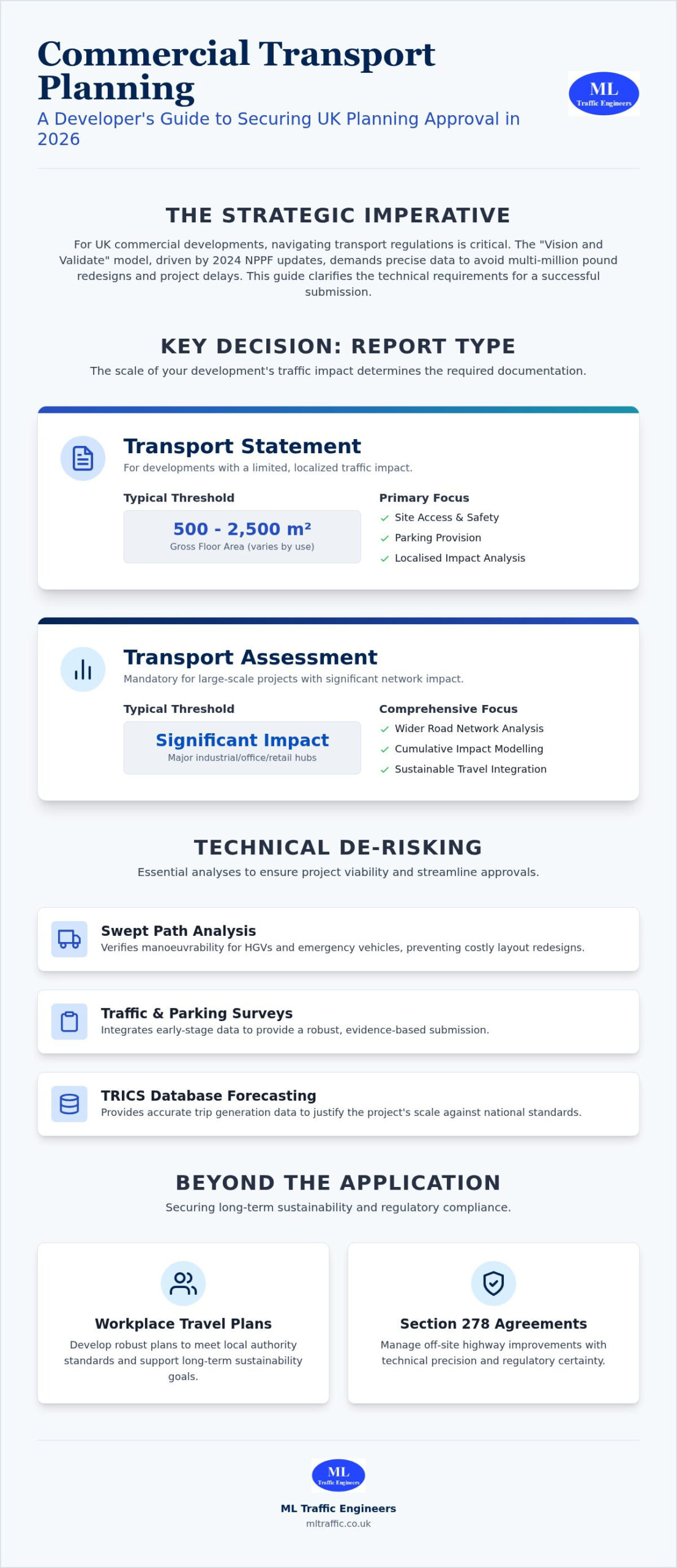
    • Identify the specific development thresholds that dictate whether your project requires a concise Transport Statement or a comprehensive Transport Assessment.
    • Utilize Swept Path Analysis to verify vehicle manoeuvrability, ensuring your site layout accommodates HGVs and emergency services without costly redesigns.
    • Streamline the approval process for transport planning for commercial developments by integrating early-stage data from Traffic and Parking Surveys.
    • Develop robust Workplace Travel Plans that meet local authority standards and support the long-term sustainability goals of your commercial scheme.
    • Understand the technical requirements for Section 278 agreements to manage off-site highway improvements with precision and regulatory certainty.

    The Strategic Role of Transport Planning in Commercial Infrastructure Engineering

    Effective The Strategic Role of Transport Planning functions at the critical intersection of civil engineering, policy compliance, and site logistics. For developers, transport planning for commercial developments serves as the technical foundation that determines whether a project is physically possible and financially viable. It isn’t merely a box-ticking exercise for the local council; it’s a strategic tool used to optimize how goods, services, and people move through a space. Precision at this stage prevents operational bottlenecks that could diminish the long-term utility of the asset.

    Securing early transport input is a non-negotiable requirement for commercial viability in the UK market. A site with poor connectivity or unresolved access issues suffers from depressed land value because the potential for high-density use is restricted. By addressing these factors during the initial feasibility studies, we help clients maximize their return on investment. The core objectives remain consistent: ensuring public safety, meeting sustainability targets, and providing the operational efficiency that commercial occupiers demand for their daily logistics.

    Identifying Transport Constraints Early in the Design Phase

    Commercial infrastructure engineering is the technical management of vehicle and pedestrian movement within a development site. During the design phase, we analyze site access points against strict local highway authority standards to identify potential deal-breakers before they become expensive problems. These constraints often dictate the maximum commercial floor space potential of a plot. If a site cannot safely accommodate the required volume of HGV traffic or lacks sufficient visibility splays, the allowable building footprint may be reduced. Proactive planning ensures every square meter of the site is utilized effectively while maintaining technical compliance.

    Meeting Statutory Requirements for UK Planning Applications

    The regulatory environment for 2026 requires a sophisticated approach to statutory compliance. Following the National Planning Policy Framework (NPPF) updates in December 2024 and the subsequent reforms in early 2026, the focus has shifted heavily toward sustainable outcomes. The Local Highway Authority acts as a primary consultee, scrutinizing how a development impacts the wider road network. We utilize the TRICS database to provide accurate trip generation forecasting, which is essential for justifying the scale of a project. Whether you are submitting a Transport Statement or a full assessment, your data must be robust enough to withstand rigorous public and professional scrutiny.

    Transport Statements vs. Assessments: Determining Your Commercial Submission

    Choosing the correct reporting level is a pivotal decision in transport planning for commercial developments. It’s the difference between a streamlined approval and a protracted negotiation with the highway authority. The primary driver for this decision is the anticipated scale of traffic impact, which is typically measured by the gross floor area and the specific use class of the proposal. Local Highway Authorities apply different thresholds, but the objective remains the same: ensuring the network can safely absorb the new demand.

    The TRICS database provides the empirical evidence needed to forecast trip generation. If these figures suggest a minimal impact on the local network, a Transport Statement usually suffices. However, for large-scale industrial hubs or major office complexes, a full Transport Assessment becomes mandatory to address cumulative impacts on the wider infrastructure. Retail developments often face stricter scrutiny due to high customer turnover and specific peak-hour demands that differ from traditional employment sites.

    When to Commission a Transport Statement

    A Transport Statement is appropriate for smaller commercial units where the impact is limited to the immediate vicinity of the site. Typical floor area thresholds for these reports often fall between 500 and 2,500 square meters, depending on the use class and local policy. These documents focus on local access, parking provision, and basic safety rather than complex network modeling. You can find more detail on these requirements in our Transport Statement London: A Developer’s Buying Guide. It’s a cost-effective way to demonstrate that a small-scale development is sustainable and safe.

    The Scope of a Comprehensive Transport Assessment

    Major schemes require the deeper technical rigour of a Transport Assessment. This document models the impact on major junctions and the wider highway network, often requiring sophisticated software to simulate traffic flow. We integrate multi-modal travel analysis to prove that the site is accessible by public transport, walking, and cycling. This is essential for developments exceeding 2,500 square meters, such as B2 general industrial or B8 storage and distribution centers. Our Transport Assessment London: The Developer’s 2026 Guide outlines how these comprehensive reports de-risk large-scale planning applications.

    Confirming your reporting requirements early prevents the risk of the local authority requesting additional data mid-application. If you are unsure which threshold your project meets, ML Traffic Engineers provides the technical expertise to determine the most efficient route for your submission.

    Technical De-Risking: Swept Path Analysis and Parking Surveys

    Assumptions are the enemy of planning approval. In the high-stakes environment of commercial development, technical de-risking through precise data ensures that transport planning for commercial developments withstands the scrutiny of local highway authorities. We move beyond general layout drawings to provide empirical proof that a site functions as intended. This proactive approach prevents “design-locked” errors, which occur when a site layout is finalized but cannot actually accommodate necessary vehicle movements.

    Site accessibility is a non-negotiable safety requirement. We utilize technical data to demonstrate that every vehicle, from HGV deliveries to emergency fire tenders and refuse trucks, can enter, turn, and exit the site safely. By identifying these logistical constraints during the early design phases, we protect developers from the costly redesigns that often follow a failed planning consultation. This precision is what allows a project to move from a concept to a viable, operational asset.

    Precision in Swept Path Analysis for Commercial Loading

    For industrial and retail developments, the ability to handle large-scale logistics is essential. We use specialized software to simulate the movements of 16.5m articulated lorries, ensuring they can navigate constrained urban sites without impacting public safety or damaging infrastructure. This simulation proves that turning circles and loading bays are fit for purpose. Our AutoTURN Swept Path Analysis: A Practical Guide provides a deeper look at how this technical modeling supports your planning application. We prioritize these simulations to ensure that fire tender access and refuse vehicle routes meet the specific statutory requirements of the local council.

    Evidence-Based Parking Strategies

    Local authorities often push for lower parking provision to meet sustainability goals, especially in areas with high Public Transport Accessibility Levels (PTAL). However, insufficient parking can lead to overspill that impacts the local community. We conduct overnight parking surveys to establish a baseline of existing street capacity. Using the Lambeth Methodology, we provide the technical justification needed to balance operational requirements with policy expectations. This evidence-based approach allows us to justify specific parking layouts, ensuring that your commercial scheme remains functional for occupiers while satisfying the highway authority’s demand for reduced car dependency.

    Beyond the Application: Travel Plans and Section 278 Agreements

    Transport planning for commercial developments doesn’t end when the planning committee grants permission. In fact, the most operationally critical work often begins with the discharge of transport-related planning conditions. These obligations ensure that the development remains sustainable and safe once it becomes operational. For developers, this phase involves a transition from theoretical modeling to active management and physical infrastructure delivery. Precision during this stage is essential to avoid the enforcement of Travel Plan Bonds or delays in site occupation.

    Multi-occupant commercial parks often require a Framework Travel Plan. This high-level document sets the overarching strategy for the entire site, which individual occupiers then refine through their own subsidiary plans. Consistent monitoring and reporting are standard requirements. Most UK local highway authorities mandate a five-year monitoring cycle to track the effectiveness of travel interventions. If data shows that trip generation targets are not being met, developers may be required to implement additional mitigation measures to reduce local traffic impact.

    Securing Approval with Effective Travel Planning

    A successful Workplace Travel Plan sets realistic targets for modal shift. This involves moving employees and visitors away from single-occupancy car use toward walking, cycling, and public transport. The role of the Travel Plan Coordinator is vital for long-term compliance. They act as the primary point of contact for both the local authority and the site’s tenants, ensuring that the agreed strategy is implemented effectively. Engaging expert Travel Plan Consultants: Strengthening Planning Applications allows you to design incentives that work, such as cycle-to-work schemes or car-sharing initiatives, which are increasingly prioritized under the 2026 “Vision and Validate” planning model.

    The Developer’s Guide to S278 Agreements

    When a commercial development requires modifications to the existing public highway, a Section 278 agreement becomes necessary. This covers works such as new site access junctions, roundabouts, or improved pedestrian crossings. S278 agreements are legally binding contracts for road improvements necessitated by new developments. Managing the relationship with the Highway Authority is crucial during this process to ensure that technical approvals and site inspections proceed without delay. We recommend establishing the scope of highway works early to prevent unexpected costs from arising during the construction phase.

    If you need technical support to discharge your planning conditions or manage your highway obligations, contact ML Traffic Engineers to ensure your project moves from approval to successful operation.

    Transport Planning for Commercial Developments 2026

    Why UK Developers Choose ML Traffic Engineers

    The 2026 planning environment requires more than just technical skill; it demands a partner who understands the high stakes of commercial infrastructure. We position ourselves as that partner. Our commitment to technical authority ensures that transport planning for commercial developments meets every benchmark set by the December 2024 NPPF and the latest 2026 regulatory updates. We don’t just provide data. We provide the certainty that your development is safe, compliant, and operationally sound. Precision is a functional necessity in this industry, and we deliver it without compromise.

    Our engineers maintain round-the-clock readiness to meet urgent planning deadlines. We know the infrastructure sector is unpredictable. We’ve built our workflow to respond with speed and precision. This reliability reduces the logistical and regulatory pressures on your team, allowing you to focus on the broader vision of your project. From the first data point to the final discharge of conditions, we manage the entire technical lifecycle. We view our role as a vital guardian of public safety and a facilitator of commercial growth.

    Expert Technical Reporting for Commercial Success

    A specialized focus leads to higher approval rates. Our team produces robust Transport Statements and Assessments that stand up to the most rigorous Highway Authority consultations. We leverage deep local knowledge across England to navigate regional variations in policy and infrastructure requirements. This technical lexicon is paired with a clear understanding of commercial viability. Our data-driven approach uses the most current TRICS database thresholds to ensure your trip generation forecasts are unassailable. If you need a clear path forward, request a tailored transport planning fee proposal today to see how we can support your specific scheme.

    A Fully Managed Service for Commercial Infrastructure

    We integrate Traffic Surveys, Swept Path Analysis, and Parking Surveys into a single, seamless workflow. This end-to-end approach eliminates the friction of managing multiple consultants and ensures data consistency across all reports. The ML Traffic promise is built on precision, safety, and unwavering reliability. We prioritize the rapid delivery of information to keep your project on track. By identifying site constraints during the initial assessment, we help you maximize the floor space potential of your development. Contact our engineers for a pre-application review of your site to address potential transport issues before they impact your planning timeline.

    Securing Your Commercial Site’s Operational Future

    Mastering the technical requirements of transport planning for commercial developments is the most effective way to eliminate project delays and avoid costly design revisions. By prioritizing early-stage data collection and precise Swept Path Analysis, you ensure that your site is both safe and operationally efficient from the start. Technical accuracy remains your strongest asset when navigating the thresholds for a Transport Assessment or managing the long-term obligations of a Workplace Travel Plan. These reports are the foundation of a successful planning submission and a viable commercial asset.

    ML Traffic Engineers provides the comprehensive support needed to navigate these intricate regional regulations. We deliver expertly prepared Transport Statements and Assessments alongside specialist Swept Path Analysis for all vehicle types. Our team maintains a proven track record with UK Local Highway Authorities, ensuring that your technical documentation meets every statutory requirement with precision. Secure your planning approval with expert transport planning support from ML Traffic Engineers. We are ready to help you move your project from the design phase to successful completion with confidence and reliability.

    Frequently Asked Questions

    When is a full Transport Assessment required for a commercial development?

    A full Transport Assessment is typically mandatory for developments that exceed 2,500 square meters of gross floor area, particularly for B1 office, B2 industrial, or B8 storage use classes. Local highway authorities may also trigger this requirement for smaller sites if the proposal is expected to generate significant traffic or impact sensitive junctions. We use the TRICS database to forecast trip generation and confirm whether your project meets these specific reporting thresholds.

    What is the difference between a Transport Statement and a Transport Assessment?

    The primary difference lies in the scope and depth of technical modeling. A Transport Statement is a concise report focused on local site access and parking for smaller schemes with minimal network impact. In contrast, a Transport Assessment is a comprehensive document that analyzes the wider highway network and multi-modal travel patterns. It’s an essential component of transport planning for commercial developments that reach major scale or complexity.

    How does Swept Path Analysis help with planning permission for commercial sites?

    Swept Path Analysis provides empirical proof that your site layout can safely accommodate the specific vehicles required for your operations. By simulating the movements of 16.5m articulated lorries or fire tenders, we demonstrate that there is sufficient space for turning and loading. This technical data removes the guesswork for planning officers and prevents objections based on highway safety or vehicle manoeuvrability, significantly de-risking your application.

    Do I need a Travel Plan for a small office development?

    You generally need a full Workplace Travel Plan if your office development exceeds 2,500 square meters or if staff numbers surpass 50. However, local councils often request a “Travel Plan Statement” for smaller developments in urban areas with high congestion. These documents outline how you’ll encourage sustainable commuting through cycle storage or public transport incentives. It’s always best to check the specific supplementary planning documents of your local authority.

    What is a Section 278 agreement in the context of commercial infrastructure?

    A Section 278 (S278) agreement is a legally binding contract between a developer and the Highway Authority that allows for permanent alterations to the public road. This is necessary when your commercial development requires a new junction, a roundabout, or improved pedestrian crossings to ensure safe access. We manage the technical details of these agreements to ensure that the required highway works are approved and executed without delaying your site’s occupation.

    How long does it take to conduct a parking survey for a planning application?

    Conducting a parking survey usually takes between one and two weeks from the initial site visit to the final technical report. Data collection typically occurs during peak stress periods, such as overnight on weekdays for residential areas or during business hours for commercial zones. We use the Lambeth Methodology to provide a robust snapshot of parking capacity, which is essential for transport planning for commercial developments in areas with restricted space.

    What happens if my commercial development doesn’t meet local parking standards?

    If your development provides less parking than local standards require, you must provide technical justification to prove that it won’t cause overspill. We use Parking Surveys to demonstrate existing capacity on nearby streets or leverage high Public Transport Accessibility Level (PTAL) scores to support your case. A strong Workplace Travel Plan also helps by showing how you will actively reduce car dependency among employees and visitors to the site.

    Can a transport consultant help with discharging planning conditions?

    Yes, transport consultants are vital for the successful discharge of transport-related planning conditions post-approval. We prepare the detailed monitoring reports, updated Travel Plans, and technical drawings required by the local authority to satisfy these obligations. This service ensures that you meet all legal requirements within the agreed timelines, preventing enforcement action and allowing for the smooth, long-term operation of your commercial infrastructure project.

    Michael Lee

    Article by

    Michael Lee

    Transport planner with over 35 years' experience.

    Disclaimer

    The content on mltraffic.co.uk, including all technical articles, guides, and resources, is provided for general informational and educational purposes only. It is not intended to constitute professional advice in traffic engineering, transportation planning, development approvals, or any other technical or legal field.
    While ML Traffic Engineers makes every reasonable effort to ensure the accuracy, completeness, and timeliness of the information published, we do not provide any warranties or representations (express or implied) regarding its reliability, suitability, or availability for any particular purpose. Any reliance you place on the content is strictly at your own risk.
    In no event shall ML Traffic Engineers, its directors, employees, authors, or affiliates be liable for any direct, indirect, incidental, special, consequential, or punitive damages (including, without limitation, loss of profits, data, or business opportunities) arising out of or in connection with the use of, or inability to use, any information provided on this website.
    The articles and guides on this site are not a substitute for engaging a qualified, professional traffic engineer to assess your specific project requirements. For tailored advice, compliance assessments, or traffic engineering services, please contact a competent professional.
    This disclaimer may be updated from time to time without notice. By accessing or using this website, you agree to be bound by the most current version of this disclaimer.

  • Traffic Survey for Planning Application: The 2026 Developer’s Guide

    Traffic Survey for Planning Application: The 2026 Developer’s Guide

    Did you know that 42% of minor development applications in London face immediate delays at the validation stage because of insufficient highway data? This statistic highlights a growing trend across England where local planning authorities are applying stricter scrutiny to every submission. Securing a professional traffic survey for planning application success is no longer just a checkbox exercise; it is the empirical foundation required to prove your project’s safety and sustainability to skeptical planning officers.

    You’re likely feeling the pressure of tight deadlines and the confusion of choosing between ATC, MCC, or parking surveys while trying to hit those elusive neutral weeks for data collection. We understand that a single error in your transport evidence base can lead to a costly rejection or a complex appeal process. This 2026 guide provides the technical clarity you need to navigate the latest statutory requirements, including the 3.8% planning fee increase and the transition toward mandatory Manual for Streets 3 standards. You’ll learn how to build a robust, council-approved evidence base that streamlines your path through Section 106 or 278 negotiations and keeps your development on schedule.

    Key Takeaways

    • Understand how proving ‘nil detriment’ to the highway network aligns your project with the latest National Planning Policy Framework requirements.
    • Identify the specific technical differences between Automatic Traffic Counts and Manual Classified Counts to ensure your data meets local authority standards.
    • Learn how to leverage a professional traffic survey for planning application success by converting raw data into accurate peak-hour flow models.
    • Master the timing of data collection by identifying “neutral weeks” and understanding the two-to-three-year validity window for transport evidence.
    • Discover how integrating technical reporting like Swept Path Analysis can preemptively address council concerns and reduce the risk of planning refusal.

    Why a Traffic Survey is Mandatory for Your Planning Application

    Every UK planning application must demonstrate ‘nil detriment’ to the surrounding road network. This principle ensures that new developments don’t compromise safety or cause unacceptable congestion on existing highways. Under the National Planning Policy Framework (NPPF), local authorities require an evidence-based approach to transport planning. Without empirical data, your project relies on assumptions that planning officers are likely to reject during the validation stage. A traffic survey for planning application success acts as the primary evidence to prove your development is sustainable and safe.

    Submitting an application without professional data often results in immediate delays or automatic refusal. In London, approximately 42% of minor development applications face validation hurdles due to insufficient highway data. These counts allow engineers to build accurate traffic generation models that forecast exactly how many vehicles your site will produce during peak hours. This technical precision is vital for securing Transport Assessments London councils will accept, especially in high-density areas where road capacity is already at its limit.

    To better understand the mechanics of data collection, watch this helpful video:

    Statutory Requirements and Local Highway Authorities

    Council officers operate on a ‘reasonable basis’ when requesting data. They need to see that your proposal won’t create a safety hazard or gridlock. Precise survey data informs critical Section 106 and Section 278 negotiations, determining the financial contributions or physical road improvements required for your project. Beyond the council, robust data helps mitigate community objections. When local residents fear increased congestion, having verifiable, independent traffic counts allows you to address those concerns with facts rather than speculation. It’s about maintaining professional integrity and ensuring public safety throughout the project lifecycle—a vision for road security shared by professional driving schools like Mondial Permis.

    Surveys as the Foundation for Transport Statements

    You cannot produce a valid Transport Statement without baseline data. A traffic survey serves as the empirical baseline for all development-related transport modeling. This data is essential for justifying parking provision, particularly in PTAL-sensitive areas where you might seek a reduction in on-site spaces. By showing current road usage and available capacity, you can prove that your parking strategy won’t lead to dangerous overspill on local streets. We focus on providing this comprehensive support so you don’t have to manage the logistical pressure of regulatory compliance alone.

    Core Types of Traffic Surveys Used in UK Planning

    Selecting the correct traffic survey for planning application success depends entirely on the scale and nature of your development. Local highway authorities often require a mix of methodologies to capture a 360-degree view of site impact. While some projects only need baseline flow data, others require granular junction analysis to satisfy safety and capacity requirements. We ensure every data point aligns with the UK government guidance on transport assessments to prevent validation delays.

    ATC vs. MCC: Which Does Your Project Need?

    Automatic Traffic Counts (ATC) typically utilize pneumatic tubes or side-detection radar to capture data over a minimum of seven days. This method is the industry standard for establishing baseline traffic volumes and recording 85th percentile speeds, which are critical for determining safe visibility splays. Many councils, such as Leicestershire County Council, now mandate at least one seven-day automated count to supplement manual data.

    Manual Classified Counts (MCC) provide the detail that automated tubes cannot. These surveys involve human observers or video analysis to record specific turning movements at junctions during peak hours. If your project requires complex capacity modeling using software like LinSig or Junctions 9, an MCC is non-negotiable. It allows us to classify vehicles into categories like HGVs, buses, and light goods vehicles, providing the precision needed for robust impact forecasting. Choosing the right duration and method early in the process prevents the high costs of re-surveying if the initial data is deemed insufficient by council engineers.

    Specialised Parking and Access Surveys

    For residential and commercial developments in high-density urban areas, parking accumulation surveys are essential. These surveys often follow the Lambeth Methodology, which involves counting parked vehicles on surrounding streets during the early morning hours to determine existing stress levels. This empirical evidence is vital when justifying ‘car-free’ developments or requesting a reduction in standard parking provisions.

    Modern planning standards, influenced by the upcoming Manual for Streets 3, place a heavy emphasis on active travel. Pedestrian and cyclist counts are now standard requirements to demonstrate how a development supports sustainability targets. These counts integrate directly with your project’s Travel Plan, providing a baseline for future monitoring. If you are unsure which methodology your local authority expects, securing a professional traffic survey ensures your evidence base is beyond reproach from the outset.

    Methodology: How Survey Data Fuels Technical Analysis

    Raw data collection is only the first stage of a robust transport evidence base. To satisfy council requirements, we transform these initial counts into “Peak Hour” flow models. These models represent the 60-minute window of highest intensity, typically during the morning and evening commutes. This step is vital because it allows us to test junction capacity under maximum stress. Beyond capacity, this data serves as a critical input for environmental consultants. High traffic volumes and vehicle classifications directly influence the accuracy of noise and air quality impact assessments.

    Modern traffic engineering relies on high-definition video verification to ensure absolute accuracy. Unlike traditional manual tallies, video allows for a transparent audit trail that planning officers can verify if they dispute the findings. This precision is essential when your project faces scrutiny from local residents or skeptical highway engineers. We use this verified data to build a logical narrative for your development, proving that the proposed changes are manageable and safe.

    Integrating Data with Swept Path Analysis

    A primary gap in many planning submissions is the lack of synergy between baseline data and site design. We use volume data from your traffic survey to inform the frequency of “design vehicle” movements within our Swept Path Analysis. This technical simulation proves that essential services, such as refuse collection vehicles and fire tenders, can safely navigate the site under real-world traffic conditions. Survey-derived speed data dictates the required visibility splays in site access design. By using the 85th percentile speeds recorded during the survey, we ensure that your site entrance meets all safety criteria without over-engineering the road layout.

    Forecasting and Growth Factors

    Local highway authorities require more than a snapshot of current conditions. They demand a forecast of how your development will function in the future. We utilize the TRICS database alongside site-specific survey data to calculate expected trip generation. To meet 2026 standards, we apply TEMPro growth factors to project these traffic volumes five or ten years into the future. This analysis creates a clear comparison between three distinct scenarios:

    • Base Scenario: The current traffic levels as recorded by the traffic survey for planning application validation.
    • Future Base: Predicted traffic levels in the design year without your development.
    • With Development: The cumulative impact of your project added to the future base levels.

    This sequential approach allows planning officers to see the exact percentage of impact your project has on the network. With 71% of local highway authorities still categorizing roads based on traffic flow, providing this level of granular detail is the most effective way to avoid requests for additional data and prevent costly project delays.

    Planning for Success: Timing, Validity, and Council Standards

    Securing a successful outcome for your development depends heavily on when you collect your data. Highway authorities are exceptionally strict about the “Neutral Week” rule. These are specific windows when traffic patterns are representative of typical, everyday conditions. To ensure your traffic survey for planning application is accepted, you should target May, June, September, or October. You must avoid school holidays, bank holidays, and the weeks immediately surrounding them. Submitting data from a non-neutral period often leads to immediate rejection, forcing you to pay the 3.8% planning fee increase again for a resubmission.

    Data longevity is another critical factor in 2026 planning cycles. Most local authorities consider traffic data outdated if it’s more than three years old. If your project has been in the pipeline for several years, you’ll likely need a fresh count to reflect current network conditions. You also need to account for “anomalous events” that could skew your results. Local roadworks, emergency utility repairs, or even localized festivals can create artificial congestion or diversions. We recommend checking the local highway authority’s schedule for planned works before deploying equipment to ensure your evidence base is beyond reproach.

    The Developer’s Timeline for Data Collection

    Don’t wait until the submission stage to commission your survey. We advise developers to secure traffic data during the feasibility stage. This proactive approach allows you to identify potential highway capacity issues before you’ve finalized your site layout or architectural designs. If you need urgent data outside of neutral periods, you must engage with the Highway Authority early. They may allow “factored” data based on historic trends, but this requires expert negotiation to ensure the council accepts the adjusted figures. To keep your project on schedule, book your traffic survey during the next available neutral window.

    Meeting Local Authority Specifications

    Every borough maintains its own technical standards for data submission. For example, Transport for London (TfL) requires specific data formats and digital spreadsheets that differ significantly from rural county councils. Providing raw data transparency is vital. Planning officers need to see the unprocessed counts to verify the integrity of your technical reporting. Before mobilization, ensure you have agreed upon the survey locations, known as transects, with the council engineers. This pre-application engagement prevents the costly mistake of surveying the wrong junction or missing a critical access point that the council deems essential for their assessment.

    Traffic Survey for Planning Application: The 2026 Developer's Guide

    Securing Approval with ML Traffic Engineers UK

    Navigating the 2026 planning landscape requires more than just raw numbers. It requires a partner who understands how those numbers influence a planning officer’s decision. ML Traffic Engineers UK provides an all-encompassing service that bridges the gap between field data collection and technical reporting. By managing the full project lifecycle from inception to completion, we reduce the logistical and regulatory pressures on your team. Every traffic survey for planning application we conduct is designed to meet the specific benchmarks of the relevant local highway authority, ensuring your evidence base is beyond reproach.

    The ML Traffic Expert Approach

    Our dual expertise in data collection and traffic engineering significantly reduces your planning risk. We don’t just provide a spreadsheet; we provide a technical narrative that supports your development’s viability. For example, we recently assisted a developer facing a ‘refusal of permission’ due to concerns over local parking stress. By implementing a tailored parking survey that utilized precise overnight accumulation data, we demonstrated that the local network could easily accommodate the proposal. This evidence-based approach turned a potential rejection into a successful approval.

    We take pride in our role as a dependable partner and guardian of project safety. Whether it’s validating a reduction in parking through a Travel Plan or proving site access safety via Swept Path Analysis, our technical lexicon and professional business terms reflect our commitment to precision. We operate with a sense of readiness and urgency, providing rapid response capabilities for time-sensitive applications that need to meet specific neutral week windows.

    Next Steps for Your Planning Application

    Securing a tailored quote for your site is a straightforward process. To provide an accurate survey proposal and methodology for your traffic survey for planning application, we typically require a site location plan, a description of the development scale, and any initial correspondence or scoping requirements from the local highway authority. We’re ready to help you navigate the complexities of statutory requirements with confidence and reliability. Contact ML Traffic Engineers UK to secure your planning data today and ensure your application moves toward approval without unnecessary friction.

    Streamline Your Development Approval for 2026

    Mastering the nuances of highway data is the most effective way to protect your project from avoidable delays and validation failures. As planning scrutiny intensifies across England, the quality of your evidence base determines the speed of your progress. By prioritizing data collection during neutral windows and ensuring your modeling reflects future growth factors, you create a transparent narrative that planning officers can trust. A precise traffic survey for planning application success serves as the empirical foundation for your entire transport strategy, facilitating smoother Section 106 and 278 negotiations.

    ML Traffic Engineers UK has operated as an expert transport planning consultancy since 2014. We specialize in the English regulatory environment, providing full project lifecycle management that moves seamlessly from raw data collection to comprehensive technical design. For developers who want to showcase their successful project history and service coverage on their own sites, using a platform like Monster Maps can be a great way to present this information alongside technical reports. Our team ensures your submission adheres to every industry benchmark and legislative requirement, reducing your regulatory burden so you can focus on delivery.

    Reliable data is the key to navigating technical assessments with confidence and professional integrity. Secure Professional Traffic Data for Your Planning Application today to ensure your development remains on schedule and fully compliant. We look forward to helping you achieve a smooth and successful planning outcome.

    Frequently Asked Questions

    How much does a traffic survey for a planning application cost?

    The cost of a traffic survey for planning application success depends on the number of junctions being analyzed, the duration of the count, and the specific methodology required. Factors like the choice between seven day automated counts and manual peak hour video analysis will influence the final proposal. Each site requires a bespoke scope to satisfy local authority standards while avoiding unnecessary data collection. We recommend securing a tailored quote early in the feasibility stage to ensure your budget accounts for all necessary technical reporting.

    Can I use a traffic survey from a previous developer for my application?

    You can only use existing data if the survey is less than three years old and remains representative of current network conditions. Local highway authorities generally consider transport data outdated once it exceeds this three year window. If significant new developments have been completed nearby or road layouts have changed, you’ll need a fresh traffic survey for planning application validation. It’s vital to confirm data acceptance with the highway officer before submitting your transport evidence base.

    What is a ‘neutral week’ in traffic surveying and why does it matter?

    A neutral week is a period during the school term when traffic patterns are typical and free from seasonal distortions. These usually occur in May, June, September, and October. You must avoid school holidays, bank holidays, and weeks with major local events because they produce anomalous data that planning officers will likely reject. Using neutral weeks ensures your evidence base is robust and accurately reflects the daily reality of the road network, protecting your application from technical objections.

    How long does it take to get the results of a traffic survey?

    Most surveys require at least seven days for data collection followed by five to ten working days for processing and technical analysis. Automated Traffic Counts (ATC) typically run for a full week to capture a complete profile of vehicle speeds and volumes. Once the raw data is retrieved, our engineers transform the figures into peak hour flow models for your report. Total turnaround times generally range from two to three weeks depending on the complexity of the junction modeling required.

    Does every planning application require a traffic survey?

    Not every application requires a survey, but most projects with a noticeable highway impact do. Residential developments of 10 to 49 units typically require a Transport Statement based on baseline traffic data. Larger schemes of 50 units or more usually trigger the requirement for a full Transport Assessment. Even smaller sites might need a survey if they’re in a highly congested area or if the council identifies specific safety concerns during the pre-application stage.

    What happens if the traffic survey shows a high impact on the road network?

    If a survey identifies a high impact, you’ll likely need to propose mitigation measures through Section 106 or Section 278 agreements. This could involve physical junction upgrades, traffic calming measures, or contributions toward local sustainable travel initiatives. Our engineers use the survey data to ensure any requested mitigation is proportionate to your development’s actual impact. Precise modeling often prevents councils from demanding excessive infrastructure improvements that could jeopardize your project’s financial viability.

    What is the difference between an ATC and an MCC survey?

    Automatic Traffic Counts (ATC) use pneumatic tubes or radar to record vehicle volume and speed over a continuous seven day period. Manual Classified Counts (MCC) use video or observers to record detailed turning movements at junctions during specific peak hours. While ATCs are excellent for establishing baseline flow and speed data, MCCs are essential for complex junction capacity modeling and vehicle classification. Most comprehensive planning submissions require a strategic combination of both methods to meet technical standards.

    Do I need a parking survey if my development is car-free?

    Yes, car-free developments almost always require a parking survey to prove that residents won’t cause overspill stress on surrounding streets. We typically use the Lambeth Methodology to assess existing parking capacity within a 200 meter radius of the site during early morning hours. This empirical evidence is vital for justifying a zero-parking provision to planning committees. It demonstrates that the local network can absorb any residual visitor or delivery demand without compromising highway safety or resident convenience.

    Michael Lee

    Article by

    Michael Lee

    Transport planner with over 35 years' experience.

    Disclaimer

    The content on mltraffic.co.uk, including all technical articles, guides, and resources, is provided for general informational and educational purposes only. It is not intended to constitute professional advice in traffic engineering, transportation planning, development approvals, or any other technical or legal field.
    While ML Traffic Engineers makes every reasonable effort to ensure the accuracy, completeness, and timeliness of the information published, we do not provide any warranties or representations (express or implied) regarding its reliability, suitability, or availability for any particular purpose. Any reliance you place on the content is strictly at your own risk.
    In no event shall ML Traffic Engineers, its directors, employees, authors, or affiliates be liable for any direct, indirect, incidental, special, consequential, or punitive damages (including, without limitation, loss of profits, data, or business opportunities) arising out of or in connection with the use of, or inability to use, any information provided on this website.
    The articles and guides on this site are not a substitute for engaging a qualified, professional traffic engineer to assess your specific project requirements. For tailored advice, compliance assessments, or traffic engineering services, please contact a competent professional.
    This disclaimer may be updated from time to time without notice. By accessing or using this website, you agree to be bound by the most current version of this disclaimer.

  • Transport Consultant for Architects in London: Securing 2026 Planning Approvals

    Transport Consultant for Architects in London: Securing 2026 Planning Approvals

    Did you know that 42% of minor development applications in London face immediate delays at the validation stage simply because of insufficient highway data? For architects, these regulatory hurdles often manifest as late-stage design errors or conflicting instructions between TfL and local highway authorities. Engaging a specialist transport consultant for architects London at the inception phase transforms these technical pressures into manageable project milestones. Our team provides the technical authority and rapid response needed to navigate the capital’s complex 2026 planning landscape.

    You already know that a successful project requires more than just aesthetic excellence. It demands rigorous compliance with the London Plan’s Vision Zero and Healthy Streets standards. We’ll show you how professional transport consultancy streamlines your workflow, from executing precise Swept Path Analysis to delivering cost-effective Transport Statements that satisfy borough requirements. This article previews the essential strategies for optimising site access and securing planning approvals without transport-related delays, ensuring your 2026 developments remain on schedule and within budget.

    Key Takeaways

    • Learn how early integration with a transport consultant for architects London prevents late-stage design errors and ensures alignment with evolving borough mandates.
    • Identify whether your project requires a Transport Statement or a full Assessment based on 2026 scale thresholds and impact criteria.
    • Utilise Swept Path Analysis to provide definitive proof of vehicle manoeuvrability for fire tenders and refuse lorries in restricted urban spaces.
    • Navigate the complexities of PTAL ratings to optimise your site’s parking strategy while meeting the London Plan’s sustainable transport targets.
    • Partner with ML Traffic Engineers UK for a technical, full-lifecycle approach that streamlines the planning process from initial data collection to final approval.

    Why Architects in London Require a Specialist Transport Consultant

    London’s architectural landscape is defined by extreme density and rigorous regulatory oversight. For an architect, the challenge isn’t just creating a functional building; it’s ensuring that building integrates into the city’s complex infrastructure without causing safety hazards or congestion. This is where a transport consultant for architects London becomes essential. We don’t just provide data. We provide a technical shield that protects your design from the scrutiny of local highway authorities.

    Modern transportation planning in the capital has shifted from simply accommodating cars to prioritizing the “Vision and Validate” model. With the Mayor’s target for 80% of trips to be made via walking, cycling, or public transport by 2041, every square metre of your site must contribute to this goal. Failing to account for these requirements during the initial massing phase often leads to planning refusal or costly redesigns late in the project lifecycle. Our role is to identify these constraints early, allowing you to design with confidence.

    To better understand how specialist consultancy supports the architectural process in London, watch this helpful video:

    Bridging the Gap Between Design and Regulation

    Architects focus on space, light, and form. Highway authorities focus on gradients, visibility splays, and vehicle swept paths. We translate your vision into technical reports that satisfy both. By providing expert interpretation of the London Plan 2026 transport policies, we ensure your project aligns with the latest sustainable transport targets. This includes navigating the expansion of the Lane Rental scheme and the strict Healthy Streets indicators. We manage the delicate relationship between the developer and the council, ensuring that technical constraints don’t compromise your architectural intent.

    The Value of Technical Authority in Planning Meetings

    When a highway officer objects to a proposed entrance or parking layout, you need more than an opinion; you need evidence. We provide technical authority through evidence-based rebuttals, using hard data from Parking Surveys and Swept Path Analysis to justify deviations from standard guidance. Whether it’s proving that a refuse vehicle can safely navigate a tight mews or justifying lower parking ratios based on PTAL ratings, our technical reports carry weight in planning committees. A transport consultant serves as the vital guardian of planning compliance for architects, ensuring every design decision is defensible under regulatory scrutiny.

    Determining whether your project requires a Transport Statement or a full Transport Assessment is a critical decision that influences both your budget and your timeline. While both documents evaluate the impact of a development on the highway network, their scope varies significantly. In London, where 42% of minor development applications experience delays at the validation stage due to insufficient data, choosing the wrong report type can be a costly error. A specialist transport consultant for architects London ensures your submission meets the specific thresholds set by the individual borough and the London Plan.

    The choice between these documents generally depends on the scale of the development and its anticipated impact on the local area. Following official government guidance, we assess your project’s characteristics against local policy to provide the most efficient reporting route. Our goal is to provide technical clarity that satisfies planning officers while minimizing unnecessary data collection for smaller schemes.

    Transport Statements for Smaller Developments

    Small-scale projects, such as residential conversions or minor commercial units, typically require a Transport Statement. These reports focus on localized issues like trip generation and immediate highway safety. In high PTAL areas (ratings 5 or 6), we use these statements to justify car-free or low-parking designs, aligning with the Mayor’s sustainable transport targets. We provide clear evidence that the existing infrastructure can absorb the minor increase in activity without compromising safety or accessibility. For a deeper look at navigating these requirements, see our Transport Assessment London: The Developer’s 2026 Guide.

    Comprehensive Transport Assessments for Major Sites

    Major developments, generally those exceeding 80 residential units or 2,500 square metres of commercial space, necessitate a full Transport Assessment. These are far more technical and involve detailed junction capacity modelling and multi-modal analysis. We must demonstrate how the project fits into the wider London network, often addressing the cumulative impact of several nearby developments. These reports are strictly aligned with TfL’s “Healthy Streets” approach, requiring us to prove that the design encourages walking and cycling while meeting “Vision Zero” safety standards. If you’re managing a large-scale site, our team can provide a rapid review of your site’s specific requirements to ensure your technical reporting is robust from day one.

    Engaging a transport consultant for architects London early in the design phase allows us to manage these complex requirements as a fully-managed service. We take the technical burden off your desk, allowing you to focus on the architectural vision while we secure the necessary highway approvals.

    Swept Path Analysis: Optimising Site Access and Manoeuvrability

    Swept Path Analysis (SPA) is the digital simulation of a vehicle’s movement and turning circle. For a transport consultant for architects London, this analysis is a non-negotiable component of a successful planning submission. London’s tight urban grain leaves no room for error. A refuse vehicle or fire tender that cannot turn safely within the site boundary is a primary reason for planning refusal. We use sophisticated software like AutoTurn to map these movements against your CAD layouts, identifying design flaws long before construction begins.

    Demonstrating safe and suitable access is a core requirement for all developments under the UK Government Planning Practice Guidance. Our Practical Guide to Swept Path Analysis 2026 details how these simulations protect your design from highway authority objections. By visualising the exact footprint of a vehicle’s body and wheel path, we provide the technical evidence needed to secure approval for challenging sites.

    Designing for Modern Vehicle Dimensions

    Modern vehicle dimensions are evolving. Delivery vans are larger, and emergency service vehicles require specific clearance heights and turning radii. We ensure your car park ramps, basement access, and internal turns meet these modern safety standards. SPA reduces the ‘safety margin’ risk in high-density London plots by providing millimetre-accurate simulations that eliminate guesswork. This precision allows you to maximise the developable area without compromising on operational safety or accessibility.

    Integrating SPA into the RIBA Plan of Work

    Technical analysis shouldn’t be an afterthought. We integrate SPA into the RIBA Plan of Work to ensure design viability from the start. At Stage 2 (Concept Design), we perform initial feasibility and access checks to confirm that the site can accommodate the necessary vehicle types. Moving into Stage 3 (Spatial Coordination), we finalise the layout for planning submission. Accurate CAD data is vital here. We work directly with your architectural drawings to ensure the analysis reflects the exact site conditions, including kerb lines, pillars, and street furniture. This proactive approach prevents the need for costly redesigns after you’ve already submitted your application to the borough.

    London-Specific Challenges: PTAL Ratings and Parking Surveys

    London’s planning environment is governed by data-driven metrics that can make or break an architectural design. A transport consultant for architects London understands that Public Transport Accessibility Level (PTAL) scores are the heartbeat of any urban development. These ratings, ranging from 0 to 6b, determine exactly how much parking the borough will permit. With the city aiming for 80% sustainable travel by 2041, the pressure to reduce car dependency is immense. We provide the technical precision needed to interpret these ratings and defend your design choices before planning committees.

    Mastering the PTAL Factor

    PTAL directly affects project viability. For sites with a rating of 5 or 6, car-free development is often a non-negotiable requirement under the London Plan. However, “borderline” ratings often present opportunities for negotiation. We use detailed technical analysis to prove whether a site truly possesses the connectivity the score suggests. High PTAL scores also trigger the mandatory requirement for a Travel Plan. This strategic document outlines how your development will manage the long-term transport needs of its occupants without increasing local congestion.

    Conducting Robust Parking and Traffic Surveys

    Snapshot data or anecdotal evidence won’t satisfy London boroughs in 2026. If your project relies on on-street parking or faces objections regarding local capacity, you must provide a rigorous Parking Survey. Most boroughs now mandate the Lambeth Methodology for these assessments. This standard requires us to survey all available parking spaces within a 200-metre walking distance of the site on two separate weekday nights, specifically between 00:30 and 05:30. This precision is vital. It allows us to prove “no net loss” of highway safety and demonstrates that local streets can absorb residual demand without creating hazards for emergency vehicles or pedestrians.

    Our team provides the technical authority to manage these complex data requirements from start to finish. We ensure your surveys meet the strict methodological standards required for 2026 approvals. Don’t let technical data hurdles stall your project; contact our expert team today to commission a Lambeth-compliant parking survey for your London development.

    Transport Consultant for Architects in London: Securing 2026 Planning Approvals

    Partnering with ML Traffic Engineers UK for Seamless Approvals

    Architects in the capital require a partner who understands that planning is a high-stakes environment where technical precision is mandatory. ML Traffic Engineers UK has built a reputation as a trusted transport consultant for architects London by delivering technical reports that withstand the most rigorous scrutiny. We don’t just provide data snapshots; we manage the full project lifecycle from inception to completion. Our team ensures that every technical requirement, from initial traffic surveys to complex junction modelling, is handled with unwavering reliability and professional integrity.

    Our approach is rooted in technical authority and a deep understanding of the capital’s infrastructure. We recognize the logistical and regulatory pressures architects face. Just as local businesses rely on Networking2000 for expert IT infrastructure and network security, we act as a comprehensive partner rather than a simple service provider, reducing burdens through rapid response and constant availability. This readiness is a hallmark of our brand promise, ensuring that urgent planning deadlines are met without compromising the quality of the technical submission.

    Tailored Consultancy for Architectural Firms

    Each development has unique goals and site-specific challenges. Whether you’re designing a residential conversion in Camden or a major commercial hub in the City, we provide bespoke reporting that aligns with your architectural vision. Our expertise spans all 32 London boroughs and the City of London, meaning we understand the specific nuances of local highway authority expectations. We maintain a standard of formal excellence and regulatory compliance, ensuring your design remains protected from technical objections. Discover why architects choose ML Traffic Engineers UK for their London projects to see how our technical authority translates into planning success.

    Ready to Secure Your Planning Permission?

    Time is a critical factor in infrastructure and development projects. We maintain a constant state of readiness to meet urgent planning deadlines, offering rapid response capabilities that reflect the fast-moving nature of the industry. By choosing a comprehensive, fully-managed transport service, you reduce the risk of validation delays and design errors. Engaging a specialist transport consultant for architects London allows your firm to focus on design while we handle the technical complexities of highway data and borough negotiations.

    Start your transport planning review today to ensure your 2026 submissions are robust and delay-free. Partner with an expert who understands the London landscape and takes immense pride in adherence to industry benchmarks. Our team is ready to provide the technical precision needed to secure your next planning approval. Contact ML Traffic Engineers UK today to discuss your project requirements and see how our specialist consultancy streamlines the planning process.

    Future-Proof Your London Architectural Projects

    London’s planning environment in 2026 demands a shift from simple documentation to strategic design-enabling partnerships. By integrating technical tools like Swept Path Analysis and robust parking surveys early, you eliminate the risk of late-stage redesigns. Whether your project requires a concise Transport Statement or a multi-modal Assessment, engaging a transport consultant for architects London ensures your development aligns with the capital’s evolving sustainability and safety mandates.

    Just as you meticulously plan for the longevity of your architectural projects, it is wise to apply the same foresight to your personal assets; Aiker Wills and Trusts offers dedicated support for estate planning and legal document preparation to help secure your future.

    ML Traffic Engineers UK has provided technical authority for London planning applications since 2014. We specialize in navigating the intricate requirements of all 32 boroughs, delivering the expert Swept Path Analysis and Transport Statements needed for a seamless approval process. Get a Professional Transport Consultancy Quote for Your London Project today to secure your site’s future. We remain ready to manage your full technical lifecycle with unwavering reliability and professional integrity.

    Frequently Asked Questions

    What is the difference between a transport consultant and a civil engineer?

    A transport consultant focuses on the planning, policy, and functional movement of people and vehicles to secure planning permission. We specialize in technical reports like Transport Assessments and parking surveys required for the regulatory phase. A civil engineer typically handles the structural design and physical construction of the infrastructure once the project moves past the planning stage. We ensure your design is compliant and defensible before construction begins.

    At what stage of the design process should I hire a transport consultant?

    You should engage a transport consultant for architects London during RIBA Stage 2 (Concept Design). Early involvement allows us to perform initial access checks and feasibility studies. This proactive approach prevents you from finalizing a layout that the local highway authority might later reject due to inadequate vehicle manoeuvrability. Integrating technical analysis at the inception phase ensures your architectural vision is operationally viable from day one.

    Do I need a transport statement for a small residential extension in London?

    Most small residential extensions don’t require a Transport Statement unless they involve a new site access or a significant change in parking arrangements. However, London boroughs have diverse local policies that can trigger technical requirements for smaller schemes. If your project is in a high-density area or involves a new driveway, we can verify the specific borough mandates to help you avoid validation delays at the council.

    What happens if the local highway authority objects to my architectural design?

    If an objection occurs, we provide evidence-based rebuttals using technical data from Swept Path Analysis or parking surveys. We work directly with the highway officer to understand their concerns and provide technical justification for your design. Our role is to manage this negotiation and find a compliant solution that preserves your architectural intent while meeting the safety standards required by the council.

    How long does it take to produce a Swept Path Analysis for a London site?

    We typically produce a Swept Path Analysis within 24 to 48 hours of receiving your accurate CAD site layouts. Our rapid-response capability ensures that technical analysis doesn’t stall your project timeline. This speed allows for multiple design iterations during the spatial coordination phase, ensuring the final layout is operationally safe and meets the strict turning circle requirements of London’s emergency and refuse vehicles.

    Can a transport consultant help reduce the number of parking spaces required by the council?

    Yes, we use PTAL ratings and local census data to justify lower parking ratios for your development. By proving high public transport accessibility or demonstrating existing on-street capacity through a Lambeth Methodology survey, we can support a case for car-free or low-parking schemes. This strategy aligns with the London Plan’s sustainability targets and allows you to maximize the developable area of your site.

    What are the current London parking standards for 2026?

    Current 2026 standards prioritize car-free development in areas with high PTAL ratings of 5 and 6. The London Plan generally mandates zero parking for residential schemes in central locations and well-connected inner London boroughs. We analyze these specific thresholds to ensure your site layout meets mandatory cycle parking and disabled access requirements while avoiding the inclusion of unnecessary car parking spaces that the council might reject.

    Is a Travel Plan always required for new office developments in London?

    A Travel Plan is mandatory for office developments exceeding 2,500 square metres under the 2026 London Plan requirements. Smaller developments might still require a Travel Plan Statement if the local borough policy is more stringent or if the site is in a sensitive area. We assess these thresholds during the initial assessment phase to ensure your planning submission includes the necessary long-term transport management strategy for the occupants.

    Michael Lee

    Article by

    Michael Lee

    Transport planner with over 35 years' experience.

    Disclaimer

    The content on mltraffic.co.uk, including all technical articles, guides, and resources, is provided for general informational and educational purposes only. It is not intended to constitute professional advice in traffic engineering, transportation planning, development approvals, or any other technical or legal field.
    While ML Traffic Engineers makes every reasonable effort to ensure the accuracy, completeness, and timeliness of the information published, we do not provide any warranties or representations (express or implied) regarding its reliability, suitability, or availability for any particular purpose. Any reliance you place on the content is strictly at your own risk.
    In no event shall ML Traffic Engineers, its directors, employees, authors, or affiliates be liable for any direct, indirect, incidental, special, consequential, or punitive damages (including, without limitation, loss of profits, data, or business opportunities) arising out of or in connection with the use of, or inability to use, any information provided on this website.
    The articles and guides on this site are not a substitute for engaging a qualified, professional traffic engineer to assess your specific project requirements. For tailored advice, compliance assessments, or traffic engineering services, please contact a competent professional.
    This disclaimer may be updated from time to time without notice. By accessing or using this website, you agree to be bound by the most current version of this disclaimer.
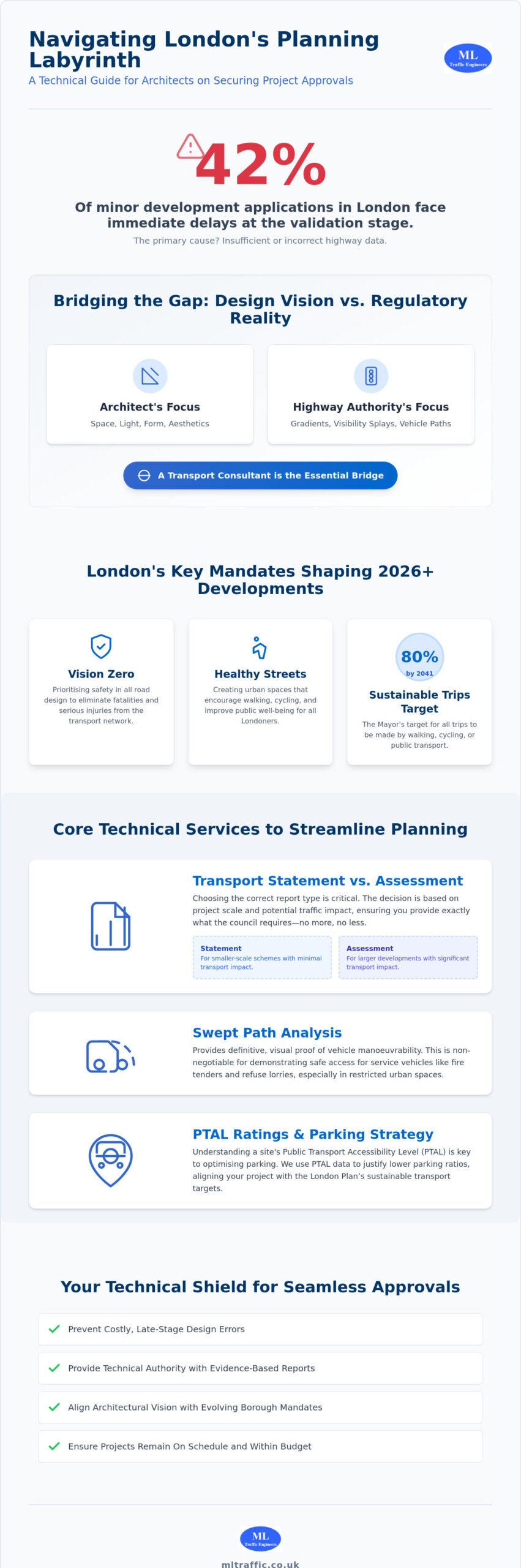
  • The Ultimate Guide to Transport Planning Consultants

    The Ultimate Guide to Transport Planning Consultants

    A single highway authority objection can stall a development project for months, inflating costs and jeopardising your entire investment. You likely know that navigating the labyrinth of local regulations, such as s278 agreements or the latest 2026 London Plan mandates, is a high-stakes challenge where precision is a functional necessity. It’s frustrating when generic advice leads to avoidable delays, but your planning submission doesn’t have to be a gamble.

    By partnering with specialized transport planning consultants, you can unlock a smooth planning process through expert guidance and rigorous technical reporting. This guide provides a comprehensive look at how data-driven site analysis, accurate Transport Assessments, and precise Swept Path Analysis reduce the risk of design errors. You’ll learn how to navigate complex highway regulations efficiently. We’ll show you how to ensure your submission is both cost-effective and fully compliant with the latest 2026 industry benchmarks, turning regulatory hurdles into a clear path for project completion.

    Key Takeaways

    • Understand how transport planning consultants navigate the latest 2026 national strategies to ensure your development meets rigorous regulatory standards.
    • Identify whether your project requires a Transport Statement or a full Transport Assessment based on current residential and commercial development thresholds.
    • Learn how Swept Path Analysis uses CAD simulations to provide technical proof of vehicle maneuverability and prevent costly design errors.
    • Discover the role of bespoke Traffic and Parking Surveys in providing the data-driven evidence needed to overcome highway authority objections.
    • Gain insights into managing the full project lifecycle from initial feasibility to final planning submission through expert technical reporting.

    The Role of Transport Planning Consultants in the UK Planning System (2026)

    Transport planning consultants are specialist advisors who manage the technical transport implications of new development projects. They act as the primary interface between developers and Local Highway Authorities (LHAs), ensuring that proposed infrastructure aligns with local and national safety standards. The field of transportation planning has evolved rapidly, moving beyond simple traffic counts to a holistic evaluation of sustainability, safety, and digital connectivity.

    As of June 2026, the UK planning system demands more robust transport evidence than ever before. This shift stems from the “Better Connected” national strategy published on April 2, 2026, and the updated Road Safety Strategy launched in January. These policies require developers to provide granular data on how their projects impact regional targets, such as the 65% reduction in road deaths aimed for by 2035. Consultants provide the data-driven defense needed to navigate these stricter thresholds, effectively mitigating the risk of expensive planning refusals.

    To better understand the daily impact of these professionals, watch this overview of the role:

    Consultants don’t just produce reports; they manage the entire lifecycle of the transport element. They translate the developer’s vision into the technical lexicon required by LHA engineers. This technical authority is vital when negotiating s278 and s38 agreements, where precision is a functional necessity to avoid costly delays. By taking a proactive approach, they ensure that transport considerations support the commercial viability of the site rather than hindering it.

    Supporting Planning Applications with Technical Evidence

    The role of transport planning consultants is to translate complex regulatory requirements into actionable design solutions that secure planning consent. Key responsibilities include:

    • Providing technical documentation required by the National Planning Policy Framework (NPPF) to prove a development’s sustainability.
    • Addressing highway safety and capacity concerns during the design phase to prevent later objections.
    • Developing mitigation strategies that satisfy LHA requirements while remaining cost-effective for the developer.

    Feasibility and Site Appraisals

    Effective site appraisals happen before land purchase to ensure a project is viable from the outset. Consultants evaluate site access and transport connectivity to identify “showstopper” issues, such as inadequate visibility splays or restricted vehicle maneuverability, that could derail a project. You can learn about our project types to see how early-stage analysis protects your investment from unforeseen regulatory hurdles.

    Essential Documentation: Transport Statements vs. Transport Assessments

    Determining whether your project requires a Transport Statement (TS) or a full Transport Assessment (TA) is a critical technical hurdle that impacts both your budget and your planning timeline. Experienced transport planning consultants use specific thresholds set by local authorities to advise on the appropriate level of reporting. The primary goal of both documents is to demonstrate “nil detriment.” This proves that the proposed development won’t negatively impact the safety or capacity of the existing highway network. Detailed guidance on Transport Assessments and Statements provided by the government sets the foundation for these technical requirements.

    The choice between a TS and a TA isn’t arbitrary. It’s dictated by the scale of the development and the potential volume of traffic it will generate. Getting this wrong leads to immediate objections from highway authorities, causing avoidable delays. Professional consultants ensure your submission is proportionate to the project’s impact, saving you from over-investing in unnecessary analysis while still meeting every regulatory benchmark.

    When Do You Need a Transport Statement?

    A Transport Statement is typically sufficient for smaller developments where the anticipated trip generation is relatively low. As of June 2026, for residential projects in London with fewer than 50 units or commercial spaces under 1,000 square meters, a TS is generally the standard requirement. This document focuses on the immediate site vicinity. It covers existing conditions, proposed access points, and options for sustainable travel. It’s a focused technical defense of your site’s accessibility. For specific regional requirements, you can refer to our London Transport Statements Guide to ensure your submission meets local expectations.

    The Depth of a Full Transport Assessment

    Larger developments trigger the need for a comprehensive Transport Assessment. In London, this requirement applies to residential schemes of 80 or more units or commercial developments exceeding 2,500 square meters. Unlike a statement, a TA involves rigorous junction modelling and capacity analysis. Consultants use the TRICS database to predict trip generation accurately based on comparable sites across the UK. This analysis evaluates the cumulative impact of your project alongside other committed developments in the area. It ensures that the wider network remains safe and functional, even during peak hours.

    Precision in these reports prevents costly design errors and highway authority objections. If you’re unsure which document your project requires, exploring our technical reporting services can provide the clarity needed to move forward with confidence. By addressing these requirements early, you reduce the risk of planning delays and ensure a more efficient path to approval.

    Technical Precision: Swept Path Analysis and Vehicle Maneuverability

    Swept Path Analysis (SPA) is the digital simulation of vehicle movements within a proposed site layout. It’s a non-negotiable requirement for modern planning applications. By using sophisticated CAD software, such as the 2026 versions of AutoTURN or Kobi Swept Path, transport planning consultants can map the exact path a vehicle’s body and wheels take during a turn. This technical precision provides the empirical evidence needed to satisfy highway authorities that a design is safe and functional. Adherence to the standards set by the Chartered Institution of Highways & Transportation ensures that these simulations reflect real-world operational requirements.

    Without SPA, developers risk significant post-construction errors that are both expensive and difficult to rectify. If a refuse truck cannot clear a corner or a fire tender cannot reach a building’s entrance, the development fails to meet basic safety and serviceability benchmarks. Consultants use standardized vehicle templates—ranging from 11.4m refuse collection vehicles to heavy articulated HGVs—to stress-test every junction and turning head before a single brick is laid. This proactive analysis transforms a conceptual drawing into a technically sound site plan.

    Demonstrating Access for Service and Emergency Vehicles

    Meeting the strict requirements of Building Regulations, specifically Approved Document B, is a primary concern for any new development. You must prove that emergency vehicles have unobstructed access to all parts of the site. Similarly, local authorities require evidence that refuse collection vehicles can enter, turn, and exit in a forward gear. Our Swept Path Analysis Services in London focus on these critical maneuvers to clear the way for planning approval. We ensure your layout accommodates these essential services without compromising on safety or regulatory compliance.

    Optimising Car Park and Access Layouts

    Precision in design doesn’t just ensure safety; it also protects your bottom line. By verifying that parking bays and access roads are functional for all users, transport planning consultants help you avoid over-engineered roads that waste valuable land. SPA justifies tight site designs to planners by providing mathematical certainty that the layout accommodates the largest anticipated vehicles without compromising safety. This allows you to reduce the footprint of infrastructure and maximize the developable area of your site. It’s a balance of technical authority and commercial awareness that ensures your project remains viable and efficient.

    The Ultimate Guide to Transport Planning Consultants

    Data-Driven Development: The Importance of Accurate Traffic and Parking Surveys

    Relying on generic or “off-the-shelf” data is a common mistake that leads to immediate planning refusals. Transport planning consultants provide the site-specific evidence needed to satisfy highway authorities and justify your development’s impact. Accurate data acts as a technical defense, ensuring that your proposals are grounded in reality rather than theoretical averages. Timing is also critical; surveys must avoid school holidays or atypical local events to ensure the data is representative and legally robust. Precision in data collection reduces the risk of highway authority objections and keeps your project moving forward.

    Parking Surveys and the Lambeth Methodology

    In urban environments, parking stress is a major concern for planners. The Lambeth Methodology has become the industry standard for measuring this stress, requiring surveys to be conducted during the early hours of the morning when residential parking demand is at its peak. This data is essential for justifying reduced parking provision, particularly in areas with a high Public Transport Accessibility Level (PTAL). Under the London Plan 2026, developments in areas with a PTAL score of 4 or higher must often be car-free. Accurate parking surveys prove that the surrounding streets can accommodate any small increase in demand without compromising safety or local amenity. This technical authority is vital for securing approval in high-density regions.

    Traffic Data Collection for Capacity Analysis

    Traffic surveys provide the foundation for junction modeling and capacity assessments. We use Automatic Traffic Counts (ATC) for long-term volume and speed data, while Manual Turning Counts (MTC) capture specific vehicle movements at junctions. This data calibrates software like Junctions 9, which includes ARCADY for roundabouts and PICADY for priority junctions. Without this calibration, your capacity models lack the precision required by Local Highway Authorities. Precise data ensures that your proposed junction designs are both safe and functional under peak load conditions.

    You can explore our data collection resources to understand how we gather the evidence required for successful submissions. If you need site-specific data to support your application, you can book a professional traffic survey today to ensure your project remains on track and compliant with the latest 2026 standards.

    Interaction with Local Highway Authorities (LHAs) is where technical data meets regulatory reality. ML Traffic Engineers UK provide the technical authority required to navigate these discussions with the urgency your project schedule demands. As transport planning consultants, we know that administrative delays directly impact construction financing and delivery windows. We manage the full project lifecycle, ensuring that every report anticipates and resolves potential regulatory hurdles before they become formal objections. This proactive stance ensures that your project maintains momentum from inception to approval.

    Our approach centers on constant availability and unwavering reliability. When an LHA engineer raises a technical concern regarding junction capacity or highway safety, we provide immediate, data-backed responses. This rapid response capability is a hallmark of our brand promise. By taking ownership of the technical dialogue, we reduce the logistical and regulatory pressures on your team. This allows you to focus on the broader aspects of development while we secure the necessary highway approvals.

    Why Precision Matters for s278 and s38 Agreements

    Section 278 and Section 38 agreements are the legal gateways to construction on the public highway. Precision during the initial design phase is a functional necessity to ensure works meet the exacting standards of the LHA. Our expertise in these negotiations reduces the risk of unforeseen costs and design changes during the construction phase. We ensure that all proposed highway works are technically sound and fully compliant with the latest 2026 industry benchmarks. For a deeper dive into these requirements, see our Highway Design S278 & S38 Guide.

    Comprehensive Support for Your Planning Submission

    Every site has unique constraints that require a tailored approach. We provide bespoke transport reporting that addresses site-specific issues, whether it involves a complex junction or restricted urban access. By maintaining a proactive dialogue with authority engineers, we resolve objections through technical evidence rather than costly compromise. This level of precision significantly reduces the need for expensive planning appeals. We take pride in our adherence to standards and our role as a vital guardian of public safety throughout the planning process.

    Securing professional guidance early in the project lifecycle is the most effective way to avoid regulatory friction. Contact ML Traffic Engineers UK for a project review to ensure your next planning submission is backed by technical authority and data-driven precision.

    Secure Your Planning Success with Expert Transport Guidance

    Achieving a successful planning submission in 2026 requires more than just standard reporting. It demands technical authority and a proactive approach to highway regulations. By integrating precise Swept Path Analysis and site-specific data from Parking Surveys, you eliminate the guesswork that often leads to highway authority objections. Professional transport planning consultants act as your technical defense; they ensure every aspect of your development’s infrastructure is safe, functional, and fully compliant with the latest national strategies.

    Founded in 2014, ML Traffic Engineers UK brings deep UK planning expertise to every project. We specialize in providing the technical evidence needed to navigate complex s278 and s38 agreements without the risk of design errors. Our safety-conscious approach to highway engineering prioritizes your project’s timeline and commercial viability. Don’t let regulatory hurdles stall your progress. You can get a quote for your Transport Statement or Assessment from ML Traffic Engineers UK today to ensure your site is ready for approval. We are ready to help you move your project forward with confidence.

    Frequently Asked Questions

    What do transport planning consultants actually do?

    Transport planning consultants manage the technical transport implications of new development projects to ensure safety and regulatory compliance. They act as a vital bridge between developers and Local Highway Authorities, producing essential documentation like Transport Assessments and Travel Plans. Their role involves using data-driven site analysis and technical modeling to prove that a proposed project won’t negatively impact the existing highway network or public safety.

    When is a Transport Statement required for a planning application?

    A Transport Statement is required for smaller developments that generate relatively low levels of traffic but still impact the local highway. As of June 2026, residential projects in London with fewer than 50 units generally trigger this requirement. It focuses on the immediate site vicinity, detailing proposed access points and sustainable travel options. It provides the technical evidence needed to satisfy planners that the development is accessible and safe.

    How much does a Transport Assessment cost in 2026?

    The cost of a Transport Assessment depends entirely on the scale and complexity of the proposed development. Factors such as the number of junctions requiring detailed modeling and the volume of traffic surveys needed will influence the final fee. Developers should request a tailored quote to ensure the reporting is proportionate to their project’s impact. This approach avoids over-investing in unnecessary analysis while meeting all local authority benchmarks.

    What is Swept Path Analysis and is it always necessary?

    Swept Path Analysis is a digital simulation used to prove that specific vehicles can maneuver safely within a site layout. It’s almost always necessary for developments that require access for service vehicles like refuse trucks or emergency fire tenders. Planners require this technical proof to ensure that the site design is functional and safe. It prevents costly design errors that might otherwise be discovered only after construction begins.

    Is a Travel Plan mandatory for residential developments?

    Travel Plans are mandatory for residential developments that exceed specific size thresholds set by the Local Highway Authority. These documents outline strategies to encourage sustainable travel, such as walking, cycling, or public transport use. In many urban areas, they are a standard requirement to mitigate the environmental impact of new housing. They help developers meet the sustainability targets mandated by the 2026 National Planning Policy Framework.

    How long does it take to complete a transport planning report?

    Completing a transport planning report typically takes between two to four weeks, depending on the complexity of the site and the data required. If new traffic or parking surveys are necessary, these must be scheduled during neutral periods to ensure the data is representative. Professional consultants prioritize technical rigor to ensure the final report withstands authority scrutiny. This timeline ensures a robust submission that reduces the risk of later delays.

    What is the difference between Section 278 and Section 38 agreements?

    Section 278 agreements cover works on the existing public highway, while Section 38 agreements involve the adoption of new roads by the local authority. Both require precise engineering drawings and technical approval from the highway authority. Consultants manage these negotiations to ensure all infrastructure meets the exacting safety standards required for legal adoption. This precision reduces the risk of unforeseen costs during the construction phase of a project.

    Can a transport consultant help if my application has already been objected to?

    Yes, transport planning consultants can review highway authority objections and provide the technical evidence needed to resolve them. This process often involves conducting bespoke parking surveys or refining a Swept Path Analysis to address specific safety concerns. A proactive technical defense can frequently overturn initial objections without the need for a full planning appeal. This expert intervention saves time and protects the commercial viability of your development project.

    Michael Lee

    Article by

    Michael Lee

    Transport planner with over 35 years' experience.

    Disclaimer

    The content on mltraffic.co.uk, including all technical articles, guides, and resources, is provided for general informational and educational purposes only. It is not intended to constitute professional advice in traffic engineering, transportation planning, development approvals, or any other technical or legal field.
    While ML Traffic Engineers makes every reasonable effort to ensure the accuracy, completeness, and timeliness of the information published, we do not provide any warranties or representations (express or implied) regarding its reliability, suitability, or availability for any particular purpose. Any reliance you place on the content is strictly at your own risk.
    In no event shall ML Traffic Engineers, its directors, employees, authors, or affiliates be liable for any direct, indirect, incidental, special, consequential, or punitive damages (including, without limitation, loss of profits, data, or business opportunities) arising out of or in connection with the use of, or inability to use, any information provided on this website.
    The articles and guides on this site are not a substitute for engaging a qualified, professional traffic engineer to assess your specific project requirements. For tailored advice, compliance assessments, or traffic engineering services, please contact a competent professional.
    This disclaimer may be updated from time to time without notice. By accessing or using this website, you agree to be bound by the most current version of this disclaimer.