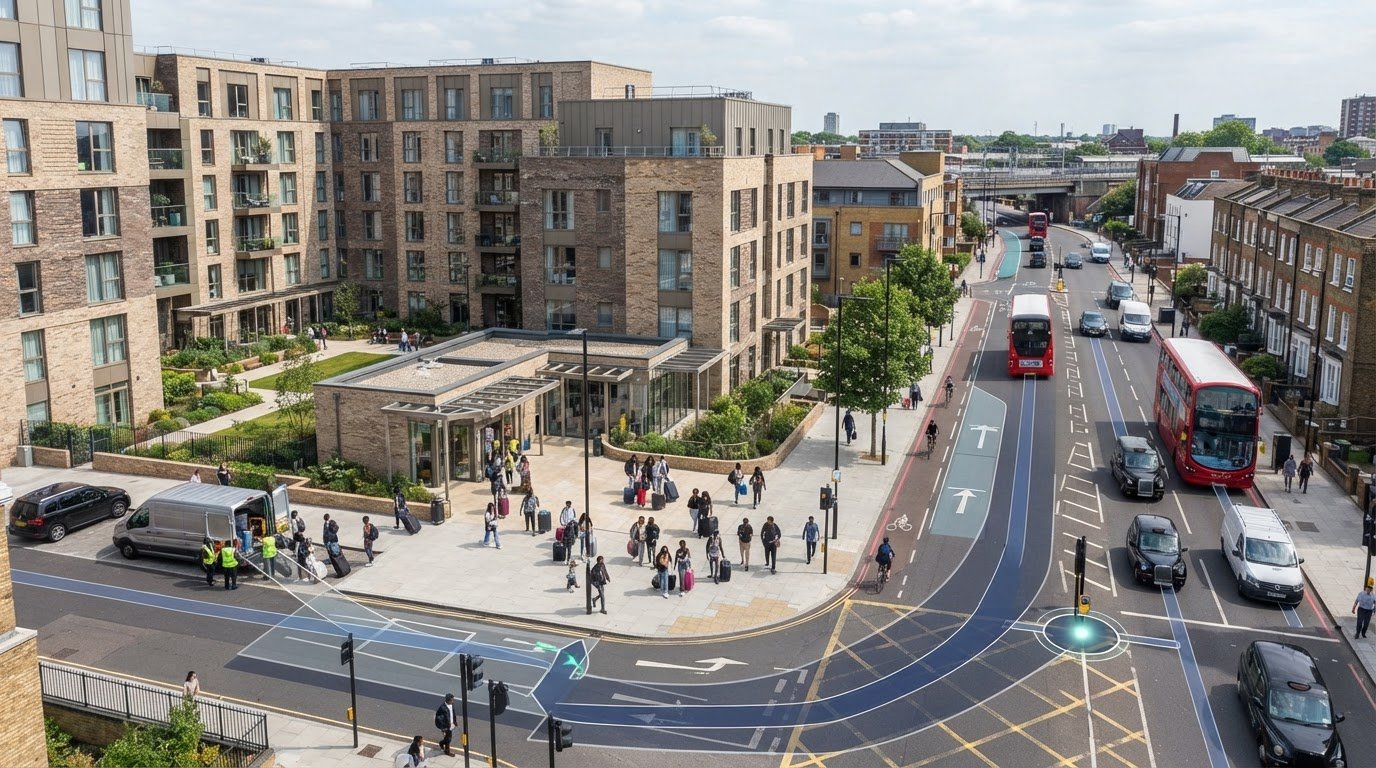
PBSA planning approval in East London rarely collapses over architectural design; it falls apart at the kerbside. Securing highway officer sign-off demands strict alignment with borough priorities, making a comprehensive transport assessment for student accommodation in Newham essential for schemes exceeding 150 bedspaces. If you’re facing statutory holding objections from Transport for London (TfL), struggling with trip generation justifications in high PTAL corridors, or trying to resolve move-in logistics within strict car-free zones, you know how quickly highways scrutiny can derail project timelines.
Mastering Newham’s planning policies and transport assessment requirements allows you to protect your programme and secure approval without costly late-stage redesigns. Following the return of full planning powers from the LLDC to Newham and the adoption of an ambitious 83% sustainable mode share target, planning officers expect watertight technical submissions. This 2026 guide delivers a clear roadmap through Newham’s Local Plan transport criteria, detailing exact submission thresholds, Section 106 car-free obligations, and robust operational booking strategies for peak student arrival weekends.
Key Takeaways
- Identify statutory thresholds determining whether your PBSA scheme requires a Transport Statement or full assessment under Newham’s direct planning jurisdiction.
- Discover how to build a robust transport assessment for student accommodation in Newham that substantiates non-car trip generation within high PTAL corridors.
- Resolve arrival and departure peak bottlenecks using structured booking frameworks that fully satisfy car-free Section 106 requirements.
- Streamline pre-application engagement with Newham Highways and TfL to eliminate statutory holding objections before reaching the planning committee.
- Leverage precision technical modelling, including Swept Path Analysis and baseline Traffic Surveys, to safeguard layouts against costly redesigns.
Statutory Triggers & Thresholds for Student Housing TAs in Newham
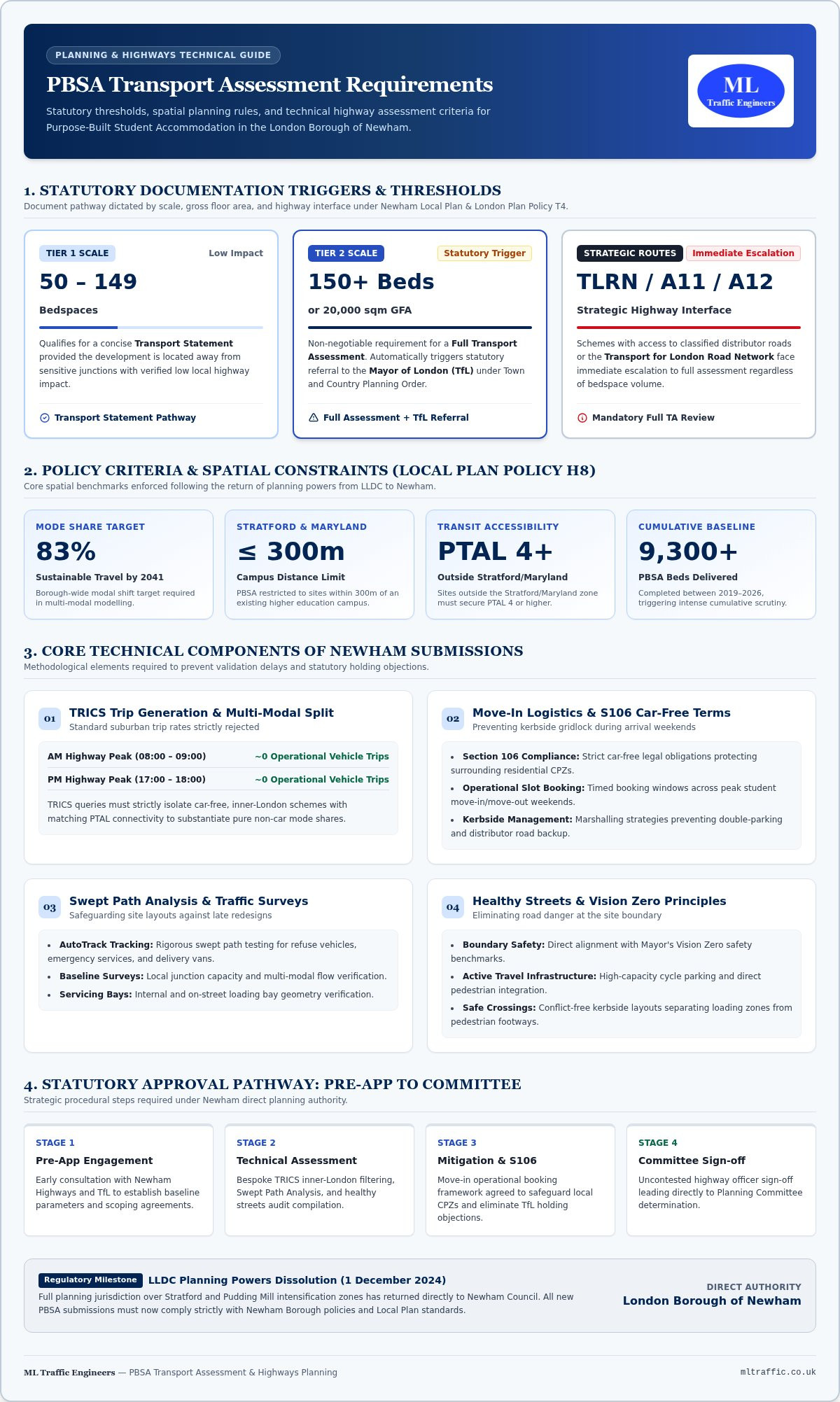
Delivering purpose-built student accommodation (PBSA) in East London requires clearing stringent statutory hurdles. Following the dissolution of the London Legacy Development Corporation’s (LLDC) planning powers on 1 December 2024, Newham Council now exercises direct planning authority over key intensification zones such as Stratford and Pudding Mill. A robust transport assessment for student accommodation in Newham is critical to prevent validation delays, holding objections, and costly project pauses.
To see how transport planners evaluate urban highway capacity and active travel integration, watch this visual breakdown:
When Is a Full Transport Assessment Required Instead of a Statement?
The scale of development dictates your documentation path under Newham Local Plan policies and London Plan Policy T4:
- 50 to 149 Bedspaces: Schemes within this bracket generally qualify for concise Transport Statements, provided the site sits away from sensitive junctions and exhibits low local highway impact.
- 150+ Bedspaces or 20,000 sqm GFA: Triggers the non-negotiable requirement for a full Transport Assessment. This scale also initiates a statutory referral to the Mayor of London (TfL) under the Town and Country Planning Order.
- Strategic Highway Interfaces: Proposals with access onto classified distributor roads or near the Transport for London Road Network (TLRN), such as the A11 or A12, face immediate escalation to a full assessment regardless of bedroom totals.
Stratford and Canning Town sites carry heightened sensitivity. Because Stratford delivered over 9,300 PBSA beds between 2019 and 2026, Newham planning officers apply intense scrutiny to cumulative highway impacts even on mid-scale schemes.
Newham Local Plan and London Plan Policy Context for 2026
Submitting a successful transport assessment for student accommodation in Newham requires technical alignment with the borough’s emerging Local Plan Policy H8. In the Stratford and Maryland neighbourhood, PBSA is restricted to sites within 300 metres of an existing higher education campus. Elsewhere, sites must achieve a Public Transport Accessibility Level (PTAL) of 4 or higher.
Every submission must demonstrate compliance with the Healthy Streets Approach and Newham’s ambitious target of achieving an 83% sustainable mode share by 2041. Designs must integrate the Mayor’s Vision Zero safety principles, proving that servicing arrangements, pedestrian crossings, and cycle paths eliminate road danger at the site boundary.
Core Technical Components of a Newham Student Housing Assessment
Generic highways methodology fails in East London’s dense regeneration corridors. Officers at Newham Council evaluate submissions against stringent criteria established in statutory government guidance on Transport Assessments, demanding bespoke analytical outputs. Ensuring your technical documentation follows the structured frameworks detailed in our London Transport Assessment guide prevents procedural pushback from both borough officers and statutory bodies like TfL.
TRICS Trip Generation and Multi-Modal Split Modelling
Standard trip rates do not reflect student behaviour. To produce an acceptable transport assessment for student accommodation in Newham, TRICS database interrogations must exclude suburban or car-dependent university halls. The dataset must strictly isolate car-free, inner-London schemes with identical public transport connectivity.
Your multi-modal model must demonstrate that daily operational vehicle trips remain virtually zero during the morning (08:00-09:00) and evening (17:00-18:00) highway network peaks. Trip distributions must realistically assign student flows:
- Rail and Mass Transit: Quantifying passenger entries and exits onto the Elizabeth line, DLR, and London Underground networks serving Stratford, West Ham, or Canning Town.
- Active Travel Desire Lines: Mapping direct, high-volume walking journeys toward regional institutions, including Birkbeck, UCL East, and UEL campuses.
- Bus Capacity Impact: Analysing route capacities across local bus corridors passing adjacent stops.
Public Transport Accessibility Levels (PTAL) and Active Travel Audits
Most viable PBSA development land in Newham falls within high PTAL brackets, ranging from 4 to 6b. This high level of connectivity justifies zero resident parking provision, but it escalates expectations for pedestrian infrastructure.
Highway officers enforce comprehensive Active Travel Zone (ATZ) audits. Your assessment must evaluate key walking and cycling routes within a 20-minute journey envelope from the scheme entrance. These audits score surface conditions, footway widths, crossing provision, and street lighting along primary links to transport hubs. Any highlighted deficiencies often become triggers for Section 278 highway works or Section 106 financial contributions.
Cycle Parking and End-of-Trip Infrastructure Standards
Design teams must follow London Plan Policy T5 standards. PBSA developments require 0.75 long-stay cycle spaces per bedroom, alongside 1 short-stay space per 40 beds. In accordance with London Cycling Design Standards (LCDS), a minimum of 5% of this total must cater to non-standard cycles, such as adapted bikes and cargo cycles.
If you’re assembling documentation for an upcoming submission, engaging ML Traffic Engineers UK early ensures your trip distribution, cycle layout geometry, and baseline modelling satisfy borough highways officers from the outset.
Overcoming Key PBSA Hurdles: Move-In Peaks, Parking, and Servicing
Start-of-term arrival weekends represent the single greatest operational concern for Newham Highways DM officers. While day-to-day student life generates minimal private vehicle movement, concentrated turnover in September and June threatens surrounding residential streets with severe gridlock. Overcoming these specific challenges within your transport assessment for student accommodation in Newham requires a legally binding operational framework rather than broad reassurances.
Student Move-In and Move-Out Operational Logistics Plans
Planning committees routinely secure a Move-In and Move-Out Management Plan (MIMOP) via pre-occupation planning conditions. Under national statutory guidance on Travel Plans, Transport Assessments and Statements, applicant teams must demonstrate that temporary arrival spikes will not compromise highway safety or network efficiency. Your submission should detail four key controls:
- Staggered Arrival Windows: A mandatory digital booking platform allocating fixed 20- to 30-minute unloading slots per student, preventing uncontrolled curb-side stacking.
- On-Site Marshal Protocols: Trained personnel positioned at site access gates and loading pads to direct traffic, check booking QR codes, and enforce slot deadlines.
- Off-Highway Unloading: Designated internal loading bays or segregated off-street zones designed to turn vehicles around without obstructing public footways.
- Tenancy Restrictions: Clear lease clauses prohibiting personal vehicle ownership and informing students of parking permit disqualifications.
Car-Free Design Justifications and Blue Badge Provision
Under Newham Local Plan Policy T3 and London Plan Policy T6.1, student accommodation is strictly car-free. Developers must accept Section 106 legal agreements that explicitly exclude occupants from applying for on-street permits within Newham’s Controlled Parking Zones (CPZs) and Residential Parking Zones (RPZs).
Car-free does not mean zero parking. Highway standards require accessible Blue Badge bays from day one, generally allocated at 1 space or between 3% and 4% of total bedspaces, supported by passive layout expansion plans. These bays must feature dedicated active electric vehicle charging points and level thresholds directly connecting to building cores.
Refuse Collection and Servicing Swept Path Analysis
Weekly operational deliveries require clear geometric justification. Applying precision AutoTurn swept path analysis models the complex tracks of Newham Council’s standard 10.2-metre refuse collection vehicles and typical 8.5-metre medium goods delivery vans.
Highway officers reject designs relying on dangerous reverse manoeuvres onto the public highway. Your swept path analysis must confirm that all servicing vehicles can pull into dedicated bays, turn fully, and exit the site safely in forward gear. Bin store layouts must align with maximum collection pull distances, which must not exceed 10 metres from vehicle tailgate to storage threshold under local waste collection guidelines.
Securing Newham Highway Approval: Pre-App to Committee
Navigating East London highways determinations requires a disciplined, multi-stage strategy. In major growth corridors like Stratford and the Royal Docks, schemes interface simultaneously with Newham Council’s Highways Development Management team and Transport for London (TfL) Spatial Planning. Managing this dual scrutiny through structured pre-application engagement is the fastest way to resolve technical friction before your scheme reaches the Strategic Development Committee.
Achieving smooth highway sign-off follows four progressive stages:
- Step 1: Baseline Scoping & Surveys: Define the transport study area, agree on TRICS donor site criteria with officers, and commission multi-modal baseline traffic counts during standard university term-time weeks.
- Step 2: Dual Pre-Application Submission: Lodge formal pre-app technical notes jointly to Newham and TfL to test junction capacity, bus network absorption, and pedestrian comfort levels.
- Step 3: Technical Iteration: Refine layouts based on highway engineer feedback, incorporating swept path tracking for servicing bays and addressing local footway pinch points.
- Step 4: Final Package & Legal Heads of Terms: Submit the finalized transport assessment for student accommodation in Newham alongside an integrated Travel Plan and agreed Section 106 obligations.
Early Consultation with Newham Highways and Transport for London
Pre-application scoping agreements lock down key parameters before design freeze. Early discussions clarify whether TfL will seek Section 278 kerbside alterations or financial contributions toward strategic bus corridors like the A118 or Romford Road. Agreeing on methodology early eliminates late statutory holding objections that stall committee target dates.
Drafting Student Travel Plans That Satisfy Borough Planners
Planning officers will not sign off major PBSA schemes without a robust, long-term operational framework. An effective Student Travel Plan provides enforceable commitments aligned with Newham’s 83% sustainable transport mode target. The submission must detail:
- Designated on-site travel coordinators responsible for freshers’ week sustainable transit inductions.
- Cycle loan schemes, maintenance workshops, and active travel welcome packs for arriving residents.
- Annual TRICS-compliant monitoring surveys for a minimum of five years post-occupation.
- Automated remedial triggers, including increased micromobility funding, if monitoring reveals private car reliance.
Addressing Local Resident and Ward Councillor Concerns
Highways representations at planning committee frequently stem from resident anxiety regarding on-street parking stress and student turnover congestion. Transparent empirical data defuses these challenges. Clear parking beats and rigorous move-in logistics protocols assure ward councillors that surrounding neighbourhoods will remain protected.
If you need expert representation to steer your East London scheme through highway scoping and formal determination, partner with ML Traffic Engineers UK to deliver your technical submission with precision.
Why Partner with ML Traffic Engineers UK on Newham PBSA Schemes
Delivering major student accommodation within East London’s dense regeneration quarters demands technical authority and clear communication with highway authorities. With over 35 years of senior engineering expertise across London boroughs, ML Traffic Engineers UK acts as your strategic partner from initial site feasibility through to final determination. We transform complex transport planning requirements into compliant, defensible submissions that satisfy both Newham Council and Transport for London (TfL).
Specialist Transport Planning and Technical Analysis
Our core services directly resolve the technical challenges unique to purpose-built student housing:
- Bespoke Transport Documentation: We prepare comprehensive Transport Assessments and concise Transport Statements specifically tailored to PBSA operational profiles and local highway constraints.
- Advanced Swept Path Analysis: Using specialised AutoTurn software, we model exact turning envelopes for refuse freighters, delivery vans, and emergency tenders, ensuring on-site layouts function safely.
- Defensible Data Collection: We coordinate robust Traffic Surveys and parking surveys, establishing accurate baseline network conditions that withstand highway officer examination.
- TRICS Modelling Precision: Our engineers isolate relevant, car-free urban comparator sites to justify low trip generation and active travel splits.
By collaborating closely with your project architects during early design stages, we optimize site layouts, servicing access, and cycle storage configurations before planning submission. This proactive approach prevents costly redesigns late in the planning cycle.
Strategic Guidance from Project Feasibility to Determination
Navigating the planning process requires sustained technical negotiation. We represent your scheme during pre-application meetings, responding directly to queries from Newham’s Highways Development Management team and TfL Spatial Planning. Our proactive engagement addresses concerns around network capacity, Vision Zero design interventions, and pedestrian comfort levels before statutory consultation concludes.
We deliver an end-to-end service, supporting your scheme through Section 106 heads of terms negotiations and post-permission planning condition discharge. Rapid turnarounds ensure your application programme stays on track while maintaining the highest engineering rigor. When you need a reliable transport assessment for student accommodation in Newham, our experienced engineering team provides the technical backing necessary to secure committee approval with confidence.
Protect your development timeline today. Contact ML Traffic Engineers UK for a project assessment and discuss your upcoming East London student housing scheme with our senior engineers.
Secure Your Student Housing Highway Approval with Confidence
Securing planning consent across Stratford, Canning Town, and the Royal Docks requires strict attention to transport mechanics. Achieving swift highway officer sign-off hinges on proving car-free Section 106 compliance, establishing workable arrival slot frameworks, and aligning multi-modal trip distribution with Newham’s 83% sustainable transport mode target. Submitting a rigorous, evidence-led transport assessment for student accommodation in Newham eliminates statutory holding objections and keeps your development program on course.
Don’t let avoidable highway disputes delay your project milestones. ML Traffic Engineers UK pairs technical precision with practical planning advocacy. Backed by a senior highway engineering team with over 35 years of planning experience, we hold a proven track record securing technical approvals across London boroughs and TfL. We resolve complex urban access constraints and defend your layout from initial scoping right through to determination. Instruct ML Traffic Engineers UK for your Newham Transport Assessment today and advance your PBSA scheme toward committee approval with complete confidence.
Frequently Asked Questions
Do all student accommodation schemes in Newham require a full Transport Assessment?
No, smaller schemes accommodating between 50 and 149 bedspaces typically require only a concise Transport Statement, provided network impact remains negligible. Schemes exceeding 150 student bedspaces automatically trigger a full transport assessment for student accommodation in Newham and mayoral referral. Developments under 50 bedspaces rarely require full assessments unless they sit at sensitive highway junctions or access classified distributor roads.
How does Newham Council enforce car-free policies on student housing developments?
Newham enforces car-free development through legally binding Section 106 agreements. These covenants prohibit student occupants from applying for or obtaining parking permits within local Controlled Parking Zones (CPZs) or Residential Parking Zones (RPZs). Tenancy contracts must explicitly notify students of this restriction. On-site provision is strictly limited to essential operational servicing bays and designated Blue Badge accessible parking spaces equipped with electric vehicle charging points.
What is an Active Travel Zone assessment and why is it needed for PBSA?
An Active Travel Zone (ATZ) assessment evaluates pedestrian and cycling route quality across key routes within a 20-minute catchment. Transport for London and Newham Council require it for PBSA schemes to prove students can safely navigate toward transit hubs and university campuses. Highway officers examine audit scores for footway widths, crossing safety, and street lighting, often using identified deficiencies to justify Section 278 off-site highway improvements.
How are student move-in and move-out days managed within transport planning submissions?
Move-in and move-out turnover is regulated through a formal management strategy secured by pre-occupation condition. Developers implement an online booking system that allocates staggered 20- to 30-minute unloading windows across turnover weekends. On-site traffic marshals check bookings and supervise off-street bays to prevent curbside queues. Incorporating this operational framework into your transport assessment for student accommodation in Newham reassures officers that local road networks won’t suffer gridlock.
Will Transport for London be involved in reviewing my student housing transport assessment?
Yes, TfL reviews your scheme if it exceeds 150 bedspaces, creates over 20,000 square metres of gross internal area, or borders the Transport for London Road Network (TLRN). Arterial routes like the A11 and A12 trigger statutory referrals to the Mayor of London. Even on non-referable proposals, Newham highway officers frequently invite TfL Spatial Planning to assess local bus capacity and nearby rail interchange impacts.
What cycle parking standards apply to student accommodation under the London Plan?
London Plan Policy T5 mandates 0.75 long-stay cycle parking spaces per student bedroom and 1 short-stay space per 40 beds. Under London Cycling Design Standards (LCDS), at least 5% of this total must support wider, non-standard cycles like adapted bikes and cargo tricycles. All cycle facilities must be secure, weather-protected, well-lit, and accessible via step-free routes, supported by charging points for electric bicycles.
How does swept path analysis assist in securing planning permission for student residences?
Swept path analysis uses specialized CAD software to simulate vehicle tracking envelopes across your proposed site layout. For student accommodation schemes, it demonstrates to highway officers that Newham’s 10.2-metre refuse trucks, parcel delivery couriers, and fire tenders can enter, turn, and leave safely in forward gear. Demonstrating clear vehicle clearance eliminates highway safety objections and avoids costly architectural layout changes late in the planning process.

Disclaimer
The content on mltraffic.co.uk, including all technical articles, guides, and resources, is provided for general informational and educational purposes only. It is not intended to constitute professional advice in traffic engineering, transportation planning, development approvals, or any other technical or legal field.
While ML Traffic Engineers makes every reasonable effort to ensure the accuracy, completeness, and timeliness of the information published, we do not provide any warranties or representations (express or implied) regarding its reliability, suitability, or availability for any particular purpose. Any reliance you place on the content is strictly at your own risk.
In no event shall ML Traffic Engineers, its directors, employees, authors, or affiliates be liable for any direct, indirect, incidental, special, consequential, or punitive damages (including, without limitation, loss of profits, data, or business opportunities) arising out of or in connection with the use of, or inability to use, any information provided on this website.
The articles and guides on this site are not a substitute for engaging a qualified, professional traffic engineer to assess your specific project requirements. For tailored advice, compliance assessments, or traffic engineering services, please contact a competent professional.
This disclaimer may be updated from time to time without notice. By accessing or using this website, you agree to be bound by the most current version of this disclaimer.