Tag: Highways Planning

  • Transport Statement Liverpool: A Developer’s Guide for 2026 approvals

    Transport Statement Liverpool: A Developer’s Guide for 2026 approvals

    A single highways objection can stall a multi-million pound development for months; however, most planning delays in Liverpool are entirely preventable through early technical intervention. You likely recognize that meeting the city’s "people-first" design standards is no longer a secondary concern. It is a fundamental requirement for any developer looking to contribute to the 30,000 homes planned for the region by 2041. Securing a professional transport statement Liverpool planners can approve immediately is the most effective way to de-risk your site and avoid the logistical friction of technical pushback.

    We understand that confusion over parking survey methodologies and the 2026 Local Transport Plan requirements can stall your momentum. This article provides a clear path to achieving technical compliance while maintaining project viability. You’ll learn how to align your submission with current net-zero goals and active travel mandates. We preview the essential steps for a successful application, including the role of swept path analysis and travel plans in mitigating highways risks before they impact your delivery timeline.

    Key Takeaways

    • Distinguish between a Transport Statement and a full Assessment to ensure your technical submission matches the specific scale of your development’s impact.
    • Identify the residential and commercial thresholds that trigger the requirement for a transport statement Liverpool planners will review under 2026 regulations.
    • Utilize Swept Path Analysis and standardized parking surveys to provide concrete evidence of safe vehicle maneuvering and local infrastructure capacity.
    • Mitigate the risk of costly planning delays by aligning your site design with the “people-first” priorities of the latest Local Transport Plan.
    • Navigate complex requirements for sensitive locations where technical documentation is mandatory regardless of the total number of units or floor space.

    Table of Contents

    What is a Transport Statement in the Liverpool Planning Context?

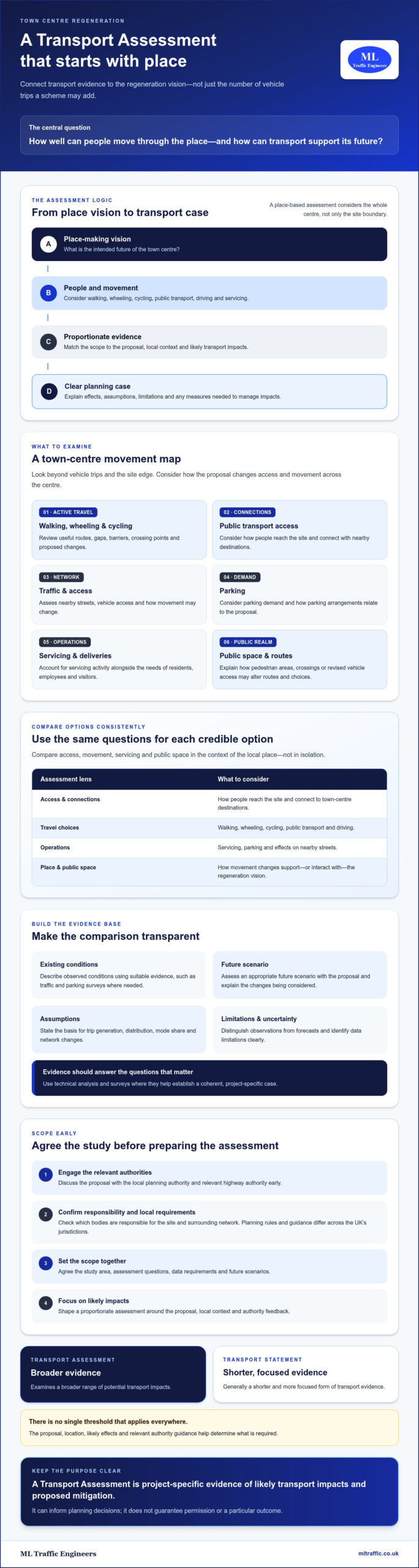
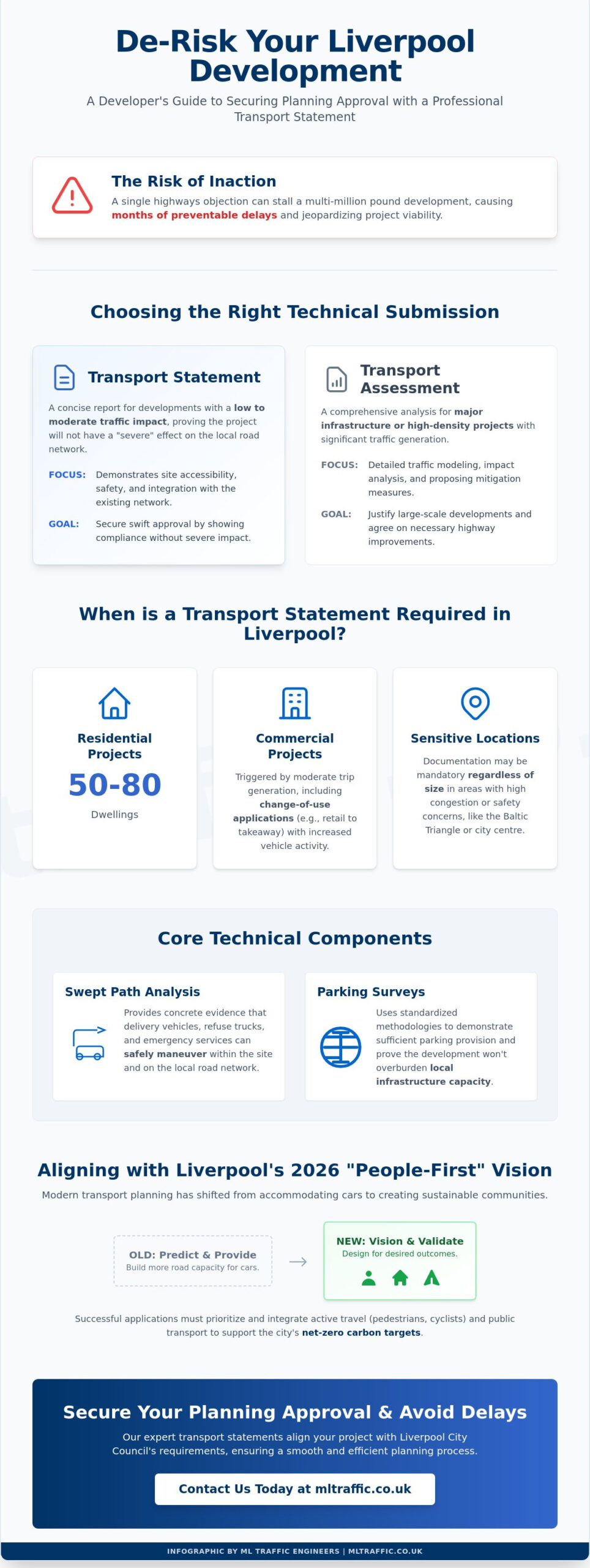
    A Transport Statement is a concise technical report required for developments where the anticipated traffic impact is relatively low but still requires formal scrutiny. It serves as a vital bridge between your architectural vision and the safety standards upheld by the local Highways Authority. Unlike a full Transport Assessment, which is reserved for major infrastructure or high-density projects, this document focuses on demonstrating that your project’s impact on the local road network is not severe. This "severity" threshold is the legal benchmark used to determine whether a planning application should be approved or refused on highways grounds.

    The primary goal is to provide Liverpool City Council with evidence that the development is accessible, safe, and integrated into the existing transport network. It’s about proving that the additional trips generated by your site won’t compromise the safety of other road users. To better understand how transport investment is shaping the region’s future, watch this helpful video:

    In practice, your transport statement Liverpool submission must align with both the National Planning Policy Framework (NPPF) and the specific policies within the Liverpool Local Plan. While the NPPF provides the high-level "presumption in favour of sustainable development," the Local Plan dictates the granular requirements for Merseyside’s unique urban fabric. We ensure your report addresses these dual layers of compliance to prevent avoidable delays during the consultation period.

    Liverpool City Council (LCC) and Planning Requirements

    The LCC Highways department acts as a statutory consultee, reviewing every technical detail of your application. In high-density zones like the Baltic Triangle or the city centre, space for vehicle movement is extremely limited. These areas require specific considerations regarding active travel and public transport connectivity. Your statement must reflect Liverpool’s 2026 Sustainable Transport goals, which prioritize pedestrians and cyclists. Aligning with these goals isn’t just about compliance; it’s about demonstrating civic responsibility and professional integrity in your site design.

    The Legal and Regulatory Framework

    The technical data within a Transport Statement often forms the basis for legal obligations, such as Section 106 or Section 278 agreements. These are legally binding requirements to fund or implement highway improvements. A key shift in 2026 is the transition from "Predict and Provide" to a "Vision and Validate" approach. This modern methodology focuses on creating the transport outcomes we want to see, such as increased cycling and bus usage, rather than simply building more road capacity for cars. This shift is a core principle of modern transport planning, ensuring that new developments support the city’s net-zero carbon targets. By utilizing our technical services, you can ensure your project meets these evolving regulatory standards with precision.

    When is a Transport Statement Required in Liverpool?

    Determining if your project requires a transport statement Liverpool planners will accept depends on both the scale of the development and its geographical context. While national guidelines provide a baseline, Liverpool City Council applies specific scrutiny to sites that might impact localized congestion or public safety. You must assess your project against these thresholds early to avoid unexpected requests for technical data mid-application. Even a minor change-of-use application, such as converting a retail unit into a high-turnover takeaway, can trigger the need for a formal transport justification due to increased delivery vehicle activity.

    Residential vs. Commercial Thresholds

    Residential projects typically trigger a Statement when they fall between 50 and 80 dwellings. Anything larger usually moves into the territory of a full Transport Assessment involving complex traffic modelling. For commercial retail or office spaces, floor space triggers often begin at 1,000 to 2,500 sqm, depending on the specific use class. However, size is not the only factor. Small-scale infill projects in dense areas like Everton or Toxteth often require an access appraisal. This proves that service vehicles can enter and exit safely without obstructing the public highway. The National Planning Policy for Transport Statements provides the framework for these requirements, but local site conditions often override general size rules.

    Scrutiny is also heightened in "sensitive locations." If your site is near a known congested junction, a school, or within a designated Air Quality Management Area (AQMA), the council may demand a report regardless of the unit count. This ensures that even minor increases in trip generation don’t compromise public safety or environmental standards. We frequently see applications delayed because developers assumed a small footprint meant zero technical requirements.

    The Pre-Application Advantage

    Using the LCC pre-application service is the most effective way to define the exact scope of your reporting. This stage allows you to agree on the methodology for parking surveys and traffic counts before investing in full technical production. It prevents "over-scoping," where you pay for unnecessary data that the council does not actually require. Early engagement transforms the highways department from a potential obstacle into a collaborative partner in your planning success.

    Engaging with professional consultants during this phase ensures that your technical documentation is data-driven and safety-conscious from day one. If you’re unsure whether your current site plan meets these criteria, reviewing our technical services can help you identify potential highways risks before they become planning objections. This proactive approach is a hallmark of successful development in Liverpool’s competitive 2026 landscape.

    Transport Statement Liverpool: A Developer’s Guide for 2026 approvals

    Transport Statement vs. Transport Assessment: Key Differences

    Choosing between these two technical documents is a critical decision that impacts both your budget and your planning timeline. A transport statement Liverpool developers typically commission is a concise report focused on sites with manageable traffic footprints. It provides a qualitative assessment of the site’s accessibility and a quantitative summary of trip generation. In contrast, a Transport Assessment is required for larger projects that significantly alter local traffic patterns. These assessments demand rigorous junction capacity modelling and a deeper dive into the TRICS database to predict impact across multiple peak periods. Precision here is vital. An error in your initial trip rate assumptions can lead to a refusal on highways grounds.

    Liverpool City Council (LCC) maintains the right to upgrade a Statement to a full Assessment if initial findings show a risk of severe congestion. This often happens when a site sits near critical infrastructure or within a designated Air Quality Management Area. To avoid this, we focus on technical authority from the first draft. We use local traffic surveys to validate TRICS data, ensuring the council receives a realistic picture of the development’s impact. This proactive approach reduces the logistical and regulatory pressures on your team while ensuring the highways department has the data they need to grant approval.

    Determining the Right Report for Your Site

    When determining the right report, you should evaluate three main factors: trip generation, local junction capacity, and site accessibility. Developments in Central Liverpool often skew toward Assessments because of high density and complex public transport integration. It’s about more than just unit numbers; it’s about how those units interact with the existing flow of the city. For a comparison of how these technical requirements scale in other major urban hubs, you can review our Transport Assessment London Guide.

    The Role of the Travel Plan

    In 2026, LCC requires a Travel Plan for almost all commercial applications and larger residential schemes. This document outlines how you will encourage sustainable commuting and reduce single-occupancy vehicle trips. It focuses heavily on active travel, such as secure cycle storage, shower facilities, and pedestrian-friendly site layouts. A robust Travel Plan is a prerequisite for planning success in the urban core. While the requirements in Merseyside are specific, you can use our London Travel Plans Guide as a methodology benchmark for high-standard technical compliance.

    Technical Components: Swept Path Analysis and Parking Surveys

    A robust transport statement Liverpool highways officers can endorse must be built on a foundation of verifiable technical data. Securing a transport statement Liverpool planners trust requires more than just high-level descriptions; it demands raw data. This evidence base consists of specialized appendices that prove your site design works in the real world. Without these technical justifications, your application remains vulnerable to objections regarding road safety and local capacity. We prioritize precision in these components to ensure your development meets the strict regulatory requirements of the 2026 planning cycle.

    Swept Path Analysis for Liverpool Sites

    Swept Path Analysis (SPA) uses advanced Autotrack software to simulate the physical movement of vehicles through your site. For tight urban locations in the city centre or the Baltic Triangle, this is a non-negotiable requirement. You must demonstrate that fire tenders and refuse trucks can enter, turn, and exit the site in a single, fluid movement without mounting curbs or endangering pedestrians. If a 11.4-meter refuse vehicle cannot navigate your proposed layout, the council will likely refuse the application. For a detailed look at how we manage these simulations, review our Swept Path Analysis Services Guide.

    Parking Surveys and Justification

    Parking capacity is often the most contentious part of a planning application. We conduct overnight parking beat surveys using the Lambeth Methodology to establish the current level of on-street stress. This data is essential if you’re proposing a "car-free" or "low-parking" development in high-accessibility zones. By proving that there is sufficient capacity within a 200-meter walk of the site, we can justify lower parking ratios that align with Liverpool’s 2026 sustainable transport goals. You can find more detail on our specific survey methodologies in our technical resource center.

    Traffic surveys also play a critical role in establishing baseline flows on Merseyside roads. We deploy pneumatic tubes or video cameras to capture real-time vehicle counts, ensuring your trip generation data is compared against accurate local conditions. These components transform a generic report into a site-specific technical document that de-risks your project. If you’re ready to secure the technical evidence needed for your application, you can book our professional Swept Path Analysis and Parking Survey services today.

    Securing Approval: Why Professional Transport Planning Matters

    Entrusting your highways documentation to a non-specialist consultant, such as a generic civil engineer, often introduces unnecessary risk to your planning timeline. While these professionals understand basic infrastructure, they frequently lack the specialized knowledge required to navigate Liverpool City Council’s 2026 "Vision and Validate" mandates. A professional transport statement Liverpool planners can approve on the first pass requires a specific blend of technical authority and local policy alignment. ML Traffic Engineers UK provides ready-to-submit reports that eliminate the need for multiple rounds of council revisions, keeping your project on schedule and within budget.

    Your technical report is more than a statutory requirement; it’s a strategic tool for negotiation with local highway officers. When we present a data-driven case supported by precise traffic surveys and swept path analysis, we set the technical baseline for the discussion. This proactive stance allows us to mitigate potential highways objections before they become formal refusals. By providing a clear evidence base, we transform complex regulatory hurdles into manageable design solutions that satisfy both your commercial goals and the city’s safety standards.

    The ML Traffic Engineers UK Advantage in Liverpool

    We specialize in navigating the intricate regional regulations that define the North West planning landscape. Our team manages full project lifecycles, moving from initial site assessment through to final execution with speed and precision. ML Traffic Engineers UK maintains a high standard of formal excellence, ensuring every document adheres to the latest industry benchmarks and legislative requirements. Our brand promise is built on constant accessibility and a readiness to act, providing the unwavering reliability that high-stakes developments demand. We understand the local road network’s nuances, allowing us to deliver tailored support that reduces the logistical pressures on your development team.

    Next Steps for Your Liverpool Project

    Moving your project toward approval starts with a comprehensive technical review. To provide an accurate quote for your transport statement Liverpool, we require your site location, a detailed development description, and any relevant planning history. Once we establish the scope, the process moves efficiently through the following stages:

    • Initial site visit and baseline traffic survey collection.

    • Technical analysis of trip generation and junction impact.

    • Production of swept path analysis and parking justification.

    • Delivery of the final, LCC-aligned report for submission.

    Our streamlined workflow ensures that your technical documentation is ready when you need it, avoiding the unpredictable delays often associated with highways consultations. If you’re ready to de-risk your development and secure your planning success, Get a Transport Statement Quote for Your Liverpool Project today.

    Secure Your Planning Approval with Technical Precision

    Navigating Liverpool’s 2026 planning landscape requires more than just meeting unit targets; it demands a robust evidence base that satisfies the Highways Authority. You now understand how technical components like Swept Path Analysis and localized Parking Surveys transform a standard application into a de-risked project. Securing a professional transport statement Liverpool planners can trust is the final step in ensuring your development moves from the drawing board to the construction phase without highways-related delays.

    Since 2014, ML Traffic Engineers UK has delivered over a decade of planning success for developers across the North West. We specialize in the high-stakes technical data required for modern approvals and offer expert navigation of Local Highway Authority requirements. Our team provides the precision and reliability your project needs to succeed in a competitive regulatory environment. We take pride in our ability to manage full project lifecycles with unwavering technical authority.

    Don’t let technical friction stall your site’s progress. Contact ML Traffic Engineers UK for a Liverpool Transport Statement Quote today to gain the technical authority your project deserves. We’re ready to help you achieve a seamless planning outcome.

    Frequently Asked Questions

    Do I need a Transport Statement for a small Liverpool development?

    Yes, you may require one if your site is in a sensitive location or involves a high-turnover change of use. While general thresholds start around 50 dwellings, Liverpool City Council often requests technical justification for smaller projects near congested junctions or schools. This ensures that even minor increases in vehicle movements don’t compromise local road safety.

    How long does it take to produce a Transport Statement in Liverpool?

    The production timeline typically ranges from two to four weeks. This schedule depends heavily on whether your project requires fresh data from traffic surveys or parking counts. We initiate technical analysis immediately after data collection to ensure your planning application stays on track for a 2026 submission.

    What is the difference between a Transport Statement and a Transport Assessment?

    The primary difference lies in the scale of the development and the depth of traffic modeling required. A transport statement Liverpool developers use for smaller schemes focuses on site accessibility and basic trip generation. Assessments are reserved for major projects that require complex junction capacity modeling to predict wider network impacts.

    Does Liverpool City Council require a Swept Path Analysis for all applications?

    No, but it is mandatory for any site where service or emergency vehicle access is a concern. You must prove that fire tenders and refuse trucks can maneuver safely within your site layout. Failing to include this technical evidence often leads to immediate objections from the LCC Highways department.

    How much does a Transport Statement cost in 2026?

    The cost of a transport statement Liverpool varies based on the complexity of the site and the specific surveys required. Factors such as the need for overnight parking counts or junction visibility assessments influence the final technical fee. You should request a site-specific quote to ensure all regulatory requirements are accurately covered.

    Can a Transport Statement help reduce my Section 106 contributions?

    Yes, a data-driven report can demonstrate that your project’s impact is lower than the council’s initial estimates. By proving that the development doesn’t necessitate major off-site infrastructure improvements, you can negotiate more favorable Section 106 or Section 278 terms. This makes technical compliance a cost-effective strategy for project viability.

    What parking survey methodology does Liverpool City Council accept?

    LCC typically requires the Lambeth Methodology for on-street parking surveys. This involves conducting overnight "beat" surveys to assess the current parking stress within a 200-meter radius of the site. Accurate data here is vital for justifying car-free developments or reduced parking ratios in high-accessibility zones.

    What happens if my Transport Statement shows a negative impact on the road network?

    We work with you to implement mitigation strategies that reduce the development’s residual impact. This might involve refining the site layout, improving pedestrian visibility, or developing a robust Travel Plan to encourage active travel. Our goal is to ensure the final submission demonstrates a safe and sustainable integration into the Merseyside road network.

    Which areas do we cover?

    We service Aigburth, Ainsdale, Aintree, Allerton, Anfield, Appleton, Bebington, Belle Vale, Bidston, Birkdale, Birkenhead, Blackbrook, Blundellsands, Bootle, Broadgreen, Bromborough, Childwall, Churchtown, Clock Face, Cronton, Crosby, Croxteth, Daresbury, Dingle, Dovecot, Earlestown, Eastham, Eccleston, Edge Hill, Everton, Fazakerley, Formby, Garston, Garswood, Gateacre, Greasby, Hale, Halewood, Haydock, Heswall, Hightown, Hoylake, Hunts Cross, Huyton, Kensington, Kirkby, Kirkdale, Knotty Ash, Knowsley Village, Litherland, Maghull, Moreton, Mossley Hill, Netherley, New Brighton, Newton-le-Willows, Norris Green, Old Swan, Orrell Park, Page Moss, Parr, Port Sunlight, Prenton, Prescot, Rainford, Rainhill, Roby, Runcorn, Sandymoor, Sefton Park, Southport, Speke, Stockbridge Village, Sutton, Thatto Heath, Toxteth, Tuebrook, Upton, Vauxhall, Wallasey, Walton, Waterloo, Wavertree, West Derby, West Kirby, Whiston, Widnes, Windle, Woolton

    Michael Lee

    Article by

    Michael Lee

    Transport planner with over 35 years' experience.

    Disclaimer

    The content on mltraffic.co.uk, including all technical articles, guides, and resources, is provided for general informational and educational purposes only. It is not intended to constitute professional advice in traffic engineering, transportation planning, development approvals, or any other technical or legal field.
    While ML Traffic Engineers makes every reasonable effort to ensure the accuracy, completeness, and timeliness of the information published, we do not provide any warranties or representations (express or implied) regarding its reliability, suitability, or availability for any particular purpose. Any reliance you place on the content is strictly at your own risk.
    In no event shall ML Traffic Engineers, its directors, employees, authors, or affiliates be liable for any direct, indirect, incidental, special, consequential, or punitive damages (including, without limitation, loss of profits, data, or business opportunities) arising out of or in connection with the use of, or inability to use, any information provided on this website.
    The articles and guides on this site are not a substitute for engaging a qualified, professional traffic engineer to assess your specific project requirements. For tailored advice, compliance assessments, or traffic engineering services, please contact a competent professional.
    This disclaimer may be updated from time to time without notice. By accessing or using this website, you agree to be bound by the most current version of this disclaimer.
  • Transport Planning Consultants Newnham: Securing 2026 Planning Approvals

    Transport Planning Consultants Newnham: Securing 2026 Planning Approvals

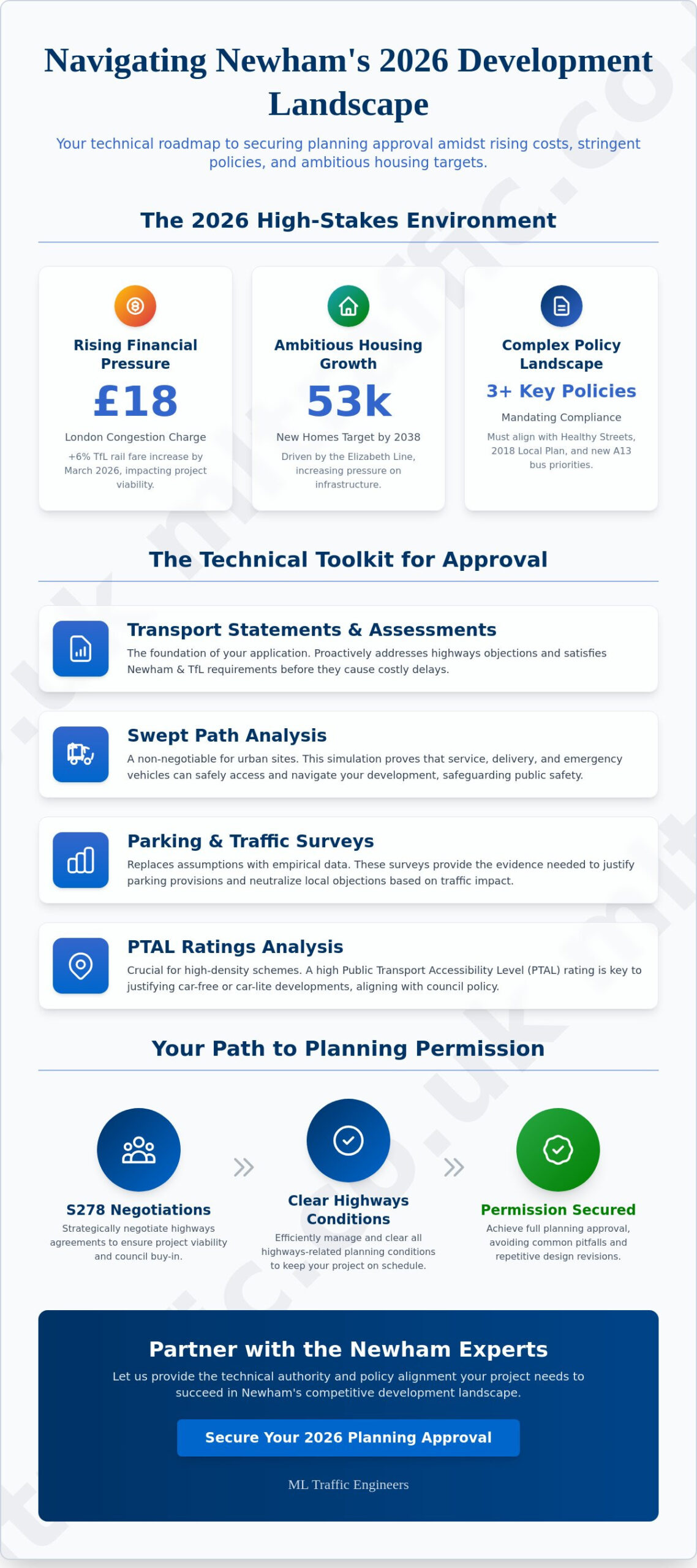
    With the London Congestion Charge rising to £18 and TfL rail fares increasing by 6% in March 2026, the financial and regulatory stakes for Newham developments have never been higher. You’re likely facing intense pressure to align with the Mayor’s Healthy Streets objectives while navigating the 2018 Local Plan policies that remain in force during the current examination period. Many developers find that highways objections lead to costly delays and repetitive design revisions. Engaging expert Transport Planning Consultants Newnham is the most effective way to address these technical challenges early in the application process.

    We understand that managing complex London-specific transport policies, such as the latest bus priority measures on the A13, can feel like a moving target. This article provides a clear roadmap for securing your 2026 planning approvals through technical precision and policy alignment. You’ll learn how to leverage data-driven Transport Statements, Swept Path Analysis, and detailed Parking Surveys to satisfy council requirements. We’ll also cover the essential steps for successful S278 negotiations and the clearance of highways-related planning conditions to keep your project on schedule.

    Key Takeaways

    • Gain insights into Newham’s 2026 development landscape and the impact of the Elizabeth Line on high-density residential planning.
    • Learn the technical requirements for successful submissions, including the role of Swept Path Analysis and PTAL ratings in urban environments.
    • Discover how Transport Planning Consultants Newnham use empirical Traffic Surveys to neutralize local objections and provide data to highways authorities.
    • Explore the strategic process for negotiating with Newham Council to clear highways-related conditions and avoid common planning pitfalls.
    • Understand how a fully-managed approach to Transport Assessments and Travel Plans ensures consistent compliance with evolving London-specific regulations.

    The Role of Transport Planning in Newham’s 2026 Development Landscape

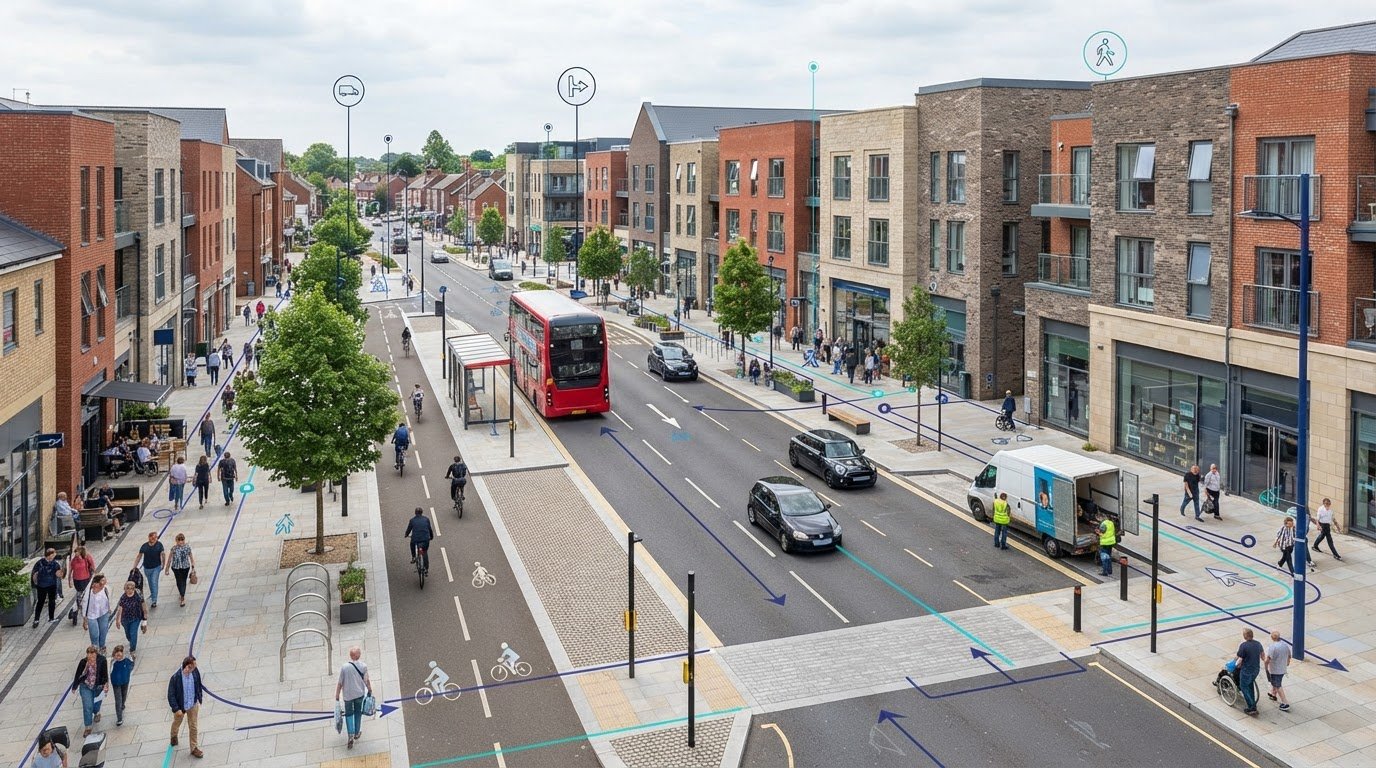
    Newham is currently the epicenter of East London’s high-density regeneration, with Stratford and Canning Town serving as primary hubs for mixed-use growth. This rapid expansion places immense pressure on the borough’s infrastructure, particularly along the critical A13 and A406 corridors. Effective transport planning is no longer optional; it’s the foundation of any successful planning application in this region. Developers must account for the A13’s evolving traffic patterns and the increased demand for sustainable connectivity to avoid highways objections.

    To better understand this concept, watch this helpful video:

    The Elizabeth Line has fundamentally altered Newham’s development potential, driving the borough’s target to deliver between 51,425 and 53,784 new homes by 2038. As Transport Planning Consultants Newnham, we recognize how this shift creates a high-stakes environment where precision is a functional necessity. You need technical authority to balance these ambitious housing targets against the strict highways requirements set by Newham Council. We provide the data-driven advice required to manage these logistical pressures from the initial assessment through to project completion.

    Navigating Newham Council’s Local Plan and Transport Policies

    While a new Local Plan was submitted in July 2025 and remains under examination, the 2018 Local Plan policies are still the primary legal framework for 2026 applications. These policies prioritize reducing private vehicle dependency to improve local air quality. In high PTAL areas, Newham Council increasingly mandates car-free or car-lite developments. Your project must also align with the £1,167,000 allocated for the 2026/27 Safer Corridors and Neighbourhoods program. Additionally, the A13 bus priority order (GLA/2026/0004) coming into force in 2026 will change access slip road permissions at Canning Town, requiring updated technical surveys for nearby sites.

    Why Transport Statements are Essential for Newham Applications

    Determining whether your project needs a Transport Statement or a full Assessment depends on specific size thresholds and local triggers. In areas like East Ham and Beckton, even smaller residential schemes often require a formal report due to existing parking stress. A robust Transport Statement prevents costly delays by addressing highways objections before they reach the committee stage. Our team manages the technical surveys and assessments needed to clear highways-related planning conditions efficiently. We focus on providing a policy-compliant document that satisfies both the borough and Transport for London requirements.

    Technical Requirements: From Swept Path Analysis to PTAL Ratings

    Technical precision is the cornerstone of any successful planning application in East London. For projects within the London Borough of Newham, the technical toolkit must address specific spatial constraints and high-density requirements. As Transport Planning Consultants Newnham, we prioritize data accuracy to reduce regulatory pressure on our clients. This technical lexicon is essential for communicating with local authorities and adhering to the professional standards advocated by the Transport Planning Society. Our approach ensures that every design iteration meets the rigorous safety and functional benchmarks expected by council highways officers.

    Swept Path Analysis is a computer-aided simulation of vehicle movement. It allows us to visualize how specific vehicles navigate a proposed site layout. In high-stakes urban environments, this simulation acts as a vital guardian of public safety by ensuring that emergency and service vehicles can operate without obstruction. By identifying potential conflicts during the design phase, we help developers avoid the high costs of post-submission revisions.

    Ensuring Access with Swept Path Analysis (SPA)

    Newham’s urban fabric, particularly in areas undergoing intense regeneration like Stratford, often features tight site boundaries and complex street furniture. We use SPA to prove that fire tenders and refuse vehicles can access and exit a site safely in forward gear. We model these movements using the standard London 12.2m refuse vehicle template to ensure full compliance with Newham’s waste management requirements. This level of detail prevents design errors before the first brick is laid. If you are currently refining a site layout, our team can provide detailed Swept Path Analysis to validate your access strategy and secure technical approval.

    Understanding PTAL and Sustainable Transport Links in Newham

    Public Transport Accessibility Level (PTAL) is a standard method used across London to grade the connectivity of a specific location. In Newham, your site’s PTAL rating directly dictates the maximum number of parking spaces permitted under the London Plan and the borough’s Local Plan. Sites located near major interchanges such as West Ham, Plaistow, or Royal Victoria typically achieve high PTAL scores. These high ratings often necessitate a car-lite or car-free approach to align with the council’s sustainability mandates. We analyze existing infrastructure and planned improvements to provide a clear accessibility profile for your development. This proactive analysis ensures your application meets the professional integrity required for 2026 approvals.

    Transport Planning Consultants Newnham: Securing 2026 Planning Approvals

    Data-Driven Success: Parking and Traffic Surveys in East London

    Empirical data serves as the ultimate shield against anecdotal objections from local residents during the planning process. In high-density boroughs like Newham, community groups often cite a perceived lack of parking to block new developments. Without technical evidence, these objections can stall your project indefinitely. As Transport Planning Consultants Newnham, we manage the full lifecycle of data collection to provide a factual basis for your application. This approach aligns with the official government guidance on Transport Assessments, which emphasizes the need for proportionate and robust evidence to support development proposals.

    Our team understands that precision is a functional necessity in the London regulatory environment. We don’t just collect numbers; we provide the technical authority required to justify your project’s impact on the local highway network. By delivering comprehensive Traffic Surveys, we reduce the logistical and regulatory pressures on developers, ensuring a smoother path toward 2026 approvals.

    Applying the Lambeth Methodology to Newham Parking Surveys

    The Lambeth Methodology is the industry-recognized standard for conducting parking stress tests across London. We utilize this framework to assess overnight parking demand within a 200-meter walking distance of a site. In residential areas like Beckton, these surveys are typically conducted between 00:30 and 05:30 on two separate weekday nights. This specific timing ensures we capture the peak demand for resident parking, providing a credible snapshot of local capacity.

    Interpreting these results is critical for your planning submission. If the data shows that parking stress exceeds 85%, planners may require specific mitigation strategies or a transition to car-lite development. We provide detailed Parking Surveys for London Planning Applications to help you navigate these technical thresholds. Our reports present clear, indisputable data that reduces the risk of highways-related refusals.

    Traffic Data Collection for High-Density Developments

    Busy corridors like the A13 require a sophisticated mix of Manual and Automated Traffic Counts (ATC). ATC sensors provide continuous data over seven days, capturing volume and speed trends that a manual count might miss. For sites near the Royal Docks, junction turning counts are essential to identify existing bottlenecks and peak-hour constraints. This data doesn’t just support your statement; it informs the entire design of your scheme.

    Accurate traffic data is also a prerequisite for our Swept Path Analysis services in London. By understanding the real-world flow of traffic, we can simulate vehicle movements more effectively. This integrated approach ensures that your technical simulations work in tandem to satisfy Newham’s highways department. We prioritize precision at every stage to ensure your development remains safe, compliant, and ready for execution.

    Overcoming Highways Objections and Securing Planning Permission

    Negotiating with Newham Council’s highways department requires a sequential and highly organized approach. Highways objections are often the primary cause for planning refusals in East London. As Transport Planning Consultants Newnham, we act as a vital bridge between your development goals and the borough’s strict regulatory standards. We understand the unique pressures placed on the A13 and A406 corridors, where traffic volume and safety are constant priorities. Our role is to provide the technical authority needed to address these concerns before they lead to costly delays.

    Professional integrity is essential when presenting impact mitigation strategies to the council. We don’t just identify problems; we propose actionable solutions that satisfy both the developer and the highways officer. This collaborative process ensures that your Transport Assessment London remains a robust and defensible document throughout the consultation period. By maintaining a focus on precision and adherence to standards, we reduce the logistical pressures on your project team.

    Addressing Junction Capacity and Traffic Impact

    Junction capacity analysis protects local road safety by ensuring that new developments do not create hazardous levels of congestion or impede emergency vehicle response times. We model traffic flow at key intersections across Newham to prevent local network saturation. This modelling is particularly critical for sites near the Canning Town intersection or the Royal Docks, where existing capacity is already limited. When our analysis identifies potential bottlenecks, we develop comprehensive mitigation strategies. These may include physical road improvements or the implementation of Travel Plan incentives to encourage sustainable transport choices. Addressing these impacts early reduces the risk of highways-related objections and demonstrates a clear commitment to civic responsibility.

    Negotiating S278 Agreements and Highway Design

    Securing planning permission is often just the first step in the regulatory journey. If your development requires off-site works on the public highway, you’ll need to negotiate a Section 278 agreement. These agreements are legally binding and require technical designs that meet the rigorous standards of Newham’s highways officers. We manage the transition from initial planning approval to the detailed Highway Design S278 & S38 phase. Our team ensures that every design adheres to industry benchmarks and legislative requirements. This precision is a functional necessity to avoid delays during the technical approval process. We prioritize constant accessibility and rapid response to keep your project moving forward. If you’re facing highways objections or need support with your submission, contact our expert consultants to secure your 2026 planning approval.

    ML Traffic Engineers: Your Comprehensive Partner in Newham

    Securing planning approval in East London’s high-pressure environment requires more than just technical data; it demands a partner who understands the urgency of development cycles. We position ourselves as a dependable, highly organized expert for developers who cannot afford delays. As Transport Planning Consultants Newnham, we provide a consistent sense of readiness through our commitment to 24/7 availability for urgent planning deadlines. This constant accessibility ensures that unexpected highways queries don’t derail your submission timeline. We take immense pride in our adherence to standards, acting as a vital guardian of public safety while reducing the regulatory pressure on your team.

    Choosing a single-source partner for surveys, analysis, and reporting streamlines the entire application process. We manage full project lifecycles from initial inception to final approval, ensuring that data collected during a Parking Survey flows seamlessly into your Transport Statement. This integrated approach eliminates the communication gaps that often occur when using multiple providers. Our technical authority allows us to provide expert testimony and support throughout the entire project lifecycle, ensuring your development remains compliant with evolving 2026 standards.

    Our Rapid Response Approach to Technical Reporting

    The East London property market moves at a relentless pace. We meet these demands by prioritizing clarity and the rapid delivery of information. Our rapid response approach isn’t just about speed; it’s about the technical excellence required to satisfy Newham’s highways officers on the first attempt. We manage all liaison with the highways authority on your behalf, removing the logistical burden from your shoulders. Our team uses a direct and functional structure in every report to ensure readers grasp the scope of the offering quickly. This efficiency is a hallmark of our brand promise, allowing you to focus on construction while we handle the regulatory complexities.

    Fully Managed Transport Solutions from Inception to Approval

    Our service begins with initial site feasibility and continues through to the delivery of policy-compliant London Travel Plans. We’ve successfully navigated the intricate regional regulations of Newham and surrounding boroughs, securing approvals for high-density residential and mixed-use schemes. These success stories stem from our ability to pair technical lexicon with tailored support for every client. We understand that every site has unique constraints, from PTAL limitations to complex access requirements. By providing an all-encompassing, fully-managed service, we act as a comprehensive partner rather than a simple survey provider. If you’re ready to move your project forward with precision and reliability, contact ML Traffic for a professional fee proposal today.

    Secure Your 2026 Planning Approval with Technical Authority

    Success in Newham’s high-density development landscape depends on the ability to transform complex regulatory requirements into actionable technical data. We’ve explored how empirical evidence from Parking Surveys and Traffic Surveys neutralizes anecdotal objections. We also highlighted the necessity of Swept Path Analysis to ensure safe site access for emergency and refuse vehicles. These technical foundations don’t just support your application; they protect your project from the high costs of design revisions and planning delays.

    Founded in 2014 with deep London expertise, ML Traffic Engineers provides the precision required to navigate the borough’s strict highways standards. We are specialists in Transport Statements and technical simulations with a proven track record of successful applications within the London Borough of Newham. As your dedicated Transport Planning Consultants Newnham, we manage the full lifecycle of highways liaison to reduce your regulatory burden. Our team delivers the data-driven reports you need to clear planning conditions efficiently.

    Contact ML Traffic Engineers for expert Transport Planning in Newham and secure a policy-compliant submission today. We look forward to helping you move your development from the planning stage to successful execution.

    Frequently Asked Questions

    Do I need a Transport Statement for a small development in Newham?

    You typically need a Transport Statement if your development falls below the threshold for a full Assessment but still impacts the local highway. Newham Council often requires these reports for residential schemes in areas with high parking stress or near busy junctions. Providing this document early helps prevent highways objections and demonstrates that your project complies with the 2018 Local Plan requirements.

    How long does it take to complete a Transport Assessment in East London?

    A standard Transport Assessment usually takes four to six weeks to complete from the initial site visit to the final report. This timeline accounts for the necessary data collection, such as seven day traffic counts or overnight parking surveys. As Transport Planning Consultants Newnham, we prioritize a rapid response approach to meet urgent planning deadlines and keep your project on schedule.

    What is the Lambeth Methodology and why is it used in Newham?

    The Lambeth Methodology is the industry standard for conducting parking stress surveys across London. Newham highways officers require this specific framework to assess the available on-street parking capacity within a 200 meter radius of your site. It provides the empirical data needed to prove that a new development won’t lead to local network saturation or compromise road safety for existing residents.

    Can a Travel Plan help secure planning permission for a site with low parking?

    Yes, a Travel Plan is an essential tool for securing permission for car-lite or car-free developments. It outlines specific incentives and measures to encourage residents to use public transport, cycling, and walking. This document directly supports the Mayor’s Transport Strategy and helps satisfy Newham’s sustainability targets by reducing the overall dependency on private vehicles for daily travel.

    How much does a Swept Path Analysis cost for a Newham project?

    The cost of a Swept Path Analysis depends on the complexity of the site layout and the number of vehicle types modeled. We provide tailored fee proposals for each project to ensure you only pay for the technical precision your specific application requires. This approach ensures that your technical designs meet the rigorous standards of Newham’s highways officers without unnecessary expenditure.

    What happens if my development exceeds Newham’s parking standards?

    Exceeding parking standards often results in a formal highways objection and can lead to a planning refusal. In these cases, you must provide a robust Transport Assessment to justify the provision through site specific data and impact mitigation strategies. We help developers navigate these challenges by aligning their schemes with the latest London Plan mandates and borough specific policies.

    Do you provide traffic surveys for sites near the Elizabeth Line?

    We conduct comprehensive Traffic Surveys near all major transport hubs, including Elizabeth Line stations like Stratford and Custom House. These surveys capture the increased pedestrian and vehicle flow patterns unique to these high density areas. Our data-driven approach ensures that your development accounts for the specific infrastructure pressures found within the borough’s most active regeneration zones.

    How do ML Traffic Engineers handle urgent highways objections from the council?

    We utilize a rapid response protocol to address highways objections immediately upon receipt. Our team of Transport Planning Consultants Newnham reviews the technical basis of the objection and provides a defensible rebuttal or a revised design strategy. This constant accessibility reduces the regulatory pressure on developers and ensures that projects move toward execution without avoidable delays.

    Michael Lee

    Article by

    Michael Lee

    Transport planner with over 35 years' experience.

    Disclaimer

    The content on mltraffic.co.uk, including all technical articles, guides, and resources, is provided for general informational and educational purposes only. It is not intended to constitute professional advice in traffic engineering, transportation planning, development approvals, or any other technical or legal field.
    While ML Traffic Engineers makes every reasonable effort to ensure the accuracy, completeness, and timeliness of the information published, we do not provide any warranties or representations (express or implied) regarding its reliability, suitability, or availability for any particular purpose. Any reliance you place on the content is strictly at your own risk.
    In no event shall ML Traffic Engineers, its directors, employees, authors, or affiliates be liable for any direct, indirect, incidental, special, consequential, or punitive damages (including, without limitation, loss of profits, data, or business opportunities) arising out of or in connection with the use of, or inability to use, any information provided on this website.
    The articles and guides on this site are not a substitute for engaging a qualified, professional traffic engineer to assess your specific project requirements. For tailored advice, compliance assessments, or traffic engineering services, please contact a competent professional.
    This disclaimer may be updated from time to time without notice. By accessing or using this website, you agree to be bound by the most current version of this disclaimer.