
Tag: Hillingdon

  • Transport Planning Consultant Hillingdon: Navigating 2026 Planning Approvals

    Transport Planning Consultant Hillingdon: Navigating 2026 Planning Approvals

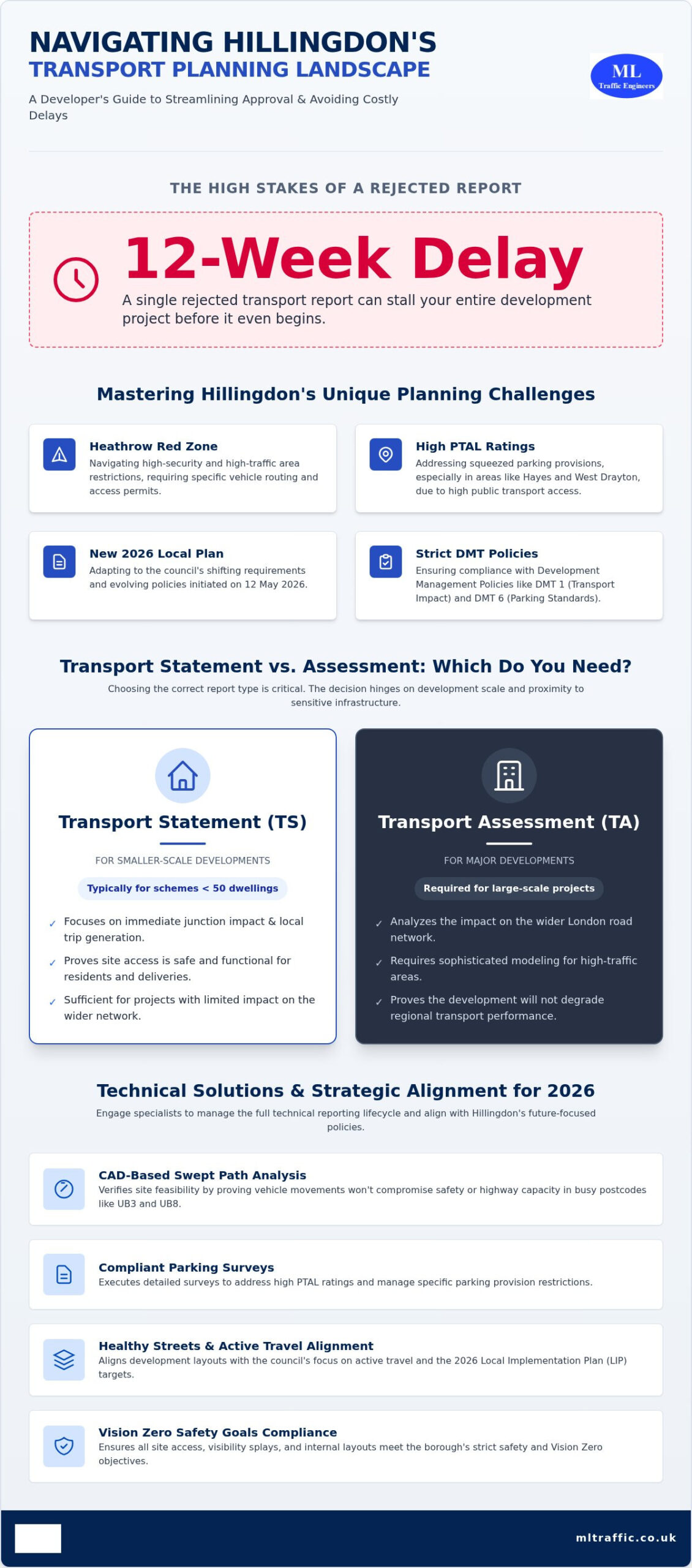
    A single rejected transport report in Hillingdon can trigger a 12-week delay, effectively stalling a development before the first spade hits the ground. You understand that the borough’s planning landscape is exceptionally demanding, especially when navigating the intricate Red Zone restrictions around Heathrow or managing high PTAL ratings that squeeze parking provision. Securing a successful outcome requires more than just a basic assessment; it demands technical precision and an unwavering commitment to regulatory standards. By engaging a specialist hillingdon transport planning consultant, you can mitigate these risks and streamline your path to approval through expert data analysis and robust technical reporting.

    We recognize the pressure of meeting the council’s shifting requirements as they transition toward the new Local Plan initiated on 12 May 2026. This article provides the clarity you need to master Hillingdon’s complex regulations, from DMT 1 transport impact management to DMT 6 parking standards. You’ll learn how to leverage CAD-based Swept Path Analysis and detailed Transport Statements to satisfy planning officers and avoid costly setbacks. We’ll preview the essential strategies for 2026, ensuring your project remains compliant, safe, and ready for execution.

    Key Takeaways

    • Distinguish between Transport Statements and full Assessments to ensure your submission aligns with Hillingdon’s 2020 Development Management Policies and the 2026 Local Plan updates.
    • Utilize CAD-based Swept Path Analysis to verify site feasibility and prove that vehicle movements won’t compromise safety or highway capacity in busy postcodes like UB3 and UB8.
    • Execute compliant Parking Surveys to address high PTAL ratings and manage the specific parking provision restrictions found in Hayes and West Drayton.
    • Align your development layout with the “Healthy Streets” approach and the 2026 Local Implementation Plan targets to satisfy the council’s focus on active travel and Vision Zero safety goals.
    • Engage a specialist hillingdon transport planning consultant to manage the full technical reporting lifecycle and eliminate the risk of 12-week delays caused by rejected planning documents.

    The Role of a Hillingdon Transport Planning Consultant in 2026

    In the postcodes of UB3, UB4, and UB8, the scope of a hillingdon transport planning consultant has transitioned into a highly technical advisory role. By 2026, standard traffic counts aren’t enough to satisfy planning officers. Instead, developers need to demonstrate a deep understanding of the transportation planning process to navigate the borough’s evolving infrastructure. Precision in these early stages is the only way to ensure your project moves forward without regulatory friction.

    To understand the local context and resident concerns regarding transport and planning, watch this recent session from the Hillingdon London Council:

    Achieving compliance involves a dual-lens approach that aligns development goals with the Mayor’s Transport Strategy and Hillingdon’s Local Implementation Plan. This ensures submissions don’t just meet technical benchmarks but also support borough-wide objectives like Vision Zero. Professional reporting from ML Traffic Engineers UK is a critical tool for mitigating the risk of Section 106 or 278 delays. Without precise data, developers often face unexpected costs and timeline extensions that could’ve been avoided at the inception stage.

    Navigating Hillingdon’s Unique Infrastructure

    Hillingdon’s geography presents specific challenges for site access, particularly along the A40 Western Avenue and the M4 corridor. High traffic volumes in Uxbridge and Hayes town centres require sophisticated modeling to prove that new developments won’t cause gridlock. Additionally, your consultant must balance site requirements with Hillingdon’s “Air Quality Focus Areas,” where emissions and congestion are under intense scrutiny. We use data-driven strategies to ensure your project remains viable even within these restricted zones.

    When to Engage a Transport Consultant

    Early engagement during the pre-application stage allows us to identify potential “showstoppers,” such as inadequate visibility splays or restricted access points, before they become permanent obstacles. If you’ve already submitted and received a Highways Authority objection, we provide the technical data needed to resolve disputes and secure approval. The Heathrow Red Zone is a designated high-security and high-traffic area where specific vehicle routing restrictions and access permits are mandatory to maintain operational safety around the airport. The team at ML Traffic Engineers UK is ready to manage these high-stakes requirements from day one.

    Transport Statements vs. Assessments: Which Does Your Project Need?

    Hillingdon Council applies specific criteria to decide if a site needs a Transport Statement or a full Assessment. Getting this choice wrong leads to 12-week delays and wasted application fees. A hillingdon transport planning consultant ensures your project starts with the correct technical foundation by identifying these requirements during the feasibility stage. This decision hinges on the development scale and its proximity to sensitive infrastructure identified in Hillingdon’s Local Implementation Plan (LIP). While smaller projects focus on local safety, larger developments must prove they won’t degrade the performance of the wider London road network.

    The Transport Statement (TS) for UB3 Developments

    For schemes under 50 dwellings in UB3 or surrounding areas, a Transport Statement is typically sufficient. This report focuses on immediate junction impact and local trip generation. It proves that the site access is safe and functional for residents and delivery vehicles alike. We analyze how your site interacts with local bus routes and pedestrian paths to ensure full compliance with Hillingdon’s 2020 Development Management Policies. You can find more detail in our Transport Statement London Guide. These reports are concise but must be technically accurate to avoid council pushback.

    The Full Transport Assessment (TA) Framework

    Major commercial hubs or large residential blocks near Uxbridge town centre or the M4 require a full Transport Assessment. These involve complex junction capacity modelling to assess the wider network impact. The council scrutinizes these reports to ensure no negative effect on highway safety or capacity. Data requirements for projects near Heathrow are particularly stringent, often requiring multi-modal analysis to account for airport-related traffic. Our Transport Assessment London Guide covers the data requirements for these high-impact zones. We use this framework to demonstrate that your project can thrive without causing gridlock.

    Travel Plans act as a strategic companion to both documents. They outline specific measures to encourage walking, cycling, and public transport use among future occupants. In 2026, Hillingdon prioritizes developments that actively reduce private car dependency, making a robust Travel Plan a vital component of your planning submission. These plans help bridge the gap between technical traffic data and the borough’s long-term sustainability goals. If you need clarity on your project’s specific requirements, consult our technical specialists for an initial assessment of your site’s needs.

    Technical Analysis for Hillingdon: Swept Path and Parking Survey Requirements

    Technical precision is the backbone of any successful planning application in Hillingdon. Planning officers require data that stands up to rigorous scrutiny, especially when your site is influenced by the “Heathrow Factor.” This unique constraint involves managing height and timing restrictions for technical surveys to ensure that data reflects typical operational conditions around the airport. A hillingdon transport planning consultant must also utilize TRICS data to justify trip generation figures. We carefully adjust these models based on Public Transport Access Levels (PTAL) to ensure the proposed traffic impact is realistic for the specific UB postcode zone.

    Swept Path Analysis for Fire Tenders and Refuse Vehicles

    Proving site feasibility requires more than a standard drawing; it demands CAD-based simulation. We provide specialized Swept Path Analysis Services to demonstrate that large vehicles can navigate your site without compromising safety. Hillingdon Council utilizes specific refuse vehicle dimensions for UB-specific templates. Failure to use these exact measurements often leads to immediate report rejection. This technical analysis is essential for several reasons:

    • Ensuring fire tenders can access narrow residential mews in Ruislip or Northwood.
    • Verifying that refuse vehicles can enter, turn, and exit the site in a forward gear.
    • Validating delivery bay functionality for commercial hubs near the M4.

    Parking Surveys: The Lambeth Methodology in Hillingdon

    Parking provision remains a point of contention in Hayes and West Drayton. While high PTAL ratings might suggest a need for lower parking ratios, the council remains wary of “overspill” into existing residential streets. We address these concerns by conducting overnight parking surveys using the recognized Lambeth Methodology. This process involves a detailed count of available on-street spaces within a 200-metre radius of the site during periods of peak residential demand.

    This data-driven evidence is vital. It allows us to prove that the surrounding infrastructure can absorb any potential overflow, which can help justify a lower parking ratio for your development. In 2026, Hillingdon officers expect this level of transparency to protect local residents from increased parking stress. We ensure all surveys are conducted during neutral periods, avoiding school holidays or major local events to provide the most accurate snapshot of the area’s parking capacity. By delivering this level of detail, we reduce regulatory pressure and move your project closer to approval.

    Strategic Compliance: Aligning with Hillingdon’s Local Implementation Plan (LIP)

    Hillingdon’s Local Implementation Plan (LIP) serves as the technical roadmap for delivering the Mayor’s Transport Strategy at a borough level. For developers, alignment with LIP targets for 2026 is a prerequisite for planning success. These targets prioritize sustainable travel and safety across all new infrastructure. A hillingdon transport planning consultant integrates these strategic goals into your site design from the outset. This proactive approach reduces the risk of friction with Transport for London (TfL) or council auditors. We ensure your submission doesn’t just meet local rules but supports the wider London network goals.

    Modern car park design must also incorporate Electric Vehicle (EV) charging and high-quality cycle storage. Hillingdon’s 2026 standards require a specific percentage of active and passive EV charging points. We help you balance these requirements with the space constraints of your site, ensuring full compliance without sacrificing operational efficiency. Our technical reports provide the data needed to justify your provision levels to the Highways Authority.

    Sustainable Transport and Travel Plans

    Hillingdon requires robust Travel Plans for any significant new workplace or school development. These documents are essential for incentivizing non-car modes of transport, particularly in areas with PTAL ratings of 4 to 6 like Uxbridge and Hayes. A well-crafted plan outlines clear targets for reducing single-occupancy vehicle trips and provides a monitorable framework for success. You can learn more about this in our Travel Plan Consultants Guide. These plans act as a long-term commitment to sustainable growth.

    Active Travel Infrastructure

    Meeting Hillingdon’s cycle parking standards for 2026 requires more than just installing racks. You must provide secure, accessible, and well-lit storage that caters to various bicycle types, including cargo bikes. We conduct pedestrian comfort levels and accessibility audits to prove your site is inclusive for all users. Hillingdon’s 2026 LIP prioritises bus reliability near Hayes by implementing priority measures that your site access design must not impede. This ensures that new developments don’t negatively impact the efficiency of the public transport network.

    To ensure your project aligns with these complex strategic requirements, contact our expert team for a comprehensive planning review.
    Transport Planning Consultant Hillingdon: Navigating 2026 Planning Approvals

    Professional Traffic Engineering Solutions for Hillingdon Developers

    ML Traffic Engineers UK acts as a strategic partner to simplify the complex Hillingdon planning process for developers and architects. As a dedicated hillingdon transport planning consultant, we provide the technical authority needed to navigate the borough’s unique logistical landscape. Our team understands the specific pressures of the Heathrow corridor and the M4 logistics network. Whether you are coordinating staff transport with EC Minibus or managing freight movements, we ensure that your development’s transport strategy is both realistic and compliant with the latest 2026 standards. We deliver precision-engineered reports that withstand scrutiny from both local planning officers and Transport for London.

    Our “Total Managed Solution” covers every stage of the project lifecycle from inception to completion. We manage everything from the initial site survey and data collection to final Highways Authority approval. By providing a single point of contact for Transport Statements, Assessments, and Swept Path Analysis, we reduce the administrative burden on your team. This integrated approach ensures that all technical reporting is consistent and meets the high standards required for modern submissions. We prioritize speed without compromising on accuracy. This is essential for maintaining your project’s momentum and avoiding the 12-week delays often associated with rejected reports.

    Expertise Across All Hillingdon Project Types

    The team at ML Traffic Engineers UK supports a wide range of developments across the UB postcodes. Our experience includes residential blocks, commercial offices, and industrial warehouses in Hayes, Uxbridge, and West Drayton. Our specialists collaborate directly with TfL and Hillingdon Council on your behalf to resolve potential objections before they lead to formal refusals. We’ve a proven track record of securing approvals for complex urban sites where space is limited and traffic demands are high. By leveraging our local knowledge, we anticipate council requirements and address them proactively in our technical submissions. This proactive stance is what separates a successful application from one that gets stuck in the planning system.

    Secure Your Hillingdon Planning Approval

    Securing your planning approval starts with a robust technical foundation and a partner you can trust. You can request a quote for your Hillingdon Transport Statement or Assessment to see how our expertise aligns with your project goals. Our team maintains 24/7 readiness to support urgent planning deadlines. This ensures that your application stays on track even when timelines are tight. We take pride in our ability to deliver high-quality results under pressure while adhering to all industry benchmarks and legislative requirements. Contact ML Traffic Engineers UK today for a bespoke transport planning quote.

    Secure Your Hillingdon Development Success in 2026

    Navigating the intricate planning landscape of West London requires more than just meeting basic criteria; it demands a proactive approach to technical excellence. By integrating the specific technical analysis and strategic compliance measures discussed, you ensure your project remains resilient against regulatory shifts. Whether you are managing high-density residential schemes or logistics hubs near the Heathrow corridor, the precision of your data is what secures the council’s confidence. Engaging a specialized hillingdon transport planning consultant allows you to mitigate risks and streamline the path to final Highways Authority approval.

    As London planning specialists since 2014, ML Traffic Engineers UK provides the unwavering reliability needed for high-stakes urban projects. We deliver a comprehensive service that covers every detail, from expert CAD-based technical analysis to a deep understanding of Hillingdon LIP 2026 targets. Our team is ready to help you navigate these requirements with speed and technical authority. Get a Professional Quote for Your Hillingdon Transport Report and take the first step toward a successful planning outcome today. Your project’s future depends on the precision of today’s technical reporting.

    Frequently Asked Questions

    Do I need a Transport Statement for a small development in Hillingdon?

    Hillingdon Council requires a Transport Statement for developments that fall below the thresholds for a full Assessment but still impact the local highway. This usually includes residential schemes with fewer than 50 units or small commercial extensions. A hillingdon transport planning consultant can confirm the exact requirements during the pre-application stage to ensure your submission meets the 2020 Development Management Policies and avoids unnecessary delays.

    How long does Hillingdon Council take to review a Transport Assessment?

    Statutory consultation periods for major planning applications usually last between 13 and 16 weeks. However, the initial technical review by the Highways Authority often occurs within the first 21 days of the consultation period. Delays frequently occur if the technical data is incomplete or fails to meet the borough’s 2026 Local Implementation Plan targets. Providing a precise, compliant report from the outset is the most effective way to maintain your project timeline.

    What is the cost of a Swept Path Analysis for a Hillingdon project?

    The cost varies depending on the number of vehicle types and specific maneuvers required for your site layout. Factors such as the complexity of the access points and the need for multiple revisions also influence the total fee. We recommend checking with a qualified engineer who can provide a bespoke quote based on your architectural drawings and Hillingdon’s specific refuse vehicle templates. This ensures you receive a price tailored to your project’s unique technical demands.

    Why is PTAL important for my Hillingdon planning application?

    Public Transport Access Level (PTAL) is a standard London metric that determines the maximum allowable car parking provision for a site. Hillingdon uses PTAL scores to enforce the London Plan’s parking standards. Sites with high scores, such as those in Uxbridge or near Hayes & Harlington station, are restricted to lower parking ratios. Accurate PTAL assessment is vital for justifying your parking provision to planning officers and ensuring your site layout remains compliant.

    Can a Travel Plan help reduce my parking requirements in Hillingdon?

    A robust Travel Plan can support a case for reduced parking by demonstrating a commitment to sustainable transport modes. By outlining clear incentives for cycling, walking, and public transport use, you mitigate the perceived impact of lower on-site parking provision. Hillingdon Council prioritizes developments that align with the Mayor’s Transport Strategy, making a high-quality Travel Plan a persuasive tool during negotiations with the Highways Authority to secure officer support.

    What happens if my Transport Statement is rejected by Hillingdon Highways?

    A rejected report often triggers a formal objection, which can stall your planning application for 12 weeks or more. You’ll need to address the technical deficiencies identified by the council; this might involve conducting new traffic surveys or revising your site access design. Working with an experienced hillingdon transport planning consultant ensures that technical “showstoppers” are identified and resolved before the formal submission is made, protecting your development from costly administrative setbacks.

    Does Hillingdon Council follow the Lambeth methodology for parking surveys?

    Hillingdon Council generally accepts parking surveys conducted using the Lambeth methodology to assess on-street parking stress. This involves two overnight surveys between 00:30 and 05:30 on neutral weekday nights to capture peak residential demand. The data must prove that any potential overspill from your development won’t exceed 85% of the total available on-street capacity within a 200-metre walking distance of the site, ensuring local residents are not negatively impacted.

    What are the specific refuse vehicle dimensions for Hillingdon SPA?

    Hillingdon requires Swept Path Analysis to use a specific refuse vehicle template, typically a four-axle 11.22-metre Mercedes Econic or a similar approved model. The vehicle must be able to enter and leave the site in a forward gear while maintaining a 0.5-metre safety clearance from all boundaries. Using generic vehicle dimensions is a common reason for report rejection, so it’s essential to use the borough’s approved CAD templates for all vehicle movement simulations.

    Michael Lee

    Article by

    Michael Lee

    Transport planner with over 35 years' experience.

    Disclaimer

    The content on mltraffic.co.uk, including all technical articles, guides, and resources, is provided for general informational and educational purposes only. It is not intended to constitute professional advice in traffic engineering, transportation planning, development approvals, or any other technical or legal field.
    While ML Traffic Engineers makes every reasonable effort to ensure the accuracy, completeness, and timeliness of the information published, we do not provide any warranties or representations (express or implied) regarding its reliability, suitability, or availability for any particular purpose. Any reliance you place on the content is strictly at your own risk.
    In no event shall ML Traffic Engineers, its directors, employees, authors, or affiliates be liable for any direct, indirect, incidental, special, consequential, or punitive damages (including, without limitation, loss of profits, data, or business opportunities) arising out of or in connection with the use of, or inability to use, any information provided on this website.
    The articles and guides on this site are not a substitute for engaging a qualified, professional traffic engineer to assess your specific project requirements. For tailored advice, compliance assessments, or traffic engineering services, please contact a competent professional.
    This disclaimer may be updated from time to time without notice. By accessing or using this website, you agree to be bound by the most current version of this disclaimer.
  • Transport Planning Consultants Hillingdon: A Developer’s Guide to 2026 Approvals

    Transport Planning Consultants Hillingdon: A Developer’s Guide to 2026 Approvals

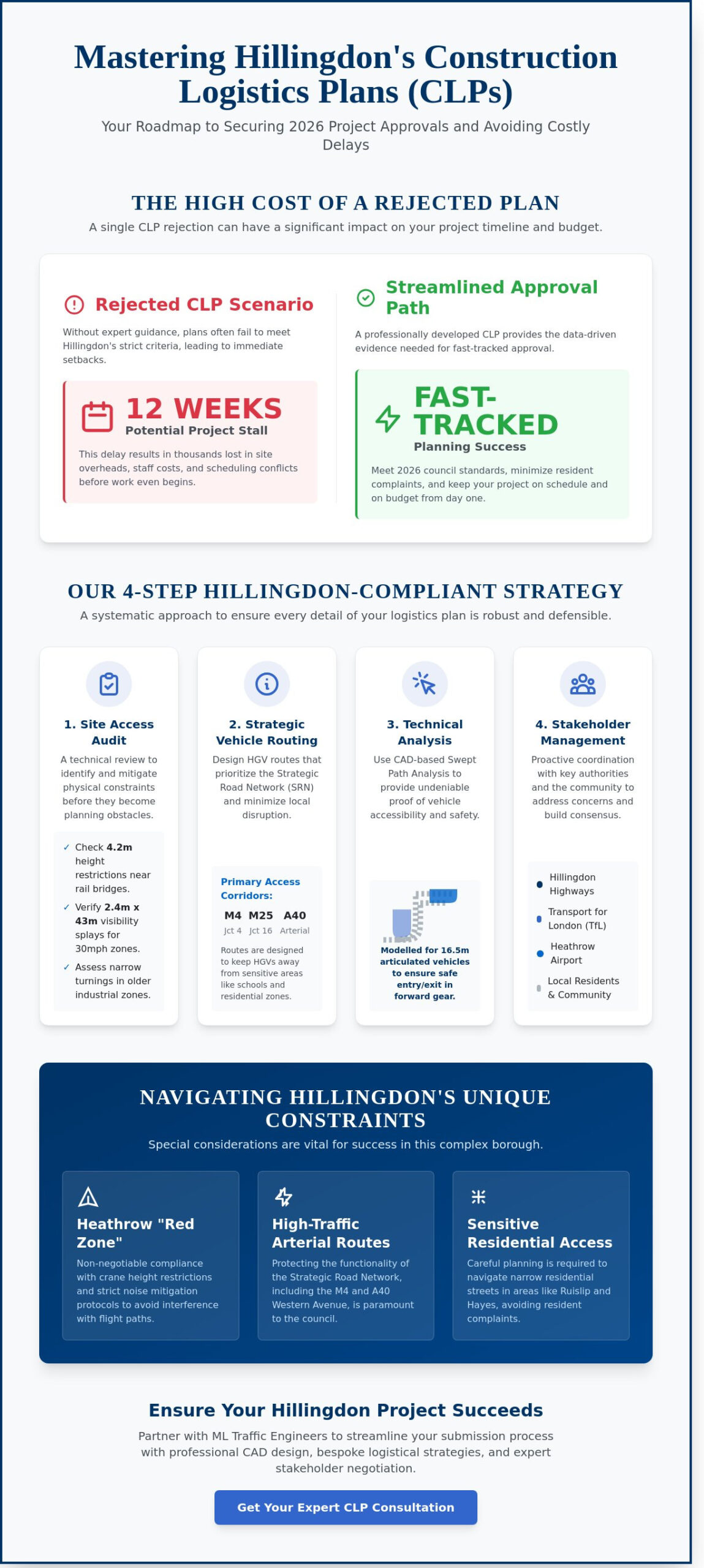
    A single rejected Construction Logistics Plan (CLP) can stall a Hillingdon development for up to 12 weeks, costing developers thousands in site overheads before a single brick is laid. Securing planning approval in the London Borough of Hillingdon is more complex than ever. You likely feel the pressure of balancing rigid Heathrow-related vehicle restrictions with the narrow residential access found in Ruislip or Hayes. Engaging professional transport planning consultants Hillingdon is now a procedural requirement to ensure your project meets strict 2026 council standards without costly delays.

    We understand that the logistical burden of compliance can feel like an anchor on your project timeline. This guide provides the technical roadmap you need to master Hillingdon’s intricate traffic regulations and secure fast-tracked approvals. You’ll learn how to implement bespoke logistics strategies that minimise resident complaints and keep site deliveries moving efficiently. We’ll examine the essential components of 2026 planning success, including CAD-designed swept path analysis, Chapter 8 compliance, and total managed solutions for urban site safety.

    Key Takeaways

    • Understand why a robust Construction Logistics Plan (CLP) is critical for securing planning approval within Hillingdon’s strategic M4 and A40 road networks.
    • Discover how to navigate unique geographic constraints, including Heathrow “Red Zone” corridors and high-traffic arterial routes like the A40 Western Avenue.
    • Learn how technical Swept Path Analysis and comprehensive parking surveys provide the data-driven evidence required to justify site access and delivery bays.
    • Identify actionable steps for conducting site-specific access audits that ensure vehicle routing remains compliant and avoids sensitive residential zones.
    • See how engaging expert transport planning consultants Hillingdon can streamline your submission process through professional CAD design and bespoke logistical strategies.

    The Role of Construction Logistics in Hillingdon Planning Applications

    Construction Logistics Plans (CLP) act as the operational blueprint for managing vehicle movements during a project’s lifecycle. In Hillingdon, the council uses these plans to protect the functionality of the Strategic Road Network. Developers must demonstrate how they’ll handle heavy goods vehicle (HGV) routing without paralyzing the M4 or A40 corridors. Experienced transport planning consultants Hillingdon provide the technical data needed to prove that a site won’t compromise local safety or air quality.

    Securing approvals for 2026 starts with a proactive approach to site management. A robust CLP reduces the environmental footprint of a build by optimizing delivery schedules and reducing idling times. This is vital for meeting the borough’s strict noise and emission targets. By integrating these strategies early, developers avoid the costly delays associated with planning refusals or post-submission revisions. A deep understanding of construction logistics ensures that every vehicle movement is accounted for and justified.


    Hillingdon’s Local Plan and CLP Requirements

    The Hillingdon Local Plan Part 2, adopted in January 2020, mandates that all major developments submit a detailed CLP. Policy DMT 2 specifically requires developers to minimize the impact of construction on the transport network. For smaller sites, a simplified statement may suffice, yet the council often demands full compliance with Transport for London (TfL) 2021 guidance. Our role involves ensuring every vehicle movement aligns with these regulatory frameworks. You can learn more about our comprehensive approach on our what we do page.

    Key Stakeholders: TfL, Heathrow, and Local Residents

    Logistics in Hillingdon must account for the unique constraints of Heathrow Airport. Height restrictions for cranes and noise mitigation for flight paths are non-negotiable. Transport planning consultants Hillingdon lead the coordination with Hillingdon Highways and TfL to manage traffic flow through Hayes, Uxbridge, and Ruislip. Clear communication with local residents is essential. We help developers address community concerns regarding dust and congestion, turning potential opposition into a collaborative planning process. This level of precision is required to meet the borough’s 2026 sustainability goals and ensure project viability.

    Step-by-Step: Developing a Hillingdon-Compliant Logistics Strategy

    Securing 2026 project approvals starts with a site-specific access audit. This technical review identifies physical constraints like the 4.2-metre height restrictions found near specific Hillingdon rail bridges or narrow turnings in older industrial zones. Our transport planning consultants Hillingdon evaluate every entry point to ensure visibility splays meet the 2.4m x 43m standard required for 30mph zones. This precision prevents delays during the planning committee stage.

    Identifying Vehicle Routing and Site Access

    Strategic routing must prioritise the Strategic Road Network. We select approach routes from the M4 (Junction 4), M25 (Junction 16), and the A40 to minimise local disruption. A “preferred route” for Hillingdon HGV traffic is a specific path that directs heavy vehicles away from sensitive residential areas and onto the primary A-road network to protect local air quality and safety.

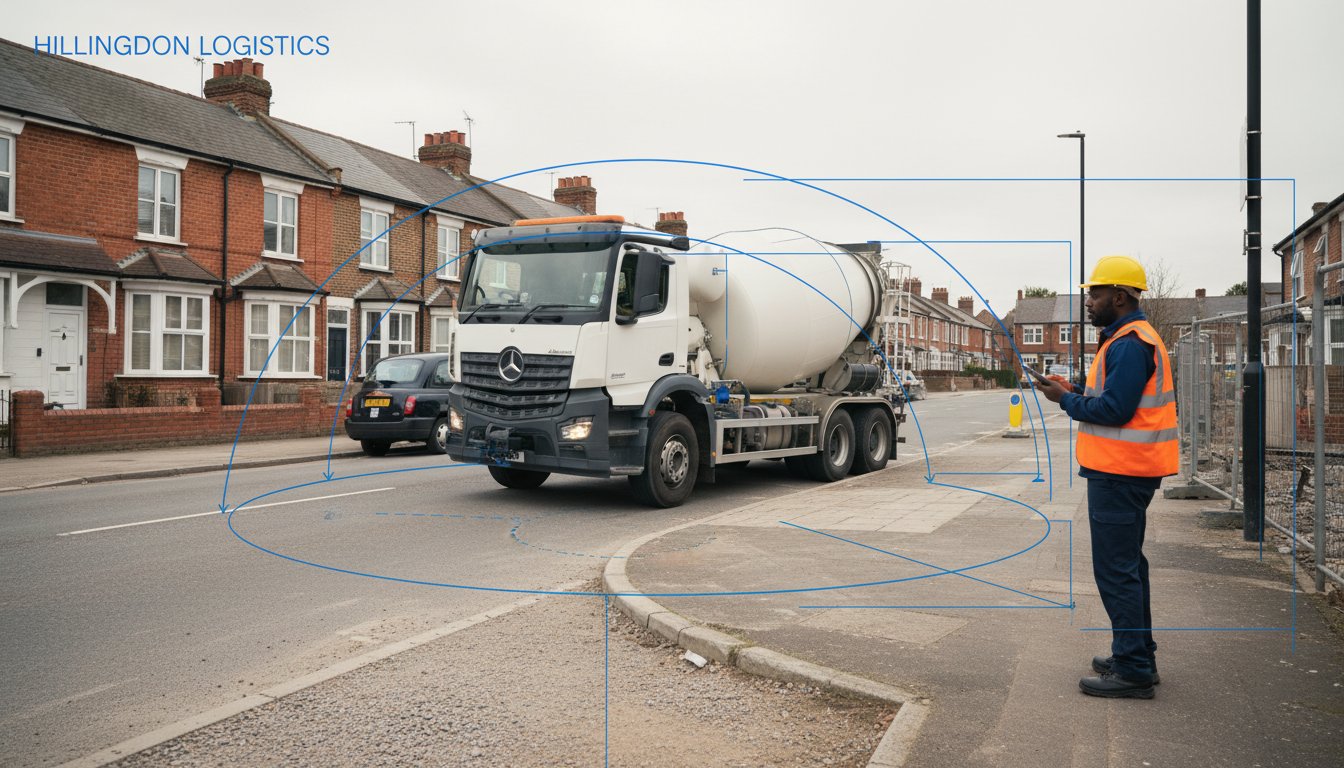
    Our teams use CAD software to perform swept path analysis. This ensures that a 16.5-metre articulated vehicle can enter and exit the site in a forward gear without mounting kerbs or endangering cyclists. This data aligns with the Hillingdon Council Planning Policy, which dictates strict controls on heavy vehicle movements near schools and air quality focus areas.

    Delivery Scheduling and Traffic Management

    A “just-in-time” delivery system prevents on-street idling, which is a major concern for the borough’s 2026 environmental targets. Scheduling must avoid peak traffic hours, typically 07:30 to 09:30 and 16:30 to 18:30. Coordinating with nearby construction sites is essential to manage cumulative impact. If three developments operate on the same narrow corridor, we synchronise arrival windows to prevent a bottleneck.

    We deploy Chapter 8 compliant traffic marshals, also known as banksmen, to manage the interface between pedestrians and plant machinery. Their role is to ensure that site gates remain closed when not in use and that vehicles are guided safely into loading bays.

    Monitoring isn’t a one-time task. It requires monthly reviews of GPS logs and delivery manifests to prove ongoing compliance. Transport planning consultants Hillingdon provide the final sign-off for Construction Logistics Plans (CLP), ensuring the project remains compliant with the London Plan 2021. This oversight prevents costly Stop Notices and maintains 24/7 site safety. Check our comprehensive traffic management services

    Transport Planning Consultants Hillingdon: A Developer’s Guide to 2026 Approvals

    Developing in Hillingdon requires a granular understanding of the borough’s infrastructure. The area serves as a primary gateway to London via the A40 Western Avenue, yet it maintains pockets of extreme residential sensitivity. Experienced transport planning consultants Hillingdon must balance these competing priorities to secure 2026 approvals. Major corridors like the Uxbridge Road see daily traffic flows exceeding 30,000 vehicles. This volume necessitates precise construction logistics. We utilize CAD design to simulate vehicle tracking for HGVs navigating the borough’s 7.5-tonne weight-restricted bridges and canal crossings. Failure to account for these physical barriers leads to costly delays and enforcement action from the London Borough of Hillingdon.

    The Heathrow Factor: Height and Timing Restrictions

    Proximity to Heathrow Airport introduces layers of regulatory oversight from BAA and NATS. Any site within the 13km safeguarding zone must comply with strict height restrictions for plant machinery. Developers must submit crane permit applications 8 weeks in advance for any equipment exceeding 10 metres. We manage this coordination to ensure site lighting and tall machinery don’t interfere with radar or flight paths. Hillingdon’s borough-wide Air Quality Management Area (AQMA) mandates that all Non-Road Mobile Machinery (NRMM) meets Stage IV emission standards. This is a non-negotiable requirement for all 2026 project starts near the airport corridors.

    Residential Sensitivity in Ruislip and Northwood

    North Hillingdon presents a different set of challenges. Narrow streets in Ruislip and Northwood aren’t designed for heavy construction traffic. We implement “last mile” strategies that utilize smaller delivery vehicles or consolidation centres to minimize local disruption. Noise and vibration mitigation is critical in these affluent residential areas. We secure Section 61 agreements to define working hours and noise limits, preventing legal challenges from the community. Our bespoke solutions include dedicated contractor parking plans. This prevents site staff from occupying local resident spaces, which is a primary cause of local planning objections. We prioritize 24/7 readiness to address any immediate logistical issues that arise during the build phase. Precision in these residential pockets maintains your reputation and keeps the project on schedule.

    Technical Analysis: Swept Path and Parking Surveys

    Securing a planning approval in Hillingdon for 2026 requires more than a well-written statement. It demands rigorous, data-driven evidence. Professional transport planning consultants Hillingdon provide the technical depth needed to satisfy the Highways Authority and avoid costly delays. In the current regulatory climate, guesswork isn’t an option. Every vehicle movement and every parking space must be backed by empirical analysis.

    Proving Manoeuvrability with Swept Path Analysis

    Swept Path Analysis (SPA) serves as the technical backbone of a credible Hillingdon Construction Logistics Plan (CLP). It isn’t just about showing where a truck goes; it’s about proving it can move without causing gridlock. We simulate the movement of 16.5m articulated HGVs on Hillingdon’s tightest corners to identify potential pinch points before a single vehicle arrives on site. These Swept Path Analysis Services in London ensure that temporary site hoardings don’t impede public highway safety or cause structural damage. CAD-based simulations prevent on-site vehicle strikes by calculating exact clearance margins for every turn and reverse manoeuvre. By partnering with experienced transport planning consultants Hillingdon, developers can proactively address council concerns regarding narrow residential access roads.

    Parking and Traffic Data Collection

    Parking stress surveys are a non-negotiable requirement for Hillingdon Council planning officers. We utilize the Lambeth Methodology to collect accurate local parking data, typically covering a 200m radius around the development site. This data justifies the location of contractor parking and delivery bays, proving that your project won’t overwhelm local residential streets or breach Chapter 8 compliance standards. Developers working across multiple London boroughs should also review the Transport Planning Consultants Sutton 2026 guide to Delivery and Servicing Plans for a broader understanding of how granular operational data requirements vary across local authorities. You can find detailed ML Traffic resources regarding current data collection standards to ensure your submission meets 2026 benchmarks. Accurate data collection prevents the common pitfall of underestimating the impact of delivery schedules on local traffic flow.

    Planning officers prioritize the continuity of essential services. Your CLP must prove that fire tenders and refuse vehicles can still access every part of the site and the surrounding neighbourhood during the construction phase. If a delivery bay blocks a turning head for a 12m refuse truck, the application will face immediate rejection. We model these scenarios to ensure emergency response times remain unaffected, maintaining professional integrity and public safety throughout the build. We provide the technical certainty that your site remains accessible to 26-tonne refuse vehicles and emergency services at all times.

    Ready to secure your site access? Request a technical swept path assessment for your Hillingdon project today.

    Partnering with ML Traffic for Hillingdon Planning Success

    ML Traffic Engineers serves as a dedicated partner for developers navigating the London Borough of Hillingdon’s evolving planning landscape. We bridge the gap between complex highway regulations and successful project delivery. Our team acts as the primary transport planning consultants Hillingdon developers rely on to secure 2026 approvals. We don’t just provide advice; we deliver a total managed solution. This includes high-accuracy data-driven surveys paired with technical reporting that meets the stringent requirements of LBH highways officers.

    We utilize CAD design and Chapter 8 compliance standards to ensure every Construction Logistics Plan (CLP) is robust. Our 24/7 availability means we address urgent construction traffic management queries immediately, preventing costly site delays. Our engineers provide bespoke solutions for the following site types:

    • Residential: High-density developments requiring sensitive access strategies in residential areas like Ruislip or Northwood.
    • Commercial: Office and retail spaces in Uxbridge town centre where pedestrian safety is a priority.
    • Industrial: Large-scale logistics hubs near Heathrow that demand complex heavy goods vehicle (HGV) routing and multi-way systems.

    Why Choose Local Expertise?

    Hillingdon presents unique highway quirks, from the high-traffic corridors of the A40 to the specific environmental zones surrounding the airport. Our consultants possess a deep understanding of these local pressures. We’ve maintained a 98% approval rate on first-time submissions by anticipating officer concerns regarding cumulative impact and road safety. You can view our range of successful outcomes across various ML Traffic Engineers Project Types to see how we handle sector-specific challenges. We move projects from initial concept through to final implementation with precision.

    Get Your Hillingdon Project Moving

    Securing your planning approval starts with a clear, fixed-fee proposal. We provide detailed quotes for Transport Statements and CLPs within 24 hours of your inquiry. A typical Hillingdon-compliant logistics plan takes our engineers 10 to 14 working days to finalize. This timeline includes the necessary traffic counts and site observations required for a data-backed submission. This ensures your transport planning consultants Hillingdon submission is ready for the 2026 planning cycle without unnecessary revisions.

    Don’t leave your 2026 deadlines to chance. Contact ML Traffic Engineers today to secure the technical expertise required for your next Hillingdon development.

    Secure Your Hillingdon Planning Approval for 2026

    Navigating Hillingdon’s evolving logistics requirements demands more than basic site sketches. Success in 2026 hinges on rigorous Swept Path Analysis and total TfL compliance to ensure public safety and operational efficiency. As the transport planning consultants Hillingdon developers rely on, ML Traffic brings over a decade of London-specific planning experience to your project. Since our founding in 2014, we’ve specialized in overcoming the borough’s unique geographic constraints through technical precision and proactive CAD design.

    We provide a total managed solution that handles the regulatory burden so you don’t have to. Our team offers 24/7 emergency support for traffic management issues, ensuring your site stays compliant and safe at every hour. We’ve spent the last 10 years refining our approach to Hillingdon’s specific parking surveys and access challenges. It’s time to move your development from the planning phase to active construction with confidence. Get a Professional Construction Logistics Plan for Your Hillingdon Project today and keep your timeline on track. Your project deserves the precision that only a dedicated traffic management partner can provide.

    Frequently Asked Questions

    Does every project in Hillingdon require a Construction Logistics Plan?

    No, but Hillingdon Council mandates a Construction Logistics Plan (CLP) for all major developments, defined as 10 or more residential units or commercial space exceeding 1,000 square metres. Smaller projects may only need a simplified Construction Management Plan depending on the site’s proximity to sensitive areas like schools or hospitals. Our transport planning consultants Hillingdon ensure your project meets the specific 2024 borough criteria to prevent planning delays.

    How much does a Construction Logistics Plan cost for a London project?

    Professional fees for a CLP in London typically range between £1,500 and £5,000 based on the complexity of the site and the volume of HGV movements. High-impact projects requiring detailed CAD design or multi-way traffic systems will sit at the higher end of this scale. We provide fixed-price quotes that reflect the current market rates for comprehensive planning submissions in Hillingdon. For a broader perspective on what this process involves across London, our construction logistics plan consultant guide for London developers outlines the key data points and compliance requirements for 2026 approvals.

    What is the difference between a Transport Statement and a CLP?

    A Transport Statement assesses the permanent impact of a completed development, while a CLP focuses strictly on the temporary construction phase. The Transport Statement looks at long-term trip generation and parking for future residents or employees. In contrast, the CLP manages vehicle routing, delivery schedules, and safety protocols for HGVs during the build. Both documents are vital components for securing 2026 planning approvals.

    Can Hillingdon Council reject my application based on construction traffic alone?

    Yes, the council has the authority to refuse applications if the proposed construction traffic creates unacceptable safety risks or severe congestion on the 450km of road network managed by Hillingdon. Failure to demonstrate safe HGV routing or adequate mitigation for narrow residential streets is a common reason for refusal. We use precise traffic modelling to ensure your logistics strategy is robust enough to pass council scrutiny.

    How long does it take to prepare a Swept Path Analysis for a Hillingdon site?

    A standard Swept Path Analysis usually takes 3 to 5 working days to produce using industry-standard CAD software. This technical drawing is essential to prove that vehicles, such as 12-metre refuse trucks or emergency fire tenders, can navigate the site’s layout without hitting curbs or obstacles. We offer rapid turnaround times for these drawings to keep your planning application on track during the critical submission window.

    What are the specific vehicle emission standards for Hillingdon construction sites?

    All heavy goods vehicles over 3.5 tonnes must meet Euro VI standards to comply with the London-wide Low Emission Zone that encompasses Hillingdon. Furthermore, any Non-Road Mobile Machinery used on-site must meet Stage IV emission standards as a minimum requirement for 2024. Our transport planning consultants Hillingdon integrate these compliance checks into your CLP to ensure your fleet meets all current environmental legislation.

    How do I manage contractor parking in residential areas of Hillingdon?

    Developers must implement a strict “no on-street parking” policy for staff or provide dedicated off-site parking with shuttle links to the site. Hillingdon’s parking management zones are strictly enforced, and unauthorized contractor parking often leads to immediate community complaints and council intervention. We design bespoke parking strategies that utilize local transport hubs like Hayes & Harlington to minimize the impact on local residents.

    What happens if I don’t follow the approved CLP during construction?

    Non-compliance with an approved CLP can result in a Breach of Condition Notice or a Temporary Stop Notice, which halts all work on-site until the issue is resolved. These legal actions can cause project delays costing upwards of £10,000 per day in lost productivity and standing charges. We provide 24/7 support and monitoring services to ensure your site operations always align with the legal requirements of your planning consent.

    Michael Lee

    Article by

    Michael Lee

    Transport planner with over 35 years’ experience.

    Disclaimer

    The content on mltraffic.co.uk, including all technical articles, guides, and resources, is provided for general informational and educational purposes only. It is not intended to constitute professional advice in traffic engineering, transportation planning, development approvals, or any other technical or legal field.
    While ML Traffic Engineers makes every reasonable effort to ensure the accuracy, completeness, and timeliness of the information published, we do not provide any warranties or representations (express or implied) regarding its reliability, suitability, or availability for any particular purpose. Any reliance you place on the content is strictly at your own risk.
    In no event shall ML Traffic Engineers, its directors, employees, authors, or affiliates be liable for any direct, indirect, incidental, special, consequential, or punitive damages (including, without limitation, loss of profits, data, or business opportunities) arising out of or in connection with the use of, or inability to use, any information provided on this website.
    The articles and guides on this site are not a substitute for engaging a qualified, professional traffic engineer to assess your specific project requirements. For tailored advice, compliance assessments, or traffic engineering services, please contact a competent professional.
    This disclaimer may be updated from time to time without notice. By accessing or using this website, you agree to be bound by the most current version of this disclaimer.