
A PTAL score of 4 is the definitive red line between a successful HMO planning application and a costly refusal in London’s tightening regulatory environment. You likely understand that securing planning permission for a high-occupancy HMO feels like a moving target, especially with the expansion of Article 4 directions across 22 London boroughs as of April 2026. The pressure to provide on-site parking often clashes with the reality of limited urban space and strict local policies. If you’re struggling to meet minimum parking standards, you aren’t alone; many developers find their projects stalled by technical transport objections.
This guide will help you master the transport requirements for your hmo development, minimum PTAL 4 thresholds, and the strategic shift toward car-free residential schemes. We’ll explain how a “good” accessibility rating influences your development strategy and when you must provide a professional Transport Statement to satisfy council requirements. We will break down the London Plan’s car-free mandates for sui generis residential uses and provide a clear roadmap for navigating borough-specific parking charges. By the end of this article, you’ll understand how to leverage technical transport data to secure your planning permission and manage full project lifecycles with confidence.
Key Takeaways
- Identify why local authorities utilize PTAL 4 as the critical benchmark for approving high-density HMO schemes without on-site parking.
- Learn the technical methodology for calculating PTAL scores to ensure your site assessment withstands rigorous council scrutiny.
- Master the technical transport requirements for your hmo development, minimum PTAL 4 thresholds, and the implementation of car-free parking strategies.
- Recognize the essential role of professional Transport Statements and Parking Surveys in mitigating planning refusal risks related to parking stress.
- Navigate the complex 2026 regulatory landscape, including Article 4 directions and London Plan Policy T6.1, to ensure full planning compliance.
HMO Planning and the PTAL 4 Requirement
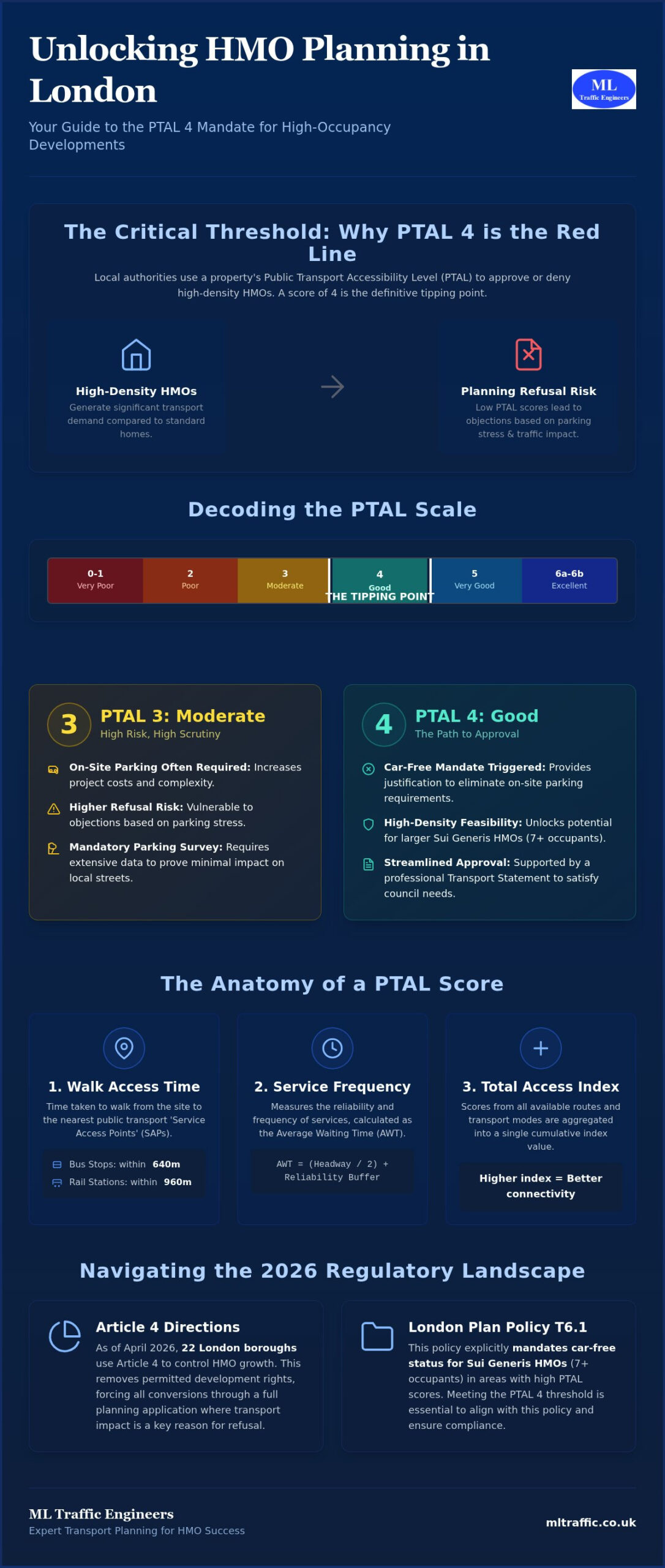
The relationship between a property’s Public Transport Accessibility Level (PTAL) and its viability as a House in Multiple Occupation (HMO) is fundamental to modern urban planning. Local authorities view HMOs as high-intensity residential uses that generate significantly more transport demand than standard family homes. For a successful hmo development, minimum PTAL 4 is often the baseline requirement to satisfy council concerns regarding parking stress and traffic congestion. A PTAL 4 rating is officially defined as a “good” accessibility level, providing the necessary justification for high-density living in areas with robust transport infrastructure.
Planning departments categorize HMOs under Use Class C4 for small conversions or Sui Generis for larger schemes housing seven or more occupants. Both classifications face intense scrutiny because they often lack on-site parking. Without a high PTAL score, councils fear that new residents will saturate local streets with vehicles, leading to planning refusals based on an unacceptable impact on the highway. This is why technical transport data is no longer optional for developers; it’s a prerequisite for feasibility.
The Tipping Point: Why PTAL 4 Matters
In the 2026 planning landscape, PTAL 4 serves as the regulatory tipping point where car-free developments move from being a preference to a mandatory requirement. The London Plan 2021, and its subsequent 2026 updates, sets strict parking standards that favor developments in well-connected areas. For Sui Generis HMOs, Policy T6.1 explicitly mandates car-free status in high PTAL zones. Councils apply these rules more strictly to HMOs than standard C3 dwellings because the per-person car ownership rate in shared housing can quickly overwhelm a neighborhood’s existing capacity. If you don’t meet this threshold, you’ll likely need a robust Parking Survey to prove the streets can handle the extra load.
London Borough Variations in HMO Policy
Requirements vary significantly across the capital. Inner boroughs like Tower Hamlets often enforce zero-parking policies for all new HMOs, whereas outer London boroughs might allow limited parking if the PTAL is lower. However, the trend is moving toward restriction. As of April 2026, 22 London boroughs have implemented Article 4 directions to control HMO growth. These directions remove permitted development rights, forcing every conversion through a full planning application where transport impact is a primary reason for refusal. Developers should consult a Transport Assessment London guide to navigate these borough-specific hurdles and secure approval.
Decoding PTAL Calculations for HMO Developments
The Public Transport Accessibility Level (PTAL) is a mathematical model used by Transport for London (TfL) to quantify the connectivity of a specific geographic point. For an hmo development, minimum PTAL 4 is the strategic target because it signifies that residents have high-quality alternatives to private car ownership. The calculation begins with the “walk access time” from the site’s center to the nearest service access points. These are typically bus stops within 640 meters or rail stations within 960 meters. Every meter counts when a project’s feasibility hangs on a specific decimal point.
The methodology incorporates service frequency and specific reliability factors. A key metric is the Average Waiting Time (AWT). This is calculated as half the headway, which is the time between services, plus a mode-specific reliability buffer. For instance, if a bus runs every 10 minutes, the headway is 10, and the AWT is 5 minutes plus a constant. These scores are aggregated across all available routes and modes to produce a Total Access Index. This index is then converted into a PTAL grade from 0 to 6b.
The Technical Components of a PTAL Score
A site’s score is cumulative. While a single bus route might only provide a low score, the presence of multiple overlapping modes pushes a development into higher brackets. The distinction between PTAL 3 (Moderate) and PTAL 4 (Good) is critical for planning success. In many London boroughs, PTAL 3 still requires some on-site parking, whereas PTAL 4 often triggers the car-free mandate necessary for high-density HMO feasibility. Aligning with HMO licensing guidance for local authorities, these accessibility standards ensure the local infrastructure can support the increased occupancy levels without degrading the highway network.
Challenging an Inaccurate PTAL Rating
You shouldn’t rely solely on static TfL maps. These automated tools often lag behind actual network improvements. If a new bus route was introduced recently or a station upgrade increased service frequency, the official database might still show a PTAL 3 for a site that technically qualifies for PTAL 4. Static maps also fail to account for site-specific pedestrian access points that could shorten walk times significantly.
ML Traffic Engineers UK justifies higher accessibility scores by conducting bespoke PTAL assessments. By manually calculating the Access Index using the latest 2026 timetables and precise walking routes, we can often prove a higher grade to the planning officer. This technical precision is often the difference between a refusal and an approval. If your site’s viability depends on its transport links, consider a professional Transport Statement to verify your actual connectivity and strengthen your application.
Car-Free HMOs: Navigating Parking Restrictive Policies
Establishing a car-free status is often the only viable path for a high-occupancy hmo development, minimum PTAL 4 areas. Local authorities, particularly across London’s 32 boroughs, utilize the Public Transport Accessibility Level as a legal lever to enforce parking restrictions. This approach is codified in Policy T6.1 of the London Plan, which mandates that developments in well-connected zones should be car-free. A PTAL rating of 4 or higher generally triggers a total ban on on-site parking for new HMOs, forcing developers to adopt car-free models to secure planning consent. This strategy aligns with broader car-free development policies designed to reduce urban congestion and improve air quality.
For Sui Generis HMOs, justifying limited parking is technically challenging. You must demonstrate that the proposed residents won’t rely on private vehicles. In areas where the PTAL is lower, some councils may allow limited disabled parking or car club bays, but these are exceptions rather than the rule. The burden of proof lies with the developer to show that the local transport network can absorb the increased residential density without creating overspill parking on neighboring streets.
Sourcing Evidence for Car-Free Viability
Successful applications rely on data-driven justifications. We utilize 2021 Census data to analyze local car ownership statistics, often proving that residents in shared accommodation are statistically less likely to own a vehicle than those in family homes. This demographic analysis is a powerful tool for rebutting generic council objections. Additionally, a bespoke Travel Plan can further mitigate concerns by outlining tangible measures to encourage cycling and public transport use. Developers looking to strengthen their application should consult our London Travel Plans Guide for specific 2026 compliance strategies.
Section 106 and Permit-Free Agreements
Councils enforce car-free status through Section 106 legal agreements or specific planning conditions known as “Permit-Free” obligations. These agreements legally prevent HMO residents from applying for on-street parking permits within a Controlled Parking Zone (CPZ). It’s a non-negotiable requirement in high PTAL areas; without it, the risk of local parking stress is deemed too high for approval. Landlords must include these restrictions in tenancy agreements to avoid legal complications. To support these agreements, a robust Transport Statement is essential. This document provides the technical framework that proves the development is sustainable without private car access, ensuring the project meets all regulatory benchmarks.
Essential Technical Documentation for HMO Approvals
Securing approval for high-density shared housing requires more than a favorable connectivity score; it demands a robust technical defense. A Transport Statement serves as the primary document for most HMO applications, consolidating the accessibility data and car-free strategies discussed in previous sections into a formal submission. For any hmo development, minimum PTAL 4 status must be backed by this technical report to justify the removal of on-site parking and prove that the local infrastructure remains resilient under increased residential density. This document acts as the definitive response to highway officer concerns regarding traffic generation and sustainable travel compliance.
Technical precision in these reports is non-negotiable. If your application lacks a professional analysis of the site’s transport logistics, you risk immediate refusal on the grounds of highway safety or parking stress. We manage the full technical lifecycle of these reports, ensuring that every calculation and policy reference aligns with the latest 2026 planning benchmarks. This level of detail provides the certainty required by local planning authorities to approve high-occupancy schemes.
Why a Parking Survey is Non-Negotiable
Even when a site achieves a high PTAL rating, councils often demand empirical evidence of local street capacity. A parking survey proves that the development won’t exacerbate local parking stress, especially during the peak hours when residents are most likely to be at home. ML Traffic Engineers UK utilizes the Lambeth Methodology, which is the industry standard for overnight parking observations. This specific process involves two separate surveys conducted between 00:30 and 05:30 on weekday nights to capture the maximum occupancy of on-street bays.
Accuracy during this data collection phase is vital. A survey that fails to correctly identify restricted bays or ignores recent changes to Controlled Parking Zones (CPZs) can lead to a planning refusal. Our team conducts these surveys with a focus on technical excellence, ensuring the resulting data is indisputable during the planning committee review. We provide a clear breakdown of “stress levels,” helping officers understand that the local network can safely absorb any potential overspill without compromising the highway.
Swept Path Analysis for HMO Access
Operational feasibility is a common sticking point for HMO approvals. We provide Swept Path Analysis services in London to demonstrate that fire tenders and refuse vehicles can safely maneuver around the property. This is particularly critical for HMOs where higher occupancy levels necessitate larger bin storage areas and significant cycle parking provision. If a refuse truck cannot reach the designated collection point, the council will likely reject the scheme on operational grounds.
By using our AutoTurn Swept Path Guide, you can see how we simulate vehicle movements to eliminate design errors before submission. We use precise vehicle dimensions, such as the standard 11.2m refuse vehicle, to ensure your site layout is functionally sound. This technical proof ensures that your access points and service bays are optimized for safety and efficiency. To ensure your project meets these rigorous standards, you should order a professional Transport Statement to support your planning application.
Securing HMO Approval with ML Traffic Engineers UK
Planning for a high-occupancy hmo development, minimum PTAL 4 included, is a complex regulatory challenge in the current 2026 landscape. As of April 2026, the proliferation of Article 4 directions across England means developers face unprecedented scrutiny regarding transport impacts. ML Traffic Engineers UK provides the technical authority required to navigate these hurdles. We specialize in transforming transport-related obstacles into planning successes by delivering precise, evidence-based reports that satisfy the most stringent council requirements.
Our consultancy manages the full technical lifecycle of your planning application. We provide a seamless transition from initial site assessment and data collection to the final submission of your Transport Statement or Assessment. This end-to-end service reduces your logistical burden, allowing you to focus on the commercial delivery of your project. Every report we produce is tailored to the specific constraints of your site, ensuring total alignment with local and national benchmarks.
The ML Traffic Engineers UK Advantage in London
The ML Traffic Engineers UK advantage lies in our deep-rooted understanding of borough-specific transport policies. Founded in 2014, we’ve navigated the evolving landscape of TfL requirements and regional parking standards across London and the wider UK. Our engineers maintain a consistent sense of readiness, understanding the fast-moving nature of infrastructure development. We take pride in our precision, ensuring that every Swept Path Analysis and Parking Survey we conduct is beyond technical reproach.
Our experience includes direct engagement with local highway authorities to resolve complex access issues. We don’t just provide data; we provide solutions that protect the safety of all road users while facilitating development growth. By partnering with us, you gain access to specialists who understand the intricate regional regulations so you don’t have to. This technical expertise is the primary hallmark of our brand promise to developers.
Next Steps for Your HMO Development
Reviewing your site’s actual connectivity is the first step toward a viable development. You shouldn’t rely on outdated automated maps when a bespoke PTAL assessment could unlock higher density and car-free status. If your application requires technical support, we recommend consulting our Transport Statement Buying Guide for professional advice. Contact us today for a bespoke quote and take the next step toward securing your HMO planning approval with confidence.
Strategic Transport Planning for HMO Success
Mastering the technical nuances of your hmo development, minimum PTAL 4 requirements is the most effective way to secure planning consent in London’s current regulatory landscape. A high accessibility score triggers car-free mandates, and bespoke PTAL assessments can often overturn outdated official data. Every project requires a tailored approach to satisfy borough-specific parking standards and highway safety concerns. These technical strategies aren’t optional; they’re essential for project viability and long-term operational success.
Since 2014, ML Traffic Engineers has operated as a specialist in London transport planning. We provide the technical precision required for Swept Path Analysis and Lambeth Parking Surveys to ensure your application meets every legislative benchmark. Our team manages full project lifecycles to reduce your regulatory pressure and secure the approvals you need. Contact ML Traffic Engineers for a Professional Transport Statement to ensure your next HMO project is built on a foundation of technical excellence. We’re ready to help you navigate these complex requirements and achieve a successful outcome.
Frequently Asked Questions
What happens if my HMO development is in a PTAL 3 area?
In a PTAL 3 area, local authorities typically require some level of on-site parking or a robust technical justification for its absence. Unlike a PTAL 4 zone, which often permits car-free status, a PTAL 3 rating is considered moderate. You will likely need a detailed Parking Survey to prove that the surrounding streets can accommodate any overspill. This evidence is vital to prevent planning refusals based on local parking stress.
Can I build an HMO without any parking spaces if the PTAL is 4 or higher?
Yes, a PTAL 4 rating or higher is the standard threshold for car-free developments in London. Under the London Plan Policy T6.1, councils prioritize sustainable travel in these highly accessible areas. For a large-scale hmo development, minimum PTAL 4 status usually mandates a permit-free agreement. This legally prevents residents from obtaining on-street parking permits, thereby protecting the local highway network from additional vehicle saturation.
How long does a Lambeth Methodology parking survey take to complete?
A standard Lambeth Methodology parking survey typically requires two separate overnight observations. These must occur on weekday nights between 00:30 and 05:30 to capture the peak residential parking demand. Once data collection is complete, our engineers analyze the results and produce a technical report within a few business days. This timeline ensures you have the necessary documentation ready for your planning submission without causing project delays.
Is a Transport Statement required for a 6-person HMO conversion?
A Transport Statement is often required for a 6-person (Use Class C4) HMO conversion if the property is located within an Article 4 direction area. As of April 2026, 22 London boroughs require full planning permission for these conversions. Even for smaller schemes, councils scrutinize the transport impact. Providing a professional statement demonstrates your commitment to regulatory compliance and helps mitigate concerns regarding cycle storage and refuse access.
What is the difference between a Transport Statement and a Transport Assessment for HMOs?
The primary difference lies in the scale and complexity of the project. A Transport Statement is a concise report used for smaller hmo development, minimum PTAL 4 applications or C4 conversions. In contrast, a Transport Assessment is a more comprehensive document required for large-scale Sui Generis HMOs or developments with significant traffic implications. Both documents serve to prove the proposal aligns with local transport policies and doesn’t compromise road safety.
How much does it cost to increase a site’s PTAL rating through technical justification?
We don’t provide fixed pricing for bespoke PTAL justifications, as the technical complexity varies by site. The process involves a detailed audit of current walking routes, service frequencies, and recent network improvements not yet reflected on TfL’s automated maps. By conducting a manual calculation using the latest 2026 timetables, we can often prove a higher accessibility grade. Contact our team for a specific quote based on your site’s location.
Do I need a Swept Path Analysis for a mid-terrace HMO conversion?
You may still require a Swept Path Analysis for a mid-terrace HMO if the development includes new off-street bin stores or cycle parking. Councils must be certain that refuse vehicles and emergency services can safely access the site. Even without a private driveway, proving that service vehicles can maneuver within the existing street layout without causing obstruction is a frequent requirement for securing planning approval in high-density urban environments.
Can a car-free HMO development be refused if the local streets are already at capacity?
Yes, a car-free development can be refused if the council believes the project will still generate unacceptable parking stress. While a high PTAL score supports a car-free model, some residents may still own vehicles and park them outside the Controlled Parking Zone. A professional Parking Survey is necessary to prove that there is sufficient capacity nearby, ensuring the highway officer that the development won’t negatively impact local residents.

Disclaimer
The content on mltraffic.co.uk, including all technical articles, guides, and resources, is provided for general informational and educational purposes only. It is not intended to constitute professional advice in traffic engineering, transportation planning, development approvals, or any other technical or legal field.
While ML Traffic Engineers makes every reasonable effort to ensure the accuracy, completeness, and timeliness of the information published, we do not provide any warranties or representations (express or implied) regarding its reliability, suitability, or availability for any particular purpose. Any reliance you place on the content is strictly at your own risk.
In no event shall ML Traffic Engineers, its directors, employees, authors, or affiliates be liable for any direct, indirect, incidental, special, consequential, or punitive damages (including, without limitation, loss of profits, data, or business opportunities) arising out of or in connection with the use of, or inability to use, any information provided on this website.
The articles and guides on this site are not a substitute for engaging a qualified, professional traffic engineer to assess your specific project requirements. For tailored advice, compliance assessments, or traffic engineering services, please contact a competent professional.
This disclaimer may be updated from time to time without notice. By accessing or using this website, you agree to be bound by the most current version of this disclaimer.