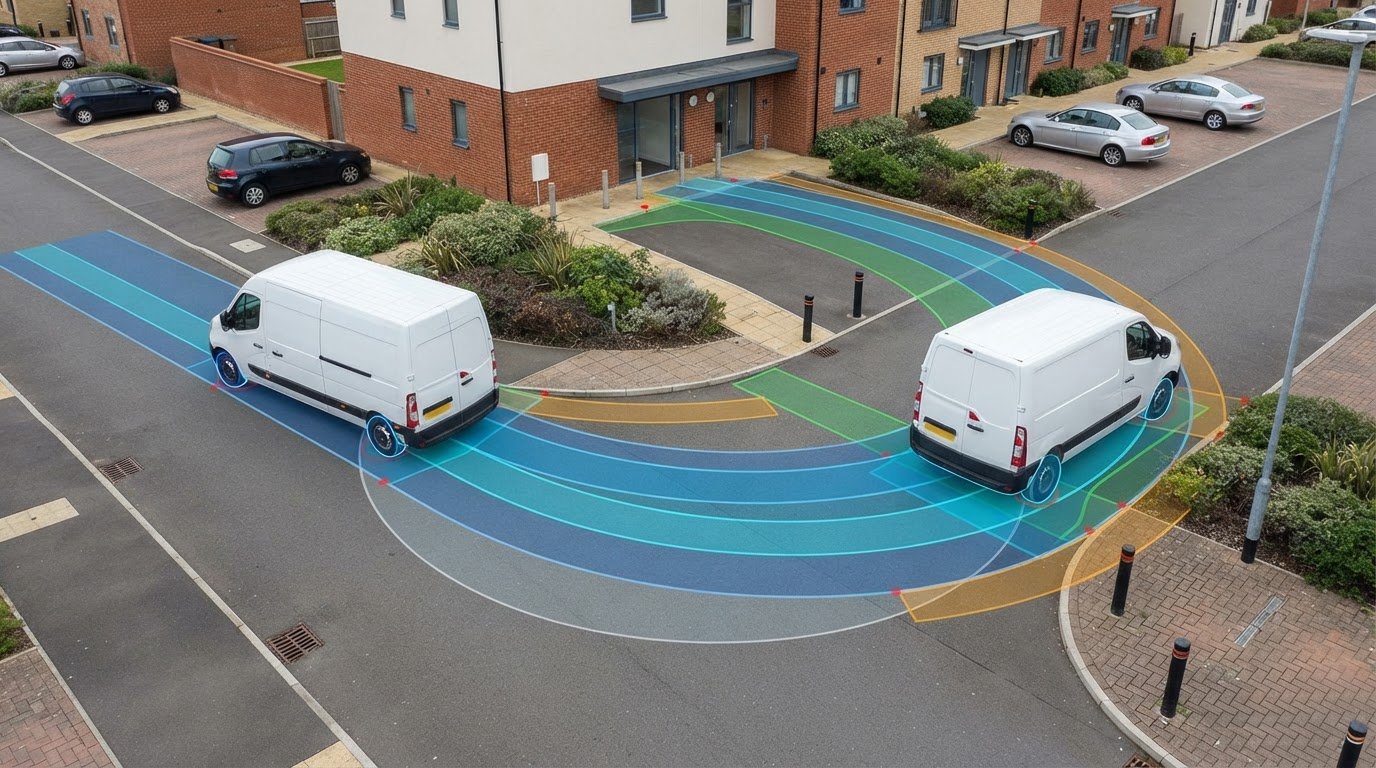
What if a delivery van can clear the entrance but can’t reach the loading area or turn around safely? Swept path analysis for delivery vans tests the complete movement through a site, not just one turn at the entrance. A layout that looks workable on plan may still create conflicts with parked cars, buildings, kerbs or other site features.
Before fixing the layout, check whether the van expected to serve the development can enter, manoeuvre, reach its servicing position and leave. A generic vehicle template may not match the van’s dimensions or steering characteristics, so the choice of vehicle can affect what the assessment shows.
This guide explains what van swept path drawings demonstrate, which information supports a useful assessment, and how to review the findings. Project-specific vehicle tracking can help identify layout conflicts early and provide technical evidence for design decisions and, where relevant, a planning submission. ML Traffic Engineers UK undertakes swept path analysis to assess vehicle manoeuvrability and access feasibility for development projects.
Key Takeaways
- Swept path analysis for delivery vans can assess approach, entry, on-site manoeuvring, loading access and exit as one movement.
- Vehicle dimensions and site features, including wheelbase, overhangs, kerbs and turning space, all affect whether a manoeuvre works.
- Choose vehicle data that reflects the site’s delivery arrangements and known fleet details, rather than defaulting to a generic template.
- Prepare a current, scaled site plan showing access and servicing arrangements, alongside the vehicle and movements to be assessed.
- Project-specific findings from ML Traffic Engineers can inform layout decisions and relevant planning documentation.
What does swept path analysis for delivery vans show?
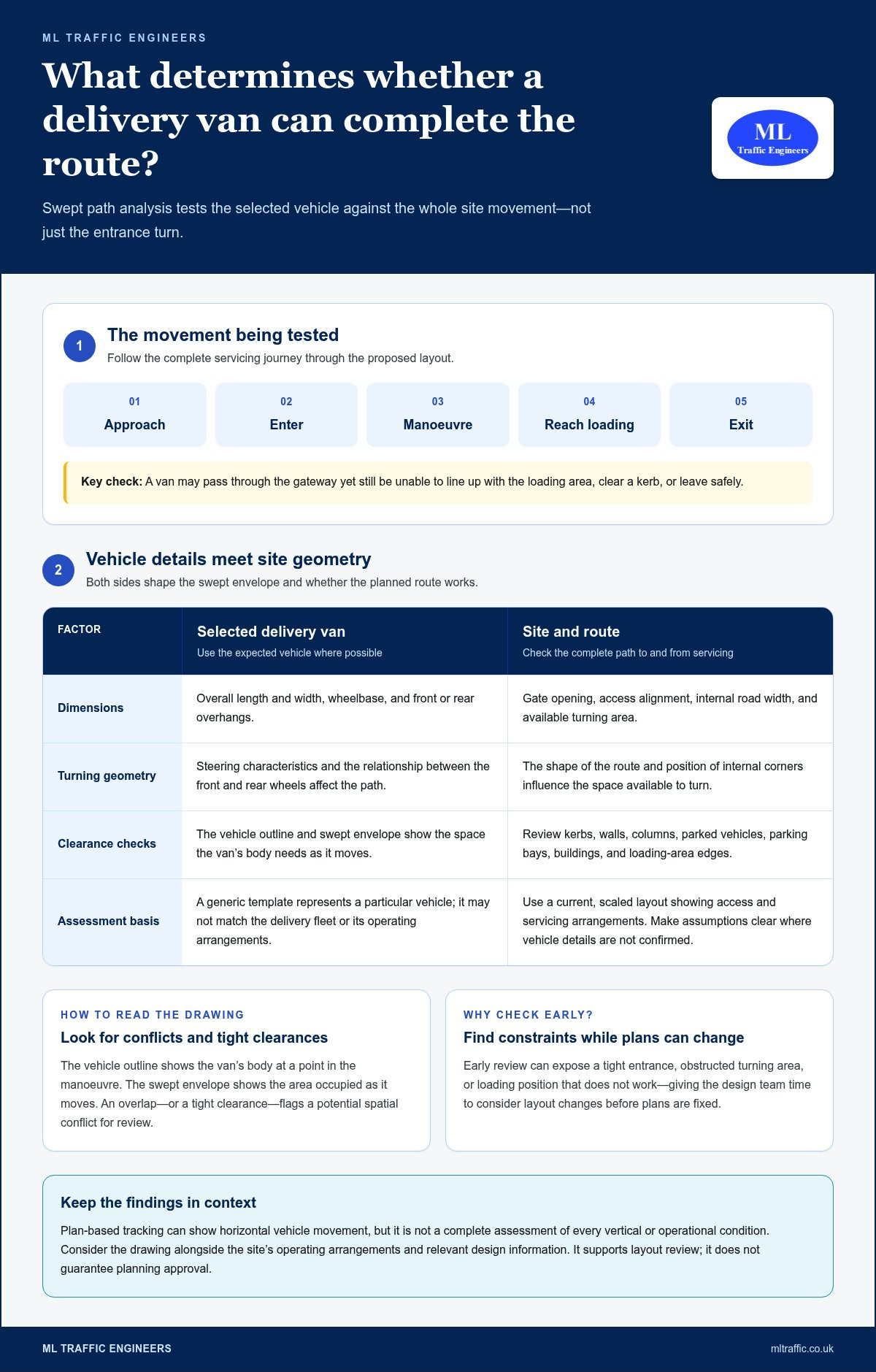
Swept path analysis for delivery vans is a vehicle movement assessment showing the space a selected van needs to approach, enter, manoeuvre within, reach a loading position and exit a site. It tests the complete movement against the proposed layout, rather than showing only whether the van can turn at the entrance.
This matters for everyday servicing. A van might pass through a gateway but still be unable to line up with a loading area, clear a kerb or leave without reversing into a constrained space.
This video offers a visual introduction to how swept path analysis supports site design:
What does a delivery van swept path drawing include?
A swept path drawing places the selected vehicle’s outline and movement envelope over a site layout. The outline represents the van’s body at a particular point in the manoeuvre. The swept envelope shows the area occupied as the vehicle moves, including the outer space its body needs to clear.
The plan can show the route in relation to the entrance, kerbs, parking bays, buildings, loading areas and other fixed constraints. An overlap with a feature, or a tight clearance, flags a potential spatial conflict for review. This helps the design team assess whether the van can follow the intended route and reach its servicing position.
Turning geometry matters. Wheelbase, steering characteristics and the relationship between the front and rear wheels affect the path a vehicle follows. Ackermann steering geometry describes a principle behind how wheels are angled through a turn, helping explain why a van’s path is not simply a fixed-width line.
Why assess delivery access before a layout is finalised?
Early review can expose a tight entrance, obstructed turning area or loading position that does not work with the proposed arrangement. Finding these constraints while the layout is still being developed gives the design team time to consider changes before plans are fixed and helps reduce the risk of late revisions.
Movement evidence also helps assess servicing practicality: whether the delivery van can reach the intended area and complete the planned manoeuvre within the available space. Consider the drawing alongside the site’s operating arrangements and other relevant design information. It supports a layout review, but does not guarantee planning approval or demonstrate that every aspect of future site operation will be suitable.
How do vehicle dimensions and site geometry shape van tracking?
A van’s swept envelope depends on its length, width, wheelbase, steering geometry and body overhangs, as well as the shape of the route. Longer vehicles may need more room to turn, while front or rear overhang can bring parts of the body closer to kerbs or other constraints. The Manual for Streets recognises swept path analysis as a tool for assessing vehicle movement in street design.
In practical terms, vehicle dimensions and steering characteristics combine with entrance alignment, kerb positions, internal road width and turning space to define the swept envelope. These factors determine whether the van can travel between the site access and servicing point without conflicting with fixed or temporary obstructions.
Which delivery-van details matter to the assessment?
Where possible, use the dimensions and configuration of the proposed or expected delivery vehicle. Relevant details include overall length and width, wheelbase, steering characteristics and overhangs. Distinguish confirmed fleet information from assumptions where vehicle details are not yet available. This makes the basis of the tracking clear and shows where a generic template may differ from the van used in practice.
A template can help with an early design check, but it represents a particular vehicle model and set of dimensions. It may not match every van in a delivery fleet or reflect different operating arrangements. For a project-specific assessment, select a vehicle that represents the expected servicing requirement as closely as the available information allows.
Which site features can restrict a van manoeuvre?
Assess the whole route, not just the tightest turn. The gate opening, access alignment, internal corners and available turning area all influence the path. Kerbs, walls, columns, parked vehicles and the edges of loading areas can restrict usable space. A layout may allow the van to enter but leave too little room to reach the loading position or depart along the planned route.
Include gradients and level changes in the site information where they affect access or circulation. A plan-based tracking drawing can show horizontal movement, but it is not a complete assessment of every vertical or operational condition. Clear assumptions help keep the findings relevant to the proposed arrangement.
For development layouts, project-specific swept path analysis can help identify vehicle and layout conflicts while design changes are still being considered.
How should you compare van templates and assess drawing reliability?
A swept path drawing is only as useful as the vehicle and operating assumptions behind it. A generic van template can help test an early layout, but it may not represent the vehicle that will make deliveries to the site. For swept path analysis for delivery vans, match the selected vehicle as closely as possible to the expected servicing arrangement and make any assumptions clear.
When is a standard van template a reasonable starting point?
If the delivery fleet is not known during early design, a standard template can help assess whether the access and turning area appear workable. Treat it as an initial test, not proof that every van can use the site. The suitable vehicle depends on the development, delivery frequency, servicing arrangements and reliable information about the fleet. Where delivery arrangements or vehicle details are known, use them to guide the choice of vehicle for assessment.
The table shows how to interpret key inputs and the limits of assumptions:
| Input | What it represents | Implication of an assumption |
|---|---|---|
| Vehicle template | A defined set of dimensions and steering characteristics | A generic model may differ from the vans used for deliveries |
| Fleet information | Known vehicle types expected to serve the site | Without it, the assessment may need to use a representative vehicle |
| Delivery arrangements | How often and where vehicles are expected to service the site | Unclear operating details can affect which vehicle and movements are assessed |
| Site layout | The access, circulation route and servicing position shown on the plan | Out-of-date or incomplete plans can omit constraints affecting the movement |
What makes a swept path drawing easier to assess?
Check that the drawing identifies the assessed vehicle and makes the movement direction clear. The site plan should show the relevant access, boundaries, kerbs, buildings, parking and servicing area. Confirm that the route connects the entrance to the intended loading position and includes the manoeuvre needed to leave, rather than stopping at the turning arc.
Trace the complete movement and look for overlaps or tight clearances around fixed features and parked vehicles. A clear drawing makes its assumptions and constraints visible, so reviewers can understand what the result does and does not demonstrate. If the layout or delivery arrangements change, review the assessment against the updated information.
What information should you prepare for a delivery-van swept path analysis?
A useful swept path analysis for delivery vans starts with a clear vehicle, a current site layout and an agreed movement to assess. Separate confirmed project information from design assumptions and details still being developed. That makes the drawing easier to review and highlights which changes could affect the result.
Which drawings and vehicle information help the assessment?
Prepare the information in sequence, from the delivery vehicle to the site plan:
- Identify the vehicle. Provide dimensions or a clear description of the expected van. If fleet details are still being developed, identify the representative vehicle and its assumptions.
- Describe the servicing arrangement. State the intended delivery or loading location, expected approach and exit route, and any relevant operating arrangements.
- Provide a current, scaled plan. Show the proposed layout, site entrance, access geometry, internal route, servicing area and relevant boundaries. Include dimensions and levels where available and relevant to the assessment.
- Mark constraints and uncertainties. Identify features such as kerbs, parking, buildings, gates or other fixed obstructions. Note which elements are confirmed, proposed or still subject to design development.
- Set out the movement to test. Clarify where the vehicle approaches from, how it enters, the manoeuvre needed to reach the servicing position, and how it leaves.
Use a scaled drawing that reflects the current design, not an outdated layout. Inaccurate or incomplete access details make it harder to judge how the tracked movement relates to the site.
How should you review the movement and drawing?
Trace the vehicle from the public highway towards the entrance, then follow it through the site to the servicing position and back towards the exit. Check the full manoeuvre, not only the turning arc. Look at how the path relates to boundaries, kerbs, buildings, parking and other constraints along the route.
Record assumptions about vehicle dimensions or operating arrangements, along with potential conflicts and design changes that need further review. If the access or servicing layout changes, revisit the drawing against the revised plan. Planning and highway authority expectations can vary by project, so establish the requirements that apply to the specific proposal rather than treating one drawing format as universally mandatory.
For project-specific vehicle movement evidence, see ML Traffic Engineers’ swept path analysis service.
How can ML Traffic Engineers UK support delivery-van swept path analysis?
ML Traffic Engineers provides project-specific swept path analysis to assess vehicle manoeuvrability and access feasibility. For a development, this means testing how the selected delivery van moves through the proposed layout using the project information and operating assumptions available. The findings can highlight design questions before plans are finalised, helping inform access decisions with a clear assessment rather than appearance alone.
Useful inputs include the current site or design plan, the known or proposed delivery vehicle, the intended loading location and the access movements to be assessed. Where details are still developing, state that clearly. This defines the basis of the assessment and shows which assumptions may need revisiting as the design progresses.
How does analysis fit into development planning?
Van access evidence can inform the site layout and, where relevant, support planning documentation such as a Transport Statement or Transport Assessment. The appropriate documentation depends on the development and its planning context. Swept path analysis is one part of the evidence, not a guarantee of planning approval. Read this practical guide to swept path analysis for more on how vehicle tracking can support planning applications.
What is a practical next step for your site?
Bring together the proposed layout, available delivery-van dimensions or fleet details, and a concise description of the access objective. For example, say whether the main question is entry from the highway, circulation to a loading point or the route back out. This gives the assessment a clear focus and helps define what the tracking needs to demonstrate.
ML Traffic Engineers supports development projects in Greater London, Manchester, Birmingham, the West Midlands, Liverpool, Surrey, East Sussex, West Sussex, Hampshire, Berkshire and Buckinghamshire. Early review can bring potential conflicts into view while the layout is being developed. Discuss delivery-van access for your project.
Plan delivery access with confidence
A delivery van must be able to complete the whole site movement, not simply clear the entrance. Swept path analysis for delivery vans tests the selected vehicle against the proposed layout, helping reveal whether its approach, manoeuvre, loading access and exit work together. The assessment is only as relevant as its inputs, so use current drawings and distinguish known vehicle details from assumptions.
Early vehicle tracking can help identify access or layout questions before plans are finalised. It can also provide technical evidence to inform development decisions and, where relevant, wider planning documentation. ML Traffic Engineers supports development projects with project-specific swept path analysis to assess vehicle manoeuvrability and access feasibility.
Share your proposed layout, available vehicle information and access objectives with ML Traffic Engineers to discuss the next step for your project. Discuss delivery-van access for your project.
Frequently Asked Questions
What is swept path analysis for delivery vans?
Swept path analysis for delivery vans is a drawing-based assessment of the space a selected van occupies as it moves through a site. It can show the approach, entrance, internal manoeuvres, access to a servicing position and exit against the proposed layout. Its usefulness depends on suitable vehicle information and an accurate site plan. It provides evidence about the assessed movement, but does not guarantee planning approval.
Do I need swept path analysis for a delivery van on my development site?
Whether it is needed depends on the proposal, access arrangement, servicing activity and expectations of the relevant planning or highway authority. There is no universal requirement for every development. A drawing can help demonstrate access feasibility where a layout is constrained or the van’s route needs explaining. Establish the project-specific evidence requirements through the planning process, and use vehicle tracking to clarify design questions early.
Which delivery van should be used in a swept path analysis?
Use a vehicle that reflects the anticipated delivery operation when reliable fleet or vehicle details are available. Relevant information includes the van’s dimensions and steering geometry. If the exact vehicle is not known, a suitable standard template can support early layout testing, provided the assumption is clearly stated. No single generic van necessarily represents every fleet or delivery arrangement, so choose the assessed vehicle in light of the project’s servicing needs.
Can a delivery van turn around on my site?
That depends on the selected van, access geometry, internal layout and any obstructions. A swept path assessment can model the intended movement against the site plan and highlight potential conflicts. Review the whole route, from the entrance to the servicing position and back towards the exit, rather than checking only an isolated turn. The finding must be based on the project’s vehicle information, layout and movement assumptions.
What information is needed for a delivery-van swept path analysis?
Provide a current, scaled site or design plan showing entrance and internal layout dimensions, the intended servicing location, and relevant obstructions or circulation constraints. Include available delivery-vehicle details, such as dimensions, and describe the route and manoeuvre to assess. Separate confirmed information from assumptions or details still being developed. Requirements can vary between projects and authorities across Greater London, Manchester, Birmingham, the West Midlands, Liverpool, Surrey, East Sussex, West Sussex, Hampshire, Berkshire and Buckinghamshire.
Does swept path analysis guarantee planning approval for delivery access?
No. A swept path drawing is evidence about whether the assessed vehicle can move through the proposed layout. It does not guarantee planning permission or determine the outcome of an application, which may consider wider transport matters and relevant local requirements. Treat the drawing as one part of project-specific technical evidence. Clear vehicle, layout and operating assumptions help reviewers understand what the assessment demonstrates and where its scope ends.
What is the difference between swept path analysis and vehicle tracking?
The terms often describe closely related assessments and drawings of vehicle movement. Swept path analysis focuses on the space a vehicle occupies while moving; vehicle tracking commonly refers to modelling or illustrating that movement. Terminology can vary between projects, so look beyond the label. Check which vehicle is represented, what assumptions apply, and whether the drawing shows the complete route, including access, manoeuvring, servicing and exit.

Disclaimer
The content on mltraffic.co.uk, including all technical articles, guides, and resources, is provided for general informational and educational purposes only. It is not intended to constitute professional advice in traffic engineering, transportation planning, development approvals, or any other technical or legal field.
While ML Traffic Engineers makes every reasonable effort to ensure the accuracy, completeness, and timeliness of the information published, we do not provide any warranties or representations (express or implied) regarding its reliability, suitability, or availability for any particular purpose. Any reliance you place on the content is strictly at your own risk.
In no event shall ML Traffic Engineers, its directors, employees, authors, or affiliates be liable for any direct, indirect, incidental, special, consequential, or punitive damages (including, without limitation, loss of profits, data, or business opportunities) arising out of or in connection with the use of, or inability to use, any information provided on this website.
The articles and guides on this site are not a substitute for engaging a qualified, professional traffic engineer to assess your specific project requirements. For tailored advice, compliance assessments, or traffic engineering services, please contact a competent professional.
This disclaimer may be updated from time to time without notice. By accessing or using this website, you agree to be bound by the most current version of this disclaimer.