Securing planning permission for a new logistics hub in East London now requires more than just proving you won’t block the A13. You already know that the London Borough of Barking and Dagenham (LBBD) is under intense pressure to hit a 10% traffic reduction target while maintaining its status as a premier industrial zone. It’s often frustrating when your HGV-reliant project faces strict Be First sustainable travel requirements that seem at odds with heavy logistics. A robust transport assessment for industrial site in Barking and Dagenham is no longer a formality; it’s a strategic necessity.
This guide provides the technical roadmap to master the 2026 regulatory landscape. We’ll show you how to satisfy TfL and LBBD requirements to ensure your project secures rapid approval with minimal conditions. We will cover the impact of the latest 7.5-tonne weight restrictions, the necessity of optimized swept path analysis for tight regeneration zones, and the critical shift toward sustainable freight within the borough’s car-lite framework. By aligning your site layout with these specific technical benchmarks, you can reduce regulatory pressure and move straight to the execution phase of your development.
Key Takeaways
- Understand how the 2037 Local Plan and the London Riverside corridor influence industrial land use for 2026 logistics projects.
- Learn when to trigger a full transport assessment for industrial site in Barking and Dagenham versus a simpler Transport Statement to meet LBBD technical standards.
- Resolve the “car-lite” conflict by balancing mandatory traffic reduction targets with the operational needs of 16.5m articulated HGVs.
- Identify why Swept Path Analysis is the most critical technical proof for de-risking your site layout and ensuring safe vehicle maneuverability.
- Streamline your planning application through strategic pre-application advice and negotiated Section 278 agreements for site access improvements.
Navigating Barking and Dagenham’s Industrial Planning Landscape
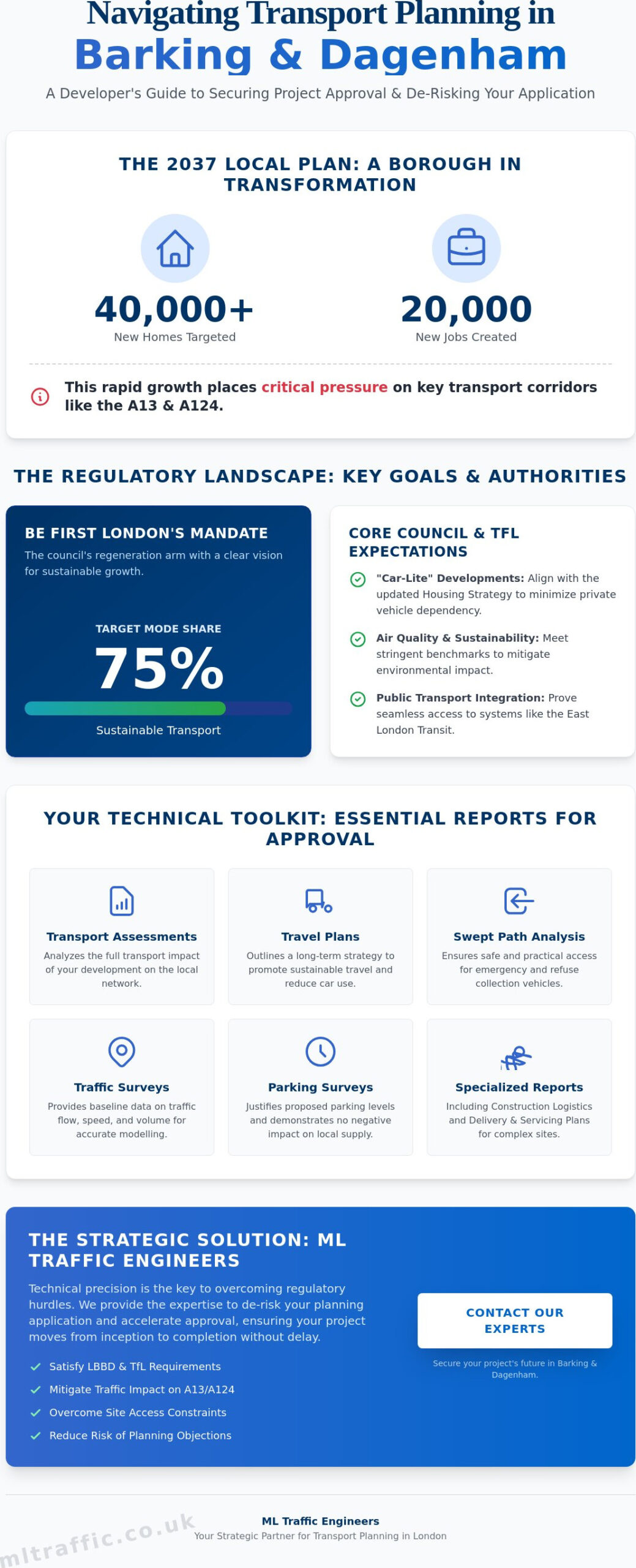
The London Riverside corridor remains the engine room of East London’s industrial economy in 2026. For developers, this area offers unparalleled access to the capital, but the 2037 Local Plan has introduced stringent requirements for industrial land use. Planning success now depends on proving that your site doesn’t just exist alongside residential growth but actively supports it through reduced congestion and smarter logistics. A transport assessment for industrial site in Barking and Dagenham must account for this intensification, showing how heavy freight can coexist with the borough’s aggressive 10% traffic reduction target.
Strategic feasibility is often decided by the proximity to the A13 and A124 corridors. These routes are the lifeblood of the region’s logistics, yet they are also major sources of severance and poor air quality. Securing a compliant transport assessment for industrial site in Barking and Dagenham requires a deep understanding of how these specific corridors function under peak load. Effective transportation planning at the inception stage is vital. It’s the only way to ensure that a project doesn’t stall due to unforeseen impact on the Strategic Road Network.
The Role of Be First in Industrial Regeneration
Be First acts as the primary driver for development in LBBD, managing the planning process with a focus on rapid, high-quality growth. They operate as a gatekeeper for the Thames Road regeneration strategy, where industrial sites are being revitalized. If you’re proposing a freight-heavy site, Be First expects a high level of technical detail during pre-application. They prioritize projects that demonstrate a clear understanding of local infrastructure pressures. Precision in your initial reports prevents delays during the formal consultation phase.
Strategic Road Network (SRN) Constraints
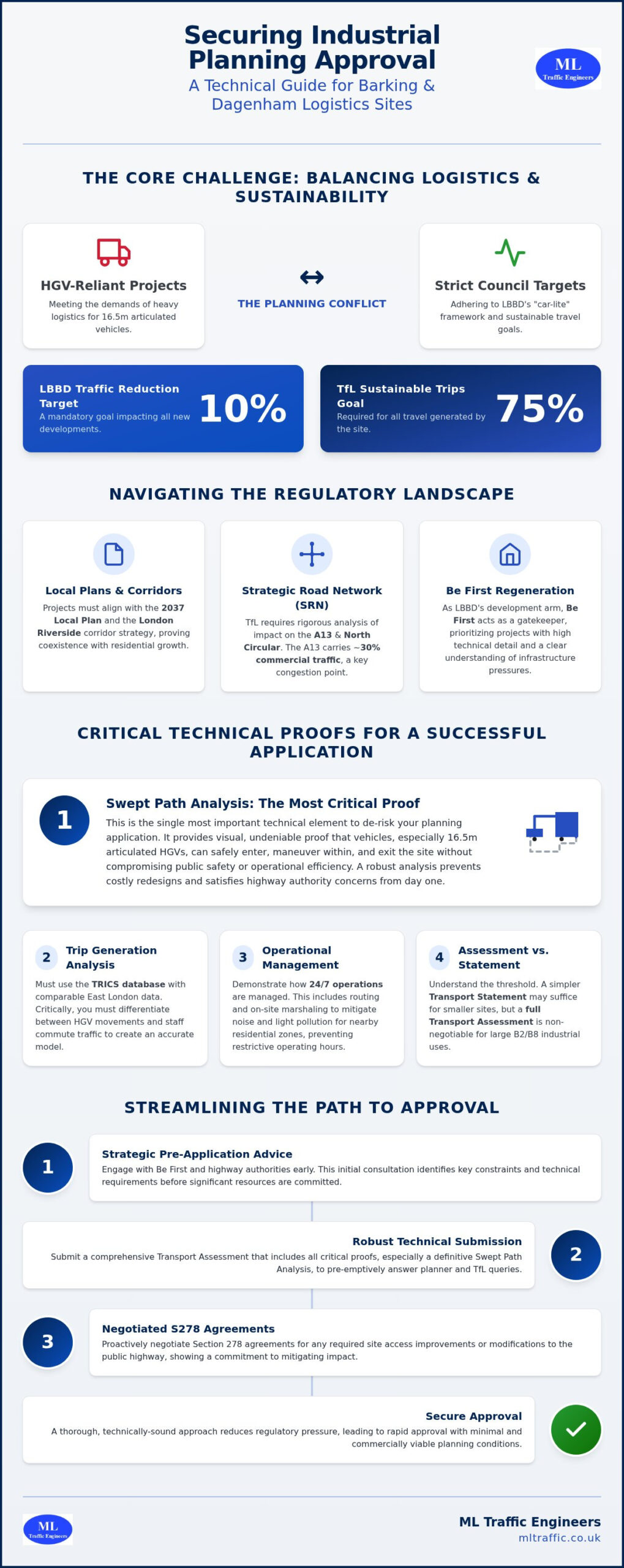
The A13 carries roughly 30% commercial traffic, making it one of the most congested arteries in London. Transport for London (TfL) maintains strict oversight of any development that impacts the SRN or the North Circular. Your industrial transport reports must address air quality and junction capacity with extreme accuracy. TfL will scrutinize how your site contributes to the borough’s goal of 75% sustainable trips. Even for warehousing, you must prove that HGV movements are optimized to avoid peak-hour gridlock. Failure to mitigate these impacts often leads to heavy planning conditions or outright refusal.
Core Requirements for Industrial Transport Assessments
A transport assessment for industrial site in Barking and Dagenham serves as the technical validation that your development won’t compromise local road safety or network efficiency. Following official UK government guidance, this document details how the site manages its operational footprint. In the London Borough of Barking and Dagenham (LBBD), the distinction between a full Assessment and a simpler Transport Statement hinges on the scale of the proposed floor space and the anticipated volume of HGV movements. For larger B2 and B8 developments, a full assessment is a non-negotiable requirement for planning success.
For industrial uses, data modelling must reflect the reality of 24/7 operations. Night-time logistics are a standard requirement for modern warehousing, but they introduce noise and light pollution concerns for nearby residential regeneration zones. Your report must prove that these movements are managed through efficient routing and on-site marshaling. Precision here prevents the council from imposing restrictive operating hours that could cripple your business model. If you need comprehensive transport planning support to navigate these operational constraints, early technical engagement is essential.
Trip Generation and Distribution Analysis
Calculating industrial trip rates requires a nuanced approach using the TRICS database. We prioritize data from comparable sites across East London to ensure the modelling reflects local conditions in Dagenham Dock and London Riverside. It’s not enough to list total vehicle numbers. You must differentiate between heavy HGV movements and staff commute traffic. During the Regulation 19 review, planning officers will scrutinize these figures to determine the total impact on the A13. Providing a transparent, data-backed justification for your trip rates is the most effective way to de-risk the application.
Accessibility and Connectivity Reviews
While HGVs are the operational priority, LBBD’s sustainable transport goals require a focus on staff accessibility. We analyze Public Transport Accessibility Level (PTAL) ratings to determine how workers will reach the site. Even in heavy industrial zones, your design must integrate walking and cycling strategies. This might include secure cycle storage or improved pedestrian pathways. You can view examples of how we balance these requirements in our industrial project types portfolio. Integrating these elements early ensures your transport assessment for industrial site in Barking and Dagenham aligns with the borough’s healthy streets initiative.
Balancing Freight Logistics with Sustainable Infrastructure
Barking and Dagenham’s shift toward “car-lite” development creates a unique friction point for industrial operators. While the borough aims for 75% of all trips to be taken via sustainable modes by 2037, logistics sites inherently require high vehicle capacity. Your transport assessment for industrial site in Barking and Dagenham must bridge this gap. You need to demonstrate that reducing on-site staff parking won’t lead to parking overspill on local roads, while simultaneously ensuring HGV access remains unhindered. This requires a precise balance between operational necessity and the borough’s healthy streets initiative.
By September 2026, Electric Vehicle (EV) charging infrastructure is no longer an optional extra for industrial fleets. Planning officers expect a clear strategy for fleet transition. This includes providing both active and passive charging points for staff vehicles and commercial HGVs. Aligning these technical specifications with the borough’s air quality goals is a primary pillar of a successful application. It’s vital to show that your site can support modern, low-emission logistics without placing undue strain on the local power grid or road network.
Industrial Travel Plans in Barking
A robust Travel Plan is often the deciding factor in industrial planning success. It provides the framework for managing how workers access the site without relying on private cars. We focus on practical strategies like car-sharing schemes and shuttle links to the Barking Riverside station. Following best practices from the Chartered Institution of Highways & Transportation, we help you build a document that satisfies Be First’s requirements. If you require expert support for Travel Plans, securing technical input early in the design phase is critical to avoid late-stage planning objections.
Managing the Thames Road Mixed-Use Transition
The Thames Road area exemplifies the challenge of residential encroachment on traditional industrial heartlands. As new housing developments move closer, the potential for conflict between heavy freight and pedestrians increases. Your transport assessment for industrial site in Barking and Dagenham must include specific traffic mitigation strategies to protect residential amenity. This involves proving “no adverse impact” through rigorous modelling of HGV routing and arrival times. We ensure that industrial operations don’t just survive but thrive within these mixed-use zones. Effective separation of active travel paths from heavy vehicle routes is essential to maintain safety standards and public health.
Technical Proof: Swept Path Analysis and Servicing
Swept Path Analysis (SPA) provides the definitive technical proof that your industrial site is operationally viable. Without this data, a transport assessment for industrial site in Barking and Dagenham lacks the credibility needed to satisfy Be First or TfL. We use this modelling to demonstrate that heavy vehicles can navigate the site without conflicting with existing infrastructure or pedestrian paths. It’s a functional necessity for any project involving B2 or B8 land uses. Precise simulations ensure that your servicing and delivery plans are grounded in physical reality. A robust Servicing and Delivery Plan (DSP) is often a mandatory requirement for industrial units in 2026, outlining how you’ll manage arrivals to minimize local network impact.
In 2026, the benchmark for warehousing remains the 16.5m articulated HGV. We model these vehicles to ensure they can enter and exit the site in a forward gear. This is a critical safety requirement for sites near high-traffic zones like the A13. If your site layout can’t accommodate these movements, the application will likely face immediate objections. We also integrate refuse vehicle and fire tender modelling to ensure emergency access is never compromised. Our detailed guide to Swept Path Analysis explains how these technical simulations de-risk your development from the inception stage.
HGV Maneuverability and Site Layout
Our engineers utilize AutoCAD and AutoTurn to create precise digital simulations of vehicle behavior. We don’t just check the main gates. We simulate every internal turn, loading bay approach, and reversing maneuver. This level of detail is vital for constrained sites in Barking’s regeneration zones where space is at a premium. By identifying potential “pinch points” early, we can suggest layout adjustments that optimize HGV efficiency. If you need to verify your site’s physical capacity and ensure operational safety, you can request a Swept Path Analysis to prevent costly design revisions during the planning process.
Parking Provision and Servicing Standards
Adhering to London Plan parking standards is a core requirement for a transport assessment for industrial site in Barking and Dagenham. The borough’s “car-lite” focus means staff parking spaces are heavily restricted. You must justify every bay with concrete data. We conduct parking stress surveys to prove that your site won’t cause overflow into neighboring streets. Efficient loading bay design is equally important. We calculate the required number of bays based on your anticipated delivery frequency. This ensures that vehicles don’t queue on the public highway while waiting for a space, which is a major concern for LBBD planning officers focused on road safety.
Securing Approval: How ML Traffic Engineers De-Risks Your Project
Securing planning approval for a major logistics hub involves more than just submitting a report. It requires a proactive defense of technical data during the consultation phase with Be First and Transport for London (TfL). A transport assessment for industrial site in Barking and Dagenham must withstand intense scrutiny regarding its impact on the A13 and local air quality. Our approach focuses on precision reporting that identifies potential roadblocks before they trigger a formal objection. We provide the technical authority needed to move your project from initial feasibility to final execution.
Early engagement through pre-application advice is the most effective way to de-risk your submission. By consulting with local authorities at the inception stage, we can align your industrial proposals with the borough’s 2037 Local Plan. This prevents the need for costly late-stage design revisions. Our team manages the intricate regional regulations of LBBD so you don’t have to, ensuring every data point in your transport assessment for industrial site in Barking and Dagenham is accurate and defensible.
Navigating Section 278 Agreements
Industrial developments often require off-site highway works to facilitate HGV access, such as bell-mouth junction improvements or road widening. These are managed through Section 278 (s278) agreements. Negotiating these agreements in LBBD requires a clear understanding of both cost and timeline implications. We lead these negotiations on your behalf, ensuring that the scope of works is proportional to your development’s impact. For a deeper look at how these requirements fit into the wider planning framework, you can read our Guide to Transport Assessments in London.
Strategic Planning Support
Since our founding in 2014, we’ve built a record of successful industrial submissions across East London’s regeneration zones. We specialize in London-specific PTAL and TRICS analysis, providing the data depth that planning officers demand. Our involvement reduces regulatory delay by delivering “right-first-time” technical reports. We manage the full project lifecycle, from initial site feasibility and Swept Path Analysis to the final discharge of transport-related conditions. If you’re ready to advance your logistics or warehousing project, contact ML Traffic Engineers for a comprehensive project review and a tailored quote for your Barking and Dagenham site.
Strategic Planning for Industrial Success in LBBD
Navigating the complex regulatory environment of East London requires a partner who understands the high stakes of industrial planning. We’ve explored how technical precision in Swept Path Analysis and a proactive approach to sustainable travel are now mandatory for securing planning permission. By focusing on data-backed reporting and early engagement with Be First, you can bypass the common delays that stall logistics projects in the London Riverside corridor. Expert analysis of LBBD and TfL requirements ensures that your site layout is optimized for both safety and efficiency.
Our team specializes in Swept Path Analysis for HGV access, ensuring even the most constrained sites can accommodate 16.5m articulated vehicles without compromising local infrastructure. Securing a transport assessment for industrial site in Barking and Dagenham doesn’t have to be a regulatory bottleneck when you have a partner with a proven track record in the region. We’re ready to provide the technical authority needed to move your project from initial feasibility to final approval.
Take the next step in de-risking your development and ensuring operational viability. Request a Transport Assessment Quote for Your Industrial Project today. We look forward to helping you achieve a successful planning outcome.
Frequently Asked Questions
When is a Transport Assessment required for an industrial site in Barking and Dagenham?
A full assessment is typically required when a development meets specific floor area thresholds or generates significant traffic volumes. In LBBD, this often applies to sites exceeding 2,500 square meters for B2 or B8 uses. A transport assessment for industrial site in Barking and Dagenham ensures that HGV movements and staff trips won’t overwhelm local infrastructure. Planning officers use this data to determine if the network can absorb the additional load safely.
How does TRICS data help my industrial planning application?
TRICS provides the evidence base for calculating trip generation rates. By analyzing similar industrial sites across East London, we can predict how many HGVs and employee vehicles will enter and exit your facility daily. This data is essential for proving your project’s impact is manageable. Using accurate, regionally specific TRICS benchmarks reduces the likelihood of planning officers challenging your traffic projections during the consultation phase, ensuring a smoother application process.
What is the “car-lite” policy and how does it affect industrial staff parking?
The “car-lite” policy restricts on-site parking to encourage sustainable travel modes. In Barking and Dagenham, this means industrial sites must minimize staff parking spaces, even in logistics-heavy zones. You must justify any proposed parking through detailed assessments and prove that it won’t lead to overspill on public roads. Balancing this with operational needs requires technical precision to satisfy the borough’s target for 75% sustainable trips by 2037.
Does my industrial site need a separate Delivery and Servicing Plan (DSP)?
Most large-scale industrial units in LBBD require a Delivery and Servicing Plan as a condition of planning approval. While we focus on the technical reports like Transport Assessments that justify these plans, the DSP itself outlines operational parameters. Your assessment will detail the HGV routing, arrival windows, and on-site management strategies. These technical foundations are designed to mitigate congestion on major arteries like the A13 and ensure safe site operations.
How much does a Transport Assessment cost for a warehouse in LBBD?
Costs vary based on the project’s scale, the complexity of the local road network, and specific requirements from TfL or Be First. A site located near a major junction on the A13 may require more extensive junction modelling than a smaller, isolated unit. We provide tailored quotes based on your specific site requirements and the scope of work needed to secure planning success. Contact us directly to discuss your project’s technical needs.
Can I use Swept Path Analysis to justify a smaller yard area?
Swept Path Analysis acts as a vital tool for space optimization. By digitally simulating the movement of 16.5m articulated HGVs, we can prove that a site remains functional even with a constrained layout. This technical proof allows you to maximize floor space while ensuring safe ingress and egress. Demonstrating that vehicles can maneuver safely within a smaller yard helps satisfy safety standards without sacrificing the commercial viability of your industrial development.
What is the role of Be First in the industrial planning process?
Be First manages the planning and regeneration process on behalf of the London Borough of Barking and Dagenham. They act as the primary interface for developers, setting the technical standards for new submissions. Their focus is on ensuring that industrial growth aligns with the borough’s long-term sustainability and traffic reduction goals. Engaging with Be First during the pre-application stage helps identify potential transport objections before you submit your formal planning application.
How does the A13 congestion affect my transport report requirements?
The A13 is a critical artery that often operates at capacity. Any transport assessment for industrial site in Barking and Dagenham must include a rigorous analysis of how HGV traffic impacts this corridor. TfL and the local council will scrutinize your report to ensure your site doesn’t exacerbate existing bottlenecks. You may be required to provide detailed junction modelling or commit to specific HGV routing strategies to mitigate your development’s impact on this strategic road network.

Disclaimer
The content on mltraffic.co.uk, including all technical articles, guides, and resources, is provided for general informational and educational purposes only. It is not intended to constitute professional advice in traffic engineering, transportation planning, development approvals, or any other technical or legal field.
While ML Traffic Engineers makes every reasonable effort to ensure the accuracy, completeness, and timeliness of the information published, we do not provide any warranties or representations (express or implied) regarding its reliability, suitability, or availability for any particular purpose. Any reliance you place on the content is strictly at your own risk.
In no event shall ML Traffic Engineers, its directors, employees, authors, or affiliates be liable for any direct, indirect, incidental, special, consequential, or punitive damages (including, without limitation, loss of profits, data, or business opportunities) arising out of or in connection with the use of, or inability to use, any information provided on this website.
The articles and guides on this site are not a substitute for engaging a qualified, professional traffic engineer to assess your specific project requirements. For tailored advice, compliance assessments, or traffic engineering services, please contact a competent professional.
This disclaimer may be updated from time to time without notice. By accessing or using this website, you agree to be bound by the most current version of this disclaimer.