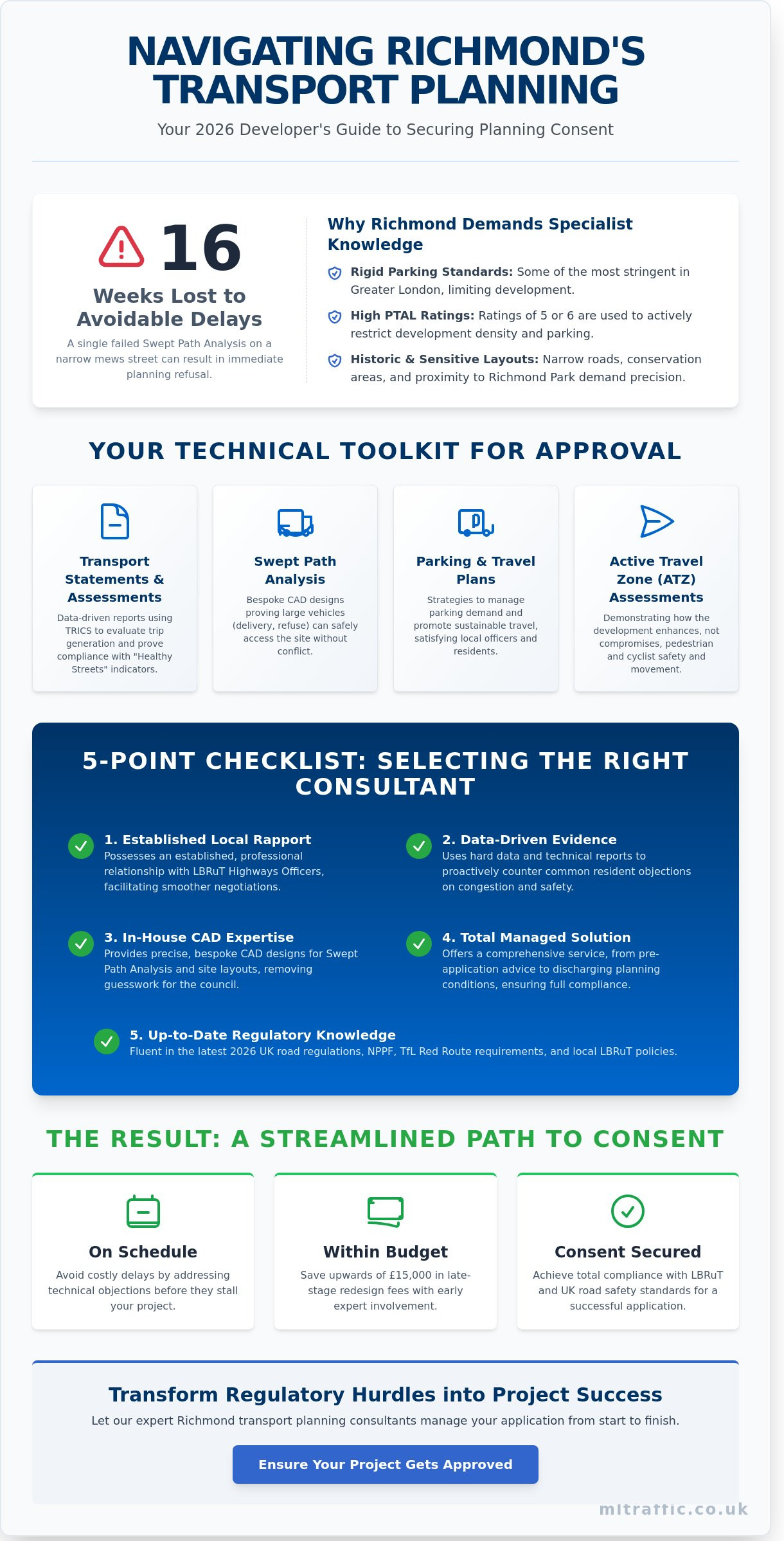
Securing planning permission for a care facility in Richmond often fails not because of the quality of care, but because of the vehicles parked outside. You likely feel the pressure of Richmond’s rigorous highway standards, which frequently lead to frustrating delays or outright refusals for developers. A technical transport assessment for care home in Richmond upon Thames is no longer a simple formality; it’s the critical evidence required to prove your development won’t overwhelm local infrastructure or compromise public safety.
We understand the difficulty of balancing essential clinical access with the borough’s aggressive active travel targets. This guide provides the expert strategies you need to meet Richmond’s specific planning requirements with absolute precision. You’ll learn how to justify parking provision through valid surveys, manage staff trip generation data, and secure essential approval from the Highways Authority. We’ll walk through the vital components of a planning-ready submission, from swept path analysis to comprehensive travel plans. This ensures your project maintains momentum through the regulatory process.
Key Takeaways
- Understand why the LBRuT Local Plan 2026 mandates technical documentation for Class C2 developments and how to meet these rigorous regulatory benchmarks.
- Master the use of TRICS database analysis to provide accurate trip generation data that withstands scrutiny from the Richmond Highways Authority.
- Discover how a comprehensive transport assessment for care home in Richmond upon Thames utilizes Lambeth Methodology parking surveys to justify on-site provision.
- Learn why Swept Path Analysis is a non-negotiable requirement for ensuring safe and reliable access for ambulances, fire tenders, and refuse vehicles.
- Identify the specific Travel Plan incentives, including cycling infrastructure and public transport subsidies, required to align with Richmond’s sustainability targets.
Navigating Richmond’s Planning Requirements for Care Facilities
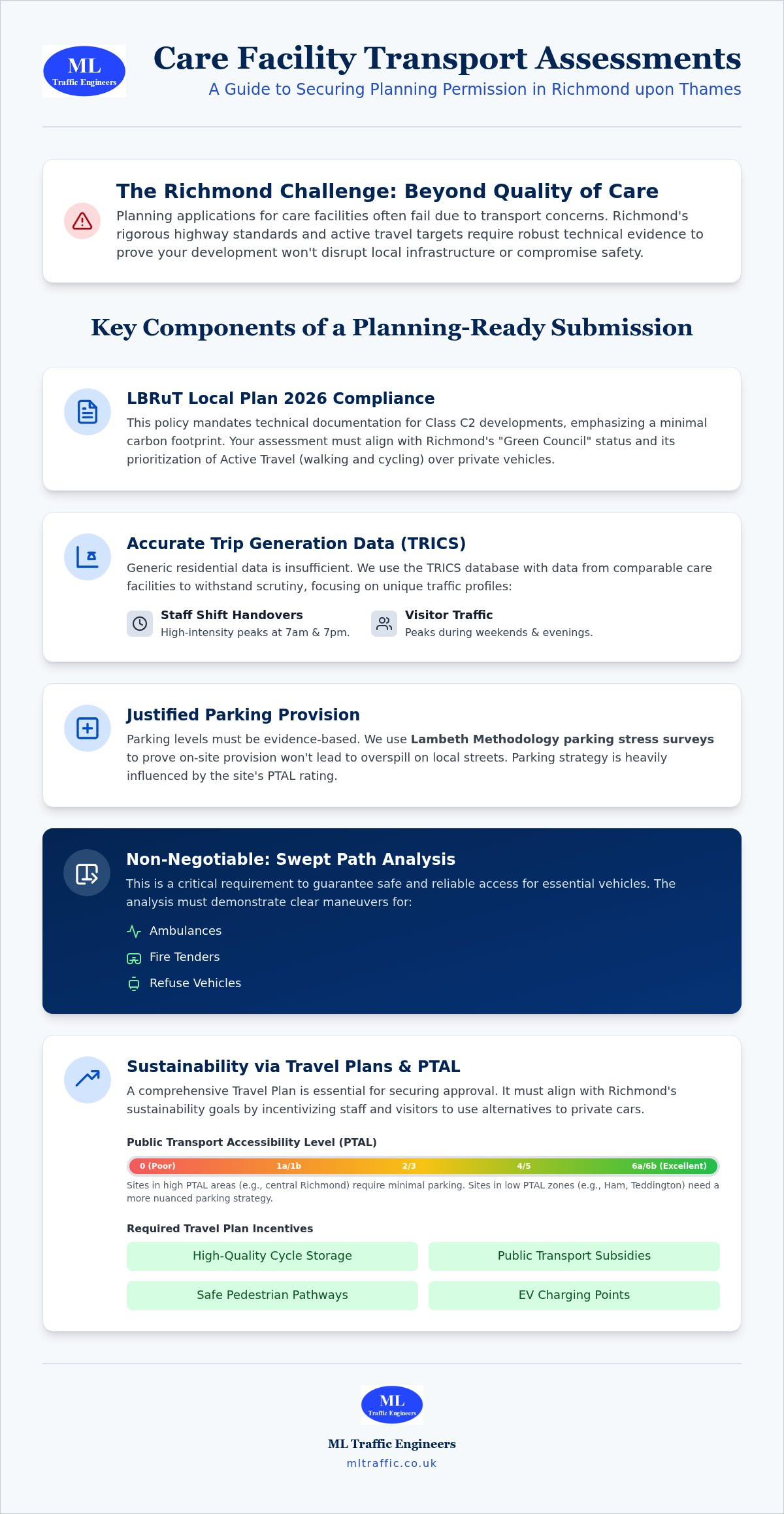
Securing approval for a care facility in the London Borough of Richmond upon Thames (LBRuT) requires a sophisticated understanding of the Local Plan 2026. This policy framework places immense weight on sustainable development and infrastructure capacity. For developers, a transport assessment for care home in Richmond upon Thames isn’t just a box-ticking exercise; it’s the technical backbone of your planning application. The council’s “Green Council of the Year” status means every new Class C2 development must demonstrate a minimal carbon footprint and a proactive approach to traffic management.
Care homes trigger mandatory assessments because of their unique operational profiles. Unlike standard residential blocks, care facilities require 24/7 staffing shifts, frequent medical deliveries, and accessible visitor parking. These factors create complex trip generation patterns that can alarm local residents and planning officers alike. Your assessment must address these concerns directly, providing clear data to mitigate fears of increased congestion or overspill parking on narrow Richmond streets. By integrating your transport strategy with Richmond’s sustainability goals, you transform a potential regulatory hurdle into a compelling argument for the project’s viability. Alongside transport planning, meeting operational healthcare standards is paramount; CQC Consultancy offers the expert guidance needed to navigate registration and compliance for new facilities.
The Impact of Richmond’s Local Plan on Care Homes
The 2026 policy shifts prioritize Active Travel over private vehicle use. Richmond expects care home operators to facilitate cycling and walking for their workforce, regardless of the clinical nature of the site. This involves providing high-quality cycle storage and clear pedestrian pathways that meet modern safety standards. Early engagement with Richmond Highways is essential. It allows you to identify site-specific constraints in areas like Kew or Barnes before you commit to a final site layout. This proactive strategy reduces the likelihood of facing late-stage objections from the Highways Authority.
Transport Statement vs. Transport Assessment
Choosing the right level of reporting is critical for your budget and timeline. In Richmond, the threshold for a full assessment typically depends on the number of beds or the total Gross Floor Area (GFA). While a smaller facility might technically qualify for a Transport Statement, LBRuT often demands a full transport assessment for care home in Richmond upon Thames if the site sits within a sensitive traffic zone. Understanding the Transport Statement vs. Assessment: London Differences helps you determine the necessary depth of data collection. If your development involves significant service vehicle movements or complex swept paths, the technical rigor of an assessment is non-negotiable for securing planning consent.
Core Components of a Richmond Transport Assessment
A successful transport assessment for care home in Richmond upon Thames must move beyond generalities. It requires a granular look at the local highway network in specific areas like Kew, Twickenham, and Barnes. These locations often feature historic, narrow street layouts that struggle with modern traffic volumes. Your baseline study needs to capture current vehicle speeds and existing parking saturation levels to demonstrate that the development won’t push the local system to a breaking point. Precision at this stage is vital for building a credible case for the Highways Authority.
TRICS Data and Care Home Trip Generation
Generic residential trip data isn’t suitable for Class C2 applications. Care homes operate on a round-the-clock basis, which creates unique traffic profiles. We utilize the TRICS database to isolate data from comparable care facilities, specifically accounting for high-intensity shift handovers at 7am and 7pm. These handovers often coincide with local peak hours, requiring a detailed breakdown of how staff arrive and depart. Additionally, visitor traffic typically peaks during weekends and early evenings. Your assessment must prove that these surges won’t cause localized congestion or block access for emergency services.
PTAL Ratings and Sustainable Access
Public Transport Accessibility Level (PTAL) ratings are the primary tool Richmond planners use to determine appropriate parking levels. These scores range from 0 (poor) to 6b (excellent). In high-PTAL areas like central Richmond, the council expects minimal on-site parking. However, developments in lower PTAL zones, such as parts of Ham or Teddington, which often sit at PTAL 1a or 2, require a more nuanced approach. In these scenarios, you must provide a clear justification for parking provision that balances council targets with operational safety. PTAL ratings directly dictate the maximum allowable parking spaces for any new Richmond development, making accurate mapping a priority.
Our team ensures your technical data aligns with these specific regional expectations. You can explore our transport planning resources to see how we handle complex London datasets for care facilities.
Impact on the Highway Network
The final stage of the core assessment involves quantifying the development’s impact on key junctions. Richmond Highways Authority will scrutinize how your projected trip generation affects local capacity. If a project in Barnes adds even a small percentage of traffic to a saturated junction, the council may require mitigation measures. Precision in these early calculations prevents expensive redesigns or planning refusals later in the project lifecycle. We focus on providing the technical certainty needed to move from assessment to approval.
Parking Standards and Stress Surveys in Richmond
Richmond’s parking policies for Class C2 developments are among the most stringent in London. While the council pushes for car-free developments, care homes present a unique challenge that requires a tailored approach. You must provide enough spaces for essential staff handovers and medical visitors without violating LBRuT’s maximum parking standards. A robust transport assessment for care home in Richmond upon Thames provides the necessary technical justification for these essential spaces, ensuring clinical safety isn’t compromised by rigid urban planning targets.
Justifying Parking Provision
Balancing Richmond’s 2026 sustainability targets with operational reality requires precise data. The council expects developers to meet specific electric vehicle (EV) charging quotas, which often involve 20% active and 80% passive provision for new sites. We use Parking Surveys for London Planning Applications to demonstrate that on-site provision remains at an absolute minimum while still meeting the needs of disabled residents and emergency services. This includes dedicated ambulance bays designed for rapid ingress and egress. These bays must feature sufficient clearance for modern, high-roof medical vehicles to ensure they don’t obstruct the public highway or block visibility for other road users.
Mitigating Local Resident Objections
Resident consultations in Richmond often center on the fear of parking displacement, especially near high-traffic zones like the A316 corridors. We counter these subjective claims with objective evidence through Lambeth Methodology parking surveys. These surveys involve counting parked vehicles on surrounding streets during the early hours of the morning, typically between 12:30 am and 5:30 am, across two separate weekday nights. This data proves whether there’s sufficient capacity to absorb occasional overspill from visitors or shift handovers without impacting local residents.
Within Controlled Parking Zones (CPZs), Richmond often restricts new residents from obtaining parking permits. For a care home, the focus shifts to staff who may travel from outside the borough. Your transport assessment for care home in Richmond upon Thames must detail how these movements are managed without adding pressure to existing street capacity. We analyze specific CPZ operating hours in your site’s vicinity to ensure your shift handover times don’t conflict with peak resident parking periods. By providing hard data on overnight and weekend parking stress, we help you secure approval while maintaining positive relations with the local community.
Swept Path Analysis: Ensuring Clinical and Service Access
Richmond’s road network presents significant logistical challenges for large vehicles, especially within historic residential pockets. A transport assessment for care home in Richmond upon Thames must include precise Swept Path Analysis (SPA) to prove that essential service vehicles can maneuver without striking curbs, street furniture, or parked cars. This technical simulation uses specialized software to track the path of a vehicle’s body and wheels throughout a specific maneuver. It’s a non-negotiable requirement for LBRuT, particularly for sites on narrow streets where access is naturally restricted. Without this data, planning officers cannot guarantee that your development won’t lead to highway obstruction.
Emergency Vehicle Maneuverability
Care facilities rely on immediate, unfettered access for emergency services. We model maneuvers for standard London Ambulance Service (LAS) vehicles and fire tenders to ensure compliance with both local and London-wide safety standards. Historic locations in Richmond often feature tight cornering that requires careful site layout design. Our Swept Path Analysis Services in London help developers identify these “pinch points” early. This allows for adjustments to gate widths or junction radii before you submit your formal application, reducing the risk of a refusal based on safety grounds.
Refuse and Delivery Logistics
Daily operations for a care home involve heavy vehicle movements that go beyond resident transport. Refuse collection is a major concern for Richmond Council, which demands clear evidence that collection teams can operate safely. We utilize the standard 11.5m refuse vehicle template for LBRuT modeling, which typically measures 2.53m in width with a 20.4m turning circle. This ensures the vehicle can enter, turn, and exit the site in a forward gear. Forward-gear exit is a standard safety requirement that prevents dangerous reversing maneuvers onto the public highway.
Beyond waste management, you must account for frequent laundry and food deliveries. These vehicles often require dedicated bays that don’t block primary access routes for ambulances. Using AutoTURN Swept Path Analysis, we create detailed overlays that show the exact footprint of these movements. This level of technical detail prevents the council from raising objections regarding highway obstruction. If you need to verify your site layout against Richmond’s strict access standards, contact us for a professional Swept Path Analysis today.
Precision in these models is vital for a planning-ready transport assessment for care home in Richmond upon Thames. We ensure every template used matches the latest London vehicle specifications, providing the technical certainty required by the Richmond Highways Authority. This proactive approach protects your project from costly redesigns and ensures the long-term operational safety of the facility.
Travel Plans: Securing Approval through Sustainability
A Travel Plan acts as the operational commitment that bridges the gap between technical data and real-world behavior. While previous sections of this guide detailed the physical constraints and parking requirements of the site, this strategy manages how staff and visitors actually arrive. Richmond Council demands a clear roadmap for reducing single-occupancy car trips, especially for a workforce that operates 24/7. A bespoke Travel Plan ensures that the final transport assessment for care home in Richmond upon Thames provides a sustainable solution that planners can confidently approve.
Setting realistic modal shift targets for the 2026 to 2031 period requires a deep understanding of the specific needs of care staff. We focus on providing genuine alternatives to the private car, such as car-sharing databases or interest-free season ticket loans. These measures are particularly effective in overcoming objections regarding marginal increases in local traffic. By demonstrating a proactive approach to trip reduction, you show that the facility’s growth is compatible with Richmond’s long-term environmental vision and infrastructure capacity.
Active Travel in Richmond upon Thames
Richmond offers specific local infrastructure that should be leveraged within your submission to satisfy “Green Council” requirements. We incorporate the “Richmond Bikehangars” scheme to provide secure on-street parking for staff who cycle from neighboring areas. Our team also conducts walking route audits to nearby public transport hubs, such as Barnes Bridge or Teddington stations. These audits evaluate lighting, pavement quality, and crossing safety to ensure that walking is a viable and safe choice for late-shift workers. You can find more detail on these requirements in our London Travel Plans: The Essential Guide.
Monitoring and Enforcement
Compliance doesn’t end once you secure planning permission. Most Richmond care home approvals include Section 106 legal obligations that mandate ongoing Travel Plan monitoring for at least five years post-occupation. This typically involves appointing a Travel Plan Coordinator to conduct annual staff surveys and adjust strategies if modal shift targets aren’t being met. This long-term oversight ensures the development remains a good neighbor within the Richmond community and maintains its sustainability credentials. If you need technical support to meet these statutory duties, Contact ML Traffic Engineers UK for a Richmond Transport Assessment Quote. Our specialists ensure your documentation is both rigorous and planning-ready.
Securing Your Care Facility Planning Consent
Navigating the highway requirements in the London Borough of Richmond upon Thames requires technical precision and a deep understanding of the Local Plan 2026. Success hinges on your ability to prove that clinical and service access is safe through specialized swept path analysis and that parking provision is justified by rigorous local stress surveys. A comprehensive transport assessment for care home in Richmond upon Thames acts as the vital evidence needed to overcome resident objections and satisfy the Highways Authority’s strict sustainability benchmarks.
Our team provides the technical reporting necessary for LBRuT compliance, utilizing London-wide planning expertise to manage your project from inception to approval. We specialize in detailed vehicle tracking and data-driven travel plans that align with the borough’s active travel targets. By addressing these regulatory pressures early, you protect your development timeline and ensure the long-term operational safety of your facility. Get an Expert Transport Assessment for Your Richmond Project to move your development forward with technical certainty. We’re ready to help you turn these complex requirements into a successful planning outcome.
Frequently Asked Questions
Do I need a full Transport Assessment for a small 10-bed care home in Richmond?
Richmond Council typically requires a Transport Statement for smaller developments that fall below specific Gross Floor Area thresholds. However, if your site is in a high-traffic area or has complex access requirements, they may mandate a full transport assessment for care home in Richmond upon Thames regardless of bed count. Early engagement with the Highways Authority helps determine the exact reporting level needed to avoid delays during the formal planning process.
What are the current parking standards for care homes in Richmond upon Thames in 2026?
Richmond follows maximum parking standards based on the site’s Public Transport Accessibility Level (PTAL). For Class C2 use, the council expects a minimal approach, prioritizing disabled bays and essential ambulance space over general staff parking. Additionally, new developments must meet 2026 sustainability quotas, which include 20% active and 80% passive electric vehicle (EV) charging point provision for all on-site spaces. This ensures the facility supports the borough’s transition to zero-emission travel.
How does Richmond Council view “car-free” care home developments?
The council strongly favors car-free or car-lite developments, particularly in central Richmond or Twickenham where PTAL scores are high. While this aligns with their “Green Council” objectives, they recognize that care facilities have unique clinical and emergency requirements. You must provide a technical justification for any “essential” parking, such as doctor bays or ambulance loading areas. A robust assessment proves these spaces are necessary for resident safety and won’t encourage unnecessary private car use.
Can I use national trip generation averages for a Richmond-based project?
National averages often fail to reflect the specific traffic pressures of South West London. Richmond Highways Authority expects a transport assessment for care home in Richmond upon Thames to use TRICS data filtered for Greater London or highly comparable suburban sites. This ensures that peak staff handovers and visitor patterns are modeled accurately against the local network’s capacity. Using generic data can lead to objections from planning officers who require site-specific evidence for their decisions.
What vehicle templates are required for Swept Path Analysis in Richmond?
LBRuT requires modeling for several specific vehicle types to ensure safe site access. The most common templates include the standard 11.5m refuse vehicle, a fire tender meeting London Fire Brigade standards, and a London Ambulance Service (LAS) vehicle. We use these templates to perform swept path analysis, demonstrating that each vehicle can enter and exit the site in a forward gear. This prevents hazardous reversing maneuvers on narrow residential roads like those found in Barnes or Kew.
How long does it take to get a Transport Assessment approved by Richmond Council?
The technical review of your assessment occurs during the standard planning application window, which is usually 8 to 13 weeks depending on the project’s scale. However, the approval timeline often extends if the Highways Authority requests additional data or technical revisions. We recommend starting the data collection and survey process at least six weeks before submission. This allows sufficient time to address potential “pinch points” and ensure the final report meets all statutory requirements.
Is a Travel Plan always required alongside a Transport Assessment?
A Travel Plan is almost always required for new care home developments in Richmond to support the borough’s active travel targets. While the assessment identifies traffic impacts, the Travel Plan provides the long-term strategy for managing them. It outlines specific incentives for staff, such as cycle-to-work schemes or public transport subsidies. Richmond planners view a robust Travel Plan as a non-negotiable commitment to reducing the development’s overall carbon footprint and local highway impact.
What happens if my care home project has a low PTAL rating?
Sites with low PTAL ratings, such as those in parts of Ham or Teddington, often face stricter scrutiny regarding parking and staff access. If public transport links are poor, you must provide a more detailed justification for on-site parking to prevent overspill onto local streets. Alternatively, your Travel Plan must include enhanced measures, such as private shuttle services or improved pedestrian links to the nearest bus stops. This balances the council’s car-reduction goals with the practical operational needs of the facility.

Disclaimer
The content on mltraffic.co.uk, including all technical articles, guides, and resources, is provided for general informational and educational purposes only. It is not intended to constitute professional advice in traffic engineering, transportation planning, development approvals, or any other technical or legal field.
While ML Traffic Engineers makes every reasonable effort to ensure the accuracy, completeness, and timeliness of the information published, we do not provide any warranties or representations (express or implied) regarding its reliability, suitability, or availability for any particular purpose. Any reliance you place on the content is strictly at your own risk.
In no event shall ML Traffic Engineers, its directors, employees, authors, or affiliates be liable for any direct, indirect, incidental, special, consequential, or punitive damages (including, without limitation, loss of profits, data, or business opportunities) arising out of or in connection with the use of, or inability to use, any information provided on this website.
The articles and guides on this site are not a substitute for engaging a qualified, professional traffic engineer to assess your specific project requirements. For tailored advice, compliance assessments, or traffic engineering services, please contact a competent professional.
This disclaimer may be updated from time to time without notice. By accessing or using this website, you agree to be bound by the most current version of this disclaimer.