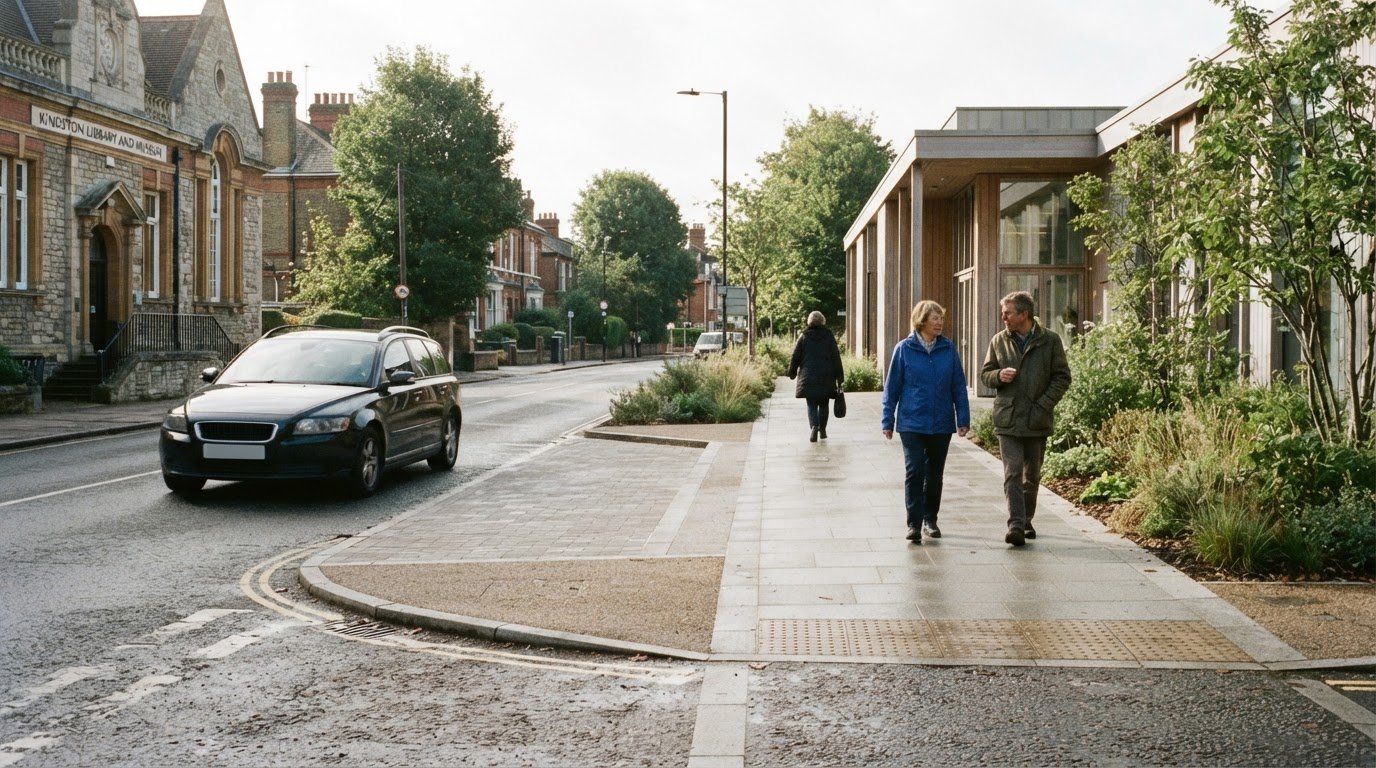
A leisure centre’s transport impact is shaped by its setting as well as its facilities. A transport assessment for a new leisure centre in Kingston upon Thames should examine how visitors and staff can reach the site, how access and parking are arranged, and how journeys interact with the surrounding streets. The project site covers 1.2 hectares and sits in a conservation area north of Fairfield Park, beside Kingston Library and Museum.
For a leisure centre in Kingston upon Thames, a transport assessment considers walking, cycling, public transport, vehicle access and parking together. The proposal includes new pedestrian links and changes to vehicle access, so how the site connects with its town-centre surroundings is central to the analysis.
This article explains how the project area, town-centre setting and the leisure centre’s location shape the transport evidence required. It also shows how to assess visitor movements and access arrangements using the proposed details, rather than treating every leisure development alike.
Key Takeaways
- See how the project’s scale and mix of leisure and community uses shape the transport questions an assessment needs to address.
- Understand why a town-centre conservation setting calls for careful consideration of how site access and nearby public spaces work together.
- Learn how the former leisure centre site’s position and proposed access arrangements influence the assessment’s focus.
- Find out which development characteristics help determine the transport evidence and planning considerations relevant to a proposal.
- Discover how a tailored Transport Assessment, supported by relevant surveys or swept path analysis, can address project-specific planning needs.
Project area
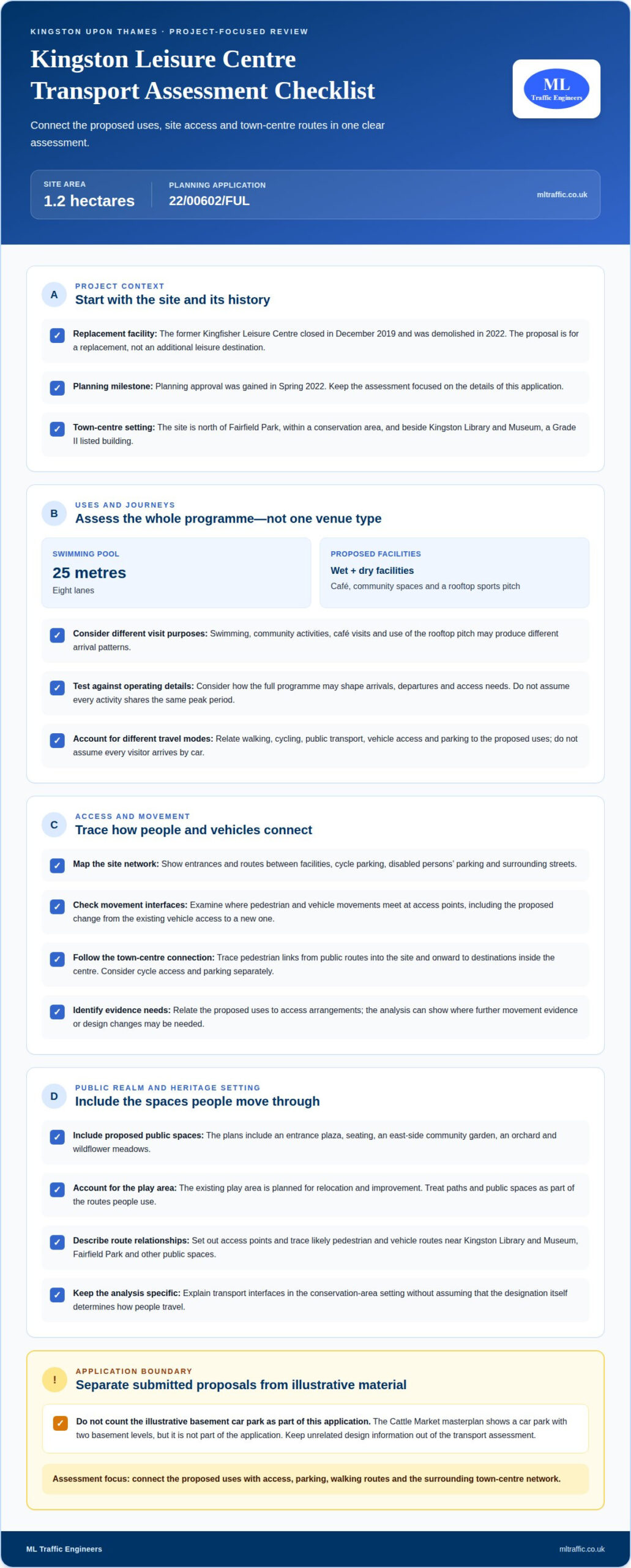
The Kingston Leisure Centre project combines leisure, community and public-realm uses on one site. Its planning application, 22/00602/FUL, concerns a new building and associated changes around the former Kingfisher Leisure Centre. The former centre closed in December 2019 and was demolished in 2022. Those dates help explain why the proposal involves a replacement facility rather than an additional leisure destination. A transport assessment for a new leisure centre in Kingston upon Thames needs to reflect that specific project context.
Planning approval was gained in Spring 2022. The proposed building includes wet and dry facilities, a café and community spaces. Its planned swimming pool is 25 metres long, with eight lanes. These uses can attract different visitors throughout the day. An assessment therefore needs to consider how the full programme may shape arrivals, departures and access needs, rather than treating the building as a single-purpose venue.
The proposal extends beyond the building itself. It includes cycle parking, disabled persons’ parking, landscaping and changes to vehicle access, as well as new pedestrian links intended to connect the site with Kingston town centre. These elements form a network of entrances, paths, parking areas and connecting routes. A transport assessment for a new leisure centre in Kingston upon Thames should relate each component to the proposed uses.
Illustrative project-area example
Situation: One visitor may arrive for swimming, while another attends a community activity or uses the café. The proposed rooftop sports pitch adds another use to consider. These activities may have different arrival patterns, which the assessment should test against the proposed operating details.
Action: Map each entrance and the routes between facilities, cycle parking, disabled persons’ parking and surrounding streets. Then examine how pedestrian and vehicle movements meet at access points. The proposed change from an existing vehicle access to a new one should also be assessed as part of this layout.
Result: This approach shows planners how the proposed uses relate to access arrangements and where further movement evidence or design changes may be needed. It avoids assuming that every visitor arrives by car or that all activities share the same peak period.
The application includes public realm on every side of the centre. Its landscape proposals include an entrance plaza, seating, an east-side community garden, an orchard and wildflower meadows. The existing play area is also planned for relocation and improvement. These details matter because paths and public spaces form part of the routes people use, not merely the setting around the building.
For this project, the assessment should connect proposed uses with access, parking and walking routes, while distinguishing application proposals from illustrative material. For instance, an illustrative Cattle Market masterplan shows a car park with two basement levels, but this is not part of the application. Keeping the distinction clear prevents unrelated design information from influencing the assessment.
Town-centre location and conservation-area context
The Kingston Leisure Centre site adjoins Kingston Library and Museum, a Grade II listed building. It is also within a conservation area, north of Fairfield Park. This context makes the relationship between routes, entrances and surrounding public spaces important. The analysis should explain how the development connects with the town centre, rather than treating the site as an isolated destination.
Being in a conservation area does not, by itself, determine how people travel. The assessment should examine how the proposed layout affects access. For example, a pedestrian route towards Kingston town centre may cross vehicle movements near an entrance. Mapping this interface shows where people walk and where vehicles enter or leave. The analysis can also consider cycle access and parking without assuming that all journeys use the same mode.
Example: access beside a heritage setting
Situation: The proposed centre sits beside Kingston Library and Museum. The planning application also includes a single-storey extension to the listed building. Access proposals therefore need to be understood in relation to the surrounding buildings and public realm.
Action: Set out the proposed access points and trace likely pedestrian and vehicle routes around them. Identify where these routes pass close to the library and museum, Fairfield Park or other public spaces. This explains how movement patterns relate to the site without making unsupported assumptions about heritage effects.
Result: The assessment gives the planning authority a clearer picture of the development’s transport interfaces and distinguishes movement considerations from design decisions about the listed building or conservation area.
The project’s design process involved consultation with Royal Borough of Kingston upon Thames planning and urban design officers, conservation officers, Historic England, the Design Review Panel, local residents, stakeholders and interest groups. This engagement reflects the range of interests around a town-centre site. The transport analysis should explain how the proposed routes and access arrangements work in this setting.
Consider a visitor walking from the town centre. The assessment can describe the connection between the public route, site entrance and destination inside the centre. Separately, it can consider a vehicle arriving at the proposed access and any interaction with nearby pedestrians. This step-by-step account helps show whether the layout makes movement clear and coherent.
The application proposes public realm around the centre, the pedestrianisation of an existing vehicle access and a new vehicle access. This makes the change in movement patterns relevant. The assessment should identify which access changes are part of the application and explain how they affect routes around the site.
For a useful transport assessment for planning applications, the report should connect location, access and movement evidence. In Kingston, that means addressing the conservation-area setting through clear site-specific analysis, while keeping transport conclusions distinct from heritage design matters.
Leisure centre site and location
The application covers the former Kingfisher site at The Kingfisher, Fairfield Road, Kingston upon Thames, KT1 2PY. The project area is 1.2 hectares, giving the assessment a defined site boundary for analysing access, parking and travel movements. The former centre was demolished in 2022, and the new facility is planned on that site.
What are the parking standards for leisure centres in Kingston upon Thames? Assess parking provision against relevant planning policy, the site’s proposed uses, accessibility and travel options. The application includes cycle parking and disabled persons’ parking. The project information does not set out a numerical parking standard.
What traffic surveys and trip-generation data are needed? Establish existing traffic and movement conditions near the site, then estimate travel associated with the proposed activities. Evidence may include vehicle, pedestrian and cycle counts, supported by trip assumptions that reflect the centre’s facilities and operating pattern.
How many vehicle, walking, cycling and public-transport trips might the centre generate? The project information does not provide trip totals. The assessment should estimate travel using the proposed uses, expected attendance patterns and relevant local evidence, considering each travel mode separately.
What public transport serves the proposed site? Identify bus and rail connections accessible from the Fairfield Road site and explain how they relate to visitor journeys. Use service and access information relevant to the location rather than assuming every visitor arrives by car.
What walking and cycling improvements should be considered? Examine links between the site, Kingston town centre and nearby destinations, including the proposed pedestrian links. Consider how cycle access connects with the cycle parking included in the application.
How should the assessment evaluate safety, congestion and junction capacity? Examine movement conflicts at access points, traffic conditions on relevant nearby roads and the operation of affected junctions. The proposed vehicle access is a specific location for assessing how vehicles enter and leave the site.
What travel plan measures should be considered? Choose measures that respond to the site’s access and travel evidence. A plan could provide practical information to support walking, cycling and public transport, alongside measures relevant to staff and visitors.
Which impacts and mitigation measures should be assessed? Relate predicted travel to access, parking, pedestrian routes and nearby junctions. Where the analysis identifies a specific issue, proposed mitigation should address it directly and relate to the application.
Example, situation: A swimming session and a community activity may attract visitors at overlapping times. Action: Test the resulting movement assumptions against local survey evidence and the site layout. Result: The assessment can show where access or route changes may be needed without inventing trip totals.
For the Fairfield Road proposal, strong analysis links each movement estimate to a specific facility, route or access point. This provides a traceable basis for assessing the development’s transport effects.
What transport assessment requirements apply to new developments in Kingston upon Thames?
For a Kingston development, transport evidence should explain how the proposal affects access and movement around its site. The appropriate scope depends on the development’s scale, proposed uses, location and likely transport effects. There is no project-specific numerical threshold in the available facts that can be applied to every application. A clear assessment therefore links its evidence to the proposal rather than relying on a generic checklist.
The first step is to define the development being assessed. For the Kingfisher application, 22/00602/FUL, that means identifying the proposed leisure and community uses, access arrangements and surrounding routes. The report then sets out its study area and explains why nearby streets or junctions are relevant. This makes the relationship between the application and the transport analysis traceable.
Start by establishing existing conditions. Depending on the proposal and available evidence, this may include traffic counts, pedestrian and cycle activity, parking conditions, access layout and public transport connections. Survey locations should relate to journeys the development may affect. Counts near a site access, for example, can describe movements there, while a junction survey can inform analysis of that junction.
Explain how trip generation is assessed. Set out the assumptions used to estimate travel for each proposed use, then consider how journeys may be distributed across modes and routes. Swimming, sports and community activities may have different visitor patterns. The report should explain how these uses inform its estimates instead of presenting a total without context.
Assess effects using those estimates. Consider whether vehicle movements could affect nearby junction operation and whether pedestrian and cycle routes connect coherently with the site. Identify relevant interactions between vehicles and people walking or cycling. If the analysis finds an issue, explain its likely significance and relate any proposed response to that issue.
The Kingston proposal shows why application details matter. Changes to access, cycle parking and pedestrian links give the assessment specific features to analyse in relation to the routes and movements they serve. Distinguish the submitted application from illustrative material so that features in an unsubmitted masterplan are not treated as transport proposals.
Planning evidence should be easy for decision-makers to follow. A useful structure describes the proposal and existing conditions, explains assumptions, presents effects and sets out relevant mitigation. Conclusions should follow from the evidence. For the Kingston Leisure Centre, show how the proposed uses and access arrangements inform the analysis, rather than relying on unsupported trip totals or general claims about congestion.
The evidence required depends on the development and its location. A focused assessment for the Kingfisher site should make its methods, assumptions and conclusions clear and address the transport effects of the actual application.
Which planning and transport policies guide transport assessments in the Royal Borough of Kingston upon Thames?
A transport assessment in Kingston should explain how its conclusions relate to planning policies applicable to the application. The project information identifies the Royal Borough of Kingston upon Thames but does not name individual policy documents. Identify the relevant adopted development-plan policies and national planning framework, then show how the transport evidence addresses them.
Start with the application itself. The Kingfisher proposal is associated with application reference 22/00602/FUL. Its transport analysis should be read alongside the uses, access changes and site layout submitted for that application. This keeps the policy discussion tied to the development being considered, rather than relying on broad statements about leisure centres.
Connect each relevant policy theme to evidence. For example, if a policy concerns accessible movement, describe pedestrian and cycle connections, site entrances and links towards Kingston town centre. If it concerns transport effects, explain the traffic assumptions and examine relevant routes or junctions. Each policy point should lead to a clear assessment task.
The conservation-area setting is another planning consideration. The site adjoins Kingston Library and Museum, and the design process involved Royal Borough conservation officers, Historic England and the Design Review Panel. Keep movement analysis clear while recognising that access proposals sit within a wider planning context. Transport evidence does not replace heritage or design assessment.
Situation: A proposed access change may affect pedestrian and vehicle movements around the Kingfisher site. Action: Describe the change, examine movement evidence and relate the findings to relevant planning considerations. Result: Decision-makers can see how the transport analysis relates to the actual proposal and its setting.
Consultation also informs this context. The project team engaged planning and urban design officers, local residents, stakeholders and interest groups. Their involvement does not replace policy or technical analysis, but it reinforces the value of explaining access arrangements clearly, including how proposed routes relate to people using the surrounding area.
Structure the policy review around the application’s effects: identify relevant policy themes, state the evidence, explain the analysis and show how the conclusions follow. For Kingston’s leisure centre, connect the submitted access and movement proposals with the site’s town-centre and conservation-area context.
A focused policy assessment avoids unsupported claims about specific rules. It identifies the planning context, explains how the evidence addresses it and distinguishes transport findings from other planning matters. This gives the Royal Borough a clear basis for considering the application.
Guide the transport assessment by the applicable adopted development-plan policies and national planning framework. Relate policies on accessible movement and transport effects to evidence about routes, access and the proposal, while recognising the site’s conservation-area setting.
ML Traffic Engineers UK: Transport Assessments
ML Traffic Engineers UK prepares Transport Assessments and Transport Statements for development planning applications. For a leisure centre, a project-specific assessment can bring together access arrangements, travel evidence and likely transport effects. Parking Surveys can establish existing parking conditions, while Swept Path Analysis can assess whether vehicles can manoeuvre through proposed access areas.
Turn to ML Traffic Engineers UK when a planning application needs clear transport evidence grounded in its location, proposed uses and access layout. The analysis can address the questions raised by a town-centre site without assuming every project has the same travel patterns or requirements.
To discuss transport assessment requirements for a development, contact ML Traffic Engineers UK.
Move your planning evidence forward
A transport assessment for a new leisure centre in Kingston upon Thames is most useful when its scope reflects the design and the planning questions the application must answer. Changes to entrances, parking or pedestrian routes can affect the evidence and analysis. Keeping the assessment aligned with the current design maintains a clear link between proposed arrangements and reported transport effects.
Define the project information and decisions that will shape the assessment. Clear drawings, proposed uses and access details provide a practical basis for the work and help identify where survey evidence or further analysis can support the planning case. A precise scope keeps the assessment focused on the development’s actual transport considerations.
For support with planning transport evidence, contact ML Traffic Engineers UK. A clear starting point can help you progress the assessment with confidence.
Frequently Asked Questions
What is a transport assessment for a proposed leisure centre in the UK?
A transport assessment is a technical report explaining how a proposed development may affect travel and transport networks. For a leisure centre, it examines how different activities influence visitor and staff journeys and sets out the evidence behind its conclusions. For example, it can distinguish assumptions for different facilities rather than treating every visit as identical, giving decision-makers a reasoned account of the transport implications.
What are the parking standards for leisure centres in Kingston upon Thames?
Assess parking provision against relevant planning policy, the proposed uses, site accessibility and travel options. The application includes cycle parking and disabled persons’ parking.

Disclaimer
The content on mltraffic.co.uk, including all technical articles, guides, and resources, is provided for general informational and educational purposes only. It is not intended to constitute professional advice in traffic engineering, transportation planning, development approvals, or any other technical or legal field.
While ML Traffic Engineers makes every reasonable effort to ensure the accuracy, completeness, and timeliness of the information published, we do not provide any warranties or representations (express or implied) regarding its reliability, suitability, or availability for any particular purpose. Any reliance you place on the content is strictly at your own risk.
In no event shall ML Traffic Engineers, its directors, employees, authors, or affiliates be liable for any direct, indirect, incidental, special, consequential, or punitive damages (including, without limitation, loss of profits, data, or business opportunities) arising out of or in connection with the use of, or inability to use, any information provided on this website.
The articles and guides on this site are not a substitute for engaging a qualified, professional traffic engineer to assess your specific project requirements. For tailored advice, compliance assessments, or traffic engineering services, please contact a competent professional.
This disclaimer may be updated from time to time without notice. By accessing or using this website, you agree to be bound by the most current version of this disclaimer.