
A single technical error in a Transport Statement can stall a multi-million pound development for months, costing far more than the initial report itself. You likely understand the frustration of facing unpredictable Local Highway Authority (LHA) requirements or being forced into expensive design changes late in the process. Securing a reliable highway planning consultant is no longer just a box-ticking exercise. It’s a strategic necessity for any developer looking to mitigate risk and ensure project viability in 2026.
We understand that precision is a functional necessity in this high-stakes environment. This guide explains how specialist technical oversight ensures your project meets rigorous UK regulatory standards from the first assessment. You’ll discover how a specialist consultant navigates regulatory hurdles and technical requirements to secure planning approval for your development. We’ll outline the roadmap for Section 278 and 38 agreements and explain how to use Swept Path Analysis to optimise your site layout. By the end of this article, you’ll have a clear strategy for managing data collection, reports, and LHA negotiations to ensure a successful planning submission.
Key Takeaways
- Learn how a specialist highway planning consultant acts as a vital technical liaison to resolve Local Highway Authority objections and justify complex site layouts.
- Understand the specific regulatory triggers that distinguish a Transport Statement from a full Transport Assessment to ensure your submission meets UK planning benchmarks.
- Discover why Swept Path Analysis is a non-negotiable requirement for securing refuse vehicle and fire tender access approval during the initial design phase.
- Gain a clear roadmap for transitioning from planning permission to technical highway implementation through Section 278 and Section 38 agreements.
- Identify the critical data requirements, including specialist parking surveys, needed to support development viability in areas with strict sustainable transport mandates.
What is a Highway Planning Consultant and Why Do You Need One?
A highway planning consultant serves as the essential technical bridge between a developer’s vision and the Local Highway Authority’s (LHA) rigid safety requirements. They manage the complex process of Transportation planning to ensure every vehicle movement is accounted for. This expertise is vital because highway issues are among the most common reasons for planning refusals in the UK. We act as your technical liaison, translating engineering constraints into a layout that satisfies both your commercial goals and the LHA’s standards.
To better understand the core requirements of this role, watch this helpful guide on transport assessments:
The 2026 updates to the National Planning Policy Framework (NPPF) prioritise sustainable travel and carbon reduction. This shift makes it harder to secure approval for car-dependent sites without robust justification. A specialist highway planning consultant uses empirical data to demonstrate that a site remains safe and viable under these new rules. Engaging an expert early in the project lifecycle prevents technical errors in reports that lead to “reasons for refusal” regarding highway safety or junction capacity.
The Intersection of Transport Planning and Development
Local authorities apply varied borough parking standards that can significantly impact site density. We interpret these local nuances alongside “Manual for Streets” guidance to find a balance between developer profit and public safety. By 2026, environmental standards also dictate how we approach vehicle access and drainage. Our role involves ensuring the site layout accommodates everything from fire tenders to refuse trucks while maintaining high safety benchmarks. We help you understand what we do to turn these constraints into opportunities for better site design.
When to Appoint a Specialist Consultant
You should appoint a consultant during the pre-application phase to identify “deal-breakers” before purchasing land. Identifying a lack of visibility or inadequate road width early saves thousands in wasted fees. For a full planning submission, our technical reports provide the professional backing needed to satisfy the LHA. If you face a refusal, we act as expert witnesses during the appeal process to challenge objections with factual traffic data and rigorous analysis.
In addition to physical site assessments, professional financial due diligence is essential; developers frequently explore RICS Property Valuation Services to secure the independent Red Book reports necessary for investment and project appraisal.
Transport Statements vs. Assessments: Navigating UK Requirements
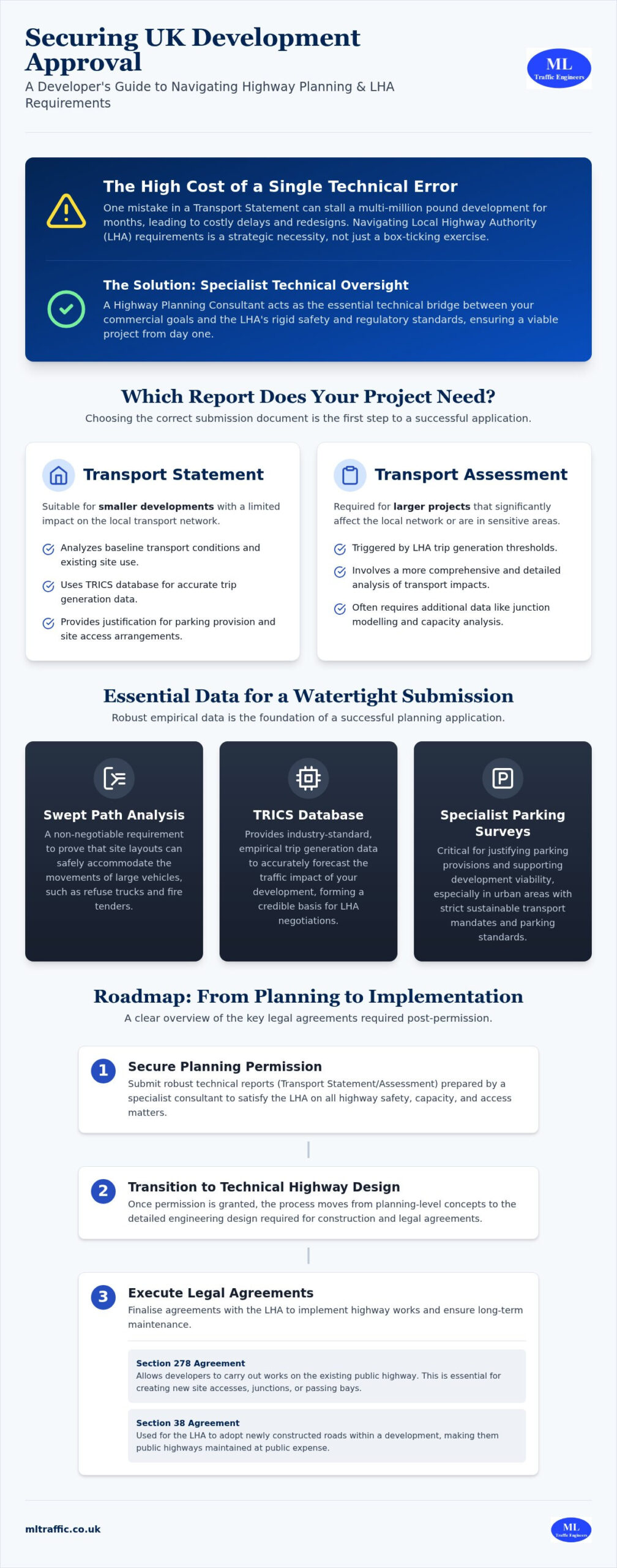
Developers often struggle to determine which technical document is required for their planning submission. A highway planning consultant provides the clarity needed to avoid over-scoping or under-preparing your application. Generally, a Transport Statement is suitable for smaller developments with limited traffic impact. In contrast, a Transport Assessment is necessary for larger projects that significantly affect the local network. Local Highway Authorities (LHAs) typically trigger a full Assessment based on specific trip generation thresholds or if the development is located in a sensitive area. Following the UK guidance on Transport Assessments ensures your submission aligns with national expectations from the outset.
What Goes into a Professional Transport Statement?
A robust Statement must establish clear baseline transport conditions. This involves analyzing existing site use and current transport infrastructure to provide a benchmark for comparison. We use the TRICS (Trip Rate Information Computer System) database to provide accurate trip generation data for the proposed development. This technical data justifies your parking provision and access arrangements to the LHA. For developers working in the capital, our Transport Assessment London: The Developer’s 2026 Guide to Planning Success offers deeper insight into these regional variations.
The Role of Travel Plans in Modern Planning
Travel Plans are no longer optional extras; they’re critical supporting documents for sustainable development. A Workplace Travel Plan focuses on employee commuting habits, while a Residential Travel Plan targets household travel patterns. These documents propose active measures, such as cycle storage or car-sharing schemes, to reduce reliance on private vehicles. By proving that a site won’t overwhelm local junctions, you significantly improve your chances of approval. Partnering with expert Travel Plan Consultants: Strengthening Planning Applications in 2026 helps you navigate these requirements with precision.
Precision in these technical documents prevents costly delays during the planning cycle. If you’re unsure which report your project requires, a highway planning consultant can review your site plans and provide a definitive recommendation. Our team manages the entire process from initial data collection to final report delivery. You can explore our full range of transport planning services to see how we support UK developers with reliable technical backing and unwavering reliability.
Technical Data: Swept Path Analysis and Parking Surveys
Data provides the foundation for any successful planning negotiation. While policy sets the stage, technical simulations prove that a development functions safely in the real world. A highway planning consultant uses empirical evidence to resolve Local Highway Authority (LHA) objections before they lead to a refusal. This data-driven approach is essential for justifying modern site layouts that must balance high density with strict access requirements. Adhering to UK Government guidance on Transport Assessments ensures that your technical evidence meets the rigorous standards expected by planning officers.
Swept Path Analysis for Site Feasibility
Swept Path Analysis (SPA) is a digital simulation of vehicle movements through a proposed site. It’s a non-negotiable requirement for securing approval for refuse vehicle and fire tender access. We use industry-standard software like AutoTURN to model specific vehicle templates against your site layout. Common vehicles we model include:
- 11.4m refuse collection vehicles
- Standard UK fire tenders
- Heavy Goods Vehicles (HGVs) for commercial sites
- Large cars for tight basement parking ramps
SPA prevents costly site redesigns by proving access feasibility at the layout stage. If a vehicle cannot safely navigate a turn or a junction, we identify the issue early. This allows for minor adjustments to kerb lines or building footprints before you submit your final plans. You can find more technical details in our AutoTURN Swept Path Analysis: A Practical Guide for 2026.
Parking Surveys and the Lambeth Methodology
In urban areas with high Public Transport Accessibility Levels (PTAL), developers often propose “parking-light” or car-free developments. However, LHAs frequently worry that residents will still own cars and park them on local streets. To overcome this, we conduct specialist parking surveys to assess “parking stress” on the surrounding network. We typically perform these surveys overnight when residential parking demand is at its peak.
The Lambeth Parking Survey methodology is the gold standard for this work, particularly in London and the South East. It provides a consistent framework for measuring how many on-street spaces are available within a 200-metre walk of the site. By providing factual data on local capacity, a highway planning consultant can demonstrate that a development won’t cause overspill issues. This technical backing is often the deciding factor in securing approval for developments with limited on-site parking provision.
Negotiating with Local Authorities and Section 278 Agreements
Securing planning permission is a significant milestone, but it’s only the first step in the technical implementation phase. Once you have a ‘Resolution to Grant’, the focus shifts from policy compliance to engineering precision. An experienced highway planning consultant manages this transition, ensuring your project moves from paper to pavement without costly delays. This stage involves formal legal agreements that dictate how you interact with the existing road network and how new infrastructure is adopted. Understanding these legal frameworks is essential for maintaining your project timeline and budget.
A Section 278 (S278) agreement is required when a developer needs to make permanent alterations or improvements to the public highway. This could include creating a new site access, installing a mini-roundabout, or widening a footway. Conversely, a Section 38 (S38) agreement relates to the adoption of new roads within the development site. When the LHA adopts these roads, they take over future maintenance responsibilities, provided the infrastructure meets their strict construction standards. For a detailed breakdown of these requirements, see our Highway Design S278 & S38: The London Developer’s Guide for 2026.
The S278 Approval Process
The transition to technical approval follows a logical, sequential path that requires constant attention to detail. The process typically begins once planning permission is secured, moving through these critical stages:
- Technical Submission: You must submit detailed engineering designs to the LHA for a full technical audit. These drawings must comply with national standards and specific local variations.
- Bond Negotiation: The LHA will calculate a bond amount based on the estimated cost of the highway works. This acts as financial security to ensure the works are completed to a safe standard.
- Inspection and Fees: Developers must pay inspection fees to the council, covering the cost of LHA officers visiting the site to verify that the construction matches the approved plans.
Overcoming LHA Objections
LHA requirements can sometimes feel unpredictable or disproportionate to the site’s actual impact. We use the technical data from your Transport Assessment to challenge unreasonable demands with factual evidence. Engaging a highway planning consultant during the pre-application stage allows us to align with council expectations before you’ve committed to a final design. This proactive approach reduces the risk of ‘Grampian’ conditions, which are planning requirements that prevent development from starting until specific off-site highway improvements are completed. We ensure that any requested improvements are necessary, relevant, and commercially viable for your project.
Reliable technical backing is the only way to navigate these high-stakes negotiations successfully. Speak with our highway planning consultants today to secure an all-encompassing managed service for your next development.
Why Choose ML Traffic Engineers as Your Highway Consultant?
ML Traffic Engineers UK has provided specialist transport planning since our founding in 2014. We operate across England, delivering a level of precision that is a functional necessity for high-stakes developments. Unlike firms that outsource their data collection, we maintain a dual capability. We manage everything from the initial traffic survey to the final technical report. This all-encompassing managed service reduces the regulatory pressure on your team. As your highway planning consultant, we act as a vital guardian of project safety and compliance.
Our team understands that highway planning is a data-led negotiation. We combine technical authority with a client-focused approach to ensure your project remains on track. We take pride in our adherence to industry benchmarks and legislative requirements. This reliability is why developers trust us to handle complex infrastructure requirements. We provide a reassuring presence throughout the planning lifecycle, ensuring that technical data supports your commercial objectives.
Expertise Across Diverse Project Types
We manage a broad range of ML Traffic Project Types, including large-scale residential developments, commercial units, and complex mixed-use sites. Our expertise is particularly valuable in London. We navigate intricate borough requirements such as PTAL assessments and Lambeth parking surveys with ease. We understand the high-stakes environment of urban planning. We provide the technical backing needed to satisfy even the most demanding Local Highway Authorities. Whether your site is a small residential infill or a major industrial hub, our sequential approach ensures every technical hurdle is cleared before it becomes a delay.
Get Started with a Technical Review
Early engagement is the most effective way to protect your project from unpredictable LHA requirements. Identifying technical constraints during the feasibility stage allows for an optimised site layout. This avoids costly redesigns later in the process. We provide the clarity and readiness required to move your project from inception to completion. As your highway planning consultant, our experts are ready to review your site plans and identify any potential issues before you submit your application.
If you are preparing a planning submission for 2026, don’t leave your highway strategy to chance. Precision at the start of the process ensures a successful outcome at the end. Contact ML Traffic Engineers UK for a Transport Statement quote to secure a dependable partner for your development. We provide the comprehensive support you need to navigate the UK’s strict regulatory environment with confidence.
Securing Your Project Viability for 2026 and Beyond
Navigating the UK’s evolving regulatory environment requires more than just paperwork. It demands technical precision and a data-led strategy that survives Local Highway Authority scrutiny. By integrating Swept Path Analysis and specialist parking surveys early in your design phase, you eliminate the risk of late-stage design changes and costly delays. A dedicated highway planning consultant ensures your site layout is optimised for safety while meeting the strict sustainable transport mandates of the 2026 planning landscape.
Since 2014, we’ve provided developers across England with the comprehensive guidance needed to manage full project lifecycles. We handle everything from initial Transport Statements to complex Section 278 and 38 agreements. Our all-encompassing managed service reduces your regulatory pressure so you can focus on construction and delivery. We remain ready to provide the professional backing and technical authority your development requires to succeed. Secure your planning approval with expert highway consultancy from ML Traffic Engineers. We look forward to supporting your next successful submission.
Frequently Asked Questions
What is the difference between a transport statement and a transport assessment?
A Transport Statement is typically required for smaller developments with lower traffic impacts, while a Transport Assessment is necessary for larger projects that significantly affect the local network. Local Highway Authorities use specific trip generation thresholds to determine which report you need. We review your site plans to ensure you submit the correct documentation. This prevents over-scoping your project while satisfying all technical requirements for planning approval.
When is swept path analysis required for a planning application?
Swept Path Analysis (SPA) is required whenever a development needs to prove that specific vehicles can safely enter, turn, and exit the site. It’s a non-negotiable requirement for refuse collection and fire tender access. We use digital simulations to model these movements against your proposed layout. This technical evidence is vital for securing approval from the Local Highway Authority and avoiding expensive site redesigns later in the process.
How much does a highway planning consultant cost in the UK?
The cost of hiring a highway planning consultant depends on the complexity of your site and the specific reports required by the council. Fees generally reflect the level of technical data collection and engineering analysis involved. While we don’t provide fixed pricing here, investing in professional technical backing early often prevents costly planning delays and design errors. You should request a tailored quote based on your project’s unique requirements.
Can a highway consultant help if the council has already objected?
Yes, a consultant can often resolve objections by providing factual technical data to challenge the council’s concerns. We review the specific reasons for refusal and use evidence from traffic surveys or swept path analysis to prove the development is safe. This technical negotiation is often the only way to overcome highway-related objections. We act as your dependable highway planning consultant to find a technical solution that satisfies the Local Highway Authority.
What is a Section 278 agreement in simple terms?
A Section 278 agreement is a legal contract between a developer and the Local Highway Authority for works on the existing public highway. This is necessary if your development requires a new site access, junction improvements, or footway widening. It ensures that any changes to the public road are constructed to a safe, adoptable standard. We provide the technical designs and guidance needed to navigate this complex legal and engineering process.
Do I need a parking survey for a small residential conversion?
You may need a parking survey if your conversion is in an area with high parking stress or if you aren’t providing on-site spaces. Local authorities often worry about overspill parking on surrounding streets. We use the Lambeth methodology to assess local capacity and prove your project won’t negatively impact the neighbourhood. This data is essential for justifying “parking-light” developments in urban areas with high public transport accessibility.
How long does it take to produce a Transport Statement?
The timeline for producing a Transport Statement varies based on the availability of traffic data and the complexity of the site. It generally takes several weeks to complete the necessary surveys and technical analysis. We prioritise efficiency to meet your planning deadlines while ensuring every report meets rigorous industry benchmarks. Early engagement is the best way to ensure your documentation is ready for a successful and timely planning submission.
What is the TRICS database and why is it used?
TRICS (Trip Rate Information Computer System) is the industry-standard database used to predict the amount of traffic a new development will generate. It contains data from thousands of existing sites across the UK and Ireland. We use this system to provide empirical evidence of your project’s impact on the local road network. This factual approach is preferred by planning officers because it relies on real-world observations rather than theoretical guesswork.

Disclaimer
The content on mltraffic.co.uk, including all technical articles, guides, and resources, is provided for general informational and educational purposes only. It is not intended to constitute professional advice in traffic engineering, transportation planning, development approvals, or any other technical or legal field.
While ML Traffic Engineers makes every reasonable effort to ensure the accuracy, completeness, and timeliness of the information published, we do not provide any warranties or representations (express or implied) regarding its reliability, suitability, or availability for any particular purpose. Any reliance you place on the content is strictly at your own risk.
In no event shall ML Traffic Engineers, its directors, employees, authors, or affiliates be liable for any direct, indirect, incidental, special, consequential, or punitive damages (including, without limitation, loss of profits, data, or business opportunities) arising out of or in connection with the use of, or inability to use, any information provided on this website.
The articles and guides on this site are not a substitute for engaging a qualified, professional traffic engineer to assess your specific project requirements. For tailored advice, compliance assessments, or traffic engineering services, please contact a competent professional.
This disclaimer may be updated from time to time without notice. By accessing or using this website, you agree to be bound by the most current version of this disclaimer.