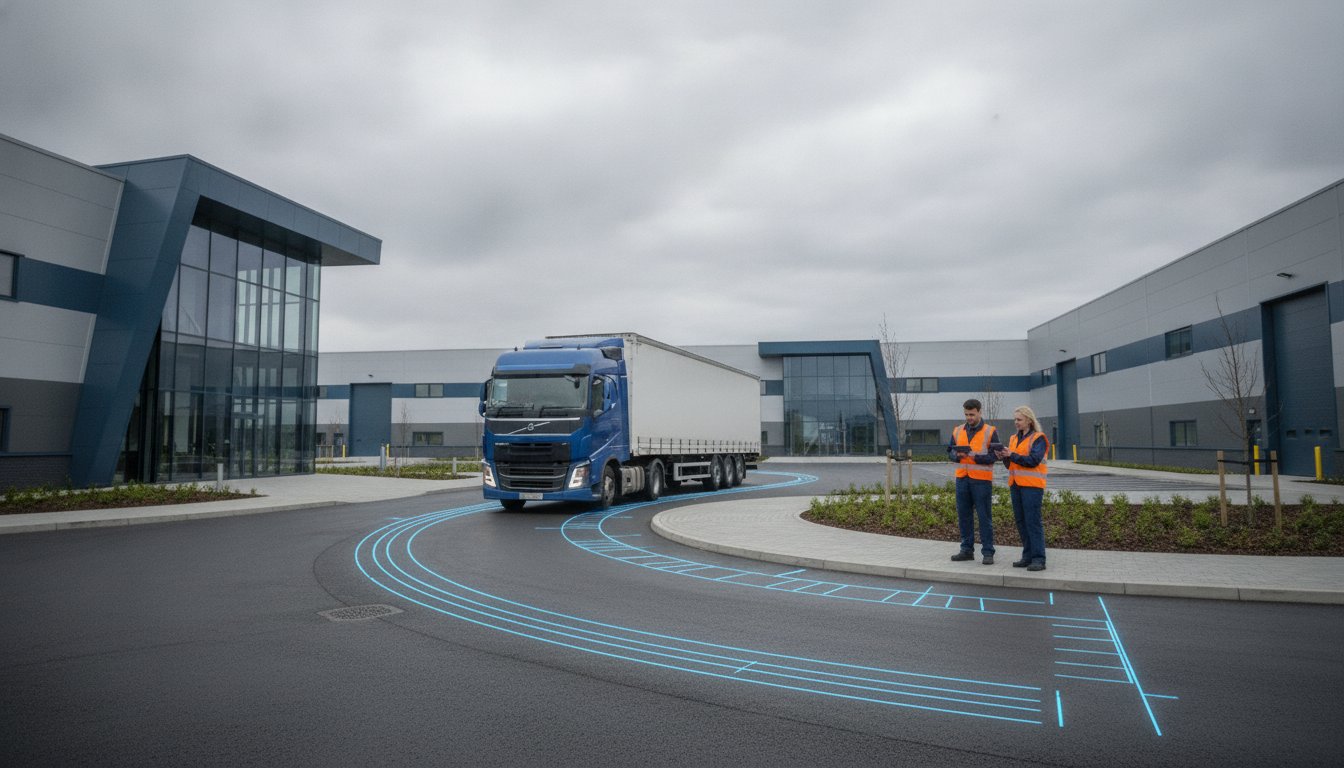
A transport assessment that merely predicts traffic volume is no longer enough to secure planning permission in 2026. You likely understand the frustration of a project stalling because a Local Highway Authority (LHA) objects to your HGV tracking or questions your trip generation data. The gap between a site layout that looks good on paper and one that actually functions for a 16.5m articulated vehicle can cost weeks in revisions and thousands in lost floor space. It’s a high-stakes environment where technical precision is a functional necessity for your project’s timeline.
This guide provides the technical roadmap to master a transport assessment for industrial development under the newest August 17, 2026 NPPF standards. By following these benchmarks, you can reduce regulatory pressure and secure faster approvals. We’ll examine how to implement the new “vision-led” approach, satisfy Policy E3 requirements for freight, and use detailed Swept Path Analysis to ensure your site logistics are both compliant and commercially optimized. From TRICS 8.26.2 data analysis to sustainable travel plans, we’ll cover the essential components of a robust, submission-ready report.
Key Takeaways
- Learn how a robust transport assessment for industrial development navigates 2026 planning requirements to secure faster LHA approvals.
- Identify the technical differences in trip generation profiles between B2 manufacturing and B8 distribution centres using precise TRICS data forecasting.
- Discover why Swept Path Analysis is the non-negotiable standard for proving site feasibility and preventing costly HGV maneuvering errors.
- Integrate effective Workplace Travel Plans and sustainable freight strategies to mitigate highway impacts and meet regional net-zero targets.
- Understand why early pre-application engagement with highway authorities is the most effective way to eliminate planning objections and project delays.
The Role of Transport Assessments in Industrial Planning Approvals
A transport assessment for industrial development is a detailed technical document required by planning authorities to evaluate how a proposed site affects the surrounding road network. Unlike residential schemes, industrial developments introduce high volumes of heavy goods vehicles (HGVs), requiring a rigorous transportation planning process to ensure safety and capacity. These reports aren’t just administrative hurdles; they’re critical safety audits that prove your site’s operational viability to the Local Highway Authority (LHA) and, if you’re near a motorway, National Highways. Securing an accurate assessment early in the project lifecycle reduces the risk of costly redesigns or planning refusals.
When is a Full Assessment Triggered?
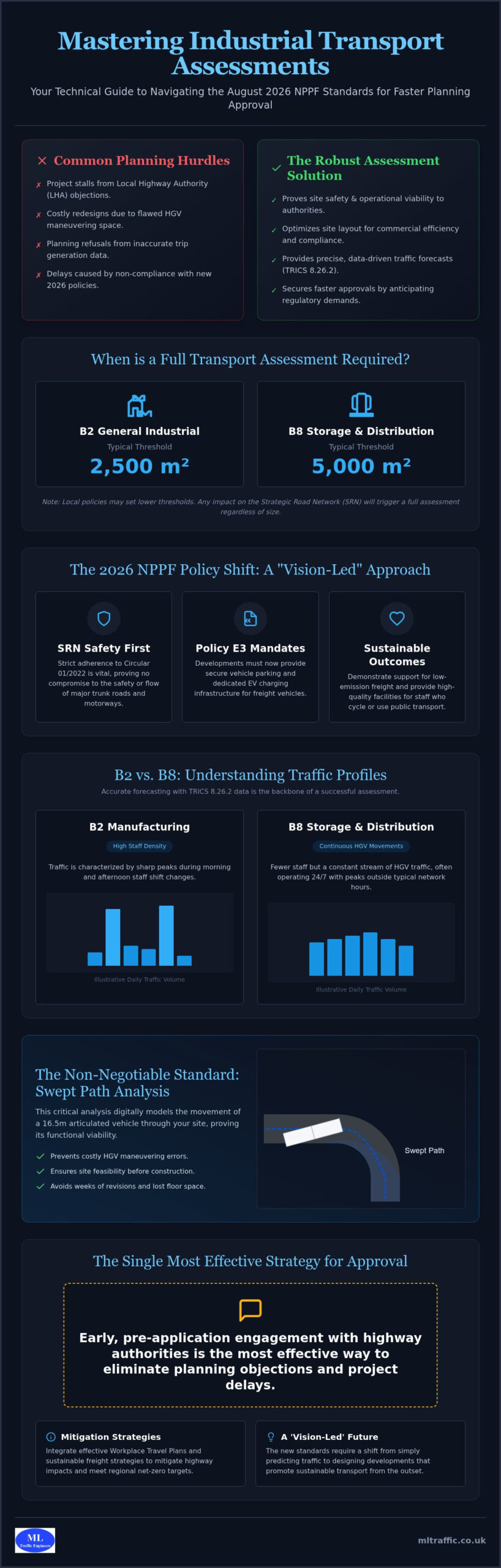
Determining whether you need a full Transport Assessment (TA) or a simpler Transport Statement depends on the scale of your project. In 2026, the standard UK thresholds for B2 (General Industrial) often start at 2,500 square metres, while B8 (Storage and Distribution) typically triggers a full TA when exceeding 5,000 square metres. However, local borough policies across England frequently lower these bars in congested or environmentally sensitive areas. If your site impacts the Strategic Road Network (SRN), National Highways will demand a more granular analysis regardless of the total floor space. You can view our 2026 guide to planning success for more specific regional threshold examples.
Statutory Requirements and 2026 Policy Alignment
Your report must align with the National Planning Policy Framework (NPPF) updated on August 17, 2026. This latest version introduces Policy E3, which specifically mandates that freight and logistics developments provide secure vehicle parking and EV charging infrastructure. It’s no longer enough to just manage traffic; you must demonstrate a “vision-led” approach that prioritises sustainable outcomes over simply “predicting and providing” for car use. This shift requires developers to integrate transport considerations into the site’s design from the very beginning.
Adherence to Circular 01/2022 remains vital for any development near major trunk roads or motorways. This policy requires developers to prove that their project won’t compromise the safety or flow of the SRN. In 2026, a transport assessment for industrial development must also account for the UK’s accelerated decarbonisation targets. This means showing how your site layout supports low-emission freight and provides high-quality facilities for staff who cycle or use public transport. Precision in these technical details ensures your planning application moves through the system without the friction of highway authority objections.
Industrial Trip Generation: TRICS Data and Use Class Impacts
Accurate forecasting is the backbone of any transport assessment for industrial development. We use the TRICS (Trip Rate Information Computer System) database to predict how many vehicles will enter and exit your site. For 2026 applications, it’s vital to use the latest quarterly updates, such as version 8.26.2, to ensure your data reflects current logistics trends. Following official government guidance ensures that these forecasts are robust enough to withstand scrutiny from the Local Highway Authority (LHA).
B2 vs. B8: Understanding the Traffic Profile
The difference between B2 manufacturing and B8 distribution is stark. Manufacturing sites often have higher staff densities. This leads to sharp traffic peaks during shift changes, usually early morning and late afternoon. In contrast, B8 storage and distribution centres typically have fewer employees per square metre but generate a continuous stream of HGV movements throughout the day. It’s common for B8 sites to operate on a 24/7 basis, meaning the ‘peak hour’ for the site might not align with the traditional peak hour of the local road network. For operators coordinating high-volume port-to-warehouse logistics, taking time to explore Container Haulage options can help benchmark operational traffic flows and yard requirements accurately.
We’re also seeing a rise in ‘last-mile’ logistics sites on urban fringes. These developments involve smaller vans making frequent trips, which impacts local junctions differently than traditional long-haul HGV traffic. Understanding these nuances helps us tailor the assessment to your specific operational model, ensuring the highway authority receives a realistic picture of your site’s impact.
Highway authorities often default to conservative, high-impact trip rates that can make a project look unviable. To protect your site’s floor space and commercial viability, ML Traffic Engineers UK justifies lower rates through site-specific evidence. We select comparable sites within the TRICS database that mirror your location and operational hours exactly. If the database lacks a perfect match, we conduct bespoke traffic surveys at similar existing facilities to provide a calibrated, evidence-based profile.
Transparency in methodology is non-negotiable. We provide clear calculations for peak hour movements, even in 24/7 environments where the impact on the local network must be measured during the most sensitive times. This level of technical detail builds trust with the LHA and streamlines the approval process. If you’re unsure about your project’s potential traffic impact, our team can provide a preliminary review of your industrial project type to identify potential hurdles before they cause delays.
HGV Logistics and Swept Path Analysis: Ensuring Site Feasibility
Swept Path Analysis (SPA) is the most critical technical component of any transport assessment for industrial development. It provides the physical proof that your site layout works in reality, not just on a 2D drawing. Without this evidence, you’re essentially guessing. Local Highway Authorities (LHAs) require definitive simulations showing that the largest legal HGVs can enter, turn, and exit the site in a forward gear. Reversing onto the public highway is almost always a ground for immediate refusal. By integrating SPA into the early design phase, you prevent the need for expensive site layout revisions after the planning application has been submitted. Our team treats this as a safety-critical audit that protects your project’s timeline and budget.
Technical Standards for Industrial Access
We utilise the latest version of Autoturn software to model various vehicle templates with high precision. This includes 16.5m articulated HGVs, which are the standard for UK logistics, and 12m rigid lorries for smaller deliveries. Our simulations don’t just look at empty yards; they account for ‘worst-case’ scenarios. This means modeling simultaneous vehicle arrivals or complex maneuvers when loading bays are already occupied. This level of technical detail is essential for a 24/7 industrial environment where delays at the gatehouse can cause traffic to tail back onto the public highway. For deep technical guidance on these simulations, refer to our Swept Path Analysis services.
Optimising Loading Docks and Yard Space
Balancing maximum Gross Internal Area (GIA) with functional yard depth is a constant challenge for industrial developers. A yard that’s too small might maximise floor space but will fail an SPA, leading to a swift planning objection. We help you identify the ‘sweet spot’ where HGV manoeuvres are safe and efficient without wasting valuable land. Safety remains a non-negotiable priority. Our designs clearly separate pedestrian staff movements from heavy vehicle paths to reduce risk. We also ensure that emergency vehicle access, specifically for fire tenders, is maintained across the entire site. This dual focus ensures your development is commercially viable while meeting the strict safety standards required for modern industrial infrastructure.
Mitigating Impact: Sustainable Freight and Industrial Travel Plans
A transport assessment for industrial development must now prove long-term sustainability to align with the August 17, 2026 NPPF updates. The new “vision-led” approach requires developers to mitigate traffic impacts through proactive management rather than just infrastructure expansion. This involves two distinct streams: managing how staff get to work and controlling how freight moves through the local network. With the extension of the UK Emissions Trading Scheme to domestic maritime transport on July 1, 2026, and increasing pressure on road freight to decarbonise, your mitigation strategy must be technically sound and forward-thinking. Alongside physical site planning, freight operators and haulage businesses often rely on platforms like Logivo.ai to optimize transport schedules, coordinate vehicle movements, and streamline operational logistics.
The Industrial Travel Plan Challenge
Industrial sites often operate on a 24/7 basis, creating a unique challenge for travel planning. Standard council advice often suggests staff should use buses, but this ignores the reality of shift workers starting at 2:00 AM when public transport is non-existent. We develop realistic strategies like private shuttle buses, incentivised car-sharing schemes, and high-quality secure cycle storage with drying rooms. A robust Travel Plan can offset LHA objections regarding sites with limited public transport access by providing evidence-based alternatives that actually work for your workforce.
Effective monitoring and reporting are essential for long-term compliance. Planning conditions often require annual surveys to prove that modal shift targets are being met. We manage this entire lifecycle, ensuring your development remains compliant with its planning obligations without creating an administrative burden for site managers. This proactive approach reduces the risk of enforcement action and builds a positive relationship with the local authority.
Freight Routeing and S106/S278 Agreements
Policy E3 of the 2026 NPPF mandates that freight developments include sufficient EV charging infrastructure for both staff cars and commercial fleets. We integrate these requirements into a comprehensive Freight Management Plan. This document controls delivery timings to avoid local school runs and specifies mandatory HGV routeing to protect sensitive residential areas or weight-restricted bridges. Addressing the ‘last mile’ problem for urban fringe estates is a priority. We model how smaller electric delivery vans can efficiently transition from the Strategic Road Network to local streets.
If your transport assessment for industrial development identifies a need for off-site highway improvements, these are secured via Section 278 agreements. We negotiate these alongside Section 106 contributions to ensure the scope of work is proportional to your site’s impact. This might include junction signalisation, improved site access, or traffic calming measures. For a detailed breakdown of these technical requirements, see our S278 Guide. Our experts can help you design a mitigation strategy that satisfies the LHA while maintaining operational efficiency. Contact ML Traffic Engineers UK today to ensure your site is fully compliant with 2026 standards.
Securing Permission: How ML Traffic Engineers UK Streamline Submissions
Securing planning permission for high-stakes industrial projects demands more than just technical data. It requires a strategic approach to negotiation and a deep understanding of the Local Highway Authority’s (LHA) priorities. We position your project for success by managing the full lifecycle from initial data collection to the final planning submission. A transport assessment for industrial development is a tool for negotiation. We ensure yours is robust enough to withstand the most rigorous scrutiny from statutory consultees.
We prioritise early engagement through pre-application transport scoping. This process allows us to agree on trip generation rates, junction modeling parameters, and Swept Path Analysis vehicle templates before the formal application begins. This proactive step saves months of potential delays by eliminating technical disagreements during the determination period. We combine this technical precision with a commercial understanding of industrial development. Our goal is to ensure your site layout remains efficient and profitable while meeting all safety benchmarks discussed in previous chapters.
When highway authorities raise objections, we don’t just relay the message. We provide technical rebuttals backed by hard data. Whether it’s defending a specific HGV tracking path or justifying shift-pattern trip rates that differ from standard database averages, we handle the heavy lifting of LHA negotiations. This reduces the regulatory pressure on your team and provides a clear path to planning permission.
Our Technical Methodology
We employ rigorous data collection methods to build an accurate baseline for every project. This includes automated traffic counts and detailed Parking Surveys to assess current network capacity. Our reporting standards mirror the exact expectations of UK planning authorities, using clear, functional language and precise technical diagrams. We understand that time is a critical factor in infrastructure development. Our team maintains rapid response capabilities to ensure your assessment is ready for tight planning deadlines without compromising on quality or accuracy.
Partnering for Planning Success
Our expertise extends beyond initial submissions. If a project faces challenges or moves to an appeal, we provide expert witness capability and technical support to defend the scheme’s transport merits. We’ve built a proven track record across England, securing approvals for complex B2 manufacturing and B8 distribution sites in highly sensitive locations. ML Traffic Engineers UK acts as a reliable partner that understands intricate regional regulations so you don’t have to. We take pride in our adherence to standards and our role as a guardian of public and worker safety. Contact ML Traffic Engineers UK today for an industrial transport scoping review.
Accelerate Your Industrial Planning Approval
The 2026 planning landscape demands a higher standard of technical evidence than ever before. Successfully managing a transport assessment for industrial development requires balancing rigid regulatory benchmarks with the commercial realities of warehouse and factory operations. By prioritising expert Swept Path Analysis and leveraging the latest TRICS data, you ensure your site layout is operationally sound and fully compliant with the August 17, 2026 NPPF updates. These technical foundations are what turn a speculative design into a deliverable asset.
Early engagement with highway authorities remains the most effective strategy to eliminate objections and prevent project delays. Our team specializes in industrial and logistics planning, providing the technical precision needed to secure faster approvals across England. We handle the full project lifecycle, from initial data collection to final reporting, ensuring UK planning compliance is guaranteed for your B2 or B8 development. It’s a high-stakes environment where precision is a functional necessity, and we’re ready to manage that regulatory pressure for you.
Get a Professional Transport Assessment Quote for Your Industrial Project
We’re here to provide the expert support your project requires to move forward with confidence and speed.
Frequently Asked Questions
When is a Transport Assessment required for an industrial site in England?
A transport assessment for industrial development is typically mandatory in England for B2 General Industrial sites over 2,500 square metres and B8 Storage and Distribution sites over 5,000 square metres. These thresholds are defined in national guidance, though local authorities frequently reduce them for sites in sensitive or congested areas. You should check your specific local plan early to determine if a full assessment or a simpler statement is required for your project.
What is the difference between a Transport Statement and a Transport Assessment for B8 use?
The primary difference lies in the scale of the analysis. A Transport Statement is a concise report for smaller developments with limited traffic impact. A Transport Assessment is a comprehensive technical study required for larger schemes. It includes detailed junction modeling, capacity analysis, and a thorough review of the cumulative impact on the local road network. For B8 distribution centres, the assessment must specifically account for 24/7 HGV operational cycles.
How do you calculate HGV trip generation for a warehouse that hasn’t been built yet?
We calculate forecasted HGV movements using the TRICS database, specifically the latest 2026 quarterly updates like version 8.26.2. By selecting established sites with similar floor areas and locations, we generate accurate trip rate profiles. If your warehouse has unique operational needs, we calibrate this data with results from bespoke traffic surveys at comparable facilities. This evidence-based approach ensures your trip generation figures are robust enough to satisfy the Local Highway Authority.
What vehicle templates should be used for industrial swept path analysis?
For most industrial sites, we model the 16.5m articulated vehicle as the standard “worst-case” template. We also include 12m rigid lorries for smaller deliveries and specialized templates for fire tenders to ensure emergency access compliance. Using Autoturn software, we simulate these vehicles navigating your site layout. This precision proves that HGVs can enter and exit in a forward gear, which is a non-negotiable requirement for securing planning permission in England.
Can a Travel Plan really help secure planning permission for a remote industrial estate?
A Workplace Travel Plan is a vital tool for sites with limited public transport access. It demonstrates a commitment to the “vision-led” approach required by the August 2026 NPPF. By implementing strategies like private shuttle buses, car-sharing schemes, and high-quality cycle storage, you can mitigate concerns about staff commuting. This proactive management often bridges the gap between a highway authority’s initial objection and a successful planning approval for remote industrial estates.
What happens if the local highway authority objects to my industrial development access?
An objection usually triggers a requirement for a technical rebuttal or a layout revision. We analyze the specific concerns, such as junction capacity or HGV tracking, and provide evidence-based solutions. This might involve running new Swept Path Analysis simulations or negotiating off-site improvements through a Section 278 agreement. Our role is to handle these high-stakes negotiations, providing the technical authority needed to resolve disputes and keep your planning application on track.
Do I need a separate Parking Survey for an industrial planning application?
Yes, a dedicated Parking Survey is frequently required to justify your proposed parking provision. Under the new Policy E3 in the NPPF, authorities scrutinize industrial developments to ensure they provide sufficient secure vehicle parking and EV charging infrastructure. A survey proves that your site won’t cause dangerous overspill onto local roads. We collect real-world data to demonstrate that your parking levels are proportional to the anticipated staff density and operational HGV requirements.
How long does it take to prepare a full Transport Assessment for an industrial site?
Preparing a transport assessment for industrial development generally takes between four and six weeks. This timeline accounts for initial site visits, commissioning traffic surveys, and performing the technical analysis. The duration can vary based on the responsiveness of the Local Highway Authority during the scoping phase. We prioritise rapid response times to meet your planning submission deadlines, ensuring that technical precision is maintained even within tight project schedules.

Disclaimer
The content on mltraffic.co.uk, including all technical articles, guides, and resources, is provided for general informational and educational purposes only. It is not intended to constitute professional advice in traffic engineering, transportation planning, development approvals, or any other technical or legal field.
While ML Traffic Engineers makes every reasonable effort to ensure the accuracy, completeness, and timeliness of the information published, we do not provide any warranties or representations (express or implied) regarding its reliability, suitability, or availability for any particular purpose. Any reliance you place on the content is strictly at your own risk.
In no event shall ML Traffic Engineers, its directors, employees, authors, or affiliates be liable for any direct, indirect, incidental, special, consequential, or punitive damages (including, without limitation, loss of profits, data, or business opportunities) arising out of or in connection with the use of, or inability to use, any information provided on this website.
The articles and guides on this site are not a substitute for engaging a qualified, professional traffic engineer to assess your specific project requirements. For tailored advice, compliance assessments, or traffic engineering services, please contact a competent professional.
This disclaimer may be updated from time to time without notice. By accessing or using this website, you agree to be bound by the most current version of this disclaimer.