
A Local Implementation Plan can shape a development’s transport context without serving as evidence about the development itself. If you’re asking what is a local implementation plan (LIP), it’s a borough-level plan for putting the Mayor of London’s Transport Strategy into practice through local priorities and schemes.
Official guidance can be difficult to interpret, especially when London-wide goals meet borough-specific decisions. Each London borough prepares a LIP, while the Mayor’s Transport Strategy sets the broader direction, including a goal for 80% of trips to be made by walking, cycling or public transport by 2041.
This guide explains who prepares and uses a LIP, how it informs borough transport priorities, and when those priorities may matter to a development. It also clarifies the key distinction: a LIP provides policy context, while a Transport Assessment or Transport Statement addresses the transport effects of a specific proposal. Understanding that difference helps you interpret local priorities and put project-specific evidence in the right planning context.
Key Takeaways
- Understand what is a local implementation plan (LIP) and how it translates London-wide transport policy into borough priorities.
- Follow the relationship between strategic goals, borough programmes and local transport schemes.
- Distinguish borough policy from a Transport Statement or Transport Assessment prepared for a specific development.
- Use the relevant borough’s published priorities as context when assessing a project, without treating them as a prediction of a planning decision.
- See how ML Traffic Engineers UK can reflect local planning context in project-specific Transport Statements, Transport Assessments and Green Travel Plans.
What Is a Local Implementation Plan (LIP) in London?
A Local Implementation Plan (LIP) is a borough-level plan for implementing the Mayor of London’s Transport Strategy through local priorities and programmes. It sets out how an area will contribute to the strategy while reflecting the transport conditions and needs of that part of London.
If you’re asking what is a local implementation plan (LIP), its scope is the key distinction: it guides transport planning across a borough or the City of London, rather than assessing the effects of one development. The Greater London Authority Act 1999 requires each London borough and the Common Council of the City of London to prepare a LIP. The Mayor’s Transport Strategy provides the strategic direction; the local plan explains how it will be implemented in the relevant area.
A general overview of the related Local Transport Plan (LTP) framework in England can help explain the wider planning context, though London’s LIPs have their own statutory relationship with the Mayor’s Transport Strategy.
The following video introduces the general idea of an implementation plan. It isn’t specific guidance on London’s LIP framework.
Who prepares a Local Implementation Plan?
The relevant London borough prepares its LIP, and the Common Council of the City of London prepares the plan for the Square Mile. TfL does not write every borough’s plan. The borough or City Corporation sets out how it will take forward local transport priorities in line with the Mayor’s strategic direction, while the Mayor and TfL have roles in the wider strategy and funding framework.
This division supports local decision-making within a London-wide policy structure. Boroughs understand local streets and travel needs; the Mayor’s Transport Strategy sets shared objectives for transport across the capital. A LIP connects these levels, rather than replacing local judgement or citywide strategy.
What does a LIP aim to achieve?
A LIP translates broad transport aims into borough-level priorities. For example, the Mayor’s Transport Strategy’s Healthy Streets Approach and goal of increasing the proportion of trips made by walking, cycling or public transport give boroughs a strategic basis for considering measures such as safer crossings, cycle routes and improved bus priority. The relevant priorities and actions depend on the local plan.
These are policy aims and borough-wide programmes, not automatic requirements for every development. A LIP can provide useful context for a proposal in that area, but it doesn’t determine the outcome of an individual planning application or replace project-specific evidence. Understanding the plan’s scope helps keep local policy, transport strategy and development assessment distinct.
How Does a London LIP Turn Transport Strategy into Borough Action?
The Mayor’s Transport Strategy sets the shared direction for transport across London. Each borough and the City of London Corporation then translates that direction into local priorities and delivery programmes through its LIP. In short: the Mayor’s Transport Strategy sets the strategic direction; each LIP sets out how that direction will be implemented at borough level.
How does a LIP relate to the Mayor’s Transport Strategy?
The Greater London Authority Act 1999 establishes the relationship between the Mayor’s strategy and borough implementation plans. The Mayor sets the citywide transport strategy, while local authorities prepare plans showing how they will contribute to it. TfL supports delivery and allocates funding for borough projects; it does not prepare every borough’s LIP.
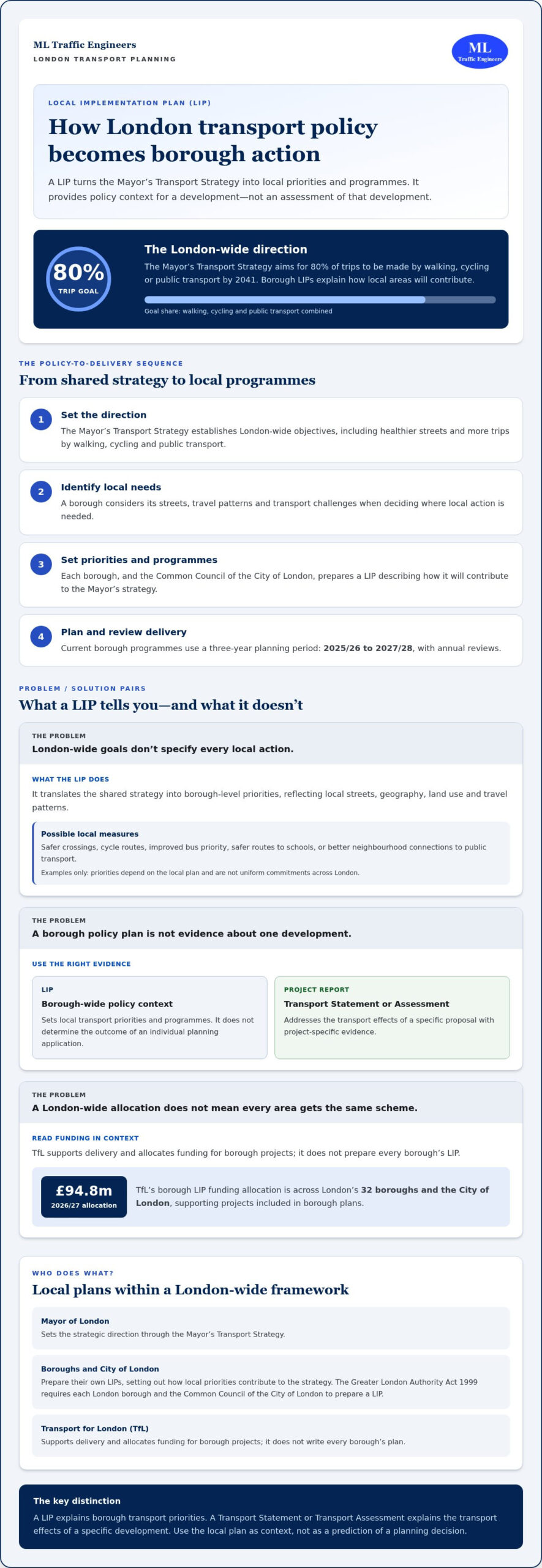
The policy-to-delivery relationship can be understood as a sequence:
- Set the direction. The Mayor’s Transport Strategy establishes London-wide objectives, including healthier streets and more trips by walking, cycling and public transport.
- Identify local needs. A borough considers its streets, travel patterns and transport challenges when deciding where local action is needed.
- Set out priorities and programmes. The LIP explains how the borough intends to contribute to the strategy through local transport measures.
- Plan and review delivery. Current borough programmes use a three-year planning period, covering 2025/26 to 2027/28, with annual reviews.
This structure links strategic policy to local action without requiring every borough to choose identical measures. A LIP must fit the Mayor’s Transport Strategy, but its priorities can respond to the specific conditions of the area it covers.
How can borough priorities differ across London?
Transport needs vary with local geography, land use and travel patterns. One area may focus on making town-centre streets safer for people walking and cycling; another may prioritise bus movement, safer routes to schools or better connections between neighbourhoods and public transport. These are examples of possible policy emphases, not commitments that apply uniformly across London.
Local authorities can pursue different measures while supporting shared objectives such as active travel and safer streets. To understand a particular borough’s approach, review its published LIP and current delivery programme rather than assuming that a London-wide policy translates into the same scheme everywhere.
TfL’s 2026/27 borough LIP funding allocation is £94.8 million across London’s 32 boroughs and the City of London. This supports projects included in borough plans, but a citywide allocation does not mean every proposed measure receives funding. The current multi-year programme and annual review provide important context when checking which priorities are being taken forward.
For a development, the LIP helps identify relevant local policy priorities, but it doesn’t establish how a planning authority will decide an individual application. Project-specific transport evidence still needs to address the proposal itself. Where that work must account for local planning context, transport planning support can help connect borough priorities with development-level reporting.
How Is a LIP Different from a Transport Statement or Assessment?
These documents operate at different scales. A LIP sets borough transport priorities and helps implement London-wide policy; a Transport Statement or Transport Assessment examines transport matters linked to a particular development proposal. A Travel Plan is also development-related, but focuses on measures to support more sustainable travel associated with a site.
Put simply, a LIP provides policy context, while project documents provide evidence about a proposal. Knowing what is a local implementation plan (LIP) helps prevent a borough-wide strategy from being mistaken for an application report.
| Document | Scale | Purpose | Authoring context | Typical planning relevance |
|---|---|---|---|---|
| Local Implementation Plan | Borough or City of London area | Set out how local transport priorities support the Mayor’s Transport Strategy | Prepared by the relevant local authority | Provides local policy context for transport decisions and development proposals |
| Transport Statement | One development proposal | Summarise relevant transport considerations and likely effects | Prepared for a planning application | Provides project-level information proportionate to the proposal and its context |
| Transport Assessment | One development proposal | Analyse transport implications in greater detail | Prepared for a planning application | Supports consideration of the proposal’s transport effects |
| Travel Plan | A development or site | Set out measures to encourage sustainable travel | Prepared in connection with a development | Addresses how travel to and from the site can be influenced |
LIP versus Transport Statement
A Transport Statement focuses on the proposal, not the whole borough. It may describe site access, existing transport conditions and the development’s relevant travel implications. The appropriate document depends on the proposal and planning context, so a LIP cannot replace this project-specific work. For further detail on the application document, see this London Transport Statement guidance.
LIP versus Transport Assessment and Travel Plan
A Transport Assessment provides project-specific analysis of transport effects. Its scope depends on the development and planning context; there is no single threshold that should be assumed to apply universally. A Travel Plan has a related but distinct function: it sets out development-level measures intended to support sustainable travel. Neither document is the borough’s policy implementation plan.
For a development submission, use the LIP to understand the local policy setting, then ensure the relevant project documents address the proposal itself. A London Transport Assessment guide can help clarify the role of project-level analysis. Keep the distinction clear: borough priorities inform the assessment, but they don’t prove the transport effects of an individual scheme or determine the planning authority’s decision.
How Should Developers Use a LIP When Planning a London Project?
Use the LIP as a local policy reference, not as a checklist that automatically determines a planning decision. It can help identify the borough’s stated transport priorities and inform how a proposal’s transport effects are assessed. It doesn’t guarantee planning permission or remove the need for project-specific evidence.
A clear review follows a practical sequence:
- Identify the relevant authority. Confirm which London borough or the City of London Corporation covers the site. Don’t rely only on a nearby town-centre name or postal address, as boundaries and decision-making responsibilities may differ.
- Find current policy. Review the relevant authority’s published LIP and delivery information alongside the Mayor’s Transport Strategy and other applicable planning policy. Check publication dates, status and updates against official sources.
- Relate priorities to the proposal. Consider which published transport objectives are relevant to the site and development. Distinguish a genuine policy connection from an assumption about what the planning authority will require or decide.
- Establish the project evidence needed. Consider the development’s characteristics and planning context to determine whether a Transport Statement or Transport Assessment is appropriate.
What should a developer check in the relevant borough policy?
Look for the borough’s stated transport priorities, planned measures and current delivery information that relate to the site or surrounding network. Check the source document and its date, and cite the correct title and version in project work. If a LIP describes a broad aim, such as supporting active travel, present it as borough policy context. Don’t recast it as a site-specific requirement unless the relevant policy or planning advice supports that interpretation.
Accuracy matters. Separate what the published document says from your assessment of how the proposal relates to it. If you refer to a borough priority, explain the connection clearly and avoid predicting the planning authority’s conclusion. The LIP can inform the assessment; it isn’t a decision notice or a substitute for the planning authority’s consideration of the application.
When might a project need transport planning evidence?
The planning authority’s requirements depend on the development and its context. A Transport Statement or Transport Assessment provides evidence about a specific proposal, with the document and scope shaped by the issues that need to be considered. A borough’s LIP can help frame that work, but it cannot establish the proposal’s transport effects on its own. For more detail on project-level reporting, see this London Transport Assessment guide.
ML Traffic Engineers UK prepares Transport Statements, Transport Assessments and Green Travel Plans for planning applications, tailoring its work to local planning contexts. For support connecting borough policy with project-specific transport evidence, discuss your London project with ML Traffic Engineers UK.
How ML Traffic Engineers Connect Local Policy Context with Project Reports
A borough’s transport priorities can help shape the context for a development report, but they don’t replace analysis of the proposal itself. A sound planning submission distinguishes what local policy says from what the project’s evidence demonstrates. For teams asking what is a local implementation plan (LIP), that distinction is central: the LIP informs the local context, while project reports address development-specific transport matters.
ML Traffic Engineers UK prepares Transport Statements, Transport Assessments and Green Travel Plans for planning applications. Its work is tailored to local planning contexts, recognising that borough priorities and policy frameworks can differ. This connects relevant local policy with the proposal without treating a borough-wide objective as proof of a particular site’s effects or as a prediction of the planning decision.
Turning borough context into relevant development evidence
Local context becomes useful when a report explains how the proposal relates to published priorities and then assesses the development on its own merits. For example, if a borough’s policy highlights walking and cycling, a project report can consider relevant access and travel issues for that proposal. The policy provides a reference point; the assessment must still be grounded in the development, its location and the evidence relevant to it.
A LIP alone doesn’t determine a report’s scope. The information needed depends on the project and planning context. A Transport Statement may suit one proposal, while another may need the fuller project-specific analysis of a Transport Assessment. A Green Travel Plan may be relevant where development circumstances and planning considerations support one. These documents have distinct purposes, and none should be treated as interchangeable with borough policy.
Choosing the right next step for a planning application
Start by identifying the proposal’s relevant transport issues and reviewing current local policy. Then establish which project document best addresses the application’s needs. A Transport Statement or Transport Assessment can set out evidence about the development; a Green Travel Plan can address measures to support sustainable travel where appropriate. The LIP informs the local policy context, but it doesn’t guarantee permission or replace the planning authority’s assessment.
ML Traffic Engineers UK brings local planning context into its project work, with senior staff who each have over 35 years of traffic engineering experience. Its hands-on approach supports a focused review of how policy relates to a proposal and keeps the distinction between strategic priorities and project evidence clear. The consultancy supports projects across Greater London, Manchester, Birmingham, the West Midlands, Liverpool, Surrey, East Sussex, West Sussex, Hampshire, Berkshire and Buckinghamshire. A London LIP applies to its relevant London authority; projects elsewhere need to be considered in their own local planning context.
If you’re preparing a planning application, explore ML Traffic Engineers UK’s transport planning support to see how project-specific reports can be tailored to local planning contexts.
Make Local Policy Part of Your Project Brief
Bring borough transport policy into the project discussion early, while the proposal can still respond to relevant local priorities. Record the policy sources reviewed, note which objectives may affect the site, and identify where project-specific evidence is needed. This gives the planning and design teams a clearer basis for coordination.
Knowing what is a local implementation plan (LIP) also helps keep the planning conversation precise. Treat published policy as context to assess, not as a substitute for professional judgement or a promise about the application outcome. Where the relevance of a borough priority is uncertain, frame it as a matter for assessment rather than presenting an assumption as a formal requirement.
ML Traffic Engineers UK can bring local planning context into transport reports tailored to the proposal. Discuss your planning project with ML Traffic Engineers UK.
Frequently Asked Questions
What does LIP stand for in London transport planning?
LIP stands for Local Implementation Plan. In London transport planning, it refers to the plan through which a borough or the City of London Corporation sets out its local approach to implementing the Mayor’s Transport Strategy. The term describes a policy and delivery framework for an area, not a report prepared for an individual planning application. If you see “LIP” in borough transport material, check which authority and plan the document covers.
Who is responsible for preparing a Local Implementation Plan?
The relevant London borough prepares its Local Implementation Plan, while the Common Council of the City of London prepares the plan for the City. The Mayor sets the strategic transport direction through the Mayor’s Transport Strategy, and Transport for London has a role in supporting delivery and funding. This division matters when checking a policy source: use the local authority’s published plan for its priorities, rather than treating TfL as the author of every LIP.
Is a Local Implementation Plan a statutory document?
Yes. London boroughs and the City of London Corporation are required to prepare Local Implementation Plans under the Greater London Authority Act 1999. That statutory basis makes a LIP part of London’s formal transport planning framework. For practical use, identify the published plan and its status through the relevant authority’s official material. A statutory plan sets policy and implementation context, but it isn’t itself a decision on an individual development application.
Can a Local Implementation Plan affect a planning application?
A LIP can provide relevant local transport policy context when a planning application is considered. It may help a project team identify issues to address, such as how a proposal relates to borough priorities for travel or local streets. However, it doesn’t guarantee permission or dictate the authority’s decision. Applicants should distinguish statements directly supported by the published plan from their own interpretation, and support project-specific claims with evidence appropriate to the proposal.
What is the difference between a LIP and a Transport Assessment?
A LIP addresses transport priorities and implementation across a borough or the City of London. A Transport Assessment examines transport matters associated with a specific development proposal. For instance, a LIP may identify local priorities relevant to an area, while an assessment considers how a particular scheme relates to transport conditions and effects. The local plan can inform the assessment, but it cannot replace development-specific analysis or evidence.
How often are London borough Local Implementation Plans reviewed?
Current borough delivery programmes cover a three-year period, from 2025/26 to 2027/28, and are reviewed annually. This annual review applies to delivery programming, so check the latest borough and TfL publications before relying on a specific project or funding detail. Don’t assume that an annual programme review means the full Local Implementation Plan has been rewritten; verify the status and date of the policy document itself.

Disclaimer
The content on mltraffic.co.uk, including all technical articles, guides, and resources, is provided for general informational and educational purposes only. It is not intended to constitute professional advice in traffic engineering, transportation planning, development approvals, or any other technical or legal field.
While ML Traffic Engineers makes every reasonable effort to ensure the accuracy, completeness, and timeliness of the information published, we do not provide any warranties or representations (express or implied) regarding its reliability, suitability, or availability for any particular purpose. Any reliance you place on the content is strictly at your own risk.
In no event shall ML Traffic Engineers, its directors, employees, authors, or affiliates be liable for any direct, indirect, incidental, special, consequential, or punitive damages (including, without limitation, loss of profits, data, or business opportunities) arising out of or in connection with the use of, or inability to use, any information provided on this website.
The articles and guides on this site are not a substitute for engaging a qualified, professional traffic engineer to assess your specific project requirements. For tailored advice, compliance assessments, or traffic engineering services, please contact a competent professional.
This disclaimer may be updated from time to time without notice. By accessing or using this website, you agree to be bound by the most current version of this disclaimer.