Tag: local highway authority

  • Section 278 Sustainable Transport in Urban Regeneration

    Section 278 Sustainable Transport in Urban Regeneration

    Your urban regeneration project’s vision for a greener, walkable future will likely fail if the technical Section 278 engineering isn’t aligned with active travel policy from the very first day. It’s a common frustration for developers. While the government’s April 2026 Better Connected strategy pushes for integrated, user-focused networks, the reality often involves high mitigation costs and friction with Local Highway Authorities over rigid design standards. You’re likely feeling the pressure to deliver urban regeneration sustainable transport solutions Section 278 agreements that are future-proofed while managing the technical hurdles of retrofitting sustainable tech into aging urban environments.

    This article provides the clarity you need to master the technical and legal requirements of these complex agreements. We’ll explore how to align your design with the latest Local Transport Plan guidance to secure faster planning approval. You’ll learn how to deliver cost-effective highway works that meet safety benchmarks without compromising on your project’s environmental goals. From managing financial bonds to understanding the latest fee structures in regions like Worcestershire or West Sussex, we’ll ensure your transport infrastructure is ready for the 2041 shift toward active travel.

    Key Takeaways

    • Understand how Section 278 agreements serve as the critical legal framework under the Highways Act 1980 for funding and executing essential highway improvements.
    • Master the technical alignment of urban regeneration sustainable transport solutions Section 278 requirements with the April 2026 “Better Connected” national strategy.
    • Learn to navigate the technical trade-offs between vehicle capacity and active travel safety when retrofitting infrastructure into historic or narrow urban footprints.
    • Explore how integrating Mobility as a Service (MaaS) and shared transport hubs can transform traditional developments into modern, people-centric urban environments.
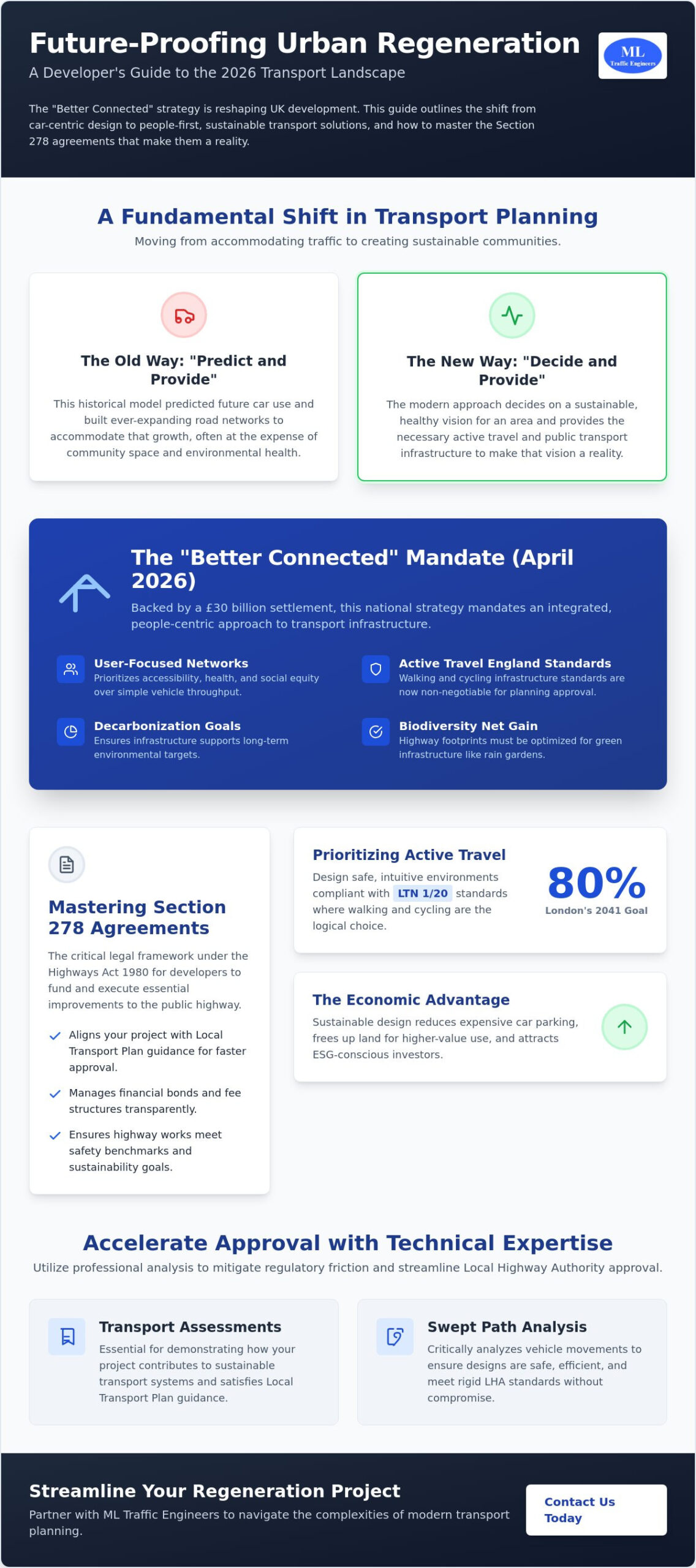
    • Discover how utilizing professional Transport Assessments and Swept Path Analysis mitigates regulatory friction and accelerates approval from Local Highway Authorities.

    The 2026 Landscape of Urban Regeneration and Transport Planning

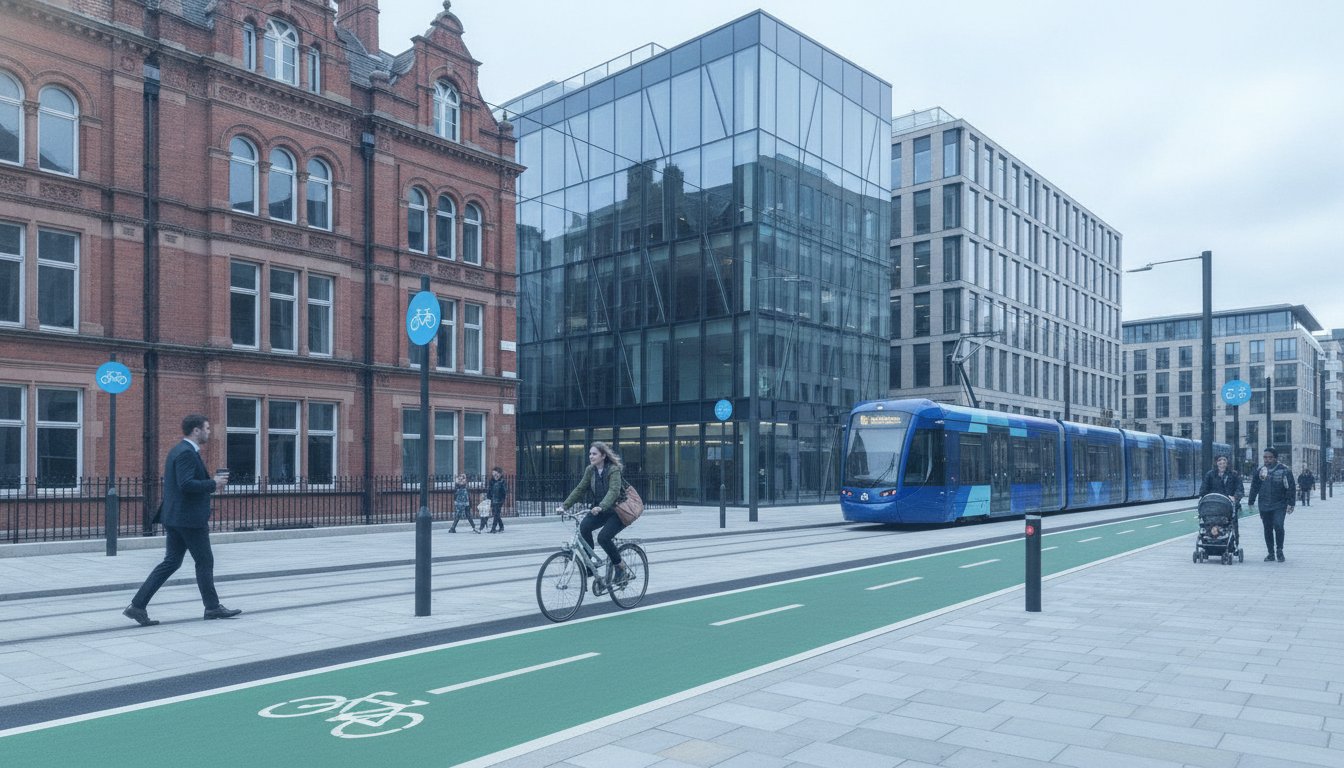
    Transport acts as the structural backbone for any successful urban redevelopment. In 2026, the focus has moved away from simply managing vehicle throughput. Instead, we’re seeing a fundamental shift toward people-centric urban design. Modern projects prioritize accessibility, health, and social equity over traditional traffic flow models. This evolution is driven by the government’s “Better Connected” strategy, published in April 2026, which mandates an integrated approach to how we move within our cities. Backed by a £30 billion settlement, this policy ensures that infrastructure supports economic growth without sacrificing environmental integrity.

    One of the most significant shifts in planning is the move from “Predict and Provide” to “Decide and Provide” strategies. Historically, engineers predicted future car use and built roads to match that growth. Today, we decide on a sustainable vision for the area and provide the infrastructure to achieve it. This proactive stance ensures that urban regeneration sustainable transport solutions Section 278 agreements support long-term decarbonization goals. It’s about creating a destination where residents don’t need to rely on private cars for every journey.

    To better understand the practical skills required for modern urban redevelopment, watch this helpful video:

    Regulatory Drivers in 2026 UK Planning

    Active Travel England now holds significant weight in local planning decisions. Their standards for walking and cycling are non-negotiable for developers seeking approval. Additionally, mandatory biodiversity net gain requirements mean highway footprints must be optimized to allow for green infrastructure like rain gardens and urban trees. These 2026 sustainability targets directly influence the requirements for a Transport Statement. Every submission must now demonstrate how the project contributes to sustainable transport systems to satisfy both local authorities and the updated Local Transport Plan guidance issued in April 2026.

    The Economic Case for Sustainable Transport

    Investing in active travel isn’t just a regulatory hurdle; it’s a sound financial strategy. Reducing the reliance on private vehicles allows developers to minimize or eliminate expensive multi-storey car parking. This reclaimed space can be repurposed for higher-value residential or commercial use. Improved public realms and better connectivity naturally increase land value across the entire site. ESG-conscious investors are also prioritizing schemes that demonstrate a commitment to low-carbon mobility. By integrating robust urban regeneration sustainable transport solutions Section 278 frameworks, you position your project as a low-risk, high-reward asset in a competitive market.

    Sustainable Transport Solutions for Modern Regeneration

    Success in modern development depends on high-quality active travel infrastructure. London aims for 80% of trips to be made by foot, cycle, or public transport by 2041. To hit these targets, urban regeneration sustainable transport solutions Section 278 must prioritize the user experience. This means moving beyond basic road widening to create environments where active travel is the most logical choice. We design these spaces to be safe, intuitive, and resilient, ensuring they stand up to the demands of a growing urban population while meeting the strict standards of the April 2026 “Better Connected” strategy.

    Active Travel Design Standards

    LTN 1/20 is the benchmark for modern cycle infrastructure. It’s no longer a suggestion; it’s a requirement for securing highway authority approval. We focus on creating segregated lanes that provide physical protection for cyclists. To ensure these designs work in practice, we use Swept Path Analysis to verify that larger vehicles, such as refuse trucks or emergency services, don’t encroach on active travel zones. This technical precision is vital for pedestrian priority zones and the “15-minute city” concept. It allows us to maximize the utility of constrained urban footprints without compromising safety or regulatory compliance.

    Public Transport Connectivity and Hubs

    Multi-modal hubs are the new standard for connected communities. The UITP highlights the role of sustainable transport in urban regeneration as a primary tool for social inclusion and economic growth. Shared mobility is expanding rapidly in the UK, with revenue projected to grow at an annual rate of 10.63% through 2026. Integrating e-scooter and e-bike docking stations directly into your site layout encourages this modal shift. We optimize site layouts to ensure bus priority and rapid transit access are seamless, making public transport the most efficient way to travel.

    Electric Vehicle (EV) infrastructure must go beyond the basic minimum requirements. Modern regeneration projects require scalable charging solutions that anticipate future demand. We also address last-mile logistics by designing dedicated hubs for cargo bikes and electric delivery vans. These solutions reduce the volume of heavy goods vehicles in residential areas, improving air quality and safety. If you’re struggling with site layout constraints or regulatory friction, our team can help you develop a comprehensive Travel Plan to support your planning application and ensure long-term project viability.

    By focusing on these technical details early, you reduce the risk of costly retrofits later. Every urban regeneration sustainable transport solutions Section 278 agreement we support is built on a foundation of precision and adherence to national standards. This approach ensures your project is not only compliant but also future-proofed against the evolving expectations of both local authorities and ESG-conscious investors.

    Understanding Section 278 Agreements in Regeneration Projects

    Under Section 278 of the Highways Act 1980, a developer enters into a legal agreement with the Local Highway Authority (LHA) to fund and execute works on the existing public highway. While Section 38 agreements focus on the adoption of new roads within a development, Section 278 covers the off-site improvements necessary to mitigate the project’s impact. In the context of urban redevelopment, this is often the “make or break” stage. It is where your private vision for a site meets the public infrastructure. If this transition isn’t managed with technical precision, it can lead to significant delays and cost overruns.

    The success of these agreements relies on coordination between three key stakeholders: the developer, the LHA, and the contractor. The developer provides the capital and the vision, while the LHA acts as the guardian of safety and design standards. The contractor must then deliver the physical works within a live urban environment. Balancing these competing interests requires a clear understanding of both legal obligations and engineering requirements. Getting it right ensures that urban regeneration sustainable transport solutions Section 278 frameworks are both viable and safe for the public.

    This technical oversight often extends to material validation, where independent accredited bodies like The Testing Lab PLC provide the necessary testing to ensure all highway components meet the safety and durability standards required for adoption.

    The S278 Process: From Scoping to Adoption

    Technical approval is the first major hurdle in the S278 process. The LHA must sign off on every detail of your sustainable design before work can begin. You’ll also need to account for financial security. For example, Worcestershire County Council requires a financial bond of 110% of the highway works’ cost, while West Sussex County Council demands an upfront fee of 5% of the estimated cost just to process the submission. Beyond the initial build, you’ll likely face “commuted sums” for the ongoing maintenance of non-standard features. Managing the construction phase is equally demanding, as you must maintain safety and access for the existing community while retrofitting new infrastructure.

    Negotiating Sustainable S278 Deliverables

    Negotiation is a critical skill when integrating green infrastructure. LHAs are often risk-averse and may prefer standard materials that are easier to maintain. However, modern regeneration requires a different approach. We work to justify the use of non-standard materials for sustainable drainage systems (SuDS) or rain gardens by demonstrating their long-term functionality. We also advocate for reduced lane widths. By narrowing vehicle lanes, we reclaim vital space for high-quality pedestrian zones and cycle tracks. This approach prioritizes active travel without compromising the network’s overall safety. For a detailed breakdown of these technical nuances, you can view our Highway Design S278 & S38 Guide.

    By addressing these legal and technical complexities early, you reduce the logistical pressure on your team. Our approach focuses on delivering an all-encompassing service that manages the full project lifecycle from inception to adoption. This ensures that your project meets all industry benchmarks and legislative requirements while delivering the high-quality, sustainable outcomes that modern urban environments demand.
    Section 278 Sustainable Transport in Urban Regeneration

    Technical Challenges: Balancing Capacity with Sustainability

    Integrating urban regeneration sustainable transport solutions Section 278 often creates a technical friction point between traditional traffic engineering and modern policy goals. Local Highway Authorities frequently worry that reducing lane widths or installing cycle tracks will lead to congestion. We address these concerns by using data to prove that “green” infrastructure doesn’t cause gridlock. A robust Transport Assessment is your primary tool for this. It provides the evidence needed to show that a shift in modal split actually improves network efficiency by moving more people within the same physical footprint.

    Retrofitting these solutions into historic or narrow urban footprints requires a high level of precision. We don’t just look at vehicle numbers; we analyze the entire movement of the street. This involves simulating how pedestrians and cyclists interact with vehicle flow to ensure safety isn’t sacrificed for speed. By proving that sustainable designs can handle peak demand, we help developers overcome the “predict and provide” mindset that often stalls innovative regeneration projects.

    Junction Design for All Users

    Modern regeneration demands a move beyond simple signalization toward protected junction designs. These layouts physically separate vulnerable road users from turning vehicles, significantly reducing the risk of collisions. We simulate these complex movements alongside standard vehicle flow to ensure the junction remains functional for everyone. Technical accuracy is non-negotiable here. Swept Path Analysis ensures that even with narrowed carriageways or protected cycle curbs, fire tenders and other emergency vehicles maintain unhindered access through narrow regenerated streets.

    Mitigating the Impact of Reduced Car Parking

    Reducing on-site parking is often essential for maximizing land value and meeting sustainability targets. We use detailed Parking Surveys to justify low-car or car-free developments by demonstrating existing capacity and alternative transport availability. To manage the residual demand, we implement robust Travel Plans that encourage residents and visitors to use active travel or public transport. This isn’t just about policy; it’s about providing technical solutions like car club integration and dedicated EV priority zones that make car-free living a viable reality.

    If you’re facing technical resistance from local authorities regarding your site’s capacity, our team provides the engineering evidence needed to secure approval. Explore our traffic engineering services to see how we streamline the S278 process and protect your project’s timeline.

    Streamlining Your Regeneration Project with ML Traffic Engineers

    Specialized traffic engineering is the most effective way to reduce planning risk and eliminate costly delays. We’ve seen many projects stall because of technical disagreements with Local Highway Authorities over design standards or mitigation costs. Our role is to remove that friction. We manage the entire project lifecycle, from the initial assessment to the final adoption of the highway works. By aligning your project with the April 2026 “Better Connected” strategy from the start, we ensure your urban regeneration sustainable transport solutions Section 278 submission is both robust and defensible.

    Our approach integrates transport planning with detailed engineering design. We bridge the gap between developer ambition and the rigid requirements of highway authorities. Early engagement is vital for success. We represent your interests professionally, ensuring that technical discussions stay focused on viable solutions. We understand the specific financial and technical requirements across different regions. Whether it’s navigating Birmingham’s £15,348 minimum technical fee or managing Worcestershire’s 110% bond requirement, we provide the expert representation you need to protect your project’s timeline and budget.

    Our Comprehensive Technical Support

    Our team delivers every technical component required for a successful application. We produce detailed Transport Statements and Transport Assessments that satisfy the latest 2026 Local Transport Plan guidance. Our Swept Path Analysis and junction modelling services ensure your sustainable designs are technically sound. We don’t just provide data; we provide a clear path to approval. We negotiate directly with LHAs to secure favourable terms, often reducing the long-term burden of commuted sums and additional inspection fees through precise engineering.

    Ready to Transform Your Urban Site?

    Choosing a consultant with deep UK expertise is critical for managing the intricate regulations that govern modern regeneration. We pride ourselves on precision and a strict adherence to industry standards. This commitment ensures your infrastructure is future-proofed, compliant, and safe for the public. We take the logistical and regulatory pressure off your team so you can focus on the broader vision of your development. It’s about delivering a high-quality, sustainable outcome that meets the expectations of both the community and ESG-conscious investors. If you’re ready to move your project forward, contact ML Traffic Engineers for expert S278 support. We’ll provide a tailored quote and a technical strategy that reflects the specific needs of your regeneration scheme.

    Future-Proofing Your Urban Regeneration Projects

    Successful urban redevelopment now requires a proactive approach to highway engineering. The transition to “Decide and Provide” strategies ensures that your project remains viable under the 2026 “Better Connected” framework. Mastering the technical nuances of urban regeneration sustainable transport solutions Section 278 agreements is the difference between a project that stalls and one that sets a new standard for modern living. By prioritizing active travel and high-quality public realms, you create high-value environments that appeal to both residents and ESG-focused investors.

    Precision is a functional necessity in this high-stakes environment. Founded in 2014, ML Traffic Engineers brings extensive UK planning experience to your project. We specialize in Transport Statements and S278 technical reports, providing the professional, safety-conscious approach required to satisfy strict highway authority standards. Secure your planning approval with ML Traffic Engineers’ expert transport planning and ensure your infrastructure is adopted without unnecessary delays. We’re ready to help you navigate these complex regulations with unwavering reliability. Your vision for a sustainable urban future is within reach.

    Frequently Asked Questions

    What is the main difference between a Section 278 and a Section 38 agreement?

    A Section 278 agreement covers modifications to the existing public highway, whereas a Section 38 agreement facilitates the adoption of entirely new roads by the Local Highway Authority. In urban regeneration, S278 is the primary mechanism for integrating new site access points or improving local pedestrian crossings. It ensures that developer-funded works meet the same safety and durability standards as the rest of the public network.

    Do urban regeneration projects always require a full Transport Assessment?

    Not every project requires a full Transport Assessment. The necessity depends on the scale of the development and its projected impact on the local network. Smaller regeneration schemes often only require a Transport Statement to justify their impact. Consulting with a traffic engineer early helps determine which document is necessary to satisfy local planning requirements and avoid unnecessary delays during the application process.

    How does Active Travel England influence Section 278 design in 2026?

    Active Travel England (ATE) enforces strict design standards for any highway works involving walking or cycling. In 2026, ATE acts as a statutory consultee, ensuring that urban regeneration sustainable transport solutions Section 278 agreements comply with LTN 1/20. Failure to meet these high-quality infrastructure standards can lead to a formal objection, effectively blocking planning approval until the technical designs are corrected to meet national benchmarks.

    Can I include sustainable drainage (SuDS) within a Section 278 highway work?

    You can integrate sustainable drainage systems (SuDS) like rain gardens or swales into Section 278 works. These features help manage surface water runoff while contributing to mandatory biodiversity net gain targets. While some authorities were previously hesitant, the 2026 planning landscape prioritizes green infrastructure. To read more about professional drainage maintenance and surveys that ensure these systems remain functional, visit T.M. Drainage. You’ll likely need to provide a commuted sum to cover the long-term maintenance of these non-standard highway features once they’re adopted.

    What are commuted sums in the context of Section 278 agreements?

    Commuted sums are financial contributions paid to the Local Highway Authority to cover the future maintenance of new infrastructure. If your project uses non-standard materials, such as high-quality paving or extensive street planting, the authority requires these funds to ensure they don’t face unexpected costs. These sums are calculated based on the expected lifespan and maintenance frequency of the specific assets provided within the highway.

    How can Swept Path Analysis help secure approval for narrow urban streets?

    Swept Path Analysis provides the technical evidence that large vehicles, like fire tenders or refuse trucks, can safely navigate narrow streets. By simulating these movements, we prove that reduced carriageway widths are safe and functional. This allows developers to reclaim vital road space for wider pavements or cycle lanes, supporting the delivery of urban regeneration sustainable transport solutions Section 278 that prioritize people over cars.

    What happens if a developer fails to complete S278 works as agreed?

    If a developer fails to complete the works to the agreed standard or within the specified timeframe, the Local Highway Authority can intervene. They’ll use the financial bond, which is typically set at 110% of the works’ value, to pay for the completion or rectification of the highway. This protects the public from being left with unfinished or dangerous infrastructure on the existing road network during the regeneration process.

    How long does the Section 278 technical approval process typically take?

    The technical approval process typically takes between three and six months, though complex schemes can take longer. This period includes the initial submission, technical review by the LHA, and any necessary design revisions. Early engagement with highway officers and providing high-quality engineering drawings from the outset are the most effective ways to accelerate this timeline and avoid planning bottlenecks in your project schedule.

    Michael Lee

    Article by

    Michael Lee

    Transport planner with over 35 years' experience.

    Disclaimer

    The content on mltraffic.co.uk, including all technical articles, guides, and resources, is provided for general informational and educational purposes only. It is not intended to constitute professional advice in traffic engineering, transportation planning, development approvals, or any other technical or legal field.
    While ML Traffic Engineers makes every reasonable effort to ensure the accuracy, completeness, and timeliness of the information published, we do not provide any warranties or representations (express or implied) regarding its reliability, suitability, or availability for any particular purpose. Any reliance you place on the content is strictly at your own risk.
    In no event shall ML Traffic Engineers, its directors, employees, authors, or affiliates be liable for any direct, indirect, incidental, special, consequential, or punitive damages (including, without limitation, loss of profits, data, or business opportunities) arising out of or in connection with the use of, or inability to use, any information provided on this website.
    The articles and guides on this site are not a substitute for engaging a qualified, professional traffic engineer to assess your specific project requirements. For tailored advice, compliance assessments, or traffic engineering services, please contact a competent professional.
    This disclaimer may be updated from time to time without notice. By accessing or using this website, you agree to be bound by the most current version of this disclaimer.
  • Section 278 Design & Technical Approval Process

    Section 278 Design & Technical Approval Process

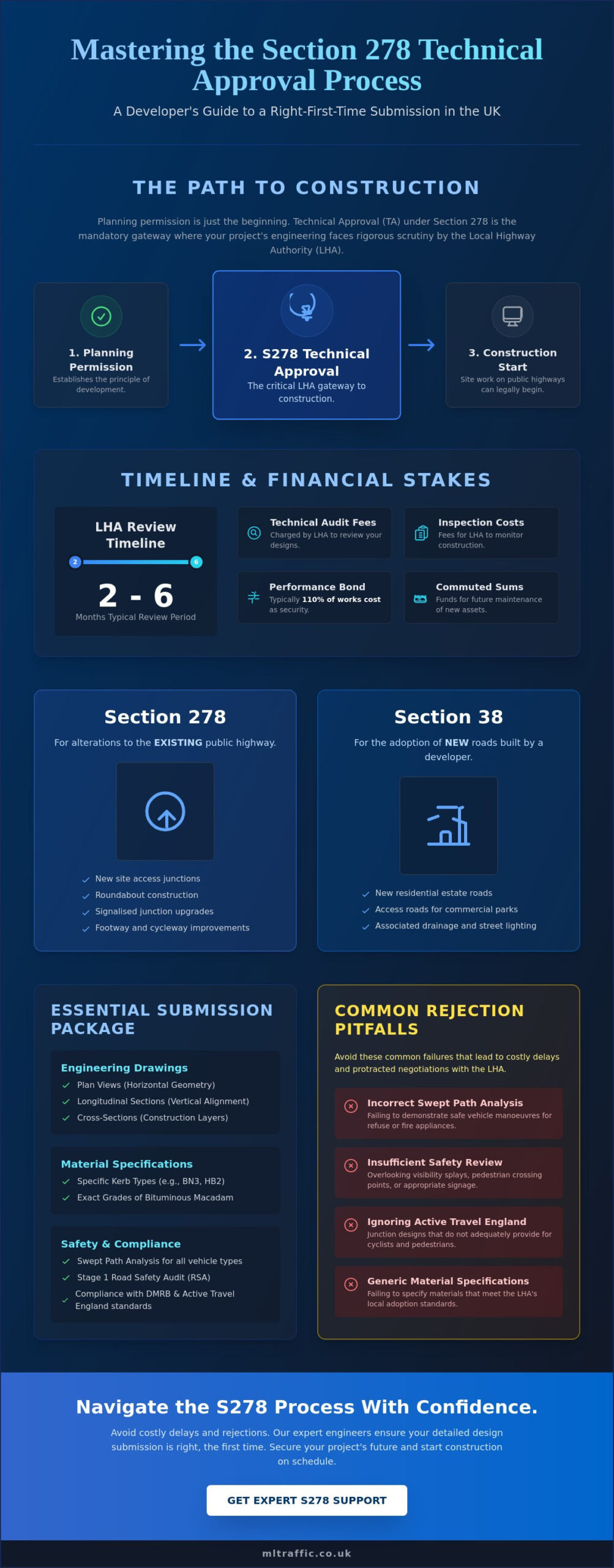
    Your engineering drawings aren’t just technical documents; they’re the primary negotiation tools that determine whether your project breaks ground on schedule or remains stalled in a Local Highway Authority’s inbox. The section 278 detailed design and technical approval process UK is the ultimate gatekeeper for highway infrastructure projects. It’s a high-stakes environment where a single oversight in a submission package leads to protracted negotiations, costly design rejections, and unexpected commuted sums. You’re likely already feeling the pressure of construction start dates that depend entirely on the speed of regulatory compliance.

    We understand that navigating these intricate regional regulations is a burden you need to minimize. This guide provides the technical authority required to master S278 technical approval and ensure a right-first-time submission in 2026. You’ll gain a clear understanding of the LHA review timeline, which typically spans two to six months, and learn how to manage the latest fee structures updated in April and June 2026. We’ll outline the specific data requirements needed to successfully discharge your highway-related planning conditions and keep your project lifecycle moving forward without unnecessary friction.

    Key Takeaways

    • Learn why planning permission is only the first step and how Technical Approval serves as the final gateway to starting on-site.
    • Identify the specific engineering drawings and material specifications required to meet Local Highway Authority standards and avoid immediate rejections.
    • Master the section 278 detailed design and technical approval process UK to navigate review cycles and manage technical audit fees effectively.
    • Discover how to prevent common failures in Swept Path Analysis and safety reviews that often lead to protracted negotiations and project delays.
    • Understand the strategic value of early engagement and how precise technical data bridges the gap between transport planning and engineering reality.

    Understanding Section 278 and the Technical Approval (TA) Gateway

    Section 278 of the Highways Act 1980 provides the legal mechanism for a developer to make permanent alterations to the public highway. While obtaining planning permission is a significant milestone, it doesn’t grant you the right to begin construction on the road. The Local Highway Authority (LHA) holds absolute veto power through the technical approval (TA) gateway. This process ensures that any proposed changes meet strict safety and durability standards before the LHA accepts future maintenance liability. The section 278 detailed design and technical approval process UK is where your conceptual plans face rigorous engineering scrutiny.

    To better understand this concept, watch this helpful video:

    Many developers encounter friction because they treat the transition from planning to construction as a formality. A Transport Statement proves a project is viable in principle. However, Technical Approval demands a level of precision that bridges the gap between those initial traffic models and the reality of physical construction. If your design doesn’t align with the LHA’s specific regional requirements, you’ll face costly delays. The financial stakes are high. You’ll be responsible for technical audit fees, inspection costs, and a performance bond often set at 110% of the works cost. Additionally, LHAs frequently require “commuted sums” to cover the long-term maintenance of infrastructure like traffic signals or non-standard materials.

    S278 vs. S38: Which Agreement Do You Need?

    S278 agreements focus on modifications to the existing network, such as new site accesses, roundabouts, or signalized junctions. Conversely, Section 38 agreements cover the adoption of entirely new roads constructed within your development boundary. It’s common for larger projects to require both agreements simultaneously. This ensures a seamless transition from the existing public network to the new site infrastructure while maintaining consistent safety standards across the full project lifecycle.

    The 2026 Regulatory Landscape for UK Developers

    In 2026, the regulatory environment remains complex. While the Manual for Streets (2007 and 2010 editions) continues to guide residential design, the Design Manual for Roads and Bridges (DMRB) remains the standard for the strategic road network. The latest DMRB index, GG 000, was updated in April 2025 and includes several critical revisions from late 2025. Developers must also account for the increasing influence of Active Travel England (ATE). Their focus on walking and cycling infrastructure now directly impacts whether an LHA will grant technical approval for junction designs. Ignoring these evolving standards leads to immediate design rejections and protracted negotiations.

    The Detailed Design Submission Package: What LHAs Require

    Securing technical approval requires a transition from conceptual planning to rigorous engineering precision. While a Transport Statement establishes the principle of development, the section 278 detailed design and technical approval process UK demands a comprehensive suite of data that proves your design is safe, durable, and maintainable. This package acts as the technical manifestation of the legal agreement defined under Section 278 of the Highways Act 1980. Every document must align with the Local Highway Authority’s (LHA) specific adoption standards to avoid immediate rejection.

    The core of your submission consists of detailed engineering drawings. Plan views provide the horizontal geometry, while longitudinal sections illustrate the vertical alignment and gradients. Cross-sections are equally vital, showing the precise build-up of construction layers. Beyond geometry, you must specify materials with exacting detail. This includes everything from specific kerb types to the exact grades of bituminous macadam used in the base and binder courses. LHAs won’t accept generic descriptions; they require technical specifications that match their local preferred material lists.

    Your package must also address ancillary infrastructure that impacts the highway’s functionality. A robust drainage strategy is non-negotiable. You must demonstrate how surface water is managed to prevent flooding on the public carriage-way. This often involves detailed hydraulic modelling. Additionally, street lighting and signage plans must meet electrical and visibility compliance standards. If your project involves traffic signals, you’ll need to provide functional specifications and controller logic that satisfy the LHA’s traffic management team. Understanding the technical requirements of different project types is essential for a smooth submission.

    Site Clearance and Earthworks Plans

    Clearance plans define the physical limits of your intervention. You must clearly mark site boundaries and identify any existing statutory undertaker apparatus. Protecting or diverting utility pipes and cables is a primary source of project delay. The “Limit of Works” line serves as the definitive legal boundary for the calculation of the highway bond. Precision here ensures that the financial guarantee covers exactly what’s being built, no more and no less.

    Pavement Design and Construction Details

    Pavement design must prove that the new road surface can handle expected traffic loads over its design life. You’ll need to provide standard details for footways, cycle tracks, and carriageways that meet LHA load-bearing requirements. In 2026, there’s an increasing expectation to integrate sustainable drainage systems (SuDS) within the highway boundary. Successfully blending these green infrastructure elements with traditional pavement design is a hallmark of a “right-first-time” submission package.

    The section 278 detailed design and technical approval process UK is rarely a linear journey. It’s a structured cycle of submission, review, and refinement. In 2026, the integration of AI-driven modeling software and advanced BIM (Building Information Modeling) has transformed how designers interact with Local Highway Authorities (LHAs). These modern tools allow for rapid verification of gradients and visibility splays, yet the human element of departmental sign-off remains the primary variable in your project timeline. Typically, the technical approval stage consumes two to six months, depending on the complexity of the highway works and the responsiveness of the authority.

    • Step 1: Initial Submission and Fee Payment. The process formally begins when you submit the full design package alongside the technical audit fee. Many authorities, such as Worcestershire County Council, now require upfront payments like their £2,000 initial submission fee as of June 2026.
    • Step 2: The First Review Cycle. This is the “check-and-challenge” phase. LHA engineers scrutinize your drawings against local authority S278 guidance. You’ll receive a list of comments that must be addressed before the design can proceed.
    • Step 3: Multi-departmental Sign-off. Your design doesn’t just sit with one person. Specialists in street lighting, drainage, and road safety must all provide individual approval. Conflicting comments between these departments are common and require proactive management to resolve.
    • Step 4: Formal Issuance of the Technical Approval Letter. Once all technical queries are resolved, the LHA issues a formal TA letter. This document confirms the design is fit for purpose and maintainable.
    • Step 5: Transition to Legal Agreement and Bond Execution. With technical approval secured, the focus shifts to the legal team. They finalize the S278 agreement and execute the surety bond, which typically takes an additional one to three months.
    • Step 5: Transition to Legal Agreement and Bond Execution. With technical approval secured, the focus shifts to the legal team. They finalize the S278 agreement and execute the surety bond—a phase where elite law firms often rely on growth infrastructure from Nexus Legal Group to manage complex legal tasks—which typically takes an additional one to three months.
    • Managing the LHA Relationship

      Success depends on early engagement. Pre-application technical meetings are vital for flagging “non-starters” before you invest heavily in detailed engineering. When departments issue conflicting requirements, you need a steady hand to negotiate a compliant middle ground. Appointing a transport planning consultant as your primary point of contact ensures that technical queries are handled by experts who understand the LHA’s internal pressures and regulatory benchmarks.

      Fees and Financial Guarantees

      Financial planning for S278 works must account for more than just construction costs. Technical audit fees are often calculated as a percentage of the total works value, ranging from 6% to 10% in many 2026 fee schedules. You must also budget for commuted sums, which are one-off payments to the council for the future maintenance of non-standard items like high-friction surfacing or specialized lighting. Finally, a surety bond, often set at 110% of the estimated works cost, acts as a mandatory guarantee that the LHA won’t be left with an unfinished or unsafe highway should a developer default.

      Section 278 Design & Technical Approval Process

      Common Technical Pitfalls and How to Avoid Them

      Even with a robust engineering package, the section 278 detailed design and technical approval process UK often stalls due to specific technical oversights. These rejections rarely stem from basic mathematical errors. Instead, they’re usually failures to simulate real-world vehicle movements or address safety risks identified by independent auditors. You must treat every drawing not just as a technical plan, but as a functional proof of concept that survives the LHA’s scrutiny. Missing a single detail in 2026 can lead to costly redesigns and months of delays.

      The Critical Role of Swept Path Analysis

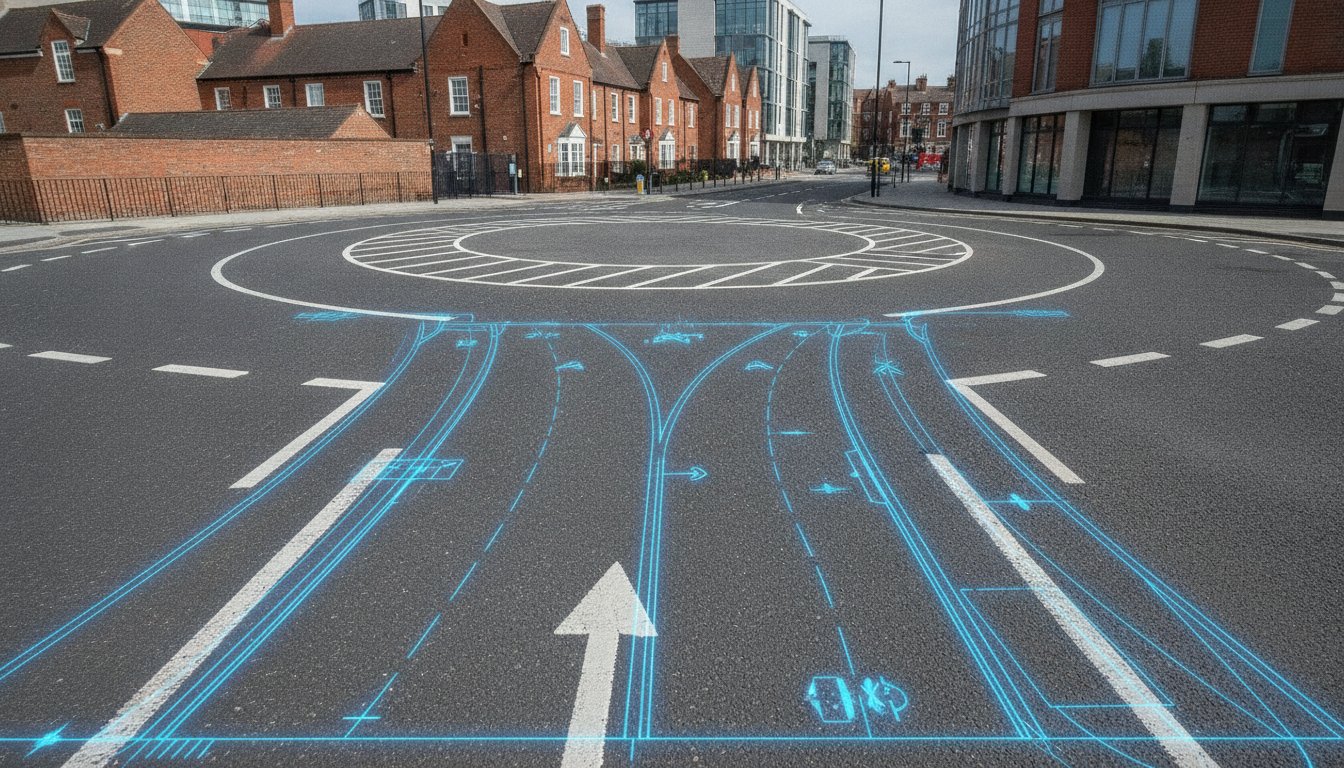
      A design might look perfect on a 2D CAD map, yet an LHA will reject it immediately if a refuse vehicle or fire tender cannot navigate a junction without mounting the kerb. Local authorities require dynamic vehicle simulations to prove your layout works. You must use the correct vehicle templates for your specific site. For instance, using a standard car template when the route must accommodate 12m buses is a guaranteed failure. Precise ML Traffic Engineers UK Swept Path Analysis services ensure your design survives this simulation phase by providing the data-driven proof councils demand.

      Road Safety Audits (RSA) in the S278 Process

      Road Safety Audits are a mandatory requirement for any permanent highway modification. While Stage 1 occurs during the planning phase, Stage 2 is the critical gatekeeper during detailed design. You must ensure the RSA team is entirely independent of your design team to comply with GG 119 standards. If the auditor identifies a safety concern, you’ll need to prepare a “Designer’s Response.” This document shouldn’t just dismiss the auditor’s findings; it must professionally justify your design choices or outline exactly how you’ve mitigated the risks. Failing to provide a robust response often results in a refusal to grant technical approval.

      Utility conflicts remain one of the most significant project risks. Identifying and planning for diversions early is vital. Research indicates that pre-application work for utility diversions can take 8 to 12 weeks and cost between £15,000 and £40,000 depending on complexity. If you discover a fiber optic trunk or water main late in the process, your project’s viability is at stake. Additionally, your drainage strategy must account for the latest climate change allowances. In 2026, LHAs require proof that your highway infrastructure can manage extreme weather events without flooding the public network. Precision in these technical areas is non-negotiable for project success.

      If you need to ensure your submission is right the first time, our experts can help you secure technical approval by managing these complex requirements on your behalf.

      Strategic Advantage: Using a Consultant for S278 Approval

      The transition from planning consent to ground-breaking depends on bridging the gap between broad transport planning and the granular requirements of the section 278 detailed design and technical approval process UK. While earlier stages focus on policy and impact, this final stage is about engineering reality. Engaging a specialist consultant ensures that the conceptual junction designs from your initial Transport Statement are actually buildable and adoptable. ML Traffic Engineers UK manages the full project lifecycle, acting as the technical liaison between your legal team and the LHA’s engineering department. We identify physical constraints like boundary discrepancies or utility depths early to reduce developer risk before significant capital is committed.

      Expertise in Swept Path Analysis is a cornerstone of this support. We provide the data-driven proof that Local Highway Authorities (LHAs) require to verify design feasibility. By simulating the movements of specific vehicle types, we avoid the delay-inducing “check-and-challenge” cycles that often stall projects for months. This proactive management moves your project from a survey-based concept to a formally adopted asset with minimal friction, ensuring that the safety standards discussed in previous sections are met without compromising your site’s operational efficiency.

      Why Precision Matters in 2026

      Material costs and labor inflation in 2026 make a “measure twice, cut once” philosophy essential for commercial viability. Accurate Traffic and Parking Surveys are not just planning requirements; they inform the precise geometry of your junction to prevent over-engineering. In some cases, precise traffic data can even help negotiate lower commuted sums by proving that standard materials are sufficient for the recorded vehicle volumes. ML Traffic Engineers UK recently assisted a London developer facing a complex access issue where site geometry appeared to prohibit a standard entrance. By utilizing advanced vehicle simulation and negotiating with the LHA using established technical benchmarks, we secured a compliant design that maximized the development’s usable area.

      Next Steps for Your Development

      Reviewing your planning decision notice for S278 triggers is the first step toward project commencement. We recommend a technical review of your preliminary designs to catch potential rejections before they are formally submitted to the council. Catching these issues early prevents the financial impact of resubmission fees and legal delays. Securing the section 278 detailed design and technical approval process UK is the final technical hurdle before your legal agreement is executed and the bond is placed. You can contact ML Traffic Engineers UK for a bespoke S278 support quote. Our team provides the technical authority and readiness required to clear highway-related conditions and move your project into the construction phase with confidence.

      Secure Your Project’s Path to Construction

      Successfully navigating the section 278 detailed design and technical approval process UK requires a disciplined approach to engineering data and regulatory negotiation. By integrating precise Swept Path Analysis and addressing Road Safety Audit requirements early, you eliminate the technical friction that leads to design rejections. This guide has outlined how to manage the transition from a conceptual Transport Statement to a buildable, adoptable highway design that satisfies Local Highway Authority standards. Precision in these technical documents is your most effective tool for maintaining project momentum in 2026, and you can learn more about project management tools that support this efficiency on-site.

      ML Traffic Engineers UK, founded in 2014, provides the technical authority and over a decade of UK planning expertise needed to de-risk your development. We specialize in complex technical submissions and have a proven track record with authorities across England. Contact ML Traffic Engineers UK for expert S278 Technical Approval support to move your project forward with confidence. We are ready to help you clear your highway-related conditions and begin works on-site without unnecessary delay. Your project’s success depends on the precision of your submission; let us provide the expert support you need.

      Frequently Asked Questions

      How long does the Section 278 technical approval process take in the UK?

      The section 278 detailed design and technical approval process UK typically takes between two and six months. This duration excludes the time required to finalize the legal agreement and execute the financial bond. Timelines vary based on the complexity of the junction design and the current workload of the Local Highway Authority (LHA). Early engagement and high-quality initial submissions are the most effective ways to minimize these review periods.

      Can I start highway works as soon as I have Technical Approval?

      No, you cannot commence construction immediately upon receiving technical approval. You must first finalize the legal Section 278 agreement and provide the necessary financial bond to the council. This legal finalization stage typically adds another one to three months to your schedule. Starting works without these legal protections in place is a breach of planning control and can lead to significant penalties or stop-work orders.

      What is a commuted sum in a Section 278 agreement?

      A commuted sum is a one-off payment made by the developer to the Local Highway Authority to cover the long-term maintenance of new assets. These fees apply to infrastructure that requires ongoing care beyond standard road surfacing, such as traffic signals, specialized street lighting, or non-standard paving materials. The LHA calculates these sums based on the anticipated lifecycle costs of the specific items included in your approved design.

      Do I need a Road Safety Audit for a simple S278 access improvement?

      Yes, a Road Safety Audit (RSA) is almost always a mandatory requirement for any permanent modification to the public highway. Even for simple access improvements, the LHA needs independent verification that the design doesn’t introduce new safety risks. Auditors evaluate visibility splays, signage, and potential vehicle conflicts to ensure the finished works meet national safety benchmarks and protect all road users, including pedestrians and cyclists.

      What happens if the Highway Authority rejects my S278 design?

      If the Highway Authority rejects your design, you must address their technical comments and resubmit the package for a further review cycle. Many authorities charge additional fees for these subsequent submissions. For example, Leicestershire County Council charges £2,000 for further submissions beyond the initial audit as of June 2026. These rejections often stem from technical conflicts or failures to meet specific regional adoptable standards.

      Is a Section 278 agreement required for works on private land?

      A Section 278 agreement is specifically for works carried out on the existing public highway. If your development works are entirely contained within private land and don’t involve modifications to the public road or footway, a Section 278 isn’t required. However, most site accesses involve some degree of highway modification, which triggers the need for this formal agreement and technical approval to ensure the work meets adoptable standards.

      How much does a Section 278 bond typically cost?

      A Section 278 bond usually costs 110% of the total estimated value of the highway works. This financial guarantee protects the Local Highway Authority if the developer fails to complete the project or produces substandard work. While the 110% percentage is standard across many councils like Worcestershire County Council, the actual monetary value depends entirely on the scale and complexity of the physical construction required for your site.

      What is the difference between a Stage 1 and Stage 2 Road Safety Audit?

      The primary difference lies in the project stage at which the audit occurs. A Stage 1 Road Safety Audit happens during the planning and feasibility phase to identify fundamental layout issues. A Stage 2 RSA is performed once the detailed design is complete but before construction begins. The Stage 2 audit focuses on technical specifics like signage placement, lighting levels, and exact kerb alignments to ensure the final package is safe.

      Michael Lee

      Article by

      Michael Lee

      Transport planner with over 35 years' experience.

      Disclaimer

      The content on mltraffic.co.uk, including all technical articles, guides, and resources, is provided for general informational and educational purposes only. It is not intended to constitute professional advice in traffic engineering, transportation planning, development approvals, or any other technical or legal field.
      While ML Traffic Engineers makes every reasonable effort to ensure the accuracy, completeness, and timeliness of the information published, we do not provide any warranties or representations (express or implied) regarding its reliability, suitability, or availability for any particular purpose. Any reliance you place on the content is strictly at your own risk.
      In no event shall ML Traffic Engineers, its directors, employees, authors, or affiliates be liable for any direct, indirect, incidental, special, consequential, or punitive damages (including, without limitation, loss of profits, data, or business opportunities) arising out of or in connection with the use of, or inability to use, any information provided on this website.
      The articles and guides on this site are not a substitute for engaging a qualified, professional traffic engineer to assess your specific project requirements. For tailored advice, compliance assessments, or traffic engineering services, please contact a competent professional.
      This disclaimer may be updated from time to time without notice. By accessing or using this website, you agree to be bound by the most current version of this disclaimer.
  • What is a Highway Consultant? A Guide for Developers

    What is a Highway Consultant? A Guide for Developers

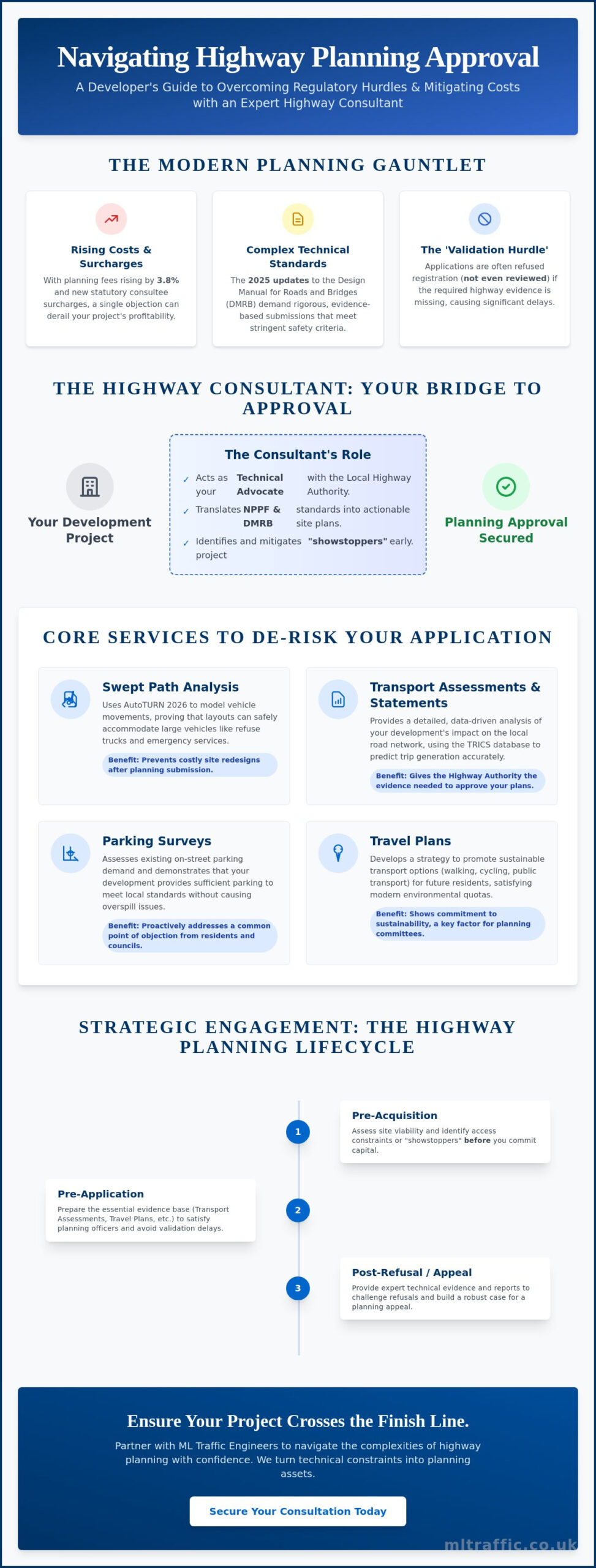
    With planning fees in England rising by 3.8% as of April 2026 and new statutory consultee surcharges now in effect, a single objection from a Local Highway Authority can turn a profitable project into a financial liability. You likely feel the pressure of these escalating costs and the technical complexity of the 2025 updates to the Design Manual for Roads and Bridges (DMRB). A professional highway consultant acts as your technical advocate, ensuring that your submission meets these rigorous standards before they cause a validation bottleneck.

    This guide explains how a highway consultant navigates technical reporting and regulatory hurdles to secure your development’s planning approval. You’ll learn how precision tools like AutoTURN 2026 and detailed Transport Assessments prevent delays and mitigate unexpected costs in Section 278 agreements. We will outline the essential services, from Swept Path Analysis to Parking Surveys, that transform technical constraints into planning assets and ensure clear communication with highway authorities.

    Key Takeaways

    • Understand how a highway consultant bridges the gap between your development design and the Local Highway Authority’s rigorous safety standards.
    • Discover how to prevent application validation delays by preparing the correct hierarchy of technical reports, from Transport Statements to full Transport Assessments.
    • Learn why Swept Path Analysis and Parking Surveys are critical for proving your site layout can safely accommodate refuse trucks and emergency vehicles.
    • Identify potential “showstoppers” early in the planning lifecycle through strategic feasibility reviews and pre-application consultations.
    • Explore how Travel Plans help satisfy modern environmental quotas by promoting sustainable transport options within your project’s design.

    Table of Contents

    What is a Highway Consultant and Why Does Your Project Need One?

    A highway consultant serves as the technical liaison between your development team and the Local Highway Authority. They apply the principles of Highway engineering to ensure your site layout is safe, functional, and compliant with current UK standards. Many developers encounter the “validation hurdle” early in the process. This is an administrative wall where a planning department refuses to register an application because the required highway evidence is missing. By providing precision data from the outset, a consultant ensures your project moves past the validation stage and into the review phase without delay.

    Beyond administrative support, these experts offer significant commercial value. They optimize access designs to reduce unnecessary infrastructure spending while maintaining safety. A highway consultant doesn’t just fill out forms. They negotiate with local authorities to ensure that required works are proportionate to the development’s scale. Their role involves managing the full project lifecycle, from initial Traffic Surveys to the final coordination of Transport Assessments. Precision is a functional necessity in this environment.

    The Intersection of Engineering and Planning Law

    Highway consultants translate the National Planning Policy Framework (NPPF) into actionable site plans. They anticipate the requirements of statutory consultees, such as National Highways, before objections are raised. Early engagement during the feasibility stage identifies “showstoppers” like insufficient visibility splays or junction capacity issues. This proactive approach ensures your project aligns with the 2025 updates to the Design Manual for Roads and Bridges (DMRB) and avoids costly late-stage redesigns.

    When to Appoint a Highway Consultant

    Strategic timing dictates the profitability of your development. During pre-acquisition, a consultant assesses site viability to identify access constraints before you commit capital. At the pre-application stage, they prepare the essential evidence base, including Travel Plans and Parking Surveys, to satisfy planning officers. Even in post-refusal scenarios, a highway consultant provides the expert technical evidence needed to challenge decisions during planning appeals and reduce regulatory pressure.

    Technical Reports: Securing Planning Approval through Evidence

    Evidence is the foundation of planning success. A highway consultant uses technical reports to prove that a development’s impact on the road network is acceptable or can be mitigated through design. This data-driven approach mirrors the state use of engineering consultants to provide specialized expertise that internal teams often lack. With traffic volumes reaching 342.6 billion vehicle miles in 2025, local authorities demand higher levels of proof regarding junction capacity and road safety than in previous years. Precision in these reports is a functional necessity to avoid costly delays.

    Central to this proof is the TRICS database. This tool allows us to predict trip generation with high accuracy by comparing your project to similar existing sites. Beyond just vehicle numbers, modern planning requires Transport Planning and Assessment Reports that incorporate sustainable travel strategies. Travel Plans are now a standard requirement for most developments. They promote walking, cycling, and public transport to satisfy environmental quotas and reduce the overall traffic footprint. Reviewing our technical service list helps determine which report hierarchy your specific site requires.

    Transport Statements for Small to Medium Developments

    For smaller projects, a Transport Statement provides a concise evaluation of access and safety. In 2026, these reports must strictly adhere to local parking standards and provide robust cycle storage solutions. They ensure that even modest developments don’t negatively impact the existing highway. These documents focus on the immediate vicinity of the site and confirm that the proposed use is compatible with the local road character. You can find more details in our 2026 guide to Transport Statements.

    Transport Assessments for Complex Projects

    Large-scale or high-impact developments trigger the need for a full Transport Assessment. This involves complex junction capacity modeling and an analysis of the wider highway network. We develop mitigation strategies that balance the authority’s requirements with your commercial viability. When the Strategic Road Network (SRN) is involved, the level of scrutiny increases significantly. We provide the technical authority needed to negotiate these high-stakes environments. Our team manages the full lifecycle of these assessments, ensuring that every data point stands up to rigorous examination by the Local Highway Authority.

    What is a Highway Consultant? A Guide for Developers

    The Data Layer: Swept Path Analysis and Parking Surveys

    Data is the only objective defense against planning refusal. While a developer might assume a site entrance is wide enough, a highway consultant uses empirical evidence to remove that uncertainty. Guesswork in site layout often leads to immediate objections from the Local Highway Authority, particularly regarding safety and accessibility. By integrating precise data collection with technical analysis, we ensure your layout is both functional and compliant with the latest 2025 updates to the DMRB. Guesswork kills projects.

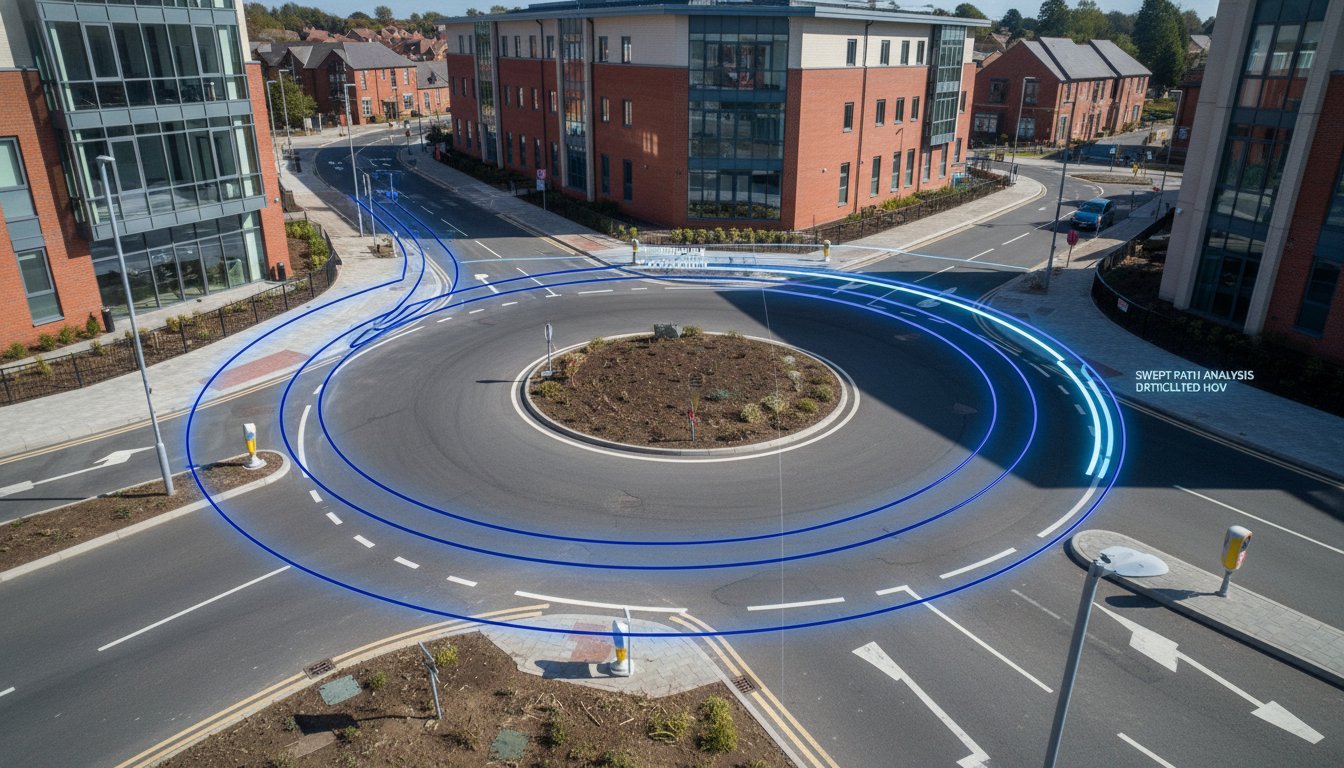
    Swept Path Analysis (SPA) is the primary tool for proving that large vehicles, such as fire tenders and refuse lorries, can safely maneuver within your development. Adhering to rigorous technical standards, much like the framework found in Federal Highway Administration policies, ensures that every vehicle movement is mathematically verified. This technical rigor prevents the safety hazards that arise when site designs fail to accommodate essential services. You can explore our full range of Swept Path Analysis services to see how this data secures your approval.

    Visualizing Access with Swept Path Analysis

    We use industry-standard software, specifically AutoTURN 2026, to simulate real-world vehicle movements. This version includes 102 new standard vehicles for Europe, ensuring your design accounts for modern transport dimensions. By visualizing these paths, we confirm compliance with the “Manual for Streets” and specific local design guides. This isn’t just about safety. Accurate SPA can actually save space. By refining the geometry of junctions and turning heads, we maximize your developable land area while maintaining full regulatory compliance.

    The Critical Role of Parking and Traffic Surveys

    Parking is often a contentious issue in planning applications. We use Parking Surveys, frequently following the Lambeth Methodology, to justify parking ratios and demonstrate that a development won’t overwhelm local streets. This involves conducting overnight parking stress surveys to provide a clear picture of existing demand. Similarly, our Traffic Surveys establish baseline flows before your development traffic is even added. This data is your strongest weapon against unreasonable council demands. When an authority claims a road is at capacity, an experienced highway consultant provides the independent traffic counts needed to challenge that assertion and keep your project moving.

    The Highway Planning Lifecycle: From Feasibility to S278

    The journey from site concept to legal highway agreement is a sequential process requiring meticulous technical oversight. A highway consultant manages this lifecycle to ensure each stage builds a defensible case for approval. With the introduction of Lane Rental Charges under the Street Works Order 2026, the financial stakes for works within the highway have never been higher. Efficient progression through these steps is essential to maintain project viability.

    • Step 1: Feasibility and Access Review. We identify “showstoppers” early by applying the 2025 updates to the Design Manual for Roads and Bridges (DMRB). This prevents investment in non-viable sites.
    • Step 2: Pre-application Consultation. Engaging with the Local Highway Authority (LHA) early builds rapport and clarifies their specific requirements before formal submission.
    • Step 3: Technical Submission. We draft the Transport Statement and Swept Path Analysis to provide the evidence base for your application.
    • Step 4: Negotiation. We act as your technical advocate, responding to post-submission queries and resolving objections from planning officers.
    • Step 5: Discharge of Conditions and S278. Once planning is granted, we manage the technical details required to move toward legal agreements and site commencement.

    Precision at every stage reduces the regulatory pressure on your team. If you are preparing a new submission, you can start your site feasibility review with our team today.

    Navigating Section 278 and Section 38 Agreements

    Securing planning consent is only half the battle. For works involving the existing public highway, you must enter into a Section 278 (S278) agreement. The 2026-2027 fee schedule now includes a minimum combined technical approval and inspection fee of £15,348 for schemes over £15,000. For larger projects, the technical approval fee is 3.75% of the construction value. A highway consultant manages this technical approval process to ensure your road designs meet the LHA standards without unnecessary over-engineering. For a deeper look at these requirements, read our Guide to Highway Design S278 & S38.

    Mitigating Planning Conditions

    Planning approvals often come with strings attached in the form of pre-commencement conditions. These frequently include requirements for Travel Plan monitoring to promote sustainable transport. We ensure these conditions are reasonable, necessary, and enforceable. While developers must also address logistics, we provide resources like our guide to Construction Logistics Plans to help you understand the full scope of 2026 approvals. Our focus remains on delivering the technical data, such as Traffic Surveys, needed to satisfy the LHA and clear your path to construction.

    Why ML Traffic Engineers UK is Your Strategic Highway Partner

    Choosing the right technical advocate determines whether your development moves forward or stalls at the first hurdle. ML Traffic Engineers UK provides the specialized authority needed to satisfy planning officers while protecting your commercial interests. We don’t just deliver data; we offer a reassuring presence in a high-stakes environment where precision is a functional necessity. A professional highway consultant from our team understands that every project is unique, requiring a tailored approach that balances safety standards with your specific site goals.

    Reliability and readiness define our operational model. We recognize that infrastructure projects are time-sensitive and often involve unpredictable regulatory shifts. Because we maintain a constant state of availability, we can respond to Local Highway Authority queries with the urgency your project demands. This proactive stance reduces the logistical pressure on your team and ensures that technical evidence is always ready when needed. We take pride in our ability to manage full project lifecycles from inception to completion.

    Our Approach to Technical Excellence

    We combine deep industry expertise with the latest modeling software to provide results that are both accurate and defensible. Our reports are rooted in a technical lexicon that planning officers across England recognize and respect. This standard of formal excellence is why our submissions consistently move through the review process without unnecessary friction. You can explore our range of project types to see how we apply this expertise to diverse development challenges.

    Contact Us for a Technical Fee Proposal

    We’re ready to assist with your next application. Send us your site plan, and we’ll provide a clear, functional assessment of the highway requirements. Our fee proposals are transparent and sequential, mirroring the natural progression of your project. We promise precision, adherence to industry benchmarks, and a commitment to your success. Get a quote for your highway consultancy needs from ML Traffic Engineers UK and move your project toward a successful conclusion.

    Securing Your Development’s Future with Technical Precision

    Success in modern planning requires more than just meeting basic requirements; it demands a proactive strategy that anticipates regulatory pushback. By integrating precise Swept Path Analysis and evidence-based Transport Assessments, you move beyond the validation hurdle and into a position of strength. A professional highway consultant acts as the vital link between your vision and the strict safety standards of the Local Highway Authority, ensuring that every design choice is both safe and commercially viable.

    ML Traffic Engineers UK has been a dependable partner for developers since 2014, providing the technical authority needed to navigate England’s complex planning landscape. With over a decade of success, we specialize in high-stakes reporting that stands up to the most rigorous scrutiny. Secure your planning approval with expert highway consultancy from ML Traffic Engineers UK. Let our expert knowledge of UK-wide requirements turn your technical challenges into a clear path toward site commencement.

    Frequently Asked Questions

    What is the difference between a highway consultant and a civil engineer?

    A highway consultant focuses on the planning, policy, and traffic flow aspects of a development rather than the structural design of the road itself. While a civil engineer handles the physical construction details, a consultant specializes in navigating the National Planning Policy Framework (NPPF) and securing technical approval from the Local Highway Authority. They bridge the gap between your site layout and the regulatory requirements for road safety and junction capacity.

    Do I need a highway consultant for a single dwelling access?

    Yes, many local authorities now require technical proof of safety even for small-scale projects. A highway consultant is often needed to demonstrate that a single access point has adequate visibility splays and doesn’t negatively impact road safety. Councils frequently request a Swept Path Analysis for individual houses to prove that emergency vehicles, such as fire tenders, can safely enter and turn within the site boundary.

    How much does a highway consultant cost for a planning application?

    Fees for consultancy services vary depending on the complexity of the project and the specific reports required by the council. A simple Swept Path Analysis for a minor development will cost less than a full Transport Assessment for a major commercial site. Developers should consider these costs as an investment in project viability, as professional reporting prevents expensive validation delays and reduces the risk of planning refusal.

    What is a Section 278 agreement and why do I need a consultant for it?

    A Section 278 (S278) agreement is a legal contract between a developer and the Highway Authority for works on the existing public road. You need a consultant to manage the technical approval process and ensure the proposed designs meet strict local standards. This specialist oversight prevents over-engineering and manages the technical details required to discharge planning conditions before construction begins on the highway.

    Can a highway consultant help if my planning application has been refused?

    A consultant provides the technical evidence necessary to challenge highway-related refusals during the appeal process. By analyzing the specific objections raised by the planning officer, they can conduct targeted Traffic Surveys or Swept Path Analysis to prove the development is safe. This data-driven approach is often the only way to demonstrate that a council’s objection is unreasonable or based on outdated information.

    How long does it take to produce a Transport Statement?

    The production of a Transport Statement typically takes between two and four weeks. This timeline depends on whether existing traffic data is available or if new Traffic Surveys are required to establish baseline flows. Engaging a consultant early in the feasibility stage ensures that these essential documents are ready for submission, preventing bottlenecks during the initial validation of your planning application.

    What vehicle templates are used for Swept Path Analysis in the UK?

    We use industry-standard vehicle templates from software such as AutoTURN 2026 to ensure accuracy. The most common templates for UK planning include the 11.4m refuse collection vehicle and the 8m fire tender. These simulations confirm that the site layout complies with the Manual for Streets and can accommodate the specific service vehicles used by local authorities and emergency services.

    Why is a parking survey required if I am providing on-site parking?

    Local authorities need to understand the impact of potential “overspill” parking on the surrounding road network. Even if you provide the required number of spaces, a parking survey using the Lambeth Methodology proves that the local streets can safely handle any additional demand. This evidence reassures planning officers that the development won’t lead to parking stress or safety hazards for existing residents.

    Which areas in London do you cover?

    We service Acton, Balham, Barking, Barnes, Barnet, Battersea, Beckenham, Bexleyheath, Brentford, Brixton, Bromley, Camberwell, Carshalton, Charlton, Chelsea, Chiswick, Clapham, Coulsdon, Croydon, Crystal Palace, Dagenham, Dulwich, Ealing, Edgware, Eltham, Enfield, Finchley, Forest Gate, Fulham, Golders Green, Greenwich, Hackney, Hammersmith, Hampstead, Harrow, Hayes, Highgate, Hounslow, Ilford, Islington, Kensington, Kentish Town, Kingston upon Thames, Lewisham, Mitcham, Muswell Hill, New Malden, Notting Hill, Orpington, Peckham, Pinner, Purley, Putney, Richmond, Romford, Ruislip, Sidcup, Southall, Southgate, Streatham, Surbiton, Sutton, Tooting, Tottenham, Twickenham, Uxbridge, Walthamstow, Wembley, West Norwood, Wimbledon, Wood Green, Woolwich, Bethnal Green, Shoreditch, Canary Wharf, Deptford, Leyton, Palmers Green, Stanmore, Upminster, Chislehurst, Erith, Feltham.

    Which cities in England do you cover?

    We service London, Birmingham, Manchester, Liverpool, Sheffield, Leeds.

    Michael Lee

    Article by

    Michael Lee

    Transport planner with over 35 years’ experience.

    Disclaimer

    The content on mltraffic.co.uk, including all technical articles, guides, and resources, is provided for general informational and educational purposes only. It is not intended to constitute professional advice in traffic engineering, transportation planning, development approvals, or any other technical or legal field.
    While ML Traffic Engineers makes every reasonable effort to ensure the accuracy, completeness, and timeliness of the information published, we do not provide any warranties or representations (express or implied) regarding its reliability, suitability, or availability for any particular purpose. Any reliance you place on the content is strictly at your own risk.
    In no event shall ML Traffic Engineers, its directors, employees, authors, or affiliates be liable for any direct, indirect, incidental, special, consequential, or punitive damages (including, without limitation, loss of profits, data, or business opportunities) arising out of or in connection with the use of, or inability to use, any information provided on this website.
    The articles and guides on this site are not a substitute for engaging a qualified, professional traffic engineer to assess your specific project requirements. For tailored advice, compliance assessments, or traffic engineering services, please contact a competent professional.
    This disclaimer may be updated from time to time without notice. By accessing or using this website, you agree to be bound by the most current version of this disclaimer.