
Tag: London Borough of Brent

  • Brent Transport Planning Consultant: Navigating 2026 Regulatory Hurdles

    Brent Transport Planning Consultant: Navigating 2026 Regulatory Hurdles

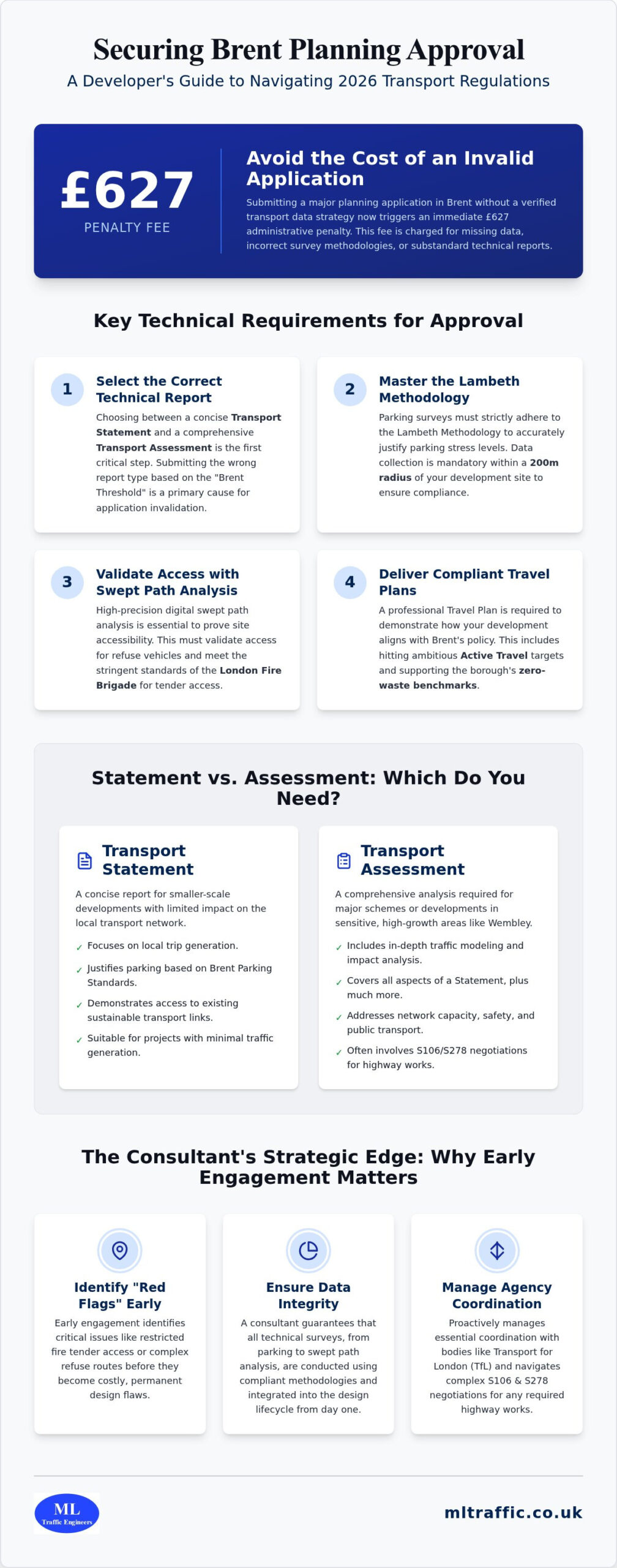
    Submitting a planning application in the London Borough of Brent without a verified transport data strategy is now a £627 gamble you simply can’t afford to lose. As the 2026 regulatory landscape tightens, engaging an expert brent transport planning consultant has transitioned from a professional recommendation to a critical financial safeguard against immediate application invalidation. We understand that navigating complex car-free requirements in high PTAL zones and meeting strict refuse access standards feels like a moving target that threatens your project’s momentum.

    You aren’t alone in feeling the pressure of these heightened technical expectations and the rigid 2026 planning fee increases. We’re here to help you master the precise data standards and digital modeling requirements necessary to secure first-time transport planning approval. This article provides a comprehensive roadmap through the mandatory Lambeth Methodology for parking surveys, the nuances of BSI PAS2161 compliance, and the digital swept path analysis needed to validate your site access design. You’ll gain the technical clarity required to minimize parking provisions while ensuring your submission remains beyond reproach.

    Key Takeaways

    • Determine the correct technical report for your site to avoid the £627 invalid application fee and meet 2026 LIP targets.
    • Master the Lambeth Methodology for parking surveys to justify parking stress levels within the mandatory 200m radius of your development.
    • Leverage a brent transport planning consultant to manage complex S106 and S278 negotiations for essential highway works.
    • Prove site accessibility through high-precision Swept Path Analysis that meets the London Fire Brigade’s strict tender access standards.
    • Secure planning approval by delivering professional Travel Plans that hit Brent’s ambitious Active Travel and zero-waste benchmarks.

    The Role of a Brent Transport Planning Consultant in 2026

    A brent transport planning consultant serves as the vital link between a development’s architectural vision and the rigid requirements of Brent Highways policy. These specialist engineers don’t just produce documents; they navigate the technical intersection of safety, capacity, and sustainability. In 2026, this role has become indispensable due to the borough’s heightened focus on digital precision and regulatory compliance. We work to ensure that every design element aligns with the council’s vision for a safer, more efficient urban environment.

    The landscape changed significantly this year. Brent Council now imposes a £627 administrative penalty for invalid major applications. This fee is triggered by missing data, incorrect survey methodologies, or substandard technical reports. By providing robust Transport Assessments, we act as a guardian of submission quality. This technical reporting acts as a shield, protecting developers from both immediate financial losses and the long-term costs associated with planning refusals. Success in 2026 requires a deep understanding of transportation planning principles tailored to London’s unique constraints.

    Navigating the 2026 Brent Local Plan

    Brent’s current Local Plan emphasizes a radical shift toward “Active Travel.” This means developments must now prove they can function with minimal car dependency while supporting the borough’s zero-waste and environmental targets. We interpret the Mayor of London’s Transport Strategy to ensure your site meets local LIP targets. In high-density zones like Wembley, where growth is rapid, we provide the specific data needed to show that new infrastructure can handle increased pedestrian and cyclist volumes without compromising public safety.

    The Value of Early Engagement

    Securing a brent transport planning consultant during the initial design phase is a strategic necessity. Early engagement allows us to identify “red flag” issues, such as restricted fire tender access or complex refuse collection routes, before they become permanent design flaws. We also manage the essential coordination with Transport for London (TfL) for any sites adjacent to the Strategic Road Network. This proactive management prevents abortive design costs and ensures that technical surveys, like Swept Path Analysis, are integrated into the project lifecycle from day one. Our constant availability ensures that as your design evolves, the transport strategy remains compliant and ready for submission.

    Technical Requirements: Transport Statements vs. Assessments

    Selecting the correct technical report is the first critical decision in the planning process. Brent Council differentiates between submissions based on the scale of the development and its potential impact on the local highway network. A brent transport planning consultant determines whether your project requires a concise Transport Statement or a comprehensive Transport Assessment. This choice is governed by the “Brent Threshold,” which typically aligns with GLA guidance but remains subject to local sensitivity. Submitting the wrong report type often leads to immediate application invalidation, triggering the £627 administrative penalty mentioned previously. Precision at this stage protects your timeline and your budget.

    The distinction between these documents is defined by the depth of analysis required. Official guidance on Transport Assessments and Statements establishes that smaller developments with limited traffic generation usually qualify for a Statement. However, major schemes or those located in sensitive areas, such as the high-growth zones surrounding Wembley, demand a full Assessment. We analyze your site’s specific context to ensure the level of detail meets Brent’s 2026 standards without over-engineering the solution.

    Brent Transport Statement Essentials

    For smaller residential or commercial projects, a Transport Statement focuses on local trip generation and existing sustainable transport links. You must justify your parking provision according to the latest Brent Parking Standards, which are increasingly restrictive in high PTAL areas. We provide the technical evidence to support “car-free” or “car-capped” developments by demonstrating the availability of alternative travel modes. If you are preparing a minor application, our Transport Statement London: A Developer’s Buying Guide offers a deeper look at the specific requirements for 2026.

    Full Transport Assessments for Major Schemes

    Major schemes require a more rigorous approach. These reports include detailed junction capacity modeling and multi-modal impact analysis to prove the network can absorb new demand. We utilize the TRICS database to predict future traffic flows with high accuracy, ensuring your data stands up to council scrutiny. This is particularly vital in areas like Kilburn or Harlesden, where existing congestion is a primary concern for highways officers. For a complete breakdown of these complex requirements, refer to our Transport Assessment London: The Developer’s Guide. Coordinating these elements early ensures your project moves toward approval without technical setbacks. If you’re unsure which threshold applies to your site, exploring our full range of technical services can provide the clarity needed for a successful submission.

    Data Standards: Parking Surveys and the Lambeth Methodology

    Brent Council demands empirical evidence for any parking provision that deviates from local standards. The Lambeth Methodology is the non-negotiable framework for these justifications in 2026. This process involves mapping overnight parking stress within a 200m walking distance of your site entrance. Surveys are typically conducted between 00:30 and 05:30 on two separate weekday nights to capture the peak residential demand. This technical rigour ensures that your proposal won’t negatively impact existing residents or lead to dangerous levels of on-street congestion.

    A brent transport planning consultant uses these specific datasets to negotiate effectively with highways officers. We align our local findings with national Transport analysis guidance to provide a robust defense of your site design. Your Public Transport Accessibility Level (PTAL) rating acts as the primary ceiling for parking provision. Higher ratings allow for significant reductions in on-site spaces, but they also require more sophisticated arguments to prove the network can support the shift in travel behavior. Our team manages the full survey lifecycle to ensure no data gaps trigger the £627 invalidation fee.

    Justifying Car-Free Developments in Wembley

    In Wembley’s high-growth zones, PTAL ratings often reach the maximum levels of 5 or 6. This accessibility allows us to eliminate on-site parking requirements entirely. However, we must address “displacement” concerns. We prove through detailed analysis that future residents won’t simply park on adjacent residential streets. This often involves negotiating Controlled Parking Zone (CPZ) contributions. These payments support local infrastructure and act as a key planning gain for the council. Our expertise in Travel Plans further strengthens these arguments by promoting car clubs and cycling infrastructure as viable alternatives.

    Conducting Accurate Traffic Surveys

    Data integrity depends on survey timing and the choice of technology. We deploy both Automatic Traffic Counters (ATC) for long-term volume data and manual turning counts for complex junctions. It’s critical to avoid school holidays or periods of local roadworks, as Brent highways officers will reject unrepresentative data. We translate these raw numbers into a clear narrative that shows your development won’t overwhelm the local street capacity. By managing the full scope of Traffic Surveys, we ensure your submission is based on unassailable facts. This precision reduces regulatory pressure and accelerates the approval process for major schemes.

    Design Feasibility: Swept Path Analysis for Brent Sites

    Proving vehicle manoeuvrability is a non-negotiable requirement for any urban development in Brent. In densely populated areas like Kilburn or Harlesden, street widths are often at their absolute limit. A brent transport planning consultant uses digital simulations to demonstrate that service vehicles can access the site without damaging infrastructure or endangering pedestrians. This technical rigour prevents costly post-permission design changes that occur when architects realize a truck cannot physically make a turn after the layout is finalized. We ensure that your design works in the real world, not just on paper.

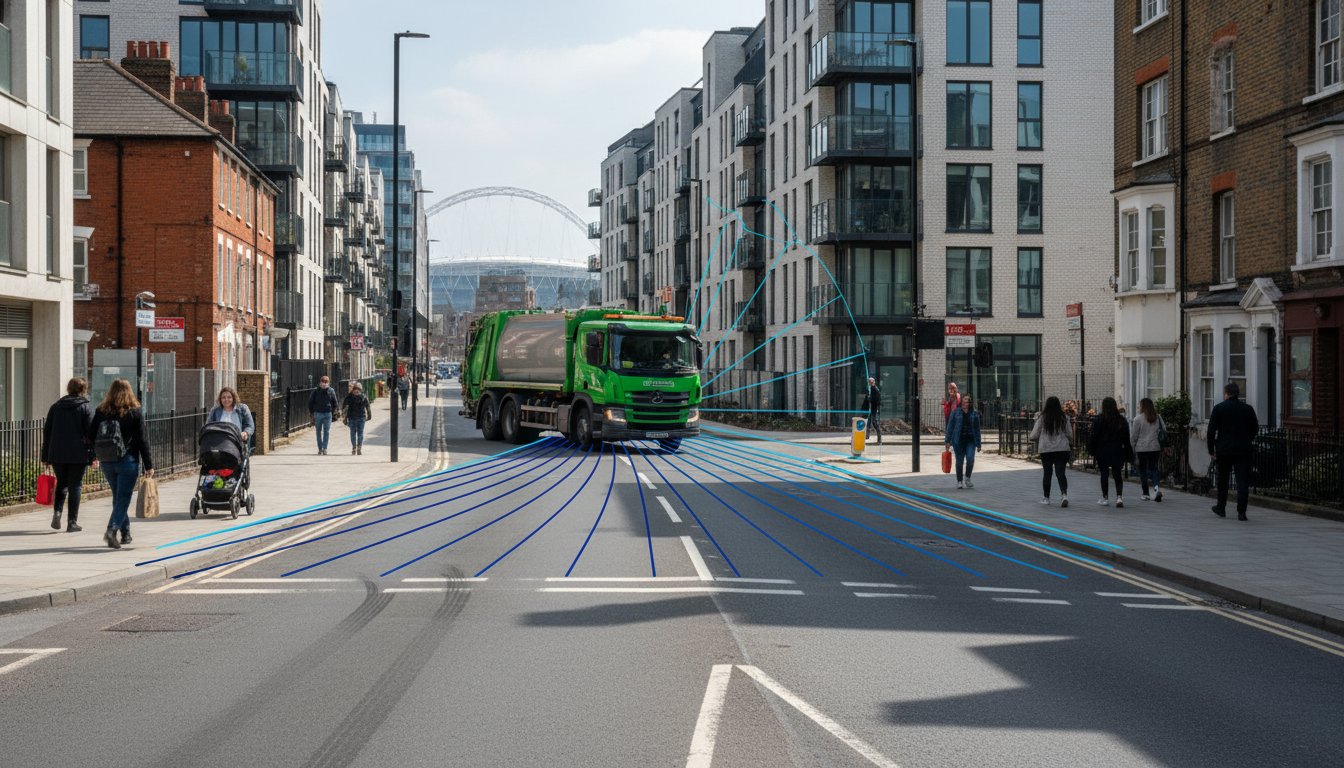
    The “Fire Tender Test” is a critical component of the design feasibility stage. We simulate the exact movements of London Fire Brigade appliances to ensure they can reach within 45 metres of all points within a building. Similarly, Brent Council’s waste management team requires refuse trucks to enter and exit every development in a forward gear. Our simulations ensure your site layout accommodates these 10.2-metre vehicles, removing the risk of a late-stage planning refusal. Precision at this stage is the only way to satisfy both highways officers and emergency services.

    Vehicle Templates for Brent Compliance

    Accuracy in simulation starts with using the correct vehicle templates. We model everything from the standard 10.2m refuse vehicle to the larger 12m pantechnicon used for residential removals. It isn’t enough to show a vehicle moving in a vacuum. We simulate “worst-case” scenarios that account for existing on-street parking obstructions common in residential Brent. For a detailed look at how we apply these standards to your plans, read our AutoTurn Swept Path Analysis Practical Guide.

    Mitigating Access Constraints

    If a simulation fails, we work directly with your design team to mitigate constraints. This might involve widening site entrances or strategically placing “over-run” areas and mountable kerbs to facilitate tighter turns. Brent’s highways officers generally reject designs that require “reversing in” or “reversing out” maneuvers due to safety risks. We prioritize designs that allow for internal turning heads or circular routes. To ensure your site layout meets every safety and waste collection standard, contact our engineering team for a professional swept path analysis today. This proactive approach ensures your submission is technically sound and ready for council scrutiny.
    Brent Transport Planning Consultant: Navigating 2026 Regulatory Hurdles

    Securing Brent Approval: The Consultant’s Strategic Edge

    Securing a positive decision in the London Borough of Brent requires more than just raw data; it requires a strategic narrative that aligns with the council’s specific policy objectives. While an architect focuses on the internal layout and aesthetic of a development, a brent transport planning consultant provides the technical authority needed to navigate the complex highway requirements that often stall or derail projects. Engaging an experienced brent transport planning consultant ensures that technical arguments carry the weight of professional integrity, which is vital when defending parking reductions or site access designs before the planning committee.

    Strategic negotiation is particularly critical when dealing with Section 106 and Section 278 agreements. In 2026, Brent has established a clear fee structure for these negotiations, with S106 administrative charges ranging from £1,051.10 for simple obligations to £2,456.00 for complex review mechanisms. Additionally, S38 and S278 approval fees are set at 9% of the works cost. We use our deep understanding of Brent’s infrastructure priorities to ensure that any requested highway improvements or financial contributions remain proportional to the development’s actual impact. This prevents developers from being burdened with excessive mitigation costs while still satisfying the council’s requirements for public safety and network efficiency.

    Developing Effective Travel Plans

    With Brent’s 2026 commitment to zero waste and the Mayor of London’s “Active Travel” targets, a robust Travel Plan is no longer a secondary document. It is a primary tool for securing approval. We set realistic modal shift targets that encourage cycling and public transport use, backed by evidence of local connectivity. Our role ensures that these plans are not just static documents but active strategies for long-term compliance. For a comprehensive look at how these strategies bolster your submission, see our guide on Travel Plan Consultants: Strengthening Applications.

    Final Submission Checklist for Brent

    The final stage of securing approval is ensuring complete document harmony. Highways officers frequently flag inconsistencies between the Transport Statement and the Design and Access Statement, which can lead to the £627 invalidation fee. We perform a rigorous final audit of all technical data against the 2026 Brent Local Plan, verifying that every survey result and swept path simulation is accurately reflected across the entire application suite. This meticulous attention to detail acts as the ultimate safeguard for your project timeline. To ensure your submission is beyond reproach, contact ML Traffic Engineers UK for a professional Brent site review and leverage our proven track record with London planning authorities.

    Secure Your Development’s Future in Brent

    Navigating the 2026 planning landscape in Brent requires absolute technical precision. We’ve explored how mastering the Lambeth Methodology for parking surveys and utilizing high-fidelity digital modeling are now non-negotiable requirements. These standards act as your primary defense against the borough’s strict invalidation fees and protracted negotiation cycles for Section 106 agreements. By integrating technical reporting early in your design phase, you eliminate the risk of abortive costs and ensure your site layout meets every safety and access benchmark established by the council.

    Partnering with a specialized brent transport planning consultant provides the strategic edge needed to move your project forward with confidence. We include expert AutoTurn Swept Path Analysis in our service and maintain a zero-failure rate on technical report validation from 2025. Our team understands the specific expectations of Brent Highway Officers, ensuring your submission is compliant and authoritative from the first day. Secure your Brent planning approval with a professional transport assessment and let us manage the regulatory complexity for you. Your project’s success is within reach, and we’re ready to help you achieve a first-time approval.

    Frequently Asked Questions

    When is a Transport Statement required for a Brent planning application?

    A Transport Statement is typically required for smaller developments with lower traffic impact. In Brent, this usually applies to residential schemes between 10 and 80 units or commercial sites under 2,500 sqm, provided they aren’t situated in sensitive locations. If your proposal exceeds these thresholds or sits near a complex junction, the council will likely request a full Transport Assessment to analyze the wider network impact.

    What is the Lambeth Methodology for parking surveys in Brent?

    The Lambeth Methodology is the industry-standard framework Brent Council uses to assess on-street parking stress. It requires an overnight assessment of available spaces within a 200m walking distance of the site. You must conduct these surveys between 00:30 and 05:30 on two separate weekday nights. This data proves whether the local network can absorb any additional parking demand without compromising residential amenity or highway safety.

    How much does a Brent transport planning consultant cost in 2026?

    Professional fees for a brent transport planning consultant vary based on the project’s scale and the complexity of the required technical reports. Costs are typically structured around the specific surveys needed, such as Lambeth Methodology parking surveys or digital Swept Path Analysis. While we don’t provide fixed price lists, we offer tailored quotes that reflect the precise technical requirements and data standards of your Brent planning application.

    Can I use a general architect for my Swept Path Analysis?

    While architects provide basic site layouts, they often lack the specialized AutoTurn software and engineering expertise required for a valid Swept Path Analysis. Brent highways officers expect high-precision digital simulations that use specific vehicle templates, such as the 10.2m refuse vehicle. A specialist engineer ensures the analysis meets the rigorous standards needed to avoid immediate application invalidation and ensures the design works in real-world conditions.

    What happens if my transport report is found to be technically flawed?

    A technically flawed report often leads to an immediate “invalid” status for your planning application. In Brent, this triggers a £627 administrative fee for major schemes and causes significant project delays. Beyond the financial penalty, errors in trip generation or junction modeling can lead to a formal refusal. You’ll then need to resubmit corrected data, which restarts the entire statutory determination period and increases your project costs.

    Does Brent Council allow car-free developments in low PTAL areas?

    Securing a car-free development in low PTAL areas (ratings 0 to 2) is significantly more challenging than in high-accessibility zones like Wembley. Brent Council generally expects on-site parking for these locations unless you provide unassailable evidence through a parking survey. You must prove that any overspill won’t compromise highway safety. These applications usually require robust Travel Plans to mitigate the lack of on-site spaces and promote sustainable travel.

    What are the fire tender access requirements for new Brent developments?

    Brent follows London Fire Brigade standards, requiring fire appliances to reach within 45 metres of all points within a building. The site access must accommodate a standard fire tender’s turning circle and width. We use Swept Path Analysis to prove that these vehicles can enter, maneuver, and exit the site safely in a forward gear. Failure to meet these standards will result in a direct objection from the emergency services and planning refusal.

    How long does it take to prepare a full Transport Assessment for a Brent site?

    A full Transport Assessment typically takes four to six weeks to complete, depending on the availability of survey data. This timeline includes conducting overnight parking surveys, performing junction capacity modeling, and drafting the technical report. Early engagement is essential to ensure that site-specific surveys are scheduled during neutral periods, avoiding school holidays or local roadworks that could skew the results and lead to council rejection of the data.

    Michael Lee

    Article by

    Michael Lee

    Transport planner with over 35 years' experience.

    Disclaimer

    The content on mltraffic.co.uk, including all technical articles, guides, and resources, is provided for general informational and educational purposes only. It is not intended to constitute professional advice in traffic engineering, transportation planning, development approvals, or any other technical or legal field.
    While ML Traffic Engineers makes every reasonable effort to ensure the accuracy, completeness, and timeliness of the information published, we do not provide any warranties or representations (express or implied) regarding its reliability, suitability, or availability for any particular purpose. Any reliance you place on the content is strictly at your own risk.
    In no event shall ML Traffic Engineers, its directors, employees, authors, or affiliates be liable for any direct, indirect, incidental, special, consequential, or punitive damages (including, without limitation, loss of profits, data, or business opportunities) arising out of or in connection with the use of, or inability to use, any information provided on this website.
    The articles and guides on this site are not a substitute for engaging a qualified, professional traffic engineer to assess your specific project requirements. For tailored advice, compliance assessments, or traffic engineering services, please contact a competent professional.
    This disclaimer may be updated from time to time without notice. By accessing or using this website, you agree to be bound by the most current version of this disclaimer.
  • Transport Planning Consultants Brent: Securing 2026 Planning Approvals

    Transport Planning Consultants Brent: Securing 2026 Planning Approvals

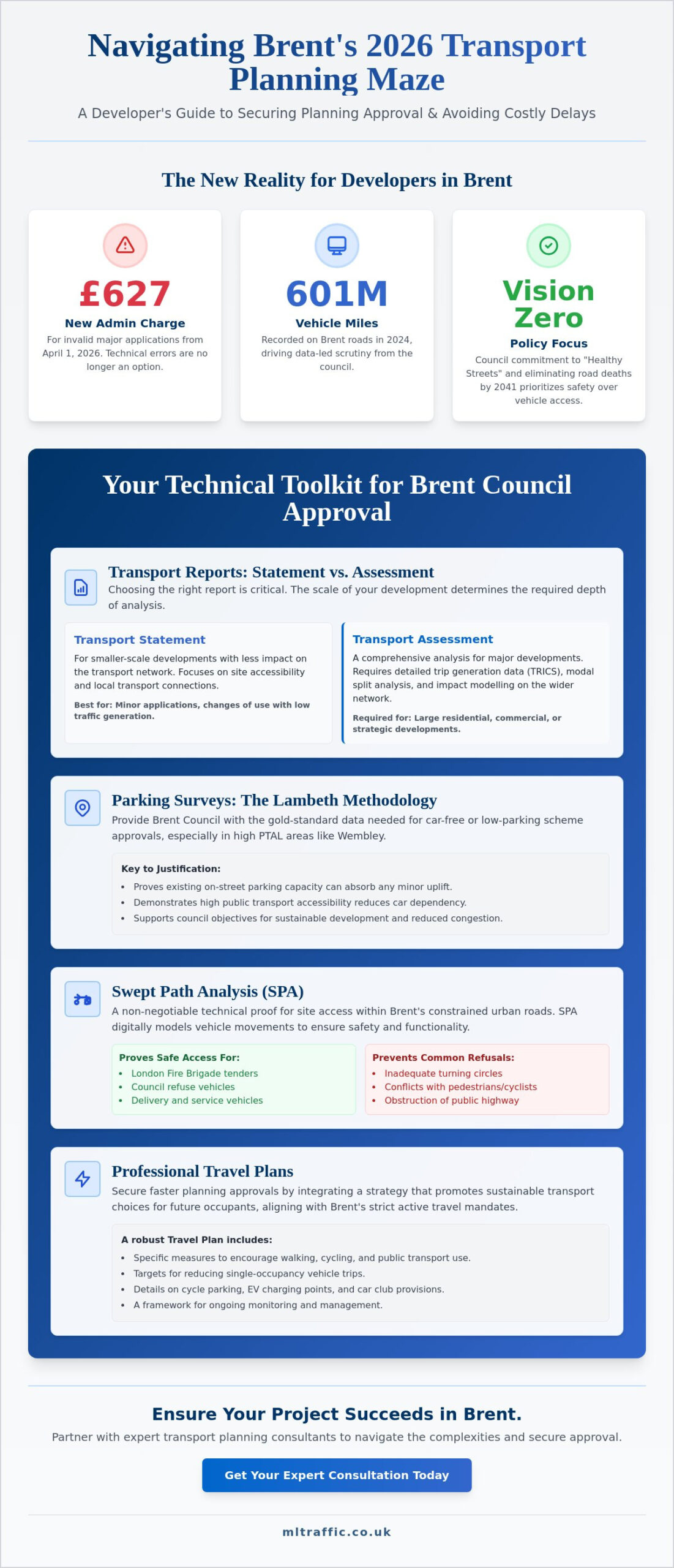
    With 601 million vehicle miles recorded on Brent roads in 2024, the council’s focus on the Mayor of London’s Transport Strategy has reached a critical peak. As of April 1, 2026, developers face new administrative charges of up to £627 for invalid major applications, leaving no room for technical errors in your submission. Engaging expert Transport Planning Consultants Brent is now a baseline requirement for those who want to avoid these costly delays. You likely understand that balancing Wembley’s high PTAL requirements against the car-free expectations of the 2025/26 Local Implementation Plan is a complex technical challenge.

    We agree that the pressure to deliver precise data that highways officers will actually accept can feel like a moving target. This guide promises to simplify Brent’s strict parking standards and active travel mandates into a clear, actionable strategy for your next project. We’ll outline the specific technical reports you need, from Swept Path Analysis to bespoke Travel Plans, to ensure your development secures approval while maintaining cost-effective reporting standards.

    Key Takeaways

    • Understand how the 2026 Brent Local Plan shifts requirements for new developments, particularly in high-PTAL areas like Wembley.
    • Identify when your project requires a Transport Statement versus a full Assessment to ensure Transport Planning Consultants Brent provide the exact data highways officers expect.
    • Master the Lambeth Methodology for parking surveys to provide Brent Council with the gold-standard data needed for car-free or low-parking approvals.
    • Utilize Swept Path Analysis (SPA) to prove safe site access for London Fire Brigade tenders and refuse vehicles within Brent’s constrained urban environments.
    • Secure faster planning approvals by integrating professional Travel Plans that align with the borough’s strict active travel and sustainability mandates.

    Securing planning approval in the London Borough of Brent requires more than just submitting architectural drawings. It demands a technical understanding of the borough’s evolving infrastructure and policy framework. Transport Planning Consultants Brent serve as the essential link between your development goals and the council’s strict highways requirements. They translate complex site constraints into acceptable technical reports. With Brent recording 601 million vehicle miles in 2024, the council uses data-led scrutiny to manage congestion and safety. These consultants ensure your project aligns with the broader principles of transportation planning, which prioritizes sustainable movement and network efficiency.

    The Brent Local Plan and Transport Policy

    The Brent Local Plan 2026 dictates how growth areas like Wembley and Kilburn High Road evolve. Since the council’s climate emergency declaration, every transport report must prove it supports carbon reduction. Brent’s commitment to “Vision Zero” aims to eliminate all road deaths and serious injuries by 2041. This means your submission must prioritize pedestrian safety and cycling infrastructure over private vehicle access. Highways officers now look for “Healthy Streets” compliance as a non-negotiable standard. Developments in the Wembley Growth Area, in particular, face intense scrutiny regarding their contribution to active travel networks and public transport capacity.

    When Do You Need a Transport Consultant in Brent?

    You need professional transport input the moment your project impacts the public highway. For major applications, which trigger a £627 administrative charge if found invalid as of May 2026, technical accuracy is vital. Transport Planning Consultants Brent identify potential access issues before they become grounds for refusal. In high PTAL areas like Wembley Park, the council often mandates “Car-Free” developments. A consultant justifies these designs through robust Travel Plans and Parking Surveys. For larger schemes, pre-application fees for strategic developments can reach £15,620.40 as of the 2026/2027 fee schedule. Investing in professional data early protects this significant capital outlay. You can explore the specific technical reports required for these submissions at what we do. Early engagement with the council’s transport team prevents the common delays that stall London developments.

    Essential Technical Reports: Transport Statements and Assessments for Brent

    Brent Council highways officers expect a high degree of technical precision before they’ll validate your planning application. The primary tool for this is either a Transport Statement or a full Transport Assessment. While both documents evaluate a project’s impact on the local network, the depth of analysis required depends on the scale of the development and the sensitivity of the surrounding infrastructure. Every report must now align with the borough’s Local Implementation Plan for 2025/26 through 2027/28, which prioritizes sustainable movement over car-centric design.

    The TRICS database remains the industry standard for trip generation data, but you can’t rely on national averages alone for a London project. You must demonstrate how your site encourages walking and cycling through a detailed modal split analysis that reflects Brent’s specific urban density. These reports must follow the Transport analysis guidance (TAG) to ensure the methodology withstands council scrutiny. Professional Transport Planning Consultants Brent ensure these technical documents aren’t just compliant but are optimized to support your development’s commercial viability.

    Preparing a Robust Transport Statement

    Small-to-medium residential developments in Brent typically require a Transport Statement. These documents focus on local connectivity and the “Healthy Streets” approach. With the borough benefiting from the Jubilee, Bakerloo, and Overground lines, many sites have high accessibility that justifies car-free designs. You must analyze these links to prove that future residents won’t rely on private vehicles. Unlike generic reports, a Brent-specific statement must explicitly address how the design reduces car dependency in line with the council’s 2026 parking standards. If your data doesn’t convincingly support these active travel goals, you risk facing the new £159 administrative charge for invalid minor applications.

    Full Transport Assessments for Major Brent Developments

    Major projects in Wembley or Alperton demand a full Transport Assessment. These high-occupancy sites often sit near the Strategic Road Network (SRN), which requires direct collaboration with Transport for London (TfL). You’ll need a comprehensive impact analysis that accounts for cumulative traffic from neighboring developments. This is particularly vital in growth areas where the council monitors the network’s total capacity. For a deeper look at these requirements across the capital, read our guide on Transport Assessment London. Securing approval for these complex sites requires data that is both accurate and defensible. If you’re unsure which report your site needs, you can consult our technical team to receive a bespoke scoping opinion.

    Transport Planning Consultants Brent: Securing 2026 Planning Approvals

    Accurate Data Collection: Parking Surveys and Traffic Analysis in Brent

    Securing planning approval in Brent requires more than just high-level estimates; it demands empirical evidence that council highways officers can verify. Data-led submissions are the only way to navigate the borough’s complex parking standards, especially given the new administrative charges for invalid applications effective from April 2026. Reliable Transport Planning Consultants Brent prioritize accurate traffic surveys and parking stress tests to ensure your project doesn’t stall at the validation stage. Whether you’re developing near the busy A406 North Circular or a quiet residential street in North Brent, the quality of your data determines your success.

    The Lambeth Methodology in a Brent Context

    Brent Council considers the Lambeth Methodology the gold standard for assessing parking capacity. To provide a true reflection of residential parking stress, we conduct surveys during the peak period between 00:30 and 05:30 on two separate weekday nights. This timeframe captures the maximum number of residents at home. We define a survey area within a 200m walking distance of the site, which is the standard radius for Brent applications. Our reports explicitly detail the impact of Controlled Parking Zones (CPZs). Since resident parking permits now cost £49 for the first vehicle and £136 for the second as of May 2026, understanding these permit restrictions is vital for accurate capacity reporting. We ensure every survey accounts for these local constraints to provide a defensible data set.

    PTAL Ratings and Parking Justification

    The Public Transport Accessibility Level (PTAL) of your site dictates the council’s starting position on parking provision. In Wembley Park, where PTAL ratings often reach 6, the council’s Local Implementation Plan mandates car-free developments. However, projects in Kingsbury or Kenton often fall into PTAL 1 or 2 zones. In these areas, developers must provide robust data to justify any parking provision. We use professional Parking Surveys to demonstrate that the local network can absorb the anticipated demand without compromising road safety or active travel goals. For sites along the Strategic Road Network like the A406, we also provide detailed traffic counts to justify new or modified site access points. This precision ensures that highways officers have the exact data they need to recommend approval without requesting expensive revisions.

    Site Access and Swept Path Analysis: Overcoming Brent’s Constraints

    Brent’s urban fabric presents significant physical challenges for new developments. Narrow Victorian streets in areas like Harlesden and Willesden leave little room for error when designing site entrances. Swept Path Analysis is a computer-aided simulation of vehicle turning circles. We use this technology to prove that your site access works before you commit to a final layout. Experienced Transport Planning Consultants Brent identify these physical constraints early in the design phase to prevent costly redesigns during the planning process. Our CAD-based simulations provide the technical certainty that council highways officers require for validation.

    Vehicle Maneuverability and Refuse Collection

    Brent Council’s waste management policies for 2026 are uncompromising. You must demonstrate that a standard refuse vehicle can enter, turn, and exit the site in forward gear without overhanging the footway. We use professional software to model the specific dimensions of Brent’s 26-tonne refuse collection vehicles. This analysis also confirms that bin carry distances remain within the council’s mandated limits, typically 10 to 15 metres from the collection point. Failure to provide this data often results in immediate objections. You can view our full range of Swept Path Analysis Services to see how we handle these technical requirements for London developers.

    Fire Tender Access and Safety Compliance

    The “Fire Tender Swept Path” is a non-negotiable safety requirement for any residential approval in the borough. The London Fire Brigade requires clear, unobstructed routes that accommodate their specific turning radii. In tight urban infill sites near Kilburn or Harlesden, this often requires centimetre-perfect planning. We simulate these movements to ensure that fire crews can reach every part of your development without delay. Our reports also prioritize the safety of pedestrians and cyclists at site access points. We design visibility splays that protect vulnerable road users while maintaining vehicle flow. This comprehensive approach satisfies both safety inspectors and planning officers. Transport Planning Consultants Brent ensure that your access strategy meets the highest safety standards while maximizing the developable area of your site. If your project faces challenging access constraints, request a Swept Path Analysis from our technical team today.

    Partnering with ML Traffic Engineers: Expert Transport Planning for Brent Developers

    Securing planning permission in the London Borough of Brent requires a partner who treats technical precision as a legal and physical necessity. We understand that the stakes are high. As of April 1, 2026, Brent Council’s administrative charges mean that an invalid major application can cost you up to £627 in wasted fees alone. ML Traffic Engineers act as a safe pair of hands, managing the technical and regulatory burdens so you can focus on the construction phase. Our team provides a total, managed solution that bridges the gap between your site’s potential and the council’s strict highways requirements. We operate with a sense of readiness and urgency, offering 24/7 availability to ensure your project stays on track regardless of the timeline.

    Our track record across Brent is built on professional integrity and data-led reporting. We don’t just provide equipment; we deliver comprehensive support from the initial consultation through to final implementation. Whether your site is a high-density development in Wembley Park or a complex infill project in Harlesden, we produce reports that Brent highways officers trust. Our expertise as Transport Planning Consultants Brent ensures that every Transport Statement and Parking Survey we submit meets the highest standards of compliance. ML Traffic Engineers take pride in our ability to navigate the intricate complexities of UK road regulations on your behalf.

    Why ML Traffic Engineers?

    We possess deep knowledge of Brent’s specific highways and parking standards, which is vital for clearing modern planning conditions. Our engineers specialize in what we do, providing everything from CAD-based Swept Path Analysis to detailed Travel Plans. We prioritize clarity and speed, using direct sentence structures in our reports to help project managers grasp key benefits quickly. ML Traffic Engineers utilize technical vocabulary rooted in industry reality, employing CAD design and multi-way systems to solve access constraints. We maintain a standard of formal excellence that matches the strict regulatory environment of 2026.

    Ready to Start Your Brent Project?

    Waiting for a response can stall your development’s momentum. We offer a sequential and logical communication flow that mirrors your project’s lifecycle. You can access our technical resources to understand the latest requirements for architects and developers. If you need immediate assistance with an upcoming submission, our team is ready to provide a bespoke quote tailored to your site’s PTAL rating and scale. Contact our Transport Planning Consultants today to secure the technical authority your Brent planning application requires.

    Success in Brent’s 2026 development landscape hinges on data that withstands rigorous highways officer scrutiny. We’ve detailed how the borough’s Local Plan and Vision Zero principles dictate the technical requirements for your specific submission. Whether you’re navigating high-PTAL zones in Wembley or proving access on the narrow streets of Harlesden, the role of Transport Planning Consultants Brent is to provide the empirical evidence that validates your design. This technical certainty prevents the administrative delays and financial penalties associated with invalid applications that can stall a project before it begins.

    ML Traffic Engineers provide a comprehensive suite of services, from overnight parking surveys to CAD-based simulations, ensuring your submission is both compliant and defensible. Our 24/7 availability ensures that even the most urgent project timelines are met with professional integrity and safety-conscious precision. We’re ready to help you navigate the intricate highways regulations of the London Borough of Brent so you don’t have to. Get a Professional Transport Report for Your Brent Project today and move your development toward a successful 2026 planning approval.

    Frequently Asked Questions

    Do I need a Transport Statement for a small residential conversion in Brent?

    Yes, Brent Council requires a Transport Statement for most residential conversions to confirm the project doesn’t negatively impact local parking stress or active travel routes. Since April 2026, the council has increased its scrutiny of minor applications to ensure they align with the borough’s sustainability targets. We assess your site’s specific footprint to ensure your submission meets these strict validation requirements without unnecessary revisions.

    What is the current parking standard for new developments in Wembley?

    Developments in Wembley typically follow a car-free standard due to the area’s high accessibility ratings. To compensate for the lack of parking, you must provide high-quality cycle storage and a robust Travel Plan that encourages the use of local bus and rail networks. These measures satisfy the council’s requirements for reducing private vehicle dependency in high-density growth zones.

    How much does a Lambeth Methodology parking survey cost in London?

    The cost of a Lambeth Methodology survey varies based on the size of the survey area and the number of nights required to establish a baseline for parking stress. We conduct these surveys over two separate weekday nights to provide the representative data that Brent highways officers demand. Accuracy at this stage is vital to avoid the administrative charges the council applies to invalid or poorly evidenced applications.

    Can Brent Council refuse my application based on traffic impact alone?

    Brent Council can refuse an application if the technical data suggests a development will cause a severe impact on the safety or capacity of the local road network. Our role as Transport Planning Consultants Brent is to identify these risks early and propose effective mitigation measures. We provide the empirical evidence needed to prove your site operates safely within the constraints of the borough’s existing infrastructure.

    What happens if my site has a low PTAL rating?

    Sites in areas like Kingsbury or Kenton with lower PTAL ratings may be allowed a higher ratio of on-site parking compared to Wembley. You must still provide a detailed justification within your Transport Statement to show that this provision won’t lead to overspill parking on surrounding streets. We use overnight stress tests to demonstrate that the local network has the capacity to accommodate your project’s specific needs.

    Is Swept Path Analysis required for all commercial developments in Brent?

    Swept Path Analysis is mandatory for any commercial site where delivery vehicles or refuse trucks must enter the property. We use CAD software to model the movements of specific vehicles, ensuring they can turn safely without overhanging the public footway. This analysis also protects the safety of pedestrians and cyclists by ensuring that visibility splays at the site entrance are clear and compliant.

    How long does it take ML Traffic Engineers to produce a Transport Statement?

    ML Traffic Engineers typically deliver a completed Transport Statement within 10 to 14 working days once the initial site surveys are finished. Our 24/7 readiness allows us to deploy survey teams immediately, capturing the real-world data your project requires without delay. This efficient turnaround helps you meet tight planning deadlines while maintaining the technical authority that highways officers expect.

    Do you liaise directly with Brent Council highways officers?

    We frequently liaise with Brent Council highways officers to discuss technical scoping and resolve potential objections before they lead to a refusal. As expert Transport Planning Consultants Brent, we understand the specific preferences of the local highways team regarding active travel and site access. This proactive communication is a core part of our managed solution, helping to streamline the approval process for complex London developments.

    Michael Lee

    Article by

    Michael Lee

    Transport planner with over 35 years’ experience.

    Disclaimer

    The content on mltraffic.co.uk, including all technical articles, guides, and resources, is provided for general informational and educational purposes only. It is not intended to constitute professional advice in traffic engineering, transportation planning, development approvals, or any other technical or legal field.
    While ML Traffic Engineers makes every reasonable effort to ensure the accuracy, completeness, and timeliness of the information published, we do not provide any warranties or representations (express or implied) regarding its reliability, suitability, or availability for any particular purpose. Any reliance you place on the content is strictly at your own risk.
    In no event shall ML Traffic Engineers, its directors, employees, authors, or affiliates be liable for any direct, indirect, incidental, special, consequential, or punitive damages (including, without limitation, loss of profits, data, or business opportunities) arising out of or in connection with the use of, or inability to use, any information provided on this website.
    The articles and guides on this site are not a substitute for engaging a qualified, professional traffic engineer to assess your specific project requirements. For tailored advice, compliance assessments, or traffic engineering services, please contact a competent professional.
    This disclaimer may be updated from time to time without notice. By accessing or using this website, you agree to be bound by the most current version of this disclaimer.