A single miscalculation in your Swept Path Analysis can trigger an immediate planning refusal from a London borough, often costing developers over £45,000 in redesign fees and project delays. You likely understand that aligning the London Plan’s parking restrictions with evolving safety codes is a complex logistical challenge that requires absolute precision. This guide delivers the essential design recommendations for multi-storey and underground car parks. Institution of Structural Engineers (IStructE) guidance for 2026, ensuring your project achieves full structural compliance and passes rigorous local authority scrutiny.
We provide a clear roadmap for optimising bay counts while integrating high-cost fire safety requirements and EV infrastructure into underground tiers. You’ll gain a technical understanding of how to navigate conflicting regulatory standards and implement CAD-backed layouts that guarantee safety and efficiency. This article explains the transition from initial planning to final implementation, helping you secure approval without sacrificing project viability.
Key Takeaways
- Align with the latest IStructE 5th edition standards to ensure your structural designs meet the rigorous safety benchmarks required for 2026 London developments.
- Optimise geometric layouts beyond the standard 2.4m x 4.8m bay to accommodate modern vehicle sizes and ensure efficient ramp transitions for multi-storey structures.
- Implement the latest design recommendations for multi-storey and underground car parks. Institution of Structural Engineers (IStructE) guidance to integrate mandatory EV charging infrastructure and fire compartmentation.
- Secure planning approval by utilising technical documentation and data-led parking surveys to provide the evidence-based justification London Boroughs demand.
Table of Contents
- Understanding IStructE Guidance in the London Planning Context
- Geometric Design Standards: Ramps, Bays, and Circulation
- Fire Safety and Structural Resilience in Underground Facilities
- Integrating EV Charging and Sustainable Transport Infrastructure
- Securing Approval: From IStructE Design to Planning Permission
Understanding IStructE Guidance in the London Planning Context
The Institution of Structural Engineers (IStructE) serves as the primary technical authority for UK parking infrastructure. Their standards define how developers approach safety, structural resilience, and operational efficiency. The transition from the 4th edition to the comprehensive 5th edition, published in 2023, is vital for any project reaching the construction phase in 2026. This updated guidance addresses the physical reality of modern vehicles, specifically the increased static and dynamic loads imposed by Electric Vehicles (EVs). When applying for planning permission in London, these standards aren’t just suggestions; they are the benchmarks used by borough engineers to determine if a structure is fit for purpose. Incorporating multi-storey car park design principles from the outset ensures that structural integrity aligns with complex transport planning requirements.
Key Objectives of Modern Car Park Design
Designers must prioritise user safety and vehicle security, particularly in high-density areas like Southwark, Tower Hamlets, or Camden. Modern design recommendations for multi-storey and underground car parks. Institution of Structural Engineers (IStructE) guidance now mandate larger bay sizes and revised load-bearing calculations. Average car widths have increased by approximately 1cm every two years since 2000, and the weight of a typical EV can be 20% to 30% higher than its petrol equivalent. New layouts must accommodate these dimensions while balancing structural longevity. Flexibility is another core requirement. Developers are increasingly asked to design structures that can be repurposed or adapted if car ownership rates shift by 2030.
London-Specific Regulatory Overlays
London presents unique challenges due to the London Plan’s “Car-Free” and “Car-Lite” mandates. These policies restrict the number of spaces allowed in new developments, especially in areas with high PTAL ratings. Navigating these constraints requires a precise Transport Assessment London to justify every square metre of parking. Transport for London (TfL) also maintains strict oversight on basement access points to prevent vehicle tailbacks on the Red Route network. We ensure your designs meet these rigorous safety standards while satisfying the specific technical demands of local planning authorities. This proactive approach reduces the risk of costly redesigns during the planning process.
Geometric Design Standards: Ramps, Bays, and Circulation
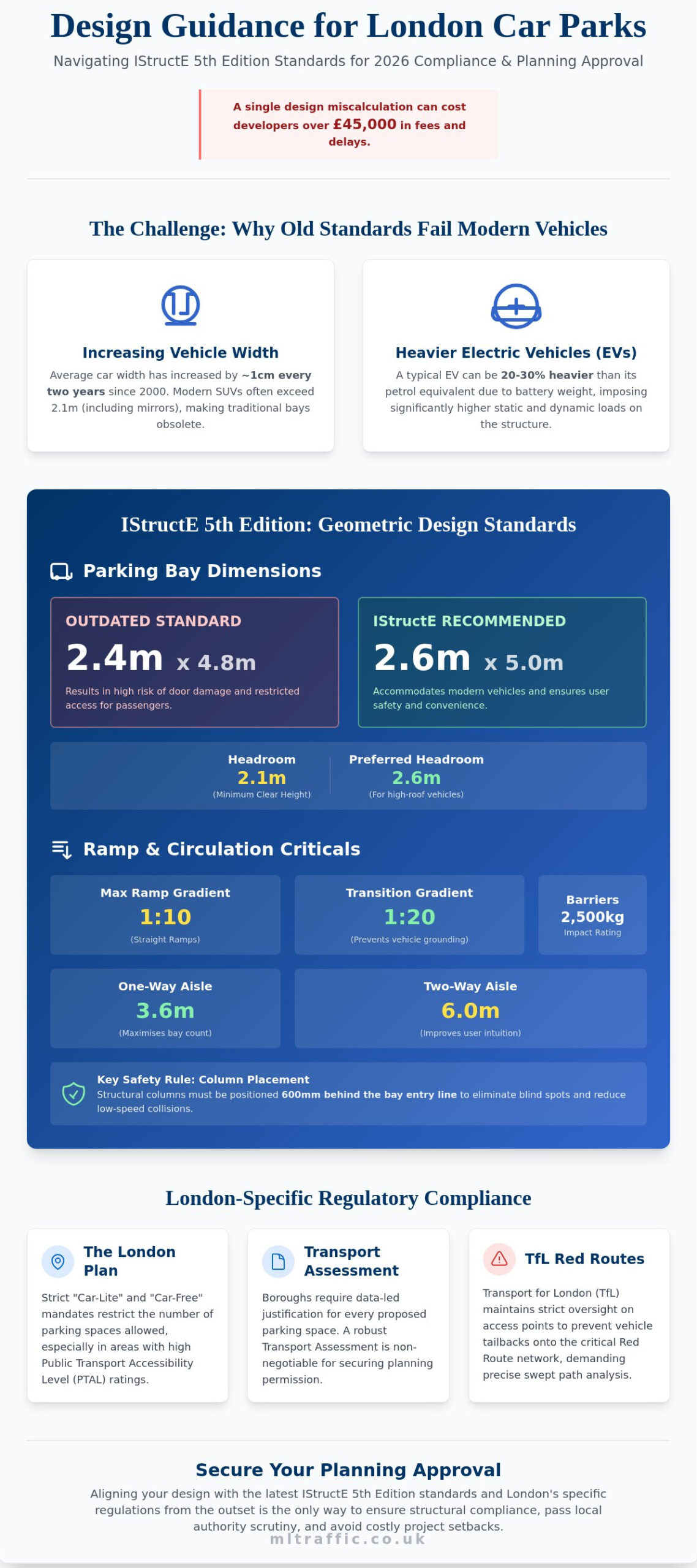
The traditional 2.4m x 4.8m parking bay is no longer the gold standard for London developments. As vehicle widths have increased by an average of 1cm every two years since 2000, many modern SUVs now exceed 2.1m in width including mirrors. This creates a high risk of door-to-door damage and restricted egress for passengers. Professionals must follow the latest IStructE’s ‘Car Park Design’ guidance, which suggests increasing standard bay widths to 2.5m or 2.6m for commercial sites where vehicle turnover is high. For underground structures, headroom is equally vital; a minimum clear height of 2.1m is required, though 2.6m is preferred to accommodate high-roof conversion vehicles and overhead building services.
Ramp design is the most common point of failure in car park functionality. Gradients shouldn’t exceed 1:10 for straight runs or 1:12 for curved sections. We implement 1:20 transitions at the top and bottom of every ramp to prevent vehicle grounding. These transitions ensure that low-slung vehicles don’t scrape their undercarriages, a frequent issue in older multi-storey builds. Safety barriers must be rated to withstand the impact of a 2,500kg vehicle, reflecting the increased weight of modern Electric Vehicles (EVs).
Optimising Layout Geometry
One-way systems allow for narrower 3.6m aisles, which helps developers maximise the number of bays in tight underground footprints. Two-way systems require 6.0m aisles but offer better user intuition and reduced driver frustration. For London residential projects, the “Design Vehicle” is typically a large family car, whereas commercial hubs must account for light delivery vans. Structural columns should be positioned 600mm behind the bay entry line to remove blind spots and reduce the likelihood of low-speed collisions. If you’re unsure about your current layout, our team can help you optimise your car park capacity through precise technical audits.
Validating Geometry with Swept Path Analysis
Static dimensions on a 2D plan don’t guarantee operational success. We use CAD-based Swept Path Analysis services to simulate vehicle movements in real-time. This is essential for proving that fire tenders and refuse vehicles can navigate underground tiers without striking structural elements. Providing this visual evidence is often the difference between a rejected application and securing planning approval from London authorities. It’s a reliable way to ensure your Design recommendations for multi-storey and underground car parks. Institution of Structural Engineers (IStructE) guidance compliance is airtight. By simulating the turning circles of specific vehicle classes, we eliminate the guesswork that leads to costly structural retrofits.
- Pedestrian Clear Zones: Ensure a minimum 1.2m wide path that is physically separated from vehicle lanes.
- Turning Radii: Inner radii for ramps should be at least 4.5m to accommodate the average UK saloon.
- Signage: High-contrast, reflective signage is mandatory to guide drivers through restricted underground tiers.
Fire Safety and Structural Resilience in Underground Facilities
Underground parking facilities in London face intense regulatory scrutiny regarding structural integrity and thermal resistance. The 2026 Design recommendations for multi-storey and underground car parks. Institution of Structural Engineers (IStructE) guidance mandates a shift in how we approach fire resistance periods. Designers must now account for the extended burn times associated with lithium-ion battery fires, which often require structural elements to maintain stability for 120 minutes or longer in deep basement scenarios. Compartmentation is no longer just a box-ticking exercise; it’s a critical strategy to prevent lateral fire spread across large floor plates. Effective compartmentation limits the volume of smoke and heat, protecting the primary frame from progressive collapse.
Ventilation strategies in London’s constrained urban sites require a balance between natural and mechanical systems. While natural ventilation remains the gold standard for surface-level decks, deep basements typically rely on mechanical smoke extraction. These systems must achieve a minimum of 10 air changes per hour during an emergency to ensure visibility for fire crews. Additionally, the physical weight of modern vehicles has increased by approximately 25% over the last two decades. Structural slabs must now support heavier point loads from Electric Vehicles (EVs), which often weigh between 2,000kg and 3,000kg. This weight increase necessitates thicker slabs and reinforced column junctions to prevent punching shear, especially when navigating the tight turns often verified through swept path analysis during the design phase.
Modern Fire Protection Standards
The 2023 Luton Airport car park fire served as a catalyst for stricter suppression requirements. The latest UK Government’s Fire Safety Guidance (Approved Document B) now strongly advocates for automatic sprinkler systems in all enclosed multi-storey structures. Pedestrian safety depends on protected escape routes that use fire-rated materials with Class A1 non-combustible ratings. Clear signage and emergency lighting must remain functional even under extreme heat, ensuring that occupants can exit the facility within the calculated safe evacuation time.
Drainage and Flood Resilience
Managing surface water run-off is a primary concern for London developments, particularly those near the Thames Tideway. Designers must implement high-capacity attenuation tanks and oil separators to prevent contaminated water from entering the public sewer system. Underground facilities in Flood Zones 2 and 3 require robust waterproofing and redundant pumping systems to mitigate the risk of total immersion. The IStructE flood resilience standard for 2026 requires all basement tiers to include a secondary backup drainage system capable of handling a 1-in-100-year storm surge without compromising structural stability.
Successfully implementing these complex drainage and foundation systems requires specialized expertise. For large-scale projects, engaging professional civil engineers is crucial to ensure the structure’s long-term integrity. As an example of the specialists available for such demanding projects, reputable firms like the groundworks contractors Cambridge provide the necessary skills for robust foundation and drainage solutions.
Integrating EV Charging and Sustainable Transport Infrastructure
The 2026 update to the London Plan mandates that all new car parks provide 20% active and 80% passive Electric Vehicle (EV) charging points. This shift transforms a building from a simple storage unit into a complex energy hub. The latest Design recommendations for multi-storey and underground car parks. Institution of Structural Engineers (IStructE) guidance reflects the need for robust structural responses to these requirements. Electric vehicles are significantly heavier than their internal combustion counterparts; a typical electric SUV can weigh upwards of 2,500kg, representing a 20% to 30% increase in static load. Engineers must now calculate floor loading with these higher averages to prevent long-term structural fatigue. This increased weight also places greater stress on tyres, creating new maintenance challenges within car parks. The rise of on-site service providers like Mobile Tyres Bolton is one response to this, offering a convenient solution for EV owners.
Fire safety remains a primary concern in the 2026 guidance. Lithium-ion battery fires burn at higher temperatures and require specific suppression strategies. Designers must integrate enhanced sprinkler systems and thermal monitoring technologies within the charging zones. Proper cable management is also vital. Exposed cabling creates trip hazards and complicates maintenance. By housing infrastructure within dedicated fire-rated risers and ceiling-mounted trays, developers ensure both safety and longevity.
Electric Vehicle Infrastructure Design
Positioning EV bays requires strategic planning to minimise the length of heavy-duty copper cabling. Placing these bays near structural columns or primary electrical risers reduces the weight burden on ceiling voids and lowers installation costs. Future-proofing is no longer optional. You must design for the total electrical load of 100% occupancy charging, even if only a fraction is active at launch. This includes allocating space for onsite battery storage systems to manage peak demand without overstressing the local grid.
Supporting Multi-Modal Travel
Modern car parks must function as mobility hubs rather than isolated assets. This involves dedicating ground-floor space to micro-mobility, including secure cycle racks and e-scooter docking stations with integrated charging. Clear, well-lit pedestrian links must connect the facility directly to London public transport networks to encourage fluid travel. Aligning these designs with London Travel Plans is essential for securing planning approval, as it demonstrates a commitment to reducing overall car dependency. These plans provide the data needed to justify parking ratios while ensuring the site remains accessible to all users.
ML Traffic provides the technical expertise and CAD design services required to integrate these complex systems into your next project. Ensure your facility is compliant and future-ready by choosing our comprehensive traffic management and design solutions.
Securing Approval: From IStructE Design to Planning Permission
Securing planning permission from London Boroughs like Westminster, Southwark, or Tower Hamlets requires more than just structural drawings. You must prove your project aligns with the latest 2026 standards. The technical documentation you submit must explicitly reference the Design recommendations for multi-storey and underground car parks. Institution of Structural Engineers (IStructE) guidance to demonstrate a commitment to safety and operational efficiency. This technical alignment acts as a shield against common planning objections regarding vehicle circulation and pedestrian safety.
Developers often face scrutiny over proposed capacity. A professional Parking Survey provides the empirical evidence needed to justify your design. It maps out current demand within a 200-metre radius of your site, ensuring your provision isn’t just a guess. This data-driven approach prevents the delays caused by over-building or under-providing. Your Transport Statement must then articulate how the IStructE geometric standards, such as the 2.5m x 5.0m bay sizes, integrate seamlessly with the existing local road network.
Liaising with local highway authorities is a critical phase. Disputes often arise regarding access and egress points. We resolve these by providing detailed CAD layouts that prove visibility splays and junction capacities meet the strict requirements of the Traffic Signs Manual and Chapter 8 compliance. We provide the technical authority needed to satisfy even the most cautious planning officers.
The Pre-Application Process
Engaging with London borough transport officers early in the design phase reduces the risk of expensive late-stage revisions. We use technical data to overcome objections regarding traffic impact or safety before they reach the public consultation stage. Presenting a clear What We Do overview builds developer credibility by showing you have a managed solution for every stage of the project. This proactive approach shows the council that you understand the intricacies of UK road regulations and are prepared to mitigate any local disruption.
Final Checklist for Design Submission
Before you submit your final application, verify that every technical detail is cross-referenced for consistency. A single discrepancy can lead to a refusal. Use this checklist to ensure your submission is robust:
- Ensure all IStructE geometric checks, including ramp gradients and headroom, are cross-referenced with your Swept Path Analysis (SPA) results.
- Verify that fire safety strategies and EV charging infrastructure meet the 20% active and 80% passive requirement for 2026.
- Confirm that the Design recommendations for multi-storey and underground car parks. Institution of Structural Engineers (IStructE) guidance are cited in both the structural and transport reports.
- Check that visibility splays at the site entrance are clear of all obstructions and documented in your CAD drawings.
Professional traffic engineering oversight remains the single most critical factor in securing rapid planning approvals for London car park developments.
Secure Your Planning Approval with Expert Car Park Design
Adhering to the latest Design recommendations for multi-storey and underground car parks. Institution of Structural Engineers (IStructE) guidance is now a prerequisite for successful development in 2026. You must integrate complex EV infrastructure and enhanced fire safety measures while maintaining strict geometric standards for ramps and circulation. These technical requirements are rigorous, but they ensure the long-term structural resilience of underground facilities. Precision in the planning phase prevents costly retrofits and delays during construction.
ML Traffic delivers the technical certainty required to navigate the planning landscape across all 32 London Boroughs. We’re specialists in IStructE-compliant Swept Path Analysis and offer bespoke CAD solutions tailored to your site’s specific constraints. Our experts are available 24/7 to handle urgent planning deadlines, ensuring your project remains on track and fully compliant with UK road regulations. We’ll manage the intricate details so you can focus on the broader build. It’s time to transform your layout into a high-performing, safe asset.
Request a Car Park Layout & Access Review for Your London Project and let’s get your development moving.
Frequently Asked Questions
What are the minimum bay dimensions recommended by IStructE for UK car parks?
The 2026 IStructE guidance recommends a standard parking bay dimension of 2.6 metres wide by 5.0 metres long. This represents a shift from the older 2.4 metre standard to accommodate the increased size of modern SUVs and electric vehicles. We ensure every layout we design follows these specific metrics to prevent vehicle damage and maintain smooth traffic flow within the facility.
How does IStructE guidance address the fire risks of electric vehicles in underground car parks?
The 2026 update mandates a minimum of 120 minutes of structural fire resistance for underground car parks housing electric vehicles. It requires enhanced sprinkler systems and dedicated smoke extraction zones to manage thermal runaway risks. Our team incorporates these safety standards into every project to protect the structural integrity of the building and ensure occupant safety during an emergency.
Is IStructE guidance legally mandatory for London planning applications?
While the guidance itself isn’t statutory law, the Greater London Authority and local councils almost always mandate compliance as a condition for planning approval. Adhering to these design recommendations for multi-storey and underground car parks ensures your project meets the safety criteria required by building control. We provide the technical documentation needed to prove your site aligns with these industry-leading benchmarks.
What is the maximum recommended ramp gradient for a multi-storey car park?
The maximum recommended gradient for a straight ramp is 1:10, or 10 percent. For curved or helical ramps, the gradient shouldn’t exceed 1:12 on the centre line to prevent vehicles from grounding. We use precise CAD modelling to ensure these gradients are maintained throughout the structure, providing a safe and comfortable experience for all motorists using the facility.
How has IStructE guidance changed regarding vehicle weights in 2026?
The 2026 guidance increases the design floor load to 3.0kN/m² to account for the heavy batteries found in modern electric vehicles. This is a significant rise from the previous 2.5kN/m² standard used in older multi-storey designs. Our structural reviews always apply these updated weight calculations to guarantee the long-term durability of the concrete slabs and support columns under modern loading conditions.
Do underground car parks in London require specific flood risk assessments?
Every underground car park in London located within Flood Zones 2 or 3 must submit a site-specific Flood Risk Assessment. This document must prove the facility can manage a 1 in 100-year storm event plus a 40 percent allowance for climate change. We coordinate with drainage engineers to ensure your basement design includes the necessary pump systems and threshold defences to satisfy these strict environmental regulations.
Can IStructE standards be used to justify reduced parking provision in PTAL 6 zones?
Developers use this Institution of Structural Engineers (IStructE) guidance to prove that even with reduced parking numbers, the remaining bays are fully accessible and safe. In PTAL 6 zones where “car-free” developments are preferred, following these standards helps justify the quality of the limited spaces provided for blue badge holders. We help you balance high-density requirements with the physical realities of safe vehicle movement.
What is the difference between a car park layout review and a full Transport Assessment?
A car park layout review focuses on internal geometry, including swept path analysis and column placement, to ensure the building is functional. A full Transport Assessment examines the project’s impact on the external London road network and public transport capacity. We offer both services to provide a total managed solution, taking your project from the initial planning phase through to final implementation.
Which areas in London do you cover?
We service Acton, Balham, Barking, Barnes, Barnet, Battersea, Beckenham, Bexleyheath, Brentford, Brixton, Bromley, Camberwell, Carshalton, Charlton, Chelsea, Chiswick, Clapham, Coulsdon, Croydon, Crystal Palace, Dagenham, Dulwich, Ealing, Edgware, Eltham, Enfield, Finchley, Forest Gate, Fulham, Golders Green, Greenwich, Hackney, Hammersmith, Hampstead, Harrow, Hayes, Highgate, Hounslow, Ilford, Islington, Kensington, Kentish Town, Kingston upon Thames, Lewisham, Mitcham, Muswell Hill, New Malden, Notting Hill, Orpington, Peckham, Pinner, Purley, Putney, Richmond, Romford, Ruislip, Sidcup, Southall, Southgate, Streatham, Surbiton, Sutton, Tooting, Tottenham, Twickenham, Uxbridge, Walthamstow, Wembley, West Norwood, Wimbledon, Wood Green, Woolwich, Bethnal Green, Shoreditch, Canary Wharf, Deptford, Leyton, Palmers Green, Stanmore, Upminster, Chislehurst, Erith, Feltham.
Which cities in England do you cover?
We service London, Birmingham, Manchester, Liverpool, Sheffield, Leeds.

Article by
Michael Lee
Transport planner with over 35 years’ experience.
Disclaimer
The content on mltraffic.co.uk, including all technical articles, guides, and resources, is provided for general informational and educational purposes only. It is not intended to constitute professional advice in traffic engineering, transportation planning, development approvals, or any other technical or legal field.
While ML Traffic Engineers makes every reasonable effort to ensure the accuracy, completeness, and timeliness of the information published, we do not provide any warranties or representations (express or implied) regarding its reliability, suitability, or availability for any particular purpose. Any reliance you place on the content is strictly at your own risk.
In no event shall ML Traffic Engineers, its directors, employees, authors, or affiliates be liable for any direct, indirect, incidental, special, consequential, or punitive damages (including, without limitation, loss of profits, data, or business opportunities) arising out of or in connection with the use of, or inability to use, any information provided on this website.
The articles and guides on this site are not a substitute for engaging a qualified, professional traffic engineer to assess your specific project requirements. For tailored advice, compliance assessments, or traffic engineering services, please contact a competent professional.
This disclaimer may be updated from time to time without notice. By accessing or using this website, you agree to be bound by the most current version of this disclaimer.