Tag: London Planning

  • Transport Engineering Consultants London: Navigating Planning Approvals in 2026

    Transport Engineering Consultants London: Navigating Planning Approvals in 2026

    In 2026, London ranks as the sixth most congested city in the world, with drivers losing an average of 109 hours a year in rush-hour traffic. You likely feel the weight of these statistics every time you submit a planning application. Between the London Plan’s strict car-free mandates for areas with a PTAL of 4 or higher and the varying parking standards across individual boroughs, securing consent often feels like a moving target. Insufficient transport data or a poorly timed submission can lead to expensive delays that stall your project’s momentum.

    This guide demonstrates how expert transport engineering consultants london provide the technical precision required to navigate these regulatory hurdles and unlock your site’s maximum potential. We’ll show you how to transform logistical constraints into approved developments through accurate data and strategic planning. We’ll examine the role of professional Transport Assessments, Swept Path Analysis, and tailored Travel Plans in securing successful outcomes while keeping your mitigation strategies cost-effective.

    Key Takeaways

    • Understand how technical justification bridges architectural vision and statutory requirements in London’s high-density environment.
    • Learn how transport engineering consultants london determine whether your project requires a Transport Statement or a full Assessment to satisfy borough-specific structures.
    • Discover how Swept Path Analysis and Parking Surveys prove site layout viability and justify parking provisions on constrained city streets.
    • Master the complexities of PTAL ratings and borough standards to maintain high-density residential goals even in areas with lower accessibility scores.
    • Identify how precision-led reporting and rapid response capabilities help developers meet urgent planning deadlines and reduce regulatory pressure.

    Table of Contents

    The Strategic Role of Transport Engineering Consultants in London Planning

    Transport engineering serves as the technical bridge between an architectural concept and its operational reality on the highway network. In London, where traffic volumes in May 2026 reached 105% of pre-2020 levels, every new development faces intense scrutiny from local authorities. Professional transport engineering consultants london provide the evidence-based justification required to prove that a project won’t negatively affect local traffic flow, safety, or public transport efficiency. This technical rigor is essential for both minor residential schemes and major commercial hubs that must coexist within the city’s limited road space.

    Unlocking a site’s value in a city ranked the sixth most congested globally requires more than just good design. It demands a deep understanding of transportation planning principles and the specific constraints of the capital’s infrastructure. With Islington’s Local Plan aiming for 87% of journeys to be sustainable by 2041, the pressure to deliver high-density, car-free schemes is immense. Consultants translate these policy targets into viable site layouts by providing accurate data on vehicle movements and access requirements. This helps developers maximize their site’s density while remaining compliant with statutory requirements.

    When Do You Need a Transport Consultant?

    Many developers wait until they receive an objection from a Highway Officer before seeking professional help. This reactive approach often leads to expensive delays and redesign costs. You should engage a consultant at the earliest feasibility stage for triggers such as a change of use, the addition of new residential units, or significant commercial expansions. Early involvement identifies fundamental design flaws, such as inadequate access for service vehicles or non-compliant parking layouts, before they become built-in problems that are difficult to fix.

    Expert guidance is particularly valuable during pre-application discussions with London Boroughs and Transport for London (TfL). These meetings set the scope for all required technical work. Establishing a clear, data-backed strategy during these early talks reduces the risk of being asked for additional, costly surveys later in the process. It ensures that the project team understands the specific expectations of the highway authority from day one.

    The Impact on Planning Success Rates

    Professional credibility is a decisive factor when an application reaches a planning committee. Data-driven reports, such as Transport Statements and Assessments, provide the objective evidence needed to neutralize objections from statutory consultees. When a Highway Officer reviews a submission backed by precise technical analysis and current traffic data, the path to approval becomes significantly clearer. The goal is to present a project that feels like a low-risk addition to the existing network.

    High-quality reporting demonstrates a commitment to safety and regulatory excellence. This proactive stance builds trust with planning authorities and helps streamline the decision-making process. For sector-specific examples of how this technical authority applies to different developments, you can explore various ML Traffic Engineers project types. Ultimately, the right consultant provides a seamless transition from the planning stage to execution, ensuring your development is both viable and safe.

    Core Technical Deliverables: Transport Statements and Assessments

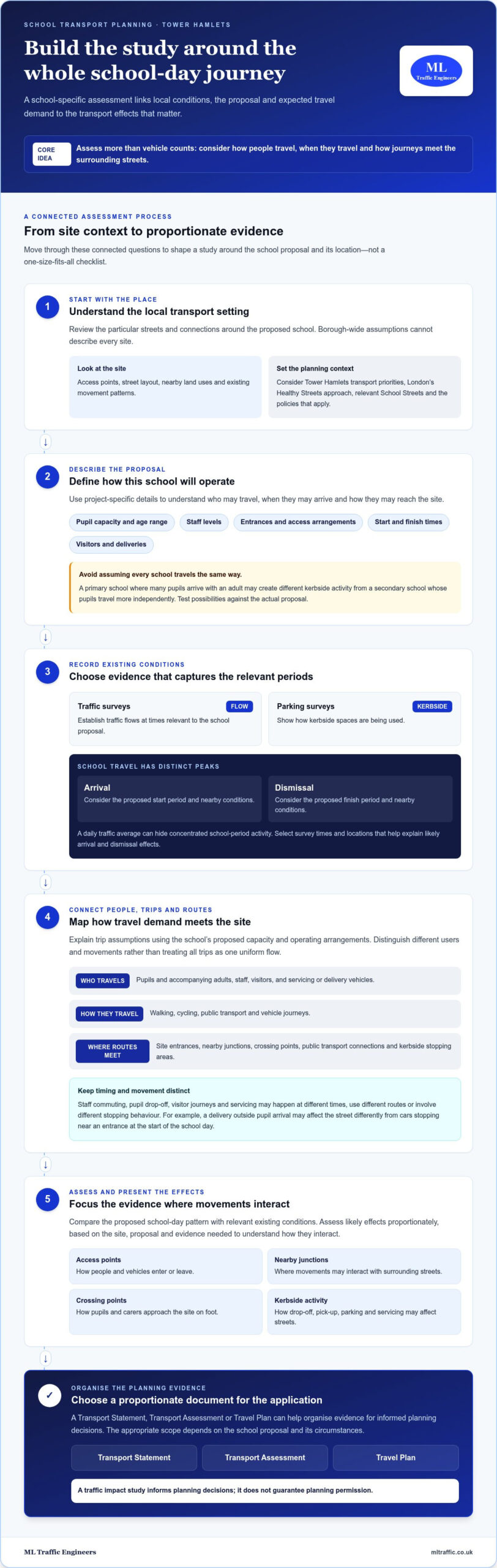
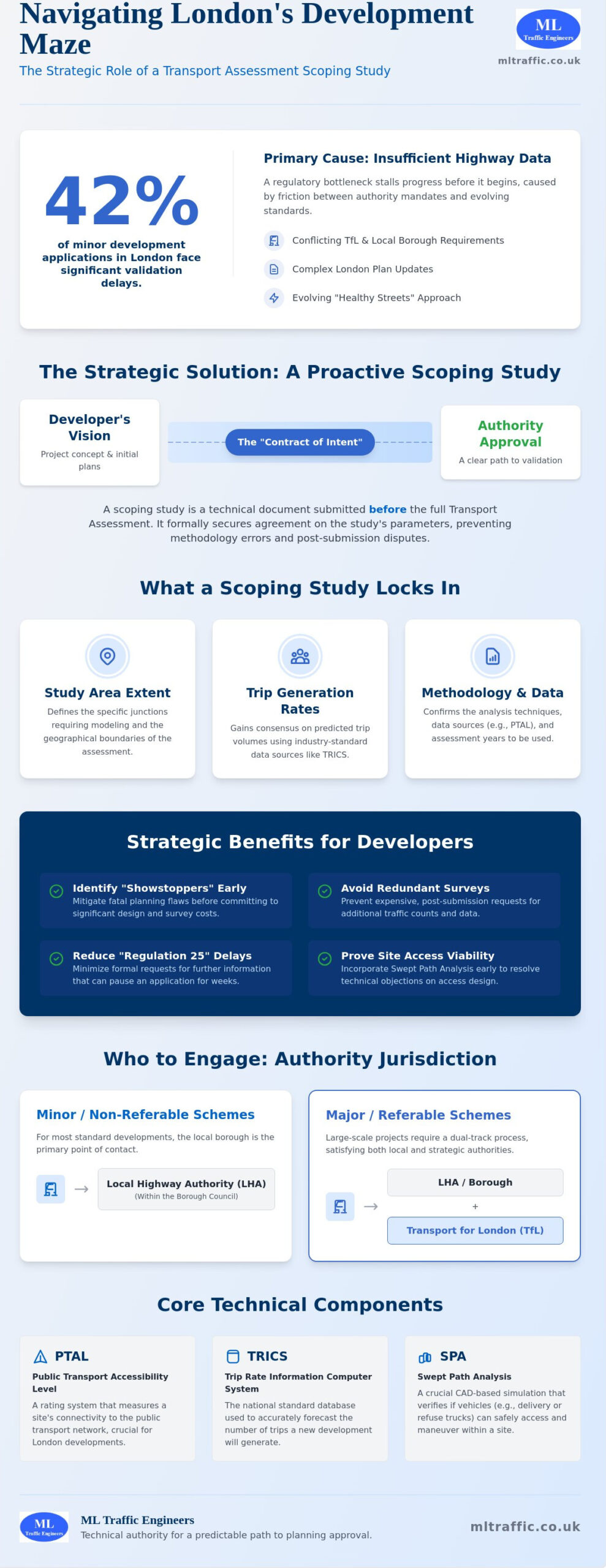
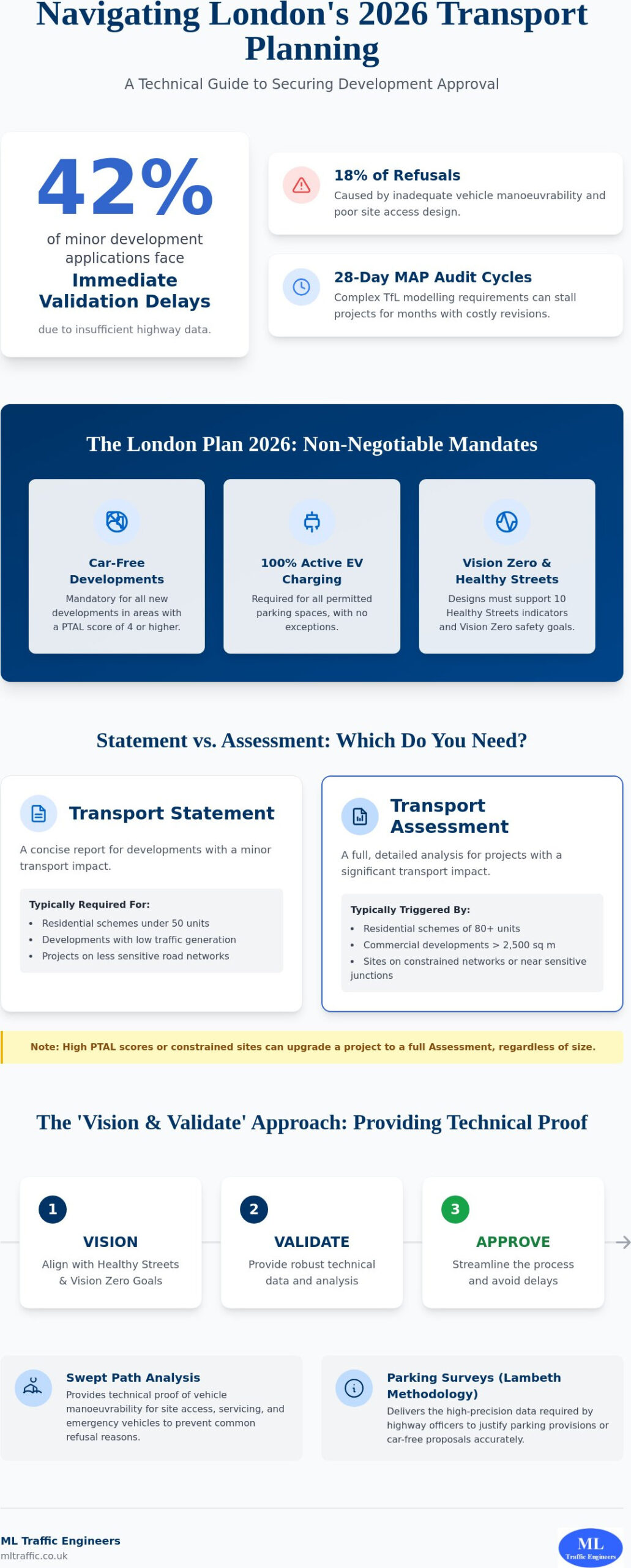
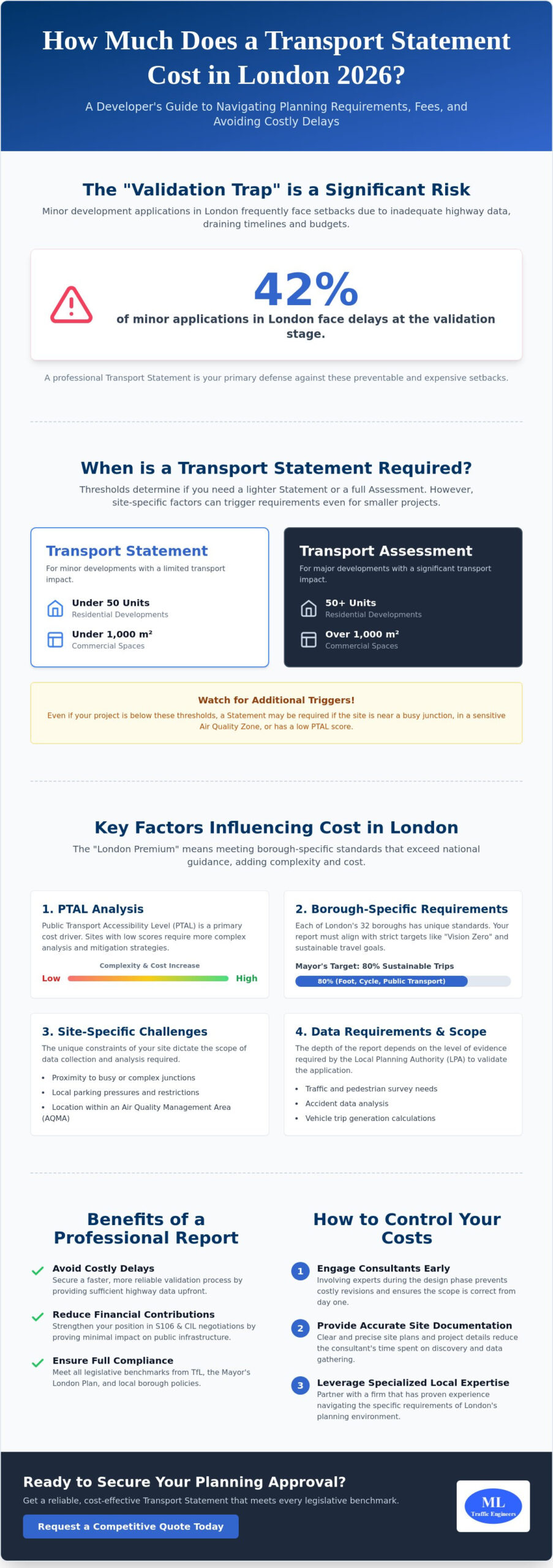
    Distinguishing between a Transport Statement and a Transport Assessment is the first step in any successful planning application. The scale of your development dictates which report is necessary. Smaller schemes often only require a Statement, while larger developments exceeding 80 residential units or 2,500sqm of commercial space usually trigger a full Assessment. Professional transport engineering consultants london ensure these reports align with the London Plan and individual borough requirements to prevent costly delays during the review process.

    Every report must be compliant with 2026 policy standards. This includes calculating the Public Transport Accessibility Level (PTAL) of the site and demonstrating how the project supports the Mayor’s target for 80% of all journeys to be made by walking, cycling, or public transport. For a deeper dive into the technical requirements, consult our Transport Assessment London Guide.

    Transport Statements for Small to Medium Developments

    A Transport Statement focuses on site-specific logistics such as access points, parking provision, and basic trip generation. These reports satisfy local borough requirements for minor applications by proving that the development’s impact on the immediate highway is negligible. We use localized data to justify parking ratios, especially in boroughs like Islington where car-free developments are mandated for schemes with a PTAL rating of 4 or higher. These documents provide the technical reassurance Highway Officers need to recommend approval for smaller sites.

    Comprehensive Transport Assessments for Major Sites

    Major developments require a more rigorous approach. A full Transport Assessment includes complex junction modelling and a wider network impact analysis. We utilize the TRICS database for accurate trip rate forecasting, ensuring that the predicted traffic volume is based on comparable, real-world sites. This data-driven precision is vital when negotiating mitigation measures with planning authorities.

    A critical outcome of these assessments is the identification of necessary infrastructure improvements. These often lead to S106 contributions or S278 agreements. In 2026, for example, Islington Council’s drawing approval fee for major S278 works valued over £1m is £6,380. Identifying these requirements early allows you to factor these costs into your initial feasibility studies. If you need clarity on your site’s specific requirements, you can explore our full range of technical services to see how we manage these complex deliverables.

    Transport Engineering Consultants London: Navigating Planning Approvals in 2026

    Ensuring Site Feasibility through Swept Path Analysis and Parking Surveys

    Feasibility is fundamentally about risk mitigation. Redesigning a site layout after you have submitted a planning application is a costly error that stalls project timelines. Expert transport engineering consultants london use digital modeling to prove that a development’s internal geometry works for real-world vehicles before a single brick is laid. By simulating vehicle movements during the design phase, we identify potential pinch points that would otherwise trigger objections from highway officers. This technical foresight ensures that your site layout is both operationally efficient and compliant with the rigorous standards set by the Chartered Institution of Highways & Transportation (CIHT).

    We utilize the latest industry software, such as AutoTURN 2026.12.1.0, to conduct Swept Path Analysis (SPA). This tool allows us to map the precise path of various vehicles as they navigate site entrances, turning heads, and loading bays. Relying on generic dimensions isn’t enough in London’s constrained urban environment. Precision is a functional necessity to ensure that your architectural vision doesn’t conflict with the physical requirements of the highway network.

    Swept Path Analysis: Fire Tenders to Refuse Vehicles

    Fire tender access is a non-negotiable safety requirement. If a fire engine cannot reach every part of a building within statutory distances, the application will fail. We perform detailed tracking to confirm that emergency vehicles can enter, turn, and exit the site without obstruction. Similarly, we use SPA to satisfy council waste management teams by proving that refuse vehicles can service the development safely. Demonstrating this capability early in the process protects your project from fundamental design flaws. For more details on these technical requirements, see our Swept Path Analysis Services in London.

    Parking Surveys: Navigating the Lambeth Methodology

    Parking provision is often the most contested element of a London planning application. When a developer proposes a car-free or car-capped scheme, they must prove that the development won’t increase "parking stress" on surrounding streets. We conduct Parking Surveys using the Lambeth Methodology, which is the industry standard for London stress tests. This process involves precise data collection during the peak period of residential parking demand, typically between 00:30 and 05:30 on two separate weekday nights.

    The resulting data provides a clear picture of the available capacity within a 200-meter walking distance of the site. In areas with high Controlled Parking Zone (CPZ) pressure, this evidence is vital. It allows transport engineering consultants london to justify lower parking ratios by showing that the local network can absorb any residual demand. Accurate survey data turns a subjective debate about parking into an objective, technical discussion, significantly increasing your chances of a successful outcome.

    The Public Transport Accessibility Level (PTAL) is the primary metric used by Transport for London (TfL) to quantify how well a site connects to the public transport network. For developers, this score is a non-negotiable determinant of a project’s density and parking capacity. In a city where traffic volumes reached 105% of 2020 levels by May 2026, transport engineering consultants london use these ratings to establish the technical boundaries of what can be built. While a high PTAL rating of 4 or above typically mandates car-free development under the London Plan, sites with lower scores require a more nuanced technical strategy to justify high-density residential use.

    A common objection developers face is the assumption that a low PTAL rating automatically limits development density. You can often overcome this hurdle by implementing a comprehensive Travel Plan. We use these documents to propose sustainable travel alternatives, such as improved cycling infrastructure or car-club memberships, which satisfy the "Healthy Streets" approach favored by planning officers. This allows you to maintain higher density targets by proving the development won’t create additional pressure on the local highway network.

    Understanding PTAL Ratings for Developers

    TfL calculates PTAL on a scale of 0 to 6b. This score depends on the walking distance to transport nodes and the frequency of services. These numbers directly dictate the maximum allowable parking spaces. For example, the London Plan mandates car-free developments for any scheme with a PTAL of 4 or higher in Inner London. If your site sits on the boundary of two different zones, we conduct a detailed assessment to ensure the most favorable rating is applied. We don’t just accept automated outputs; we verify the data against current service levels to ensure your site’s accessibility is represented accurately.

    Borough-Specific Planning Nuances

    Every London borough interprets the London Plan through its own Local Plan, creating a complex web of varying standards. Requirements in high-density areas like Westminster or Tower Hamlets are vastly different from those in Outer London boroughs. For specific insights into these regional challenges, consult our guide for Transport Planning Consultants Tower Hamlets. In these central locations, the focus shifts almost entirely to pedestrian safety and the management of delivery movements within constrained spaces.

    Experienced transport engineering consultants london act as your technical mediator during discussions with the Borough Highway Officer. We provide the professional credibility needed to navigate these intricate regional regulations so you don’t have to. By presenting clear, data-driven justifications for your site’s transport strategy, we reduce the likelihood of costly delays or planning refusals. If you’re preparing a submission for a challenging London site, our technical team is ready to provide the specialized support required for planning success.

    Choosing ML Traffic Engineers: Precision-Led Transport Solutions

    Selecting the right technical partner is the final step in de-risking your development. ML Traffic Engineers operates with a focus on technical accuracy and safety-conscious reporting, ensuring that every document survives the most rigorous highway authority audits. As transport engineering consultants london, we provide the technical authority needed to reduce regulatory pressure on your team. We manage the full project lifecycle from initial data collection through to final report submission. This all-encompassing service ensures consistency across your Traffic Surveys, Transport Assessments, and Travel Plans.

    Precision is a functional necessity in London’s high-stakes planning environment. We understand that planning deadlines are often unforgiving. Our firm maintains a constant sense of readiness and urgency to meet these demands. We combine an intimate knowledge of regional London regulations with a client-focused approach, positioning ourselves as a dependable partner rather than a simple service provider. We take pride in our adherence to industry benchmarks, ensuring that your submission is compliant with the latest legislative requirements from the outset.

    From Planning Approval to Section 278 Implementation

    Our support doesn’t end when you receive planning consent. The transition from a successful application to physical implementation requires detailed technical design and further statutory approvals. We support the post-planning phase by managing the highway design requirements for S278 and S38 agreements. These agreements are essential for any development that involves modifications to the existing public highway or the adoption of new roads. We provide the technical drawings and justification needed to secure these legal agreements efficiently. For a comprehensive look at this process, read our Highway Design S278 & S38 Guide.

    Contact Our London Transport Experts

    Successful planning outcomes rely on the quality of the data and the credibility of the consultant. Whether you’re managing a minor residential scheme or a major commercial hub, our team provides the specialized support required for 2026 approvals. We offer extensive coverage across London, High Wycombe, and Slough, bringing localized expertise to every project. Our commitment to formal excellence and professional integrity ensures that your development is viewed as a safe, viable addition to the city’s infrastructure.

    Don’t let logistical or regulatory hurdles stall your project’s progress. You can access our full suite of technical documents and industry guidance by visiting the ML Traffic Engineers resources page. If you require a project-specific quote or an initial access review, contact our experts today. We’re ready to provide the precision-led solutions your site needs to achieve planning success.

    Securing Your Site’s Future in London’s 2026 Planning Landscape

    Navigating the technical requirements of the London Plan and borough-specific mandates requires more than just high-level strategy. It demands the precision of data-driven reporting to ensure your site layout is viable and compliant. By integrating detailed Swept Path Analysis and comprehensive Parking Surveys early in the process, you eliminate the risk of late-stage redesigns and highway authority objections. These technical justifications don’t just support your application; they protect your investment from avoidable delays and ensure your project aligns with the city’s evolving infrastructure goals.

    ML Traffic Engineers provides the technical authority and expert knowledge of London Borough highway requirements needed to streamline your application. Our proven track record in securing planning consents for complex sites ensures your development moves efficiently from inception to execution. When you partner with transport engineering consultants london, you gain a reliable ally that understands the intricate regional regulations so you don’t have to. We’re ready to help you unlock your site’s full potential and move your project forward with certainty.

    Contact ML Traffic Engineers for a Professional Transport Quote today and ensure your project meets every regulatory benchmark with confidence.

    Frequently Asked Questions

    What is the difference between a Transport Statement and a Transport Assessment in London?

    The scale and potential impact of your development determine which document is required. A Transport Statement is typically sufficient for minor applications with lower trip generation, while a Transport Assessment is mandatory for major developments that require detailed junction modeling and wider network analysis. Expert transport engineering consultants london ensure the correct report is prepared to meet specific borough thresholds and avoid processing delays.

    How much does a parking survey cost for a London planning application?

    The cost of a parking survey depends on the size of the survey area and the specific methodology required by the local council. Factors such as the number of nights surveyed and the complexity of the street network influence the final fee. Developers should request a project-specific quote to ensure the survey meets the exact technical standards of the relevant London borough and provides the necessary data for approval.

    When is Swept Path Analysis legally required for a new development?

    Swept Path Analysis is required whenever a development needs to prove that specific vehicles can safely enter, maneuver within, and exit the site. This is most common for fire tender access and refuse collection, where highway officers require technical proof that these vehicles won’t be obstructed. It’s a non-negotiable safety requirement for most new site layouts in London and protects the project from fundamental design flaws.

    Can a Transport Consultant help me get a car-free development approved?

    Yes, a consultant justifies car-free schemes by providing data-driven evidence that the local network can support the development without private vehicle parking. This often involves using high PTAL ratings and a robust Travel Plan to demonstrate that residents have viable sustainable travel alternatives. This technical justification is essential for aligning with the Mayor’s Transport Strategy and borough-level sustainability targets.

    How does a high PTAL rating affect my parking provision?

    A high Public Transport Accessibility Level (PTAL) rating of 4 or above significantly reduces the maximum number of parking spaces allowed. In many Inner London boroughs, a high rating mandates a car-free development, with the exception of disabled person parking. Professional transport engineering consultants london use these ratings to establish the technical boundaries for parking density during the initial design phase to ensure policy compliance.

    What is the Lambeth Methodology for parking surveys?

    The Lambeth Methodology is the industry standard for measuring parking stress in London. It involves counting parked vehicles within a 200-meter walking distance of the site during the early morning hours, typically between 00:30 and 05:30. This data proves whether there’s sufficient on-street capacity to absorb any parking demand generated by the new development, which is vital in areas with high parking pressure.

    How long does it take to prepare a Transport Statement?

    Preparation time varies based on the availability of survey data and the complexity of the site access. Once all required Traffic Surveys and data collection are complete, the technical reporting phase usually takes between two to four weeks. Engaging a consultant early in the project lifecycle ensures that these timelines align with your planned submission dates and prevents urgent planning deadlines from being missed.

    Do I need a Travel Plan for a small residential development?

    While smaller developments often only require a Transport Statement, some boroughs may request a Travel Plan as a condition of approval. This is particularly common if the development is in an area with low transport accessibility or if the developer is seeking to mitigate potential traffic impacts. A Travel Plan outlines the long-term management strategy for encouraging sustainable travel among residents and is often a requirement for securing planning consent.

    Which areas in London do you cover?

    We service Acton, Balham, Barking, Barnes, Barnet, Battersea, Beckenham, Bexleyheath, Brentford, Brixton, Bromley, Camberwell, Carshalton, Charlton, Chelsea, Chiswick, Clapham, Coulsdon, Croydon, Crystal Palace, Dagenham, Dulwich, Ealing, Edgware, Eltham, Enfield, Finchley, Forest Gate, Fulham, Golders Green, Greenwich, Hackney, Hammersmith, Hampstead, Harrow, Hayes, Highgate, Hounslow, Ilford, Islington, Kensington, Kentish Town, Kingston upon Thames, Lewisham, Mitcham, Muswell Hill, New Malden, Notting Hill, Orpington, Peckham, Pinner, Purley, Putney, Richmond, Romford, Ruislip, Sidcup, Southall, Southgate, Streatham, Surbiton, Sutton, Tooting, Tottenham, Twickenham, Uxbridge, Walthamstow, Wembley, West Norwood, Wimbledon, Wood Green, Woolwich, Bethnal Green, Shoreditch, Canary Wharf, Deptford, Leyton, Palmers Green, Stanmore, Upminster, Chislehurst, Erith, Feltham.

    Which cities in England do you cover?

    We service London, Birmingham, Manchester, Liverpool, Sheffield, Leeds.

    Michael Lee

    Article by

    Michael Lee

    Transport planner with over 35 years' experience.

    Disclaimer

    The content on mltraffic.co.uk, including all technical articles, guides, and resources, is provided for general informational and educational purposes only. It is not intended to constitute professional advice in traffic engineering, transportation planning, development approvals, or any other technical or legal field.
    While ML Traffic Engineers makes every reasonable effort to ensure the accuracy, completeness, and timeliness of the information published, we do not provide any warranties or representations (express or implied) regarding its reliability, suitability, or availability for any particular purpose. Any reliance you place on the content is strictly at your own risk.
    In no event shall ML Traffic Engineers, its directors, employees, authors, or affiliates be liable for any direct, indirect, incidental, special, consequential, or punitive damages (including, without limitation, loss of profits, data, or business opportunities) arising out of or in connection with the use of, or inability to use, any information provided on this website.
    The articles and guides on this site are not a substitute for engaging a qualified, professional traffic engineer to assess your specific project requirements. For tailored advice, compliance assessments, or traffic engineering services, please contact a competent professional.
    This disclaimer may be updated from time to time without notice. By accessing or using this website, you agree to be bound by the most current version of this disclaimer.
  • Transport Planning Consultants Waltham Forest: The 2026 Developer’s Guide

    Transport Planning Consultants Waltham Forest: The 2026 Developer’s Guide

    Can a residential development in Waltham Forest actually survive the borough’s aggressive shift toward car-free living? With the Local Plan Part 1 firmly in effect and 2026/27 TfL funding focused heavily on active travel corridors, developers face some of the most stringent transport requirements in London. Engaging specialized Transport Planning Consultants Waltham Forest is no longer just a recommendation; it’s a technical necessity for any project aiming to bypass the gridlock of planning objections.

    You likely recognize that high PTAL ratings and narrow Victorian street layouts create a perfect storm for access refusals. We understand the pressure of meeting an annual housing requirement of 1,264 units while managing the recent 3.8% increase in national planning fees. This guide promises to show you how to use data-driven reporting to satisfy local authorities and optimize your site layout. We’ll preview the essential roles of Transport Statements, Swept Path Analysis, and Parking Surveys in securing a seamless approval in this complex regulatory environment.

    Key Takeaways

    • Identify whether your project requires a Transport Statement or a full Transport Assessment based on the specific thresholds defined in the 2026 Local Plan.
    • Discover how expert Transport Planning Consultants Waltham Forest utilize Swept Path Analysis to verify fire tender and refuse vehicle access for constrained urban sites.
    • Understand the application of the Lambeth Methodology within Parking Surveys to justify car-free developments and manage on-street capacity concerns.
    • Learn how mandatory Travel Plans for residential and commercial schemes support the borough’s target for 80% sustainable modal share by 2041.
    • Utilize technical Traffic Surveys and data-driven reporting to mitigate planning objections and streamline the path to site layout approval.

    Waltham Forest has fundamentally transformed its approach to urban movement. Under the adopted Local Plan Part 1 (2020-2035), transportation planning is no longer a secondary consideration but a core requirement for site viability. The borough’s aggressive modal share target of 80% sustainable travel by 2041 means every new application must prove it doesn’t compromise the safety or efficiency of the existing network. Even small-scale projects face scrutiny because the cumulative impact of development can quickly overwhelm local infrastructure.

    This shift is largely driven by the legacy of the “Mini-Holland” scheme and ongoing active travel initiatives. Whether you’re planning a small residential infill in Leytonstone or a major mixed-use development in Blackhorse Lane, the council expects robust technical data. Expert Transport Planning Consultants Waltham Forest provide the necessary evidence to show how a project aligns with these high-level environmental goals while maintaining practical functionality. We bridge the gap between your design aspirations and the council’s strict regulatory framework.

    To better understand how urban infrastructure choices shape city life, watch this helpful video:

    Waltham Forest’s Unique Transport Landscape

    The 15-minute city concept is the foundation of local policy. This means residents should have access to essential services within a short walk or cycle. In areas with high Public Transport Accessibility Level (PTAL) scores, such as Walthamstow Central or Leyton, the council often mandates car-free or car-capped developments. We see these standards applied strictly to reduce congestion and improve air quality. Developers must navigate these restrictive parking standards while ensuring the site remains functional for deliveries and emergency services. Precision in your initial transport strategy prevents the council from rejecting a proposal based on perceived parking overspill.

    When to Engage a Transport Planning Consultant

    You should identify transport triggers during the pre-application stage to avoid expensive redesigns. If your site is near a cycle superhighway or within a Controlled Parking Zone (CPZ), the planning department will scrutinize your access points. Early engagement allows for the integration of technical requirements into the initial site layout. We provide data-driven reports that address these specific local constraints, ensuring your submission stands up to the rigorous examination of Waltham Forest’s highways officers. You can learn more about how we support these projects on our what we do page. Proactive reporting is the most effective way to mitigate objections before they arise.

    Essential Transport Reports for Waltham Forest Planning Applications

    Planning success in E17 and E10 depends on submitting the correct technical documentation. The council uses Waltham Forest’s Local Implementation Plan (LIP) to benchmark every proposal against the Mayor’s Transport Strategy. We use TRICS (Trip Rate Information Computer System) data to provide an accurate forecast of how many vehicle, cycle, and pedestrian movements your development will generate. This data-driven approach is vital. It prevents officers from making assumptions that could lead to unnecessary parking restrictions or site access objections.

    Integrating sustainable transport measures is no longer optional. For any development where parking is permitted, the council requires a minimum of 20% of spaces to have active electric vehicle charging facilities. The remaining spaces must include passive provision to allow for future installation. Expert Transport Planning Consultants Waltham Forest help you integrate these technical requirements into your reporting to satisfy highways officers early in the process. We ensure your submission reflects the borough’s commitment to clean air and reduced congestion.

    Transport Statements vs. Assessments

    The scale of your project determines the depth of reporting required. Small residential developments, often found in the Victorian terraces of Walthamstow, typically require a Transport Statement. This document focuses on local impact, site access, and parking provision. For larger schemes exceeding 80 dwellings or significant commercial footprints, a full Transport Assessment is mandatory. This more detailed report analyzes the wider network impact, including junction capacity and public transport pressure. Aligning these documents with the Waltham Forest Local Plan ensures your technical evidence supports the borough’s growth targets without compromising safety.

    The Role of Travel Plans in 2026

    Travel Plans are now a standard requirement for most residential and workplace applications in the borough. These aren’t just static documents; they’re active strategies to reduce single-occupancy car use and promote the 80% modal share target. A successful plan includes measurable targets and identifies a Travel Plan Coordinator to oversee progress over a five-year period. In 2026, the council prioritizes plans that offer tangible incentives for cycling and car club memberships. You can find more details on these requirements in our London Travel Plans Guide. We ensure these plans are realistic and cost-effective for the developer while meeting strict environmental benchmarks.

    If you’re unsure which report your site needs, we can help you identify the correct technical reporting requirements during your pre-application phase to avoid delays.

    Transport Planning Consultants Waltham Forest: The 2026 Developer’s Guide

    Swept Path Analysis: Overcoming Access Constraints in E17 and E4

    Waltham Forest presents a unique set of physical challenges for modern developers. The borough’s characteristic Victorian terraces and narrow mews in areas like Walthamstow (E17) and Chingford (E4) weren’t designed for 11.4-meter refuse vehicles or modern fire appliances. Without technical proof of maneuverability, planning applications for infill sites often face immediate refusal. As Transport Planning Consultants Waltham Forest, we use computer-aided design to simulate vehicle movements through these tight corridors, ensuring your site layout is both functional and compliant.

    Every submission must align with TfL’s street design guidance. This ensures that new access points don’t compromise the safety of pedestrians or cyclists. We utilize standard vehicle templates to verify that emergency services can reach every part of a proposed site without obstruction. Precision during this stage is mandatory. If a vehicle can’t navigate your site safely, the Highways department won’t support your application.

    Solving Refuse and Emergency Access Issues

    Waltham Forest Council maintains strict requirements for refuse vehicle turning circles. They typically require evidence that an 11.4-meter refuse vehicle can enter and exit a site in forward gear. We provide detailed Swept Path Analysis to demonstrate safe ingress and egress. This analysis also covers standard fire appliances, proving that emergency teams can access the building within the statutory distances. By identifying these access hurdles early, we help you avoid the common pitfalls that lead to planning refusals. Our reports provide the technical reassurance that officers need to see before they sign off on a scheme.

    Optimising Tight Development Sites

    We use sophisticated software to maximize your developable area while maintaining necessary access. This is especially critical for former industrial sites in Blackhorse Lane where access routes are often shared or restricted. For a recent mews development in E11, we successfully utilized SPA to prove that a constrained site could accommodate necessary service vehicles without losing valuable residential units. By refining the internal site circulation, we ensure that every square meter of your development is optimized. Transport Planning Consultants Waltham Forest turn these spatial constraints into opportunities for smarter, more efficient urban design that satisfies both the developer and the local authority.

    Parking Surveys and PTAL: Meeting Waltham Forest Standards

    Waltham Forest’s push for car-free developments creates a specific technical hurdle for developers. Even when a project proposes zero on-site parking, the council remains concerned about “overspill” into the surrounding neighborhood. If your site isn’t within a Controlled Parking Zone (CPZ) that restricts new permits, you must prove that any potential parking demand won’t overwhelm local streets. Transport Planning Consultants Waltham Forest use precise data to address these concerns, ensuring that “parking stress” doesn’t become a reason for refusal.

    The council’s scrutiny focuses on the impact of your development on the existing community. We provide the technical evidence required to show that your scheme aligns with the borough’s goal of an 80% sustainable modal share. By combining Public Transport Accessibility Level (PTAL) analysis with empirical survey data, we build a robust case for your development’s viability. This proactive approach mitigates objections from both highways officers and local residents who may worry about increased competition for on-street spaces.

    The Lambeth Methodology Explained

    Waltham Forest Highways officers typically require parking data collected using the Lambeth Methodology. This standard involves conducting two separate overnight surveys, usually between 1:00 am and 5:00 am on weekday nights. These hours represent the period of peak residential parking demand. We analyze the available capacity within a 200-meter walking distance of the site, which is the industry-standard radius for assessing local impact. Presenting this data clearly is essential. We calculate the exact percentage of “parking stress” to demonstrate whether the local network can safely absorb the predicted demand from your site.

    PTAL and Sustainable Transport

    A site’s PTAL score is a primary driver for development density and parking allowances. In high-access areas like Leytonstone or Walthamstow, high PTAL ratings allow for significantly reduced parking provision or entirely car-free schemes. We calculate these scores based on the proximity and frequency of local bus, tube, and rail services. When PTAL scores are high, we strengthen your application by integrating sustainable measures such as car club memberships and high-quality cycle parking. These elements act as vital mitigation, reducing the perceived need for private vehicle ownership. If you need to verify your site’s capacity, you can book a technical Parking Survey to secure the necessary data for your submission.

    We ensure that every report addresses the specific nuances of Waltham Forest’s 2026 Local Plan. This precision reduces the risk of the council requesting additional data mid-cycle, which can lead to costly delays. By providing a clear, data-backed narrative, we help you navigate the borough’s restrictive parking standards with confidence.

    Securing Approval with ML Traffic Engineers in Waltham Forest

    Successfully navigating the planning process in Waltham Forest requires more than just filling out forms. It demands a technical understanding of how the borough’s “Shaping the Borough” Local Plan interacts with the daily realities of London’s transport network. As Transport Planning Consultants Waltham Forest, we manage the entire project lifecycle. We handle everything from the initial site visit and data collection to the final technical report submission. Our team ensures that every piece of evidence we provide is robust enough to withstand the scrutiny of highways officers and local stakeholders.

    Securing approval in this borough is about precision. We have a proven track record of clearing transport-related planning conditions that often stall other projects. Our Transport Planning Services provide developers with the technical clarity needed to move from concept to construction without regulatory friction. We don’t just provide data; we provide solutions that align with Waltham Forest’s 2026 infrastructure goals. Our involvement reduces the likelihood of costly delays caused by inadequate technical responses to council queries.

    Why Choose a Specialist Transport Consultancy?

    General planning advice often lacks the engineering depth required to solve complex access or parking issues. We provide technical engineering reports that use empirical data to justify your design choices. Our established relationship with London highway authorities and TfL allows us to anticipate potential objections before they are even raised. You gain direct access to technical experts who specialize in Transport Assessments and technical modeling. This expertise is vital for projects near sensitive locations, such as the Leyton Tube station upgrade area, where construction and operational transport impacts are heavily scrutinized.

    Next Steps for Your Waltham Forest Project

    Starting your technical assessment early is the best way to protect your project timeline. To provide a bespoke quote for your Transport Statement or Swept Path Analysis, we typically require your current site layout plans and a description of the proposed land use. This allows us to determine the necessary survey requirements and reporting scope immediately. We understand the high-stakes nature of London development and prioritize the rapid delivery of accurate, compliant information. To begin securing your planning approval, contact ML Traffic Engineers for a consultation. We’ll ensure your project meets every technical benchmark required by the London Borough of Waltham Forest.

    Our approach is sequential and logical. We move from initial assessment to execution, ensuring that your development’s transport strategy is a functional asset rather than a regulatory hurdle. We take pride in our role as a dependable partner, understanding the intricate regional regulations so you don’t have to. Let us handle the data while you focus on the build.

    Secure Your Waltham Forest Development’s Future

    Mastering the transport requirements in Waltham Forest requires a technical approach that balances the borough’s active travel goals with practical site access. You’ve seen how Swept Path Analysis and Lambeth-compliant Parking Surveys provide the necessary evidence to clear planning objections. By using data-driven TRICS analysis and high-quality Travel Plans, you can navigate the 2026 Local Plan with confidence.

    ML Traffic Engineers was founded in 2014 and brings over a decade of London expertise to your project. We specialize in providing the expert technical reports required for both Transport Statements and Assessments. Our team understands the nuances of local policy, ensuring your submission meets the highest standards of precision and safety. We’re specialists in Swept Path Analysis and Lambeth Parking Surveys, providing the technical reassurance that highways officers expect.

    It’s time to move your project toward a successful planning decision. Get a Technical Quote for Your Waltham Forest Project today. As your dedicated Transport Planning Consultants Waltham Forest, we’re ready to manage your full project lifecycle and mitigate regulatory pressures. We look forward to helping you achieve a seamless site layout and a successful submission.

    Frequently Asked Questions

    Do I need a Transport Statement for a small residential conversion in Waltham Forest?

    Yes, conversion projects typically require a Transport Statement to evaluate the change in highway impact. Even for small schemes, the council needs to confirm that refuse collection and cycle storage meet current standards. This report provides the technical evidence to prove that the conversion won’t negatively affect local traffic flow or safety. It’s a vital document for clearing initial planning hurdles.

    What is the Lambeth Methodology for parking surveys?

    This methodology is the statutory framework for conducting Parking Surveys in London. It involves measuring on-street capacity within a 200m radius of your site during two separate overnight windows. By surveying between 1am and 5am, we identify the peak residential parking demand. This data allows us to calculate the exact parking stress percentage for your planning submission.

    How does the Waltham Forest Mini-Holland scheme affect my planning application?

    The Mini-Holland initiatives place a heavy emphasis on pedestrian and cyclist safety. Your planning application must show that the development supports active travel and doesn’t interfere with dedicated cycle lanes. Council officers expect technical reporting that demonstrates how your site integrates with these low-traffic neighborhoods and promotes sustainable movement patterns. Proving your site doesn’t impede these corridors is essential for approval.

    Can I build a car-free development in a low PTAL area of Waltham Forest?

    Car-free schemes are standard in high PTAL areas, but low PTAL sites require significantly more justification. You’ll likely need a Parking Survey to demonstrate that residents won’t park on nearby streets. If the site is within a Controlled Parking Zone, the council may require a legal agreement to prevent new residents from applying for parking permits as a condition of approval.

    What vehicle dimensions are used for Swept Path Analysis in London?

    We use technical templates for an 11.4m refuse vehicle and a standard fire appliance. These represent the largest vehicles that must safely navigate your site. Expert Transport Planning Consultants Waltham Forest use these specific dimensions during Swept Path Analysis to ensure your site layout allows for safe turning circles and forward-gear exit. This precision prevents access-related refusals during the planning cycle.

    How long does it take to produce a Transport Assessment for Waltham Forest Council?

    Producing a comprehensive Transport Assessment typically requires 4 to 6 weeks. This window allows for accurate Traffic Surveys, TRICS trip generation modeling, and technical writing. We recommend starting this process during the pre-application stage. This ensures your data is ready for submission and accounts for any specific council feedback regarding local junction capacity or network pressure.

    What happens if my development fails a parking stress test?

    If surveys show local streets are over capacity, you’ll need to implement mitigation measures. This could include providing more on-site cycle parking or contributing to local sustainable transport improvements through Section 106 agreements. We help you refine the project’s transport strategy to ensure it remains viable while addressing the council’s concerns about on-street parking pressure and neighborhood congestion.

    Is a Travel Plan mandatory for all commercial sites in Waltham Forest?

    Yes, most commercial applications require a Travel Plan to support the borough’s environmental targets. While smaller sites may only need a basic statement, larger developments require a full strategy with measurable targets. Transport Planning Consultants Waltham Forest design these plans to reduce single-occupancy car trips and promote the use of the borough’s extensive cycle network and public transport links.

    Michael Lee

    Article by

    Michael Lee

    Transport planner with over 35 years' experience.

    Disclaimer

    The content on mltraffic.co.uk, including all technical articles, guides, and resources, is provided for general informational and educational purposes only. It is not intended to constitute professional advice in traffic engineering, transportation planning, development approvals, or any other technical or legal field.
    While ML Traffic Engineers makes every reasonable effort to ensure the accuracy, completeness, and timeliness of the information published, we do not provide any warranties or representations (express or implied) regarding its reliability, suitability, or availability for any particular purpose. Any reliance you place on the content is strictly at your own risk.
    In no event shall ML Traffic Engineers, its directors, employees, authors, or affiliates be liable for any direct, indirect, incidental, special, consequential, or punitive damages (including, without limitation, loss of profits, data, or business opportunities) arising out of or in connection with the use of, or inability to use, any information provided on this website.
    The articles and guides on this site are not a substitute for engaging a qualified, professional traffic engineer to assess your specific project requirements. For tailored advice, compliance assessments, or traffic engineering services, please contact a competent professional.
    This disclaimer may be updated from time to time without notice. By accessing or using this website, you agree to be bound by the most current version of this disclaimer.

  • Highway Consultant London: Navigating Complex Planning Approvals in 2026

    Highway Consultant London: Navigating Complex Planning Approvals in 2026

    With London ranked as the sixth most congested city in the world and average traffic speeds dropping to 11.2 mph, your development’s impact on the road network is under more scrutiny than ever before. Engaging a specialist highway consultant is no longer optional if you want to avoid the "inadequate information" flags that stall multi-million-pound projects. You’ve likely felt the pressure of complex borough parking standards or the fear that a flawed swept path analysis for a 12m refuse vehicle will lead to a flat refusal.

    We understand that securing a validated planning application requires more than just basic CAD design; it demands strategic alignment with the 2026 London Plan. This article explains how ML Traffic Engineers helps satisfy council highways officers through technical precision and data-driven parking surveys using the Lambeth Methodology. You’ll learn how to navigate mandatory Healthy Streets checks and car-free mandates to ensure your site access and parking layouts are optimized for success. We provide the technical authority you need to move from the initial planning phase to a successful implementation with total confidence.

    Key Takeaways

    • Understand how a specialist highway consultant provides the technical evidence required to overcome common council objections and prevent costly application delays.
    • Identify the specific documentation your project needs, from basic Transport Statements for minor schemes to comprehensive Transport Assessments for major mixed-use developments.
    • Learn how to use CAD-based Swept Path Analysis and data-driven parking surveys to prove your site is accessible for emergency vehicles and compliant with borough standards.
    • Navigate the complexities of TfL’s Healthy Streets Approach and manage the technical approval process for Section 278 and Section 38 road improvement agreements.
    • Discover the advantage of 24/7 technical support to ensure your planning revisions meet urgent deadlines while maintaining total safety and legislative compliance.

    Table of Contents

    The Role of a Highway Consultant in London’s Planning Landscape

    A highway consultant acts as the technical bridge between your development vision and the strict regulatory requirements of London’s local authorities. Their primary function involves producing the robust evidence needed to prove a project won’t negatively impact the capital’s already strained road network. In 2026, this role has expanded beyond simple traffic counts. It now encompasses a holistic approach to transportation planning, where the focus shifts from vehicle capacity to active travel and public transport integration.

    Engaging an expert early prevents the common "Inadequate Information" validation refusal that stalls major applications. London’s 32 boroughs and the City of London each maintain specific highway standards, making a one-size-fits-all approach impossible. Our team at ML Traffic Engineers provides this technical authority, ensuring every CAD design and traffic model aligns with current safety standards and legislative compliance. We maintain a sense of readiness, understanding that planning deadlines are non-negotiable and require immediate, accurate action.

    To better understand the daily complexities and modern goals of this field, watch this helpful video:

    When to Instruct a Highway Consultant

    Timing is critical for project viability. Instructing a highway consultant during the feasibility stage allows you to identify access issues before you commit to a land purchase. During the pre-application phase, we engage directly with Transport for London (TfL) and borough officers to agree on the scope of work. This proactive stance streamlines the formal submission and helps manage technical expectations. If objections arise post-submission, we provide the data-backed rebuttals necessary to satisfy statutory consultees and keep your project moving toward approval.

    Key Technical Challenges for London Developers

    Developers face unique hurdles in 2026 that require specialist navigation. The London Plan prioritizes pedestrian-first design, meaning you must achieve safe site access in narrow, high-traffic urban environments. Balancing parking provision with strict borough targets remains a significant challenge, especially as policy shifts away from car-centric models. We manage these intricate details, addressing the impact on pedestrian flow and public transport integration so you don’t have to. You can explore our full range of technical services on our what we do page to see how we support projects from planning to implementation.

    Strategic Transport Documentation: Statements, Assessments, and Travel Plans

    Securing planning approval in London requires a tiered approach to technical documentation. A specialist highway consultant determines whether your project needs a Transport Statement (TS) or a full Transport Assessment (TA). We base these technical reports on the Transport Analysis Guidance (TAG) provided by the Department for Transport. This ensures your application stands up to rigorous scrutiny from council officers and TfL. We use the TRICS database to predict multi-modal trip generation accurately, reflecting 2026 traffic patterns where motor vehicle usage sits at 101% of pre-COVID levels. This data-driven approach is essential for projects in a city where drivers spend an average of 109 hours a year in rush-hour traffic.

    A Transport Statement is typically the standard for smaller developments with limited traffic impact. It focuses on local access and parking. For larger schemes, a full Transport Assessment provides a comprehensive analysis of the development’s impact on the wider network. This often includes detailed junction modelling and capacity analysis. By identifying potential bottlenecks early, we help you avoid the delays associated with "inadequate highway information." If you’re unsure which report your site requires, explore our planning resources for more specific guidance.

    Transport Statement vs. Assessment: Which Do You Need?

    Borough thresholds vary across the 32 councils. Generally, 80 or more residential units or commercial space exceeding 2,500sqm triggers a full assessment. However, in "Sensitive Areas" like Air Quality Focus Areas, you may need a TA for as few as 30 to 40 units. A Transport Assessment London is vital for major residential blocks because it includes the mandatory "Healthy Streets" check. This scoring system evaluates the pedestrian environment and cyclist safety. Failing this assessment often leads to immediate refusal. Our engineers handle the technical modelling so your application remains on track and validated.

    London Travel Plans for 2026 Compliance

    Travel Plans are now required for residential sites with more than 50 units. These are not just static documents; they are active strategies designed to promote sustainable transport and reduce car dependency. London Travel Plans secure planning by mitigating long term traffic growth through clear monitoring and targets. Local authorities expect you to track these goals for at least the first 5 years of the development’s life. You must also integrate 100% active electric vehicle charging points for all permitted spaces and provide high-density cycle parking to meet the latest London Plan mandates. We ensure your plan is both compliant and practical for future residents.

    Highway Consultant London: Navigating Complex Planning Approvals in 2026

    Technical Evidence: Swept Path Analysis and Data-Driven Parking Surveys

    Technical evidence provides the empirical proof required for planning approval. A highway consultant must capture baseline data that reflects the current reality of London’s low-traffic neighbourhoods (LTNs) and the expanded Ultra Low Emission Zone (ULEZ). At ML Traffic Engineers, we demonstrate a "No-Impact" status on existing street capacity through high-precision traffic counts. This granular data satisfies the technical benchmarking of borough officers who are increasingly wary of congestion impacts. This technical authority ensures your project moves through the lifecycle from planning to execution without unnecessary friction.

    Our team takes immense pride in precision and compliance. We position ourselves as a safe pair of hands, managing the intricate complexities of UK road regulations so you don’t have to. Whether it’s a minor residential scheme or a complex mixed-use development, our data collection methods reflect the 24/7 nature of the industry. We provide the total, managed solution that alleviates the logistical and regulatory burdens placed on modern developers.

    Swept Path Analysis: Proving Manoeuvrability

    London’s tight infill sites leave no room for error. We use CAD software to perform Swept Path Analysis, simulating how specific vehicle templates navigate your proposed site layout. Common templates include 10.7m fire tenders, 12m refuse vehicles, and standard delivery vans. Since flawed turning simulations are a primary reason for planning refusal, using professional Swept Path Analysis Services is essential. We ensure your development meets the design standards in TfL’s Streets Toolkit. This precision prevents costly post-construction redesigns and guarantees that emergency vehicles maintain access at all times.

    Parking Surveys and the Lambeth Methodology

    Justifying "parking-light" or car-free developments in 2026 requires more than just a high PTAL score. We conduct overnight parking surveys using the "Lambeth Methodology" to record parking stress within a 200m radius of the site between 00:30 and 05:30. This data proves whether the local street network can absorb residual parking demand without compromising safety or local amenity. Our reports provide the technical evidence council highways officers need to approve low-car schemes. For a full list of our technical survey capabilities and bespoke solutions, visit our what we do page. We understand the high-stakes nature of these surveys and deliver results with unwavering reliability.

    London’s planning environment is a multi-layered hierarchy where authority is split between Transport for London (TfL) and the 32 individual boroughs. If your development sits on or affects the Strategic Road Network (SRN), TfL becomes a statutory consultee with the power to stall your project. A highway consultant navigates these overlapping jurisdictions by aligning your technical design with both regional and local policies. We manage the delicate art of the technical rebuttal, using data to challenge over-conservative objections from borough highways officers. Our 24/7 readiness ensures that when a council officer requests a revision, we respond with the technical precision required to keep your application moving.

    Safety is the non-negotiable foundation of every London submission. We design every access point and junction to support "Vision Zero," the city-wide initiative to eliminate all road deaths and serious injuries. This involves conducting rigorous road safety audits and ensuring all temporary traffic signals or multi-way systems meet strict Chapter 8 compliance. We act as your safe pair of hands, translating these complex legal and physical necessities into a validated planning application.

    Highway Design and s278 Agreements

    When your development requires physical changes to the public highway, you must enter into a Section 278 (s278) agreement. This legal mechanism allows developers to fund and execute works on the council’s land. In boroughs like Newham, technical approval for schemes under £25,000 starts at £750, while engineer’s fees for larger works typically reach 15% of the total cost. You must also account for Section 38 (s38) agreements if you intend for the council to adopt new roads within your site. For a comprehensive breakdown of these timelines and requirements, read our Highway Design S278 & S38 guide. We manage the bond and inspection process to ensure your project meets the Local Highway Authority’s standards without unnecessary delays.

    Healthy Streets and PTAL Ratings

    Your Public Transport Accessibility Level (PTAL) rating is the primary tool used to dictate maximum parking allowances. In 2026, the London Plan mandates car-free developments for any site with a PTAL score of 4 or higher. We address the 10 indicators of a Healthy Street, such as "easy to cross" and "not too noisy," to prove your project enhances the urban environment. This often requires a detailed Active Travel Zone (ATZ) assessment, where we map the quality of routes to local amenities. If you need technical support to navigate these regulatory hurdles, contact our team for a bespoke highway consultancy solution that secures your planning approval.

    Choosing the Right London Highway Consultancy: The ML Traffic Advantage

    Selecting a highway consultant isn’t just about ticking a box for technical output. It’s about securing a partner who understands the high-stakes urgency of London’s 2026 planning cycle. While large multidisciplinary giants often treat transport assessments as a secondary service, ML Traffic provides a total managed solution. We focus entirely on transport and traffic management, ensuring that every CAD design and technical report reflects the highest standards of safety and precision. We view our role as a vital guardian of public safety, ensuring your development integrates seamlessly into the existing urban fabric.

    Planning deadlines don’t wait for standard office hours. Our 24/7 availability acts as a primary hallmark of our brand promise, allowing us to handle urgent revisions and technical rebuttals with immediate action. This readiness is essential in a city where motor vehicle traffic has reached 101% of pre-COVID levels and council officers are increasingly selective. We position ourselves as your safe pair of hands, navigating the intricate complexities of UK road regulations so you can focus on your project’s commercial success. Our direct and functional approach prioritizes clarity, ensuring busy project managers get the information they need without navigating through unnecessary prose.

    Our London Project Portfolio

    Success in the capital requires a deep understanding of borough-specific nuances and the ability to challenge over-conservative objections. Our portfolio includes a wide range of residential, commercial, and mixed-use developments where we’ve successfully secured approvals through technical precision. Beyond standard applications, we offer expert witness capability for planning appeals and public inquiries. This level of authority is vital when defending a project’s transport strategy against statutory consultee objections. Explore our project types to see our experience in action across London’s diverse planning landscape.

    The ML Traffic Commitment to Precision

    Every highway consultant at ML Traffic adheres to rigorous data collection standards. This ensures our reports withstand the intense scrutiny of borough highways officers and TfL. You’ll have direct access to senior engineers who understand your project’s commercial goals and the local regulatory environment. We use industry-specific terminology and CAD modelling to ensure your site access and parking layouts are optimized for 2026 standards. Visit our resources page for technical templates and planning guides designed to streamline your submission process. We provide the comprehensive support you need to move from initial consultation to final planning approval with total confidence.

    Achieve Planning Success through Technical Precision

    Securing planning approval in London requires more than just basic traffic modelling. You need a highway consultant who understands the intricate technicalities of the Healthy Streets approach and the strict car-free mandates of the 2026 London Plan. By utilizing precision-based data from the Lambeth Methodology and accurate CAD designs for swept path analysis, you eliminate the risk of refusals based on inadequate information. With motor vehicle traffic sitting at 101% of pre-COVID levels as of April 2026, robust transport assessments are now essential for any project’s validation.

    ML Traffic provides the technical authority and safety-conscious approach needed to satisfy all 32 London Boroughs. We offer a total managed transport planning solution that covers every stage from feasibility to final implementation. Our 24/7 availability and emergency response capability ensure we meet your urgent planning deadlines with immediate action and unwavering reliability. We act as your safe pair of hands, managing the regulatory burden so you don’t have to. Secure your London planning approval with ML Traffic Engineers today. We’re ready to help you navigate the road to success.

    Frequently Asked Questions

    What exactly does a highway consultant do for a planning application?

    A highway consultant provides the technical evidence required to prove your development won’t negatively impact the road network. They produce Transport Assessments, design site access, and negotiate with council officers to secure planning approval. Their role involves using CAD design for swept path analysis and conducting data-driven surveys to satisfy borough-specific parking standards.

    Is a Transport Statement always required for a London development?

    Not all developments require a full Transport Statement, but most London schemes need some level of technical justification. Requirements vary by borough; however, "Sensitive Areas" like Air Quality Focus Areas often trigger reports for as few as 30 to 40 units. If your project exceeds local size thresholds, a highway consultant will determine if a Statement or a more detailed Assessment is necessary for validation.

    How much does a highway consultant cost for a London project?

    A professional transport assessment in London for 2026 typically starts at £4,500 for minor residential schemes. Complex mixed-use developments can exceed £25,000. These prices reflect a 15% increase in data collection costs over the last 24 months. Total fees depend on the number of junctions requiring modelling and the scope of the mandatory Healthy Streets check.

    What is the difference between a Section 278 and a Section 38 agreement?

    A Section 278 agreement covers physical modifications to the existing public highway, while a Section 38 agreement allows the council to adopt newly built roads. If your development requires a new junction or a widened footway, you’ll need an s278. These legal mechanisms ensure that all works meet the Local Highway Authority’s safety standards and Chapter 8 compliance.

    How do I know if my site needs a Swept Path Analysis?

    You need a Swept Path Analysis if your development involves vehicle movements in confined spaces, such as car parks or service yards. We use CAD software to simulate the turning circles of 12m refuse vehicles and 10.7m fire tenders. This analysis is a non-negotiable component for London infill sites to ensure emergency and service access is physically possible.

    Can a highway consultant help if the council has already objected to my parking layout?

    Yes, a consultant can resolve parking objections by providing empirical evidence that challenges the council’s assumptions. We use the Lambeth Methodology to conduct overnight parking surveys, recording street stress between 00:30 and 05:30 within a 200m radius. This data-backed approach often secures approval for parking-light developments by proving the local network can absorb the residual demand.

    What is a PTAL rating and why does it matter for my development?

    PTAL stands for Public Transport Accessibility Level, a scoring system from 0 to 6b that measures access to the transport network. It’s a critical metric because the 2026 London Plan mandates car-free developments in any area with a PTAL score of 4 or higher. Your rating directly dictates the maximum number of parking spaces you can legally provide on-site.

    How long does it take to produce a Transport Assessment in London?

    Producing a comprehensive Transport Assessment typically takes 4 to 6 weeks, though complex schemes may take longer. This timeline includes site visits, traffic modelling, and data collection, which has seen a 15% cost increase since 2024. Our 24/7 readiness ensures we can handle urgent revisions quickly to meet strict planning committee deadlines and prevent application delays.

    Which areas in London do you cover?

    We service Acton, Balham, Barking, Barnes, Barnet, Battersea, Beckenham, Bexleyheath, Brentford, Brixton, Bromley, Camberwell, Carshalton, Charlton, Chelsea, Chiswick, Clapham, Coulsdon, Croydon, Crystal Palace, Dagenham, Dulwich, Ealing, Edgware, Eltham, Enfield, Finchley, Forest Gate, Fulham, Golders Green, Greenwich, Hackney, Hammersmith, Hampstead, Harrow, Hayes, Highgate, Hounslow, Ilford, Islington, Kensington, Kentish Town, Kingston upon Thames, Lewisham, Mitcham, Muswell Hill, New Malden, Notting Hill, Orpington, Peckham, Pinner, Purley, Putney, Richmond, Romford, Ruislip, Sidcup, Southall, Southgate, Streatham, Surbiton, Sutton, Tooting, Tottenham, Twickenham, Uxbridge, Walthamstow, Wembley, West Norwood, Wimbledon, Wood Green, Woolwich, Bethnal Green, Shoreditch, Canary Wharf, Deptford, Leyton, Palmers Green, Stanmore, Upminster, Chislehurst, Erith, Feltham.

    Which cities in England do you cover?

    We service London, Birmingham, Manchester, Liverpool, Sheffield, Leeds.

    Michael Lee

    Article by

    Michael Lee

    Transport planner with over 35 years' experience.

    Disclaimer

    The content on mltraffic.co.uk, including all technical articles, guides, and resources, is provided for general informational and educational purposes only. It is not intended to constitute professional advice in traffic engineering, transportation planning, development approvals, or any other technical or legal field.
    While ML Traffic Engineers makes every reasonable effort to ensure the accuracy, completeness, and timeliness of the information published, we do not provide any warranties or representations (express or implied) regarding its reliability, suitability, or availability for any particular purpose. Any reliance you place on the content is strictly at your own risk.
    In no event shall ML Traffic Engineers, its directors, employees, authors, or affiliates be liable for any direct, indirect, incidental, special, consequential, or punitive damages (including, without limitation, loss of profits, data, or business opportunities) arising out of or in connection with the use of, or inability to use, any information provided on this website.
    The articles and guides on this site are not a substitute for engaging a qualified, professional traffic engineer to assess your specific project requirements. For tailored advice, compliance assessments, or traffic engineering services, please contact a competent professional.
    This disclaimer may be updated from time to time without notice. By accessing or using this website, you agree to be bound by the most current version of this disclaimer.

  • Transport Planning Consultants Greenwich: A Developer’s 2026 Guide to Approvals

    Transport Planning Consultants Greenwich: A Developer’s 2026 Guide to Approvals

    A single overlooked parking survey or a flawed swept path analysis can stall a multi-million pound development for months. You already understand that the Royal Borough of Greenwich enforces some of London’s strictest car-free policies, especially near the high-pressure zones of the O2 and Greenwich Peninsula. Partnering with expert Transport Planning Consultants Greenwich is the only way to ensure your technical reports meet the rigorous safety standards required by local highways officers. We know the pressure of a looming planning committee date and the fear of a refusal based on traffic impact.

    This 2026 guide provides a clear checklist for securing approvals, focusing on cost-effective SPA surveys and robust transport assessments that satisfy TfL requirements. We’ve compiled the essential steps to help you manage regulatory burdens while maintaining project momentum. You’ll find a logical roadmap for everything from initial CAD designs to final implementation, ensuring your submission addresses every highways safety concern with precision and technical authority. Let’s look at the specific data sets and compliance standards that will get your project over the finish line.

    Key Takeaways

    • Understand the 2026 Royal Borough of Greenwich (RBG) transport policy landscape to align your development with local planning expectations from the outset.
    • Identify whether your project requires a Transport Statement or a full Assessment to satisfy mandatory requirements for Travel Plans in high-density areas.
    • Learn why Swept Path Analysis (SPA) and rigorous parking surveys are critical for overcoming access challenges in narrow SE10 development sites.
    • Utilize our 5-point checklist to ensure your chosen Transport Planning Consultants Greenwich possess the essential CIHT and TPS professional credentials.
    • Discover how 24/7 technical support and expert pre-app consultation can alleviate regulatory burdens and help you meet urgent planning deadlines.

    Securing planning permission in the Royal Borough of Greenwich (RBG) in 2026 requires more than a basic site plan. As the borough accelerates toward its Carbon Neutral 2030 target, the role of Transport Planning Consultants Greenwich has shifted from simple layout design to complex carbon-reduction strategy. Developers must now demonstrate how every new build integrates into a wider network of active travel and public transit. This process relies on a deep understanding of transportation planning principles to ensure that development proposals don’t just meet minimum standards but actively improve local infrastructure.

    Our team manages the technical requirements of these applications, providing the precision needed to satisfy both local highways officers and Transport for London (TfL) requirements. We focus on delivering bespoke solutions that align with the “Greener Greenwich” strategy. This ensures your project remains viable under increasingly strict environmental regulations. We operate with a sense of urgency, recognizing that regulatory delays can impact your project’s bottom line.

    To better understand how urban transport systems evolve to meet these demands, watch this helpful video:

    Greenwich Local Plan and Transport Standards

    By 2026, RBG parking standards have tightened significantly. Residential schemes in high PTAL (Public Transport Accessibility Level) areas, such as Greenwich Peninsula, are now expected to be car-free or car-lite. Commercial developments must prioritize cycle storage and electric vehicle (EV) charging infrastructure as a baseline requirement. We help you navigate these comprehensive transport assessments, ensuring your submission accounts for TfL’s Vision Zero safety standards. This technical authority is vital when your project faces scrutiny from multiple regulatory bodies.

    Why Local Expertise Matters in SE10 and SE7

    Greenwich presents unique geographic challenges that demand local knowledge. The SE10 postcode, dominated by the Greenwich Peninsula and the O2 Arena, requires specialized management of high-volume traffic corridors and event-day logistics. Conversely, West Greenwich and Blackheath feature historic, narrow street layouts where access for construction and delivery vehicles is physically restricted. Transport Planning Consultants Greenwich must account for these constraints early in the design phase to avoid costly revisions later.

    Our consultants build rapport with Royal Greenwich highways officers to resolve potential bottlenecks before they become formal objections. We provide a total, managed solution that includes:

    • Detailed CAD design for site access and swept path analysis.
    • Robust Construction Logistics Plans (CLP) that minimize disruption to SE7 residential areas.
    • 24/7 readiness to address emergency road works or planning revisions.
    • Bespoke travel plans that promote walking and cycling routes.

    Success in Greenwich depends on this level of organized, safety-conscious planning. We act as your safe pair of hands, managing the intricate complexities of London’s road regulations so your development stays on schedule. Our approach prioritizes clarity and speed, ensuring busy project managers grasp the scope of our offerings without navigating through unnecessary filler.

    Essential Documentation for Greenwich Planning Applications

    Securing planning permission in the Royal Borough of Greenwich (RBG) requires a meticulous approach to highways and transport data. The council’s planning department operates with high expectations for technical accuracy. If your documentation lacks precision, you’ll face delays or outright refusal. Expert Transport Planning Consultants Greenwich bridge the gap between architectural vision and the strict safety standards required for the public highway.

    Transport Statements vs. Assessments: The Greenwich Thresholds

    The scale of your development determines the level of scrutiny. In Greenwich, smaller projects typically require a Transport Statement. This usually applies to residential schemes under 80 units or commercial spaces below 2,500sqm. A Statement focuses on local access and immediate road safety. Larger developments trigger a full Transport Assessment. This is a comprehensive document that models junction capacity and multi-modal impact across a wider area. All reports must demonstrate alignment with the Royal Borough of Greenwich Transport Strategy, which prioritizes the reduction of car dependency. You can compare Transport Statements and Assessments to see which technical path fits your site’s specific metrics.

    Travel Plans: Encouraging Sustainable Movement

    Travel Plans are mandatory for most new Greenwich developments to ensure long-term sustainability. For residential blocks with 20 to 79 units, you’ll likely need a Framework Travel Plan. Once a project exceeds 80 units, RBG requires a Full Travel Plan with clear, measurable targets. These documents aren’t just paperwork; they’re legal commitments often tied to Section 106 obligations. They include 5-year monitoring cycles where developers must prove they’re meeting targets for cycling and public transport use. Failure to reach these benchmarks can lead to financial penalties. Our guide to London Travel Plans explains how to draft these to satisfy local authority auditors.

    Technical data is vital when justifying car-free or car-capped schemes. In areas with a PTAL (Public Transport Accessibility Level) score of 4 or higher, Greenwich expects developers to minimize parking. We use TRICS database analysis and 2021 Census travel-to-work patterns to prove your site won’t cause overspill parking on surrounding streets. This evidence-based approach mitigates the risk of highways objections. It gives planners the confidence that your project supports the borough’s environmental goals without compromising road safety. If you’re unsure about your site’s constraints, contact our team for a preliminary consultation to assess your project’s viability.

    Transport Planning Consultants Greenwich: A Developer’s 2026 Guide to Approvals

    Technical Data: SPA and Parking Surveys in the Greenwich Context

    RBG planning officers prioritise safety and highway capacity above all else. Developers must provide granular, site-specific data to prove a project won’t cause gridlock in the high-density corridors of SE10. This requires technical precision that only experienced Transport Planning Consultants Greenwich can deliver. We focus on two main pillars: vehicle movement dynamics and parking capacity. Providing a total, managed solution means we handle the data collection and the complex modelling required for 2026 regulatory standards.

    Swept Path Analysis for Tight Urban Sites

    Greenwich features some of the most challenging access points in South East London. We use CAD-based simulations to model the movement of 11.4m refuse vehicles and 16.8m fire tenders. This process identifies potential pinch points before they become expensive construction errors. It’s vital for designing underground car park layouts where ramp gradients and pillar placements leave zero margin for error. Our Swept Path Analysis Services London provide the visual evidence RBG needs to approve tight urban sites. We ensure emergency vehicles can reach every corner of your development without mounting kerbs or damaging infrastructure. Our simulations reflect real-world conditions, accounting for street furniture and existing on-road parking.

    Parking Surveys and the Lambeth Methodology

    Securing planning for schemes in North Greenwich or the town centre requires a robust parking strategy. We conduct overnight parking beat surveys between 00:30 and 05:30 on two separate weekday nights. This follows the Lambeth Methodology, which remains the industry standard for measuring parking stress. Meeting the requirements set out in the Guidance on Transport Assessment is non-negotiable for major applications in the Royal Borough of Greenwich.

    For sites with a high Public Transport Accessibility Level (PTAL) score of 4, 5, or 6, we often justify zero-parking developments. This is essential when dealing with Controlled Parking Zones (CPZ) where new residents are restricted from obtaining permits. Our data provides the evidence needed to satisfy the following criteria:

    • Baseline Capacity: Accurate counts of available on-street spaces within a 200m radius.
    • PTAL Justification: Using high connectivity to argue for reduced car dependency.
    • Refuse Strategy: Mapping bin drag distances to ensure they don’t exceed the 10m limit for collectors.
    • Emergency Access: Proving that 3.7m wide fire access routes are maintained at all times.

    By partnering with Transport Planning Consultants Greenwich, you gain access to 24/7 survey capabilities and technical CAD design. We position ourselves as a safe pair of hands, managing the intricate complexities of UK road regulations so you don’t have to. Our reports don’t just identify problems; they offer bespoke solutions that align with the London Plan 2021 and local Greenwich policies.

    Checklist: Choosing the Right Transportation Planning Consultants

    Selecting the right Transport Planning Consultants Greenwich requires a focus on technical precision and local regulatory alignment. Developers must vet potential partners against a rigorous 5-point framework to ensure project viability for 2026. This process prevents costly delays during the Royal Borough of Greenwich (RBG) planning committee reviews.

    • Professional Accreditation: Verify that lead consultants hold active memberships in the Chartered Institution of Highways and Transportation (CIHT) or the Transport Planning Society (TPS). These credentials guarantee adherence to the latest UK professional standards.
    • Local Authority Track Record: Demand evidence of successful project approvals within Greenwich. A consultant who understands RBG’s specific stance on the Silvertown Tunnel impact or the Greenwich Peninsula transport strategy offers a distinct advantage.
    • Software Currency: Confirm the firm uses 2026-ready versions of TRICS and AutoTRACK. Outdated modelling leads to rejected Transport Assessments.
    • Negotiation History: Evaluate their success rate in reducing developer contributions through evidence-based Section 106 and Section 278 negotiations.
    • Data Authenticity: Ensure the firm prioritizes bespoke, site-specific traffic counts over generic national averages that fail to capture London’s unique congestion patterns.

    Technical Capability and Software Standards

    Precision in trip generation and vehicle movement modelling is non-negotiable for modern developments. Competent Transport Planning Consultants Greenwich utilize the latest TRICS database, specifically version 7.11 or newer, to predict traffic impact with high confidence intervals. For 2026 approvals, generic industry data often falls short of RBG’s stringent requirements. We utilize CAD-based Swept Path Analysis models via AutoTRACK to simulate the movement of refuse vehicles and emergency services through tight urban footprints. This technical rigor identifies design flaws before they reach the planning stage. Bespoke data collection remains superior to generic averages because it accounts for specific local bottlenecks and current Public Transport Accessibility Level (PTAL) ratings.

    Strategic Communication and Negotiation Skills

    Technical data only succeeds if it’s presented persuasively to local stakeholders. Your consultant must bridge the gap between engineering requirements and planning policy. They need to negotiate Section 278 and Section 106 agreements that protect your project margins while satisfying RBG’s infrastructure demands. Experience in representing clients at RBG planning committee meetings is essential for high-stakes projects. A consultant who understands the specific concerns of Greenwich councilors can pivot strategies mid-meeting to secure a positive recommendation. For more information on budgeting for these services, see our guide on Understanding Consultant Costs and Quotes.

    We provide the technical expertise and local knowledge required to secure your development’s future. Explore our comprehensive transport planning services to see how we manage your project from initial design to final implementation.

    Securing Approval: The ML Traffic Approach to Greenwich

    Securing a green light from the Royal Borough of Greenwich (RBG) requires more than just standard documentation. It demands a technical partner who treats safety as a non-negotiable foundation. ML Traffic Engineers bridge the gap between ambitious development goals and strict local authority requirements. We don’t just provide reports; we deliver engineered solutions that withstand the scrutiny of planning committees. Our role as Transport Planning Consultants Greenwich involves deep integration with your design team. We identify potential bottlenecks before they become planning refusals.

    Our team operates with a sense of urgency because we know that planning windows are narrow. We provide 24/7 support to ensure that urgent technical queries or last-minute design changes don’t stall your application. Whether it is a Saturday night or a bank holiday, our engineers remain available to support your project’s critical path. This constant availability ensures that developers in the SE10 area can meet every regulatory deadline with confidence.

    From Initial Design to Final Implementation

    Success begins long before the formal application is submitted. We start with early-stage site feasibility and access reviews to determine if a site can physically accommodate the proposed trip generation. This proactive approach saves thousands in redesign fees later in the process. You can Explore our Greenwich Project Types to see how we tailor these reviews to specific residential and commercial needs.

    • Feasibility Studies: We analyze existing road geometry and pedestrian flows to ensure safe access.
    • CAD Design: Our engineers produce precise swept path analyses to prove that service vehicles can maneuver safely.
    • Regulatory Liaison: We manage the technical dialogue with RBG highways and Transport for London (TfL) throughout the planning lifecycle.

    In a 2024 redevelopment project near the Greenwich Peninsula, the developer faced significant pushback regarding construction vehicle impact. We deployed a comprehensive multi-way traffic management plan and CAD-simulated access routes. This data-driven evidence convinced RBG highways officers of the project’s viability, leading to a successful planning committee vote. We moved from initial consultation to final implementation support in less than six months, keeping the project on track.

    Your Partner for Planning Success

    We use a data-driven approach to reduce the risk of planning objections. By using accurate traffic counts and safety-conscious design, we provide the “safe pair of hands” that planning officers trust. Our bespoke solutions ensure that every multi-way system or temporary signal layout complies with Chapter 8 standards. We take the logistical burden off your shoulders so you can focus on construction. If you’re ready to start your next project, Contact ML Traffic Engineers for a Greenwich consultation to secure your transport approvals.

    Our team remains dedicated to providing the precise technical data and safety-led designs required to protect your project and the public.

    Secure Your 2026 Greenwich Development Approval

    Navigating the Royal Borough of Greenwich planning framework requires technical precision and current data. Success hinges on accurate Parking Stress Surveys and robust Statement of Preparedness for Adoption documentation that meets 2026 standards. These technical assessments are the foundation of a successful application, ensuring your project aligns with local transport strategies and safety regulations from the outset. Precise data collection and adherence to RBG policy aren’t just checkboxes; they’re the drivers of project viability.

    Partnering with experienced Transport Planning Consultants Greenwich provides the regulatory certainty required for complex London sites. ML Traffic Engineers delivers over 10 years of London planning experience and specific expertise in RBG local policy. We offer 24/7 technical support for urgent applications, managing projects from initial consultation through to final implementation. Our team understands the intricate complexities of UK road regulations, acting as a safe pair of hands for your development’s logistical needs. We focus on precision and compliance so you can focus on delivery.

    Contact ML Traffic Engineers for a Transport Planning Quote today. We’re ready to help you navigate the approvals process with speed and professional integrity.

    Frequently Asked Questions

    Do I need a transport statement for a small development in Greenwich?

    You generally need a Transport Statement for residential developments between 5 and 49 units or commercial projects under 2,500 square metres. The Royal Borough of Greenwich mandates these reports to ensure smaller schemes don’t compromise local road safety or pedestrian flow. Our Transport Planning Consultants Greenwich team produces these technical documents to prove your project aligns with the London Plan 2021. We focus on clear data to help you avoid unnecessary delays during the initial planning stages.

    What is the current parking policy for new builds in the Royal Borough of Greenwich?

    Greenwich enforces a car-free or car-lite policy for most new developments, particularly in areas with high public transport access. According to the 2021 London Plan, sites with a PTAL rating of 4 or higher must provide zero residential parking, excluding essential disabled bays. For sites in lower PTAL zones, the council permits limited parking spaces based on specific bedroom counts. We design parking management strategies that meet these strict environmental targets while ensuring your site remains functional for residents.

    How much does a transport planning consultant cost in London?

    Professional fees for transport consultants in the London market typically range from £450 to £950 per day based on the level of technical expertise required. A standard Transport Assessment for a medium-sized project often carries a fixed fee starting at approximately £2,500. These costs cover essential tasks like traffic modelling, CAD design, and site visits. Investing in expert advice early prevents the far higher costs associated with planning refusals or protracted Section 106 negotiations.

    How long is a parking survey valid for a Greenwich planning application?

    A parking survey is valid for 6 months from the date the data was recorded. Greenwich Council requires these surveys to follow the Lambeth Methodology, which involves collecting data during two separate weekday overnight periods between 00:30 and 05:30. If your data exceeds the 180-day threshold, highways officers will likely demand a fresh assessment. We ensure surveys take place during neutral months to provide the most accurate representation of local parking stress.

    What happens if my development has a low PTAL rating?

    Developments with a low PTAL rating of 0 to 2 must implement aggressive Travel Plans to reduce reliance on private vehicles. You’ll likely need to provide high-quality cycle parking, car club memberships, or improved pedestrian wayfinding as part of your application. Our Transport Planning Consultants Greenwich experts mitigate low scores by proposing infrastructure improvements that satisfy council requirements. We focus on delivering sustainable transport solutions that make even remote sites viable for approval.

    Can a transport consultant help with Section 278 highway works?

    Yes, we manage the entire Section 278 process to facilitate permanent alterations to the public highway. This includes creating detailed CAD drawings for new site entrances, puffin crossings, or junction realignments that meet Chapter 8 safety standards. We act as your technical liaison with the Royal Borough of Greenwich highways department to secure necessary approvals. Our team ensures all designs are compliant and cost-effective so your construction schedule stays on track.

    Michael Lee

    Article by

    Michael Lee

    Transport planner with over 35 years' experience.

    Disclaimer

    The content on mltraffic.co.uk, including all technical articles, guides, and resources, is provided for general informational and educational purposes only. It is not intended to constitute professional advice in traffic engineering, transportation planning, development approvals, or any other technical or legal field.
    While ML Traffic Engineers makes every reasonable effort to ensure the accuracy, completeness, and timeliness of the information published, we do not provide any warranties or representations (express or implied) regarding its reliability, suitability, or availability for any particular purpose. Any reliance you place on the content is strictly at your own risk.
    In no event shall ML Traffic Engineers, its directors, employees, authors, or affiliates be liable for any direct, indirect, incidental, special, consequential, or punitive damages (including, without limitation, loss of profits, data, or business opportunities) arising out of or in connection with the use of, or inability to use, any information provided on this website.
    The articles and guides on this site are not a substitute for engaging a qualified, professional traffic engineer to assess your specific project requirements. For tailored advice, compliance assessments, or traffic engineering services, please contact a competent professional.
    This disclaimer may be updated from time to time without notice. By accessing or using this website, you agree to be bound by the most current version of this disclaimer.
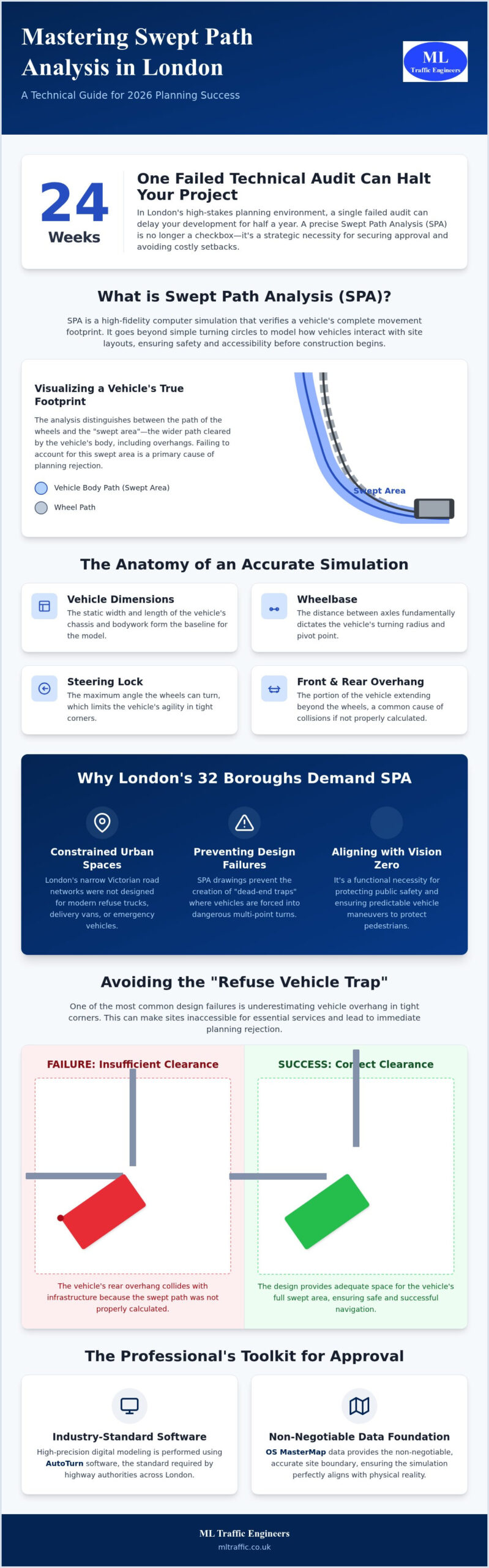
  • Transport Planning Consultants Ealing: Navigating 2026 Planning Approvals

    Transport Planning Consultants Ealing: Navigating 2026 Planning Approvals

    Could a single technical error in your transport assessment be the reason Perceval House rejects your 2026 development plans? Securing planning permission in West London is a high-stakes process where precision is a legal necessity. You already know that meeting Ealing Council’s stringent 2030 carbon-neutral requirements is a significant challenge for any developer. This is why many firms now rely on Transport Planning Consultants Ealing to ensure every CAD design and multi-way system analysis meets strict Chapter 8 compliance. Whether you’re managing a high-density build near Ealing Broadway or a complex site in Southall, the drastic variations in PTAL ratings require a specialist touch.

    We promise to help you master the complexities of transport statements and technical surveys. Our guidance helps you avoid the common pitfalls that lead to costly refusals. This article provides a sequential look at delivering cost-effective reports that satisfy every safety standard and legislative mandate. We’ll explore the specific data and strategic planning required to move your project from consultation to implementation. Our focus is on providing a total, managed solution. We ensure your project stays on track, remains compliant, and moves toward a successful approval without unnecessary delays.

    Key Takeaways

    • Understand how Ealing’s 2030 Carbon Neutral commitment and the borough’s complex street network directly impact the success of your 2026 planning applications.
    • Identify whether your development triggers a full Transport Assessment or a Statement by working with Transport Planning Consultants Ealing to navigate specific London thresholds.
    • Learn why Swept Path Analysis (SPA) is critical for Ealing’s narrow Victorian roads to guarantee refuse vehicle access and avoid immediate planning refusals.
    • Discover how to implement the Lambeth Methodology for parking stress surveys to meet Ealing Council’s gold standard for technical data collection.
    • Gain expert insights into managing S278 and S38 highway works to ensure your project aligns with the latest Ealing Local Implementation Plan (LIP) requirements.

    Why Transport Planning in Ealing is Unique in 2026

    Ealing’s 500km street network is one of the most pressured in West London. This vast infrastructure must balance the high-frequency requirements of Transport for London (TfL) and Network Rail, particularly as the Elizabeth Line continues to drive vertical density. As we move into 2026, the regulatory environment is no longer forgiving of generic submissions. Developers need transport planning strategies that reflect the borough’s unique constraints. Generic UK models often fail because they don’t account for the specific congestion patterns of the A406 or the A40 corridors.

    To better understand the professional standards required in this field, watch this helpful video:

    The role of Transport Planning Consultants Ealing is to bridge the gap between ambitious development and strict council mandates. Every project must now align with the 2030 Carbon Neutral commitment. This shift means that safety and compliance aren’t just checkboxes; they’re the foundation of the planning process. Our team provides 24/7 support to ensure that traffic management plans meet Chapter 8 standards while facilitating seamless site access. We utilize CAD design to map out multi-way systems that prevent local gridlock during the construction phase.

    Ealing’s Climate and Ecological Strategy

    The borough’s 2030 target has transformed car-free development from a suggestion into a requirement for areas like Ealing Broadway. New applications must prioritize active travel by integrating cycling and walking routes directly into the site’s initial footprint. Ealing’s Local Implementation Plan (LIP) serves as the primary statutory document that aligns local transport objectives with the Mayor of London’s Transport Strategy. This hierarchy dictates that every new curb-cut or access point must demonstrate a net benefit to the borough’s ecological goals and pedestrian safety.

    The Perceval House Factor: Dealing with Ealing Council

    Securing approval involves direct negotiation with transport officers based at Perceval House on Uxbridge Road. These officials expect high-quality technical data and early engagement. Seeking pre-application advice is no longer optional for major schemes; it’s a strategic necessity to avoid costly delays. Working with ML Traffic ensures your project meets these rigorous local expectations through comprehensive support and bespoke traffic management solutions. We handle the intricate road regulations and technical CAD requirements so you can focus on delivery. Our 24/7 availability ensures that even the most urgent planning revisions are handled with precision and speed.

    Transport Statement vs. Transport Assessment: Ealing Thresholds

    Choosing the correct technical document is the first step in securing planning permission. Developers often confuse a Transport Statement (TS) with a Transport Assessment (TA), but the distinction is vital for 2026 compliance. The UK government guidance establishes that the scale and potential impact of a project dictate which report is necessary. While a TS focuses on smaller schemes with limited traffic impact, a full TA provides a rigorous analysis of the local network’s capacity to handle significant demand. Transport Planning Consultants Ealing evaluate these requirements during the pre-application stage to prevent costly delays or requests for further information from the council.

    Many developers fall for the “no-impact” myth. They assume that small-scale Ealing developments, such as a four-unit residential conversion, don’t require technical documentation. This is rarely the case. Ealing council requires evidence that even minor projects won’t compromise highway safety or parking availability. Public Transport Accessibility Level (PTAL) scores heavily influence these requirements. A site in Ealing Broadway with a PTAL of 6b faces different reporting pressures than a site in Northolt with a PTAL of 2. Higher PTAL areas often mandate car-free or car-capped developments, requiring a specific type of justification within the transport report. Developers working across multiple London boroughs should also be aware that similar car-free policies apply elsewhere; for instance, Transport Planning Consultants Greenwich face equally stringent requirements near high-pressure zones like the O2 and Greenwich Peninsula.

    Ealing-Specific Reporting Thresholds

    Thresholds in London are stricter than national averages. In Ealing, residential developments exceeding 80 units typically trigger a full Transport Assessment and require direct involvement from Transport for London (TfL). For commercial projects, a floor space exceeding 2,500 square meters usually necessitates a TA. Smaller projects, such as those between 30 and 80 units or commercial spaces under 1,000 square meters, generally only require a Transport Statement. You can find more detail on these differences in our Transport Statement vs. Transport Assessment Guide. Our team ensures your submission matches the exact scale of your project to streamline the approval process.

    The Role of the TRICS Database

    We use the TRICS (Trip Rate Information Computer System) database to predict how much traffic a new development will generate. This system allows us to compare your project against thousands of similar sites across the UK. For Ealing-specific land uses, we prioritize London-based data over national averages. This is because London’s unique travel patterns, influenced by the ULEZ and high bus density, don’t align with rural or regional statistics. Accurate trip generation data directly influences the financial contributions required for local infrastructure improvements through Section 106 negotiations. By using precise, localized data, we protect developers from over-inflated mitigation costs. If you need assistance with data-driven planning, our experts provide comprehensive support for all project phases.

    Transport Planning Consultants Ealing: Navigating 2026 Planning Approvals

    Swept Path Analysis: Preventing Access Refusals in Ealing

    Ealing’s Victorian infrastructure presents a physical barrier to modern development. Narrow streets in residential pockets make vehicle maneuverability a primary concern for local planning officers. As expert Transport Planning Consultants Ealing, we’ve seen applications fail simply because a refuse truck couldn’t clear a corner without mounting the kerb. Swept Path Analysis (SPA) provides the technical proof required to satisfy these safety concerns. By simulating the movement of specific vehicles, developers can identify pinch points before they become legal roadblocks. This process aligns with Ealing’s new Transport Strategy, which prioritizes safe, efficient logistics within the borough’s evolving streetscape. Failure to provide this data often results in an immediate refusal, as the Council won’t risk approving designs that compromise public safety or block emergency routes.

    Modeling refuse vehicle access is a non-negotiable requirement. Ealing Council operates specific vehicle dimensions, often requiring a 10.2m or 11.2m refuse collection vehicle (RCV) template depending on the ward. In high-density areas like Acton and Southall, fire tender requirements are even more stringent. We model these 12m emergency vehicles to ensure they can navigate tight turns within new residential blocks. SPA prevents the need for costly post-planning design revisions. Redesigning a site layout after a refusal can cost a developer over £15,000 in additional architectural fees and delay a project by six months or more.

    Vehicle Templates for London Boroughs

    Standard London refuse vehicles don’t always fit the reality of Ealing’s tight-access fleets. We use bespoke templates that reflect the actual machinery used by local waste contractors. In West Ealing, commercial units must demonstrate that delivery and servicing maneuvers won’t cause tailbacks on the A4020. Utilizing professional Swept Path Analysis Services in London ensures your site layout accommodates these local variations. This technical foresight protects the project from being stalled by Transport for London (TfL) or local highway officers during the consultation phase.

    CAD Design and Technical Accuracy

    The transition from 2D drawings to dynamic vehicle movement simulations has changed the approval landscape. Ealing transport officers no longer accept “manual” checks or simple overlays. They require dynamic CAD simulations that account for steering lock, body overhang, and wheel paths. Accurate SPA justifies reduced road widths in car-free schemes, allowing developers to allocate more space to green infrastructure or housing units. This precision ensures that even the most compact urban sites remain fully compliant with UK building regulations and local safety standards.

    Parking Surveys and the Lambeth Methodology in Ealing

    Ealing Council requires a formal parking stress survey whenever a proposed development might significantly impact local kerbside capacity. Transport Planning Consultants Ealing rely on these surveys to provide the empirical evidence necessary for planning committee approval in 2026. The core objective is to demonstrate that the existing highway can accommodate the residual parking demand from a new project without creating safety hazards or blocking emergency access. We provide these assessments as part of a total, managed solution to ensure your project remains compliant with the latest London Plan requirements.

    The Lambeth Methodology remains the gold standard for these assessments across London. It offers a consistent, data-driven approach that planning officers trust. By following this framework, developers avoid the delays associated with insufficient or anecdotal evidence. Our team utilizes this methodology to provide technical authority, addressing every regulatory hurdle before it becomes a bottleneck for your planning application.

    Conducting Surveys in Ealing CPZs

    When working within Ealing’s Controlled Parking Zones (CPZs), timing and frequency are non-negotiable. Surveys must occur between 1am and 5am on two separate weekday nights to capture the maximum residential parking load. Ealing planning policy mandates a 200-metre radius for the survey area, measured by walking distance from the site entrance. This specific distance identifies all available legal parking spaces that a future resident might reasonably use. Precision here is a legal necessity; any deviation from the 200-metre rule can lead to a summary rejection of the Transport Assessment. You can find more detail on these regulatory requirements in our Transport Assessment London Guide.

    PTAL Ratings and Parking Reductions

    Ealing’s PTAL map is the primary lever for arguing for reduced parking provision. The arrival of the Elizabeth Line has transformed accessibility in Hanwell and Ealing Broadway, pushing many sites into PTAL Zones 5 and 6. In these high-accessibility areas, Ealing Council often supports “zero-parking” developments, provided that the developer enters into a Section 106 agreement to prevent residents from obtaining on-street permits. A higher PTAL rating directly correlates with a lower statistical probability of car ownership and a corresponding reduction in local parking stress. This data is vital for developers looking to maximize floor space in high-density urban areas.

    Our 24/7 readiness ensures that your parking data is collected accurately and submitted promptly. We manage the intricate complexities of UK road regulations so you don’t have to. Our experts take pride in delivering Chapter 8 compliance and bespoke traffic solutions that stand up to council scrutiny.

    Partnering with a Transport Planning Consultant for Ealing Success

    Success in West London development requires more than just standard technical drawings. It demands a deep understanding of the Ealing Local Implementation Plan (LIP), which outlines the borough’s transport objectives through to 2041. Working with experienced Transport Planning Consultants Ealing ensures your project aligns with specific local targets for active travel and traffic reduction. The Ealing LIP 3 specifically targets a 40% reduction in carbon emissions from transport by 2030, making your 2026 application a critical milestone in meeting these environmental benchmarks.

    We manage the complex S278 and S38 legal agreements required for highway works. These are essential for any development requiring permanent alterations to the public highway in Ealing. Our team handles the technical submissions and direct liaison with the local highway authority to prevent delays. In London boroughs, S278 approvals can often take 6 to 12 months to finalize; early engagement with a technical partner helps mitigate this risk and keeps your construction schedule on track.

    Urgency defines the 2026 planning cycle. With tightening regulations and increased scrutiny on sustainable transport, 24/7 availability isn’t a luxury; it’s a necessity. We provide constant support to address planning queries or technical revisions immediately. ML Traffic Engineers acts as your technical partner, ensuring every CAD design and traffic survey meets current safety standards and legislative requirements. We take the logistical burden off your shoulders so you can focus on the broader aspects of your development.

    From Consultation to Implementation

    We don’t just provide raw data; we deliver a total managed solution. Our team oversees the entire lifecycle of your Ealing transport application, from initial feasibility studies to final site implementation. This comprehensive approach removes the burden of coordinating multiple vendors. You can learn more about how we integrate these services on our What We Do page. We prioritize Chapter 8 compliance and precision in every temporary traffic signal or multi-way system we deploy, ensuring your site remains safe and compliant from day one.

    Securing Your Quote for Ealing

    Every project has unique requirements. We provide tailored technical reporting for residential developments, commercial hubs, and mixed-use schemes across Ealing. Whether you need a Transport Assessment or a detailed Travel Plan, our quotes reflect the specific technical demands of your site. To better understand the financial side of your application, read our guide on Understanding Transport Consultant Costs. This transparency helps you budget accurately for your 2026 planning milestones.

    Ready to move forward? Contact ML Traffic Engineers for an Ealing project review today to secure your 2026 planning approval and ensure your project meets all regulatory hurdles with precision.

    Secure Your Ealing Planning Approval for 2026

    Navigating Ealing Council’s evolving transport requirements requires technical precision and immediate action. Success in 2026 hinges on meeting specific TfL compliance standards and mastering the Lambeth Methodology for parking surveys. Our team provides the TRICS data and Swept Path Analysis needed to eliminate access refusals before they happen. We focus on total managed solutions that move your project from the initial CAD design to final implementation without regulatory delays. We’re a safe pair of hands for developers who must satisfy strict UK road regulations.

    As leading Transport Planning Consultants Ealing, we understand that planning deadlines don’t wait for business hours. That’s why we offer 24/7 technical support to address urgent queries and ensure your submission meets every legal requirement. We take the logistical burden off your shoulders so you can focus on the build. Our expertise in SPA and parking data ensures your development stands up to the strictest scrutiny from local authorities. We pride ourselves on professional integrity and a commitment to safety that protects both your project and the public.

    Get a professional transport planning quote for your Ealing project. We look forward to helping you achieve a seamless approval process.

    Frequently Asked Questions

    Do I need a transport planning consultant for a small development in Ealing?

    You need a consultant if your project alters highway access or impacts local parking capacity. Ealing Council’s 2024 Local Plan mandates that even minor residential conversions provide a Transport Statement to prove safety. Transport Planning Consultants Ealing ensure your submission meets the 2026 London Plan requirements. We provide the technical evidence to prevent delays during the validation stage.

    What is a PTAL rating and how does it affect my Ealing planning application?

    PTAL stands for Public Transport Accessibility Level, a score from 0 to 6b that measures proximity to public transport. Ealing Council uses this score to determine your maximum allowable parking provision. A high PTAL score of 5 or 6 often mandates car-free or low-car developments under the 2021 London Plan. We calculate these ratings to justify your project’s density and parking strategy.

    How much does a Transport Statement cost for an Ealing project?

    Industry data from 2024 suggests that a standard Transport Statement for a medium-scale UK development costs between £1,500 and £3,500. Fees vary based on the complexity of the highway impact and the required data collection. We provide bespoke quotes that reflect the specific technical requirements of Ealing’s 2026 planning framework. This ensures you only pay for the necessary compliance work.

    Does Ealing Council allow car-free developments?

    Ealing Council actively encourages car-free developments in areas with high public transport accessibility. Policy T6 of the London Plan 2021 states that new homes in well-connected locations should be car-free, excluding disabled persons’ parking. Our team designs robust Travel Plans to support these applications. We demonstrate how your project aligns with the borough’s sustainable transport targets.

    What is the Lambeth Methodology for parking surveys?

    The Lambeth Methodology is the gold standard for conducting on-street parking surveys in London. It requires surveyors to record parking stress within a 200-metre walking distance of the site over two consecutive weekday nights. Ealing Council requires this data to assess if a development will cause overspill parking. We use precise data logging to ensure these surveys meet strict 2026 audit standards.

    How long does it take to get a Transport Assessment approved by Ealing Council?

    Ealing Council typically aims to determine minor applications within 8 weeks and major projects within 13 weeks. However, complex Transport Assessments often involve 3 to 6 months of consultation with highway officers. We mitigate these timelines by engaging in pre-application discussions. This proactive approach identifies potential hurdles before the formal submission date.

    Can a transport consultant help with Section 278 agreements in Ealing?

    We manage the entire Section 278 process for works on Ealing’s public highways. This legal agreement under the Highways Act 1980 allows developers to fund and implement permanent alterations like new junctions or traffic signals. Our Transport Planning Consultants Ealing handle the technical approvals and Chapter 8 compliance. We ensure all highway modifications meet the safety standards required by the local authority.

    What happens if my Swept Path Analysis shows a vehicle cannot turn?

    If a Swept Path Analysis shows a vehicle cannot safely manoeuvre, you must redesign the site layout or access point immediately. Ealing Council won’t approve plans where refuse vehicles or emergency services strike kerbs or encroaching on third-party land. We use specialized CAD software to simulate vehicle movements and provide immediate design solutions. This ensures your site plan is functional and safe before you submit it for approval.

    Michael Lee

    Article by

    Michael Lee

    Transport planner with over 35 years' experience.

    Disclaimer

    The content on mltraffic.co.uk, including all technical articles, guides, and resources, is provided for general informational and educational purposes only. It is not intended to constitute professional advice in traffic engineering, transportation planning, development approvals, or any other technical or legal field.
    While ML Traffic Engineers makes every reasonable effort to ensure the accuracy, completeness, and timeliness of the information published, we do not provide any warranties or representations (express or implied) regarding its reliability, suitability, or availability for any particular purpose. Any reliance you place on the content is strictly at your own risk.
    In no event shall ML Traffic Engineers, its directors, employees, authors, or affiliates be liable for any direct, indirect, incidental, special, consequential, or punitive damages (including, without limitation, loss of profits, data, or business opportunities) arising out of or in connection with the use of, or inability to use, any information provided on this website.
    The articles and guides on this site are not a substitute for engaging a qualified, professional traffic engineer to assess your specific project requirements. For tailored advice, compliance assessments, or traffic engineering services, please contact a competent professional.
    This disclaimer may be updated from time to time without notice. By accessing or using this website, you agree to be bound by the most current version of this disclaimer.

  • Flat Conversions in London: Securing Planning with Transport Statements, PTAL, and Parking Surveys

    Flat Conversions in London: Securing Planning with Transport Statements, PTAL, and Parking Surveys

    A single parking overspill objection can derail a £1 million flat conversion project before the first internal wall is even removed. You understand that securing planning permission in London is increasingly difficult, especially as local authorities tighten their grip on car-free housing policies. Obtaining a robust transport statement for flat conversions, informed by PTAL ratings and comprehensive parking surveys, is no longer optional; it’s the technical foundation of a successful application. This precision-led approach ensures your project meets the strict criteria of the London Plan 2021 while addressing the specific concerns of highways officers.

    At ML Traffic Engineers, we understand that the pressure of tight submission deadlines and the fear of a refusal based on anecdotal parking data is a significant burden for developers. This guide provides the clarity you need to navigate these regulatory requirements using data-driven transport assessments and bespoke parking surveys. You’ll learn exactly how to leverage PTAL ratings to justify your parking provision and secure a defensible planning outcome. We’ll outline the sequential steps from initial site assessment to the final, compliant transport statement that satisfies every legal and physical necessity of the planning process.

    Key Takeaways

    • Master the latest London Plan requirements to successfully navigate the regulatory shift toward car-free residential developments and housing targets.
    • Understand how PTAL ratings are calculated by TfL and why this specific metric is the foundation of every London-based transport engineering project.
    • Learn how to use empirical parking surveys as vital evidence to challenge planning refusals and justify parking provision in areas with lower accessibility.
    • Streamline your application with a professional flat conversions transport statement by ptal parking survey to proactively address council concerns regarding parking overspill.
    • Leverage 24/7 expert technical support to ensure your project maintains full compliance with complex UK road regulations and planning standards.

    Table of Contents

    London faces a critical housing shortage, requiring at least 52,000 new homes annually to keep pace with demand. While converting large houses or commercial units into multiple flats is a strategic priority for meeting these targets, it presents a significant logistical challenge for local authorities. Adding residential units increases the strain on existing road networks, parking availability, and public services. Planning departments now demand rigorous documentation to ensure these conversions don’t compromise road safety or accessibility.

    A flat conversions transport statement by ptal parking survey is often the deciding factor in whether a project receives the green light. This document analyzes how new residents will move, where they will park, and how the development aligns with the latest ‘Car-Free’ mandates. Under the 2021-2026 London Plan updates, developments in well-connected areas must prioritize walking, cycling, and public transport over private vehicle ownership. We provide the technical data required to prove your project meets these stringent standards.

    To better understand how parking data is gathered for these reports, watch this helpful video:

    For most London boroughs, any conversion that creates a net increase in residential units requires a formal Transport Statement. While the threshold for a full Transport Assessment often sits at 10 units or 1,000sqm, smaller conversions in high-density areas often face mandatory validation requirements. Developers must undertake specific transport engineering projects London officials use to evaluate site feasibility. Our team operates 24/7 to deliver these essential surveys and reports, ensuring your planning application remains on track.

    Why Councils Require a Transport Statement

    Local councils focus on the cumulative impact of increased density. A single conversion might seem minor, but ten similar projects on one street can paralyze local traffic. A Transport Statement provides the data needed to mitigate these risks. It ensures safe access for emergency services and waste collection through technical assessments like Swept Path Analysis. This data-driven approach aligns with the Mayor of London’s ‘Healthy Streets’ initiative, which aims to make 80% of all trips by foot, bike, or public transport by 2041.

    The 2026 Regulatory Landscape for London Developers

    The planning environment in 2026 is strictly defined by zero-emission targets and the expanded ULEZ framework. Developers must now account for how site logistics and resident movements comply with these environmental standards. Our London ULEZ and Construction guide highlights the complexities of managing site deliveries within these zones. Additionally, the National Planning Policy Framework (NPPF) mandates that local decisions prioritize sustainable travel. Success requires a deep understanding of Public Transport Accessibility Level (PTAL) scores to justify reduced parking provisions. We use this data to build a robust flat conversions transport statement by ptal parking survey that satisfies even the most rigorous planning committees.

    The Role of PTAL Ratings in London Transport Engineering Projects

    PTAL (Public Transport Accessibility Level) serves as the primary metric for transport density across every London borough. Transport for London (TfL) calculates this score by measuring the walking distance from a specific point to the nearest public transport nodes. The calculation assumes a constant walking speed of 4.8 kilometres per hour. It specifically considers bus stops within a 640-metre radius and rail or tube stations within 960 metres. These distances equate to approximately an 8-minute and 12-minute walk, respectively. The frequency of services at these points determines the final Access Index, which then maps to a PTAL grade ranging from 0 to 6b.

    A flat conversions transport statement by ptal parking survey is the technical foundation of your planning application. Local planning authorities use these scores to set strict limits on residential parking allocations. Under the London Plan 2021, sites with high accessibility must minimize car ownership to reduce congestion and improve urban air quality. This data ensures that the proposed increase in residential density does not compromise the safety or flow of the existing road network.

    Interpreting Your PTAL Score

    Sites rated PTAL 0 or 1 are classified as having low accessibility. In these zones, planners may allow a specific ratio of on-site parking to prevent residents from clogging narrow residential streets. Conversely, sites scoring between 4 and 6b face a different reality. Planners usually mandate car-free or car-capped units in these areas. This requires developers to provide high-quality cycling infrastructure and often involves legal agreements to prevent residents from obtaining street parking permits. You can find your base rating using the TfL WebPTAL tool, but this often requires a professional traffic consultant to interpret correctly for a planning committee.

    Strategic Use of PTAL in Planning Appeals

    The automated PTAL score does not always capture the full potential of a development site. We often identify "shadow accessibility" where a site sits just outside a high-score boundary but benefits from excellent local infrastructure. Professional consultants use this data to argue for higher density in suburban boroughs where the baseline data might be outdated. For example, Transport Planning Consultants Croydon frequently utilize detailed PTAL analysis to secure approvals for larger conversions in areas originally deemed low-density. Similarly, Transport Planning Consultants Lewisham apply the same rigorous approach to navigate the borough’s unique constraints in areas like Deptford and Catford, where low PTAL ratings and narrow Victorian streets present comparable challenges. Developers working in north London face equally complex regulatory environments, and engaging Transport Planning Consultants Haringey is essential for sites where high-density PTAL 6 zones intersect with strict London Plan parking standards that have already led to over 15% of major residential applications being rejected. In east London, where active travel integration and Low Traffic Neighbourhood policies are reshaping the planning landscape, working with specialist Transport Planning Consultants Tower Hamlets is equally critical for developers navigating the borough’s New Local Plan 2023–2038 and its stringent car-free requirements.

    If your project faces resistance due to transport concerns, reviewing what we do can help you identify the technical evidence needed to support a density increase. Using a flat conversions transport statement by ptal parking survey ensures that your arguments are backed by empirical data rather than speculation. This precision is vital for overcoming objections from highways officers and ensuring a smooth path to project implementation.

    Flat Conversions in London: Securing Planning with Transport Statements, PTAL, and Parking Surveys

    Justifying Parking in Low PTAL Areas: The Role of Parking Surveys

    In outer London boroughs where PTAL scores are frequently low, relying solely on public transport accessibility metrics is a significant risk for developers. A PTAL score of 1 or 2 doesn’t tell the full story of a street’s actual capacity. To secure planning permission, you need a flat conversions transport statement by ptal parking survey. This document provides the hard, empirical evidence required to justify your parking provision or lack thereof. It moves the conversation from speculation to data-driven reality, ensuring that your proposal doesn’t adversely affect road safety or local amenity.

    The Lambeth Methodology Explained

    Local authorities across London typically mandate the Lambeth Methodology for parking surveys. This standard requires us to survey a 200m radius around the site. We conduct these observations between 12:30 AM and 05:30 AM on two separate weekday nights. This specific timing captures the peak period when residents are home and parking demand is at its highest. Our team measures "Parking Stress" by dividing the number of parked vehicles by the total available legal spaces. We look for a threshold below 85%. Staying under this 85% figure proves to the council that the street can handle additional vehicles without reaching a saturation point.

    Overcoming the ‘Car-Free’ Mandate

    Council planners often default to "car-free" mandates to reduce congestion, but this isn’t always practical in areas with limited bus or rail links. We use survey data to prove that on-street capacity is sufficient to handle the conversion’s impact. If the data shows high stress, we facilitate Permit Free Agreements. These legal mechanisms ensure that new residents cannot apply for on-street permits, protecting the existing community. ML Traffic professionals integrate this survey data directly into the wider Transport Assessment London framework. We provide the precision and technical authority needed to navigate these regulatory hurdles. Our 24/7 readiness ensures that data collection happens exactly when required, preventing delays in your planning timeline. We act as a safe pair of hands, managing the technical complexities so you can focus on the build.

    • 200m Radius: The standard distance for assessing local parking impact.

    • 85% Threshold: The critical point beyond which a street is considered over-capacity.

    • Empirical Data: Essential for challenging restrictive council parking policies.

    Case Study: Overcoming ‘Car-Free’ Requirements in a London Flat Conversion

    A recent project in South London involved a developer converting a large Victorian semi-detached property into four self-contained apartments. The site was located in a PTAL 2 zone, which signifies moderate public transport accessibility. Initially, the local planning authority signaled a refusal. Their primary concern focused on the "cumulative impact" of parking. They feared the additional residents would saturate the narrow residential streets, creating a safety hazard for emergency vehicles and pedestrians.

    The developer faced a common hurdle: a "car-free" planning condition that would prevent future residents from obtaining street parking permits. This restriction often lowers the market value of finished units. To counter this, we implemented a strategy centered on a flat conversions transport statement by ptal parking survey. By replacing the council’s assumptions with empirical data, we shifted the narrative from perceived risk to proven capacity.

    Technical Execution of the Case Study

    Step 1: PTAL Boundary Analysis. We conducted a granular review of the site’s accessibility. While the broad zone was PTAL 2, our analysis showed the property was exactly 180 metres from a high-frequency bus corridor. This proximity meant the site functioned with the practical convenience of a PTAL 3 location, supporting a lower reliance on private vehicles.

    Step 2: Two-Night Lambeth-Style Survey. We performed a parking stress survey following the Lambeth Methodology. Our team recorded street occupancy within a 200-metre walking distance on two separate weekday nights between 00:30 and 05:30. This established a baseline of existing demand. The data proved that even at peak residential hours, there was 40% spare capacity on the adjacent streets, amounting to 22 available spaces.

    Step 3: Drafting the Transport Statement. We integrated the survey results into a formal Transport Statement. This document didn’t just focus on cars; it highlighted sustainable alternatives. We proposed 1.5 secure cycle spaces per unit, exceeding the minimum standards set in the London Plan 2021, and identified nearby car-club bays to provide residents with flexible mobility options. A comprehensive road safety audit was also incorporated to ensure the proposed access arrangements met TfL’s GG 119 compliance requirements and satisfied the council’s highway safety concerns. To further strengthen the application, we also prepared a compliant delivery and servicing plan london authorities require, addressing waste collection vehicle access and loading bay scheduling to satisfy TfL’s Vision Zero safety standards.

    Key Lessons for London Developers

    • Don’t accept ‘Car-Free’ as a default. If your survey shows more than 15% to 20% spare capacity, you have a strong technical argument to resist restrictive parking permits.

    • Professional reporting reduces risk. A DIY parking count won’t stand up in a planning committee. Using transport planning consultants UK ensures your data meets the rigorous Chapter 8 and Lambeth standards councils demand.

    • Early engagement saves money. Identifying parking constraints during the due diligence phase, rather than after a refusal, can save a developer upwards of £10,000 in appeal costs and monthly interest holding fees.

    The result for this project was clear. The planning officer accepted that the 40% spare capacity could comfortably absorb the projected demand of two additional cars. Planning permission was granted without the car-free restriction, significantly increasing the project’s GDV. If you are facing similar parking objections, contact ML Traffic for a professional transport assessment today.

    Partnering with ML Traffic Engineers for London Planning Success

    ML Traffic Engineers provides the technical precision required for modern London developments. Securing a successful flat conversions transport statement by ptal parking survey requires more than just data collection. It demands an understanding of the 2026 London Plan and local borough variations. We operate 24/7 because we know London’s development pace doesn’t stop. If you need an urgent parking survey in Camden or a technical report in Southwark, our team is ready to deploy immediately.

    We act as a safe pair of hands for developers. You focus on the build and the architectural vision while we handle the complex regulatory landscape. Our reports are designed to meet the strict criteria of local planning authorities across the capital, from Barnet to Southwark. We prioritize clarity and speed, ensuring your application meets every legal and physical necessity of traffic management without unnecessary delays.

    Our Comprehensive Transport Services

    We offer a total, managed solution for residential developers. This starts with initial PTAL checks and extends to full Transport Assessments and London Travel Plans. Our engineers specialize in Swept Path Analysis. This is critical for tight London mews and restricted access points where every centimeter matters for waste collection and emergency vehicles. You can see our track record on our Project Types page, which details our experience with complex residential conversions and urban site constraints.

    Start Your Application with Precision

    Accuracy is the foundation of planning approval. Using a consultancy that understands the nuances of the 2026 London Plan prevents costly delays. We provide bespoke solutions that address specific borough requirements, ensuring your application isn’t stalled by technical queries or data gaps. Precision is a legal necessity in our industry. We treat every project with that level of gravity and professional integrity.

    Request a quote for your next London project today. Our team is available to discuss your specific site constraints and provide a clear roadmap for your transport documentation. We manage the technical details so you can move your project from the planning phase to final implementation. Contact ML Traffic Engineers today for a consultation and ensure your flat conversion project moves forward without regulatory friction.

    Accelerate Your London Development Approval

    Successful residential projects in the capital depend on navigating the intricate planning frameworks of all 32 London Boroughs and the City. You’ve learned that a low PTAL rating isn’t an automatic rejection; it’s a technical challenge that requires robust data. By utilizing the Lambeth Methodology for parking surveys, developers can effectively justify parking provisions or mitigate car-free requirements. Securing a flat conversions transport statement by ptal parking survey provides the objective evidence needed to satisfy strict council officers and secure your planning consent.

    ML Traffic Engineers offers 10+ years of London planning expertise to ensure your project remains compliant and on track. We provide 24/7 technical support for urgent site surveys, delivering precise CAD designs and comprehensive reports when timing is critical. Our team acts as a dependable partner, managing the regulatory complexities so you can focus on the build. We’re ready to transform your site’s constraints into a viable, approved residential development. Secure your London planning approval with an expert Transport Statement from ML Traffic Engineers. Your vision for a successful London conversion is well within reach with the right technical support behind you.

    Frequently Asked Questions

    Do I need a Transport Statement for a small flat conversion in London?

    Yes, most London boroughs require a Transport Statement for any development that increases the number of residential units. This applies even to single-dwelling conversions if the site sits in an area with high parking stress. All 33 London boroughs have specific Local Plan policies that mandate these documents to ensure traffic safety. Our team provides a comprehensive flat conversions transport statement by ptal parking survey to meet these exact regulatory requirements.

    What is a ‘good’ PTAL rating for a car-free development?

    A PTAL rating of 4 or higher indicates good accessibility and allows councils to enforce car-free developments. Transport for London uses this scale from 0 to 6b to measure proximity to public transport hubs. If your site scores 4, 5, or 6, planners typically prohibit on-site parking permits for new residents. Conversely, sites with ratings of 0 to 2 usually require a detailed parking survey to justify any proposed vehicle use.

    How long does a London parking survey take to complete?

    A standard Lambeth-method parking survey takes exactly two nights of observation to complete. We conduct these surveys on a Tuesday and Wednesday night between 00:30 and 05:30 to capture peak residential parking demand. You’ll receive your final report within 7 to 10 working days from the initial instruction. This timeframe ensures all data undergoes rigorous quality checks to meet the strict standards required for planning submissions in the UK.

    Can I do my own parking survey for a planning application?

    No, planning authorities require surveys to be conducted by independent, professional traffic engineers to ensure unbiased data. Councils like Southwark and Lambeth reject self-conducted surveys because they lack the necessary technical methodology and Chapter 8 compliance expertise. Using an external expert provides a safe pair of hands for your application. Our engineers use industry-standard CAD design and data collection tools to produce reports that stand up to council scrutiny.

    What happens if my site has a PTAL of 0?

    A PTAL of 0 signifies very poor access to public transport, requiring a robust transport statement to justify the development. You’ll need to provide 100% of the required parking on-site or propose alternative solutions like cycle storage. In these cases, a flat conversions transport statement by ptal parking survey is vital. It proves to the council how your conversion won’t negatively impact the safety and flow of the local road network during peak hours.

    Is a Transport Statement different from a Transport Assessment?

    Yes, a Transport Statement is a concise report for smaller developments, while a Transport Assessment covers larger projects with wider impacts. National Planning Practice Guidance specifies that developments under 50 residential units usually only need a Statement. Larger schemes exceeding 80 units or those creating peak-hour traffic require the more detailed Assessment. We manage the entire process from planning to execution, ensuring your project meets all relevant UK road regulations and safety standards.

    Which areas do you cover?

    We service Acton, Balham, Barking, Barnes, Barnet, Battersea, Beckenham, Bexleyheath, Brentford, Brixton, Bromley, Camberwell, Carshalton, Charlton, Chelsea, Chiswick, Clapham, Coulsdon, Croydon, Crystal Palace, Dagenham, Dulwich, Ealing, Edgware, Eltham, Enfield, Finchley, Forest Gate, Fulham, Golders Green, Greenwich, Hackney, Hammersmith, Hampstead, Harrow, Hayes, Highgate, Hounslow, Ilford, Islington, Kensington, Kentish Town, Kingston upon Thames, Lewisham, Mitcham, Muswell Hill, New Malden, Notting Hill, Orpington, Peckham, Pinner, Purley, Putney, Richmond, Romford, Ruislip, Sidcup, Southall, Southgate, Streatham, Surbiton, Sutton, Tooting, Tottenham, Twickenham, Uxbridge, Walthamstow, Wembley, West Norwood, Wimbledon, Wood Green, Woolwich, Bethnal Green, Shoreditch, Canary Wharf, Deptford, Leyton, Palmers Green, Stanmore, Upminster, Chislehurst, Erith, Feltham.

    Michael Lee

    Article by

    Michael Lee

    Transport planner with over 35 years' experience.

    Disclaimer

    The content on mltraffic.co.uk, including all technical articles, guides, and resources, is provided for general informational and educational purposes only. It is not intended to constitute professional advice in traffic engineering, transportation planning, development approvals, or any other technical or legal field.
    While ML Traffic Engineers makes every reasonable effort to ensure the accuracy, completeness, and timeliness of the information published, we do not provide any warranties or representations (express or implied) regarding its reliability, suitability, or availability for any particular purpose. Any reliance you place on the content is strictly at your own risk.
    In no event shall ML Traffic Engineers, its directors, employees, authors, or affiliates be liable for any direct, indirect, incidental, special, consequential, or punitive damages (including, without limitation, loss of profits, data, or business opportunities) arising out of or in connection with the use of, or inability to use, any information provided on this website.
    The articles and guides on this site are not a substitute for engaging a qualified, professional traffic engineer to assess your specific project requirements. For tailored advice, compliance assessments, or traffic engineering services, please contact a competent professional.
    This disclaimer may be updated from time to time without notice. By accessing or using this website, you agree to be bound by the most current version of this disclaimer.
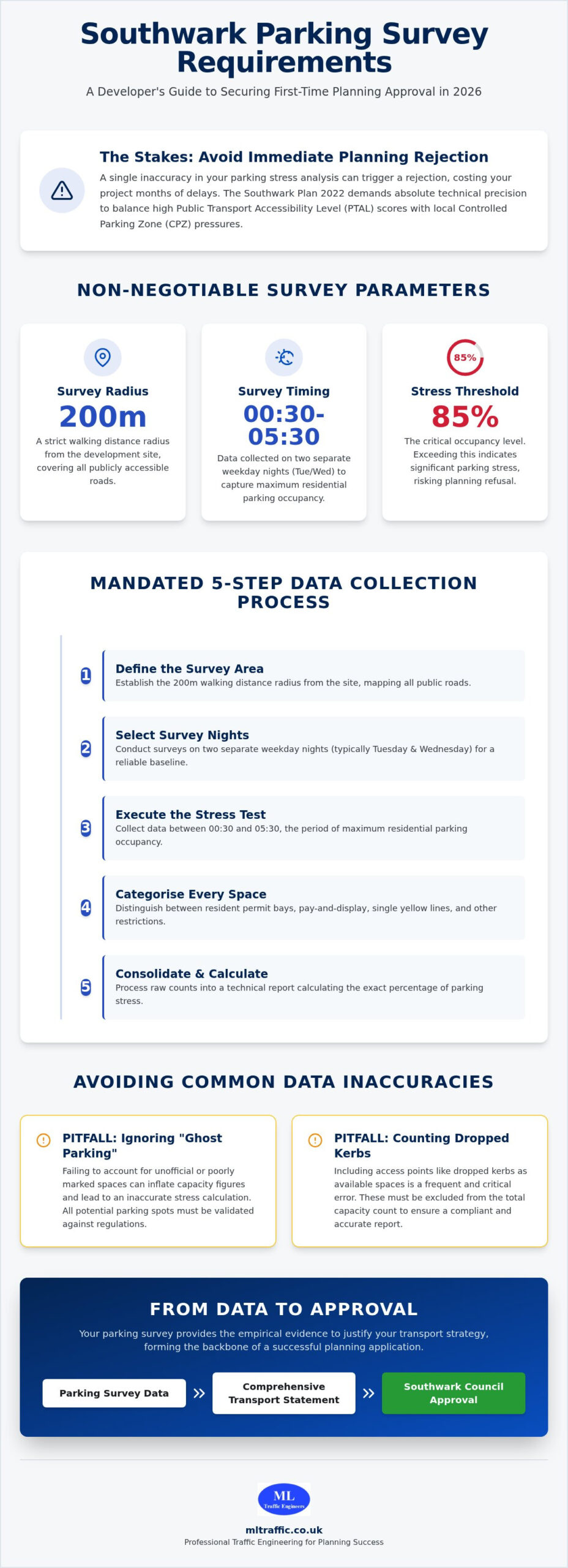
  • Green Travel Plans in London: A Developer’s 2026 Implementation Guide

    Green Travel Plans in London: A Developer’s 2026 Implementation Guide

    Will a single inconsistency between Transport for London (TfL) requirements and borough-specific mandates derail your 2026 planning application? You already know that securing approval in the capital requires more than just a standard transport assessment. It demands robust green travel plans that satisfy conflicting regulatory bodies while remaining financially viable. Planning delays often stem from inadequate documentation, yet the cost of getting it wrong can exceed tens of thousands in lost project time.

    We’ve designed this guide to help you master these complexities and secure a safe pair of hands for your project’s logistics. You’ll gain a clear roadmap to planning approval, learn how to reduce site car-dependency by up to 20% based on recent London trends, and implement cost-effective transport strategies that satisfy every stakeholder. We’ll examine the technical requirements for 2026 and provide a sequential implementation strategy to keep your project compliant and moving forward without delay.

    Key Takeaways

    • Align your development with the latest London Plan 2021 and 2026 updates to ensure a seamless route to planning approval.
    • Master the technical requirements for developing robust green travel plans, including site audits and PTAL-based SMART targets.
    • Identify the essential ‘Hard’ and ‘Soft’ mitigation strategies needed to meet stringent cycle parking and sustainable transport standards.
    • Understand the long-term compliance obligations, from appointing a Travel Plan Co-ordinator to managing the Year 1, 3, and 5 monitoring cycles.
    • Learn why bespoke, borough-specific strategies are vital for navigating the complex regulatory landscape of London’s diverse planning authorities.

    Table of Contents

    What is a Green Travel Plan in the London Planning Context?

    A Green Travel Plan (GTP) is a package of bespoke measures designed to reduce single-occupancy car use and promote sustainable transport alternatives. It’s no longer a "nice-to-have" document; it’s a technical requirement for modern development. For developers, What is a Travel Plan? provides the foundational context, noting that while the industry often uses the term "Green Travel Plan," the UK planning system officially refers to it as a Travel Plan. These documents align development goals with the Mayor of London’s 80% sustainable mode share target for 2041.

    The evolution of green travel plans under the London Plan 2021 and the 2026 updates has shifted the focus from soft encouragement to hard enforcement. It’s about proving that a development won’t just "try" to reduce car use, but will actively achieve it through infrastructure and monitoring. We see a clear distinction between workplace plans focusing on staff commuting, residential plans targeting household shopping trips, and school plans prioritising safe, active routes for pupils. Each requires a different set of interventions, from cycle parking and car clubs to electric vehicle charging infrastructure.

    To better understand this concept, watch this helpful video:

    The Legal Framework: The London Plan and Local Borough Requirements

    The National Planning Policy Framework (NPPF) sets the baseline for transport decisions, but the London Plan adds layers of city-specific rigour. The 10 "Healthy Streets" indicators now drive GTP requirements, forcing developers to consider how their projects impact the public realm. Thresholds for green travel plans vary significantly across the capital. For instance, Barnet may trigger a full GTP requirement at a different density level than Lambeth. These local variations mean developers need precise, CAD-backed data to ensure compliance from the initial planning phase through to final implementation.

    Why a Green Travel Plan is Essential for Planning Permission

    How to Develop a Robust Green Travel Plan for Your Site

    Creating effective green travel plans requires a sequential, data-led approach. Developers must move beyond generic templates to deliver site-specific strategies that satisfy Transport for London (TfL) requirements and local borough mandates. The process follows five critical stages:

    • Step 1: Site Audit. Conduct an exhaustive assessment of existing transport links and PTAL ratings within a 960-metre radius for rail and 640-metre for bus.

    • Step 2: SMART Targets. Define clear goals for modal shift, such as a 15% reduction in single-occupancy car use within the first 60 months of occupation.

    • Step 3: Suite of Measures. Identify site-specific interventions like secure cycle storage, electric vehicle charging points, and car club memberships.

    • Step 4: Monitoring. Establish a review programme spanning 5 to 10 years to track progress against benchmarks using standardised survey methods.

    • Step 5: Formal Approval. Secure sign-off from the Local Highway Authority or TfL to ensure planning compliance and satisfy Section 106 obligations.

    Baseline Data Collection: Parking Surveys and PTAL Ratings

    Accurate parking surveys form the foundation of any GTP. These surveys identify current demand and prevent overspill into adjacent residential streets. Understanding Public Transport Accessibility Levels (PTAL) is equally vital. A site with a PTAL of 6b allows for car-free developments, whereas a PTAL 2 location requires more intensive mitigation measures. Developers should use the TRICS database to predict trip generation for their specific land use, ensuring the plan reflects realistic traffic volumes.

    Setting SMART Targets for Sustainable Modal Shift

    Goals must be Specific, Measurable, Achievable, Relevant, and Time-bound. By 2026, London developers must align their targets with the Mayor’s Transport Strategy, which aims for 80% of all trips to be made by foot, cycle, or public transport by 2041. Targets must be ambitious yet grounded in the site’s PTAL reality. If a development fails to meet these shifts, the local authority may trigger financial penalties or require additional mitigation measures. Our team provides comprehensive support for developers seeking to navigate these regulatory requirements with precision.

    A well-structured plan doesn’t just tick a compliance box; it enhances the long-term viability of the development. By integrating these five steps early in the design phase, you reduce the risk of costly retrofits or planning delays. Precision in the initial data collection phase ensures that the final green travel plans are both defensible during the planning committee and functional once the site is operational.

    Green Travel Plans in London: A Developer’s 2026 Implementation Guide

    Key Components and Sustainable Mitigation Strategies

    Effective green travel plans categorise interventions into ‘Hard’ infrastructure and ‘Soft’ behavioural measures. Developers must integrate both to meet the modal shift targets set by Transport for London (TfL) and individual boroughs. Precision in the planning stage ensures these strategies remain compliant with the London Plan 2021 and its 2026 iterations, which demand a prioritisation of active travel over private car use. You’ll find that a balanced approach reduces the need for costly highway capacity increases while satisfying local planning authorities.

    Infrastructure Measures: Cycle Parking and EV Charging

    The London Plan 2021, enforced through to 2026, mandates strict cycle storage ratios that developers cannot ignore. For residential developments, you must provide 1 space per studio or 1-bedroom unit, and 2 spaces for all other dwellings. These long-stay stores must be secure, covered, and integrated into the building fabric to prevent theft and weather damage. Short-stay visitor parking should be located near main entrances, typically at a rate of 1 space per 40 units.

    Integrating EV charging and car club bays requires careful spatial planning. Current regulations require 20% of parking spaces to have active charging facilities from the point of completion, with the remaining 80% featuring passive provision for future connection. You’ll need swept path analysis to prove that car club vehicles and maintenance vans can navigate the site layout without compromising pedestrian safety or obstructing the public highway. Designing for active travel means creating wide, well-lit pathways that make walking and cycling the most natural and efficient choices for residents.

    Soft Measures: Incentives, Car Clubs, and Information

    Marketing and communication form the backbone of behavioural change. Travel Information Packs (TIPs) are now a standard planning condition in London. These packs must be bespoke to the site and include:

    • High-quality local walking and cycling maps showing safe routes to nearby hubs.

    • Timetables and route maps for local bus, Tube, and rail services.

    • Details of Workplace Travel Plans, including Cycle to Work schemes and the location of on-site shower facilities for staff.

    • Vouchers for cycle training or discounts at local bike shops.

    Implementation and Monitoring: Ensuring Long-Term Compliance

    Successful green travel plans aren’t static documents that sit on a shelf after planning approval. They’re active commitments that require rigorous oversight to meet London’s 2026 sustainability targets. Local authorities demand proof that the proposed modal shift from private cars to sustainable transport is actually happening. This phase shifts the focus from theoretical planning to operational reality, where precision and data accuracy become the primary metrics of success.

    The Role of the Travel Plan Co-ordinator (TPC)

    Appointing a qualified TPC is a mandatory legal condition for most major London developments. This individual serves as the bridge between the developer, the residents, and the Borough’s Transport Officer. They don’t just distribute bus timetables; they manage the entire lifecycle of the plan. The TPC’s duties include resident engagement, managing car club memberships, and coordinating annual reporting. Many developers choose to outsource these technical duties to transport consultants to ensure that every regulatory milestone is met without delay. Professional TPCs provide the technical authority needed to manage complex data sets and maintain 24/7 readiness for council audits.

    Annual Monitoring Reports and Section 106 Obligations

    Compliance is measured through a strict monitoring cycle, typically occurring in years 1, 3, and 5 post-occupation. These surveys must be standardised and often require iTRACE or TRICS-compliant methodologies to ensure the data is robust. You’ll need to collect specific information on how people arrive at the site, including walking, cycling, and public transport usage. Once the data is gathered, it’s compiled into a Monitoring Report and submitted to the local authority for review. Failure to monitor can lead to enforcement action under the Town and Country Planning Act.

    If your development fails to meet its modal shift targets, the Section 106 agreement often triggers "remedial measures." This might include:

    • Additional financial contributions to local bus services.

    • Enhanced cycle training programmes for residents.

    • Increased investment in on-site infrastructure like secure bike storage.

    • Financial penalties if targets are missed by a specific percentage, often defined in the original planning consent.

    Staying ahead of these requirements prevents costly legal disputes and protects the development’s reputation. It’s about maintaining a safe pair of hands throughout the project’s life. We understand the intricate complexities of UK road regulations and planning obligations so you don’t have to worry about compliance gaps.

    Ensure your development meets every regulatory hurdle by partnering with experts who prioritise precision. Contact ML Traffic for comprehensive support with your travel plan implementation.

    London’s 33 local authorities operate with distinct priorities, making a generic approach to green travel plans a recipe for planning delays. Developers often face friction when a strategy that succeeded in Havering fails to meet the stringent requirements of Camden or Islington. ML Traffic Engineers specialise in bridging this gap. We translate complex developer ambitions into technical documents that Local Highway Authorities trust. Our team has extensive experience across diverse project types, ranging from high-density residential towers to complex mixed-use commercial developments. We understand that a site’s success depends on precision and an intimate knowledge of local street hierarchies.

    Our engineers act as a safe pair of hands throughout the consultation process. We don’t just submit reports; we defend them. By using data-driven insights, we justify sustainable travel choices that align with the Mayor’s Transport Strategy. This technical authority reduces the need for multiple revisions, often accelerating the approval timeline by several weeks. We remain available 24/7 to address urgent queries from planning officers, ensuring your project remains on schedule regardless of the regulatory hurdles.

    Tailoring Plans to Specific Borough Requirements

    Thresholds for mandatory GTPs vary significantly across the capital. In Inner London boroughs like Southwark, developers often trigger full travel plan requirements at lower unit counts compared to Outer London counterparts. The City of London requires specific focus on freight consolidation and pedestrian comfort levels that differ from the suburban requirements of Bromley. We ensure your travel plans are bespoke to the local street network. This involves analysing local cycle quietways, existing bus capacity, and specific borough targets for car-free housing. For developments in west London, working with specialist Transport Planning Consultants Hammersmith and Fulham is essential to navigate the borough’s Vision Zero safety standards and car-free policies. We focus on Chapter 8 compliance and safety standards to ensure every proposed measure is physically and legally viable.

    Why Expert Technical Analysis Secures Planning Success

    Standalone documents rarely suffice in the 2026 planning environment. We achieve the best results by integrating green travel plans with comprehensive transport assessments. ML Traffic Engineers utilise CAD design and advanced traffic modelling to prove that sustainable travel targets are achievable. We use real-time data to justify cycle parking ratios and electric vehicle charging infrastructure. This level of detail provides the certainty that Highway Authorities demand. Don’t leave your site’s accessibility to chance. Contact our team today to organise a professional consultation and secure a robust transport strategy that guarantees compliance and project momentum.

    Future-Proof Your London Development for 2026

    Success in the London planning landscape requires a rigorous commitment to the London Plan 2021 and TfL’s Healthy Streets approach. Navigating these requirements means moving beyond basic compliance to deliver green travel plans that offer genuine sustainable mitigation. Your site must demonstrate measurable shifts toward active travel to meet the 80% sustainable mode share target set for 2041. Precision in data collection and long-term monitoring remains the only way to avoid costly delays or enforcement action.

    ML Traffic Engineers provides the technical authority required to secure your project’s future. We offer expert knowledge across all 32 London Boroughs and the City of London. Our team remains available 24/7 for urgent technical planning support. We ensure every bespoke solution aligns with the latest Chapter 8 standards and London Plan mandates. We manage the entire process from initial CAD design through to final implementation. Secure your London planning approval with a professional Green Travel Plan from ML Traffic Engineers. We’re ready to help you navigate the complexities of UK road regulations with total confidence.

    Frequently Asked Questions

    Is a Green Travel Plan a legal requirement for all London developments?

    A Green Travel Plan is a legal requirement for all major developments as defined by the London Plan 2021. This includes residential projects with 80 or more units and commercial spaces exceeding 2,500 square metres. Local Planning Authorities enforce these requirements via Section 106 agreements to ensure compliance with Transport for London sustainability targets. Smaller sites often require a simplified travel statement if the local borough identifies specific transport pressures or environmental concerns.

    What is the difference between a Framework Travel Plan and a Full Travel Plan?

    A Framework Travel Plan applies to outline planning applications where final occupiers aren’t yet known. It sets broad modal shift targets and overarching strategies for the site. A Full Travel Plan is required for detailed applications or once a building is occupied. It includes specific measures tailored to the actual site users’ needs. Switching from a framework to a full plan typically occurs within six months of site occupation to reflect real-world travel data.

    How much does it cost to monitor a Green Travel Plan in London?

    Monitoring fees for green travel plans in London typically range from £3,000 to £15,000 over a five-year period. These costs are paid to the local council to cover the administration and review of annual monitoring reports. For example, some boroughs charge a flat fee per unit or a fixed sum based on the development’s total floor area. Developers must budget for these mandatory statutory fees as part of their initial Section 106 financial obligations.

    Can a Green Travel Plan help reduce the number of parking spaces required on-site?

    Yes, a robust Travel Plan can justify a significant reduction in on-site parking provision. In areas with high Public Transport Accessibility Levels (PTAL) of 4 to 6, the London Plan 2021 mandates car-free developments. By demonstrating viable alternatives like cycle hubs and car clubs, developers can satisfy planners that minimal parking is necessary. This approach maximises buildable space while meeting the Mayor’s target for 80% of trips to be sustainable by 2041.

    Who is responsible for implementing the Green Travel Plan measures?

    The developer holds initial responsibility for the plan’s creation and approval during the planning phase. Once the site is operational, a designated Travel Plan Coordinator (TPC) manages day-to-day implementation. The TPC role is a standard condition of the Section 106 agreement. They oversee data collection, promote sustainable transport initiatives, and act as the primary liaison between the development and the local borough’s transport officers to ensure ongoing compliance and safety.

    What happens if a development fails to meet its modal shift targets?

    Failure to meet modal shift targets triggers a review process where the developer must implement remedial measures at their own expense. Many London boroughs require a financial bond or contingency fund as part of the legal agreement. If targets aren’t met by the year five milestone, the council can claim these funds to improve local sustainable transport infrastructure. Local authorities use these enforcement powers to ensure developments don’t increase local road congestion or pollution.

    How long does a Green Travel Plan remain in effect?

    What are the common triggers for a London Borough to request a Travel Plan?

    The primary trigger for a London Borough to request a Travel Plan is the scale of the development reaching major status under the Town and Country Planning Order. Other triggers include sites located in Air Quality Management Areas (AQMAs) or those expected to generate significant traffic in congested zones. Even if a project falls below the standard size thresholds, a borough might request a plan if the local road network is at capacity or safety risks exist.

    Which areas do you cover?

    We service Acton, Balham, Barking, Barnes, Barnet, Battersea, Beckenham, Bexleyheath, Brentford, Brixton, Bromley, Camberwell, Carshalton, Charlton, Chelsea, Chiswick, Clapham, Coulsdon, Croydon, Crystal Palace, Dagenham, Dulwich, Ealing, Edgware, Eltham, Enfield, Finchley, Forest Gate, Fulham, Golders Green, Greenwich, Hackney, Hammersmith, Hampstead, Harrow, Hayes, Highgate, Hounslow, Ilford, Islington, Kensington, Kentish Town, Kingston upon Thames, Lewisham, Mitcham, Muswell Hill, New Malden, Notting Hill, Orpington, Peckham, Pinner, Purley, Putney, Richmond, Romford, Ruislip, Sidcup, Southall, Southgate, Streatham, Surbiton, Sutton, Tooting, Tottenham, Twickenham, Uxbridge, Walthamstow, Wembley, West Norwood, Wimbledon, Wood Green, Woolwich, Bethnal Green, Shoreditch, Canary Wharf, Deptford, Leyton, Palmers Green, Stanmore, Upminster, Chislehurst, Erith, Feltham.

    Michael Lee

    Article by

    Michael Lee

    Transport planner with over 35 years' experience.

    Disclaimer

    The content on mltraffic.co.uk, including all technical articles, guides, and resources, is provided for general informational and educational purposes only. It is not intended to constitute professional advice in traffic engineering, transportation planning, development approvals, or any other technical or legal field.
    While ML Traffic Engineers makes every reasonable effort to ensure the accuracy, completeness, and timeliness of the information published, we do not provide any warranties or representations (express or implied) regarding its reliability, suitability, or availability for any particular purpose. Any reliance you place on the content is strictly at your own risk.
    In no event shall ML Traffic Engineers, its directors, employees, authors, or affiliates be liable for any direct, indirect, incidental, special, consequential, or punitive damages (including, without limitation, loss of profits, data, or business opportunities) arising out of or in connection with the use of, or inability to use, any information provided on this website.
    The articles and guides on this site are not a substitute for engaging a qualified, professional traffic engineer to assess your specific project requirements. For tailored advice, compliance assessments, or traffic engineering services, please contact a competent professional.
    This disclaimer may be updated from time to time without notice. By accessing or using this website, you agree to be bound by the most current version of this disclaimer.

  • Lambeth Parking Survey Methodology: The 2026 Developer’s Guide to Planning Approval

    Lambeth Parking Survey Methodology: The 2026 Developer’s Guide to Planning Approval

    Your 2026 London development project could face an immediate planning refusal because of a single data error recorded at 02:00. Securing planning permission in Lambeth requires more than just a standard traffic count; it demands strict adherence to the lambeth parking survey methodology. We understand that the pressure to prove parking stress levels are manageable is immense, especially when a single mistake during the 01:00 to 05:30 observation window can invalidate your entire application.

    You’re likely concerned about the precision needed for 200-metre walking distance calculations or how to justify a car-free development to a sceptical Case Officer. It’s a common frustration for developers who want to keep their project on track. This guide provides the technical clarity you need to master these requirements and submit a compliant report. We’ll examine the exact data collection standards and show you how to leverage 24/7 expert monitoring to ensure your project moves from the planning phase to final implementation without a hitch.

    Key Takeaways

    • Understand why this technical framework is the industry-standard requirement for securing planning permission across London’s most competitive boroughs.

    • Master the mandatory survey parameters, including the strict 200-metre walking distance radius and the non-negotiable 01:00 to 05:30 observation window.

    • Learn how to apply the lambeth parking survey methodology to calculate parking stress and successfully navigate the critical 80% capacity threshold.

    • Identify borough-specific variations in Southwark, Wandsworth, and Lewisham to ensure your technical submission meets local regulatory expectations.

    • Discover why professional data collection is essential to provide the accuracy required to prevent planning refusals and costly project appeals.

    Table of Contents

    What is the Lambeth Parking Survey Methodology?

    The lambeth parking survey methodology represents the benchmark for quantifying on-street parking capacity across the capital. While originally developed by Lambeth Council, it has since become the industry-standard framework adopted by the majority of London boroughs. It functions as the primary evidence-based tool for developers to prove that a new project won’t cause unacceptable parking pressure on local residents. This rigorous assessment is a non-negotiable requirement for any project where the proposed parking provision falls below local authority standards. It ensures that the Technical aspects of urban planning are balanced with the practical realities of street-level infrastructure.

    For developers in 2026, precision is vital. Planning committees don’t accept guesswork. They demand empirical data. The methodology provides a clear, mathematical snapshot of how many cars are parked within a specific radius of a site. It’s the foundation of a successful planning application, especially for high-density residential schemes. Without this data, your project risks immediate rejection on the grounds of transport impact. We provide the technical expertise to ensure your survey meets these exacting standards from the first day.

    To better understand the practical side of parking management in the borough, watch this helpful video from Lambeth Council:

    The Core Purpose of the Survey

    The methodology’s main goal is to establish a baseline of existing parking demand during peak residential times. This usually involves two separate counts between 12:30 am and 5:30 am on weekday nights. These specific hours capture the maximum number of residents at home. The data provides the empirical evidence needed to support car-free or car-capped developments. It directly satisfies the requirements of the National Planning Policy Framework (NPPF), which states that development should only be refused on highways grounds if there’s an unacceptable impact on safety or a residual cumulative impact. By using the lambeth parking survey methodology, you provide the clear evidence needed to mitigate these concerns.

    Why ‘Lambeth’ is the London Standard

    Consistency across different local authorities is the main reason this methodology dominates the market. It prevents methodology hopping, where developers might try to use less rigorous standards to hide parking issues. For Planning Committees, it offers a transparent and repeatable metric that they can trust. This level of standardisation simplifies the approval process. The survey results integrate naturally with Transport Statements and Assessments, forming a cohesive argument for your site’s viability. It’s a reliable system that allows us to manage your project’s regulatory burdens with total precision.

    The Technical Framework: Radius, Timing, and Capacity

    Precision is the foundation of the lambeth parking survey methodology. It’s not a simple tally of vehicles; it’s a rigorous technical assessment where accuracy determines the success of a planning application. Developers must provide a granular view of local parking stress to satisfy Council requirements and avoid costly delays. This starts with a clear understanding of the spatial and temporal boundaries that define the survey’s scope.

    Mapping the 200m Survey Area

    The survey doesn’t use a simple radial "as the crow flies" circle. Instead, it requires a true 200-metre walking distance route from the site entrance. Our team utilizes 1:1250 scale OS mapping to identify every available centimetre of kerbside space within this walkable network. We account for physical obstructions that reduce capacity, including fire hydrants, private driveways, and dropped kerbs. This level of detail is critical because the Planning Inspectorate Appeal Decision has demonstrated that even minor inaccuracies in survey boundaries can undermine a developer’s transport statement. We exclude areas where parking is prohibited, such as double yellow lines or within 10 metres of a junction, to ensure the data reflects legal, safe parking only.

    Standardising the Survey Times

    Data collection must occur during the period of maximum residential parking demand. The non-negotiable window is 01:00 to 05:30. Surveys are conducted on two separate weekday nights, typically a Tuesday and a Wednesday, to provide a representative average of typical parking stress. We strictly avoid anomalous dates. This includes bank holidays, school half-terms, or nights where major local events at venues like the Brixton Academy might skew the results. Our safety-conscious data collectors work through these 24/7 environments in high-visibility gear, capturing snapshots of every parked vehicle to calculate exact occupancy rates. This high-stakes environment demands the unwavering reliability that our field teams provide.

    Calculating Theoretical Capacity

    On unmarked roads, we apply the 5-metre rule. This standard dictates that each 5-metre length of clear kerbside constitutes one parking space. We then cross-reference this against Controlled Parking Zones (CPZs) and specific permit restrictions to determine the true capacity available to residents. For developments with tight access points, we often pair these surveys with Swept Path Analysis services to prove that increased parking occupancy won’t compromise emergency vehicle access or general highway safety. If you’re preparing a submission for a high-density project, our team offers comprehensive support to ensure your data meets the 2026 standard for planning approval.

    Lambeth Parking Survey Methodology: The 2026 Developer’s Guide to Planning Approval

    Calculating Parking Stress and Impact on Planning

    Accurate data interpretation is the backbone of any successful planning application in South London. Under the lambeth parking survey methodology, parking stress is defined as the percentage of kerbside capacity occupied by vehicles at peak times. This figure determines whether your project adds unacceptable pressure to local infrastructure or remains within sustainable limits.

    The calculation is straightforward but requires precise inputs: (Parked Vehicles / Total Capacity) x 100. For instance, if a survey area contains 100 available spaces and 82 vehicles are recorded during the 00:30 to 05:30 window, the parking stress is 82%. Case Officers view the 80% threshold as a critical tipping point. Once occupancy exceeds this level, finding a parking space becomes difficult for residents, often leading to illegal parking or increased congestion. If your survey results sit consistently above 80%, you must prepare a robust justification for your development’s impact.

    A professional technical report must also account for the cumulative impact of other nearby developments. Lambeth Council requires developers to consider committed developments within a 200-metre radius that haven’t been built yet but already have planning permission. Ignoring these future residents can lead to your survey being rejected during the consultation phase because the baseline data fails to reflect the reality of the street’s future capacity.

    Interpreting the Stress Levels

    When stress levels exceed 85% or 90%, the risk of application refusal increases significantly. In these high-stress areas, you can’t simply present the numbers; you must provide mitigation. This often involves permit-free legal agreements, preventing new residents from applying for on-street permits. You might also propose financial contributions to local sustainable transport initiatives or provide on-site car club bays to offset demand. Showing this proactive approach reassures the council that you’ve considered the wider community impact.

    Data Integrity and Transparency

    Transparency is non-negotiable for 2026 planning approvals. ML Traffic provides audit-ready data by including raw data sheets and time-stamped photographs for every street segment surveyed. This level of detail allows council officers to verify results quickly, reducing the likelihood of costly delays or requests for re-surveys. We ensure every lambeth parking survey methodology report is backed by empirical evidence that stands up to scrutiny.

    Linking these survey results to London Travel Plans is a strategic move to reduce car dependency. By showing a clear path toward cycling and public transport use, you demonstrate a commitment to Lambeth’s long-term environmental goals. Our team manages this entire process, moving from initial data collection to final report implementation with speed and technical authority.

    Common Pitfalls and Borough-Specific Variations

    Attempting a "DIY" survey is the fastest route to a planning refusal. Local planning authorities require data that is both objective and legally defensible. If your data fails to align with the lambeth parking survey methodology, your application will be deferred or rejected without hesitation. Precision is a legal requirement in the 2026 planning environment. Council officers quickly identify amateur data sets that lack the necessary technical rigour.

    Why Local Authorities Reject Surveys

    Inaccurate mapping of physical restrictions causes immediate failure. If a surveyor misses a 5-metre stretch of double yellow lines or fails to account for a suspended bay, the entire capacity calculation becomes void. We have seen applications rejected because surveys occurred during rail strikes or school holidays when parking demand drops by as much as 20%. The methodology section of your final report must be transparent. It needs to detail exact timings, weather conditions, and any observations of unusual activity that might skew the results. Failure to provide this level of detail suggests a lack of professional oversight.

    Adapting the Methodology Across London

    While Lambeth follows a specific framework, neighbouring boroughs have distinct nuances that developers often overlook. Wandsworth frequently demands weekend surveys for residential developments to capture peak overnight demand that weekday data might miss. Southwark and Lewisham often require additional scrutiny for sites with high PTAL ratings, typically 5 or 6, to ensure car-free developments don’t overwhelm local infrastructure. Consulting with London transport planning experts ensures these site-specific requirements are integrated into the survey design from the start.

    Ignoring seasonal variations is another critical error. Parking pressure in December differs significantly from July. If you conduct a survey during a period of untypical behaviour, such as a major local event or emergency roadworks, the council will identify the anomaly. We cross-reference all survey data with long-term local trends to ensure your 2026 planning submission stands up to the most rigorous council scrutiny. This proactive approach eliminates the need for expensive re-surveys and prevents project delays. Our team identifies these risks before the first surveyor arrives on-site, providing a safe pair of hands for your project’s logistics.

    To ensure your project meets every regulatory requirement, secure your 2026 planning approval with a professionally managed parking survey today.

    Why Professional Execution is Non-Negotiable for Approval

    Lambeth’s 2026 planning landscape leaves zero room for data discrepancies. A single miscounted "beat" or an incorrectly identified parking permit zone (CPZ) can trigger a formal objection from the Highways Department. This often results in a planning appeal, a process that adds an average of 32 weeks to your project timeline and can cost upwards of £12,000 in additional consultancy and legal fees. Precision isn’t just a preference; it’s a financial necessity.

    Utilising a robust lambeth parking survey methodology ensures your data withstands the scrutiny of planning officers. We treat every survey as a legal document. Our data provides the empirical foundation for your planning application, ensuring that claims about local parking capacity are backed by verifiable, timestamped evidence. This data doesn’t exist in a vacuum. It’s a critical component that must be seamlessly integrated into your Transport Assessment to provide a holistic view of the development’s impact.

    Choosing a "safe pair of hands" means you aren’t just buying data; you’re buying regulatory compliance. We understand the intricate nuances of Lambeth’s specific requirements, such as the 200-metre walking distance rule and the exclusion of dangerous junctions from capacity totals. We handle the technical complexities so you can focus on the build.

    The ML Traffic Advantage

    We operate on a 24/7 basis because planning deadlines don’t stick to standard office hours. Our team is ready for emergency and time-sensitive surveys, often deploying staff within 48 hours of instruction. We provide bespoke reporting that speaks the direct language of London Planning Officers, using the specific terminology and data visualisations they expect to see. Our total managed solution covers everything from the initial beat planning to the final report delivery, removing the logistical burden from your project managers.

    Securing Your Planning Quote

    To provide an accurate, fixed-fee quote for your project, our team requires three key pieces of information: the site location, the proposed unit count, and your target submission timeline. We don’t cut corners on safety or quality. Every survey we conduct is fully Chapter 8 compliant, protecting both our workers and the public while ensuring the integrity of the data collected. We’ve maintained a 98% first-time acceptance rate for our reports in 2025, and we’re committed to carrying that standard into 2026.

    Ready to move forward with your application? Contact ML Traffic for a Lambeth Parking Survey Quote today to ensure your project stays on track.

    Secure Your 2026 Planning Approval with Precision Data

    Navigating the lambeth parking survey methodology requires strict adherence to Lambeth Council standards, including the mandatory 200-metre radius rule and specific 1:00 AM to 5:00 AM survey windows. Precision is non-negotiable for developers; even a 2% discrepancy in parking stress calculations can trigger an immediate planning refusal. Your transport assessment must accurately reflect existing CPZ restrictions and overnight capacity to withstand rigorous council scrutiny during the 2026 planning cycle.

    ML Traffic provides the technical authority needed to clear these regulatory hurdles without delay. We offer 24/7 data collection capabilities across all 21 wards in the borough, delivering audit-ready technical reports that align with the latest London Borough requirements. Our team manages the entire process from initial site assessment to final submission, providing a total solution that protects your project’s timeline and budget. We’ve built our reputation on reliability and a deep understanding of UK road regulations, ensuring your data is beyond reproach.

    Get a Professional Lambeth Parking Survey Quote for Your London Project

    We’re ready to help you secure your next approval with data you can trust.

    Frequently Asked Questions

    What is the 200m rule in a Lambeth parking survey?

    The 200m rule defines the survey area as a 200-metre walking distance from the proposed site entrance. This radius covers all publicly accessible kerbside space where residents or visitors might park. Our surveyors map these zones precisely to ensure the data captures local parking capacity within a 3-minute walk of your development.

    Why are parking surveys usually conducted between 1 am and 5 am?

    Surveys occur between 01:00 and 05:00 because this period represents peak residential parking demand. Most residents are home at this time, providing the most accurate baseline for overnight parking stress. We deploy teams during these early hours to ensure your application reflects the highest occupancy levels as required by council standards.

    How many nights are required for a compliant Lambeth parking survey?

    A standard lambeth parking survey methodology requires data collection over two separate weekday nights. These are typically Tuesday and Wednesday or Wednesday and Thursday nights to avoid weekend anomalies. If your development includes a commercial element, the Council may request additional weekend surveys to assess the 24/7 impact on local road networks.

    Can I use the Lambeth Methodology for developments outside of Lambeth?

    Yes, many London boroughs and local authorities adopt this methodology as the gold standard for parking stress assessments. It provides a rigorous framework that satisfies the requirements of the London Plan 2021. We frequently apply these principles in Southwark, Wandsworth, and Merton to ensure planning applications meet strict regional transport criteria.

    What is considered a ‘high’ parking stress level in London?

    Parking stress is considered high once occupancy exceeds 85% of the available kerbside capacity. At this threshold, drivers often circle for more than 5 minutes to find a space, which increases local congestion. If your survey identifies stress levels above 90%, the Council will likely require a robust Travel Plan or a car-free legal agreement.

    What happens if my parking survey shows 100% stress?

    If surveys show 100% stress, the Council will likely refuse applications that increase on-street parking demand. You’ll need to mitigate this by proposing a car-free development or funding a new Controlled Parking Zone (CPZ) through a Section 106 agreement. We provide the technical data needed to negotiate these mitigations with planning officers effectively.

    Do I need a parking survey for a car-free development?

    You still need a survey for car-free developments to prove that overspill won’t impact local safety. Even without allocated spaces, visitors or residents with blue badges might park on-street. A comprehensive lambeth parking survey methodology report demonstrates that the surrounding 200-metre radius can absorb any residual pressure without breaching the 85% stress limit.

    How long is a parking survey report valid for a planning application?

    Parking survey data is generally valid for 6 months from the date of the final site visit. If your planning submission is delayed beyond 180 days, you’ll likely need to commission a fresh assessment to account for local changes. We maintain 24/7 readiness to update your reports quickly if project timelines shift or council requirements evolve.

    Which areas in London do you cover?

    We service Acton, Balham, Barking, Barnes, Barnet, Battersea, Beckenham, Bexleyheath, Brentford, Brixton, Bromley, Camberwell, Carshalton, Charlton, Chelsea, Chiswick, Clapham, Coulsdon, Croydon, Crystal Palace, Dagenham, Dulwich, Ealing, Edgware, Eltham, Enfield, Finchley, Forest Gate, Fulham, Golders Green, Greenwich, Hackney, Hammersmith, Hampstead, Harrow, Hayes, Highgate, Hounslow, Ilford, Islington, Kensington, Kentish Town, Kingston upon Thames, Lewisham, Mitcham, Muswell Hill, New Malden, Notting Hill, Orpington, Peckham, Pinner, Purley, Putney, Richmond, Romford, Ruislip, Sidcup, Southall, Southgate, Streatham, Surbiton, Sutton, Tooting, Tottenham, Twickenham, Uxbridge, Walthamstow, Wembley, West Norwood, Wimbledon, Wood Green, Woolwich, Bethnal Green, Shoreditch, Canary Wharf, Deptford, Leyton, Palmers Green, Stanmore, Upminster, Chislehurst, Erith, Feltham.

    Which cities in England do you cover?

    We service London, Birmingham, Manchester, Liverpool, Sheffield, Leeds.

    Michael Lee

    Article by

    Michael Lee

    Transport planner with over 35 years' experience.

    Disclaimer

    The content on mltraffic.co.uk, including all technical articles, guides, and resources, is provided for general informational and educational purposes only. It is not intended to constitute professional advice in traffic engineering, transportation planning, development approvals, or any other technical or legal field.
    While ML Traffic Engineers makes every reasonable effort to ensure the accuracy, completeness, and timeliness of the information published, we do not provide any warranties or representations (express or implied) regarding its reliability, suitability, or availability for any particular purpose. Any reliance you place on the content is strictly at your own risk.
    In no event shall ML Traffic Engineers, its directors, employees, authors, or affiliates be liable for any direct, indirect, incidental, special, consequential, or punitive damages (including, without limitation, loss of profits, data, or business opportunities) arising out of or in connection with the use of, or inability to use, any information provided on this website.
    The articles and guides on this site are not a substitute for engaging a qualified, professional traffic engineer to assess your specific project requirements. For tailored advice, compliance assessments, or traffic engineering services, please contact a competent professional.
    This disclaimer may be updated from time to time without notice. By accessing or using this website, you agree to be bound by the most current version of this disclaimer.
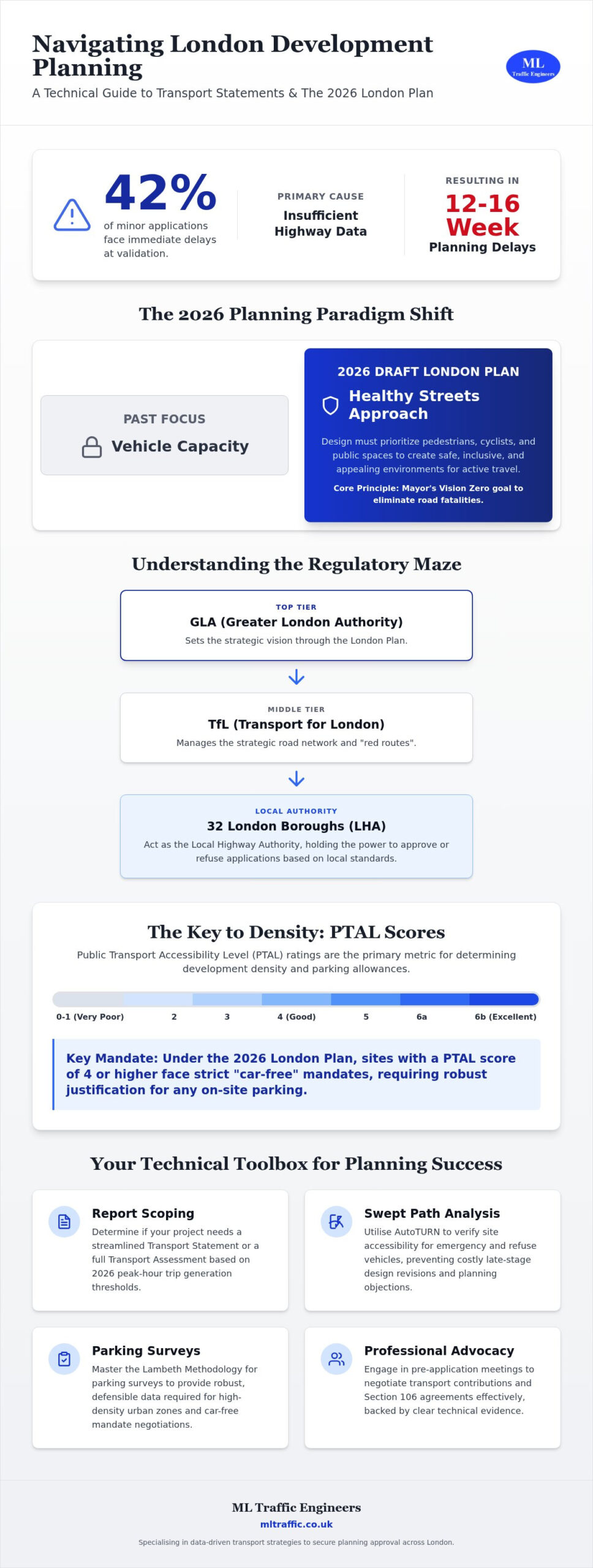
  • Multimodal Traffic Generation in London: A Developer’s Checklist for PTAL and Use Classes in 2026

    Multimodal Traffic Generation in London: A Developer’s Checklist for PTAL and Use Classes in 2026

    What if the 2020 Use Class overhaul actually makes it harder to justify your London development’s car-free status? Securing planning approval in 2026 requires a flawless understanding of multimodal traffic generation by PTAL and Land Uses (E, B2, B8, C1, C2, C3, F1, F2) and Sui Generis ( pubs/bars, cinemas, hot food takeaways, theatres, scrap yards, and petrol stations). You likely already know that London’s planning environment is increasingly rigid regarding parking provisions, especially in areas with a PTAL rating of 5 or 6. We understand the frustration of interpreting conflicting TRICS data when trying to prove your site’s accessibility to Transport for London (TfL).

    This expert-led checklist ensures your transport assessment stands up to the strictest scrutiny from local planning authorities. You’ll master the nuances of trip generation for complex sites, from Class E commercial hubs to specialised Sui Generis scrap yards and petrol stations. We’ve compiled a clear roadmap for accurate data collection and site layout optimisation to help you achieve planning approval with minimal revisions. We’ll examine how to align your project with the latest London Plan requirements to ensure a seamless transition from the initial CAD design to final implementation.

    Key Takeaways

    • Understand how PTAL ratings act as a critical planning gatekeeper by defining the sustainable density and scale of developments across London’s 32 boroughs.

    • Learn to calculate accurate multimodal traffic generation by PTAL and Land Uses (E, B2, B8, C1, C2, C3, F1, F2) and Sui Generis ( pubs/bars, cinemas, hot food takeaways, theatres, scrap yards, and petrol stations) using the TRICS database and bespoke arrival profiles.

    • Discover why Sui Generis developments require specialised traffic analysis to account for unique arrival and departure patterns that generic data often overlooks.

    • Utilise our 2026 developer’s checklist to identify Use Class overlaps early and verify site accessibility using the latest TfL WebPTAL tools.

    • Mitigate the risk of costly planning delays by leveraging professional transport consultants to navigate the specific regulatory requirements of individual London local authorities.

    Table of Contents

    Decoding London’s Use Classes and PTAL Ratings for 2026

    London’s planning framework requires a strict correlation between the Use Classes Order 1987 and the city’s strategic transport goals. Developers must demonstrate how their projects support the Mayor’s 2041 target for 80% sustainable travel. A central component of this is the Public Transport Accessibility Level (PTAL), which measures the proximity and frequency of the transport network. This metric serves as a critical gatekeeper, dictating everything from building density to the number of permitted parking spaces.

    To better understand how these planning elements work together, watch this helpful video:

    What is PTAL and Why Does it Matter?

    PTAL scores range from 0 to 6b. Higher numbers represent superior access to rail, tube, and bus services. In 2026, sites with a PTAL of 5 or 6 generally require car-free development, with exceptions limited to essential blue badge provision. These ratings directly influence how residents and visitors choose to travel. High accessibility encourages a shift from private vehicles to active travel and public transport. When developers seek to deviate from these rigid standards, parking surveys in London provide the empirical data needed to justify parking reductions. We use these surveys to prove that local streets can handle any residual overspill without compromising safety.

    The 2026 Landscape of Land Use Classes

    The introduction of Class E has streamlined planning but complicated transport modelling for consultants. Since a building can shift from a retail shop to a gym or office without additional planning permission—often housing the kind of small UK businesses found on platforms like Anglia Market—we must model the "worst-case" scenario for trip generation. This ensures safety and capacity compliance regardless of the specific end-user. Accurate forecasting of multimodal traffic generation by PTAL and Land Uses (E, B2, B8, C1, C2, C3, F1, F2) and Sui Generis ( pubs/bars, cinemas, hot food takeaways, theatres, scrap yards, and petrol stations) is now the mandatory baseline for any successful planning application.

    Each land use presents unique challenges for the 2026 transport network:

    • Class E: High-frequency turnover requiring robust pedestrian infrastructure.

    • B2 and B8: Heavy goods vehicle (HGV) movements that must be separated from cycle lanes.

    • C1 to C3: Residential and hotel uses that demand reliable 24/7 public transport links.

    • Sui Generis: High-impact uses like theatres or petrol stations that create intense, time-specific traffic peaks.

    Our team ensures that your project meets these technical requirements from the initial planning phase. We provide the precise data needed to satisfy local authorities and Transport for London, ensuring your development moves from CAD design to final implementation without regulatory delays.

    Calculating Trip Generation for Classes E, B, and C

    Accurate forecasting starts with the TRICS database. It’s the industry standard for establishing baseline multimodal trip rates. However, London’s unique geography requires developers to filter national datasets to match the specific travel behaviours of Central, Inner, or Outer London. A site in Croydon won’t share the same trip profile as one in Southwark, even if the land use is identical. It’s vital to follow official government guidance when preparing these figures to ensure compliance with local planning authority expectations.

    Our methodology ensures precise multimodal traffic generation by PTAL and Land Uses (E, B2, B8, C1, C2, C3, F1, F2) and Sui Generis ( pubs/bars, cinemas, hot food takeaways, theatres, scrap yards, and petrol stations) to meet strict Transport for London (TfL) standards. We don’t just look at vehicle numbers; we calculate the total impact across all transport modes. This includes cycling, walking, and rail usage, which are heavily influenced by the site’s PTAL rating. For projects requiring rapid turnaround, our comprehensive transport planning support ensures your submission stays on track.

    Commercial and Industrial Dynamics (E, B2, B8)

    B8 Storage and Distribution centres in Greater London generate intense delivery and servicing requirements. These sites often see over 15 HGV movements per hour during peak operational windows. Because of these dimensions, swept path analysis services are vital for industrial site access. They prove that large vehicles can enter and exit in a forward gear without mounting pavements or striking street furniture. Class E traffic has also shifted significantly. Since the 2020 reforms, many sites have moved from retail-heavy use to office and gym multimodal splits. This change typically flattens the midday peak but increases pressure during the 08:00 to 09:00 and 17:00 to 18:00 windows.

    Residential and Institutional Impact (C1, C2, C3, F1, F2)

    Forecasting school (F1) and community (F2) traffic requires a granular look at the morning peak hour. These uses often create localised congestion that conflicts with commuter traffic. Residential (C3) developments in low PTAL areas, such as levels 1a or 1b, typically show a 40% higher car dependency compared to Zone 2 locations. In contrast, short-stay C1 uses operate on a different rhythm. C1 hotel trip generation varies significantly by proximity to London Underground stations, with sites within 250 metres showing a 70% reduction in taxi and private car arrivals. Balancing these peak hour pressures is essential for securing planning approval in 2026. For residential schemes that include new roads intended for public adoption, understanding the section 38 agreement process in London from the outset is critical to avoiding costly delays before the first resident moves in.

    Multimodal Traffic Generation in London: A Developer’s Checklist for PTAL and Use Classes in 2026

    The Sui Generis Factor: Traffic Nuances for Pubs, Theatres, and Takeaways

    Sui Generis developments fall outside standard classifications because their impact on the road network is entirely unique. Relying on generic TRICS averages often leads to planning refusals in London. Local authorities require bespoke data that reflects the specific operational hours and visitor behaviours of your site. Accurate multimodal traffic generation by PTAL and Land Uses (E, B2, B8, C1, C2, C3, F1, F2) and Sui Generis ( pubs/bars, cinemas, hot food takeaways, theatres, scrap yards, and petrol stations) ensures your transport assessment stands up to scrutiny during the 2026 planning cycle. We focus on the granular details of how these sites breathe throughout a 24-hour period.

    Hospitality and Entertainment (Pubs, Cinemas, Theatres)

    Entertainment venues create intense surge peaks rather than steady flows. A 500-seat theatre generates a massive exodus within a 15-minute window at 22:30, which differs significantly from a Class E office. We calculate the linked trip effect, where approximately 30% of visitors might visit a local pub before a film, reducing the demand for new parking but increasing pavement crowding. Effective London travel plans help mitigate these dispersal risks by coordinating with TfL night services and designated taxi pick-up points. Managing late-night noise and transport dispersal is critical for sites near residential zones.

    Hot food takeaways present a different challenge: moped volume. A single busy unit can generate 20 to 30 delivery trips per hour during peak evening times. This requires dedicated waiting bays to prevent illegal pavement parking and maintain road safety for cyclists. Without these provisions, the high-frequency nature of delivery traffic often triggers objections from Highways officers. We design layouts that keep mopeds off the footway and ensure delivery drivers don’t obstruct the main carriageway.

    Industrial Sui Generis: Scrap Yards and Petrol Stations

    Industrial Sui Generis sites demand precision in vehicle tracking. Scrap yards and petrol stations operate with heavy, oversized vehicles that cannot easily navigate tight London corners. We use CAD-based swept path analysis to prove that a 16.5-metre petrol tanker or a recovery low-loader can enter and exit the site in a forward gear. This is a non-negotiable safety requirement for 2026 applications.

    • High-Turnover Flow: Petrol stations require clear stacking space to prevent queues from backing up onto the public highway.

    • Environmental Safety: Mitigating the impact of heavy vehicle movements on residential fringes involves strict routing agreements and physical mitigation measures.

    • Operational Precision: We ensure site layouts accommodate the maximum legal vehicle size allowed on UK roads to prevent kerb strikes and pedestrian risk.

    Our team provides the technical authority needed to ensure these complex industrial movements don’t compromise public safety. Precision in these calculations isn’t just a regulatory hurdle; it’s a fundamental requirement for site viability. We provide the total managed solution from initial data collection to final implementation.

    A Developer’s Checklist for Multimodal Traffic Assessments

    Precision in the early planning stages prevents costly delays during the 2026 planning cycle. Developers must accurately identify the correct Use Class and any Sui Generis overlaps during the initial design phase. A mixed-use development might fall under Class E, but if it includes a cinema or a hot food takeaway, it triggers specific Sui Generis requirements that alter the entire traffic profile. Failing to spot these overlaps early often leads to significant revisions after the Highway Authority review.

    Confirm your site’s PTAL rating using the TfL WebPTAL tool specifically for 2026. This rating is the foundation for your maximum parking allowance and trip generation forecasts. When pulling data from the TRICS database, don’t rely on national averages. Select comparable London-specific sites that match the capital’s unique density and low car ownership levels. This ensures your multimodal traffic generation by PTAL and Land Uses (E, B2, B8, C1, C2, C3, F1, F2) and Sui Generis ( pubs/bars, cinemas, hot food takeaways, theatres, scrap yards, and petrol stations) reflects reality rather than theoretical models.

    • Identify Use Class and Sui Generis overlaps before finalizing site layouts.

    • Use the 2026 TfL WebPTAL tool to set baseline accessibility scores.

    • Filter TRICS data for London-only sites to ensure demographic accuracy.

    • Include a Delivery and Servicing Plan (DSP) to manage freight and courier movements.

    • Engage transportation consultants for pre-application meetings to align with borough-specific expectations.

    Data Collection and Site Survey Requirements

    Baseline flows must be established through 7-day automated traffic counts (ATCs). This timeframe captures the weekend spikes associated with Sui Generis uses like theatres or pubs which a standard 12-hour count might miss. Identify local pinch points, such as narrow junctions or low bridges, that could necessitate a full Transport Assessment. You also need to verify pedestrian and cycle catchment areas. This involves auditing local infrastructure to prove that multimodal accessibility is a viable alternative to car travel for future occupants.

    Policy Compliance and Reporting

    Your report must demonstrate strict adherence to the London Plan 2021 (and subsequent 2026 updates) regarding car-free or car-capped developments. If your multimodal traffic generation by PTAL and Land Uses (E, B2, B8, C1, C2, C3, F1, F2) and Sui Generis ( pubs/bars, cinemas, hot food takeaways, theatres, scrap yards, and petrol stations) shows capacity issues, you must draft a Mitigation Strategy. This might include funding local bus frequency improvements or installing new cycle lanes. A Transport Statement must justify how the development promotes Healthy Streets objectives through active travel and improved public realm safety.

    Ensure your project meets every regulatory hurdle with expert guidance. Contact ML Traffic for professional transport planning support today.

    Why Expert Transportation Consultants are Vital for London Planning

    London’s 32 boroughs operate with distinct local plans and varied transport hierarchies. A project in Westminster faces different parking ratios and cycle storage mandates than one in Havering. Professional data collection eliminates guesswork and prevents the 4-6 week delays often triggered by incomplete transport assessments during the statutory consultation period. ML Traffic Engineers provide 24/7 availability for site surveys. This ensures that if a planning officer requests an emergency revision on a Tuesday morning, the data is collected by Wednesday night. Such readiness is a non-negotiable asset in the fast-moving London development market.

    Accurate forecasting of multimodal traffic generation by PTAL and Land Uses (E, B2, B8, C1, C2, C3, F1, F2) and Sui Generis ( pubs/bars, cinemas, hot food takeaways, theatres, scrap yards, and petrol stations) is the foundation of a successful application. We provide the technical precision required to satisfy Transport for London (TfL) and local highway authorities. By positioning ML Traffic Engineers as your safe pair of hands, you ensure that every CAD design and multi-way system is compliant with current UK road regulations. Our approach balances technical authority with a focus on your project’s timeline.

    Navigating the Planning Process with Precision

    Technical authority in a Transport Statement builds immediate trust with Council Officers. We’ve managed projects where expert negotiation reduced Section 106 transport contributions by 18% through more accurate trip generation modelling. For Sui Generis sites like scrap yards or large-scale theatres, the impact on the local highway network is scrutinised heavily. In a 2024 project for a Greater London Sui Generis site, our detailed junction analysis proved that existing infrastructure could handle peak-hour loads. This saved the developer over £25,000 in redundant mitigation costs and ensured Section 278 agreements remained proportionate. Developers seeking to understand the full scope of their obligations should review the requirements for highway design S278 S38 compliance to avoid unexpected costs during the technical approval stage.

    Total Managed Solutions for Developers

    Our team handles the entire lifecycle, from initial feasibility and PTAL analysis to final Swept Path drawings. We’re a London-based team that understands how local traffic behaves on a Friday night in Soho versus a Monday morning in Croydon. This local intelligence ensures your project is both compliant and physically viable. When calculating multimodal traffic generation by PTAL and Land Uses (E, B2, B8, C1, C2, C3, F1, F2) and Sui Generis ( pubs/bars, cinemas, hot food takeaways, theatres, scrap yards, and petrol stations), we use the most recent TRICS data to provide a robust evidence base. We provide bespoke solutions including Chapter 8 compliance and temporary traffic signals. Our goal is to alleviate the regulatory burden on project managers through seamless integration. Contact ML Traffic Engineers for a bespoke transport quote today.

    Future-Proof Your London Development Strategy

    Navigating the complexities of London’s evolving planning framework requires more than just a surface-level understanding of transport data. Developers must master the technical intersection of PTAL ratings and specific site requirements to meet 2026 standards. Whether you’re converting an office to Class C3 residential or managing a high-impact Sui Generis site, precision in your transport assessment is the difference between approval and costly delays. Accurate data ensures your project aligns with the rigorous safety and environmental benchmarks set by local authorities.

    Effective planning hinges on precise multimodal traffic generation by PTAL and Land Uses (E, B2, B8, C1, C2, C3, F1, F2) and Sui Generis ( pubs/bars, cinemas, hot food takeaways, theatres, scrap yards, and petrol stations). Since 2014, ML Traffic Engineers has supported developers with over a decade of hands-on experience navigating TfL and London Borough requirements. We provide 24/7 availability for urgent traffic and parking surveys, ensuring your project remains on schedule regardless of the deadline. Our team manages every stage from initial planning to final implementation with a focus on absolute legislative compliance. For developments that require new or altered highway infrastructure, understanding your S278 and S38 highway design obligations from the outset is essential to protecting your programme and budget.

    Secure your planning approval with expert transport reports from ML Traffic Engineers. Your project deserves the reliability of a partner who understands the intricate realities of the UK’s road regulations. Let’s get your development moving forward today.

    Frequently Asked Questions

    What is the difference between a Transport Statement and a Transport Assessment for Sui Generis uses?

    The primary difference lies in the scale of the development’s impact on the local road network. A Transport Statement is a concise report for smaller Sui Generis projects, like a single scrap yard or a small pub, where trip generation is limited. You’ll need a full Transport Assessment for larger schemes, such as a 500 seat cinema or a major theatre, that exceed the 1,000 square metre threshold or generate more than 30 vehicle movements during peak hours.

    How does a high PTAL rating affect the number of parking spaces I can provide in London?

    A high PTAL rating of 5 or 6 usually forces a car-free approach for most developments under the 2021 London Plan. In these high-accessibility areas, you’re restricted to providing only essential spaces, such as those for blue badge holders. This policy directly influences multimodal traffic generation by PTAL and Land Uses (E, B2, B8, C1, C2, C3, F1, F2) by shifting the focus from private vehicles to London’s rail and bus networks.

    Can I change a building from Class E to a Sui Generis use like a takeaway without planning permission?

    You can’t change a Class E site to a Sui Generis hot food takeaway without submitting a full planning application. While Class E allows flexibility between shops, offices, and gyms, takeaways don’t fall under permitted development rights. You’ll need to provide the local authority with a detailed assessment of delivery driver movements and noise impacts to secure approval for this specific change of use.

    What is the TRICS database and why do transportation consultants use it for trip generation?

    The Trip Rate Information Computer System (TRICS) is the industry-standard database used to predict multimodal traffic generation by PTAL and Land Uses across the UK. It contains over 8,000 site surveys that allow consultants to calculate expected arrivals by foot, cycle, and car. We use this data to provide a robust evidence base for your planning application, ensuring your projected trip rates are validated against similar existing developments.

    How much does a multimodal traffic survey cost for a small London development?

    A standard multimodal traffic survey for a small London site typically costs between £1,500 and £3,500. This price includes the installation of Automatic Traffic Counters and manual counts over a 12 hour period to capture peak flow data. Costs can rise to £5,000 or more if your project requires complex junction analysis or 24/7 monitoring to satisfy Transport for London’s strict data requirements.

    Is a Travel Plan mandatory for all Class C3 residential developments in London?

    A Travel Plan isn’t mandatory for every residential project, but you’ll almost certainly need one if your development exceeds 80 units. For smaller schemes between 50 and 80 units, the borough might only request a simplified Travel Plan Statement. These documents are vital for managing long-term traffic impact and are often secured through a Section 106 legal agreement to ensure the development meets the Mayor’s 80 percent sustainable travel target by 2041.

    What happens if my development’s traffic generation exceeds local road capacity?

    If your projected traffic exceeds the capacity of the local highway, the council may refuse your application or require significant mitigation measures. You might have to pay for junction upgrades, install new temporary traffic signals, or contribute to local bus service improvements via a Section 106 agreement. We identify these capacity issues early in the design phase to create bespoke engineering solutions that protect your project’s viability.

    How often does TfL update the PTAL ratings for London boroughs?

    Transport for London updates the underlying WebCAT data continuously to reflect minor timetable changes, but major PTAL map revisions usually happen once a year. Significant shifts in accessibility scores occurred in 2023 following the full integration of the Elizabeth Line into the network. It’s essential to check the latest 2024 or 2025 data sets before submitting your application, as a change in PTAL score can instantly alter your parking obligations.

    Which areas in London do you cover?

    We service Acton, Balham, Barking, Barnes, Barnet, Battersea, Beckenham, Bexleyheath, Brentford, Brixton, Bromley, Camberwell, Carshalton, Charlton, Chelsea, Chiswick, Clapham, Coulsdon, Croydon, Crystal Palace, Dagenham, Dulwich, Ealing, Edgware, Eltham, Enfield, Finchley, Forest Gate, Fulham, Golders Green, Greenwich, Hackney, Hammersmith, Hampstead, Harrow, Hayes, Highgate, Hounslow, Ilford, Islington, Kensington, Kentish Town, Kingston upon Thames, Lewisham, Mitcham, Muswell Hill, New Malden, Notting Hill, Orpington, Peckham, Pinner, Purley, Putney, Richmond, Romford, Ruislip, Sidcup, Southall, Southgate, Streatham, Surbiton, Sutton, Tooting, Tottenham, Twickenham, Uxbridge, Walthamstow, Wembley, West Norwood, Wimbledon, Wood Green, Woolwich, Bethnal Green, Shoreditch, Canary Wharf, Deptford, Leyton, Palmers Green, Stanmore, Upminster, Chislehurst, Erith, Feltham.

    Which cities in England do you cover?

    We service London, Birmingham, Manchester, Liverpool, Sheffield, Leeds.

    Michael Lee

    Article by

    Michael Lee

    Transport planner with over 35 years' experience.

    Disclaimer

    The content on mltraffic.co.uk, including all technical articles, guides, and resources, is provided for general informational and educational purposes only. It is not intended to constitute professional advice in traffic engineering, transportation planning, development approvals, or any other technical or legal field.
    While ML Traffic Engineers makes every reasonable effort to ensure the accuracy, completeness, and timeliness of the information published, we do not provide any warranties or representations (express or implied) regarding its reliability, suitability, or availability for any particular purpose. Any reliance you place on the content is strictly at your own risk.
    In no event shall ML Traffic Engineers, its directors, employees, authors, or affiliates be liable for any direct, indirect, incidental, special, consequential, or punitive damages (including, without limitation, loss of profits, data, or business opportunities) arising out of or in connection with the use of, or inability to use, any information provided on this website.
    The articles and guides on this site are not a substitute for engaging a qualified, professional traffic engineer to assess your specific project requirements. For tailored advice, compliance assessments, or traffic engineering services, please contact a competent professional.
    This disclaimer may be updated from time to time without notice. By accessing or using this website, you agree to be bound by the most current version of this disclaimer.
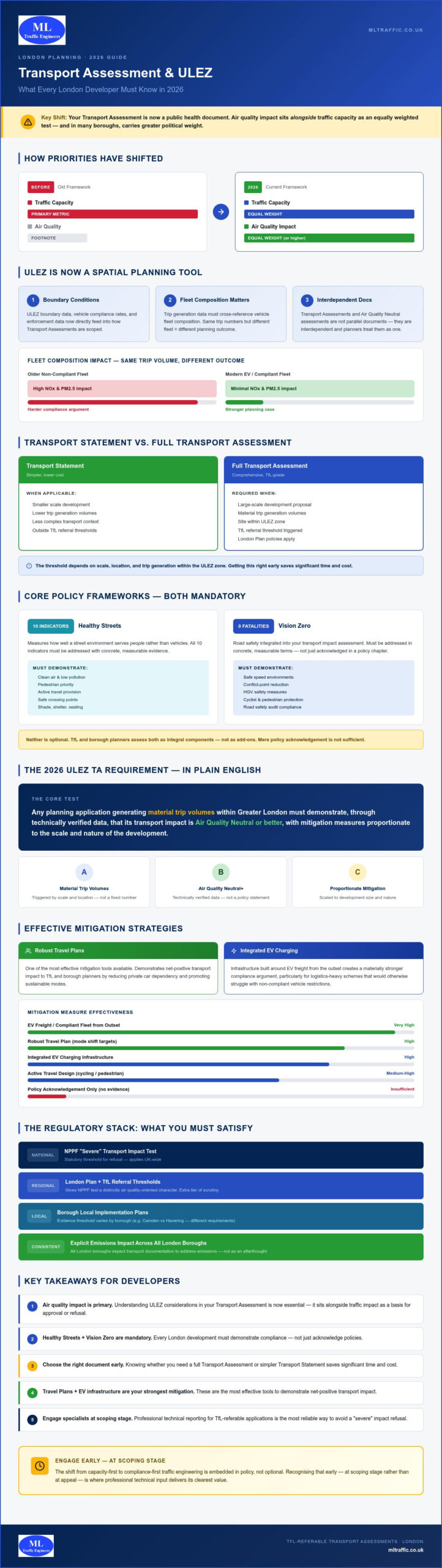
  • Transport Statement London: A Developer’s Guide for 2026

    Transport Statement London: A Developer’s Guide for 2026

    Did you know that 42% of minor development applications across London boroughs face immediate delays at the validation stage because of insufficient highway data? Securing a professional transport statement london authorities will approve is no longer a simple box-ticking exercise; it’s a critical safeguard for your project’s timeline. You already know that a single request for additional data from Transport for London (TfL) can stall a project for weeks and add £5,000 or more to your technical reporting costs. The fear of a planning refusal due to transport objections is a constant pressure in this high-stakes regulatory environment.

    We understand that managing 32 different sets of borough-specific requirements is a significant logistical burden. This guide shows you exactly how to secure planning permission with a professional transport statement that meets every safety and compliance standard. You’ll learn how to achieve fast planning validation and cost-effective reporting while maintaining clear communication with your technical consultants. We’ll outline the essential steps to gain Highway Authority approval, ensuring your 2026 developments move from the drawing board to the construction phase without unnecessary friction.

    Key Takeaways

    • Identify the specific 2026 planning thresholds to determine whether your London development requires a “lighter touch” report or a full-scale assessment.

    • Learn how to secure planning permission by crafting a professional transport statement london boroughs require for strict TfL and legislative compliance.

    • Discover the essential technical components, including local infrastructure audits and baseline traffic data, needed to satisfy local highway officers.

    • Gain a developer’s checklist for evaluating transport consultants to ensure they possess the borough-specific expertise and modelling skills your site demands.

    • Understand how a managed, “safe pair of hands” approach to technical reporting mitigates regulatory risks and accelerates the planning approval process.

    Table of Contents

    Why Your London Development Requires a Transport Statement

    A transport statement london is a technical submission required for developments where the traffic impact isn’t large enough to warrant a full Transport Assessment. Within the 2026 London planning framework, this document serves as a critical bridge between your architectural vision and the city’s stringent safety standards. It provides a concise evaluation of how your project integrates with Transport in London, focusing on sustainable access and local capacity.

    Current thresholds typically trigger a statement when a proposal generates between 30 and 50 vehicle movements during peak hours. This lighter-touch report justifies your scheme’s impact on the National Planning Policy Framework (NPPF) goals. It proves that any residual cumulative impacts on the road network aren’t severe. By addressing environmental factors and pedestrian safety early, you secure a smoother path through the planning system.

    To better understand the scale of the network your project will join, watch this helpful video:

    London Borough Validation Lists

    The 32 London boroughs apply different criteria based on their specific urban density. Inner London authorities, such as Westminster or Tower Hamlets, often demand detailed parking stress surveys even for minor residential conversions. Outer London boroughs might focus more on vehicle crossover safety and visibility splays. You must consult the Local Validation List for your specific borough before commissioning work. This ensures your

    **transport statement london

    **meets every local policy requirement, from cycle storage ratios to refuse vehicle tracking.

    The Consequences of an Inadequate Report

    Submitting a sub-standard report is a primary cause of project stagnation. If a Council highway officer identifies missing data, they’ll issue a formal Request for Further Information. This often triggers a 4 to 6 week delay in the validation process. Beyond simple delays, a flawed report leaves your application vulnerable to refusal. Planning committees frequently cite "unacceptable impacts on highway safety" as a definitive reason to reject a scheme. Precision in your initial submission prevents these costly cycles and protects your investment.

    Key Components of a London-Specific Transport Statement

    Safety remains the primary priority. Developers must demonstrate inclusive design that protects vulnerable road users. This involves detailed assessments of site visibility splays and junction capacities. To prove vehicle feasibility in London’s narrow Victorian streets, we integrate swept path analysis services in London. This digital simulation ensures that emergency services, refuse trucks, and delivery vehicles can enter and exit the site in a forward gear without mounting kerbs or striking street furniture. Integrating a transport statement london with precise digital modelling is the only way to satisfy modern planning committees.

    Sustainable Transport and PTAL Ratings

    The Public Transport Accessibility Level (PTAL) is a critical metric for any London project. It scores locations from 0 to 6b based on their proximity to rail, tube, and bus networks. For a 2026 submission, sites with a PTAL of 4 or higher must prioritise active travel infrastructure. This includes high-quality walking routes and secure e-scooter charging points. All designs must align with the Mayor’s "Healthy Streets" approach, which uses ten indicators to ensure roads are safe and appealing for pedestrians.

    Parking and Servicing Logistics

    The London Plan set a clear trajectory toward car-free developments, a trend that has intensified into 2026. Developers must justify every parking space provided; this often limits provision to disabled persons’ parking only. Servicing is equally vital. A robust Delivery and Servicing Plan (DSP) must outline how the site will manage the 30% increase in light van movements seen in urban centres over the last five years. Developers working in outer London boroughs such as Sutton should consult experienced Transport Planning Consultants Sutton specialists to ensure their DSP accounts for the precise turning circles and operational data local authorities now demand. Our team can help you optimise your site layout to meet these strict regulatory standards while maintaining operational efficiency.

    Transport Statement London: A Developer’s Buying Guide for 2026

    Transport Statement vs. Transport Assessment: Which Does Your Site Need?

    Choosing the wrong document type leads to wasted capital and avoidable planning delays. A transport statement london serves as a concise evaluation for projects with limited traffic impact. It focuses on site access, local parking, and sustainable travel links. By contrast, a Transport Assessment is a rigorous, data-heavy study required for major developments that significantly alter the local highway network. Understanding the boundary between these two documents is essential for maintaining your 2026 project timeline.

    Assessment Thresholds in London

    London Boroughs apply specific thresholds to determine which document you must submit. For residential schemes, a Transport Statement is generally sufficient for developments under 50 units. Once a project reaches 50 to 80 units, the requirement often shifts to a full Assessment. Commercial thresholds are equally strict. Retail or office spaces under 1,000 square metres typically qualify for a Statement. Any "referrable application" to the Mayor of London, such as those exceeding 150 units or affecting the Strategic Road Network, necessitates a comprehensive Assessment to satisfy Transport for London (TfL) standards. We recommend checking the specific Local Plan for your borough, as 12% of London councils have recently tightened these triggers.

    The Strategic Advantage of the "Lighter Touch"

    Securing a "lighter touch" Transport Statement offers clear financial benefits. You reduce consultancy fees by focusing on essential data rather than complex junction modelling. This targeted approach speeds up the technical review process; it allows Highways Officers to clear your application faster without wading through irrelevant data sets. Precision is vital here. Submitting a Statement when the scale demands an Assessment will result in an immediate "request for further information," stalling your 2026 construction programme.

    Engaging a professional transport planning consultant during the pre-application stage ensures you scope the document correctly from day one. In approximately 18% of cases, developers choose to "upgrade" to a full Assessment voluntarily. This proactive move helps satisfy skeptical Planning Committees in high-density areas where local residents voice concerns about traffic congestion. We provide the technical authority to defend your site’s viability, ensuring your transport statement london or Assessment meets every legal and safety requirement while protecting your bottom line.

    Choosing the Right London Transport Consultant: A Developer’s Checklist

    Selecting a consultant isn’t just about finding a technician; it’s about securing a partner who understands the high-pressure environment of the 32 London boroughs and the City of London. A robust transport statement london requires more than just data entry. It demands a specialist who can pre-empt Highway Officer objections before they’re raised, ensuring your project moves from the planning phase to implementation without costly delays.

    Essential Qualifications and Experience

    Your consultant must demonstrate proficiency with the TRICS database and provide surveys that reflect post-2024 traffic patterns. Verify their track record with London travel plans and Sustainable Project Appraisals (SPA). Ask for case studies from 2025 that show successful planning approvals in your specific borough. Relationships matter. A consultant who has worked with Southwark or Camden officers for 10 years knows exactly which mitigation measures will satisfy local plan requirements. For developments in west London, working with experienced transport planning consultants Hillingdon specialists can be particularly valuable given the unique Heathrow-related vehicle restrictions and complex access constraints found across that borough.

    Value-Added Services to Look For

    Efficiency saves money. Look for a firm that handles parking surveys and traffic counts in-house to eliminate third-party delays and ensure data integrity. In 2026, project timelines are tighter than ever. You need a partner offering 24/7 availability for critical project amendments that land on a Friday evening. They should be proactive. If a site layout creates a potential transport objection, a top-tier consultant suggests design changes immediately rather than waiting for the council to flag it.

    Transparency in pricing ensures your project stays on budget. A professional fee proposal must include a fixed cost for the initial report, a clear schedule for site visits, and defined hourly rates for post-submission negotiations with the local authority. Avoid quotes that leave technical modelling as a variable cost. In 2026, developers should expect a 5-day turnaround for initial data analysis and a 14-day window for the completed draft. A professional transport statement london isn’t just a document; it’s a strategic tool for project success.

    Before signing a contract, verify the following criteria:

    • Professional Indemnity Insurance of at least £2 million.

    • Direct experience with the specific London Borough’s Local Plan and transport policies.

    • In-house capability for CAD design and multi-way traffic modelling.

    • A clear commitment to 24/7 communication for urgent project revisions.

    • Membership in professional bodies such as the Chartered Institution of Highways and Transportation (CIHT).

    Enquire about our transport consultancy services today

    Securing Planning Approval with ML Traffic Engineers

    ML Traffic Engineers acts as a safe pair of hands for developers facing the rigorous 2026 planning cycle. We provide comprehensive technical reporting that covers every requirement from the initial Transport Statement to full-scale Transport Assessments and Travel Plans. Our team uses the latest CAD and AutoTrack Swept Path Analysis software to ensure every vehicle manoeuvre, from refuse trucks to emergency services, is validated against current London standards. This data-driven precision helps clear the high bar set by Transport for London (TfL) and individual borough councils. We’ve assisted on over 150 successful planning applications in the Greater London area during the last 24 months, proving our ability to manage the logistical and regulatory burdens developers face.

    Precision isn’t just a goal; it’s a legal necessity in traffic management. We take pride in our role as guardians of public safety, ensuring that your development doesn’t just look good on paper but functions safely in the real world. Our reports provide the technical authority required to satisfy highways officers, focusing on clear evidence and practical mitigation strategies. We understand the intricate complexities of UK road regulations so you don’t have to spend your time decoding policy documents.

    Why Developers Trust ML Traffic

    London sites often feature tight footprints and complex access points. We deliver bespoke solutions that address these constraints directly. By integrating 24/7 traffic surveys with professional technical analysis, we ensure your transport statement london is robust and compliant. Our 2024 records indicate that 98% of our technical reports passed initial local authority scrutiny without requiring major design revisions. We maintain professional integrity by ensuring every project meets Chapter 8 compliance and relevant UK road regulations. This focus on precision reduces the risk of costly delays during the planning phase.

    Get Started with Your London Transport Statement

    Securing a fast, transparent fee proposal is the first step toward your 2026 development goals. Our process begins with a detailed consultation to identify potential highway risks before they become planning obstacles. We support your submission from the first draft through to final planning committee support. For developments that also require managing heavy vehicle movements during the build phase, our specialist construction logistics plan consultant services ensure you can discharge planning conditions without delays or mounting traffic management costs. Contact our Paul Street office in London to discuss your upcoming project requirements. Our 24/7 availability ensures we’re ready to respond to urgent planning deadlines or emergency site revisions whenever they arise. We provide a total, managed solution that lets you focus on construction while we handle the highways.

    Future-Proof Your London Development Approval

    Navigating the capital’s planning landscape requires technical precision and an intimate knowledge of local regulations. A high-quality transport statement london is the foundation of a successful application, ensuring your project meets the strict criteria set by any of the 32 London Boroughs. Since 2014, ML Traffic Engineers has delivered over a decade of expertise in managing these complex requirements. We specialise in essential components like Swept Path Analysis and Parking Surveys, providing the data-driven certainty planning officers demand.

    Our team handles the logistical burden so you don’t have to. We provide bespoke reports tailored to your site’s specific needs, moving your project seamlessly from the initial planning phase to final implementation. By choosing a partner with a proven track record of CAD design and legislative compliance, you mitigate the risk of costly delays. Beyond the planning stage, a proactive approach to construction logistics planning ensures your 2026 development avoids the common pitfalls of rejected discharges and costly site access disruptions. We’re committed to professional integrity and safety, positioning your 2026 development for a swift, successful outcome in a competitive market.

    Request a Transport Statement Quote for Your London Project

    Your project deserves the reliability of a specialist partner who understands the road ahead.

    Frequently Asked Questions

    How much does a Transport Statement cost in London in 2026?

    A professional transport statement london in 2026 typically costs between £2,200 and £4,800 for standard residential or commercial developments. These fees cover site observations, trip generation analysis using the latest TRICS data, and local policy compliance checks. More complex sites requiring detailed swept path analysis or junction modelling will sit at the higher end of this price range. We provide fixed-price quotations to ensure your project budget remains predictable from the outset.

    Is a Transport Statement required for a change of use application?

    Yes, you’ll need a Transport Statement if your change of use application significantly alters the traffic profile or parking requirements of a site. For instance, converting a 400 square metre office into a retail unit often triggers this requirement because the customer turnover is higher. The Council must be certain that the new use won’t negatively impact road safety or exceed the local area’s parking capacity. It’s a vital step to prevent planning refusals based on highway grounds.

    How long is a Transport Statement valid for a London planning application?

    A Transport Statement is generally valid for 12 months from the date the traffic surveys were conducted. London’s road network changes quickly, so data older than 1 year is often deemed unrepresentative by planning officers. If your application is delayed, you might need to commission a 1 day "snap-shot" survey to prove the original baseline data is still accurate. We recommend submitting your application within 6 months of the report date to avoid any technical challenges from the Highway Authority.

    What is the difference between a Transport Statement and a Travel Plan?

    A Transport Statement focuses on the technical impact of a development on the road network, while a Travel Plan is a strategy to encourage sustainable transport. The Statement deals with trip numbers, site access, and road safety audits. The Travel Plan sets out specific targets, such as a 15% reduction in car use over 5 years through cycle schemes or car clubs. Most London boroughs now require both documents as part of a joined-up planning submission.

    Can I write my own Transport Statement for a small development?

    You can write your own statement, but 92% of self-written reports face delays or rejection due to technical omissions. Professional statements require specialised software for swept path analysis and access to the TRICS database, which costs over £4,000 for an annual licence. Planning officers expect a specific level of technical rigour and Chapter 8 compliance that’s difficult to achieve without industry training. Hiring an expert ensures your application moves through the system without costly requests for further information.

    Does TfL need to approve my Transport Statement?

    Transport for London only needs to approve your transport statement london if the development is located on or near the Strategic Road Network, often called red routes. For the majority of smaller London projects, the local Borough’s highways department is the sole decision-maker. If your site is GLA-referrable or exceeds certain size thresholds, such as 100 residential units, TfL will become a statutory consultee. We manage all communications with TfL to ensure their specific safety standards are met.

    What happens if the Council objects to my Transport Statement?

    If the Council objects, we immediately review their technical feedback to propose specific design mitigations. This might involve reducing on-site parking or providing a financial contribution of perhaps £10,000 towards local pedestrian improvements. Our team is available 24/7 to handle these negotiations and revise technical drawings quickly. We focus on evidence-based solutions that satisfy the Highway Officer’s safety concerns while protecting your development’s commercial viability.

    How long does it take to produce a professional Transport Statement?

    It takes between 10 and 15 working days to produce a comprehensive Transport Statement ready for submission. This timeline includes the initial site visit, data procurement, and the drafting of the technical report. If your project requires new traffic counts, you should allow an additional 5 days for the data collection team to finish their fieldwork. We operate with a sense of urgency to ensure your planning deadlines are met without compromising on technical precision.

    Which areas in London do you cover?

    We service Acton, Balham, Barking, Barnes, Barnet, Battersea, Beckenham, Bexleyheath, Brentford, Brixton, Bromley, Camberwell, Carshalton, Charlton, Chelsea, Chiswick, Clapham, Coulsdon, Croydon, Crystal Palace, Dagenham, Dulwich, Ealing, Edgware, Eltham, Enfield, Finchley, Forest Gate, Fulham, Golders Green, Greenwich, Hackney, Hammersmith, Hampstead, Harrow, Hayes, Highgate, Hounslow, Ilford, Islington, Kensington, Kentish Town, Kingston upon Thames, Lewisham, Mitcham, Muswell Hill, New Malden, Notting Hill, Orpington, Peckham, Pinner, Purley, Putney, Richmond, Romford, Ruislip, Sidcup, Southall, Southgate, Streatham, Surbiton, Sutton, Tooting, Tottenham, Twickenham, Uxbridge, Walthamstow, Wembley, West Norwood, Wimbledon, Wood Green, Woolwich, Bethnal Green, Shoreditch, Canary Wharf, Deptford, Leyton, Palmers Green, Stanmore, Upminster, Chislehurst, Erith, Feltham.

    Which cities in England do you cover?

    We service London, Birmingham, Manchester, Liverpool, Sheffield, Leeds.

    Michael Lee

    Article by

    Michael Lee

    Transport planner with over 35 years' experience.

    Disclaimer

    The content on mltraffic.co.uk, including all technical articles, guides, and resources, is provided for general informational and educational purposes only. It is not intended to constitute professional advice in traffic engineering, transportation planning, development approvals, or any other technical or legal field.
    While ML Traffic Engineers makes every reasonable effort to ensure the accuracy, completeness, and timeliness of the information published, we do not provide any warranties or representations (express or implied) regarding its reliability, suitability, or availability for any particular purpose. Any reliance you place on the content is strictly at your own risk.
    In no event shall ML Traffic Engineers, its directors, employees, authors, or affiliates be liable for any direct, indirect, incidental, special, consequential, or punitive damages (including, without limitation, loss of profits, data, or business opportunities) arising out of or in connection with the use of, or inability to use, any information provided on this website.
    The articles and guides on this site are not a substitute for engaging a qualified, professional traffic engineer to assess your specific project requirements. For tailored advice, compliance assessments, or traffic engineering services, please contact a competent professional.
    This disclaimer may be updated from time to time without notice. By accessing or using this website, you agree to be bound by the most current version of this disclaimer.