
In 2026, treating ULEZ standards as a simple operational surcharge is a strategy that leads directly to planning refusals and costly project delays. You understand that London’s regulatory environment is tightening, making it harder to balance commercial delivery requirements with strict emission targets across 32 boroughs. Securing a ulez compliant travel plan london is now a non-negotiable design pillar rather than a secondary administrative task. This high-stakes environment demands precision to ensure your development moves from inception to completion without regulatory friction.
You need a mobility strategy that addresses the end of the Cleaner Vehicle Discount and the central London Congestion Charge increase to £18. This guide provides the technical authority you require to navigate these shifting boundaries and borough-specific requirements. You’ll learn how to integrate current Euro 4 and Euro 6 standards into your statutory documents to eliminate transport-related objections. We’ll preview the specific data requirements for residential and commercial sites, ensuring your next application is future-proof and operationally efficient.
Key Takeaways
- Understand how a ulez compliant travel plan london serves as a mandatory design pillar to secure planning permission and avoid costly regulatory delays.
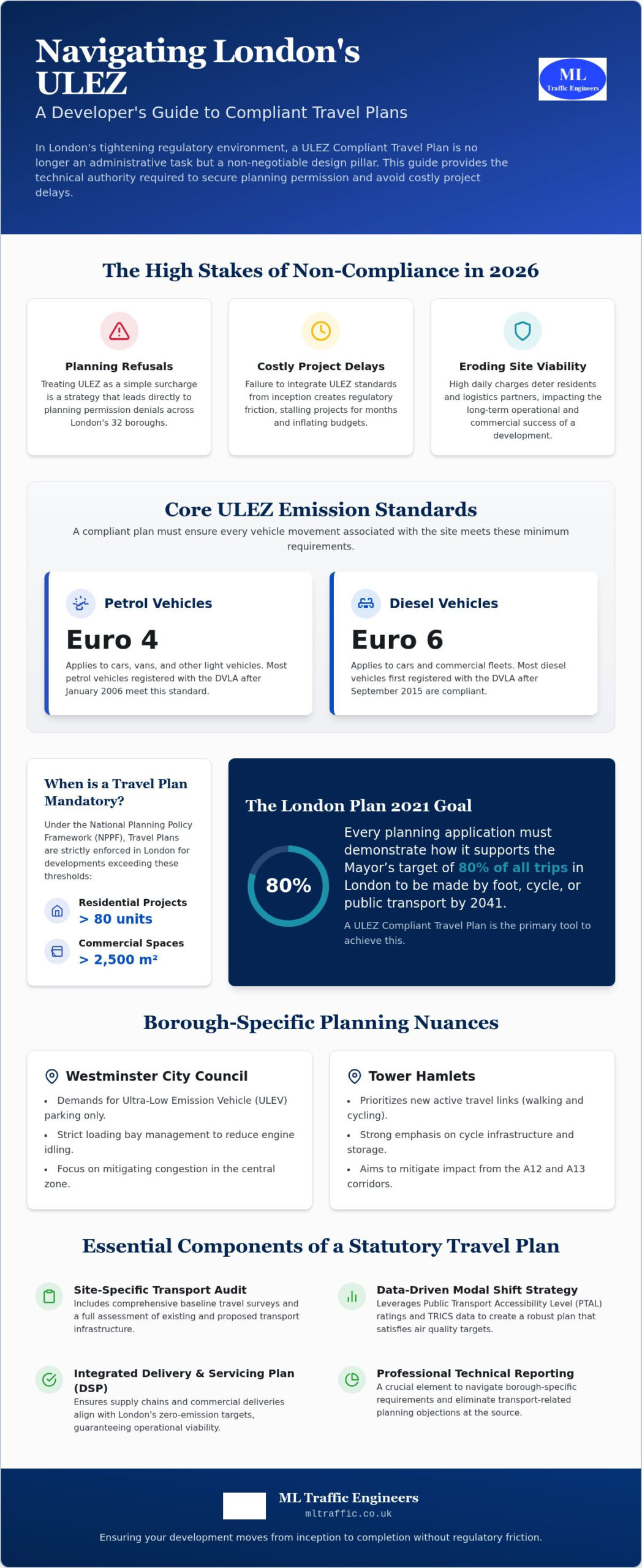
- Identify the specific Euro 4 petrol and Euro 6 diesel standards required to maintain site accessibility across all 32 London boroughs.
- Learn how to leverage PTAL ratings and TRICS data to create a robust modal shift strategy that satisfies statutory air quality targets.
- Discover the essential components of a site-specific transport audit, including baseline surveys and infrastructure assessments.
- Understand why professional technical reports are necessary to navigate borough-specific requirements and eliminate transport-related objections.
What is a ULEZ Compliant Travel Plan for London Developments?
A statutory Travel Plan is a comprehensive package of measures tailored to a specific site. It aims to encourage sustainable travel and reduce reliance on single-occupancy vehicles. In the high-stakes environment of London planning, these documents are no longer optional. They serve as a legal commitment between the developer and the local authority. Integrating London’s Ultra Low Emission Zone standards into this framework is now essential for securing planning permission. Compliance is essential.
To better understand how these compliance standards impact road users daily, watch this helpful video:
A ulez compliant travel plan london differs from a standard transport document by specifically accounting for the 24/7 emission restrictions across all 32 boroughs. While a basic plan focuses on general transport links, a ULEZ-optimised strategy ensures that every vehicle movement associated with the site meets the Euro 4 petrol or Euro 6 diesel requirements. This includes residents’ cars and commercial delivery fleets. This level of precision reduces the risk of operational bottlenecks and unexpected costs for future occupiers. High-stakes planning requires this functional necessity to avoid delays. Precision is required.
The Statutory Requirement for Travel Plans
The National Planning Policy Framework (NPPF) mandates that all developments generating significant amounts of movement must provide a Travel Plan. In London, this requirement is strictly enforced for residential projects exceeding 80 units and commercial spaces over 2,500 square meters. These plans are vital for mitigating the environmental impact of new builds. They use data-driven insights to manage traffic flow and promote public transport use. This helps boroughs meet their sustainability targets. Data drives results.
ULEZ Integration: Beyond the Daily Charge
Modern planning success requires moving from simple charge avoidance to holistic sustainable mobility design. Your strategy must account for the fact that the £12.50 daily charge for non-compliant vehicles is a significant deterrent for logistics partners and residents alike. A ulez compliant travel plan london is a strategic document that aligns site operations with London’s zero-emission targets. This alignment is particularly critical when developing your Delivery and Servicing Plan (DSP). It ensures that supply chains remain viable within the zone. Engaging professional Travel Plan consultants from ML Traffic Engineers UK ensures that your submission reflects these intricate regional regulations accurately. We balance technical authority with a client-focused approach to reduce logistical pressures.
The Role of ULEZ in Modern London Planning Policy
The London Plan 2021 transformed how developers approach transport and environmental impact. Air quality is no longer a secondary concern; it is a primary planning metric. Every planning application must now demonstrate how it supports the Mayor’s goal of 80% sustainable trips by 2041. A ulez compliant travel plan london is the primary tool for this demonstration. It bridges the gap between infrastructure design and environmental policy to ensure your project meets statutory requirements.
Borough-specific requirements vary significantly across the capital. Westminster City Council often demands ultra-low emission vehicle (ULEV) parking only and strict loading bay management to reduce idling. In contrast, Tower Hamlets prioritizes active travel links and cycle infrastructure to mitigate the impact of the A12 and A13 corridors. You must tailor your submission to these local nuances. Failure to do so results in planning delays and transport-related objections that can stall a project for months.
ULEZ also changes how we conduct parking surveys. Data collection must now consider how the official ULEZ emissions standards influence vehicle ownership and parking demand. If your site is in a zone where non-compliant vehicle ownership is dropping, your survey results must reflect this trend to justify reduced parking provision. This data-driven approach is essential for modern planning success.
PTAL Ratings and Sustainable Transport
Public Transport Accessibility Levels (PTAL) dictate the density and parking capacity of your development. High PTAL areas, such as scores of 5 or 6, often require car-free designs to comply with London-wide policy. ULEZ restrictions reinforce these mandates. They make private car travel less viable for many users, pushing the need for better cycling and walking infrastructure. You can find technical details on these metrics in the ML Traffic PTAL rating guide. Precise data ensures your mobility strategy remains robust under scrutiny.
Air Quality Neutral Assessments
All major developments in London must be “Air Quality Neutral.” This means your project cannot contribute to a net increase in local pollution during its operational phase. Your Travel Plan provides the evidence needed to support this claim. It uses traffic surveys to quantify trip rates and assess the likely vehicle types visiting the site. By proving your site will only attract compliant vehicles or promote active travel, you satisfy the local planning authority’s environmental standards. Expertly prepared reports streamline this approval process and reduce the risk of transport-related objections.
Strategic Mitigation: Meeting Emissions Standards and Reducing Trip Rates
Strategic mitigation is the bridge between a theoretical plan and a functioning, compliant development. A ulez compliant travel plan london must do more than identify transport links; it must actively reduce the volume of high-emission vehicle movements. This requires a multi-faceted approach that addresses both resident behavior and commercial logistics. By prioritizing low-emission modes from the outset, you minimize the risk of future operational penalties and ensure long-term site viability. Precision in these strategies is a requirement for success.
Electric vehicle (EV) charging infrastructure is a core pillar of this strategy. Current standards require 20% of parking spaces to have active charging facilities, while the remaining 80% must have passive provision for future connection. This infrastructure supports the transition to compliant vehicles and is a standard requirement for most London boroughs. Integrating these facilities into your Travel Plans demonstrates a commitment to sustainable growth that planning officers value. It simplifies the path to approval.
Fleet Management and Delivery Consolidation
Managing commercial vehicle movements is often the most complex part of ULEZ compliance. You must ensure that all subcontractors and suppliers utilize vehicles that meet Euro 4 petrol or Euro 6 diesel standards. Implementing a robust strategy allows you to consolidate movements through off-site hubs. This reduces the total number of trips to the development, lowering the site’s overall emission profile. Last-mile delivery solutions, such as cargo bikes or electric vans, are increasingly necessary for sites in high-density areas. These measures ensure your commercial tenants operate within the law without facing daily charges.
Incentivising Sustainable Commuting
Achieving a successful “modal shift” requires more than just providing cycle racks. You must create an environment where active travel is the most convenient option. This involves installing high-quality end-of-trip facilities, including secure storage, showers, and lockers. For residential projects, you must meet the standard of one cycle space per studio and two spaces for larger units. These facilities are essential for reducing car dependency in the capital.
Car club integration is another effective tool for reducing private car ownership. By providing dedicated car club bays on-site, you offer residents access to ULEZ-compliant vehicles for essential trips. We use TRICS data to accurately predict these travel patterns and justify your mitigation strategies. This data-driven approach ensures your targets are realistic and achievable, satisfying the SMART criteria required by Transport for London. Reliable data is the foundation of every successful application.
Key Components of a Statutory Travel Plan for Planning Approval
A successful planning submission in London requires a technical document that withstands rigorous scrutiny. A ulez compliant travel plan london must start with a detailed site audit. This audit assesses existing transport infrastructure and the site’s proximity to the ULEZ boundary. You must identify every potential access point and evaluate how emission restrictions will impact vehicle movements. Baseline travel data is the next essential component. You use surveys to understand current movements and establish a foundation for your mobility strategy. This data-driven approach ensures your plan is grounded in reality rather than assumptions.
Your document must outline SMART objectives: Specific, Measurable, Achievable, Realistic, and Timely. These goals align with the Mayor’s transport strategy, focusing on reducing car dependency. An action plan then details the concrete steps you will take to ensure compliance. This might include installing cycle storage or implementing a car club. Each action must have a clear timeline and assigned responsibility to satisfy the local planning authority. Precision at this stage prevents delays during the decision-making process.
Data Collection and Technical Analysis
Technical data is the backbone of any robust submission. You need accurate Parking Surveys to establish baseline occupancy and demand levels. This information proves that your development won’t negatively impact local street capacity. You must also integrate Swept Path Analysis to demonstrate that delivery and emergency vehicles can navigate the site safely. A Travel Plan without technical data like SPA is likely to be rejected by London highway authorities. These engineering insights provide the necessary proof of feasibility that planning officers require. If you need assistance with these technical requirements, you can book our transport survey services today.
Monitoring and Review Mechanisms
Planning approval is just the beginning of the compliance journey. Most London developments are subject to a standard 5-year monitoring period. You must appoint a Travel Plan Coordinator (TPC) to manage this process. The TPC is responsible for conducting follow-up surveys in years 1, 3, and 5 to track progress against your SMART targets. If emissions or trip targets are not met, you must implement pre-agreed corrective measures. These might include additional financial contributions to local transport schemes or enhanced travel incentives for residents. This ongoing accountability ensures the long-term success of your ulez compliant travel plan london and protects your development’s reputation.
Professional Travel Plan Consultancy for London Projects
Attempting a DIY approach to statutory transport documents often leads to planning delays. Many developers underestimate the technical depth required to satisfy London highway officers. A ulez compliant travel plan london must align with the intricate regional regulations of each specific borough. Generic templates frequently fail because they lack the necessary technical lexicon and fail to address the specific Euro standards required for site viability. You need a partner who understands the functional necessity of precision in high-stakes environments.
ML Traffic Engineers UK manages the full project lifecycle from initial assessment to final sign-off. We actively navigate the pre-application advice process with Transport for London (TfL) to identify potential objections early. This readiness ensures that your submission reflects the latest policy updates, including the draft London Plan 2026. We recently secured approval for a high-density commercial site where ULEZ sensitivity was a primary concern. By providing a data-driven strategy that prioritized zero-emission delivery consolidation, we removed all transport-related objections and secured a smooth path to approval. Precision is our standard.
Navigating Local Authority Requirements
Each borough maintains its own Supplementary Planning Documents (SPD) that dictate specific transport targets. Our experts possess deep knowledge of these borough-specific variations, from the car-free mandates in Westminster to the active travel priorities in Tower Hamlets. We manage the critical relationship between developers and highway officers to ensure smooth communication throughout the planning cycle. You can find more technical details in our London Travel Plans Guide. Professional advocacy is the foundation of a successful application.
Streamlining the Approval Process
Our primary goal is to reduce the risk of planning refusal and minimize costly Section 106 obligations. We provide a comprehensive service that includes technical reports and Traffic Surveys that satisfy all statutory requirements. This all-encompassing approach allows you to focus on development while we handle the regulatory pressure. We operate with a sense of urgency to meet your project deadlines and ensure your mobility strategy is future-proof. Contact ML Traffic Engineers UK for a professional Travel Plan quote to secure your planning approval today.
Securing Your Planning Approval in a Zero-Emission Capital
London’s shift toward a zero-emission transport network creates a high-stakes environment where precision is a functional requirement. You’ve seen how a ulez compliant travel plan london acts as a non-negotiable pillar for development success, moving beyond simple charge avoidance to holistic mobility design. By addressing borough-specific SPDs and integrating technical engineering data like Swept Path Analysis early in the project lifecycle, you eliminate the regulatory friction that often stalls planning applications. This technical authority ensures your site remains accessible and viable.
ML Traffic Engineers UK brings over 10 years of experience to this complex landscape. We balance technical expertise with a client-focused approach to ensure your statutory documents satisfy both TfL and local highway officers. Our team manages the full lifecycle of your transport requirements, from baseline parking surveys to long-term monitoring and review. This comprehensive support allows you to focus on delivery while we manage the intricate regional regulations on your behalf. We maintain a standard of formal excellence that aligns with the strict regulatory environments in which you operate.
Get a Professional Travel Plan for Your London Project
Your project’s viability depends on a future-proof mobility strategy. We remain ready to provide the unwavering reliability and precision your development deserves. Let’s secure your approval today.
Frequently Asked Questions
Do I need a Travel Plan if my vehicles are already ULEZ compliant?
Yes, you still require a statutory document. A Travel Plan focuses on reducing the total volume of vehicle movements and promoting sustainable transport modes like walking and cycling. While vehicle compliance is a key part of a ulez compliant travel plan london, it doesn’t exempt you from the legal requirement to mitigate a development’s overall transport impact. Planning officers prioritize long term modal shift over simple engine standards to meet London’s air quality targets.
How does the ULEZ expansion affect planning applications in Outer London?
The ULEZ now covers all 32 London boroughs and the City of London. This means applications in Outer London must demonstrate how the site will remain accessible and viable despite these 24/7 restrictions. Highway officers in Outer London boroughs now scrutinize transport submissions for alignment with the Mayor’s transport strategy. You must prove that your development encourages compliant vehicle use and provides sufficient infrastructure for active travel to avoid planning delays and transport objections.
What happens if my development fails to meet the Travel Plan targets?
Monitoring typically occurs in years 1, 3, and 5 after occupation. If your development fails to meet its pre-agreed SMART targets, you must implement corrective measures. These often involve enhanced travel incentives or additional financial contributions to local sustainable transport schemes. Local authorities use Section 106 agreements to enforce these obligations. Professional monitoring by a Travel Plan Coordinator ensures you remain compliant and avoid the logistical pressures of local authority enforcement actions or legal penalties.
Is a Travel Plan required for small-scale London residential conversions?
Standard thresholds for a full Travel Plan are 80 residential units or 2,500 square meters of commercial space. However, smaller conversions often require a Transport Statement to address local parking and access issues. You should check the specific Supplementary Planning Documents for your borough. Some councils demand smaller-scale plans for sites in high-PTAL areas or where local air quality is a significant concern. Precision in your initial assessment prevents unexpected planning objections and project delays.
How much does a professional ULEZ-compliant Travel Plan cost?
Costs vary significantly based on the scale of the development and the complexity of the borough-specific requirements. Factors influencing the fee include the need for detailed technical data like Traffic Surveys or Swept Path Analysis. You should request a tailored quote to ensure the report covers all statutory requirements for your specific site. Investing in a professional ulez compliant travel plan london reduces the risk of costly planning refusals and long term operational penalties for future site occupiers.
Can a Travel Plan help reduce my Section 106 transport contributions?
Yes, a robust Travel Plan can potentially reduce your financial obligations. By demonstrating a strong commitment to modal shift and reducing trip rates, you provide evidence that the development’s impact on the local highway is minimized. This technical proof allows you to negotiate more favorable Section 106 terms with highway officers. Our experts use TRICS data and site-specific surveys to build a persuasive case for your project, ensuring your mitigation strategy is both effective and cost-efficient.
How often does a London Travel Plan need to be updated?
A statutory Travel Plan is a living document that requires regular review. The standard monitoring period for London developments is five years. You must submit monitoring reports in years 1, 3, and 5 to track progress against your baseline data. If the development’s use class changes or if there are significant shifts in regional transport policy, you may need to update the plan sooner. Continuous monitoring ensures the mobility strategy remains relevant to current ULEZ standards and borough requirements.
What is the difference between a Workplace Travel Plan and a Residential Travel Plan?
A Workplace Travel Plan focuses on managing employee commutes and commercial delivery consolidation to meet ULEZ standards. In contrast, a Residential Travel Plan targets the travel habits of residents and their visitors. Both documents aim to reduce car dependency but utilize different incentives. For example, workplace plans might emphasize cycle-to-work schemes, while residential plans often integrate car club bays. Each document must be tailored to the specific demographics and operational needs of the site to secure approval.

Disclaimer
The content on mltraffic.co.uk, including all technical articles, guides, and resources, is provided for general informational and educational purposes only. It is not intended to constitute professional advice in traffic engineering, transportation planning, development approvals, or any other technical or legal field.
While ML Traffic Engineers makes every reasonable effort to ensure the accuracy, completeness, and timeliness of the information published, we do not provide any warranties or representations (express or implied) regarding its reliability, suitability, or availability for any particular purpose. Any reliance you place on the content is strictly at your own risk.
In no event shall ML Traffic Engineers, its directors, employees, authors, or affiliates be liable for any direct, indirect, incidental, special, consequential, or punitive damages (including, without limitation, loss of profits, data, or business opportunities) arising out of or in connection with the use of, or inability to use, any information provided on this website.
The articles and guides on this site are not a substitute for engaging a qualified, professional traffic engineer to assess your specific project requirements. For tailored advice, compliance assessments, or traffic engineering services, please contact a competent professional.
This disclaimer may be updated from time to time without notice. By accessing or using this website, you agree to be bound by the most current version of this disclaimer.