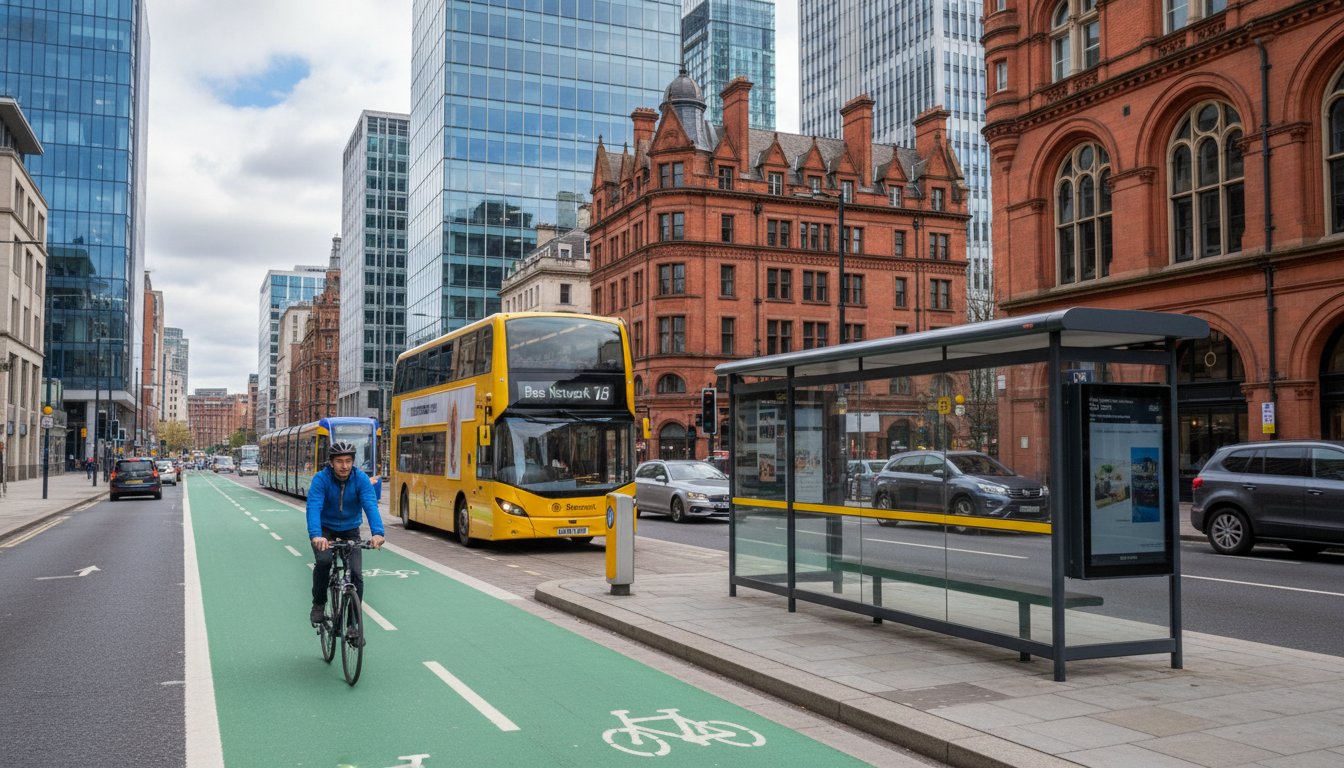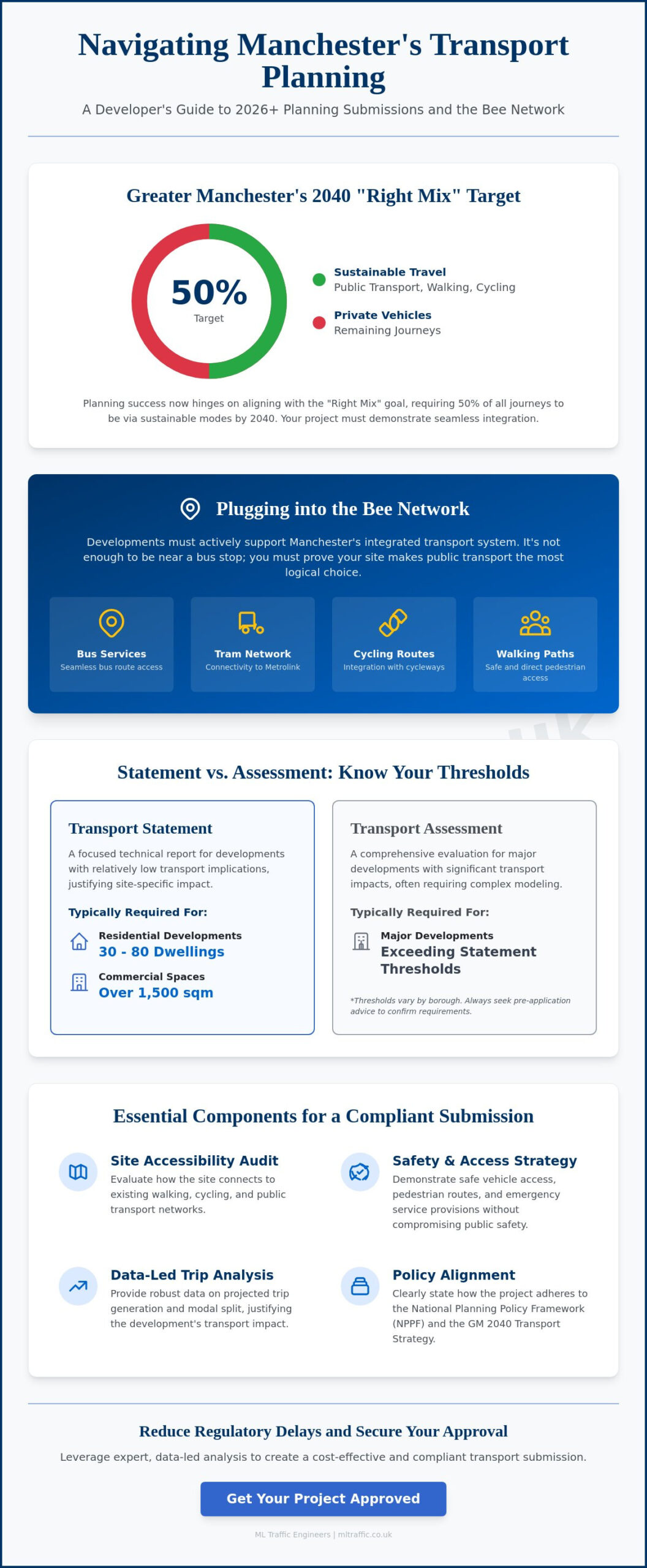
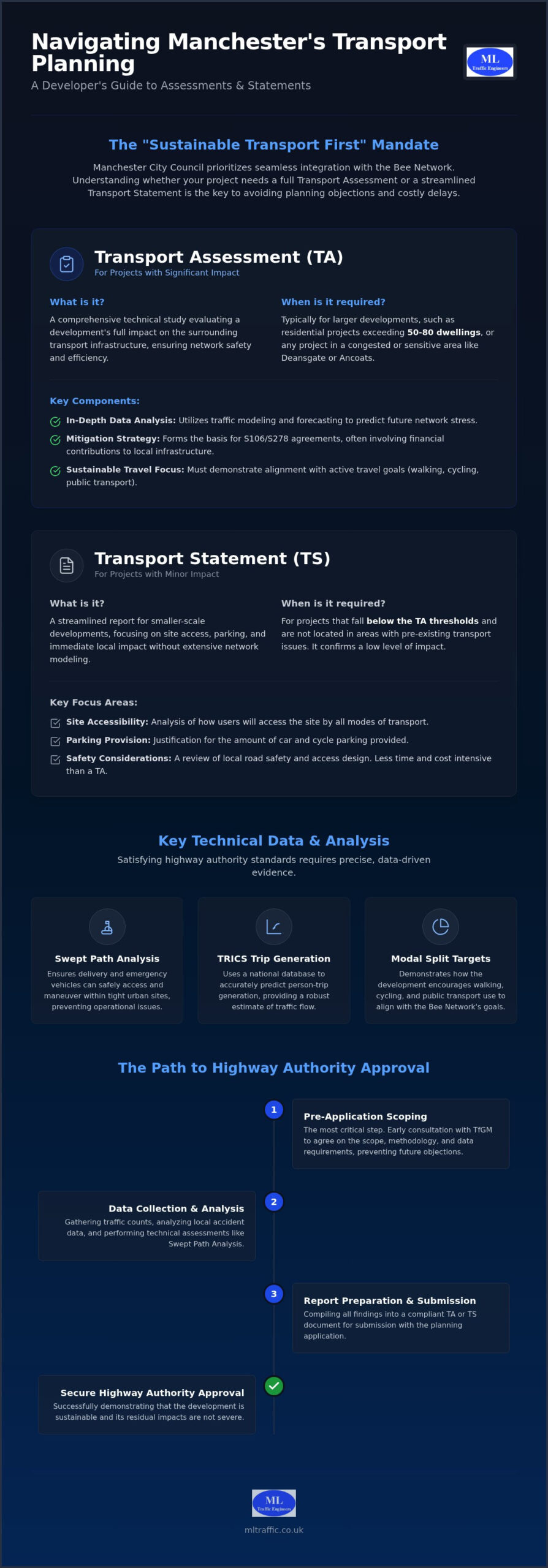
Securing planning permission in the city centre no longer depends on how many cars you can fit into a basement; it depends on how seamlessly your development integrates with the Bee Network. You likely know that Manchester City Council has set a high bar for sustainable development, yet the transition to the new “Sustainable Transport First” mandate has left many developers facing unexpected highway authority objections and rising mitigation costs. A robust transport assessment manchester is now the difference between a project that breaks ground and one that stalls in the planning committee. It’s frustrating to see a viable project delayed by technicalities, but precision at the pre-application stage can eliminate these hurdles.
This guide provides the technical clarity you need to navigate the 2026 Greater Manchester Transport Strategy 2050, ensuring your submission meets every regulatory benchmark. We will examine the specific thresholds for assessments versus statements, the role of technical data like Swept Path Analysis in tight urban sites, and how to identify cost-effective mitigation strategies that satisfy the latest council standards. By understanding these regional requirements, you can secure approval without the stress of transport-related delays.
Key Takeaways
- Learn how Manchester City Council’s “Sustainable Transport First” mandate affects your project’s planning approval and long-term viability.
- Identify whether your development requires a full transport assessment manchester or a streamlined Transport Statement based on current 2026 thresholds.
- Understand the role of technical data, including TRICS person-trip generation and Swept Path Analysis, in satisfying highway authority standards.
- Discover why early pre-application scoping with TfGM is essential to avoid highway objections and high-cost mitigation measures.
- Leverage expert strategies to align your development with the Bee Network’s active travel and modal split targets.
Understanding Transport Assessments in the Manchester Planning Context
A Transport Assessment (TA) is a comprehensive technical study that evaluates the potential impact of a proposed development on the surrounding transport infrastructure. In Manchester, where urban density is increasing rapidly, Manchester City Council requires these reports to ensure that new projects don’t compromise the safety or efficiency of the highway network. This process moves beyond simple traffic counts. It’s a critical tool for managing the city’s growth while protecting the quality of life for residents and commuters.
The requirement for a transport assessment manchester stems from the National Planning Policy Framework (NPPF), which mandates that developments should be refused only if their residual cumulative impacts on the road network would be severe. By applying the principles of transportation planning at a local level, developers can demonstrate that their projects are sustainable and compliant with statutory requirements. This documentation ensures that developers don’t just meet the bare minimum statutory requirements but follow best-practice planning to future-proof their investments.
To better understand the specific transport issues facing Manchester’s urban landscape, watch this helpful video:
The Purpose of a Transport Assessment
The primary objective is to identify potential traffic congestion and safety issues before they become operational problems. A high-quality assessment provides a technical foundation for negotiating Section 106 or Section 278 agreements, which often involve financial contributions to local infrastructure. It also serves as a platform to demonstrate how a project encourages walking, cycling, and public transport use, aligning with the “Sustainable Transport First” mandate. We focus on providing precision-led reports that reduce regulatory pressure and facilitate faster approvals.
Who Needs a Transport Assessment in Greater Manchester?
Determining if your project triggers a full transport assessment manchester depends on several factors, including location and scale. Generally, residential developments exceeding 50 to 80 dwellings will trigger the need for a full assessment. Commercial and retail projects are evaluated based on square footage and anticipated footfall. However, the council often requests reports for much smaller developments in high-density or congested areas like Deansgate, Ancoats, or the Northern Quarter. Even if a project falls below standard thresholds, the highway authority may still require a report if the site sits near a sensitive junction or an area with existing safety concerns.
Transport Assessment vs. Transport Statement: Which Does Your Project Need?
Choosing between a statement and a full assessment is a matter of scale and potential impact. The official UK government guidance provides the national framework, but Manchester City Council applies these rules based on local congestion levels and infrastructure capacity. A transport assessment manchester is a much deeper dive into the network’s capacity than a simple statement. It’s designed to manage the complexities of major urban growth while maintaining highway safety.
Planners often request a full TA if a small site is located near a critical junction or within the city’s Inner Relief Road. This “grey area” causes delays if not addressed early. Assessments require more time for data collection and modelling. This naturally impacts project timelines and budgets compared to a streamlined statement. We aim to identify the correct report type at the start to prevent wasted resources. Getting this right early on stops the highway authority from asking for more data mid-application, which can be a costly setback.
Transport Statements for Minor Developments
A Transport Statement is usually sufficient for developments that don’t generate significant traffic. It covers site descriptions, existing access arrangements, and basic trip generation data. These reports focus on localised impacts, such as whether a new driveway is safe or if parking provision is adequate. For developers working across multiple regions, our Transport Statement London Guide offers a useful comparison of how different metropolitan authorities handle these minor submissions. It’s an efficient way to satisfy the council for smaller residential or commercial units without the need for extensive junction modelling.
Full Transport Assessments for Major Impact
Major applications require a full transport assessment manchester. This involves detailed junction modelling and multi-modal trip analysis to ensure the network can handle the new demand. In 2026, these reports must also include a supporting Travel Plan to encourage sustainable commuting and reduce car dependency. This level of detail is vital for justifying high-density developments in high-traffic zones where every vehicle movement counts. Technical precision is non-negotiable here. If you’re unsure which report your project requires, reviewing our full range of services on our what we do page can help clarify the technical scope needed for your specific site.
Technical Requirements for Manchester Transport Planning in 2026
Technical standards in 2026 require a fundamental shift in how we evaluate development impacts. We utilize the TRICS database to predict total person-trip generation rather than just vehicle movements. This approach aligns with the “Sustainable Transport First” mandate outlined in the official government guidance. In Manchester, this means your transport assessment manchester must demonstrate how people will move across all modes, not just where cars will park. The Bee Network’s expansion significantly influences accessibility scoring, and planners now prioritize high-density developments that support this integrated network.
Narrow Victorian streets in areas like the Northern Quarter or Ancoats present unique logistical challenges. Precision is a functional necessity here. We apply Swept Path Analysis to ensure that service vehicles and emergency services can navigate tight urban layouts without conflict. Manchester’s parking standards are also evolving. There’s a clear trend toward car-free developments in the city centre to support the projected employment growth of 50,000 jobs. This shift requires a technical narrative that proves the site’s sustainability without traditional car ownership, making your report’s data more critical than ever.
The Role of Traffic and Parking Surveys
Accurate data is the foundation of any successful application. We conduct 7-day volumetric counts and peak-hour junction observations to capture a true picture of local conditions. For residential projects, parking stress surveys are often required to prove that overspill won’t impact neighbors. While the Lambeth Methodology is a national standard, we adapt it to Manchester’s specific urban grain. This ensures the data reflects the reality of local street capacity. For a deeper look at managing technical site constraints, see our Practical Guide to Swept Path Analysis.
Sustainable Transport and Active Travel
Alignment with the Greater Manchester Transport Strategy 2040 is non-negotiable. Your transport assessment manchester must assess connectivity to the nearest Bee Network routes. This includes analyzing cycling infrastructure and pedestrian safety. By 2040, officials anticipate 130,000 daily trips will shift from private cars to cycling and walking. We help you address “First Mile/Last Mile” connectivity to ensure residents or employees can easily access public transport hubs. This proactive approach reduces the risk of highway authority objections and helps you meet ambitious modal split targets efficiently.
The Step-by-Step Process of Securing Highway Authority Approval
The path to approval starts long before you submit the final planning application. We prioritize the pre-application scoping stage to eliminate wasted work and ensure technical alignment with local standards. Early engagement with Manchester City Council and TfGM highway engineers allows us to agree on the methodology for your transport assessment manchester upfront. This proactive strategy reduces regulatory pressure and prevents late-stage objections that can derail your project timeline. We use real-time transport data to refine site access and parking layouts iteratively. This ensures the final design is both functional for the user and compliant with highway safety requirements.
Scoping the Assessment with TfGM
Agreement on the study area is the first critical hurdle. We work directly with TfGM to identify which junctions require detailed modelling, often focusing on those most impacted by the development’s peak-hour trips. We define the “Assessment Years,” which typically include the project’s opening year and a horizon five years post-completion. Setting an accurate baseline is essential for a robust report. This involves accounting for “committed developments” in the immediate vicinity to ensure the cumulative impact on the network is correctly calculated. This precision prevents the highway authority from questioning the validity of your data later in the process.
Mitigation Strategies and S278 Agreements
If the assessment identifies a “severe” impact, mitigation measures must be proposed. We negotiate on your behalf to find the most cost-effective balance between physical highway improvements and financial contributions. Physical works often require a Section 278 agreement to legally modify the existing highway. These agreements are complex and require high-stakes precision to avoid unexpected costs. For a detailed look at how these requirements are managed, see our S278 & S38 Highway Design Guide. Our technical authority ensures that your mitigation strategy is both realistic and acceptable to statutory consultees.
Final submission involves responding to comments from various statutory bodies. We manage this full project lifecycle, providing rapid response capabilities to address any concerns raised by the highway authority. If you need a dependable partner to manage your submission from scoping to final approval, explore our transport assessment services to see how we can support your next Manchester development.
Expert Transport Planning Consultancy for Greater Manchester Developments
Why Local Knowledge Matters in Manchester
The nuances of different boroughs can make or break a planning application. For example, the expectations of Salford City Council often differ from those of Manchester City Council regarding parking ratios and active travel connectivity. We’ve built established relationships with local highway engineers, which allows us to anticipate their concerns before they become formal objections. Our track record includes successful outcomes for diverse sites across Greater Manchester, from high-density residential blocks to expansive commercial developments. This local insight ensures that your submission aligns with specific regional standards and political priorities without unnecessary delays. We position ourselves as a vital guardian of public safety, ensuring every development connects safely to the existing infrastructure.
Our Technical Toolkit for Developers
Precision is a functional necessity in Manchester’s high-stakes planning environment. We utilize advanced Swept Path Analysis to prove that fire tenders and refuse vehicles can safely access even the most constrained urban sites. This technical data often prevents the need for costly site redesigns late in the process. Additionally, we provide tailored Travel Plans that meet 2026 sustainability standards, focusing on realistic modal split targets that satisfy council requirements. To see the full scope of our capabilities, you can explore ML Traffic – What We Do.
We maintain a standard of formal excellence that reflects the strict regulatory environments in which you operate. Our goal is to reduce your regulatory pressures by providing a reliable, all-encompassing service. Whether you need a simple statement or a complex multi-modal transport assessment manchester, ML Traffic Engineers UK provides the technical lexicon and professional support required for success in 2026. Reliability and constant availability are hallmarks of our promise to every developer we partner with in the region. We treat every project with a sense of urgency, reflecting the round-the-clock nature of modern infrastructure maintenance and development.
Securing Your Development’s Future in Greater Manchester
Success in Manchester’s evolving planning environment depends on technical precision and local expertise. As we’ve explored, navigating the “Sustainable Transport First” mandate requires more than just meeting basic thresholds; it demands a strategic alignment with the city’s integrated infrastructure and active travel goals. By prioritizing early scoping with TfGM and utilizing advanced analysis for urban site constraints, you can avoid the costly delays and highway authority objections that often stall major developments. A robust transport assessment manchester is your primary tool for validating project viability and ensuring public safety.
ML Traffic Engineers UK has operated as a dependable partner for developers since 2014. We provide the technical authority and precision reporting necessary for planning success in high-stakes environments, with specialized expertise in Greater Manchester highway authority requirements. Our team manages the full project lifecycle so you don’t have to navigate intricate regional regulations alone. Get a Professional Quote for Your Manchester Transport Assessment to secure a comprehensive, fully-managed service for your next project. We’re ready to ensure your development breaks ground on schedule and with full regulatory confidence.
Frequently Asked Questions
How long does a Transport Assessment take to complete in Manchester?
Completion usually takes 4 to 6 weeks, depending on the complexity of the site and the scope of required traffic surveys. This timeline includes data collection, trip generation analysis, and technical report drafting. Early pre-application scoping with TfGM can streamline this process by agreeing on the methodology upfront. We prioritize rapid delivery to ensure your planning application remains on schedule, though external factors like seasonal traffic variations can impact survey lead times.
What is the difference between a Transport Assessment and a Travel Plan?
A Transport Assessment focuses on the technical impact of a development on the highway network, while a Travel Plan is a long-term strategy to manage the travel behavior of site users. The assessment identifies if the existing infrastructure can handle new trips. In contrast, the Travel Plan outlines specific measures, such as car-pooling schemes or cycle facilities, to encourage sustainable transport. Most major Manchester applications require both documents to satisfy the city’s modal split targets.
Do I need a Transport Assessment for a change of use application?
You might need one if the proposed change of use significantly increases the number of person-trips or shifts the peak-hour demand on the highway. Manchester City Council evaluates these applications based on the net change in traffic impact. For example, converting a warehouse into high-density residential units in Ancoats would likely trigger a report. We analyze the existing and proposed trip generation to determine if a full transport assessment manchester or a simpler statement is required.
What happens if Manchester City Council objects to my Transport Assessment?
An objection typically means the highway authority requires additional technical data or more robust mitigation strategies. We respond by reviewing the specific concerns, such as junction capacity or pedestrian safety, and providing revised modelling or design solutions. This iterative process often involves negotiating Section 106 or Section 278 agreements to fund infrastructure improvements. Our goal is to address these technical queries rapidly to minimize delays in the planning committee’s decision.
How much does a Transport Assessment cost for a typical Manchester project?
Costs vary significantly based on the scale of the development and the number of junctions requiring detailed modelling. Factors such as the need for multi-day traffic surveys or complex Swept Path Analysis also influence the final fee. While we don’t provide fixed industry averages, we focus on delivering cost-effective mitigation strategies that reduce long-term infrastructure liabilities. We recommend requesting a site-specific quote to ensure the technical scope matches your project’s unique requirements.
Is a Swept Path Analysis always required for a Transport Assessment?
It’s almost always required for Manchester urban sites where access for fire tenders or refuse vehicles is constrained. Narrow streets and tight corners in the city centre make digital vehicle tracking essential for proving a site is functional. We use specialized software to simulate vehicle movements, ensuring your layout meets the strict safety standards of the local highway authority. This technical precision prevents the need for expensive site redesigns after the planning application is submitted.
How far back can traffic survey data be used for a 2026 application?
Highway authorities generally prefer data that is no more than 3 years old, provided there haven’t been significant changes to the local network. For a 2026 application, data collected before 2023 might be rejected if new developments or major infrastructure like the Bee Network have altered local traffic patterns. We assess the validity of existing data and conduct fresh volumetric counts when necessary to ensure your transport assessment manchester is based on accurate, current conditions.
Can a Transport Assessment help reduce my Section 106 contributions?
Yes, a robust assessment can help justify a reduction in contributions by proving that the development’s impact is less severe than initially feared. By using precise TRICS data and sophisticated junction modelling, we can demonstrate that existing infrastructure has more capacity than assumed. This technical evidence provides a stronger basis for negotiation during the planning process. We focus on identifying the most efficient mitigation strategies to balance highway safety with your commercial goals.

Disclaimer
The content on mltraffic.co.uk, including all technical articles, guides, and resources, is provided for general informational and educational purposes only. It is not intended to constitute professional advice in traffic engineering, transportation planning, development approvals, or any other technical or legal field.
While ML Traffic Engineers makes every reasonable effort to ensure the accuracy, completeness, and timeliness of the information published, we do not provide any warranties or representations (express or implied) regarding its reliability, suitability, or availability for any particular purpose. Any reliance you place on the content is strictly at your own risk.
In no event shall ML Traffic Engineers, its directors, employees, authors, or affiliates be liable for any direct, indirect, incidental, special, consequential, or punitive damages (including, without limitation, loss of profits, data, or business opportunities) arising out of or in connection with the use of, or inability to use, any information provided on this website.
The articles and guides on this site are not a substitute for engaging a qualified, professional traffic engineer to assess your specific project requirements. For tailored advice, compliance assessments, or traffic engineering services, please contact a competent professional.
This disclaimer may be updated from time to time without notice. By accessing or using this website, you agree to be bound by the most current version of this disclaimer.