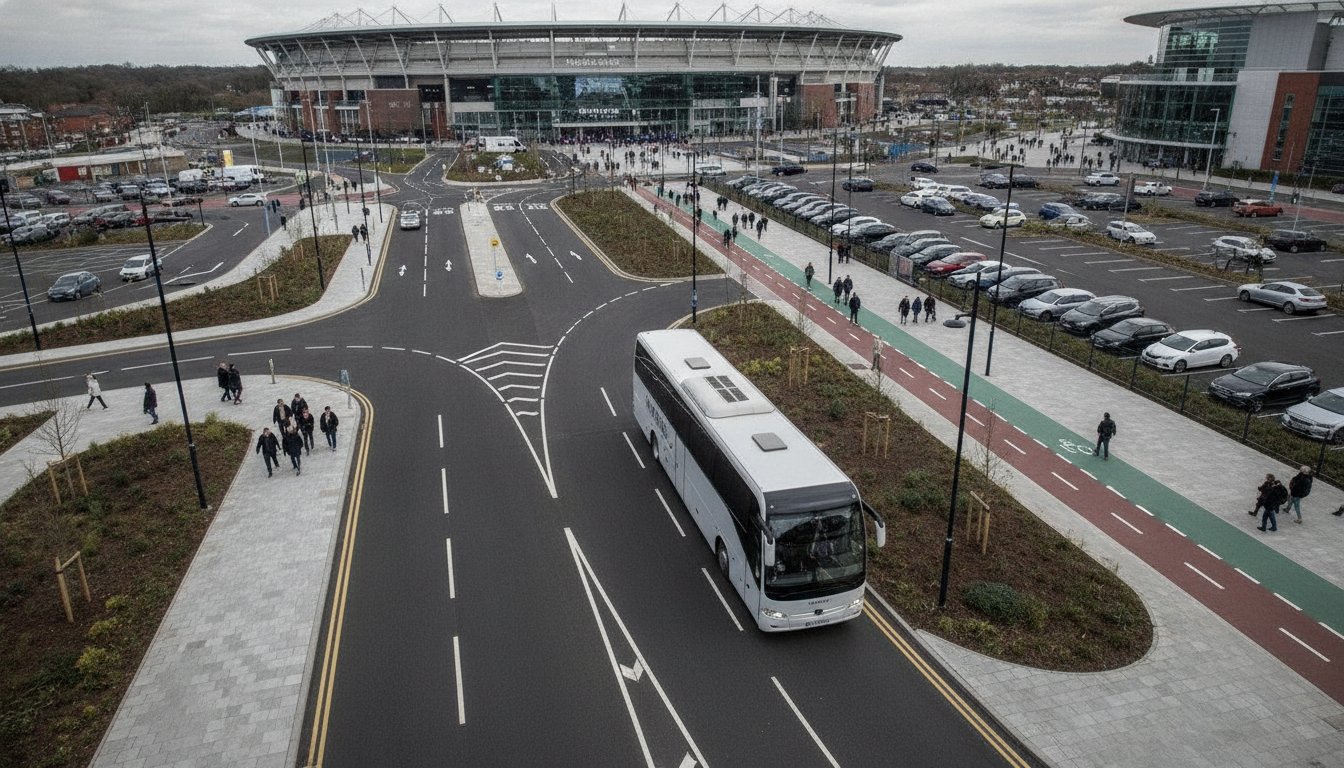
Can your sports development survive the logistical “match-day crunch” without alienating the entire local community? You’re likely facing the dual pressure of minimizing traffic mitigation costs while satisfying local authorities who are wary of parking overspill and congestion. It’s a high-stakes balancing act where a single technical oversight can lead to expensive delays or a flat refusal at the planning committee. Under the National Planning Policy Framework updated in February 2025, the margin for error in your submission has never been smaller.
This guide will help you master the complexities of a sporting facilities transport assessment so you can secure planning permission and manage peak event traffic with precision. You’ll learn how to navigate the latest vision-led Local Transport Plan guidance and determine exactly when a full Assessment is required over a simpler Transport Statement. We will preview the essential steps for designing cost-effective car parks and robust match-day management plans that meet every regulatory benchmark while protecting public safety. From utilizing the TRICS database to performing a detailed Swept Path Analysis, we provide the technical clarity you need to move your project from inception to completion.
Key Takeaways
- Identify whether your development requires a comprehensive sporting facilities transport assessment or a streamlined Transport Statement based on specific vehicle movement thresholds.
- Learn to manage the “peak-of-peaks” traffic phenomenon by aligning match-day demand with robust management strategies and local infrastructure capacity.
- Utilize parking surveys and PTAL scores to justify parking provision that meets regulatory standards without incurring unnecessary construction costs.
- Secure planning permission by integrating essential Travel Plans that set measurable targets for sustainable access and modal shift.
- Apply technical data from Traffic Surveys and Swept Path Analysis to guarantee safe, reliable access for emergency services and large vehicles like team coaches.
Understanding Transport Planning Requirements for Sports Developments
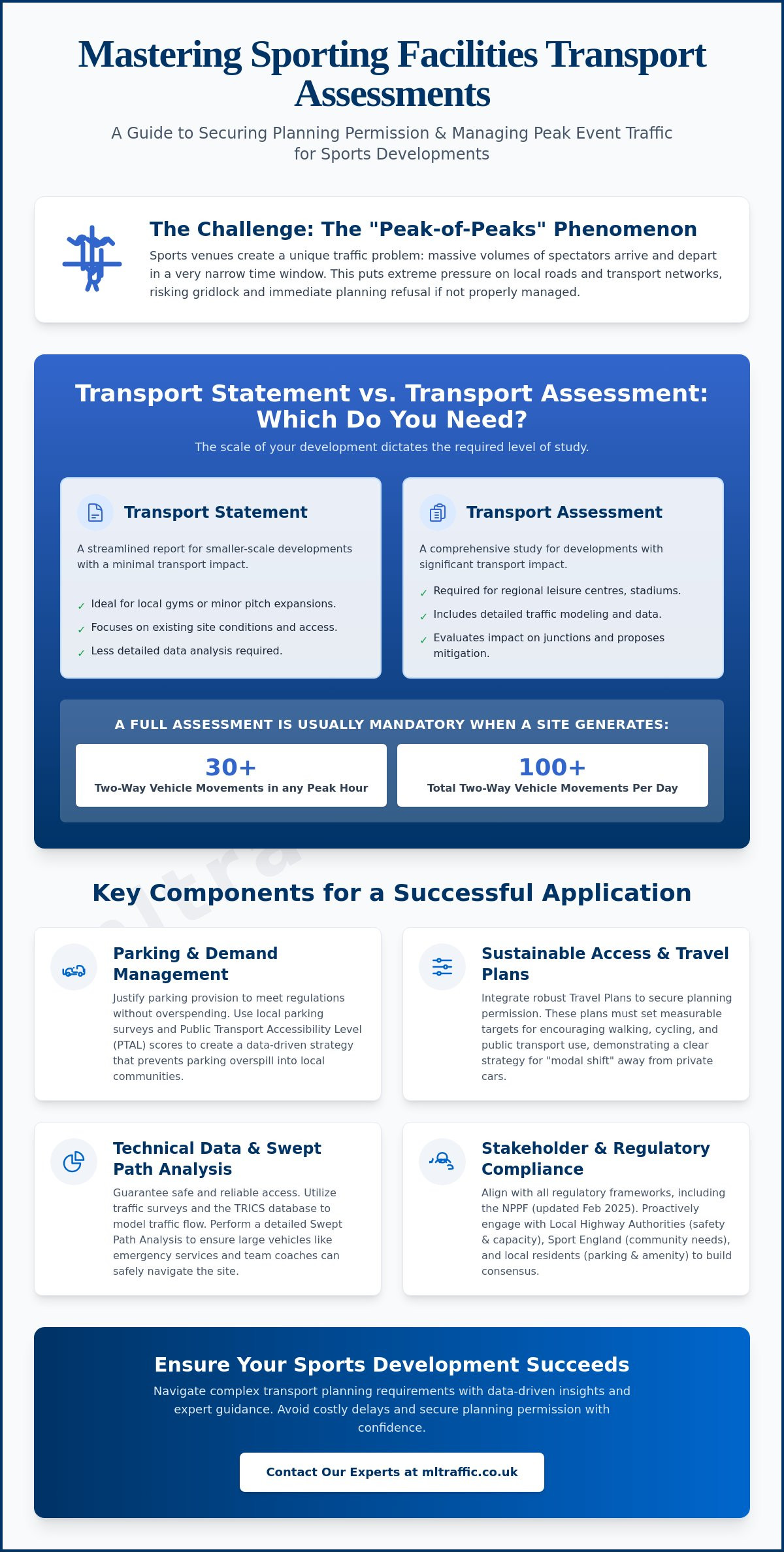
A sporting facilities transport assessment is a technical, site-specific study designed to evaluate how a new or expanded development impacts the local highway network. Unlike residential or commercial projects, sports venues produce a “peak-of-peaks” traffic phenomenon. This occurs when large volumes of spectators arrive and depart simultaneously within a narrow window, putting extreme pressure on local junctions and public transport links. Failing to account for this surge can lead to gridlock and immediate planning refusal.
The transportation planning process for these sites must account for these surges to prevent local infrastructure failure. Regulatory compliance is anchored in the National Planning Policy Framework (NPPF), which was updated in February 2025. This version places a heavier burden on developers to demonstrate how their site aligns with Net Zero targets and enhanced road safety standards. Successful applications require early consultation with key stakeholders. Local Highway Authorities focus on capacity and safety, while Sport England ensures the facility meets strategic community needs. Local residents often provide the strongest opposition, usually centered on parking overspill and residential amenity.
To better understand this concept, watch this helpful video:
The Strategic Importance of Transport in Planning
Transport accessibility is a fundamental driver of a venue’s commercial viability. If fans can’t reach the site efficiently, attendance suffers and operational costs rise. Modern planning policy has shifted heavily toward sustainable transport. This requires developers to balance daily community access with the massive regional draw of major events. We help clients bridge this gap by providing data-driven insights that satisfy both commercial goals and local authority mandates. You can find more detail on our comprehensive approach in our technical service overview.
When is a Formal Assessment Triggered?
The scale of your project dictates the depth of the study required. A small local gym or a minor pitch expansion might only need a simplified Transport Statement. However, larger developments like regional leisure centres or multi-use stadiums typically trigger a full assessment. Pre-application discussions with highway officers are vital for defining the study area. These meetings set the scope of the work and identify whether existing local congestion will complicate your application. If a site generates 30 or more two-way vehicle movements in any peak hour, or 100 movements per day, a comprehensive sporting facilities transport assessment is almost always mandatory. We ensure these technical thresholds are managed accurately from the start.
Transport Statement vs. Transport Assessment: Which Do You Need?
Determining whether your project requires a Transport Statement or a full Assessment is a critical first step in the planning process. Local authorities typically set these requirements based on the scale of the development and its potential impact on the highway. While residential sites often follow predictable trip patterns, sports venues are judged more strictly due to their concentrated arrival and departure windows. A sporting facilities transport assessment is generally mandatory for developments generating 30 or more two-way vehicle movements in any peak hour, or 100 or more movements per day.
The criteria for selection involve several factors, including Gross Floor Area (GFA), spectator capacity, and projected trip generation. Planning officers look at these metrics to gauge if the local network can absorb the sudden influx of users. Because sports venues create high-intensity traffic “pulses,” even a relatively small facility might trigger a full Assessment if it sits near a congested junction. We recommend consulting with highways officers early to define the scope of work and avoid unnecessary technical delays. If you are unsure of your project’s specific requirements, our team provides clarity through our comprehensive transport planning services.
The Transport Statement: For Smaller Sporting Sites
A Transport Statement serves as a streamlined report for lower-impact developments. This includes small community gyms, local football pitches, or minor extensions to existing leisure centres. The document focuses on local access points, parking provision, and cycle storage to prove the daily traffic increase is negligible. You must demonstrate that the site aligns with the latest guidance on Sustainable Access and Travel Plans to satisfy local planning policies. Robust Statements rely on accurate site observations and basic trip data to reassure planners that local residents will not face parking overspill.
The Transport Assessment: For High-Impact Venues
Large leisure centres, professional stadiums, and multi-use hubs require a far more rigorous technical approach. A full Assessment involves complex junction modelling using industry-standard software to simulate peak-hour performance. We utilize the TRICS database to establish accurate trip generation figures, comparing your site against similar facilities nationwide. This analysis must also account for the cumulative impact of other nearby developments to ensure the highway remains safe and functional. For these high-stakes venues, the Assessment acts as the foundation for your match-day traffic management strategy and long-term mitigation plans.
Managing Peak Event Demand and Parking Requirements
High-intensity sports events create a unique strain on local infrastructure that standard commercial developments do not face. Standard local authority parking ratios often fail to account for the intense arrival and departure windows of a stadium or leisure centre. This creates a direct conflict between providing enough spaces for spectators and adhering to council policies that aim to reduce car dependency. A robust sporting facilities transport assessment must bridge this gap by demonstrating how peak demand will be handled without causing local gridlock or safety hazards.
In urban environments, we use technical Parking Surveys to justify lower-than-standard provision, particularly in areas with high accessibility. For instance, the London Plan 2026 mandates car-free developments in areas with a Public Transport Accessibility Level (PTAL) score of 4 or higher. By collecting accurate baseline data, we prove that multi-modal arrival strategies are viable alternatives to massive on-site car parks. These strategies include dedicated coach bays, shuttle services, and “park and walk” schemes. This data-driven approach is the most effective way to dismantle the primary resident objection that fans will inevitably park on residential streets.
Car Park Design and Access Efficiency
Efficiency in car park design is focused on the speed of egress. A sports facility car park must be engineered to empty rapidly after an event without backing up onto the main highway network. We prioritize layouts that include natural surveillance and clear sightlines to protect public safety. Modern standards also require significant future-proofing for sustainable travel. Under current 2026 regulations, all permitted parking spaces must include 100% active electric vehicle charging points. We manage these intricate technical requirements throughout the project lifecycle as part of our comprehensive transport planning services.
Match-Day Traffic Management Plans (TMPs)
Securing planning permission often hinges on a robust Match-Day Traffic Management Plan. This document proves to the council that you can manage peak flows safely and predictably through operational control. It outlines the implementation of temporary traffic orders, specialized signage, and the deployment of transport marshals at key junctions. Coordination with local police is essential for high-capacity venues to ensure public safety remains the non-negotiable foundation of the event. By providing a clear, logical sequence for event-day operations, we reduce the regulatory pressure on developers and provide the technical authority needed for a successful submission. Our technical resources offer further insight into these specific operational requirements.
Sustainable Access and Travel Plans for Sports Sites
While a sporting facilities transport assessment identifies the potential impact of a development on the highway, a Travel Plan provides the operational framework to mitigate those effects. Local planning authorities now view these documents as a non-negotiable requirement for securing permission. This shift aligns with the April 2026 statutory guidance for Local Transport Plans, which prioritizes a “vision-led” approach over traditional traffic modeling. By moving away from “predict and provide” methodologies, developers can focus on active demand management and long-term sustainability.
Setting realistic targets for modal shift is the cornerstone of a successful submission. These targets must outline how the development will reduce car use over time, often aiming for ambitious benchmarks like the 80% sustainable trip target set for London by 2041. Achieving these figures requires more than just policy statements. It demands practical incentives like integrated ticketing, where event passes include local bus or rail travel. High-quality cycle parking and well-lit pedestrian links are equally essential to make non-car travel a viable, safe choice for the community. If you need to develop a robust strategy for your site, we provide expert assistance in creating Travel Plans that satisfy both regulatory requirements and fan expectations.
The Role of the Travel Plan Coordinator
The Travel Plan Coordinator acts as the technical guardian of the site’s transport strategy after the doors open. This role involves monitoring fan travel habits through annual surveys and reporting the findings back to the local authority. This data-driven approach allows for immediate adjustments if modal shift targets aren’t being met. The Coordinator also serves as a vital liaison with local transport operators. By coordinating with bus and rail providers, they ensure that match-day services are synchronized with event timings, reducing the risk of platform overcrowding and local congestion.
Active Travel Infrastructure
Safety is the primary driver when designing active travel infrastructure for high-capacity venues. Developers must create dedicated pedestrian “fan zones” and walking routes that are physically separated from vehicle traffic to prevent accidents during the post-event egress. Accessibility is a critical component of this design. With 16.8 million disabled people in the UK as of 2026, representing nearly a quarter of the population, your site must provide inclusive, step-free access for all fans. Connecting the facility to existing cycle networks and public footpaths ensures the venue remains a permeable, accessible part of the local urban fabric rather than an isolated destination.
Technical Analysis: Swept Path and Data Collection
Precision in technical modeling is the final pillar of a successful sporting facilities transport assessment. Without empirical evidence, planning applications rely on assumptions that highway officers will quickly dismantle. We utilize advanced simulation tools to prove that your site remains safe and operational under the most extreme event-day conditions. This rigorous approach ensures that your development meets every industry benchmark and legislative requirement from the outset.
Predicting attendance patterns requires a sophisticated application of the TRICS database. By comparing your proposal against similar UK venues, we establish a credible baseline for vehicle, pedestrian, and cycle movements. This data allows us to engineer solutions that manage the specific traffic surges identified in earlier chapters. Our team at ML Traffic Engineers UK provides the data-driven evidence needed to secure planning success, reducing regulatory pressure through our comprehensive transport services.
Swept Path Analysis for Stadium Logistics
Stadiums possess unique geometric challenges that standard commercial sites don’t encounter. We use Swept Path Analysis to simulate the precise movements of specialized vehicles, including high-capacity team coaches, broadcast units, and refuse vehicles. This simulation identifies potential pinch points in the site layout before construction begins, allowing for cost-effective design adjustments. Ensuring compliance with fire safety access requirements is a non-negotiable foundation of our work. We verify that emergency tenders can navigate the site without obstruction, protecting public safety and satisfying the most stringent building regulations.
Traffic and Parking Surveys: The Foundation of Evidence
A robust application requires a clear understanding of existing local capacity. We conduct both manual and automated traffic surveys to establish accurate baseline data for the surrounding highway network. This evidence is vital for proving that your development won’t push local junctions beyond their operational limits. Additionally, we perform parking stress surveys in nearby residential streets to address the concerns of local residents directly. By providing the raw data that highway officers trust, we build a persuasive case for your project. Our commitment to technical authority ensures that every survey we conduct adheres to the highest professional standards, providing a reliable foundation for your planning submission.
Securing Planning Approval for Your Sports Development
Navigating the technical requirements of a sporting facilities transport assessment requires a meticulous approach to both daily operations and event-day surges. By integrating the technical modeling and sustainable travel strategies discussed in this guide, you ensure your development remains safe and accessible for all users. A well-structured submission doesn’t just present data; it builds trust with the highway authority and the local community. These steps transform a complex logistical challenge into a clear path for development.
Since our founding in 2014, ML Traffic Engineers UK has provided extensive UK planning experience to help developers move from initial data collection to final technical reporting. We manage the full project lifecycle so you can focus on building world-class facilities. Our expertise in regulatory compliance and technical modeling removes the logistical pressure from your team. Get a Professional Quote for Your Sporting Facility Transport Assessment to ensure your project stays on track. We’re ready to help you achieve a successful planning submission and a safely managed venue.
Frequently Asked Questions
Do I need a Transport Assessment for a small local sports club expansion?
A small expansion typically requires a Transport Statement rather than a full assessment. If your project generates fewer than 30 two-way vehicle movements in a peak hour, local authorities generally accept this lighter-touch report. We analyze your specific trip generation to ensure you don’t over-invest in unnecessary technical reporting while still meeting all local validation requirements.
How does Sport England’s Facilities Planning Model relate to my transport report?
Sport England’s model identifies the strategic demand for sports provision in a specific area. While the model proves why your facility is needed, your sporting facilities transport assessment proves that the local road network can handle the resulting traffic. These documents work together to provide a complete picture of project viability and community benefit during the planning process.
What is the most common reason for a sports facility planning application to be refused on transport grounds?
Applications are most frequently refused due to a lack of evidence regarding match-day parking overspill. If you cannot prove that spectators will avoid residential streets, local residents and highway officers will object. We use detailed parking surveys and robust management plans to provide the technical reassurance councils require to approve high-capacity venues.
Can I use a Travel Plan to reduce the number of parking spaces the council requires?
You can use a Travel Plan to justify lower parking provision by committing to measurable modal shift targets. By incentivizing public transport and cycling, you demonstrate that fewer car spaces are necessary. This approach aligns with the latest National Planning Policy Framework standards and can significantly reduce your construction and land acquisition costs.
How far back from the site should my traffic surveys extend?
The extent of your surveys is defined during pre-application scoping with the Local Highway Authority. Planners usually focus on key junctions where your development increases traffic by more than 5%. For large stadiums, this study area can extend several miles to include major arterial routes and public transport hubs used by spectators.
What is the role of Swept Path Analysis in sports venue design?
Swept Path Analysis simulates the physical movement of large vehicles to ensure they can navigate your site safely. This is critical for accommodating team coaches, broadcast units, and emergency fire tenders. Identifying these requirements early prevents expensive layout changes during construction and ensures your site complies with mandatory safety access benchmarks.
How does the PTAL rating of my site affect my transport assessment?
A high Public Transport Accessibility Level (PTAL) score directly reduces the amount of on-site parking you are permitted to provide. In areas with a score of 4 or higher, planners often expect car-free developments. Your assessment must then focus heavily on pedestrian flow modeling and public transport capacity to ensure the site remains accessible.
How long does it typically take to produce a full Transport Assessment for a stadium?
Producing a comprehensive sporting facilities transport assessment for a stadium usually takes between six to twelve weeks. This timeline accounts for specialized data collection, complex junction modeling, and stakeholder consultations. Early engagement is essential to manage this process effectively and avoid delays in your planning submission schedule.

Disclaimer
The content on mltraffic.co.uk, including all technical articles, guides, and resources, is provided for general informational and educational purposes only. It is not intended to constitute professional advice in traffic engineering, transportation planning, development approvals, or any other technical or legal field.
While ML Traffic Engineers makes every reasonable effort to ensure the accuracy, completeness, and timeliness of the information published, we do not provide any warranties or representations (express or implied) regarding its reliability, suitability, or availability for any particular purpose. Any reliance you place on the content is strictly at your own risk.
In no event shall ML Traffic Engineers, its directors, employees, authors, or affiliates be liable for any direct, indirect, incidental, special, consequential, or punitive damages (including, without limitation, loss of profits, data, or business opportunities) arising out of or in connection with the use of, or inability to use, any information provided on this website.
The articles and guides on this site are not a substitute for engaging a qualified, professional traffic engineer to assess your specific project requirements. For tailored advice, compliance assessments, or traffic engineering services, please contact a competent professional.
This disclaimer may be updated from time to time without notice. By accessing or using this website, you agree to be bound by the most current version of this disclaimer.