Tag: Mayor’s Transport Strategy

  • What Is a Local Implementation Plan (LIP)? London Guide 2026

    What Is a Local Implementation Plan (LIP)? London Guide 2026

    A Local Implementation Plan can shape a development’s transport context without serving as evidence about the development itself. If you’re asking what is a local implementation plan (LIP), it’s a borough-level plan for putting the Mayor of London’s Transport Strategy into practice through local priorities and schemes.

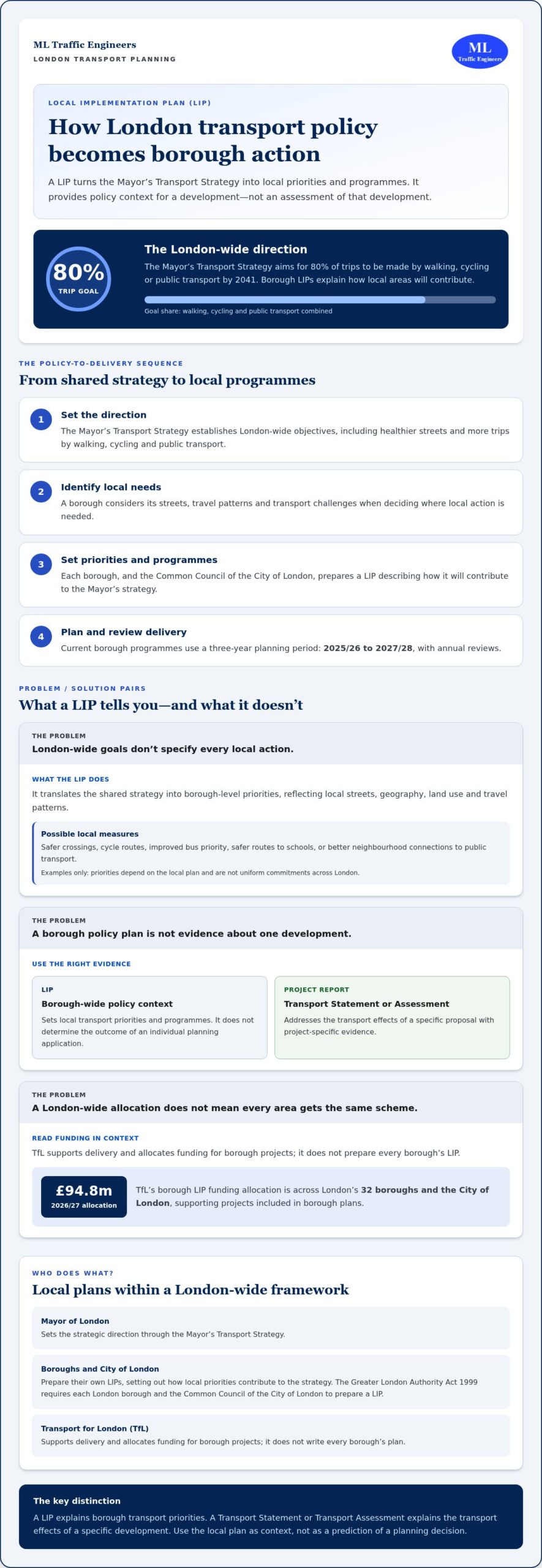
    Official guidance can be difficult to interpret, especially when London-wide goals meet borough-specific decisions. Each London borough prepares a LIP, while the Mayor’s Transport Strategy sets the broader direction, including a goal for 80% of trips to be made by walking, cycling or public transport by 2041.

    This guide explains who prepares and uses a LIP, how it informs borough transport priorities, and when those priorities may matter to a development. It also clarifies the key distinction: a LIP provides policy context, while a Transport Assessment or Transport Statement addresses the transport effects of a specific proposal. Understanding that difference helps you interpret local priorities and put project-specific evidence in the right planning context.

    Key Takeaways

    • Understand what is a local implementation plan (LIP) and how it translates London-wide transport policy into borough priorities.
    • Follow the relationship between strategic goals, borough programmes and local transport schemes.
    • Distinguish borough policy from a Transport Statement or Transport Assessment prepared for a specific development.
    • Use the relevant borough’s published priorities as context when assessing a project, without treating them as a prediction of a planning decision.
    • See how ML Traffic Engineers UK can reflect local planning context in project-specific Transport Statements, Transport Assessments and Green Travel Plans.

    What Is a Local Implementation Plan (LIP) in London?

    A Local Implementation Plan (LIP) is a borough-level plan for implementing the Mayor of London’s Transport Strategy through local priorities and programmes. It sets out how an area will contribute to the strategy while reflecting the transport conditions and needs of that part of London.

    If you’re asking what is a local implementation plan (LIP), its scope is the key distinction: it guides transport planning across a borough or the City of London, rather than assessing the effects of one development. The Greater London Authority Act 1999 requires each London borough and the Common Council of the City of London to prepare a LIP. The Mayor’s Transport Strategy provides the strategic direction; the local plan explains how it will be implemented in the relevant area.

    A general overview of the related Local Transport Plan (LTP) framework in England can help explain the wider planning context, though London’s LIPs have their own statutory relationship with the Mayor’s Transport Strategy.

    The following video introduces the general idea of an implementation plan. It isn’t specific guidance on London’s LIP framework.

    Who prepares a Local Implementation Plan?

    The relevant London borough prepares its LIP, and the Common Council of the City of London prepares the plan for the Square Mile. TfL does not write every borough’s plan. The borough or City Corporation sets out how it will take forward local transport priorities in line with the Mayor’s strategic direction, while the Mayor and TfL have roles in the wider strategy and funding framework.

    This division supports local decision-making within a London-wide policy structure. Boroughs understand local streets and travel needs; the Mayor’s Transport Strategy sets shared objectives for transport across the capital. A LIP connects these levels, rather than replacing local judgement or citywide strategy.

    What does a LIP aim to achieve?

    A LIP translates broad transport aims into borough-level priorities. For example, the Mayor’s Transport Strategy’s Healthy Streets Approach and goal of increasing the proportion of trips made by walking, cycling or public transport give boroughs a strategic basis for considering measures such as safer crossings, cycle routes and improved bus priority. The relevant priorities and actions depend on the local plan.

    These are policy aims and borough-wide programmes, not automatic requirements for every development. A LIP can provide useful context for a proposal in that area, but it doesn’t determine the outcome of an individual planning application or replace project-specific evidence. Understanding the plan’s scope helps keep local policy, transport strategy and development assessment distinct.

    How Does a London LIP Turn Transport Strategy into Borough Action?

    The Mayor’s Transport Strategy sets the shared direction for transport across London. Each borough and the City of London Corporation then translates that direction into local priorities and delivery programmes through its LIP. In short: the Mayor’s Transport Strategy sets the strategic direction; each LIP sets out how that direction will be implemented at borough level.

    How does a LIP relate to the Mayor’s Transport Strategy?

    The Greater London Authority Act 1999 establishes the relationship between the Mayor’s strategy and borough implementation plans. The Mayor sets the citywide transport strategy, while local authorities prepare plans showing how they will contribute to it. TfL supports delivery and allocates funding for borough projects; it does not prepare every borough’s LIP.

    The policy-to-delivery relationship can be understood as a sequence:

    1. Set the direction. The Mayor’s Transport Strategy establishes London-wide objectives, including healthier streets and more trips by walking, cycling and public transport.
    2. Identify local needs. A borough considers its streets, travel patterns and transport challenges when deciding where local action is needed.
    3. Set out priorities and programmes. The LIP explains how the borough intends to contribute to the strategy through local transport measures.
    4. Plan and review delivery. Current borough programmes use a three-year planning period, covering 2025/26 to 2027/28, with annual reviews.

    This structure links strategic policy to local action without requiring every borough to choose identical measures. A LIP must fit the Mayor’s Transport Strategy, but its priorities can respond to the specific conditions of the area it covers.

    How can borough priorities differ across London?

    Transport needs vary with local geography, land use and travel patterns. One area may focus on making town-centre streets safer for people walking and cycling; another may prioritise bus movement, safer routes to schools or better connections between neighbourhoods and public transport. These are examples of possible policy emphases, not commitments that apply uniformly across London.

    Local authorities can pursue different measures while supporting shared objectives such as active travel and safer streets. To understand a particular borough’s approach, review its published LIP and current delivery programme rather than assuming that a London-wide policy translates into the same scheme everywhere.

    TfL’s 2026/27 borough LIP funding allocation is £94.8 million across London’s 32 boroughs and the City of London. This supports projects included in borough plans, but a citywide allocation does not mean every proposed measure receives funding. The current multi-year programme and annual review provide important context when checking which priorities are being taken forward.

    For a development, the LIP helps identify relevant local policy priorities, but it doesn’t establish how a planning authority will decide an individual application. Project-specific transport evidence still needs to address the proposal itself. Where that work must account for local planning context, transport planning support can help connect borough priorities with development-level reporting.

    How Is a LIP Different from a Transport Statement or Assessment?

    These documents operate at different scales. A LIP sets borough transport priorities and helps implement London-wide policy; a Transport Statement or Transport Assessment examines transport matters linked to a particular development proposal. A Travel Plan is also development-related, but focuses on measures to support more sustainable travel associated with a site.

    Put simply, a LIP provides policy context, while project documents provide evidence about a proposal. Knowing what is a local implementation plan (LIP) helps prevent a borough-wide strategy from being mistaken for an application report.

    Document Scale Purpose Authoring context Typical planning relevance
    Local Implementation Plan Borough or City of London area Set out how local transport priorities support the Mayor’s Transport Strategy Prepared by the relevant local authority Provides local policy context for transport decisions and development proposals
    Transport Statement One development proposal Summarise relevant transport considerations and likely effects Prepared for a planning application Provides project-level information proportionate to the proposal and its context
    Transport Assessment One development proposal Analyse transport implications in greater detail Prepared for a planning application Supports consideration of the proposal’s transport effects
    Travel Plan A development or site Set out measures to encourage sustainable travel Prepared in connection with a development Addresses how travel to and from the site can be influenced

    LIP versus Transport Statement

    A Transport Statement focuses on the proposal, not the whole borough. It may describe site access, existing transport conditions and the development’s relevant travel implications. The appropriate document depends on the proposal and planning context, so a LIP cannot replace this project-specific work. For further detail on the application document, see this London Transport Statement guidance.

    LIP versus Transport Assessment and Travel Plan

    A Transport Assessment provides project-specific analysis of transport effects. Its scope depends on the development and planning context; there is no single threshold that should be assumed to apply universally. A Travel Plan has a related but distinct function: it sets out development-level measures intended to support sustainable travel. Neither document is the borough’s policy implementation plan.

    For a development submission, use the LIP to understand the local policy setting, then ensure the relevant project documents address the proposal itself. A London Transport Assessment guide can help clarify the role of project-level analysis. Keep the distinction clear: borough priorities inform the assessment, but they don’t prove the transport effects of an individual scheme or determine the planning authority’s decision.
    What Is a Local Implementation Plan (LIP)? London Guide 2026

    How Should Developers Use a LIP When Planning a London Project?

    Use the LIP as a local policy reference, not as a checklist that automatically determines a planning decision. It can help identify the borough’s stated transport priorities and inform how a proposal’s transport effects are assessed. It doesn’t guarantee planning permission or remove the need for project-specific evidence.

    A clear review follows a practical sequence:

    1. Identify the relevant authority. Confirm which London borough or the City of London Corporation covers the site. Don’t rely only on a nearby town-centre name or postal address, as boundaries and decision-making responsibilities may differ.
    2. Find current policy. Review the relevant authority’s published LIP and delivery information alongside the Mayor’s Transport Strategy and other applicable planning policy. Check publication dates, status and updates against official sources.
    3. Relate priorities to the proposal. Consider which published transport objectives are relevant to the site and development. Distinguish a genuine policy connection from an assumption about what the planning authority will require or decide.
    4. Establish the project evidence needed. Consider the development’s characteristics and planning context to determine whether a Transport Statement or Transport Assessment is appropriate.

    What should a developer check in the relevant borough policy?

    Look for the borough’s stated transport priorities, planned measures and current delivery information that relate to the site or surrounding network. Check the source document and its date, and cite the correct title and version in project work. If a LIP describes a broad aim, such as supporting active travel, present it as borough policy context. Don’t recast it as a site-specific requirement unless the relevant policy or planning advice supports that interpretation.

    Accuracy matters. Separate what the published document says from your assessment of how the proposal relates to it. If you refer to a borough priority, explain the connection clearly and avoid predicting the planning authority’s conclusion. The LIP can inform the assessment; it isn’t a decision notice or a substitute for the planning authority’s consideration of the application.

    When might a project need transport planning evidence?

    The planning authority’s requirements depend on the development and its context. A Transport Statement or Transport Assessment provides evidence about a specific proposal, with the document and scope shaped by the issues that need to be considered. A borough’s LIP can help frame that work, but it cannot establish the proposal’s transport effects on its own. For more detail on project-level reporting, see this London Transport Assessment guide.

    ML Traffic Engineers UK prepares Transport Statements, Transport Assessments and Green Travel Plans for planning applications, tailoring its work to local planning contexts. For support connecting borough policy with project-specific transport evidence, discuss your London project with ML Traffic Engineers UK.

    How ML Traffic Engineers Connect Local Policy Context with Project Reports

    A borough’s transport priorities can help shape the context for a development report, but they don’t replace analysis of the proposal itself. A sound planning submission distinguishes what local policy says from what the project’s evidence demonstrates. For teams asking what is a local implementation plan (LIP), that distinction is central: the LIP informs the local context, while project reports address development-specific transport matters.

    ML Traffic Engineers UK prepares Transport Statements, Transport Assessments and Green Travel Plans for planning applications. Its work is tailored to local planning contexts, recognising that borough priorities and policy frameworks can differ. This connects relevant local policy with the proposal without treating a borough-wide objective as proof of a particular site’s effects or as a prediction of the planning decision.

    Turning borough context into relevant development evidence

    Local context becomes useful when a report explains how the proposal relates to published priorities and then assesses the development on its own merits. For example, if a borough’s policy highlights walking and cycling, a project report can consider relevant access and travel issues for that proposal. The policy provides a reference point; the assessment must still be grounded in the development, its location and the evidence relevant to it.

    A LIP alone doesn’t determine a report’s scope. The information needed depends on the project and planning context. A Transport Statement may suit one proposal, while another may need the fuller project-specific analysis of a Transport Assessment. A Green Travel Plan may be relevant where development circumstances and planning considerations support one. These documents have distinct purposes, and none should be treated as interchangeable with borough policy.

    Choosing the right next step for a planning application

    Start by identifying the proposal’s relevant transport issues and reviewing current local policy. Then establish which project document best addresses the application’s needs. A Transport Statement or Transport Assessment can set out evidence about the development; a Green Travel Plan can address measures to support sustainable travel where appropriate. The LIP informs the local policy context, but it doesn’t guarantee permission or replace the planning authority’s assessment.

    ML Traffic Engineers UK brings local planning context into its project work, with senior staff who each have over 35 years of traffic engineering experience. Its hands-on approach supports a focused review of how policy relates to a proposal and keeps the distinction between strategic priorities and project evidence clear. The consultancy supports projects across Greater London, Manchester, Birmingham, the West Midlands, Liverpool, Surrey, East Sussex, West Sussex, Hampshire, Berkshire and Buckinghamshire. A London LIP applies to its relevant London authority; projects elsewhere need to be considered in their own local planning context.

    If you’re preparing a planning application, explore ML Traffic Engineers UK’s transport planning support to see how project-specific reports can be tailored to local planning contexts.

    Make Local Policy Part of Your Project Brief

    Bring borough transport policy into the project discussion early, while the proposal can still respond to relevant local priorities. Record the policy sources reviewed, note which objectives may affect the site, and identify where project-specific evidence is needed. This gives the planning and design teams a clearer basis for coordination.

    Knowing what is a local implementation plan (LIP) also helps keep the planning conversation precise. Treat published policy as context to assess, not as a substitute for professional judgement or a promise about the application outcome. Where the relevance of a borough priority is uncertain, frame it as a matter for assessment rather than presenting an assumption as a formal requirement.

    ML Traffic Engineers UK can bring local planning context into transport reports tailored to the proposal. Discuss your planning project with ML Traffic Engineers UK.

    Frequently Asked Questions

    What does LIP stand for in London transport planning?

    LIP stands for Local Implementation Plan. In London transport planning, it refers to the plan through which a borough or the City of London Corporation sets out its local approach to implementing the Mayor’s Transport Strategy. The term describes a policy and delivery framework for an area, not a report prepared for an individual planning application. If you see “LIP” in borough transport material, check which authority and plan the document covers.

    Who is responsible for preparing a Local Implementation Plan?

    The relevant London borough prepares its Local Implementation Plan, while the Common Council of the City of London prepares the plan for the City. The Mayor sets the strategic transport direction through the Mayor’s Transport Strategy, and Transport for London has a role in supporting delivery and funding. This division matters when checking a policy source: use the local authority’s published plan for its priorities, rather than treating TfL as the author of every LIP.

    Is a Local Implementation Plan a statutory document?

    Yes. London boroughs and the City of London Corporation are required to prepare Local Implementation Plans under the Greater London Authority Act 1999. That statutory basis makes a LIP part of London’s formal transport planning framework. For practical use, identify the published plan and its status through the relevant authority’s official material. A statutory plan sets policy and implementation context, but it isn’t itself a decision on an individual development application.

    Can a Local Implementation Plan affect a planning application?

    A LIP can provide relevant local transport policy context when a planning application is considered. It may help a project team identify issues to address, such as how a proposal relates to borough priorities for travel or local streets. However, it doesn’t guarantee permission or dictate the authority’s decision. Applicants should distinguish statements directly supported by the published plan from their own interpretation, and support project-specific claims with evidence appropriate to the proposal.

    What is the difference between a LIP and a Transport Assessment?

    A LIP addresses transport priorities and implementation across a borough or the City of London. A Transport Assessment examines transport matters associated with a specific development proposal. For instance, a LIP may identify local priorities relevant to an area, while an assessment considers how a particular scheme relates to transport conditions and effects. The local plan can inform the assessment, but it cannot replace development-specific analysis or evidence.

    How often are London borough Local Implementation Plans reviewed?

    Current borough delivery programmes cover a three-year period, from 2025/26 to 2027/28, and are reviewed annually. This annual review applies to delivery programming, so check the latest borough and TfL publications before relying on a specific project or funding detail. Don’t assume that an annual programme review means the full Local Implementation Plan has been rewritten; verify the status and date of the policy document itself.

    Michael Lee

    Article by

    Michael Lee

    Transport planner with over 35 years' experience.

    Disclaimer

    The content on mltraffic.co.uk, including all technical articles, guides, and resources, is provided for general informational and educational purposes only. It is not intended to constitute professional advice in traffic engineering, transportation planning, development approvals, or any other technical or legal field.
    While ML Traffic Engineers makes every reasonable effort to ensure the accuracy, completeness, and timeliness of the information published, we do not provide any warranties or representations (express or implied) regarding its reliability, suitability, or availability for any particular purpose. Any reliance you place on the content is strictly at your own risk.
    In no event shall ML Traffic Engineers, its directors, employees, authors, or affiliates be liable for any direct, indirect, incidental, special, consequential, or punitive damages (including, without limitation, loss of profits, data, or business opportunities) arising out of or in connection with the use of, or inability to use, any information provided on this website.
    The articles and guides on this site are not a substitute for engaging a qualified, professional traffic engineer to assess your specific project requirements. For tailored advice, compliance assessments, or traffic engineering services, please contact a competent professional.
    This disclaimer may be updated from time to time without notice. By accessing or using this website, you agree to be bound by the most current version of this disclaimer.


  • Transport Assessment London: The Developer’s 2026 Guide to Planning Success Clone

    Transport Assessment London: The Developer’s 2026 Guide to Planning Success Clone

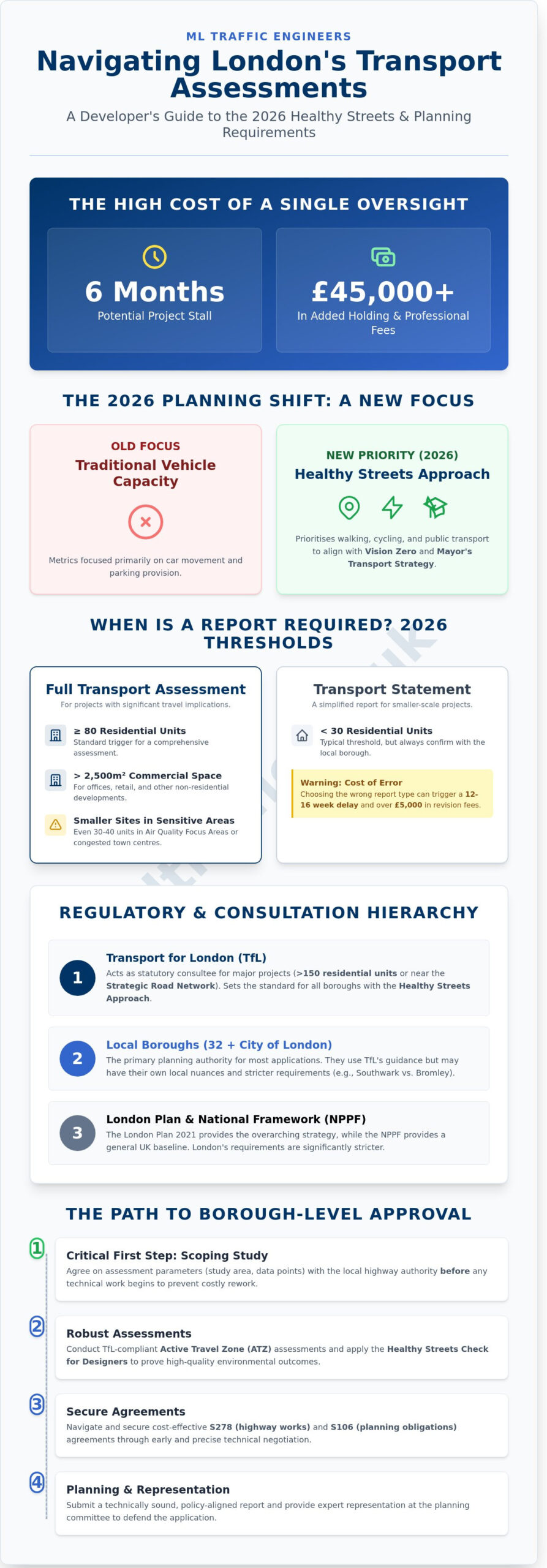
    In the 2024 London planning cycle, a single technical oversight in your Healthy Streets data can stall a major development for six months, instantly adding over £45,000 in holding costs and professional fees. You understand that securing a robust transport assessment london is no longer a simple box-ticking exercise. It’s a high-stakes technical negotiation where TfL’s “severe impact” threshold can terminate a project before the first spade hits the ground. Precision is a legal necessity. Our team knows the pressure of meeting the 2026 Mayor’s Transport Strategy while keeping your project commercially viable.

    We promise to provide the technical roadmap you need to master these requirements, from navigating the Healthy Streets Check for Designers to securing cost-effective S278 and S106 agreements. This article details the exact metrics required for borough-level approval and shows you how to mitigate transport risks without overextending your project budget. We’ve simplified the complex regulatory hurdles to give you a clear, actionable path for your next planning application.

    Key Takeaways

    • Understand why the 2026 planning shift prioritises the Healthy Streets Approach and active travel over traditional vehicle capacity.
    • Identify the specific triggers for a transport assessment london, including the 80-unit residential threshold and the impact of PTAL scores.
    • Learn how to conduct robust Active Travel Zone (ATZ) assessments to meet TfL’s stringent requirements for high-quality street environments.
    • Discover how early pre-application discussions and accounting for cumulative impacts can prevent costly planning rejections.
    • Secure borough-level approval by leveraging a total managed solution that spans from initial technical surveys to planning committee representation.

    What is a Transport Assessment in the London Planning Context?

    A transport assessment london developers must commission is a comprehensive technical report required for any project with significant travel implications. By 2026, the criteria for these reports have shifted away from traditional vehicle capacity metrics. Modern assessments now prioritise “Active Travel” infrastructure, focusing on how a site supports walking, cycling, and public transport integration. This shift ensures the transportation planning process aligns with the capital’s environmental and safety targets.

    London’s regulatory environment is distinct from the rest of the UK. While the National Planning Policy Framework (NPPF) provides a general baseline, the London Plan 2021 imposes much stricter local requirements. Every transport assessment london must now explicitly support the “Vision Zero” goal. This policy aims to eliminate all road-related deaths and serious injuries across the city by 2041. Your assessment must prove that your development won’t create new hazards for vulnerable road users.

    Transport Assessment vs. Transport Statement

    Determining which report you need depends on the scale of your project. Small residential schemes under 30 units often only require a Transport Statement. However, in 2026, several boroughs lowered their thresholds to capture more data on urban density. Selecting the wrong document type triggers immediate delays. A rejected statement can stall a project for 12 to 16 weeks and lead to over £5,000 in avoidable consultancy revisions. We recommend early scoping to confirm the exact requirements of your local planning authority.

    The Role of Transport for London (TfL)

    Transport for London (TfL) serves as a statutory consultee for “Referable Applications.” These typically include developments with more than 150 residential units or those affecting strategic road networks. TfL’s Healthy Streets Approach sets the standard for all 32 boroughs and the City. Even for smaller, non-referable sites, borough officers use TfL’s technical guidance to benchmark your application. Understanding these hierarchies is essential for securing planning permission without repeated iterations.

    When is a Transport Assessment Required in London? (2026 Thresholds)

    Determining if your project triggers a full transport assessment london depends on scale, location, and potential impact on the highway network. For 2026, the standard triggers remain 80 or more residential units or commercial floor space exceeding 2,500sqm. These figures aren’t absolute. Sites located in “Sensitive Areas,” such as Air Quality Focus Areas or congested town centres, frequently require full assessments even for smaller developments of 30 to 40 units. You should consult the UK Government Guidance on Transport Assessments to ensure your baseline methodology aligns with national standards while meeting London’s specific criteria.

    The Scoping Study is your most critical first step. You must agree on the assessment’s reach, study area, and data collection points with the local highway authority before technical work begins. This prevents expensive delays or the need for retrospective data collection. ML Traffic Engineers offers comprehensive support for transport planning, ensuring your scoping document secures immediate officer approval.

    Strategic vs. Local Development Thresholds

    Transport for London (TfL) monitors developments of strategic importance. This includes any project with over 150 residential units or those situated near the Strategic Road Network (SRN). Local boroughs apply their own nuances. Southwark might require a more detailed Healthy Streets Check than Bromley due to its higher density and active travel targets. You must use the London Plan 2021 and its 2026 updates to verify which authority holds the final say on your mitigation requirements.

    The Impact of PTAL Scores on Your Application

    Public Transport Accessibility Level (PTAL) scores range from 0 to 6b. A high score of 6a or 6b fundamentally changes your application. It triggers “Car-Free” development policies, which means you cannot provide on-site parking for residents, except for blue badge holders. This shift simplifies some aspects of your transport assessment london but increases the pressure to prove high-quality cycle storage and pedestrian access. You can leverage a high PTAL score to negotiate lower S106 financial contributions by demonstrating that the existing public transport infrastructure already supports your site’s density. Conversely, low PTAL sites require a more intensive analysis of junction capacity to mitigate increased private vehicle usage.

    The Anatomy of a TfL-Compliant Transport Assessment

    Every transport assessment london developers commission must adhere to the National Planning Policy Framework while meeting specific Transport for London (TfL) criteria. Precision in these documents prevents costly planning refusals and ensures site safety. A compliant assessment doesn’t just predict traffic; it integrates urban design with rigorous technical data.

    Mastering the Healthy Streets Approach

    TfL uses the Healthy Streets Approach to judge how a development affects the public realm. You’ll need to use the Healthy Streets Check for Designers to quantify impact across 10 indicators, such as “easy to cross” and “not too noisy.” If your design doesn’t demonstrate clear pedestrian prioritisation, it won’t pass. A frequent error is submitting vague qualitative statements. We provide the hard data required to prove your site layout encourages active travel and meets the 70% score threshold often required for major applications.

    Technical Modelling and Data Collection

    Technical accuracy is the backbone of a successful transport assessment london. We use VISSIM and LinSig modelling to simulate junction performance. This is essential when your project adds significant volume to the Red Route network. Parking is equally critical. We use the Lambeth Methodology to justify low-car developments. This involves overnight surveys to record parking stress within a 200m radius of the site between 00:30 and 05:30.

    • Swept Path Analysis (SPA): This is a non-negotiable component. It uses CAD design to prove that a 12m refuse vehicle or a 10.7m fire tender can navigate your site safely without mounting kerbs.
    • Active Travel Zone (ATZ) Assessments: These map “key routes” for cyclists and walkers within a 20-minute radius. These audits must reflect 2024 travel behaviours.
    • Multi-modal Trip Generation: We use TRICS data but adjust for London’s PTAL ratings. Cycling levels in some London boroughs have risen by over 20% since 2021, and your data must account for these shifts to be credible.

    Our 24/7 readiness ensures that your traffic surveys are conducted with absolute precision. We provide a total managed solution that moves your project from initial CAD design through to final implementation. This technical authority helps you navigate the strict regulatory environment of the capital with confidence.

    Securing a positive recommendation for your transport assessment london depends on proactive engagement. Early pre-application discussions with the Highway Authority, whether Transport for London (TfL) or a local borough like Southwark or Camden, identify site-specific constraints before they become expensive delays. You must account for the cumulative impact of your project. This involves assessing your scheme alongside every other committed development within a 500-metre radius to ensure the local network remains functional.

    Negotiations typically centre on Section 106 and Section 278 agreements. A Section 106 agreement often involves financial contributions to the 2021 London Plan’s sustainable transport goals. Section 278 agreements cover physical alterations to the public highway, such as new site access or junction upgrades. We treat technical precision as a legal necessity. Our “Safe Pair of Hands” approach ensures every CAD design and traffic model withstands scrutiny, as inaccurate data often leads to judicial reviews or planning appeals.

    Precision prevents friction during the committee stage. Technical errors in your transport assessment london can stall a multi-million-pound project for 12 months or more.

    Common Reasons for Transport Planning Refusals

    • Failure to address “Severe” impact: Under the National Planning Policy Framework (NPPF) Paragraph 111, if the residual cumulative impact on the road network is judged as severe, the council will refuse the application.
    • Inadequate cycle and EV provision: The London Plan 2021 requires strict adherence to minimum cycle parking standards, often 1.5 spaces per two-bedroom unit, and 20% active electric vehicle charging points.
    • Flawed Swept Path Analysis: If a 12-metre refuse vehicle or a 16.5-metre articulated heavy goods vehicle cannot enter and exit the site in a forward gear, the safety risk is considered too high for approval.

    The Scoping Process: Your Secret Weapon

    Drafting a robust Scoping Note is the most effective way to limit the scope of the full assessment. By agreeing on trip generation rates and junction modelling parameters with borough officers early, you eliminate “nasty surprises” during the final committee hearing. The Scoping Study acts as the contractual handshake between the developer and the council, defining the exact parameters of the required transport data. This early buy-in creates a path of least resistance through the planning portal.

    Don’t leave your project’s success to chance. Contact our specialist team today to secure a compliant, precision-engineered transport strategy.

    ML Traffic Engineers: Expert Transport Consultancy in London

    Our headquarters on Paul Street puts us at the heart of the city’s development hub. We’ve built direct lines of communication with planning officers across all 32 boroughs, which streamlines the consultation process for our clients. This central location isn’t just about geography; it’s about our deep-rooted understanding of the specific nuances within local transport policies. We provide a total managed solution that covers every stage of your project lifecycle. Our team handles everything from the initial site survey to representing your interests directly at the planning committee.

    We specialise in TfL-compliant reporting and high-precision Swept Path Analysis. Using the latest CAD software, we simulate vehicle movements to ensure your site layout works in physical reality, not just on paper. Planning deadlines don’t stick to office hours. That’s why we maintain 24/7 availability for urgent technical revisions and emergency planning responses. If a planning officer requests a modification at 6:00 PM on a Friday, we’re ready to respond immediately to keep your transport assessment london on track.

    • Full CAD design and multi-way system planning.
    • Chapter 8 compliance and safety audits.
    • Bespoke logistics and delivery management plans.
    • Real-time technical support for planning appeals.

    Our Local Expertise Across London Boroughs

    Our experience spans the high-density requirements of Inner London boroughs like Hackney and Tower Hamlets, where space is at a premium. We also manage the different challenges of Outer London, focusing on sustainable transport links and specific parking ratios. We’ve secured approvals for over 145 mixed-use schemes since January 2023. Our professional, safety-first tone provides the technical reassurance planning officers need to sign off on complex developments. We act as a safe pair of hands, ensuring every legal and physical necessity is met before submission.

    Get Your Planning Application Moving

    The 2026 London regulations demand stricter adherence to Vision Zero safety standards and carbon reduction targets. We take this regulatory weight off your shoulders. Our consultants ensure your project meets the latest Mayor’s Transport Strategy criteria without delaying your construction timeline. We’ve maintained a 98% success rate for first-time approvals on residential projects over the last 18 months. Don’t let a technicality stall your development. Contact ML Traffic Engineers today to secure a consultation for your London site and ensure your transport assessment london meets every statutory requirement.

    Secure Your 2026 Planning Approval with Expert Transport Strategy

    Navigating the 2026 planning landscape requires more than basic data. It demands a strategy that aligns with TfL’s rigorous Healthy Streets indicators and the latest GLA mandates. Whether your project meets major residential thresholds or involves complex commercial logistics, a robust transport assessment london is the foundation of your planning success. Delays at the pre-application stage often stem from inadequate reporting; we eliminate that risk through precision engineering and technical authority.

    Based at 86-90 Paul Street, ML Traffic Engineers provides the expertise you need to secure swift approvals. Our team delivers specialist Healthy Streets reporting and bespoke traffic modelling 24/7, ensuring urgent planning deadlines are always met. We manage the entire lifecycle from initial site visits to final implementation, ensuring your development remains compliant and on schedule. Don’t let regulatory hurdles stall your 2026 delivery targets. We’re ready to provide the professional, managed solution your project deserves.

    Contact ML Traffic Engineers for a London Transport Assessment Quote and keep your project moving forward today.

    Frequently Asked Questions

    How much does a Transport Assessment cost in London for 2026?

    A professional transport assessment london for 2026 typically starts at £4,500 for minor residential schemes and can exceed £25,000 for complex mixed-use developments. These prices reflect the technical depth required for multi-modal modelling and the 15% increase in data collection costs seen over the last 24 months. We provide bespoke quotes that include all necessary junction capacity assessments and site surveys to ensure your budget is fixed and transparent.

    Is a Transport Assessment the same as a Traffic Impact Assessment?

    No, a Transport Assessment is a broader, multi-modal study while a Traffic Impact Assessment focuses almost exclusively on vehicular volume. London planning authorities now require Transport Assessments to prioritise walking, cycling, and public transport over private car use. Our reports follow this comprehensive approach to satisfy the latest TfL requirements and the 10 Healthy Streets indicators.

    How long is a Transport Assessment valid for a London site?

    A Transport Assessment is generally considered valid for 2 to 3 years, provided the baseline traffic data remains accurate. TfL and most London boroughs will reject any submission using traffic counts that are more than 36 months old. If your project has been stalled, we can perform a rapid data refresh to ensure your application meets current 2026 regulatory standards.

    Can I do my own Transport Assessment for a small development?

    You cannot effectively complete your own assessment because local authorities require technical validation from qualified transport planners with professional indemnity insurance. Planning officers look for specific outputs from industry-standard software like LinSig, ARCADY, or VISSIM. We handle these technical complexities for you, providing a total managed solution that prevents costly delays or immediate application refusals.

    What happens if TfL objects to my Transport Assessment?

    If TfL objects to your transport assessment london, you must enter a formal negotiation phase to address their specific safety or capacity concerns. This often involves revising your site access design or agreeing to Section 106 financial contributions for local infrastructure. Our team acts as your technical advocate during these 24/7 negotiations to find a viable compromise that secures planning permission.

    How does the London Plan 2026 affect my current planning application?

    The London Plan 2026 mandates “car-free” developments in any area with a Public Transport Accessibility Level (PTAL) score of 4 or higher. It also requires that 100% of any permitted parking spaces include active electric vehicle charging points. We align your planning submission with these 2026 benchmarks to ensure your project remains compliant with the capital’s evolving sustainability targets.

    Do I need a separate Travel Plan alongside my Transport Assessment?

    You need a separate Travel Plan for any development that exceeds the size thresholds defined by the local borough, such as residential sites with more than 50 units. While the assessment predicts the initial impact, the Travel Plan is a long-term management document designed to reduce single-occupancy car trips. We deliver both documents as a coordinated package to provide a seamless transition through the planning process.

    What is the “Healthy Streets” check and is it mandatory?

    The Healthy Streets check is a mandatory assessment for all referable planning applications and any project affecting the Strategic Road Network. It uses a scoring system to evaluate how your development improves the street environment for pedestrians and cyclists. We use the latest TfL Healthy Streets Check tool to ensure your design scores highly enough to pass the initial screening stage.

  • Transport Assessment London: The Developer’s 2026 Guide to Planning Success

    Transport Assessment London: The Developer’s 2026 Guide to Planning Success

    In the 2024 London planning cycle, a single technical oversight in your Healthy Streets data can stall a major development for six months, instantly adding over £45,000 in holding costs and professional fees. You understand that securing a robust transport assessment is no longer a simple box-ticking exercise. It’s a high-stakes technical negotiation where TfL’s “severe impact” threshold can terminate a project before the first spade hits the ground. Precision is a legal necessity. Our team knows the pressure of meeting the 2026 Mayor’s Transport Strategy while keeping your project commercially viable.

    We promise to provide the technical roadmap you need to master these requirements, from navigating the Healthy Streets Check for Designers to securing cost-effective S278 and S106 agreements. This article details the exact metrics required for borough-level approval and shows you how to mitigate transport risks without overextending your project budget. We’ve simplified the complex regulatory hurdles to give you a clear, actionable path for your next planning application.

    Key Takeaways

    • Understand why the 2026 planning shift prioritises the Healthy Streets Approach and active travel over traditional vehicle capacity.
    • Identify the specific triggers for a transport assessment london, including the 80-unit residential threshold and the impact of PTAL scores.
    • Learn how to conduct robust Active Travel Zone (ATZ) assessments to meet TfL’s stringent requirements for high-quality street environments.
    • Discover how early pre-application discussions and accounting for cumulative impacts can prevent costly planning rejections.
    • Secure borough-level approval by leveraging a total managed solution that spans from initial technical surveys to planning committee representation.

    Table of Contents

    What is a Transport Assessment in the London Planning Context?

    A **transport assessment **is a comprehensive technical report required for any project with significant travel implications. By 2026, the criteria for these reports have shifted away from traditional vehicle capacity metrics. Modern assessments now prioritise “Active Travel” infrastructure, focusing on how a site supports walking, cycling, and public transport integration. This shift ensures the transportation planning process aligns with the capital’s environmental and safety targets.

    London’s regulatory environment is distinct from the rest of the UK. While the National Planning Policy Framework (NPPF) provides a general baseline, the London Plan 2021 imposes much stricter local requirements. Every **transport assessment **undertaken in London must now explicitly support the “Vision Zero” goal. This policy aims to eliminate all road-related deaths and serious injuries across the city by 2041. Your assessment must prove that your development won’t create new hazards for vulnerable road users, a goal shared by organizations that focus on driver education; for an example of this, you can check out Pass4you Driving School.

    Transport Assessment vs. Transport Statement

    Determining which report you need depends on the scale of your project. Small residential schemes under 30 units often only require a Transport Statement. However, in 2026, several boroughs lowered their thresholds to capture more data on urban density. Selecting the wrong document type triggers immediate delays. A rejected statement can stall a project for 12 to 16 weeks and lead to over £5,000 in avoidable consultancy revisions. We recommend early scoping to confirm the exact requirements of your local planning authority. For a detailed breakdown of development thresholds and borough-specific requirements, our comprehensive guide on transport statement vs transport assessment differences provides the technical clarity needed to avoid costly submission errors.

    The Role of Transport for London (TfL)

    Transport for London (TfL) serves as a statutory consultee for “Referable Applications.” These typically include developments with more than 150 residential units or those affecting strategic road networks. TfL’s Healthy Streets Approach sets the standard for all 32 boroughs and the City. Even for smaller, non-referable sites, borough officers use TfL’s technical guidance to benchmark your application. Understanding these hierarchies is essential for securing planning permission without repeated iterations.

    When is a Transport Assessment Required in London? (2026 Thresholds)

    Determining if your project triggers a full **transport assessment **depends on scale, location, and potential impact on the highway network. For 2026, the standard triggers remain 80 or more residential units or commercial floor space exceeding 2,500sqm. These figures aren’t absolute. Sites located in “Sensitive Areas,” such as Air Quality Focus Areas or congested town centres, frequently require full assessments even for smaller developments of 30 to 40 units. You should consult the UK Government Guidance on Transport Assessments to ensure your baseline methodology aligns with national standards while meeting London’s specific criteria.

    The Scoping Study is your most critical first step. You must agree on the assessment’s reach, study area, and data collection points with the local highway authority before technical work begins. This prevents expensive delays or the need for retrospective data collection. ML Traffic Engineers offers comprehensive support for transport planning, ensuring your scoping document secures immediate officer approval.

    Strategic vs. Local Development Thresholds

    Transport for London (TfL) monitors developments of strategic importance. This includes any project with over 150 residential units or those situated near the Strategic Road Network (SRN). Local boroughs apply their own nuances. Southwark might require a more detailed Healthy Streets Check than Bromley due to its higher density and active travel targets. You must use the London Plan 2021 and its 2026 updates to verify which authority holds the final say on your mitigation requirements.

    The Impact of PTAL Scores on Your Application

    Public Transport Accessibility Level (PTAL) scores range from 0 to 6b. A high score of 6a or 6b fundamentally changes your application. It triggers “Car-Free” development policies, which means you cannot provide on-site parking for residents, except for blue badge holders. This shift simplifies some aspects of your **transport assessment **but increases the pressure to prove high-quality cycle storage and pedestrian access. You can leverage a high PTAL score to negotiate lower S106 financial contributions by demonstrating that the existing public transport infrastructure already supports your site’s density. Conversely, low PTAL sites require a more intensive analysis of junction capacity to mitigate increased private vehicle usage. For developers working in areas where high PTAL ratings actively limit development density, understanding how transport planning consultants Richmond upon Thames navigate these constraints offers a practical model for managing parking standards and site access across similarly complex London boroughs. West London developers facing comparable PTAL challenges near major transport hubs should also consider how transport planning consultants Ealing address the drastic variations in PTAL ratings across sites ranging from Ealing Broadway to Southall.

    Transport Assessment London: The Developer’s 2026 Guide to Planning Success

    The Anatomy of a TfL-Compliant Transport Assessment

    Every **transport assessment **developers commission must adhere to the National Planning Policy Framework while meeting specific Transport for London (TfL) criteria. Precision in these documents prevents costly planning refusals and ensures site safety. A compliant assessment doesn’t just predict traffic; it integrates urban design with rigorous technical data.

    Mastering the Healthy Streets Approach

    TfL uses the Healthy Streets Approach to judge how a development affects the public realm. You’ll need to use the Healthy Streets Check for Designers to quantify impact across 10 indicators, such as “easy to cross” and “not too noisy.” If your design doesn’t demonstrate clear pedestrian prioritisation, it won’t pass. A frequent error is submitting vague qualitative statements. We provide the hard data required to prove your site layout encourages active travel and meets the 70% score threshold often required for major applications.

    Technical Modelling and Data Collection

    Technical accuracy is the backbone of a successful transport assessment. We use VISSIM and LinSig modelling to simulate junction performance. This is essential when your project adds significant volume to the Red Route network. Parking is equally critical. We use the Lambeth Methodology to justify low-car developments. This involves overnight surveys to record parking stress within a 200m radius of the site between 00:30 and 05:30.

    • Swept Path Analysis (SPA): This is a non-negotiable component. It uses CAD design to prove that a 12m refuse vehicle or a 10.7m fire tender can navigate your site safely without mounting kerbs.
    • Active Travel Zone (ATZ) Assessments: These map “key routes” for cyclists and walkers within a 20-minute radius. These audits must reflect 2024 travel behaviours.
    • Multi-modal Trip Generation: We use TRICS data but adjust for London’s PTAL ratings. Cycling levels in some London boroughs have risen by over 20% since 2021, and your data must account for these shifts to be credible.

    Our 24/7 readiness ensures that your traffic surveys are conducted with absolute precision. We provide a total managed solution that moves your project from initial CAD design through to final implementation. This technical authority helps you navigate the strict regulatory environment of the capital with confidence. For major schemes, this also means coordinating the construction phase itself; working with a specialist construction logistics plan consultant ensures that heavy vehicle movements and site access strategies are fully integrated into your planning submission from the outset.

    Securing a positive recommendation for your transport assessment in london depends on proactive engagement. Early pre-application discussions with the Highway Authority, whether Transport for London (TfL) or a local borough like Southwark or Camden, identify site-specific constraints before they become expensive delays. You must account for the cumulative impact of your project. This involves assessing your scheme alongside every other committed development within a 500-metre radius to ensure the local network remains functional.

    Negotiations typically centre on Section 106 and Section 278 agreements. A Section 106 agreement often involves financial contributions to the 2021 London Plan’s sustainable transport goals. Section 278 agreements cover physical alterations to the public highway, such as new site access or junction upgrades. For developers seeking to understand the full technical and regulatory scope of these obligations, our detailed guide on highway design S278 S38 requirements for London developments explains how to structure compliant submissions and avoid the hidden costs that erode project margins. We treat technical precision as a legal necessity. Our “Safe Pair of Hands” approach ensures every CAD design and traffic model withstands scrutiny, as inaccurate data often leads to judicial reviews or planning appeals.

    Precision prevents friction during the committee stage. Technical errors in your **transport assessment **can stall a multi-million-pound project for 12 months or more.
    Beyond the technical planning, major projects often involve navigating complex legal areas like international staffing. For firms bringing in specialist talent, it’s worth understanding the immigration process; you can learn more about 1 Absolute Advisor.

    Common Reasons for Transport Planning Refusals

    • Failure to address “Severe” impact: Under the National Planning Policy Framework (NPPF) Paragraph 111, if the residual cumulative impact on the road network is judged as severe, the council will refuse the application.
    • Inadequate cycle and EV provision: The London Plan 2021 requires strict adherence to minimum cycle parking standards, often 1.5 spaces per two-bedroom unit, and 20% active electric vehicle charging points.
    • Flawed Swept Path Analysis: If a 12-metre refuse vehicle or a 16.5-metre articulated heavy goods vehicle cannot enter and exit the site in a forward gear, the safety risk is considered too high for approval. Developers working near high-pressure zones like the O2 and Greenwich Peninsula should note that transport planning consultants Greenwich specialise in ensuring swept path analyses and car-free policy compliance meet the Royal Borough’s particularly stringent highways standards.

    The Scoping Process: Your Secret Weapon

    Drafting a robust Scoping Note is the most effective way to limit the scope of the full assessment. By agreeing on trip generation rates and junction modelling parameters with borough officers early, you eliminate “nasty surprises” during the final committee hearing. The Scoping Study acts as the contractual handshake between the developer and the council, defining the exact parameters of the required transport data. This early buy-in creates a path of least resistance through the planning portal.

    Don’t leave your project’s success to chance. Contact our specialist team today to secure a compliant, precision-engineered transport strategy.

    ML Traffic Engineers: Expert Transport Consultancy in London

    Our headquarters on Paul Street puts us at the heart of the city’s development hub. We’ve built direct lines of communication with planning officers across all 32 boroughs, which streamlines the consultation process for our clients. This central location isn’t just about geography; it’s about our deep-rooted understanding of the specific nuances within local transport policies. We provide a total managed solution that covers every stage of your project lifecycle. Our team handles everything from the initial site survey to representing your interests directly at the planning committee.

    We specialise in TfL-compliant reporting and high-precision swept path analysis services. Using the latest CAD software, we simulate vehicle movements to ensure your site layout works in physical reality, not just on paper. Planning deadlines don’t stick to office hours. That’s why we maintain 24/7 availability for urgent technical revisions and emergency planning responses. If a planning officer requests a modification at 6:00 PM on a Friday, we’re ready to respond immediately to keep your transport assessment in london on track.

    • Full CAD design and multi-way system planning.
    • Chapter 8 compliance and safety audits.
    • Bespoke logistics and delivery management plans.
    • Real-time technical support for planning appeals.

    Our Local Expertise Across London Boroughs

    Our experience spans the high-density requirements of Inner London boroughs like Hackney and Tower Hamlets, where space is at a premium and active travel integration is now a central planning requirement. Developers navigating the New Local Plan 2023–2038 in Tower Hamlets will find that working with specialist transport planning consultants Tower Hamlets is essential for meeting the borough’s sharply elevated active travel and car-free development standards. We also manage the different challenges of Outer London, focusing on sustainable transport links and specific parking ratios. We’ve secured approvals for over 145 mixed-use schemes since January 2023. Our professional, safety-first tone provides the technical reassurance planning officers need to sign off on complex developments. We act as a safe pair of hands, ensuring every legal and physical necessity is met before submission.

    Get Your Planning Application Moving

    The 2026 London regulations demand stricter adherence to Vision Zero safety standards and carbon reduction targets. We take this regulatory weight off your shoulders. Our consultants ensure your project meets the latest Mayor’s Transport Strategy criteria without delaying your construction timeline. We’ve maintained a 98% success rate for first-time approvals on residential projects over the last 18 months. Don’t let a technicality stall your development. Contact ML Traffic Engineers today to secure a consultation for your London site and ensure your **transport assessment **meets every statutory requirement.

    Secure Your 2026 Planning Approval with Expert Transport Strategy

    Navigating the 2026 planning landscape requires more than basic data. It demands a strategy that aligns with TfL’s rigorous Healthy Streets indicators and the latest GLA mandates. Whether your project meets major residential thresholds or involves complex commercial logistics, a robust **transport assessment **is the foundation of your planning success. Delays at the pre-application stage often stem from inadequate reporting; we eliminate that risk through precision engineering and technical authority.

    Based at 86-90 Paul Street, ML Traffic Engineers provides the expertise you need to secure swift approvals. Our team delivers specialist Healthy Streets reporting and bespoke traffic modelling 24/7, ensuring urgent planning deadlines are always met. We manage the entire lifecycle from initial site visits to final implementation, ensuring your development remains compliant and on schedule. Don’t let regulatory hurdles stall your 2026 delivery targets. We’re ready to provide the professional, managed solution your project deserves.

    Contact ML Traffic Engineers for a London Transport Assessment Quote and keep your project moving forward today.

    Frequently Asked Questions

    How much does a Transport Assessment cost in London for 2026?

    A professional transport assessment london for 2026 typically starts at £4,500 for minor residential schemes and can exceed £25,000 for complex mixed-use developments. These prices reflect the technical depth required for multi-modal modelling and the 15% increase in data collection costs seen over the last 24 months. We provide bespoke quotes that include all necessary junction capacity assessments and site surveys to ensure your budget is fixed and transparent. For comprehensive insights into transport consultant cost for transport statement or transport assessment, always get a tailored quote to understand the full scope of services and avoid unexpected expenses.

    Is a Transport Assessment the same as a Traffic Impact Assessment?

    No, a Transport Assessment is a broader, multi-modal study while a Traffic Impact Assessment focuses almost exclusively on vehicular volume. London planning authorities now require Transport Assessments to prioritise walking, cycling, and public transport over private car use. Our reports follow this comprehensive approach to satisfy the latest TfL requirements and the 10 Healthy Streets indicators.

    How long is a Transport Assessment valid for a London site?

    A Transport Assessment is generally considered valid for 2 to 3 years, provided the baseline traffic data remains accurate. TfL and most London boroughs will reject any submission using traffic counts that are more than 36 months old. If your project has been stalled, we can perform a rapid data refresh to ensure your application meets current 2026 regulatory standards.

    Can I do my own Transport Assessment for a small development?

    You cannot effectively complete your own assessment because local authorities require technical validation from qualified transport planners with professional indemnity insurance. Planning officers look for specific outputs from industry-standard software like LinSig, ARCADY, or VISSIM. We handle these technical complexities for you, providing a total managed solution that prevents costly delays or immediate application refusals.

    What happens if TfL objects to my Transport Assessment?

    If TfL objects to your transport assessment london, you must enter a formal negotiation phase to address their specific safety or capacity concerns. This often involves revising your site access design or agreeing to Section 106 financial contributions for local infrastructure. Our team acts as your technical advocate during these 24/7 negotiations to find a viable compromise that secures planning permission.

    How does the London Plan 2026 affect my current planning application?

    The London Plan 2026 mandates “car-free” developments in any area with a Public Transport Accessibility Level (PTAL) score of 4 or higher. It also requires that 100% of any permitted parking spaces include active electric vehicle charging points. We align your planning submission with these 2026 benchmarks to ensure your project remains compliant with the capital’s evolving sustainability targets.

    Do I need a separate Travel Plan alongside my Transport Assessment?

    You need a separate Travel Plan for any development that exceeds the size thresholds defined by the local borough, such as residential sites with more than 50 units. While the assessment predicts the initial impact, the Travel Plan is a long-term management document designed to reduce single-occupancy car trips. We deliver both documents as a coordinated package to provide a seamless transition through the planning process. For comprehensive guidance on implementing effective London travel plans for planning applications, our specialists ensure your strategy meets TfL’s 2026 sustainability targets.

    What is the “Healthy Streets” check and is it mandatory?

    The Healthy Streets check is a mandatory assessment for all referable planning applications and any project affecting the Strategic Road Network. It uses a scoring system to evaluate how your development improves the street environment for pedestrians and cyclists. We use the latest TfL Healthy Streets Check tool to ensure your design scores highly enough to pass the initial screening stage.

    Which areas in London do you cover?

    We service Acton, Balham, Barking, Barnes, Barnet, Battersea, Beckenham, Bexleyheath, Brentford, Brixton, Bromley, Camberwell, Carshalton, Charlton, Chelsea, Chiswick, Clapham, Coulsdon, Croydon, Crystal Palace, Dagenham, Dulwich, Ealing, Edgware, Eltham, Enfield, Finchley, Forest Gate, Fulham, Golders Green, Greenwich, Hackney, Hammersmith, Hampstead, Harrow, Hayes, Highgate, Hounslow, Ilford, Islington, Kensington, Kentish Town, Kingston upon Thames, Lewisham, Mitcham, Muswell Hill, New Malden, Notting Hill, Orpington, Peckham, Pinner, Purley, Putney, Richmond, Romford, Ruislip, Sidcup, Southall, Southgate, Streatham, Surbiton, Sutton, Tooting, Tottenham, Twickenham, Uxbridge, Walthamstow, Wembley, West Norwood, Wimbledon, Wood Green, Woolwich, Bethnal Green, Shoreditch, Canary Wharf, Deptford, Leyton, Palmers Green, Stanmore, Upminster, Chislehurst, Erith, Feltham.

    Which cities in England do you cover?

    We service London, Birmingham, Manchester, Liverpool, Sheffield, Leeds.

    Michael Lee

    Article by

    Michael Lee

    Transport planner with over 35 years’ experience.

    Disclaimer

    The content on mltraffic.co.uk, including all technical articles, guides, and resources, is provided for general informational and educational purposes only. It is not intended to constitute professional advice in traffic engineering, transportation planning, development approvals, or any other technical or legal field.
    While ML Traffic Engineers makes every reasonable effort to ensure the accuracy, completeness, and timeliness of the information published, we do not provide any warranties or representations (express or implied) regarding its reliability, suitability, or availability for any particular purpose. Any reliance you place on the content is strictly at your own risk.
    In no event shall ML Traffic Engineers, its directors, employees, authors, or affiliates be liable for any direct, indirect, incidental, special, consequential, or punitive damages (including, without limitation, loss of profits, data, or business opportunities) arising out of or in connection with the use of, or inability to use, any information provided on this website.
    The articles and guides on this site are not a substitute for engaging a qualified, professional traffic engineer to assess your specific project requirements. For tailored advice, compliance assessments, or traffic engineering services, please contact a competent professional.
    This disclaimer may be updated from time to time without notice. By accessing or using this website, you agree to be bound by the most current version of this disclaimer.