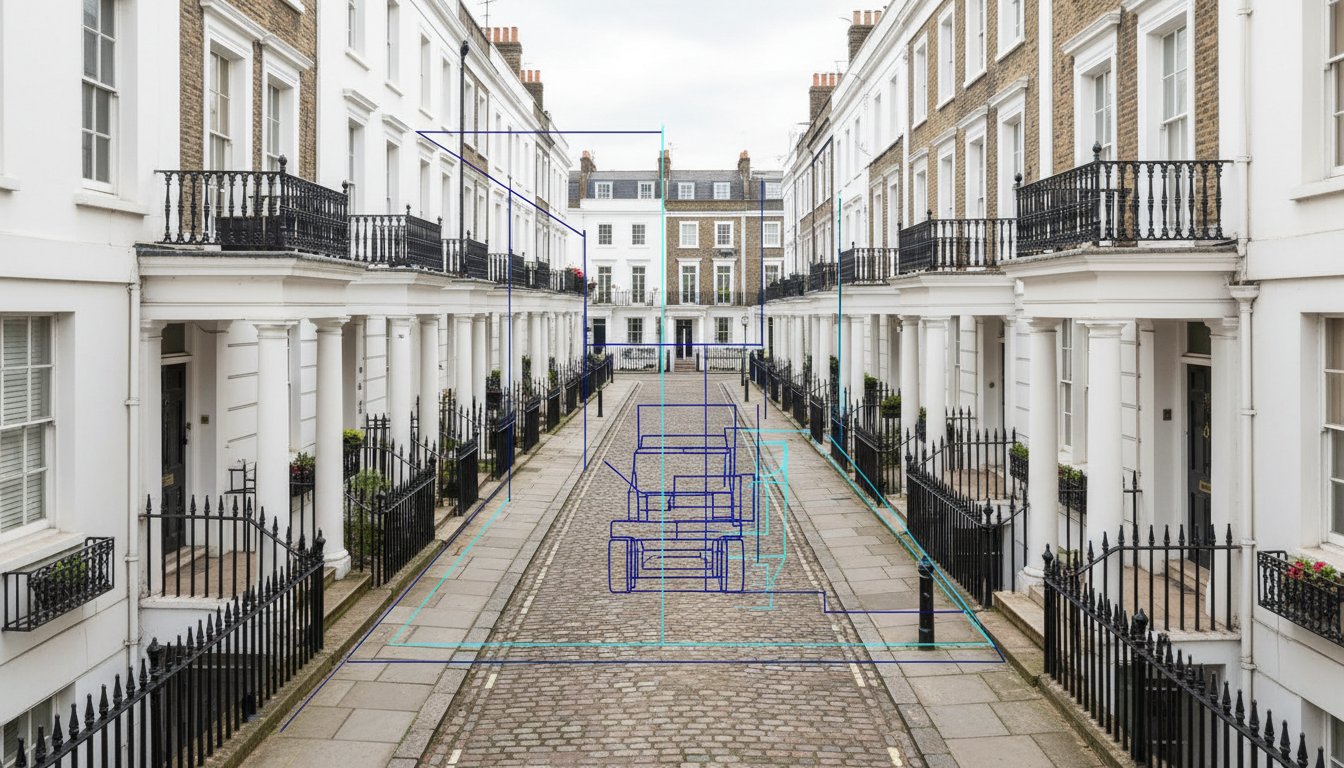
Securing planning permission in the Royal Borough of Kensington and Chelsea (RBKC) requires surgical precision rather than generic London-wide assessments. With the borough’s extreme density and narrow mews, a standard application often fails to address the unique logistical constraints that define this area. You probably recognize that strict parking policies and designated parking stress zones make obtaining approval a high-stakes challenge. As specialized Transport Planning Consultants Kensington and Chelsea, we understand that your project depends on technical accuracy and a deep knowledge of the New Local Plan adopted in July 2024.
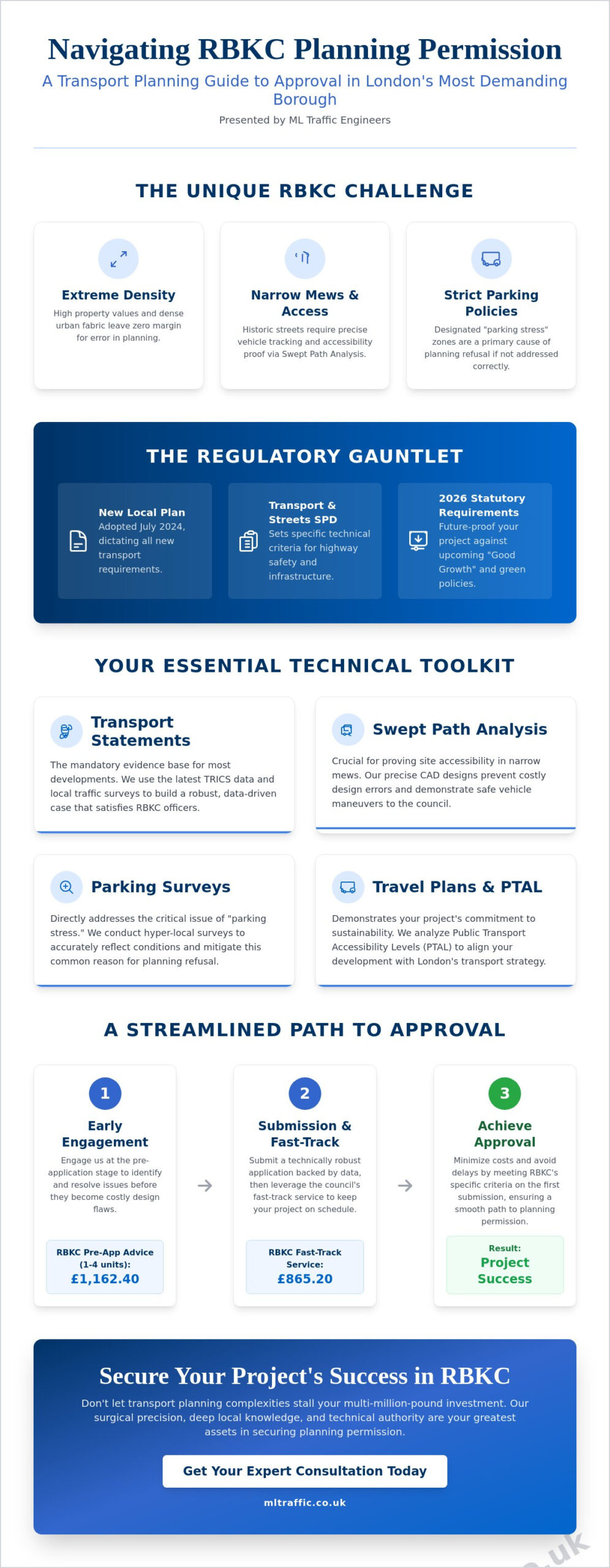
We’re here to help you master these complexities through expert Transport Statements and data-driven site analysis. You’ll learn how to minimize costs and avoid delays by meeting RBKC-specific criteria on your first submission. We provide clear guidance on navigating the 2026 statutory requirements, utilizing Swept Path Analysis for difficult access points, and leveraging the council’s £865.20 fast-track service to keep your development on schedule.
Key Takeaways
- Understand how the New Local Plan 2024 dictates transport requirements for all new developments within the borough.
- Partner with Transport Planning Consultants Kensington and Chelsea to ensure your Transport Statements meet the council’s rigorous technical standards.
- Utilize Swept Path Analysis and CAD design to prove site accessibility in narrow mews and high-density areas.
- Learn how to conduct parking surveys that accurately reflect local stress levels to minimize the risk of planning refusal.
- Discover the importance of PTAL ratings and Travel Plans in aligning your project with the Mayor of London’s Transport Strategy.
The Role of Transport Planning Consultants in Kensington and Chelsea
The Royal Borough of Kensington and Chelsea (RBKC) presents a unique environment where high property values meet extreme spatial constraints. In this high-stakes setting, Transport Planning Consultants Kensington and Chelsea act as the essential link between architectural vision and the rigid requirements of the local highway authority. Unlike other London boroughs, RBKC’s street network is characterized by historic mews and high-density residential blocks that leave zero margin for error in vehicle tracking or parking provision. We provide the technical authority needed to navigate these hurdles safely.
Professional transportation planning ensures that a development proposal doesn’t just look good on paper but functions safely within the existing road network. We mitigate the risks inherent in high-value projects, where a single rejection based on “parking stress” can stall a multi-million-pound investment for months. Our team translates complex traffic data into a clear, evidence-based narrative that satisfies council officers and statutory consultees during the planning process.
Navigating the RBKC Local Plan and Transport SPD
RBKC adopted its New Local Plan on July 24, 2024, replacing the 2019 version. This document, alongside the Transport and Streets SPD, sets the benchmark for all current and future applications. We prioritize early engagement with highway officers to identify potential roadblocks before the formal submission. Current policies focus heavily on “Good Growth” and enhanced green ambitions, meaning your project must demonstrate a net-positive impact on local traffic flow and safety to succeed in 2026.
When to Engage a Transport Consultant for Your Project
Don’t wait until the full planning submission to consider logistics. Engaging us during the pre-application stage allows us to spot hurdles like narrow access points or inadequate visibility splays before they become costly design errors. For the 2026-27 period, RBKC charges £1,162.40 for detailed residential pre-application advice for 1-4 units. A Transport Statement is a mandatory requirement for most RBKC developments to prove that the proposal will not negatively impact the local highway network. By reviewing our comprehensive support services, you can ensure every technical aspect of your submission is handled with precision and speed.
Transport Statements and Assessments for RBKC Planning Applications
RBKC planning officers demand technical rigor. For most small to medium developments in the borough, a Transport Statement serves as the primary evidence base. It isn’t just a formality; it’s a technical justification that proves your project won’t compromise highway safety or exacerbate local congestion. We use the latest TRICS data and local traffic surveys to build a robust case for your development. This data-driven approach ensures that your proposals are grounded in reality rather than estimates.
For more complex schemes, a comprehensive Transport Assessment is necessary. These reports delve into the cumulative impact of development on the wider network. We align every report with the Transport and Streets Supplementary Planning Document. This ensures your application meets the specific criteria set by the council for sustainable travel and infrastructure capacity. Integrating professional Transport Assessments London wide into your strategy is vital for navigating the city’s complex regulatory environment. As established Transport Planning Consultants Kensington and Chelsea, we provide the precision required for these high-stakes submissions.
Key Components of a Successful Transport Statement
A successful statement starts with a clear analysis of Public Transport Accessibility Levels (PTAL). In Kensington, PTAL ratings often dictate the maximum parking provision allowed under the New Local Plan. We calculate trip generation figures to show exactly how many new journeys your project will create. If the data suggests a potential impact on sensitive local mews or junctions, we develop practical mitigation strategies. This might involve enhancing pedestrian access or providing bespoke cycle storage solutions. You can view our range of technical services to see how we handle these specific requirements.
Transport Assessments for Major Kensington Developments
Major schemes, such as those within the Kensal Canalside or Earl’s Court Opportunity Areas, require sophisticated modeling. We analyze multi-modal transport impacts, ensuring that existing bus and tube networks can handle the increased demand. This process often involves direct collaboration with Transport for London (TfL) to ensure strategic corridors remain functional. Our reports focus on long-term viability, helping you meet the borough’s phased housing targets while maintaining the high standards of safety and accessibility that RBKC requires. We take the technical burden off your shoulders so you can focus on the broader project goals.
Overcoming Spatial Constraints: Swept Path Analysis and Parking Surveys
Kensington’s streetscape offers no room for error. Most residential developments in the borough involve narrow mews or basement excavations where access is physically limited. We provide high-precision Swept Path Analysis services to ensure your site layout works from day one. Without this technical proof, planning officers will likely refuse an application on the grounds of poor access or highway safety. As Transport Planning Consultants Kensington and Chelsea, we specialize in proving that your development can function safely within these historic constraints.
Our team uses advanced CAD design to simulate vehicle movements across your site. We don’t just test for standard passenger cars. We model the maneuverability of refuse vehicles and fire tenders to satisfy the strict requirements of the RBKC Transport and Streets SPD. Proving that these essential services can enter and exit in a forward gear is often the difference between approval and rejection. We ensure your technical reports meet 2026 safety standards and provide a “safe pair of hands” for your planning submission.
Swept Path Analysis for Tight Urban Sites
Tight urban sites in Kensington demand more than just a visual check. We use CAD-based tracking to provide a definitive feasibility study for your architectural plans. Our models cover a range of vehicle templates, from standard delivery vans to the largest HGVs permitted on local roads. By identifying potential “pinch points” early, we help you adjust your design before it reaches the planning committee. This proactive approach eliminates the risk of a late-stage refusal based on vehicle access issues.
Parking Surveys and the Lambeth Methodology in RBKC
Parking stress is a critical metric in RBKC planning decisions. The borough contains some of the highest-density residential areas in the UK, making on-street parking a finite and protected resource. We conduct parking surveys following the Lambeth Methodology, which is the industry standard recognized by RBKC officers. These surveys typically require overnight observations on two separate weekday nights to establish a baseline of “parking stress” within a 200-meter radius of your site.
As experienced Transport Planning Consultants Kensington and Chelsea, we use this data to justify car-free or car-capped developments. If your project has a high PTAL rating, we can demonstrate that the development won’t add to local parking pressure. We also address concerns regarding the loss of on-street spaces in residential mews, providing the technical evidence needed to mitigate local opposition. Our surveys give you the data required to navigate these sensitive negotiations with confidence.
Sustainable Development: Travel Plans and PTAL in Kensington
Sustainable transport strategies form the backbone of the New Local Plan 2024. In a borough as dense as Kensington and Chelsea, developers must prove they’re actively reducing car dependency to align with the council’s green ambitions. As Transport Planning Consultants Kensington and Chelsea, we design Travel Plans that satisfy both the Mayor of London’s Transport Strategy and local environmental goals. These documents act as a legal agreement between the developer and RBKC to ensure a long-term commitment to sustainable travel patterns.
Securing planning approval in 2026 requires more than just a mention of public transport. You need a robust strategy that prioritizes active travel and minimizes the impact on the local highway network. We recommend referencing our London Travel Plans guide to ensure your submission meets the latest compliance standards. Our team provides the technical authority to justify your transport proposals through evidence-based reporting and professional excellence. If you need immediate assistance with your submission, contact our expert consultants today for a comprehensive solution.
Developing Effective Residential and Workplace Travel Plans
Effective Travel Plans require clear, measurable targets. We establish baseline data and set realistic goals for reducing single-occupancy vehicle trips over a five-year period. In the Royal Borough, this often involves incentivizing cycling and walking through improved on-site facilities and localized travel information. The London Plan 2026 has introduced stricter requirements for site layouts, demanding better integration of cycle storage and pedestrian-friendly access points. We ensure your project stays ahead of these regulatory shifts by implementing monitoring regimes that satisfy RBKC officers.
PTAL and Parking Permit Restrictions
Public Transport Accessibility Level (PTAL) scores are the primary tool used by RBKC to determine parking provision. Most areas in Kensington and Chelsea boast high PTAL scores of 5 or 6, which typically triggers a “permit-free” development condition. This means residents of new developments aren’t eligible for on-street parking permits, a policy designed to protect existing parking capacity for current residents. We help you navigate these restrictions by providing the data needed to justify your scheme’s transport impact.
In pockets of the borough with lower PTAL scores, the challenge is different. We develop bespoke transport strategies that highlight alternative travel options, such as car clubs or proximity to major transport hubs like the upgraded South Kensington station. This technical approach allows us to argue for viable developments even in areas with perceived connectivity gaps. We take pride in delivering precision-led reports that address these specific RBKC parking permit restrictions, ensuring your project moves forward without regulatory delays.
Why Choose ML Traffic Engineers for Your RBKC Project?
ML Traffic Engineers provides the technical authority and professional excellence required for successful development in the Royal Borough. As established Transport Planning Consultants Kensington and Chelsea, we understand that precision is a legal and physical necessity. We operate with a sense of readiness and urgency that matches the fast-moving nature of the construction industry. Our team provides 24/7 availability to handle urgent planning deadlines or sudden technical queries from council officers. We position ourselves as a safe pair of hands, taking pride in our ability to deliver precision-led results that satisfy strict regulatory environments.
We balance technical authority with a customer-centric approach. This ensures we alleviate the logistical burdens placed on your project team. Our communication flow is logical and sequential, moving from initial consultation to final implementation without unnecessary delay. We use direct and functional sentence structures to prioritize clarity. This allows busy project managers to grasp key benefits quickly. We don’t just supply reports; we act as a vital guardian of professional integrity and public safety throughout the planning lifecycle.
A Comprehensive “Safe Pair of Hands” for Developers
Managing the regulatory burdens of RBKC planning requires more than just generic advice. We provide accurate data collection through professional parking and traffic surveys that reflect the true state of Kensington’s road network. Our team uses CAD design for Swept Path Analysis to prove site feasibility in even the tightest urban locations. You should explore what we do for London developers to see how our bespoke solutions integrate with your wider design goals. We maintain a standard of formal excellence that aligns with the borough’s expectations for high-value property developments.
Securing Your 2026 Planning Approval
Securing approval on your first submission saves time and minimizes costs. Our technical reports are engineered to withstand the most rigorous scrutiny from RBKC highway officers. We ensure every document, from Travel Plans to Transport Statements, adheres to the latest 2026 legislative requirements. You can access our full suite of technical resources to stay informed on the standards required for modern planning applications. Contact us today for a bespoke fee proposal tailored to your specific Kensington project. We remain available around the clock to ensure your development stays on track and meets every statutory deadline.
Secure Your Development’s Future in Kensington and Chelsea
Success in the Royal Borough requires more than just an architectural vision; it demands technical precision and an intimate understanding of the New Local Plan 2024. You’ve seen how accurate Swept Path Analysis and rigorous parking surveys form the foundation of any successful application. By addressing PTAL ratings and sustainable Travel Plans early, you can navigate the borough’s strict parking permit restrictions and avoid costly delays. As specialized Transport Planning Consultants Kensington and Chelsea, we provide the data-driven reporting needed to withstand council scrutiny.
Founded in 2014, ML Traffic Engineers brings over a decade of London planning experience to your project. We specialize in RBKC-specific technical requirements and offer 24/7 availability for your most time-sensitive submissions. Our team acts as a safe pair of hands, ensuring your project meets every safety and regulatory standard from day one. Contact ML Traffic Engineers for expert Transport Planning in Kensington and Chelsea to start your bespoke fee proposal. We look forward to helping you achieve a seamless planning approval.
Frequently Asked Questions
Do I need a Transport Statement for a small residential extension in Kensington?
Generally, small householder extensions without subterranean works don’t require a full Transport Statement. However, RBKC officers may request one if the proposal affects parking or access in a sensitive mews or high-density area. We recommend checking the specific requirements of the New Local Plan 2024 for your site’s location to avoid unexpected delays.
How does RBKC define “Parking Stress” for new developments?
RBKC defines parking stress as the percentage of on-street parking bays occupied within a 200-meter walking distance of a site. Surveys must follow the Lambeth Methodology, usually requiring overnight observations on two separate weekday nights. If stress levels exceed 80%, the council may restrict the development’s impact on local parking capacity to protect existing residents’ access.
What is the typical lead time for a Swept Path Analysis in London?
We provide a rapid turnaround for technical reports, often delivering results within 3 to 5 business days. Our 24/7 availability ensures that we can meet urgent planning deadlines for projects across London. We prioritize precision and speed to keep your development schedule on track while maintaining total legislative compliance.
Can a Transport Consultant help with a refused planning application in Chelsea?
Yes, we can assist by providing technical evidence to address specific reasons for refusal related to highway safety or parking. As experienced Transport Planning Consultants Kensington and Chelsea, we analyze the council’s feedback and produce data-driven reports, such as updated Swept Path Analysis or Parking Surveys. This professional approach often helps in securing approval upon resubmission or appeal.
What is a PTAL score and why does it matter for my Kensington project?
PTAL stands for Public Transport Accessibility Level and it measures the density and frequency of public transport near a site. A high PTAL score of 5 or 6 typically leads to “permit-free” development conditions in Kensington. This means residents won’t be eligible for on-street parking permits, which helps the council manage high local parking demand through sustainable travel policies.
Do ML Traffic Engineers provide Construction Traffic Management Plans (CTMP) for RBKC?
No, ML Traffic Engineers does not provide Construction Traffic Management Plans (CTMP) or Construction Logistics Plans. We specialize in the technical planning phase, focusing on Transport Statements, Swept Path Analysis, and Parking Surveys. This focus ensures we deliver high-quality technical data to support your initial planning application and master the complexities of RBKC’s regulatory environment.
How much does a Transport Statement cost for a project in Kensington and Chelsea?
The cost of a Transport Statement varies based on the project’s scale and the complexity of the local road network. We don’t offer flat-rate pricing because every Kensington project has unique technical requirements and spatial constraints. As Transport Planning Consultants Kensington and Chelsea, we encourage you to contact us for a bespoke fee proposal tailored to your specific site and development goals.
What vehicle templates are used for Swept Path Analysis in narrow mews?
We use specialized CAD templates for refuse vehicles, fire tenders, and standard passenger cars. For narrow Kensington mews, we specifically model the maneuvers of an 11.2m refuse vehicle or a standard fire appliance to ensure safe access. Proving these vehicles can enter and exit in a forward gear is a mandatory requirement for securing RBKC planning approval in high-density areas.

Article by
Michael Lee
Transport planner with over 35 years’ experience.
Disclaimer
The content on mltraffic.co.uk, including all technical articles, guides, and resources, is provided for general informational and educational purposes only. It is not intended to constitute professional advice in traffic engineering, transportation planning, development approvals, or any other technical or legal field.
While ML Traffic Engineers makes every reasonable effort to ensure the accuracy, completeness, and timeliness of the information published, we do not provide any warranties or representations (express or implied) regarding its reliability, suitability, or availability for any particular purpose. Any reliance you place on the content is strictly at your own risk.
In no event shall ML Traffic Engineers, its directors, employees, authors, or affiliates be liable for any direct, indirect, incidental, special, consequential, or punitive damages (including, without limitation, loss of profits, data, or business opportunities) arising out of or in connection with the use of, or inability to use, any information provided on this website.
The articles and guides on this site are not a substitute for engaging a qualified, professional traffic engineer to assess your specific project requirements. For tailored advice, compliance assessments, or traffic engineering services, please contact a competent professional.
This disclaimer may be updated from time to time without notice. By accessing or using this website, you agree to be bound by the most current version of this disclaimer.