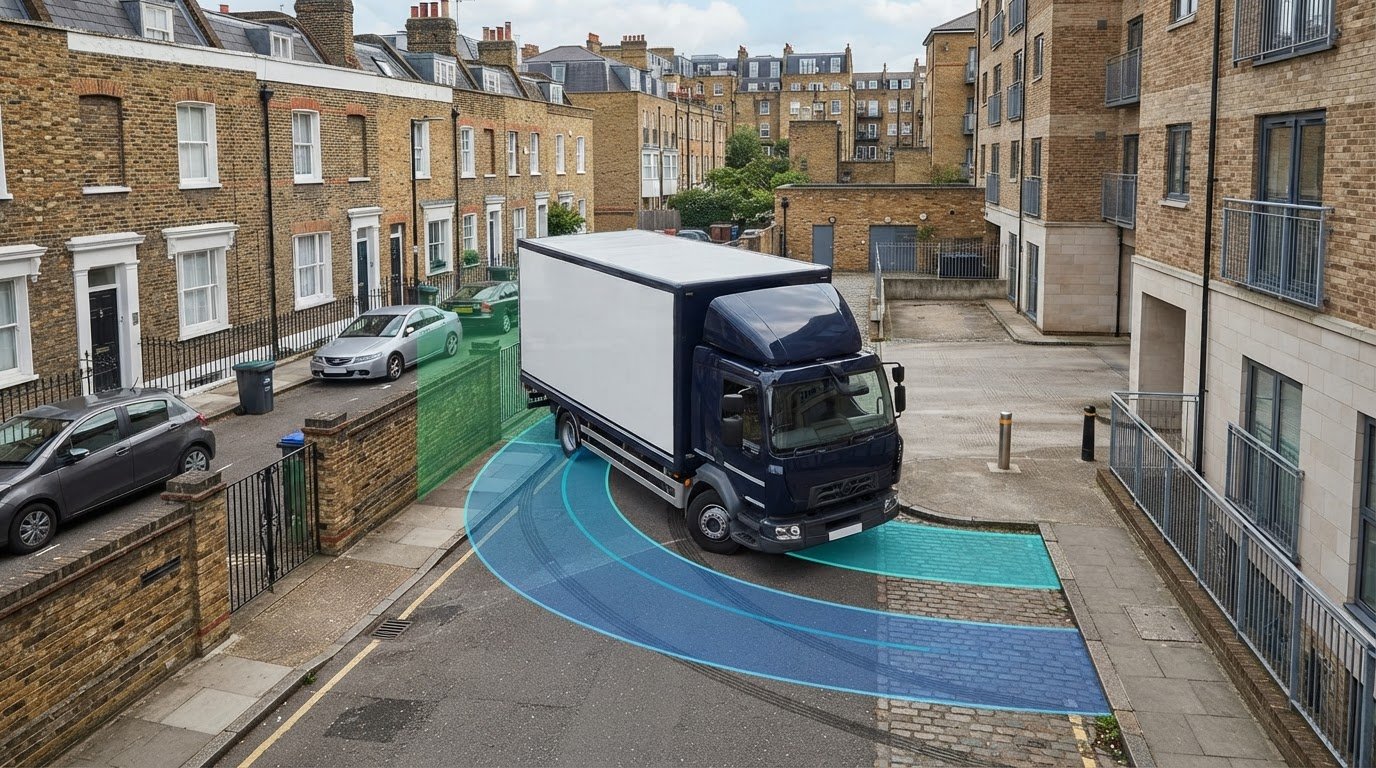
What if a pantechnicon can turn into a site but cannot complete the route once inside? A swept path analysis for pantechnicon vehicle access should assess the full manoeuvre, from the approach and entrance to the turning area and exit, rather than focusing on a single corner. Tight access, gates and narrow internal routes can all affect whether the vehicle can move through the site without conflicting with buildings, kerbs or other features.
Choosing a vehicle template and understanding what a swept path drawing demonstrates can be challenging. The assessment depends on project-specific information, including the proposed site layout and reliable dimensions for the vehicle expected to use it. This guide explains what the assessment tests, what information is needed and how to review the drawing for constraints while the design can still be revised. It also explains how the drawing can provide technical evidence of the manoeuvre assessed, with vehicle assumptions and site conditions made clear. ML Traffic Engineers UK prepares Swept Path Analysis to inform site design and transport planning documentation.
Key Takeaways
- Swept path analysis for pantechnicon vehicle access tests the vehicle’s movement envelope against the proposed route and site constraints.
- Use accurate, project-specific vehicle information and manoeuvre assumptions rather than relying on a generic vehicle label.
- Assess the complete route, including entrances, internal roads, corners, gates and loading areas, to identify potential conflicts.
- Review the drawing in sequence: confirm inputs, trace the route, inspect fixed features, resolve conflicts and update the layout.
- Clear, relevant drawings can inform site design and provide technical evidence for planning documentation.
What does swept path analysis for a pantechnicon vehicle show?
Swept path analysis for pantechnicon vehicle access plots the movement envelope of a selected vehicle completing a specified manoeuvre. It tests the proposed route against the site geometry, including boundaries, buildings, kerbs, gates and other identified constraints. The drawing shows the vehicle’s path and where its extremities may extend as it turns. It assesses a defined vehicle, route and set of manoeuvre assumptions, not every movement a driver might make on site.
Why a pantechnicon needs a representative vehicle assessment
A removal vehicle may need more manoeuvring space than a car or small van, particularly where its length and overhang affect turning. But “pantechnicon” does not describe one fixed set of dimensions or configuration. Select a representative vehicle using the information available about the intended site use and servicing requirements, rather than relying on the name alone. The Pantechnicon Wikipedia article provides background on the term and its use for removal vehicles.
For example, if a site is designed to receive a specific removals vehicle, assess it using that vehicle’s relevant dimensions and steering characteristics where available. If the expected vehicle has not yet been specified, state the assumptions used. A different size or configuration may produce a different movement envelope, so a result for one vehicle should not automatically be treated as proof that another can use the route.
What the swept path drawing communicates
A drawing typically shows the vehicle outline at points along the manoeuvre, its travel path and the wider area it occupies while turning. The body outline represents the vehicle itself; the swept envelope traces the area covered by its body and extremities throughout the movement. Front or rear overhangs can extend beyond the wheel path, making the envelope particularly relevant near corners, walls and parked vehicles.
Read the plotted movement against fixed site features. A tight corner may bring an overhang close to a boundary even when the wheels appear to clear it. An entrance, gate, loading area or obstruction may also restrict the route. Clear labels for the vehicle, direction of travel, manoeuvre and relevant assumptions help readers understand exactly what has been tested.
The drawing is technical evidence of a defined assessment, not a guarantee that every real-world manoeuvre will be completed in the same way. Its value depends on accurate vehicle and site information and on whether the plotted movement reflects the intended operation. If the design changes, for example, if a gate moves or the internal layout is revised, review the assessment against the new plan.
For a London development, swept path findings can form part of wider transport-planning evidence. The London transport assessment guide explains that broader planning context. The relevant highway authority guidance and planning requirements depend on the specific site. ML Traffic Engineers prepares Swept Path Analysis to inform site design and transport planning documentation.
How vehicle geometry and site layout shape a pantechnicon’s swept path
A plotted route depends on two sets of inputs: the vehicle’s geometry and the site layout. Overall dimensions alone do not tell the whole story. Turning behaviour also depends on characteristics such as wheelbase, steering geometry and front or rear overhang. Assumptions about speed or driving style cannot replace accurate vehicle information. The assessment should represent the intended vehicle and the manoeuvre it needs to perform.
Vehicle information needed for a credible assessment
Start with the vehicle type and configuration that reflect the project’s servicing requirements. Use suitable, verified vehicle data or a template that represents those details. Do not select a template simply because it is labelled “pantechnicon”: vehicles in this category can differ, and a mismatch can change the plotted envelope. If the operational vehicle has not been specified, record the assumptions so the drawing’s scope is clear.
Useful information may include the vehicle’s overall length and width, axle arrangement, wheelbase and overhangs, along with relevant steering characteristics. Use a source appropriate to the project vehicle, such as vehicle data provided for the intended operation. Do not fill gaps with guessed dimensions. A swept path analysis for pantechnicon vehicle access is only as representative as its vehicle inputs. If those inputs change, the assessment may need to be revisited.
Site features that can change the manoeuvre
The base plan needs to show the route and the features that could limit movement. Review more than the entrance: include the route to the loading or turning location and the exit if the vehicle must leave the site. A drawing that starts at a gate but omits a tight internal corner can miss the constraint that determines whether the whole movement works.
Check that the plan represents relevant physical features, including:
- Access width, kerb lines and changes in road alignment.
- Walls, columns, gates and other fixed obstructions near turning areas.
- Parking bays, loading areas and any space needed to complete the manoeuvre.
- The intended movement, including forward travel, reversing or a sequence of movements.
For example, a vehicle may clear an entrance when approaching straight on but need more room if it must turn immediately inside the boundary. A parked vehicle or gate position can further narrow the usable space. Show these details on the plan or reflect them in the assessment assumptions rather than treating the area as clear.
Use a current, dimensioned site layout and check that the vehicle and site information relate to the same design stage. Label assumptions and any clearance criteria clearly so reviewers can see what the drawing tests. ML Traffic Engineers prepares project-specific swept path analysis to assess proposed access and manoeuvring against site constraints.
Which vehicle template and manoeuvre should a pantechnicon analysis test?
Choose the vehicle the site is expected to accommodate, not the template that produces the simplest drawing. The right selection depends on the project brief and intended operation. A smaller vehicle may appear to clear an entrance or turn within a yard, but that result does not demonstrate that a larger removals vehicle can follow the same route.
Match the template to the intended operation
Use confirmed vehicle details where available and identify provisional assumptions separately. If several vehicle types will use the site, decide which distinct movements need assessment rather than treating one template as proof for all vehicles. The comparison below shows how to structure that choice without assuming that a generic vehicle label supplies reliable dimensions.
| Assessment option | Dimensions to use | Manoeuvre to test | How to interpret it |
|---|---|---|---|
| Project pantechnicon | Use the intended vehicle’s verified data. One example template in the research material lists 9.570 m overall length, 2.520 m overall width and a 10.450 m kerb-to-kerb turning radius. These are example values, not universal pantechnicon dimensions. | Test the access, internal route, loading or turning position, and exit required by the operation. | Use as the principal assessment when this is the vehicle the site is designed to serve. |
| Smaller alternative | Enter dimensions from the selected vehicle’s own data. Do not estimate them from “van” or another broad label. | Test its own route and turning movements if it is a genuine planned alternative. | A successful smaller-vehicle route does not establish access for the larger project vehicle. |
| Operational substitute | Use verified dimensions and steering information for the specific substitute vehicle. | Assess the manoeuvres it would actually make, including any different approach or loading position. | Include it only where it reflects a credible site operation described in the project brief. |
The example template can illustrate the information a comparison needs, but it should not be adopted automatically for a live proposal. Confirm the dimensions against the actual vehicle data or project brief. If the exact vehicle remains provisional, label the selected template and assumptions clearly so readers can distinguish an indicative assessment from one based on a confirmed vehicle.
Choose the access and turning scenarios
Set out the movement to be demonstrated: entry from the relevant approach, circulation to the required location and exit. Include constrained points such as a gate, tight corner or loading area. The assumed manoeuvre should match the operating arrangement, whether the vehicle can turn in one movement, needs to reverse or must reposition in stages.
Keep the scenario specific. A drawing of the entry alone will not test whether the vehicle can reach its destination and leave. Testing an unplanned reversing movement may also misrepresent how the site is intended to work. For further context on how analysis drawings present vehicle movements and assumptions, see the AutoTURN swept path analysis guide.
By comparing the project vehicle with credible alternatives, a swept path analysis for pantechnicon vehicle access can show which vehicle and manoeuvre the layout has actually been assessed for. ML Traffic Engineers provides project-specific swept path analysis support to turn those defined inputs into technical evidence for site design and planning documentation.
How to review a pantechnicon swept path before finalising the site layout
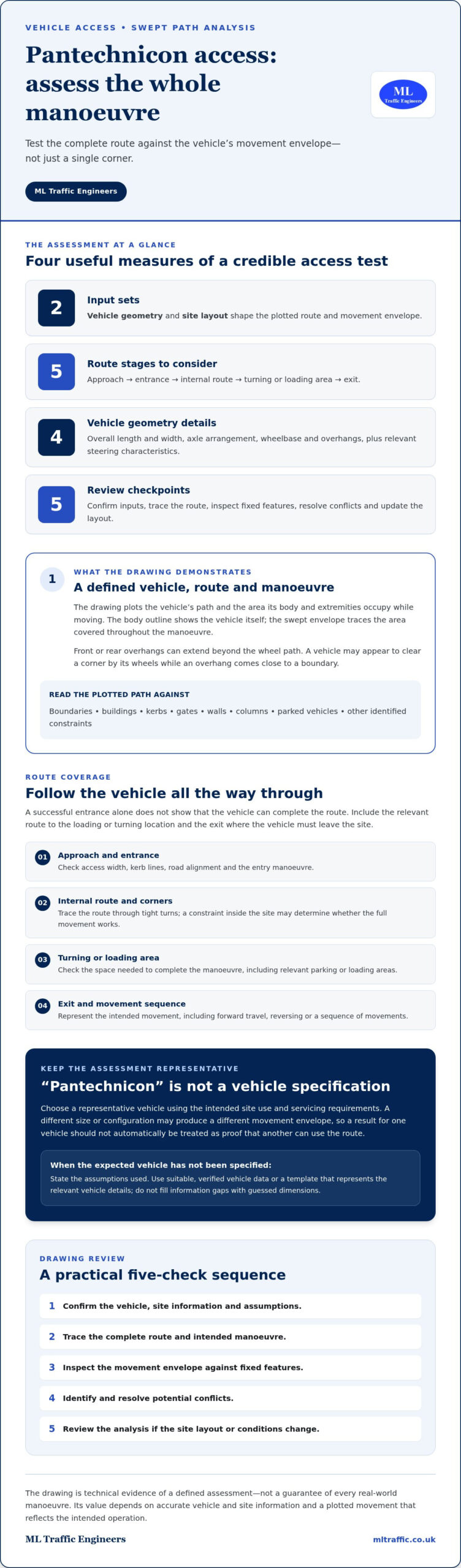
Review the drawing as a test of a defined vehicle movement against the current site plan. A line that appears to clear a corner at first glance may still pass close to a wall, gate or boundary elsewhere on the route. Work through the assessment in order, keeping its vehicle, manoeuvre and layout assumptions visible throughout.
- Confirm the inputs. Check that the drawing uses the intended vehicle information, current site layout and required manoeuvre. Note provisional assumptions so they are not treated as confirmed project facts.
- Trace the full route. Follow the vehicle from its approach through the entrance and internal circulation to the relevant destination, then check the exit movement. Look for changes in direction and any point where the vehicle needs to pause, reverse or reposition.
- Inspect constraints. Compare the plotted envelope with boundaries and fixed features such as walls, columns, kerbs and gates. Check entrance geometry, tight turns and available circulation space, not just the final turning area.
- Resolve potential conflicts. Identify where the envelope appears to overlap an obstruction or cross a boundary. Distinguish a plotted conflict from questions about the base plan, assumptions or intended operation that need project-team review.
- Update and review the drawings. If the layout or manoeuvre changes, revise the assessment and check it against the latest plan. Record the selected layout and any remaining assumptions consistently across project drawings.
Reading the plotted route and identifying conflicts
The vehicle envelope shows the area occupied during the assessed movement, so inspect its nearest approach to each relevant feature along the route. A line crossing a wall or gate on the plan flags a potential conflict under the plotted assumptions. On its own, it does not show whether the issue comes from the vehicle data, site information or an operational assumption. Resolve that distinction before treating the drawing as evidence that the layout works.
Pay close attention to the entrance and turns immediately beyond it. A manoeuvre may clear one location but become constrained further along by a change in alignment or a fixed object. Read the analysis as one continuous route, rather than as isolated snapshots that overlook the connection between movements.
Using findings to inform a revised layout
Where a conflict appears, the design team can assess options such as changing access geometry, adjusting the internal arrangement or reconsidering the manoeuvre. These are options to test against the site and operating requirements, not guaranteed fixes. Any material change to the vehicle, layout or movement assumptions may alter the result, so update the drawing before relying on it in design or planning documentation.
For a pantechnicon proposal, project-specific swept path analysis can help clarify whether a revised arrangement addresses the identified constraints. The AutoTURN swept path analysis guide offers further context on interpreting analysis drawings. ML Traffic Engineers’ swept path analysis support is tailored to the site layout and proposed movement.
How ML Traffic Engineers can support pantechnicon swept path analysis
Project-specific swept path analysis can assess whether a pantechnicon’s proposed access and internal route suit the vehicle and manoeuvre the development intends to accommodate. ML Traffic Engineers prepares Swept Path Analysis to help identify potential constraints and inform site design. The drawing can also support wider transport-planning evidence by showing what movement has been assessed and how it relates to the proposed layout. It informs a planning proposal but does not guarantee planning approval.
ML Traffic Engineers supports development projects across Greater London, Manchester, Birmingham, the West Midlands, Liverpool, Surrey, East Sussex, West Sussex, Hampshire, Berkshire and Buckinghamshire. For projects in these areas, a site-specific assessment can help the design team understand how the proposed vehicle movement relates to the current layout.
What to provide for a project-specific assessment
Useful project information helps ensure the drawing reflects the intended operation. Provide the latest available site layout and identify the entrance, route and destination the vehicle needs to reach. Include verified vehicle information or the specified template, and describe the site use and manoeuvre the assessment needs to demonstrate.
- Site layout: Share a current plan showing the access, internal circulation, loading or turning area, and relevant fixed features.
- Vehicle information: Provide the intended vehicle’s verified dimensions or project-specified template. Identify any details that remain provisional.
- Operational purpose: Explain why the pantechnicon will use the site and where it needs to travel.
- Required manoeuvre: Describe the movement to be tested, including whether it involves forward travel, reversing or repositioning.
These inputs allow the assessment to reflect the project brief rather than a generic vehicle label. If the vehicle, route or proposed layout changes, review the drawing against the updated information. Keeping the plan and assessment assumptions aligned also makes it easier for the project team to understand the drawing’s scope and use it during design development.
Turning the analysis into useful planning evidence
A clear drawing should let a reviewer follow the vehicle movement and understand how it relates to the site. Legible route lines, vehicle identification and stated assumptions help distinguish the tested manoeuvre from movements the drawing does not assess. This makes the analysis more useful alongside other transport-planning documents, while keeping its conclusions tied to the information and scenario shown.
Planning and highway authority requirements depend on the location and proposal, so consider the assessment in that specific context. For London developments, the London transport assessment planning guide provides wider context on transport evidence for planning. The swept path drawing can inform a submission, but the relevant decision-maker considers it as part of the wider application.
For a development project that needs to demonstrate pantechnicon access, ML Traffic Engineers provides pantechnicon swept path analysis. A project-specific assessment can clarify the movement being tested and provide technical information to support site design and planning documentation.
Carry the access assessment into your next design decision
A swept path drawing is most useful when it helps the project team make a clear design decision. Use the assessment to identify access questions that need resolving, then keep the vehicle and manoeuvre assumptions aligned with the layout being progressed. This gives the team a consistent basis for coordinating the site design and its planning evidence.
If your proposal depends on pantechnicon access, a project-specific swept path analysis for pantechnicon vehicle movements can clarify the route being assessed and inform the next design step. ML Traffic Engineers provides Swept Path Analysis and prepares transport planning documents for development proposals, including planning applications.
Discuss your pantechnicon swept path analysis with ML Traffic Engineers to move your project forward with a clearer understanding of the proposed access. A project-specific assessment can help inform the design and the next planning steps.
Frequently Asked Questions
Is a pantechnicon the same as a standard removal van?
Not always. “Pantechnicon” is commonly used for a removal vehicle, but it does not identify one standard size or configuration. A vehicle used for a household move may differ from another removals vehicle in its dimensions and steering characteristics. For an access assessment, use the actual vehicle details where available, rather than assuming any vehicle described as a removal van represents the one expected to visit the site.
Can one swept path drawing cover more than one pantechnicon?
It can show more than one vehicle or movement if each is identified clearly, but the result for one vehicle should not be taken as proof for another. For example, two vehicles with different dimensions may have different clearance needs at the same entrance. Make the drawing or drawing set clear about which vehicle, route and manoeuvre each plotted path represents, so the assessment’s scope is easy to understand.
Does swept path analysis account for people walking across the access route?
Not by itself. A swept path assessment plots vehicle movement, so a pedestrian crossing the route is not automatically represented as a person or as a conflict in the drawing. If people may walk through the access, consider that interaction in the wider site and transport review. A vehicle path that fits within the layout does not, on its own, demonstrate how pedestrian movement will be managed.
Can the analysis use an estimated vehicle size if the exact pantechnicon is unknown?
It can use a suitable provisional template to explore a design, but the assumptions should be stated and the result treated as indicative for that vehicle representation. Do not invent dimensions to fill gaps. For a swept path analysis for pantechnicon vehicle access, record the template source or basis and revisit the assessment if the specified vehicle differs, since even a modest change could affect a constrained turn.
Will a successful pantechnicon swept path prove that a site is safe?
No. A successful plot shows that the selected vehicle can complete the defined manoeuvre within the represented layout and assumptions. It does not prove that every operating condition is safe or cover issues outside the assessment, such as pedestrian activity, visibility, driver behaviour or changing site conditions. Use the drawing as one piece of technical evidence, alongside the project team’s wider consideration of how the site will operate.
Do planning authorities always require pantechnicon swept path drawings?
No, a pantechnicon drawing is not automatically required for every proposal. Whether vehicle tracking is needed depends on the development, proposed access and relevant planning or highway authority requirements. A constrained entrance or specific removals servicing arrangement may make a drawing useful to explain the design. For projects in Greater London, Manchester or elsewhere in the UK, assess the proposal against the requirements applicable to its site.
What should be labelled on a pantechnicon swept path drawing?
Label the vehicle or template, its key dimensions where available, direction of travel, route and manoeuvre being tested. Identify the drawing scale or plan reference and make the relevant assumptions clear, including any provisional vehicle details. The site features needed to interpret the result, such as boundaries and fixed obstructions, should be legible. Clear labels help a reviewer distinguish the assessed movement from routes or vehicles the drawing does not cover.

Disclaimer
The content on mltraffic.co.uk, including all technical articles, guides, and resources, is provided for general informational and educational purposes only. It is not intended to constitute professional advice in traffic engineering, transportation planning, development approvals, or any other technical or legal field.
While ML Traffic Engineers makes every reasonable effort to ensure the accuracy, completeness, and timeliness of the information published, we do not provide any warranties or representations (express or implied) regarding its reliability, suitability, or availability for any particular purpose. Any reliance you place on the content is strictly at your own risk.
In no event shall ML Traffic Engineers, its directors, employees, authors, or affiliates be liable for any direct, indirect, incidental, special, consequential, or punitive damages (including, without limitation, loss of profits, data, or business opportunities) arising out of or in connection with the use of, or inability to use, any information provided on this website.
The articles and guides on this site are not a substitute for engaging a qualified, professional traffic engineer to assess your specific project requirements. For tailored advice, compliance assessments, or traffic engineering services, please contact a competent professional.
This disclaimer may be updated from time to time without notice. By accessing or using this website, you agree to be bound by the most current version of this disclaimer.