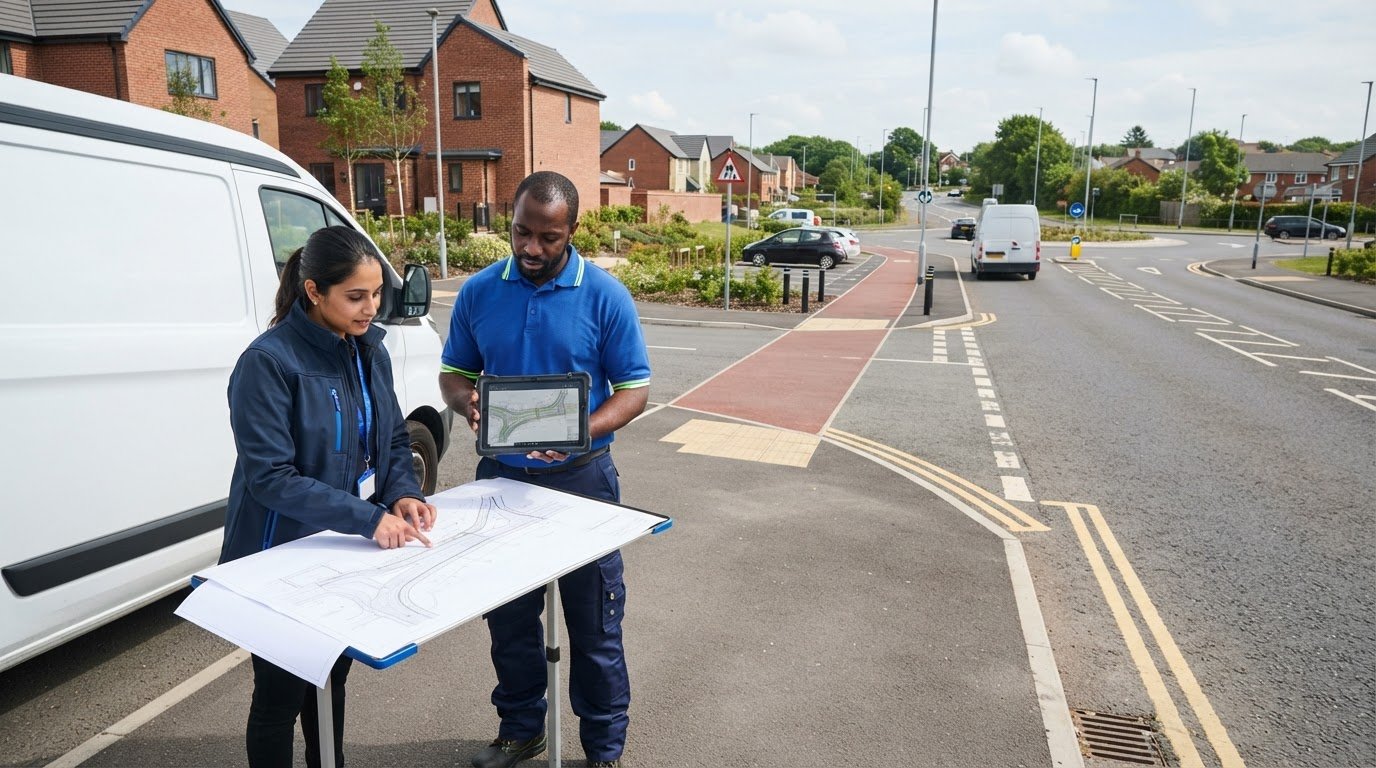
A site layout that looks workable on paper can unravel when access, parking, servicing or traffic impacts are examined. Appointing a highway consultant for planning application support early can help identify these issues and turn them into practical design decisions and proportionate transport evidence, before they delay a submission.
It is not always clear whether a proposal needs a Transport Statement, a fuller Transport Assessment, technical drawings or survey data. The right evidence depends on the site, the scale of development and the highway questions involved. Transport work should also stay aligned with the wider planning design, rather than arrive as an afterthought.
This guide explains when highway expertise may be useful, what a consultant can contribute and how the work supports an application. You’ll learn how Transport Statements and Assessments differ, when surveys and Swept Path Analysis can help, and how early transport input can inform access, parking and layout decisions. ML Traffic Engineers UK prepares project-specific transport reports, surveys and technical analysis for planning projects across Greater London, Manchester, Birmingham, the West Midlands, Liverpool, Surrey, East Sussex, West Sussex, Hampshire, Berkshire and Buckinghamshire.
Key Takeaways
- Consider whether access, parking, servicing or traffic effects could influence your proposal. The evidence needed depends on the site and its likely impacts.
- A highway consultant for planning application support can help identify suitable transport evidence, from a Transport Statement to a Transport Assessment or Travel Plan.
- Local street layouts, junctions, parking controls and walking routes can shape the analysis and inform design decisions.
- Bring transport considerations into layout development early, then coordinate the relevant plans, surveys and reports with the wider application.
- Project-specific surveys and Swept Path Analysis can help answer practical planning questions about movement, access and parking.
When does a planning application need a highway consultant?
Transport or access issues may affect a proposal depending on the site, what you plan to build or change, the likely effects on the surrounding highway network and feedback from the relevant authorities. A small scheme can raise a specific access or parking concern, while a larger development may involve several transport questions. There is no universal threshold that determines when every applicant needs highway input.
Planning permission considers whether a proposed development is acceptable in its location and context. A highway consultant helps assess the transport aspects of a proposal and prepare relevant technical evidence for the application. Early input can inform the design, but it cannot guarantee that an application will be validated or that permission will be granted.
Which development characteristics can trigger highway input?
Look for changes that could affect how people or vehicles reach, use or move around the site. A potential trigger is a question to assess, not an automatic requirement for a particular report. Depending on the proposal, relevant issues may include:
- Access: creating or changing a vehicle entrance, including whether drivers can see approaching traffic when entering or leaving.
- Vehicle movements: changes in the number or type of trips, or how traffic could interact with nearby streets and junctions.
- Servicing: how delivery, refuse or other service vehicles can enter, turn and leave the site.
- Parking: the amount and arrangement of parking, and how existing parking controls or demand could affect the proposal.
- Walking and cycling: connections between the site and nearby routes, including whether the layout provides practical access for pedestrians and cyclists.
For example, a small change of use might make servicing or parking the main consideration. A larger housing or mixed-use proposal could raise questions about access, travel patterns and junction effects together. The appropriate evidence depends on the likely impacts and the authority’s requirements, not simply the development label.
Does every planning application need a highway consultant?
No. The need for specialist input, and its scope, should be proportionate to the proposal and its setting. A development with no material change to access or transport effects may raise different questions from one beside a constrained road or involving a new site entrance. The local planning authority may consult the local highway authority for its technical view on highway matters.
Identify constraints before fixing the site layout. Entrance position, parking arrangement and building orientation can be difficult to change once other design work is underway. An early review can flag questions for the project team and help define suitable evidence. It does not replace the planning authority’s assessment, and submission requirements can vary by location.
What does a highway consultant prepare for a planning application?
The right transport evidence answers the planning questions raised by a specific proposal. A highway consultant for planning application support can prepare reports and technical analysis to explain likely effects, test design details and address relevant authority requirements. The scope should reflect the development and its transport impacts, rather than defaulting to the longest report title.
Transport Statement, Transport Assessment, or Travel Plan?
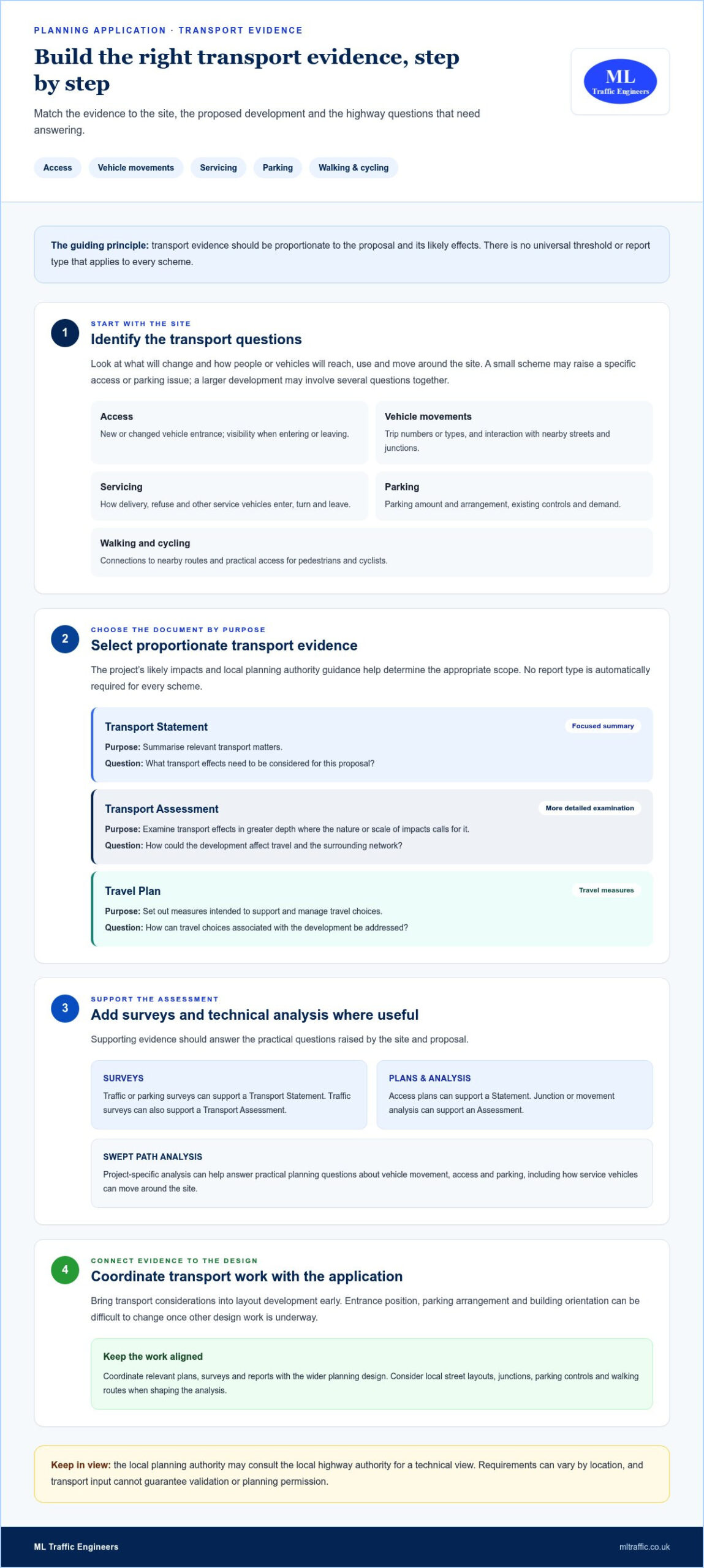
These documents serve different purposes. A Transport Statement sets out transport considerations for a proposal in a focused way. A Transport Assessment examines transport effects in greater depth where the nature or scale of impacts calls for it. A Travel Plan sets out measures intended to support and manage travel choices associated with a development. The local planning authority’s guidance and the project’s impacts help determine the appropriate scope. No report type is automatically required for every scheme.
For London schemes, applicants can review Transport Assessment guidance for London projects alongside current local requirements. Whichever document is appropriate, its purpose is to address the transport questions relevant to the proposal and provide evidence for consideration alongside the rest of the application.
| Evidence | Purpose | Typical question answered | Possible supporting evidence |
|---|---|---|---|
| Transport Statement | Summarise relevant transport matters | What transport effects need to be considered for this proposal? | Traffic or parking survey, access plans |
| Transport Assessment | Examine transport effects in more detail | How could the development affect travel and the surrounding network? | Traffic surveys, junction or movement analysis |
| Travel Plan | Set out measures to support and manage travel | How can travel choices associated with the development be addressed? | Site and user information, proposed measures |
When do surveys or Swept Path Analysis support the application?
Surveys can establish existing conditions when an application needs evidence about traffic movements or parking. A traffic survey may describe activity on nearby roads, while a parking survey can record the use of parking in the relevant area. Whether either is useful depends on the question being examined, the survey scope and authority requirements.
Swept Path Analysis tests whether selected vehicles can manoeuvre through a proposed layout. It can help assess access, turning areas, servicing space or parking arrangements before plans are finalised. For useful results, the analysis needs to reflect the actual site layout and the vehicles relevant to the proposal. See Swept Path Analysis for planning applications for a practical overview.
ML Traffic Engineers tailors reports, surveys and technical analysis to planning-stage questions and site constraints. If you’re coordinating evidence for a proposal, explore ML Traffic Engineers’ planning support as part of preparing a coordinated application.
How do local highway conditions shape transport evidence?
Transport evidence should describe the site and the network it connects to. The same development can raise different questions in different places: an access onto a narrow residential street presents different conditions from one beside a busy junction or a road with parking restrictions. Focus the evidence on the actual constraints and likely effects, rather than relying on a generic description of the area.
Useful transport evidence reflects the real site, its surrounding network and the proposal shown on the plans. Check that drawings and reports refer to the same access, layout, parking provision and development details. If the design changes, review the supporting evidence so it remains consistent.
What local transport context should the assessment consider?
A project-specific review may consider how vehicles currently enter and leave the site, nearby street layouts and junctions, parking controls, surrounding land uses and available walking or cycling routes. Existing conditions can point to the evidence needed: a survey may help establish traffic or parking activity, while a proposed layout may raise questions about vehicle manoeuvres or connections to the street.
For example, a proposal in Greater London may need to consider local parking arrangements and walking links, while a site in Hampshire or the West Midlands may have different road layouts and travel options. These examples do not establish a common rule for either area. Policy, survey methods and authority guidance depend on the specific location and proposal.
Evidence also needs to match the submitted plans. If a report describes one entrance but the drawings show another, or the assessment assumes a different amount of parking, decision-makers may not be able to assess the proposal clearly. Keep the site plan, transport analysis and application details aligned as the design develops.
How do planning and highway authorities contribute?
The local planning authority determines the planning application, considering it against relevant planning matters. It may seek technical comments from the local highway authority, which provides highway-related input on matters such as access, traffic effects and connections to the local road network. The responsible bodies and guidance depend on the location.
Authority feedback can clarify which transport questions need evidence or whether the submitted material needs further explanation. It can inform the scope, but it does not make consultation outcomes or planning permission certain. Use the current guidance for the site rather than assuming another authority’s requirements apply.
A highway consultant for planning application evidence can relate technical work to local conditions, from the access and street network to relevant travel options. That context helps keep the assessment grounded in the proposal being considered.
When should you appoint a highway consultant, and what happens next?
Bring transport advice into the project while the site layout is still taking shape, not only when the planning documents are nearly complete. An early review can show how access, parking, servicing or vehicle movement questions relate to the design, giving the team time to consider them before changes become harder to coordinate.
Early transport input helps align the proposal and its supporting evidence, but it cannot guarantee planning permission. A highway consultant for planning application support can review the brief, identify relevant transport questions and tailor technical work to the proposal and site.
What information helps start a transport planning review?
Share the information already available, even if some design details are still developing. A useful starting pack may include:
- A location plan and the current or emerging site layout.
- A description of the proposed development and its intended use.
- Available access details, including any known constraints at the site entrance.
- Known questions about parking, servicing, traffic movements or vehicle manoeuvring.
- Relevant planning correspondence, including authority comments or guidance already received.
These details give the review a clear starting point. If the layout or development description is still evolving, note what is provisional and update the project brief as decisions are made. This keeps later analysis focused on the proposal being prepared, rather than on assumptions that may no longer apply.
How does transport input fit into application preparation?
A coordinated process connects the initial review to the final submission. The exact scope depends on the project, but the work can follow a practical sequence:
- Set the brief: share the plans, proposal details, known constraints and relevant authority feedback.
- Review the transport questions: identify which aspects of access, movement, parking or travel need further consideration.
- Inform the design: use findings to help the project team consider layout choices while options remain open.
- Prepare proportionate evidence: develop the relevant report, survey or technical analysis to address the project’s planning-stage questions.
- Coordinate the submission: align the transport material with the current plans and other application documents.
Travel measures may also form part of the application where they are relevant to the proposal. For London schemes, London Travel Plans for planning applications can help explain how a Travel Plan relates to application preparation. At each stage, tailor the scope and supporting evidence to the site, design and applicable local guidance.
Share your emerging plans with ML Traffic Engineers to discuss transport evidence for your planning application.
How ML Traffic Engineers UK supports highway planning applications
ML Traffic Engineers provides project-specific transport evidence to support planning applications. The consultancy prepares reports, carries out traffic and parking surveys, and undertakes Swept Path Analysis. The right combination depends on the proposal, site constraints and the questions that need to be addressed at the planning stage.
A coordinated range of transport planning evidence
Transport Statements and Transport Assessments set out relevant transport matters and potential effects at a scope suited to the project. A Travel Plan can address measures for managing travel associated with a development. Supporting technical work can provide evidence about existing conditions or test practical design details.
- Traffic surveys can provide information about observed traffic conditions relevant to the assessment.
- Parking surveys can help establish how parking is used in the area under review.
- Swept Path Analysis can test how vehicles manoeuvre within a proposed site layout.
Choose these inputs to answer project-specific questions, rather than treating them as a standard package. For example, a proposal with a servicing or turning concern may call for vehicle movement analysis, while another site may need evidence about traffic or parking conditions. Keep reports and technical analysis consistent with the current plans and relevant planning guidance. ML Traffic Engineers’ transport planning services and technical analysis bring these types of evidence together around the application’s needs.
The consultancy works across Greater London, Manchester, Birmingham, the West Midlands, Liverpool, Surrey, East Sussex, West Sussex, Hampshire, Berkshire and Buckinghamshire. Local context matters: applicable authority guidance and transport questions vary by site, so evidence is tailored to the location and proposal.
Discuss your planning application with ML Traffic Engineers UK
Developers, landowners, architects and planning agents can outline their project to establish the relevant transport questions. Useful starting details include the site location, proposed development, application stage and any known highway concerns. Plans and authority correspondence can help frame the scope. If some details are still emerging, the brief can develop as the design progresses.
This information connects the proposed layout with the transport evidence being prepared. It gives the project team a clear basis for considering which reports, surveys or technical analysis may be relevant, without assuming every application needs the same documents or level of assessment.
Discuss your planning application with ML Traffic Engineers and outline the site, proposal and transport questions you need to address.
Make transport part of your next planning decision
Bring transport questions into the project conversation while there is still room to consider design options. Gather the plans and any authority feedback you have, then identify what remains uncertain about access, movement, parking or servicing. A focused discussion with a highway consultant for planning application support can turn those questions into a project-specific brief for transport evidence.
ML Traffic Engineers helps developers, landowners, architects and planning agents consider the transport inputs relevant to their proposals. Share the site location, current design and application stage, along with any known highway constraints. The brief can develop as the design takes shape.
Discuss your planning application with ML Traffic Engineers and take the next step towards coordinating transport evidence with your proposal.
Frequently Asked Questions
Can a highway consultant help before I buy or develop a site?
Yes. A review before purchase or early site design can help identify transport questions that may affect how the land could be used. An existing entrance, limited space for vehicles to turn or access arrangements shown on earlier plans may deserve closer attention. The review can inform your next steps, but it cannot establish that a particular development will receive planning permission.
What is the difference between a highway consultant and a transport planner?
The roles can overlap, and terminology varies between projects. A highway consultant commonly focuses on how a development relates to roads, access, vehicle movements and supporting technical evidence. A transport planner may consider a wider range of travel matters, such as how people could reach a site by different modes and how travel choices might be addressed. The project brief and required outputs are more useful guides than the job title alone.
Who decides whether a Transport Statement or Transport Assessment is required?
The local planning authority considers what information it needs to determine the application, taking account of its guidance and the proposal’s likely effects. It may seek technical advice from the local highway authority, whose comments can inform the evidence requested. The relevant authority’s current guidance can help clarify requirements for the site and application type. The appropriate document and its scope depend on the specific planning questions.
Can a highway consultant guarantee planning permission?
No. A consultant can prepare transport evidence and explain how it relates to a proposal, but the planning authority decides the application. Its decision may consider transport alongside other planning matters, and no report can control that judgement. Clear, relevant evidence can help address transport questions, but it is not a promise of approval. Treat technical advice as support for decision-making, not as a guaranteed outcome.
Do highway consultants assess site access and vehicle movements?
Yes. Transport planning work can examine access arrangements and vehicle movements. Swept Path Analysis, for example, tests whether a specified vehicle can manoeuvre through a proposed layout, such as turning within a site or reaching a servicing area. The assessment depends on the drawings and vehicle assumptions used, so these should reflect the current design. Findings can help the project team consider layout changes before plans are finalised.
Can highway planning advice be provided outside London?
Yes. ML Traffic Engineers works in Greater London and locations including Manchester, Birmingham, the West Midlands, Liverpool, Surrey, East Sussex, West Sussex, Hampshire, Berkshire and Buckinghamshire. A project outside London still needs evidence suited to its site and the relevant local authority’s guidance. Local roads, access arrangements and planning requirements differ, so advice and technical work should be tailored to the proposal’s location rather than copied from another area.

Disclaimer
The content on mltraffic.co.uk, including all technical articles, guides, and resources, is provided for general informational and educational purposes only. It is not intended to constitute professional advice in traffic engineering, transportation planning, development approvals, or any other technical or legal field.
While ML Traffic Engineers makes every reasonable effort to ensure the accuracy, completeness, and timeliness of the information published, we do not provide any warranties or representations (express or implied) regarding its reliability, suitability, or availability for any particular purpose. Any reliance you place on the content is strictly at your own risk.
In no event shall ML Traffic Engineers, its directors, employees, authors, or affiliates be liable for any direct, indirect, incidental, special, consequential, or punitive damages (including, without limitation, loss of profits, data, or business opportunities) arising out of or in connection with the use of, or inability to use, any information provided on this website.
The articles and guides on this site are not a substitute for engaging a qualified, professional traffic engineer to assess your specific project requirements. For tailored advice, compliance assessments, or traffic engineering services, please contact a competent professional.
This disclaimer may be updated from time to time without notice. By accessing or using this website, you agree to be bound by the most current version of this disclaimer.