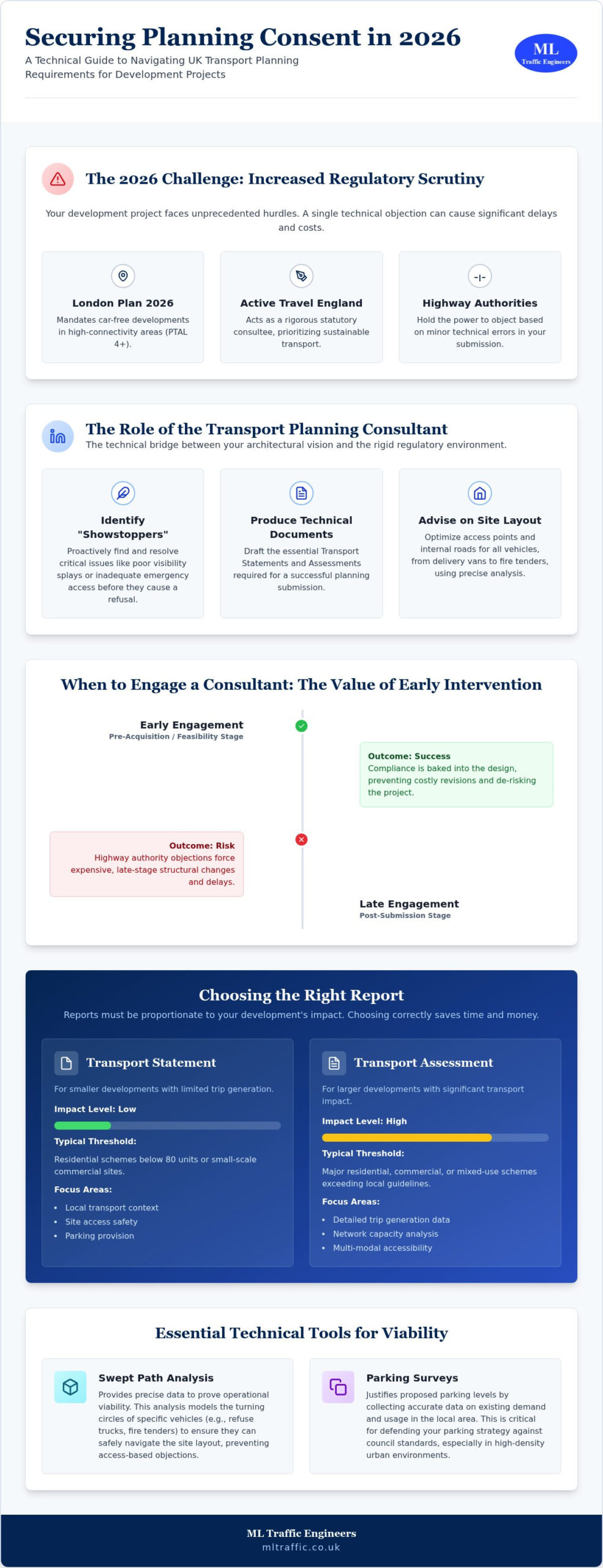
Did you know that the Draft London Plan 2026 now mandates entirely car-free developments for any site with a Public Transport Accessibility Level (PTAL) score of 4 or higher? For developers, this shift turns a standard application into a high-stakes regulatory hurdle. You’re likely familiar with the frustration of planning refusals triggered by transport objections or the long delays while waiting for a technical Swept Path Analysis. It’s a demanding environment where a single oversight in a Parking Survey can stall a multi-million pound project and lead to expensive, conflicting requirements from different London Boroughs.
Securing approval in this climate requires more than just technical drawings; it demands a transport planning consultant london who acts as a strategic negotiator with Highway Authorities. This 2026 guide explains how a specialist transport planning consultant navigates London’s intricate regulatory landscape to secure your project’s planning consent. We’ll cover how to manage the new Sustainable Access Measure (SAM), optimize your Transport Statements for first-time approval, and implement cost-effective mitigation strategies that protect your margins. By understanding these technical requirements early, you can ensure clear communication with stakeholders and move your project from inception to completion without unnecessary regulatory friction.
Key Takeaways
- Understand how a transport planning consultant london acts as a technical bridge between developers and Highway Authorities to streamline the planning approval process.
- Identify why data-driven documents like Transport Statements and Swept Path Analysis are essential for proving vehicle maneuverability on restricted urban sites.
- Navigate the complexities of Public Transport Accessibility Level (PTAL) ratings and their direct impact on parking provision and site density expectations.
- Learn the critical criteria for evaluating a consultancy, focusing on borough-specific experience and proficiency with industry-standard tools like AutoTURN and TRICS.
- Discover the advantages of a fully-managed service that handles everything from initial traffic surveys to final technical reports for maximum regulatory compliance.
The Role of a Transport Planning Consultant in London Projects
A transport planning consultant london acts as the technical bridge between private developers and the Highway Authorities. In the high-density environment of the capital, transportation planning involves balancing commercial viability with strict public safety and infrastructure capacity. Unlike the rest of the UK, London operates under a unique tier of governance where Transport for London (TfL) and individual boroughs often maintain conflicting requirements. Early engagement identifies critical access and parking constraints before they become project-killing objections during the committee stage.
To better understand the complexities of modern infrastructure decisions and how they impact development logic, watch this helpful video:
Professional reporting mitigates the risk of costly planning refusals. By providing data-driven evidence through Swept Path Analysis and traffic surveys, consultants ensure that a proposal is technically sound from day one. This proactive approach reduces the logistical and regulatory pressures on the developer, allowing for a smoother transition from initial assessment to final execution.
When is a Transport Consultant Required?
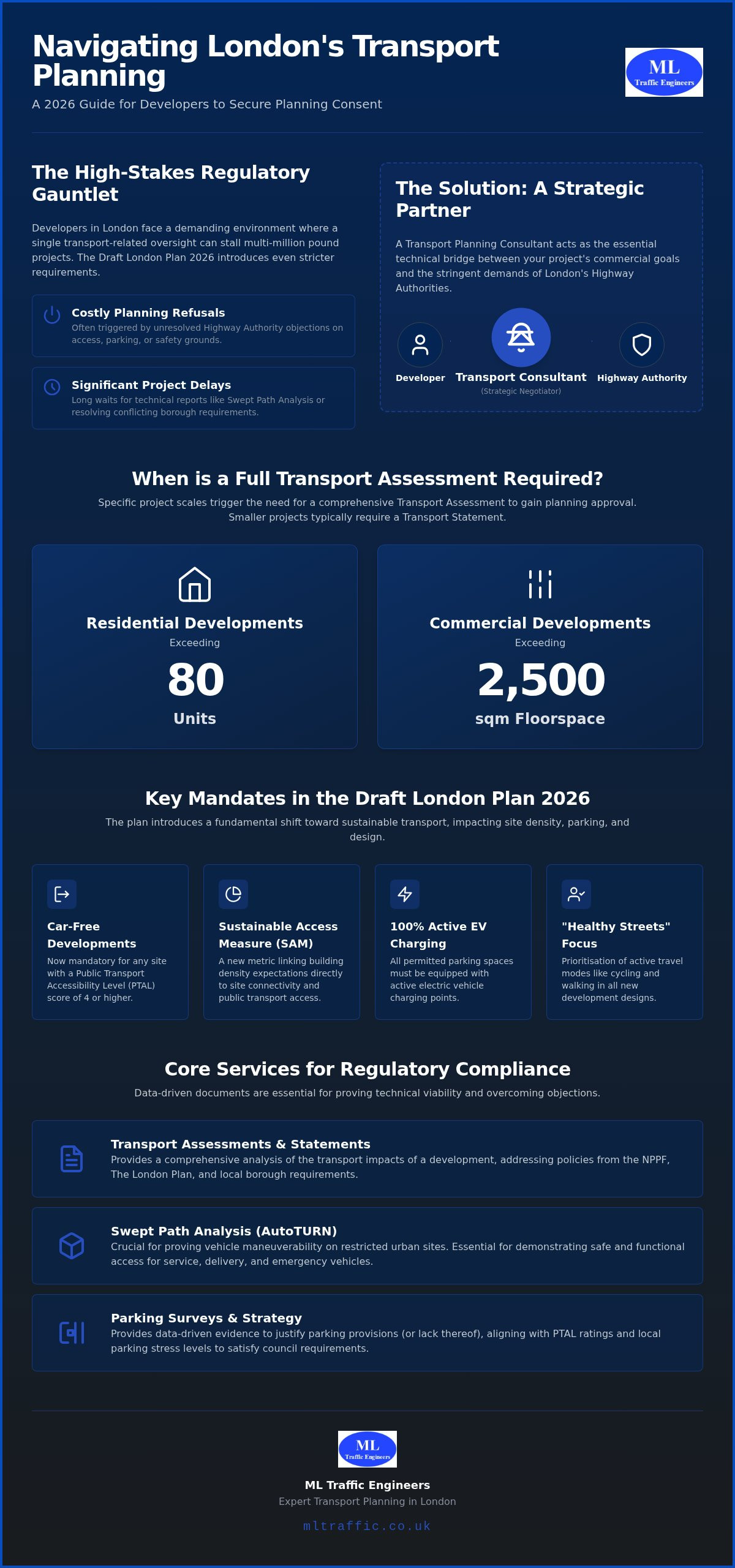
Determining when to hire a transport planning consultant london depends on the scale and location of your project. For 2026, a full Transport Assessment is generally required for developments exceeding 80 residential units or 2,500sqm of commercial floor space. Smaller projects typically require a Transport Statement to address local impact.
Consultants are vital during pre-application discussions with London Boroughs. With TfL pre-application fees currently set at £5,450 for meetings following an initial screening, entering these discussions without expert technical support is a significant financial risk. Expert consultants also address transport objections raised during the public consultation period, providing the technical rebuttals needed to keep an application on track and avoid unnecessary delays.
Navigating Statutory Requirements in 2026
The Draft London Plan 2026, published on July 16, 2026, has fundamentally changed the validation requirements for local councils. There’s a primary shift toward the “Healthy Streets Approach” and the prioritisation of active travel modes like cycling and walking. Developers must now comply with the National Planning Policy Framework (NPPF) while meeting the capital’s even stricter local mandates, such as the 100% active electric vehicle charging requirement for any permitted parking.
One major update in 2026 is the introduction of the Sustainable Access Measure (SAM). This metric links building density expectations directly to connectivity, potentially replacing or augmenting traditional PTAL scores. A consultant ensures your technical reports reflect these updates, demonstrating a commitment to sustainable travel that aligns with London’s Vision Zero goals and ensures your project meets the highest standards of professional integrity.
Core Services for London Planning Applications
Precision is the hallmark of a successful planning submission. Every technical report must adhere to the professional standards set by the Chartered Institution of Highways & Transportation. For developers, core services provide the data-driven evidence needed to overcome Highway Authority objections. A specialized transport planning consultant london ensures that every document, from a simple survey to a complex assessment, meets the rigorous validation requirements of the local council. These services don’t just tick boxes; they provide a functional roadmap for the project’s viability.
Transport Statements and Assessments
These documents quantify trip generation and evaluate local junction capacity to ensure the surrounding infrastructure can support a new development. While a Transport Statement is typically used for smaller schemes, a full Transport Assessment London is mandatory for larger developments exceeding 80 residential units or 2,500sqm of commercial floor space. This specialized reporting identifies potential traffic impacts early, allowing for cost-effective mitigation strategies. By analyzing TRICS data and local traffic flows, your consultant provides the technical authority needed to reassure planning officers that your project won’t cause gridlock.
Technical Data Collection and Analysis
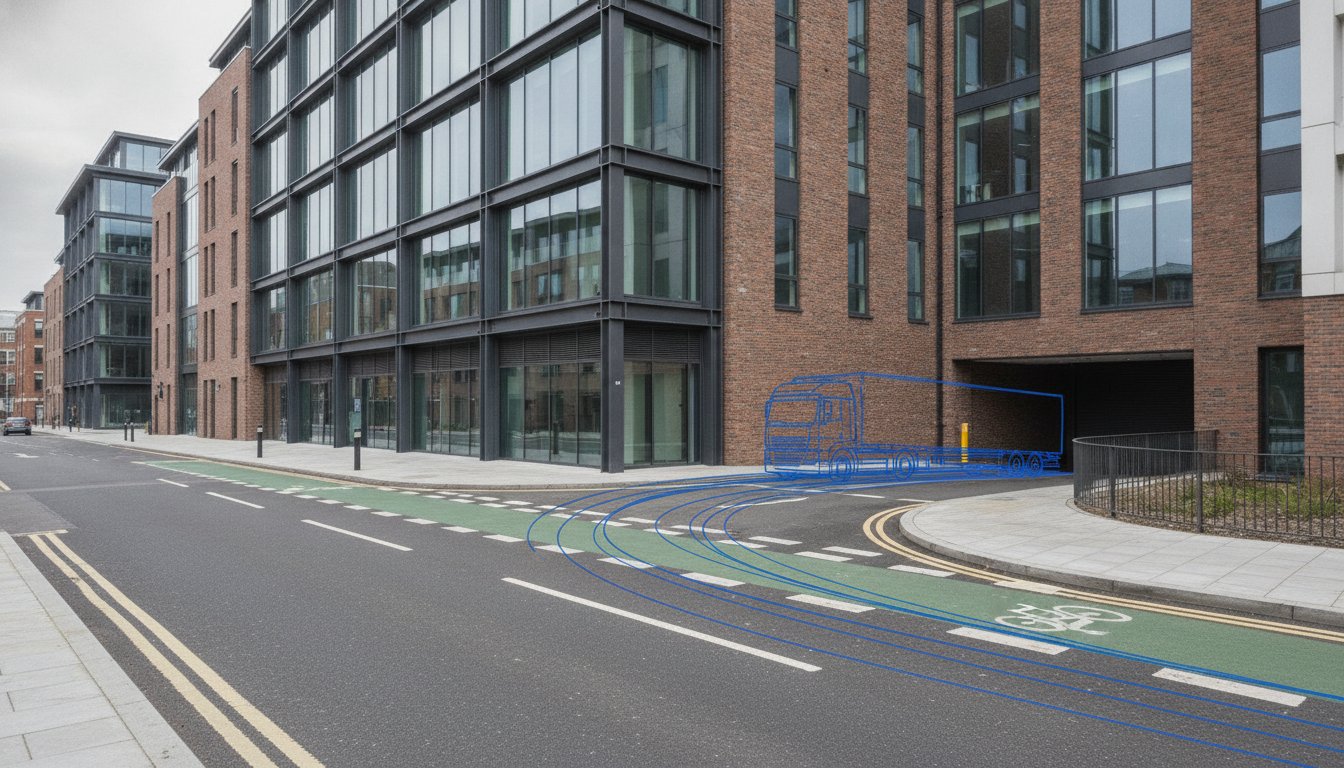
Proving vehicle manoeuvrability is critical for tight urban sites, especially within historic London mews or dense commercial blocks. Utilizing AutoTURN Swept Path Analysis allows your transport planning consultant london to demonstrate that fire tenders, refuse vehicles, and delivery vans can safely access and exit the site. This technical proof often makes the difference between a swift approval and a refusal based on public safety concerns. It’s a non-negotiable requirement for modern urban design where space is at a premium.
Parking Surveys are equally vital in high-density areas where on-street capacity is limited. We conduct overnight stress tests using the Lambeth Methodology to justify parking provision or support a car-free proposal. These surveys provide an objective snapshot of local parking demand, effectively reducing regulatory pressure during the application process. Additionally, Travel Plans outline clear strategies to encourage sustainable transport use among future residents or staff. These plans are essential for meeting the active travel targets set out in the London Plan. If you’re preparing a submission, you can view our full list of technical services to see how we support project lifecycles from inception to completion.
Navigating London Borough Nuances and PTAL Ratings
Understanding the “London nuance” is the most critical hurdle for any developer. While national policy provides a baseline, the capital operates under a fragmented system where individual boroughs and Transport for London (TfL) maintain distinct, often conflicting, priorities. A transport planning consultant london must act as a local negotiator, navigating the specific friction points of different jurisdictions. Whether your site sits on a borough-controlled local road or a TfL-managed Strategic Road Network (SRN), the technical requirements for access and mitigation vary significantly.
Local infrastructure changes, such as the implementation of Low Traffic Neighbourhoods (LTNs) and new segregated cycle lanes, have fundamentally altered how sites are accessed. These measures often restrict traditional vehicle routes, making a robust Transport Statement essential for proving that a development remains accessible without compromising local traffic reduction goals. Your consultant ensures that site access strategies align with these evolving urban designs, reducing the risk of a “default no” from highway officers concerned about active travel impacts.
PTAL and Parking Standards
Public Transport Accessibility Level (PTAL) scores are the primary tool used to dictate parking provision across the city. Scores range from 0 (poor) to 6b (excellent), and they directly determine the maximum allowable parking spaces for any given site. Under the Draft London Plan 2026, published on July 16, 2026, the mandate for “car-free” development has intensified. Any site with a PTAL score of 4 or higher is now required to be car-free, with the exception of essential disabled person parking.
Justifying even minimal parking in high-PTAL zones requires meticulous data. We focus on securing spaces for blue badge holders and essential delivery vehicles by utilizing Swept Path Analysis to prove these vehicles can maneuver safely. For sites with low PTAL ratings, we develop strategies to improve accessibility scores, often by highlighting nearby infrastructure improvements or utilizing the proposed Sustainable Access Measure (SAM) to link density expectations with actual connectivity.
Borough-Specific Planning Challenges
Each council maintains its own set of validation requirements and transport priorities. For instance, Westminster often prioritises servicing and delivery management in tight historic streets, while Southwark may focus more heavily on Section 106 contributions for public realm improvements. If you’re developing in East London, engaging Transport Planning Consultants Tower Hamlets is vital to navigate that borough’s specific stance on car-club integration and Community Infrastructure Levy (CIL) transport payments.
A professional transport planning consultant london manages these relationships so you don’t have to. We handle the complex negotiations surrounding Section 106 transport contributions, ensuring that mitigation costs remain proportionate to the development’s impact. By understanding the specific political and technical landscape of each borough, we provide a reassuring presence that minimizes regulatory pressure and secures the necessary consents for your project’s success.
How to Evaluate a Transport Planning Consultancy
Selecting the right transport planning consultant london is a strategic decision that directly impacts your project’s timeline and budget. You need a partner who understands the granular requirements of your specific borough. Before hiring, verify their local track record. Ask for case studies where they’ve successfully secured approvals in councils like Camden or Hackney. A firm with local experience knows the specific preferences of Highway Officers. This knowledge reduces the risk of unexpected objections and costly delays during the validation process.
Consider these critical factors during your evaluation:
- Borough-specific track record for residential and commercial schemes.
- Direct experience with TfL referable applications for larger developments.
- Capability to manage full project lifecycles from initial data collection to final technical reporting.
- Professional standing and adherence to industry benchmarks.
Technical Proficiency and Software
Technical authority stems from data precision. Your consultant must utilize the TRICS database, which remains the industry standard for trip generation analysis. Without this data, your Transport Assessment lacks the evidentiary weight required for council validation. Similarly, detailed CAD-based Swept Path Analysis is essential for site layout optimisation. It proves your design works in a high-stakes urban environment. A comprehensive service also includes producing robust Travel Plans that satisfy Section 106 obligations. These plans must be data-driven and actionable, ensuring they support long-term sustainability goals without creating unnecessary logistical burdens for future occupants.
Negotiation and Advocacy Skills
Technical skill is only half the battle. Your transport planning consultant london must also act as an effective advocate for your project. They often serve as an expert witness at planning appeals, where clarity and professional integrity are paramount. A proactive consultant doesn’t just accept every Highway Authority demand. They negotiate down excessive mitigation requests by building a case for “better design” over “rigid standard adherence.” Using the principles of Manual for Streets, they can demonstrate how a flexible approach benefits the public realm without compromising safety. This advocacy is vital when dealing with complex, conflicting requirements from different authorities.
Reliable partners provide an all-encompassing, fully-managed service. This includes conducting physical Traffic Surveys and Parking Surveys in-house before moving to technical reporting. This integrated approach ensures data continuity and accelerates the submission process. If you want to protect your project from regulatory pressure, you can contact our team today to discuss your specific site requirements.
ML Traffic Engineers UK: Expert Transport Planning in London
ML Traffic Engineers UK provides the technical authority and professional integrity required to navigate the capital’s complex planning environment. Since our founding in 2014, we’ve established ourselves as a dependable transport planning consultant london for developers managing high-stakes residential and commercial schemes. We specialize in producing data-driven technical reports, including Transport Statements, Assessments, and Travel Plans. Our mission is to reduce the logistical and regulatory pressures on our clients by managing full project lifecycles from initial data collection to final planning submission.
Our Approach to London Planning
We don’t believe in generic reporting templates. Every development site in London presents unique constraints, from restricted mews access to the strict car-free mandates of high-PTAL zones. Our team provides ML Traffic Engineers UK services that are customized to the specific technical and political requirements of your local borough. This fully-managed approach includes conducting in-house Traffic Surveys and Parking Surveys using established methodologies like the Lambeth overnight stress test.
By controlling the entire data chain, we ensure precision and adherence to industry benchmarks from the very first assessment. This integrated service model allows us to identify potential access issues early, providing developers with a clear roadmap for mitigation. We act as a vital guardian of public safety while ensuring your project remains commercially viable within the constraints of the 2026 regulatory framework.
Securing Your 2026 Planning Approval
The publication of the Draft London Plan 2026 on July 16, 2026, has fundamentally shifted the validation requirements for developers. Precision in transport reporting is no longer optional; it’s a functional necessity. With a 98% success rate for first-time approvals on residential projects over the last 18 months, our track record demonstrates our ability to meet these statutory requirements with unwavering reliability. We understand the technical lexicon of the “Healthy Streets Approach” and the evolving expectations surrounding active travel infrastructure.
Our role as your transport planning consultant london is to provide the technical evidence that turns a technical objection into a successful planning consent. We handle the intricate negotiations with Highway Authorities so you can focus on the broader aspects of your development. Whether you need a detailed Swept Path Analysis for emergency vehicle access or a comprehensive Travel Plan for a high-density site, we’re ready to act. You can request a fee proposal for your London transport planning needs to secure expert technical support for your 2026 submission from ML Traffic Engineers UK.
Securing Your Project’s Future in a Changing London
London’s 2026 planning environment demands a shift from generic submissions to data-driven, borough-specific strategies. Success depends on mastering PTAL nuances and delivering the precise technical documentation required by modern Highway Authorities. By identifying access and parking constraints early in the design phase, you protect your project from costly delays and the risk of regulatory friction during the consultation period.
Founded in 2014, ML Traffic Engineers UK acts as a specialized transport planning consultant london that understands the intricate statutory requirements of each individual borough. We manage the full project lifecycle, delivering comprehensive technical survey and reporting capabilities from inception to completion. This fully-managed approach ensures that your data is precise and your submission remains compliant with the latest standards, reducing the logistical pressure on your development team.
Ready to move forward? Contact ML Traffic Engineers UK for expert transport planning advice in London to ensure your development meets every industry benchmark with precision. We’re ready to help you navigate the 2026 landscape and secure a successful planning outcome for your site.
Frequently Asked Questions
What is the difference between a Transport Statement and a Transport Assessment?
The primary difference lies in the scale of the development and its potential impact on the local highway network. A Transport Statement is a concise report for small to medium projects with limited transport implications. In contrast, a Transport Assessment is a comprehensive study required for larger developments, typically those exceeding 80 residential units or 2,500sqm of commercial space. Both documents demonstrate how a proposal aligns with local planning policies.
Do I need a transport planning consultant for a small residential development in London?
Yes, most London Boroughs require a formal Transport Statement even for minor residential schemes to address local access and parking. A transport planning consultant london ensures your application meets specific validation requirements, which prevents unnecessary delays. Even small projects must prove they don’t negatively impact public safety or highway capacity. Expert reporting provides the technical evidence needed to satisfy planning officers and secure a successful outcome during the consultation phase.
How long does it take to produce a Transport Statement for a planning application?
Preparation timelines vary based on the availability of site data and the complexity of local council requirements. Generally, a professional report takes between two to four weeks to complete from the initial instruction. This period includes time for site visits, data collection, and technical analysis. If your project requires bespoke traffic surveys or parking stress tests, the timeline will extend to accommodate the physical data gathering process and subsequent analysis.
What is a PTAL rating and why does it matter for my London project?
Public Transport Accessibility Level (PTAL) is a standard method used to measure the connectivity of a specific location to the public transport network. Scores range from 0 to 6b. This rating is critical because it directly determines the maximum amount of parking a developer is permitted to provide. In 2026, sites with high PTAL scores of 4 or above are typically mandated to be car-free under the London Plan’s sustainable travel targets.
Why is Swept Path Analysis required for refuse and fire vehicle access?
Swept Path Analysis provides digital proof that large vehicles can safely enter, turn, and exit a site without striking curbs or buildings. Local Highway Authorities require this technical analysis for fire tenders and refuse trucks to ensure emergency access and efficient waste collection. In the tight urban constraints of London, this data-driven evidence is essential for validating site layouts and demonstrating that the proposed design is functionally safe for all users.
Can a transport consultant help if my planning application has been refused?
Yes, a consultant can provide technical rebuttals to address specific transport-related objections raised by the Highway Authority. We review the refusal reasons to identify if additional data, such as a revised Swept Path Analysis or a more detailed Parking Survey, can overcome the concerns. If the case moves to a planning appeal, we act as expert witnesses to provide professional testimony and demonstrate that the development complies with all relevant transport policies.
What information do I need to provide to a transport consultant for a quote?
To provide an accurate fee proposal, we require the site address, a description of the proposed development, and any existing site plans or floor layouts. It’s also helpful to share any pre-application advice received from the local council. This information allows us to determine the necessary scope of work, such as whether your project requires a simple Transport Statement or a more complex Assessment involving junction modeling and bespoke traffic surveys.
How much does a parking survey cost in London?
The cost of a parking survey depends on the specific methodology required by the local borough and the size of the survey area. Factors such as the number of streets included and the duration of the survey, such as overnight stress tests, influence the final cost. We provide bespoke quotes based on the unique technical requirements of your site. Contacting a transport planning consultant london early allows for an accurate assessment of the data collection needs for your submission.

Disclaimer
The content on mltraffic.co.uk, including all technical articles, guides, and resources, is provided for general informational and educational purposes only. It is not intended to constitute professional advice in traffic engineering, transportation planning, development approvals, or any other technical or legal field.
While ML Traffic Engineers makes every reasonable effort to ensure the accuracy, completeness, and timeliness of the information published, we do not provide any warranties or representations (express or implied) regarding its reliability, suitability, or availability for any particular purpose. Any reliance you place on the content is strictly at your own risk.
In no event shall ML Traffic Engineers, its directors, employees, authors, or affiliates be liable for any direct, indirect, incidental, special, consequential, or punitive damages (including, without limitation, loss of profits, data, or business opportunities) arising out of or in connection with the use of, or inability to use, any information provided on this website.
The articles and guides on this site are not a substitute for engaging a qualified, professional traffic engineer to assess your specific project requirements. For tailored advice, compliance assessments, or traffic engineering services, please contact a competent professional.
This disclaimer may be updated from time to time without notice. By accessing or using this website, you agree to be bound by the most current version of this disclaimer.