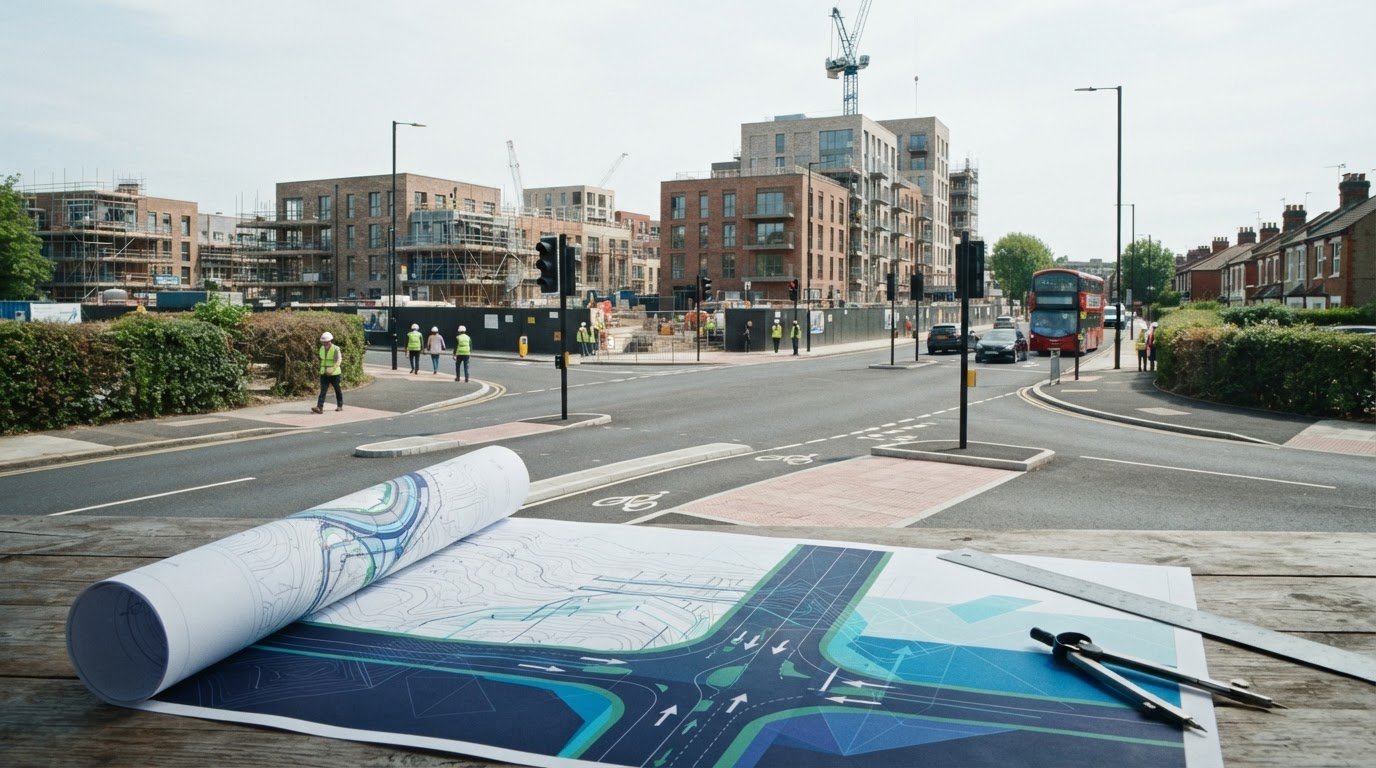
Section 106 transport contributions are negotiable legal mechanisms, not non-negotiable development taxes. When developers ask what are the section 106 transport contributions that local highway authorities demand, they are often met with rigid council formulas that threaten overall scheme viability. Protracted planning debates over these financial payments frequently stall full planning permission, while the line between Section 106 developer contributions and Section 278 works remains frustratingly blurred.
You don’t have to accept arbitrary local authority demands at face value. In this 2026 guide, you’ll discover how transport obligations are calculated, how statutory planning tests protect your scheme against double-dipping alongside the Community Infrastructure Levy, and how commissioning robust technical evidence, such as defensible Transport Assessments and Travel Plans, gives you the leverage to challenge excessive financial requests.
Below, we examine the legal framework governing council requests, distinguish your financial contributions from physical highway obligations, and detail the technical documentation required to safeguard your project budget.
Key Takeaways
- Understand what are the section 106 transport contributions and how the Town and Country Planning Act 1990 defines them as targeted site mitigations rather than blanket infrastructure taxes.
- Apply the three statutory tests under Regulation 122 of the CIL Regulations 2010 to ensure council financial requests remain strictly necessary, directly related, and proportionate in scale.
- Distinguish negotiated Section 106 developer contributions from standard Community Infrastructure Levy charges and Section 278 highway works to eliminate double-charging risks.
- Identify the formula-driven metrics local highway authorities use to calculate trip generation and evaluate where standard council models overestimate traffic impact.
- Deploy defensible technical evidence, including Transport Assessments, Traffic Surveys, and Travel Plans, to challenge inflated contribution requests and safeguard your scheme’s viability.
What Are Section 106 Transport Contributions in UK Planning?
When preparing planning submissions for major or minor schemes, developers frequently ask: what are the section 106 transport contributions that local highway authorities routinely demand? In simple terms, these contributions are bespoke, legally binding planning obligations negotiated between a developer and a local planning authority (LPA). Their operational purpose is clear: to deliver financial payments or targeted physical interventions that directly counteract the traffic, public transit, and highway safety impacts generated by a new development.
Left unmitigated, development-generated vehicle trips can overload junctions, erode pedestrian safety, and strain public transport capacity. Transport contributions ensure that the financial responsibility for absorbing site-specific impact remains with the developer, protecting existing public services and surrounding road networks from severe residual operational harm.
Statutory Basis Under the Town and Country Planning Act 1990
These legal commitments derive their authority directly from Section 106 of the Town and Country Planning Act 1990. Formalised as planning deeds executed under seal, these agreements bind anyone holding an interest in the land. Crucially, S106 obligations run with the land title rather than the individual applicant. If ownership transfers before discharge, all liabilities transfer to the successor in title.
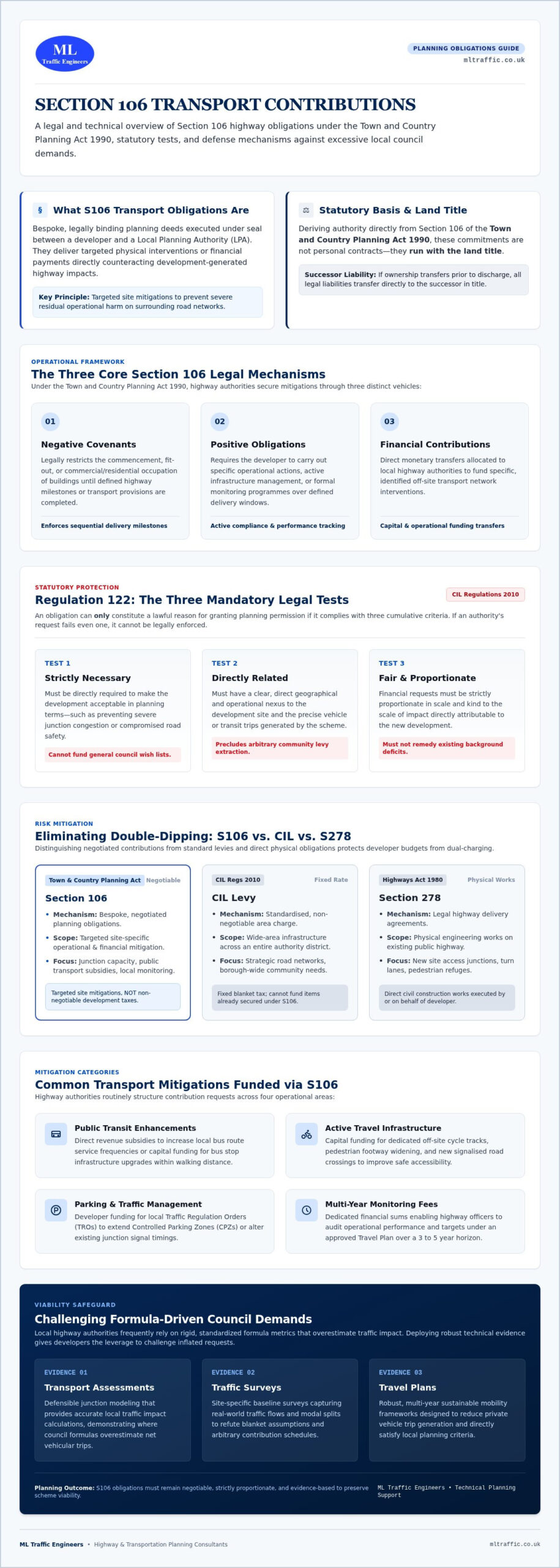
Under this legal structure, highway authorities secure three core mechanisms:
- Negative covenants: Restricting the commencement, fit-out, or occupation of buildings until defined highway milestones or transport provisions are completed.
- Positive obligations: Requiring the developer to carry out specific operational actions or monitoring programmes over set delivery windows.
- Financial contributions: Direct monetary transfers allocated to local highway authorities to fund off-site transport interventions.
Common Types of Transport Mitigation Funded via Section 106
Understanding precisely what are the section 106 transport contributions that authorities seek helps developers scrutinise local council claims early. Common mitigation provisions include:
- Public transit enhancements: Direct revenue subsidies to increase local bus route frequencies or fund bus stop upgrades within walking distance.
- Active travel infrastructure: Capital funding for dedicated cycle tracks, pedestrian footway widening, and signalised road crossings.
- Parking and traffic management: Developer funding for local traffic regulation orders (TROs) to extend controlled parking zones (CPZs) or alter junction signals.
- Multi-year monitoring fees: Dedicated financial sums enabling highway officers to audit operational performance under an approved Travel Plan over three to five years.
The Statutory Tests Governing Section 106 Transport Obligations
Local planning authorities cannot levy open-ended financial requests on a whim. While highway officers routinely issue standardized contribution schedules, establishing precisely what are the section 106 transport contributions developers legitimately owe requires testing those claims against statutory benchmarks. Under Regulation 122 of the Community Infrastructure Levy (CIL) Regulations 2010, an obligation can only constitute a lawful reason for granting planning permission if it complies with three strict legal tests. If an authority’s request fails even one requirement, it cannot be legally enforced.
The Three Mandatory Legal Tests of Regulation 122
To pass statutory scrutiny under Section 106 of the Town and Country Planning Act 1990 and Regulation 122, transport obligations must satisfy three cumulative criteria:
- Necessary to make the development acceptable in planning terms: The payment must prevent an unacceptable highways impact, such as severe junction congestion or compromised road safety. It cannot simply fund general council wish lists.
- Directly related to the development: The physical intervention or transit upgrade must have an unambiguous operational link to the proposed site.
- Fairly and reasonably related in scale and kind: The requested financial sum must reflect only the specific proportion of impact caused by the scheme’s net new trips.
Scrutinizing Cumulative Traffic Impact and Pooling Restrictions
Highway authorities often attempt to use private schemes to resolve pre-existing network deficits. However, developers aren’t responsible for fixing historical congestion or funding deferred council maintenance. Planning obligations must exclusively address the direct, residual impact created by the proposed change of use or new floorspace.
Scrutinizing what are the section 106 transport contributions requested on your site means cross-examining the baseline network assumptions used by the local authority. Technical reviews isolate site-generated trips from background traffic growth, exposing arbitrary funding requests or double-dipping alongside broad community levies. When facing contentious highway obligations, consulting with ML Traffic Engineers UK equips your planning team with the empirical baseline data required to challenge inflated council demands and safeguard scheme viability.
Section 106 Contributions vs. CIL vs. Section 278 Agreements
Planning conditions and developer levies frequently overlap, creating significant confusion during planning determinations. When evaluating what are the section 106 transport contributions for a specific site, applicants must separate site-specific mitigation payments from blanket infrastructure levies and direct highway works. Confusing these three distinct legal mechanisms often causes developers to pay twice for the same road improvements.
The table below provides a clear, side-by-side comparison of the core instruments used by local planning authorities to fund and deliver highway infrastructure:
| Mechanism | Primary Legislation | Core Purpose | Financial Format |
|---|---|---|---|
| Section 106 | Town and Country Planning Act 1990 | Site-specific mitigation of immediate impacts | Negotiated financial sums or positive covenants |
| CIL | Planning Act 2008 / CIL Regulations 2010 | Sub-regional and strategic capital projects | Non-negotiable fixed tariff per square metre |
| Section 278 | Highways Act 1980 | Direct physical construction on adopted roads | Works delivered directly or secured via bond |
Key Distinctions Between Section 106 and Community Infrastructure Levy
The Community Infrastructure Levy (CIL) operates as a mandatory, area-wide charge based on net additional gross internal floor area. Local authorities pool these funds to deliver sub-regional capital works, such as new bypasses or major rail enhancements. In contrast, Section 106 obligations remain strictly site-specific and negotiable.
Under national statutory tests for planning obligations, councils cannot use Section 106 to double-fund infrastructure items already scheduled under their local CIL spending strategy. Councils turn to Section 106 only when localized issues, such as a deficient nearby pedestrian crossing or lack of bus stop capacity outside the site boundary, cannot wait for broad CIL allocation cycles.
Financial Section 106 Obligations vs. Direct Section 278 Works
A critical operational boundary separates Section 106 contributions from Section 278 agreements. Section 106 primarily secures financial payments or operational policies, transferring cash to the council so they can deliver off-site transport services. Section 278 of the Highways Act 1980, however, governs the actual physical modifications made to adopted highways, such as installing a new priority junction, site bellmouth, or dedicated right-turn lane.
On complex residential and commercial sites, these two mechanisms operate in tandem. A Section 106 agreement establishes the overarching planning requirement and financial triggers, while technical highway delivery proceeds under an approved highway design S278 and S38 agreement. Distinguishing these agreements early ensures developers don’t mistakenly pay cash under Section 106 for road layouts they are already constructing under Section 278.
How Authorities Calculate Section 106 Highway Contributions
Local highway authorities rarely use identical formulas when calculating infrastructure payments. Instead, individual councils set out their preferred calculation methodologies in Supplementary Planning Documents (SPDs). When evaluating what are the section 106 transport contributions applicable to a development, planning officers generally calculate charges either per net vehicular trip or as a standard tariff per residential unit or commercial floorspace band.
Because baseline trip projections directly dictate your financial liability, accepting generic council calculations without independent technical scrutiny can inflate project costs significantly.
Trip Generation Metrics and Standard Local Tariffs
Most local authorities determine impact using computerised trip-generation databases, primarily TRICS. Planning officers apply average trip rates across selected land-use classes to establish how many peak-hour vehicle trips a scheme will add to surrounding junctions during morning and evening commuter windows.
In highly accessible urban areas, councils adjust these formulas using Public Transport Accessibility Levels (PTAL). Where car ownership is actively discouraged, authorities redirect their contribution requests toward public transport, cycling infrastructure, and pedestrian improvements.
Challenging Unsubstantiated Local Authority Demands
Developers don’t have to accept standard council formulas without question. Standard contribution matrices often treat brownfield sites as vacant land, ignoring the historic traffic previously handled by surrounding junctions. This oversight routinely leads to inflated financial demands.
The most reliable strategy to challenge what are the section 106 transport contributions levied by a council is proving your net trip impact. If an existing commercial building or active facility already generates trips, those existing movements must be deducted from the proposed scheme’s projected traffic. If the net change in peak-hour vehicle movements is negligible, the authority loses its legal justification for requesting heavy highway mitigation payments.
Commissioning an independent, highly detailed Transport Assessment provides the multi-modal trip evidence you need to challenge arbitrary formulas, offset existing site trip rates, and prevent budget overruns during planning negotiations.
Mitigating Transport Contributions with Robust Planning Reports
When developers examine what are the section 106 transport contributions requested by planning officers, they often overlook their greatest negotiation asset: technical documentation. Precise transport reports serve as the primary line of defence against arbitrary or inflated financial obligations. Under national planning policy, planning applications should only be refused on highway grounds if there would be an unacceptable impact on highway safety, or the residual cumulative impacts on the road network would be severe. Producing robust technical evidence during pre-application stages prevents councils from imposing disproportionate funding formulas on your development.
Demonstrating Minimal Impact via Statements and Assessments
For smaller commercial or residential proposals, submitting a focused transport statement establishes baseline accessibility without triggering expansive network obligations. For larger, higher-density schemes, a comprehensive transport assessment provides detailed junction capacity modelling, showing whether existing road infrastructure can accommodate projected trips without capital works.
Integrating empirical parking surveys and swept path analyses directly within these reports resolves internal access and servicing concerns on-site. By proving operational safety within your red-line boundary, you eliminate the planning justification for speculative off-site junction levies.
Leveraging Travel Plans to Offset Capital Demands
Financial mitigation isn’t the only solution for managing highway impact. Delivering an active, enforceable Travel Plan allows developers to substitute expensive capital contributions with measurable demand-management strategies. By committing to targeted mode shifts toward public transport, car clubs, and cycle infrastructure, you demonstrate that your site won’t overburden local road corridors during commuter peaks.
Engaging specialized travel plan consultants ensures your monitoring package meets local planning authority criteria while keeping long-term operational costs controlled. Instead of accepting vague estimates of what are the section 106 transport contributions developers must pay, presenting defensible travel planning documentation shifts discussions from expensive highway expansion to efficient, sustainable trip management.
Protect Your Scheme Viability Against Excessive S106 Demands
Managing planning agreements requires technical clarity and commercial vigilance. Knowing precisely what are the section 106 transport contributions requested on your site ensures you don’t overpay for wider council infrastructure. These obligations aren’t fixed taxes. By applying Regulation 122 statutory tests and separating site-specific mitigation from CIL and Section 278 works, developers retain the legal right to challenge unsubstantiated financial levies.
Defensible technical evidence remains your strongest asset at the negotiating table. Since 2014, our team has delivered robust planning reports that protect scheme viability across Greater London, Birmingham, Manchester, and Southern regions. Don’t let speculative council formulas derail your timeline or inflate your project costs. Instruct ML Traffic Engineers UK to assess and optimize your planning transport documentation, from rapid Transport Statements and Assessments to enforceable Travel Plans, and secure the planning approvals your project deserves.
Frequently Asked Questions
Can a developer refuse to pay a Section 106 transport contribution?
Yes, developers can challenge or refuse an obligation if the council’s request fails Regulation 122 statutory tests. However, outright refusal without empirical counter-evidence typically results in an immediate planning refusal. Developers challenge demands by submitting technical assessments showing negligible net traffic impact or by presenting viability assessments proving the contribution threatens scheme deliverability.
How do councils calculate the cost per trip for transport contributions?
Councils calculate cost per trip by dividing total planned infrastructure costs by projected trips across a local plan area. When determining what are the section 106 transport contributions for an individual site, officers multiply this standard cost-per-trip figure by the scheme’s net additional peak-hour trips derived from TRICS modelling. Independent transport data often proves council trip estimates overestimate actual impact.
What is the difference between a Section 106 contribution and a Section 278 agreement?
The distinction lies between funding off-site community mitigation and executing direct physical construction. Section 106 contributions provide financial compensation to local authorities for network-wide mitigation, such as bus route subsidies or active travel upgrades. Section 278 agreements under the Highways Act 1980 permit developers to physically build modifications on the adopted highway network, including new site junctions, pedestrian refuges, or road widening schemes.
Can Section 106 highway contributions be refunded if the funds are not spent?
Yes, Section 106 transport contributions must be repaid with interest if the local planning authority fails to spend them within an agreed timeframe. Standard planning deeds include clawback clauses that mandate repayment if funds remain uncommitted after a defined period, typically between five and ten years. Developers can review annual Infrastructure Funding Statements to verify expenditure and initiate formal recovery procedures.
Do minor commercial developments require Section 106 transport contributions?
Minor commercial developments generally avoid Section 106 transport contributions unless they generate substantial localized highway impacts. Thresholds vary across authorities in Greater London, Birmingham, and the South East, but Section 106 agreements usually apply to major schemes of ten or more dwellings or commercial floorspace exceeding 1,000 square metres. If a minor scheme introduces high trip turnover, officers may investigate what are the section 106 transport contributions needed to fund local parking controls.
How does an approved Travel Plan reduce Section 106 financial liabilities?
An approved Travel Plan reduces financial liabilities by formally committing the development to sustainable transport targets that suppress vehicle trip generation. By embedding enforceable mode-shift measures, such as car club bays, cycle facilities, and transit subsidies, developers demonstrate lower peak-hour highway demand. Lowering projected private vehicle trips directly reduces the trip-generation multiplier used in council formulas, significantly decreasing or entirely eliminating requested capital junction payments.
Can Section 106 obligations be renegotiated after planning permission is granted?
Yes, developers can formally renegotiate Section 106 obligations under Section 106A of the Town and Country Planning Act 1990. If economic viability changes or construction costs surge, developers can apply to modify or discharge planning obligations. Section 106A allows formal applications after five years, or earlier through voluntary deed of variation negotiations with the local planning authority supported by updated transport and viability evidence. For businesses and developers needing tailored support when preparing commercial agreements or deeds, check out MAR Legal for professional contract drafting services.

Disclaimer
The content on mltraffic.co.uk, including all technical articles, guides, and resources, is provided for general informational and educational purposes only. It is not intended to constitute professional advice in traffic engineering, transportation planning, development approvals, or any other technical or legal field.
While ML Traffic Engineers makes every reasonable effort to ensure the accuracy, completeness, and timeliness of the information published, we do not provide any warranties or representations (express or implied) regarding its reliability, suitability, or availability for any particular purpose. Any reliance you place on the content is strictly at your own risk.
In no event shall ML Traffic Engineers, its directors, employees, authors, or affiliates be liable for any direct, indirect, incidental, special, consequential, or punitive damages (including, without limitation, loss of profits, data, or business opportunities) arising out of or in connection with the use of, or inability to use, any information provided on this website.
The articles and guides on this site are not a substitute for engaging a qualified, professional traffic engineer to assess your specific project requirements. For tailored advice, compliance assessments, or traffic engineering services, please contact a competent professional.
This disclaimer may be updated from time to time without notice. By accessing or using this website, you agree to be bound by the most current version of this disclaimer.