
Relying on the archived 2007 DfT guidance for your planning application in 2026 is a guaranteed route to a formal refusal. Many developers still struggle to identify exactly when is a transport assessment required uk because the transition from old “predict and provide” models to modern “vision-led” standards has completely rewritten the regulatory landscape. With the August 17, 2026, NPPF update now in full effect, the thresholds for statutory consultation with National Highways and Active Travel England have shifted significantly. Precision in these early stages is a functional necessity to prevent your project from stalling at the first hurdle.
It’s understandable to feel concerned about the specific level of detail your site requires, especially when local authorities are increasingly setting their own stricter benchmarks. This article ensures you master current PPG planning standards to secure a successful submission without the risk of costly Highway Authority objections. We provide a clear breakdown of the 2026 statutory requirements, including the 250-unit threshold for Active Travel England and the latest car-free mandates for high PTAL areas. You’ll learn how to align your technical data with modern safety and sustainability targets to maintain a seamless project lifecycle from inception to completion.
Key Takeaways
- Transition from outdated DfT mythology to the 2026 NPPF framework to ensure your project aligns with the latest vision-led planning policies.
- Clarify exactly when is a transport assessment required uk by evaluating residential and commercial thresholds alongside local “Sensitive Area” triggers.
- Master the core components of a submission, from establishing a robust transport baseline to integrating advanced Swept Path Analysis for site layout approval.
- Adhere to 2026 technical standards for sustainable travel, including 100% active electric vehicle charging points and integrated active travel infrastructure.
- Leverage expert insights on London-specific challenges and National Highways negotiations to avoid costly delays and secure a successful planning outcome.
The Evolution of DfT Guidance on Transport Assessment
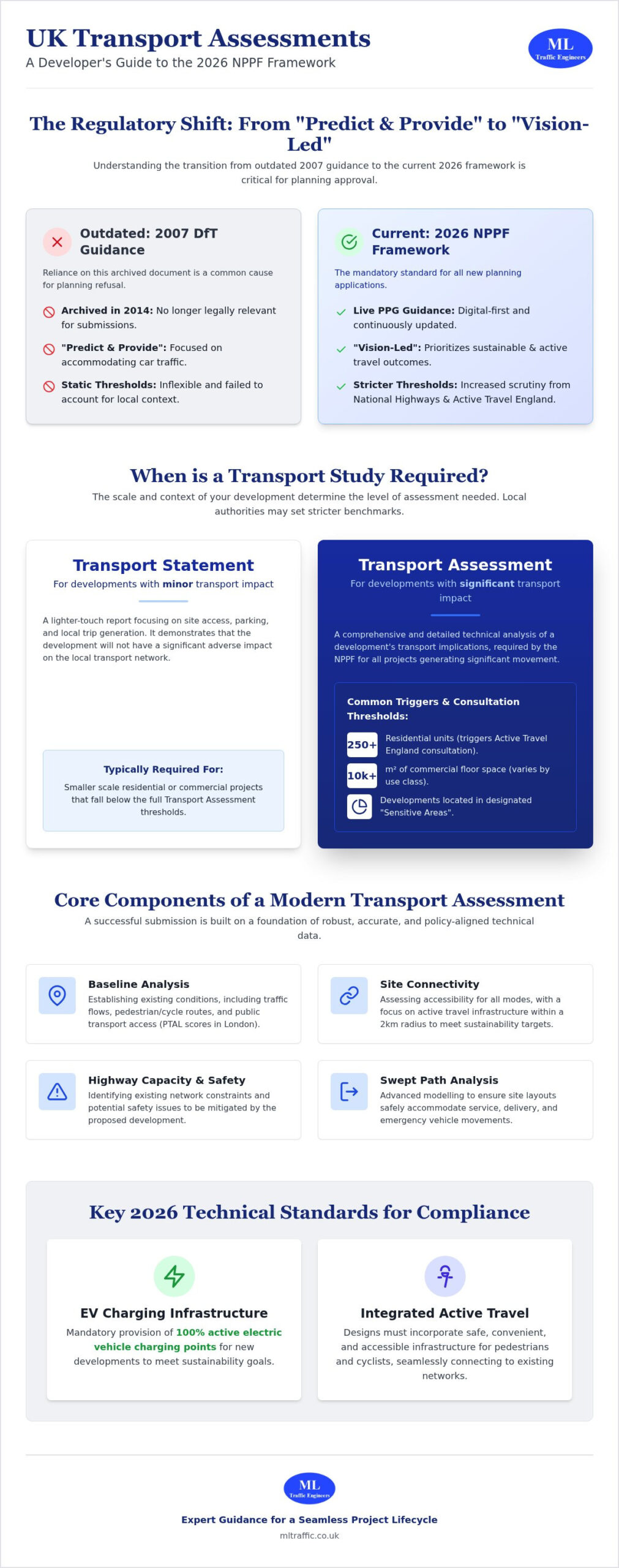
Many developers still search for the 2007 “Guidance on Transport Assessment” PDF as their primary reference. It’s a mistake that can lead to immediate planning refusal. That document was officially archived in 2014 and replaced by a digital-first approach within the Planning Practice Guidance (PPG). Understanding this shift is the first step in answering when is a transport assessment required uk for your specific site. This modern transportation planning framework prioritizes sustainable outcomes over simple road capacity, reflecting a high-stakes environment where precision is a functional necessity. ML Traffic Engineers UK provides the technical authority required to manage these full project lifecycles from inception to completion.
To better understand how a strategic approach to these assessments impacts your project performance, watch this video:
Archived 2007 DfT Guidance vs. Modern PPG
The 2007 DfT document provided static, rigid thresholds that often failed to account for regional nuances. While it offered a clear technical checklist, it didn’t adapt to the rapid changes in urban mobility or environmental standards. In 2014, the government moved to the web-based PPG format to ensure guidance remains “live” and responsive to policy changes. Developers in 2026 must use the “Travel Plans, Transport Assessments and Statements” section of the PPG. This transition ensures your project aligns with current expectations from Local Highway Authorities and National Highways. It also reduces the regulatory pressure on your team by providing a clear, updated roadmap for compliance.
The Role of the National Planning Policy Framework (NPPF)
The NPPF is the primary engine behind transport planning decisions in England. The August 17, 2026, update introduced stricter decision-making policies that prioritize “Active Travel” over private car use. Identifying when is a transport assessment required uk depends heavily on the NPPF mandate that all developments generating significant amounts of movement must be supported by a technical study. This update also changed consultation thresholds. For instance, National Highways must now be consulted for any development requiring a full assessment, removing the old “non-minor” distinction. Our team at ML Traffic Engineers UK manages this entire process, ensuring your Transport Assessment meets these rigorous national standards. This is particularly critical for complex sites, where a Transport Assessment in London must also navigate specific TfL requirements. We bridge the gap between policy and approval so you don’t have to manage the technical lexicon alone.
Core Components of a Modern Transport Assessment
A modern Transport Assessment is a technical document that demonstrates a development’s compatibility with the existing infrastructure. It moves beyond simple traffic counts to provide a holistic view of movement. Determining when is a transport assessment required uk is only the first step. The success of your submission depends on the depth and accuracy of the baseline data provided to the decision-makers. Technical authority is a functional necessity in this high-stakes environment to ensure your project doesn’t face unnecessary delays.
Baseline Analysis and Site Connectivity
Every assessment begins by establishing the current transport baseline. In London, this involves calculating Public Transport Accessibility Level (PTAL) scores to determine the appropriate intensity of development. Outside the capital, we review pedestrian and cycle infrastructure within a 2km radius to ensure the site supports active travel goals. We identify existing highway capacity and safety issues through comprehensive Traffic Surveys. A report that doesn’t account for local congestion is likely to be challenged. This ensures the data is current, as submissions using counts more than 36 months old are likely to face rejection.
Trip Generation and the TRICS Database
TRICS is the industry-standard database used to predict trip rates for new developments based on comparable historical data. We select comparable sites with precision to ensure the data accurately reflects your specific development’s geography and land use. It’s vital to select sites that share similar demographic profiles and transport links. Modern assessments must factor in multi-modal travel patterns. They account for how residents or employees will actually move in a sustainable environment. This technical lexicon is essential for answering when is a transport assessment required uk for non-standard land uses where simple thresholds may not apply.
Impact Assessment and Mitigation
We use industry-leading software like Junctions 10 and LinSig to model the impact of new trips on the local network. This process identifies potential bottlenecks before they become planning hurdles. Following the official UK Government guidance, we propose mitigation strategies that are strictly proportionate to the scale of the impact. These may include physical highway improvements or “soft” measures like bespoke Travel Plans. Our expert team manages these technical requirements so you can focus on the broader project delivery. Professional transport assessment services ensure that your application remains compliant with the latest 2026 standards.
Transport Assessment vs. Transport Statement: Which Do You Need?
Choosing between a Transport Assessment and a Transport Statement is a decision that dictates your planning timeline and budget. Determining when is a transport assessment required uk involves more than just checking a static list of numbers. The decision depends on the anticipated “significance” of the development’s impact on the highway network. While a Transport Statement is sufficient for smaller schemes with limited transport implications, a full Transport Assessment is mandatory for larger projects that require detailed junction modelling and mitigation analysis. This distinction is critical because the scope of work for a full assessment is far more extensive, often taking several weeks longer to complete and requiring a higher level of technical investment. The cost and time implications are significant, with data collection expenses alone seeing a 15% increase in the 24 months leading up to August 2026.
Thresholds and Scoping with Local Authorities
In London, the 2026 threshold for a full Transport Assessment is generally set at 80 residential units or 2,500 square meters of commercial floor space. However, local Highway Authorities often exercise discretion in “Sensitive Areas,” such as Air Quality Focus Areas or congested town centres. In these locations, a full assessment may be triggered for developments as small as 30 to 40 units. This variability is why early scoping meetings with National Highways or TfL are vital. These discussions allow us to agree on the parameters of the study before technical work begins, ensuring compliance with the latest UK government guidance on transport assessments. For smaller projects within the capital, our Transport Statement London: A Developer’s Guide provides a clear roadmap for navigating these local requirements.
The Consequences of Under-Assessing Impact
Submitting a Transport Statement when a full Assessment was required is a common cause of project delays. It frequently leads to “holding objections” from statutory consultees like Active Travel England, who, as of August 2026, focus on residential schemes of 250 units or more. If the Highway Authority deems the submitted information insufficient, they’ll refuse the application or demand a complete resubmission of technical data. This isn’t just a matter of paperwork; it involves additional traffic counts and complex modelling that can add months to your timeline. We help you avoid these pitfalls during the pre-application stage by precisely identifying when is a transport assessment required uk for your specific site. Our expert team bridges the gap between old DfT mythology and modern PPG reality, ensuring your submission is right the first time. This proactive approach reduces regulatory pressure and secures your planning path.
Technical Best Practices for 2026 Planning Applications
Securing a successful planning outcome requires more than just identifying when is a transport assessment required uk. It demands technical precision in the execution of site layouts and parking strategies. Modern standards, particularly following the August 2026 NPPF updates, place heavy emphasis on a “vision-led” approach. This means your technical data must prove that the development prioritizes sustainable travel while maintaining absolute operational safety. Precision is a functional necessity in this high-stakes environment to avoid costly delays from the Highway Authority during the final stages of the planning cycle.
Swept Path Analysis: Proving Manoeuvrability
Swept Path Analysis (SPA) is now a non-negotiable component of the DfT and PPG framework for site layouts. We use AutoTURN software to simulate the movements of 12-metre refuse vehicles and fire tenders within your proposed scheme. This process identifies geometry issues before they lead to a formal Highway Authority objection. Proving that emergency and service vehicles can safely navigate your site is a functional necessity for modern approvals. For a deeper look at these technical requirements, read our Practical Guide to Swept Path Analysis.
Parking Standards and Sustainable Transport
Parking provision in 2026 is strictly regulated to discourage private car use in urban centres. In London, developments in areas with a PTAL score of 4 or higher are now mandated to be car-free. Where parking is permitted, 100% of those spaces must include active electric vehicle charging points. We justify these provisions through detailed Parking Surveys and the Lambeth methodology. This data-driven approach ensures your parking strategy aligns with the latest Manual for Streets guidance and local policy requirements while reducing regulatory pressure.
The Travel Plan Synergy
The Transport Assessment must work in synergy with a bespoke Travel Plan. While the assessment identifies the potential impact, the Travel Plan provides the long-term mitigation strategy. It sets realistic targets for shifting residents away from the private car toward active travel modes like cycling and walking. This relationship is vital for answering when is a transport assessment required uk for mixed-use sites where mode shift is a primary planning condition. Our London Travel Plans Guide explains how to integrate these documents for maximum impact.
Contact ML Traffic Engineers UK to manage your full project lifecycle from technical assessment to planning approval.
Securing Approval with ML Traffic Engineers UK
ML Traffic Engineers UK provides the technical authority required to navigate the complexities of modern UK planning. Since our founding in 2014, we’ve bridged the gap between old policy mythology and the rigorous demands of the current 2026 framework. Determining when is a transport assessment required uk is only the first step in our comprehensive partnership. We manage the entire technical lexicon and regulatory pressure so you don’t have to. Our team understands that in high-stakes environments, precision isn’t just a goal; it’s a functional necessity for project success. We take pride in our adherence to industry benchmarks and our role as a guardian of public safety.
A Fully-Managed Transport Consultancy Service
We handle the full lifecycle of your project, from initial scoping with the Highway Authority to final post-submission negotiations. This fully-managed approach reduces the logistical burden on your team and ensures constant availability during the planning process. We specialize in navigating the unique challenges of London Borough planning and TfL requirements. Our expertise also extends to developments near the Strategic Road Network, where we act as your expert navigator with National Highways. By integrating advanced analysis early in the process, we identify potential bottlenecks before they become costly objections. Review Our Project Types and Experience to see how we manage diverse site constraints.
Contact ML Traffic Engineers UK for a Transport Assessment Quote
Ready to start your 2026 planning application? The August 17, 2026, NPPF update has made early consultation more critical than ever. This proactive approach ensures you never have to guess when is a transport assessment required uk for a complex site. We provide tailored advice based on your site’s specific constraints and local policy nuances. Whether you need a Transport Assessment, a Transport Statement, or a Travel Plan, our response is rapid. Our commitment to industry benchmarks is non-negotiable. We view our role as a reliable partner that understands intricate regional regulations so you don’t have to.
Request a Consultation with ML Traffic Engineers UK today to secure your development’s future.
Secure Your Planning Approval with Technical Precision
Navigating the transition from archived DfT documents to the current PPG and NPPF 2026 standards is essential for any successful development. You now understand that when is a transport assessment required uk depends on both national thresholds and specific local triggers. Precision in early scoping and technical data collection prevents costly delays from the Highway Authority. ML Traffic Engineers UK has provided specialized transport planning expertise since 2014, bridging the gap between policy and approval for developers across the UK. Our team delivers comprehensive technical reports and advanced Swept Path Analysis to ensure your site layout meets every regulatory benchmark.
We manage complex TRICS data integration and Highway Authority negotiations so you don’t have to. Don’t let regulatory pressure stall your progress or lead to a planning refusal. Get a Professional Transport Assessment Quote Today and move your application forward with confidence. We’re ready to act as your dependable partner in securing a seamless planning outcome. Your project deserves the technical authority that only an experienced specialist can provide.
Frequently Asked Questions
Is the 2007 DfT Guidance on Transport Assessment still valid?
The 2007 DfT Guidance is no longer valid as it was officially archived in 2014. Developers must now adhere to the Planning Practice Guidance (PPG) and the National Planning Policy Framework (NPPF), which receive regular digital updates. This shift ensures that transport planning reflects modern sustainability goals rather than just road capacity. Using outdated 2007 standards in 2026 will likely result in a formal planning refusal from the Highway Authority.
What is the difference between a Transport Assessment and a Transport Statement?
A Transport Assessment is a comprehensive report for developments with significant transport implications, requiring detailed junction modelling and mitigation strategies. In contrast, a Transport Statement is a simpler document for smaller schemes with limited impact. Determining when is a transport assessment required uk versus a statement depends on whether the development exceeds specific local or national thresholds. These triggers include residential unit counts or commercial floor space totals defined by the local planning authority.
When is a Transport Assessment required for a planning application?
A Transport Assessment is required when a development is expected to generate significant transport movements or impacts on the local highway network. National thresholds generally start at 50 to 80 residential units, but local authorities often set lower triggers in congested “Sensitive Areas.” Identifying when is a transport assessment required uk involves early scoping with National Highways or Transport for London. This step confirms the specific requirements for your site and avoids costly late-stage revisions.
How much does a Transport Assessment cost in 2026?
The cost of a Transport Assessment varies based on the development’s scale, the complexity of junction modelling required, and the extent of data collection. Technical factors like the number of junctions analyzed and the requirement for multi-modal surveys influence the final fee. Because data collection costs increased by 15% in the 24 months leading to August 2026, we recommend requesting a tailored quote. This ensures the pricing reflects your site’s specific planning constraints and technical needs.
Who prepares a Transport Assessment for a development?
Qualified transport engineers or specialized consultancies prepare these assessments to ensure technical accuracy and regulatory compliance. The process requires expertise in industry software like LinSig or Junctions 10 and access to the TRICS database for trip generation. Professional preparation is a functional necessity to navigate negotiations with Highway Authorities. Engaging an expert who understands the August 2026 NPPF updates ensures that your submission stands up to rigorous statutory scrutiny and reduces overall project risk.
What happens if my Transport Assessment shows a “severe” impact?
If an assessment identifies a “severe” residual impact, the developer must propose robust mitigation measures to offset the effect on the highway network. This might include physical junction improvements or “soft” measures like a comprehensive Travel Plan. Under the NPPF, planning permission can be refused if the transport impacts remain severe after mitigation. We work to identify these risks early, allowing for design adjustments that maintain project viability while ensuring public and worker safety.
Do I need a Travel Plan if I have already completed a Transport Assessment?
Yes, a Travel Plan is almost always required alongside a Transport Assessment for larger developments. While the assessment identifies the potential traffic impacts, the Travel Plan serves as the long-term management strategy to encourage sustainable travel and reduce car dependency. This synergy is a core requirement for modern UK planning approvals. It demonstrates a clear commitment to “Active Travel” and helps satisfy local authority targets for mode shift and carbon reduction in 2026.
How long does it take to produce a Transport Assessment for a planning submission?
Producing a full Transport Assessment typically takes between four and eight weeks. This timeline includes the initial scoping with local authorities, commissioning traffic surveys, and performing complex technical modelling. Delays can occur if surveys are required during specific school term-times or if the Highway Authority requests additional junction analysis. Starting the process during the pre-application stage is the most efficient way to ensure your report is ready for a timely and successful submission.

Disclaimer
The content on mltraffic.co.uk, including all technical articles, guides, and resources, is provided for general informational and educational purposes only. It is not intended to constitute professional advice in traffic engineering, transportation planning, development approvals, or any other technical or legal field.
While ML Traffic Engineers makes every reasonable effort to ensure the accuracy, completeness, and timeliness of the information published, we do not provide any warranties or representations (express or implied) regarding its reliability, suitability, or availability for any particular purpose. Any reliance you place on the content is strictly at your own risk.
In no event shall ML Traffic Engineers, its directors, employees, authors, or affiliates be liable for any direct, indirect, incidental, special, consequential, or punitive damages (including, without limitation, loss of profits, data, or business opportunities) arising out of or in connection with the use of, or inability to use, any information provided on this website.
The articles and guides on this site are not a substitute for engaging a qualified, professional traffic engineer to assess your specific project requirements. For tailored advice, compliance assessments, or traffic engineering services, please contact a competent professional.
This disclaimer may be updated from time to time without notice. By accessing or using this website, you agree to be bound by the most current version of this disclaimer.