Tag: property developers

  • Transport Planning Consultants in London: The 2026 Developer’s Guide

    Transport Planning Consultants in London: The 2026 Developer’s Guide

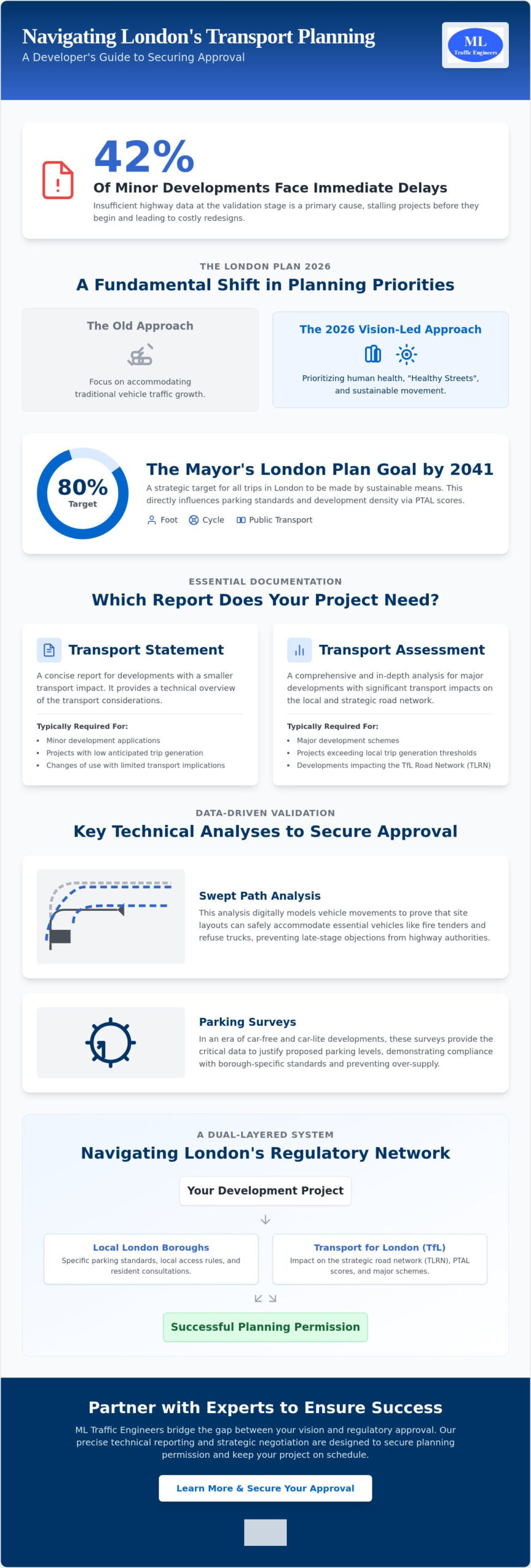
    Did you know that 42% of minor development applications across London boroughs face immediate delays at the validation stage because of insufficient highway data? For developers, these setbacks often stem from complex borough-specific parking standards or unexpected technical objections late in the planning cycle. It’s frustrating to see a project stall just as it gains momentum. Engaging expert transport planning consultants london is a functional necessity to ensure your scheme meets the rigorous demands of Transport for London and local authorities.

    We understand that you need clear communication with highway authorities and cost-effective technical reports that don’t compromise on precision. This guide promises to simplify the complexities of London planning applications by providing a clear roadmap for transport strategy and regulatory compliance. You’ll gain a comprehensive overview of the 2026 landscape, including the shift toward vision-led planning, the requirements for car-free developments in high PTAL areas, and the specific thresholds for Transport Statements and Assessments.

    Key Takeaways

    • Learn how the 2026 regulatory environment requires a data-led approach to bridge the gap between development goals and highway authority expectations.
    • Identify the specific scale-based thresholds that dictate whether your London project needs a Transport Statement or a comprehensive Transport Assessment.
    • Understand how technical data from Swept Path Analysis and Parking Surveys validates your site layout for fire tenders and refuse vehicles.
    • Navigate the dual-layered requirements of local London boroughs and the Transport for London Road Network to prevent costly validation delays.
    • Discover why expert transport planning consultants london are essential for securing planning permission through precise technical reporting and strategic negotiation.

    The Role of Transport Planning Consultants in London’s 2026 Landscape

    In 2026, the gap between a developer’s vision and a highway authority’s approval is wider than ever. Professional transport planning consultants london act as the essential bridge, translating architectural intent into technically compliant reports. This involves managing the entire transport planning process from the initial site assessment through to final planning approval. By aligning project goals with the specific requirements of the 32 London boroughs, consultants ensure that developments aren’t just viable but also compliant with the latest strategic frameworks.

    The regulatory environment has moved away from simply accommodating vehicle volumes. Today, the focus is on a vision-led approach that prioritizes human health and sustainable movement over traditional traffic growth models. This shift requires a data-intensive strategy where every design choice is justified by technical evidence. You can’t rely on outdated national guidance when TfL and borough officers expect granular, site-specific data. Whether it’s proving site access via Swept Path Analysis or justifying parking levels through Parking Surveys, precision is a functional necessity to avoid immediate delays at the validation stage.

    To better understand the environmental and strategic shifts driving these requirements, watch this helpful video from Transport for London:

    Navigating the London Plan 2026

    The Mayor’s London Plan sets a strategic target for 80% of all trips to be made by foot, cycle, or public transport by 2041. For developers, this means the Public Transport Accessibility Level (PTAL) score of a site is now the primary factor in determining density and parking provision. In areas with high PTAL scores of 4 or above, “car-free” developments are often the only path to approval. Expert transport planning consultants london help you navigate these mandates by developing robust Travel Plans that promote active travel and reduce reliance on private vehicles. This proactive strategy ensures your application aligns with the “Healthy Streets” approach, which is now a non-negotiable benchmark for all major London schemes.

    Reducing Logistical Friction for Developers

    Professional reports aren’t just paperwork; they’re a vital tool for risk mitigation. High-quality Transport Statements and Transport Assessments provide the technical authority needed to address local resident objections and speed up the statutory consultation period. Early engagement prevents costly redesigns that occur when highway authorities identify technical flaws late in the cycle. We provide a fully-managed service that identifies these risks early. Visit our services overview to see how we manage the full project lifecycle from assessment to support. This rhythmic efficiency ensures your project maintains momentum from inception to completion, reducing the regulatory pressure on your team.

    Essential Documentation: Transport Statements vs. Assessments

    Selecting the incorrect level of documentation is a leading cause of application rejection in the capital. Navigating highway requirements under the National Planning Policy Framework (NPPF) requires developers to scale their reporting based on the anticipated impact of their scheme. Professional transport planning consultants london provide the technical precision needed to classify your project correctly from the start. This ensures you don’t overspend on unnecessary analysis for minor sites or face technical objections for under-reporting on major developments.

    Every report serves as a legal and technical justification for your site layout. While the National Planning Policy Framework sets the broad context, London’s specific requirements are often more stringent. Missing a single data point regarding cycle storage or trip generation can lead to immediate delays at the validation stage. We prioritize the rapid delivery of these documents to keep your project on schedule. If you need to understand the specifics of our reporting process, you can explore our detailed service list.

    Transport Statements for Minor Developments

    A Transport Statement is a concise report for smaller developments with limited transport impacts. In London, this document is typically required when a proposal is expected to generate between 30 and 50 vehicle movements during peak hours. Boroughs like Tower Hamlets and Camden now demand that even these minor applications include high-quality data on cycle parking and waste strategy. We focus on site observations and local highway impact to prove that your development won’t compromise public safety or local traffic flow. Our team manages the full project lifecycle, ensuring that your Transport Statement meets all borough-specific standards.

    Transport Assessments for Major Schemes

    Major projects require the rigorous multi-modal analysis found in a full Transport Assessment. The common threshold for a residential development in London is 80 or more units, while commercial proposals often require this assessment if they exceed 2,500 square meters. These documents use the TRICS database to predict travel patterns across walking, cycling, and public transport. This is vital for developments in areas with high PTAL scores where car-free mandates apply. For a deeper look at these requirements, read our Transport Assessment London: The Developer’s 2026 Guide. We also integrate Travel Plans into these assessments to satisfy Section 106 obligations and demonstrate a long-term commitment to sustainable travel targets.

    Data-Driven Success: Swept Path Analysis and Parking Surveys

    Technical data serves as the “proof of concept” for every London development. Without empirical evidence, even the most innovative architectural designs risk rejection by highway officers. Professional transport planning consultants london use advanced data collection to demonstrate that a site can function safely within the existing infrastructure. This evidence-based approach is vital because 42% of minor applications in London face delays specifically due to insufficient highway data. By providing precise technical reporting from the start, we reduce the regulatory pressure on your project team and ensure a smoother path to approval.

    We manage the full data collection lifecycle, from initial site observations to the final submission. This includes justifying site access points and junction designs through comprehensive Traffic Surveys. These surveys provide the baseline data needed to predict how new trip generation will impact local road networks. When technical authority is backed by hard data, it becomes much harder for authorities or local objectors to stall a project based on anecdotal concerns.

    Precision via Swept Path Analysis

    Swept Path Analysis (SPA) is a non-negotiable requirement for demonstrating that a site can accommodate essential service vehicles. We utilize industry-standard AutoTURN software to simulate the exact movements of vehicles within your site layout. In London, this means designing for specific vehicle templates, such as the standard London Fire Brigade tender or borough-specific refuse trucks. Our analysis ensures that these large vehicles can enter, turn, and exit the site in a forward gear without overhanging curbs or endangering pedestrians. For a deeper look at this process, see our Practical Guide to Swept Path Analysis in 2026.

    Parking Stress Surveys and the Lambeth Methodology

    Most London boroughs require Parking Surveys to follow the “Lambeth Methodology” to assess local parking capacity. This typically involves overnight surveys conducted between 12:30 am and 5:30 am on two separate weekday nights. The goal is to identify “parking stress” on surrounding streets. This data is critical when justifying “parking-free” or “car-lite” developments in high PTAL areas. It proves to the council that any potential “overspill” parking from the new development won’t overwhelm neighbouring residential streets. As expert transport planning consultants london, we provide the detailed reporting needed to address these concerns head-on, ensuring your parking strategy aligns with both the London Plan and local borough standards.
    Transport Planning Consultants in London: The 2026 Developer’s Guide

    London developers face a unique dual-layered regulatory environment. Planning applications are split between the oversight of 32 local boroughs and the strategic requirements of Transport for London (TfL). This division creates a complex approval path that requires constant vigilance. If your site sits on or near the Transport for London Road Network (TLRN), also known as “Red Routes”, you face high-level scrutiny from strategic officers. Expert transport planning consultants london manage this friction by aligning local site goals with city-wide transport objectives—such as maintaining network flow through the prompt roadside assistance provided by Instant Recovery—ensuring that one authority’s demands don’t contradict the other’s.

    We manage the technical negotiations for Section 278 (s278) agreements. These legal contracts are essential when your development requires physical changes to the public highway, such as new site access or junction improvements. In 2026, Active Travel Zone (ATZ) assessments have become a primary focus for both TfL and local boroughs. These assessments evaluate the quality of walking and cycling routes within a specific radius of your site. Our team provides the data-led reporting needed to prove your scheme supports the city’s sustainable travel goals.

    TfL Pre-Application Advice

    Engaging TfL early is critical for any site near a Red Route or Tube station. They review applications against the Healthy Streets Approach and Vision Zero safety standards, which aim to eliminate all traffic fatalities. This process often involves high-level scrutiny of your construction logistics and delivery plans. We act as your technical authority during these pre-application meetings, reducing the risk of unexpected objections. To strengthen your position during these negotiations, consider how our Travel Plan consultants can demonstrate your commitment to sustainable transport targets.

    Borough-Specific Nuances

    A transport strategy that secures approval in Westminster may fail in Hackney due to differing local priorities. Policies regarding cycle parking standards, Controlled Parking Zone (CPZ) restrictions, and car-free mandates vary significantly across the capital. We understand these intricate regional regulations so you don’t have to. Our role extends beyond reporting; we attend planning committee meetings to provide technical clarity when members raise concerns. If you need a reliable partner to manage these complex negotiations, contact our team today to secure your project’s timeline.

    Choosing ML Traffic Engineers UK for Your London Project

    Securing planning permission in the capital requires a partner who understands that precision isn’t optional. We position ourselves as the leading transport planning consultants london by delivering technical reports that withstand the highest levels of scrutiny. ML Traffic Engineers UK manages the entire project lifecycle, from initial data collection to final negotiations with highway officers. This comprehensive approach ensures that your development remains compliant with the latest strategic mandates while meeting urgent planning deadlines.

    We take immense pride in our adherence to industry benchmarks. Our reports aren’t just documents; they’re professional tools designed to reduce logistical and regulatory pressures on your team. We maintain a consistent sense of readiness to address technical objections as they arise. This unwavering reliability has built our proven track record across all 32 London boroughs and with Transport for London. We understand intricate regional regulations so you don’t have to, acting as a vital guardian of professional integrity for your project.

    Just as we emphasize technical certification for our engineers, ensuring your broader workforce has recognized credentials is a key part of project risk management. For developers with international operations or team members seeking Australian certification, you can learn more about Right Pathway and their RPL facilitation services.

    A Reliable Partner for Complex Sites

    Complex urban sites demand a safety-conscious and reassuring approach. ML Traffic Engineers UK provides a fully-managed service that covers every technical requirement, including Swept Path Analysis and Parking Surveys. Our focus remains on reducing the administrative burden through expert advocacy. By providing clear, data-backed documentation, we speed up the statutory consultation period and mitigate the risk of late-cycle redesigns. You can view the full scope of our expertise on our what we do page. This rhythmic efficiency ensures your project maintains momentum from inception to completion.

    Ready to Secure Your Planning Approval?

    Time is a critical asset in infrastructure development. Our direct communication and active voice ensure that information reaches you and the planning authorities without delay. We offer tailored fee proposals that reflect the specific requirements of your London site. Don’t let technical objections stall your progress. We provide the technical authority needed to navigate the most challenging planning environments. Contact ML Traffic Engineers UK for a Transport Planning Consultation today to ensure your project moves from assessment to execution with absolute precision.

    Streamline Your London Planning Approval with Technical Precision

    Success in the 2026 London development market depends on technical authority and data-driven strategy. You’ve seen how vision-led planning and rigorous documentation standards, such as the Lambeth Methodology for parking stress, define modern applications. Aligning your project with the Healthy Streets Approach while balancing borough-specific mandates is a functional necessity for any developer. Professional transport planning consultants london provide the strategic negotiation skills required to bridge the gap between your architectural vision and highway authority requirements.

    ML Traffic Engineers UK provides the unwavering reliability you need to navigate these complexities. Founded in 2014, we bring over a decade of success to every project. Our expertise in TRICS multi-modal analysis and Swept Path Analysis ensures your site layout is both safe and compliant. We manage the full project lifecycle from initial survey to final submission, reducing the logistical pressure on your team. We take pride in our precision and adherence to industry benchmarks, acting as a dependable partner for even the most complex urban sites.

    Ready to move forward? Get a Quote for Your London Transport Planning Requirements and secure your project’s timeline today. ML Traffic Engineers UK is here to ensure your development reaches its full potential with professional integrity and expert advocacy.

    Frequently Asked Questions

    Do I need a transport planning consultant for a small London development?

    Yes, you should engage transport planning consultants london even for small schemes to ensure your data meets borough-specific validation requirements. Small developments often trigger technical objections regarding cycle storage or refuse collection that can stall an application. Expert reporting provides the technical authority needed to satisfy local highway officers and prevent immediate delays at the validation stage.

    What is the difference between a Transport Statement and a Transport Assessment in London?

    The difference lies in the scale of the development and its anticipated impact on the local network. A Transport Statement is a concise report for minor schemes generating limited traffic; while a Transport Assessment provides a comprehensive multi-modal analysis for major projects. Thresholds often include 80 residential units or 2,500 square meters of commercial space as triggers for a full assessment.

    How long does it take to prepare a Transport Statement for a planning application?

    A standard Transport Statement typically requires two to four weeks to prepare, including the time for site observations and policy analysis. The timeline depends heavily on the complexity of the site and the specific data requirements of the local borough. We prioritize rapid delivery to ensure your planning application remains on schedule and meets all technical benchmarks.

    Why is Swept Path Analysis required for my London site layout?

    Swept Path Analysis is required to prove that essential service vehicles, such as London Fire Brigade tenders and refuse trucks, can safely navigate your site. It uses simulation software to demonstrate that these vehicles can enter and exit in a forward gear. This technical “proof of concept” is a non-negotiable foundation for securing approval for your site layout.

    What is the Lambeth Methodology for parking surveys?

    The Lambeth Methodology is the industry-standard framework for conducting parking stress surveys in London. It involves recording the number of parked vehicles on surrounding streets during two separate weekday nights between 12:30 am and 5:30 am. This data justifies your parking provision and demonstrates that your development won’t overwhelm local residential parking capacity.

    Can a transport consultant help with TfL Red Route access issues?

    Yes, a consultant acts as your technical advocate during negotiations with Transport for London regarding Red Route access. We provide the strategic advice and technical reporting needed to navigate TfL’s Healthy Streets Approach and Vision Zero safety audits. Early engagement through pre-application advice is critical for resolving access issues before they impact your planning timeline.

    How does a high PTAL rating affect my parking requirements?

    A high Public Transport Accessibility Level (PTAL) score significantly reduces the amount of parking you are permitted to provide. In areas with a PTAL rating of 4 or higher, the London Plan generally mandates “car-free” developments, where parking is restricted to disabled persons’ spaces only. We help you justify this through robust Travel Plans and active travel strategies.

    What is a Section 278 agreement and when is it needed?

    A Section 278 (s278) agreement is a legal contract between a developer and the highway authority for permanent works on the public highway. You will need this agreement if your project requires physical changes, such as a new site entrance or junction improvements. We manage the technical documentation required to secure these agreements and ensure compliance with legislative requirements.

    Michael Lee

    Article by

    Michael Lee

    Transport planner with over 35 years' experience.

    Disclaimer

    The content on mltraffic.co.uk, including all technical articles, guides, and resources, is provided for general informational and educational purposes only. It is not intended to constitute professional advice in traffic engineering, transportation planning, development approvals, or any other technical or legal field.
    While ML Traffic Engineers makes every reasonable effort to ensure the accuracy, completeness, and timeliness of the information published, we do not provide any warranties or representations (express or implied) regarding its reliability, suitability, or availability for any particular purpose. Any reliance you place on the content is strictly at your own risk.
    In no event shall ML Traffic Engineers, its directors, employees, authors, or affiliates be liable for any direct, indirect, incidental, special, consequential, or punitive damages (including, without limitation, loss of profits, data, or business opportunities) arising out of or in connection with the use of, or inability to use, any information provided on this website.
    The articles and guides on this site are not a substitute for engaging a qualified, professional traffic engineer to assess your specific project requirements. For tailored advice, compliance assessments, or traffic engineering services, please contact a competent professional.
    This disclaimer may be updated from time to time without notice. By accessing or using this website, you agree to be bound by the most current version of this disclaimer.

  • Transport Consultants UK: The Developer’s Guide to London Planning Success (2026)

    Transport Consultants UK: The Developer’s Guide to London Planning Success (2026)

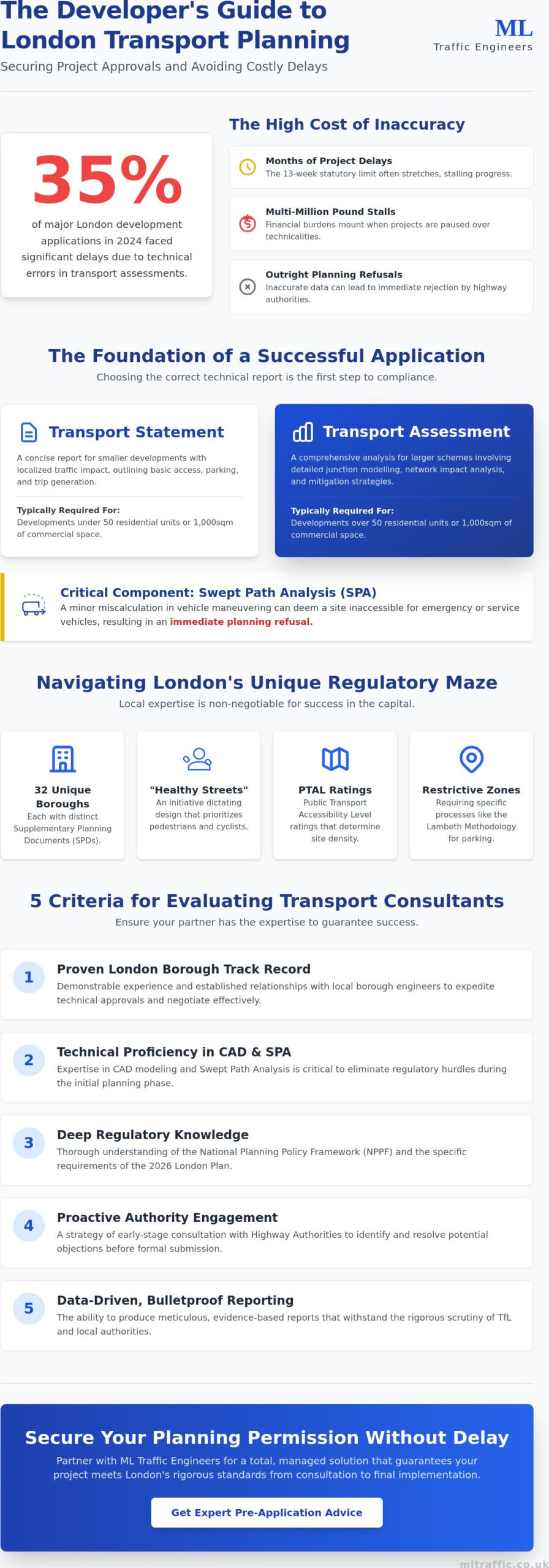
    Recent industry analysis shows that 35% of major London development applications in 2024 faced significant delays solely due to technical errors in transport assessments. You know that securing planning permission in the capital is a high-stakes process where a single inaccuracy in a Swept Path Analysis can stall a multi-million pound project for months. Selecting the right transport consultants uk developers trust is the most critical step to ensure your project meets the strict 2026 regulatory standards without unnecessary revisions.

    It’s clear that you need technical reports that are both accurate and cost-effective to satisfy local highway authorities and Transport for London (TfL). We’ll show you how to identify a consultancy that provides expert representation and bespoke technical data to guarantee a successful submission. This guide details the essential criteria for choosing a partner that eliminates hidden costs and delivers a total, managed solution for your planning needs.

    Key Takeaways

    • Partnering with expert transport consultants uk ensures your development meets rigorous London planning standards through precise Transport Assessments and Statements.
    • Discover how technical proficiency in CAD design and Swept Path Analysis (SPA) eliminates regulatory hurdles during the initial planning phase.
    • Learn to navigate complex London-specific requirements, including PTAL site density ratings and the Lambeth Methodology for parking surveys in restrictive zones.
    • Identify the five critical criteria for evaluating a consultancy’s track record with specific London Boroughs to secure faster project approvals.
    • Leverage data-driven reporting and technical expertise to manage your development’s logistical and regulatory burdens from consultation through to final implementation.

    Table of Contents

    Why You Need Specialist Transport Consultants for London Projects

    Transport consultancy isn’t just about traffic counts; it’s a technical discipline rooted in transport planning principles that align development goals with UK planning law. For developers, transport consultants uk act as the essential link between architectural vision and the rigid requirements of the Highway Authority. They provide the technical evidence, often through rigorous CAD modeling and traffic flow analysis, required to satisfy the National Planning Policy Framework (NPPF) and the London Plan 2021. General engineering firms frequently struggle in the capital because they treat transport as a secondary concern. In London, where space is at a premium and the “Healthy Streets” initiative dictates design, transport is often the primary hurdle to securing a “granted” status.

    Navigating the Planning Application Process

    Securing planning permission depends on understanding specific trigger points. If your development exceeds 50 residential units or 1,000sqm of commercial space, you’ll likely need a full Transport Assessment rather than a simpler Transport Statement. Our consultants mitigate the risk of expensive planning refusals by identifying capacity issues during the initial feasibility stage. We prioritize early-stage engagement with Highway Authorities to resolve potential objections regarding site access or parking ratios before they reach the public consultation phase. This proactive approach prevents the 13-week statutory limit for major applications from stretching into months of costly delays.

    The Value of Local London Expertise

    London’s 32 boroughs each operate with unique Supplementary Planning Documents (SPD) and distinct political priorities. Local expertise is vital for navigating these nuances, particularly when negotiating Section 278 agreements for permanent highway works. Specialist transport consultants uk provide London pre-application advice by identifying potential highway constraints and negotiating mitigation strategies with local authorities before a formal planning submission is made. By leveraging established relationships with borough engineers, consultants expedite the technical approval process. This ensures your project moves from the drawing board to the construction phase without being stalled by avoidable highway objections.

    Precision in data is non-negotiable. Whether it’s assessing the impact of a new cycle lane or calculating the trip generation of a mixed-use tower, the data must be bulletproof. A minor miscalculation in swept path analysis can lead to a site being deemed inaccessible for emergency vehicles, resulting in an immediate refusal. We provide a total, managed solution that ensures every technical requirement is met with 24/7 readiness, protecting your investment from the earliest planning stages through to final implementation.

    Core Services Provided by UK Transport Consultancies

    Experienced transport consultants uk act as the technical bridge between a developer’s vision and the stringent requirements of highways authorities. They provide the empirical evidence needed to prove a project is safe, accessible, and sustainable. By managing the complex logistics of road usage, these experts ensure that planning applications move through the system without avoidable delays or costly redesigns.

    Transport Statements and Assessments

    Developers must identify early whether their project requires a concise Transport Statement or a full Transport Assessment London. Generally, smaller developments with localized traffic impact utilize a Statement to outline basic access and trip generation. Larger schemes trigger a comprehensive Assessment, which involves detailed junction modelling and network impact analysis. Following the official UK government guidance ensures these reports address safety, capacity, and accessibility from the outset.

    Every technical report must align with the National Planning Policy Framework (NPPF). This framework dictates that development should only be prevented on transport grounds if the residual cumulative impacts on the road network are severe. Robust transport consultants uk provide the data necessary to demonstrate that a project meets these national standards while satisfying specific 2026 London Plan requirements.

    Data-Driven Design: SPA and Surveys

    Precision in design prevents project refusals during the final stages of planning. Utilizing Swept Path Analysis services allows consultants to simulate vehicle movements using CAD software. This proves that emergency vehicles, refuse trucks, and delivery vans can enter and exit the site safely without mounting kerbs or striking structures. It is a vital safety check that provides local authorities with the confidence to approve site layouts.

    Accurate parking surveys provide the empirical evidence needed to justify development density. In London, consultants typically use the Lambeth Methodology to conduct overnight surveys, measuring parking stress within a 200-metre radius of the site. This data often justifies lower on-site parking provisions, which maximizes the use of available land for actual building units. Accurate traffic data acts as the foundation of any successful planning bid, replacing guesswork with defensible facts.

    Strategic Travel Plans complete the service suite by outlining how a site will encourage sustainable transport. These plans are active management tools that promote walking, cycling, and public transport use to meet the 2026 “Healthy Streets” targets. You can explore how these technical services integrate into your project by reviewing our comprehensive service overview.

    Transport Consultants UK: The Developer’s Guide to London Planning Success (2026)

    Evaluating Transport Consultants in the UK: 5 Key Criteria

    Selecting the right transport consultants uk involves more than comparing quotes. In London’s 2026 planning environment, a consultant’s relationship with specific Boroughs determines project speed. You need a partner who understands the local nuances of Southwark versus the City of London. They must act as a safe pair of hands, managing the entire lifecycle from initial scoping to Chapter 8 compliance on-site. Don’t settle for a firm that merely provides data. Look for a managed solution that integrates traffic surveys with physical implementation to avoid fragmented communication between contractors.

    Technical Proficiency and Software

    Precision is non-negotiable. Your consultant must demonstrate expert-level use of the TRICS database to provide accurate trip generation figures. This data forms the backbone of your Transport Assessment. For physical site constraints, CAD-based Swept Path Analysis (SPA) is the industry standard for proving fire tender and refuse vehicle access. Professional standards set by the Chartered Institution of Highways & Transportation ensure these technical outputs meet rigorous safety benchmarks. It’s essential that consultants utilize the latest 2026 vehicle templates in SPA to accurately reflect the turning circles of modern emergency service fleets. You can view how these technical skills apply across different project types to ensure your site layout is viable from day one.

    Responsiveness and Reliability

    Project timelines in London are fragile. A 48-hour delay in a traffic survey can push a planning submission back by a full month, potentially costing thousands in holding fees. Reliable transport consultants uk offer 24/7 availability. This isn’t just a perk; it’s a necessity for emergency site surveys or rapid adjustments to traffic management plans when site conditions change unexpectedly. A customer-centric consultancy prioritizes your deadline as their own. They provide a single point of contact who understands the regulatory pressures of the current London Plan. This level of readiness ensures that when a local authority requests an urgent revision, your team is already executing the solution. You need a partner that moves at the speed of construction, not the speed of bureaucracy. Our approach at ML Traffic focuses on what we do best: providing immediate, technical certainty for high-stakes developments.

    London developers face a complex web of spatial and regulatory constraints that demand technical precision. Working with experienced transport consultants uk ensures projects meet the high standards set by the London Plan. By 2026, the shift toward Healthy Streets and car-free developments has intensified, making the initial transport assessment a critical factor in site viability. We provide the technical authority needed to move projects from the planning phase to implementation without delay.

    Understanding PTAL and Density

    The Public Transport Accessibility Level (PTAL) score remains the primary metric for determining site density and parking provision. Scores range from 0 to 6b. In high PTAL areas, typically scores of 5 to 6b, the default expectation is zero residential parking, excluding essential Blue Badge spaces. This policy aims to reduce congestion and improve air quality across the capital.

    For sites in Zones 3 to 6 with lower PTAL ratings, developers must justify every parking space through rigorous data. We help clients implement mitigation strategies such as car clubs or improved pedestrian wayfinding to offset lower scores. You can access specific PTAL guidance and resources to help calculate your site’s potential density and parking limits.

    Liaising with Local Highway Authorities

    Each London Borough maintains its own nuances regarding parking standards and highway adoption. Negotiating Section 278 agreements for works to existing highways and Section 38 agreements for the adoption of new roads requires a proactive stance. Council highway officers often raise objections during the planning process. Common issues include:

    • Refuse vehicle tracking and swept path analysis using CAD design.
    • Impact on local School Streets or Low Traffic Neighborhoods (LTNs).
    • Cumulative traffic impact on the Strategic Road Network (SRN).

    Our team coordinates directly with Transport for London (TfL) when projects border the red route network. This ensures that construction logistics plans (CLP) don’t disrupt the flow of London’s arterial roads. We manage these high-stakes negotiations so you don’t have to navigate the regulatory burden alone.

    The 2026 standards for sustainable transport are non-negotiable. Current regulations require 20% of parking spaces to have active Electric Vehicle (EV) charging points. The remaining 80% must have passive provision for future connection. Cycle parking must follow the London Cycling Design Standards (LCDS), prioritizing accessible, secure, and covered storage. We design bespoke layouts that maximize space while ensuring 100% compliance with these safety and environmental mandates. Precision in these details prevents costly revisions during the construction phase.

    Ready to secure your planning approval? Contact ML Traffic for a comprehensive transport solution tailored to your site.

    ML Traffic Engineers: Your Technical Partner for London Development

    Since 2014, ML Traffic Engineers has delivered technical expertise to the London development sector. We understand that planning success hinges on data-driven precision. Our team provides the technical reporting required to satisfy Transport for London (TfL) and local borough requirements. As experienced transport consultants uk, we specialise in Swept Path Analysis (SPA), Parking Surveys, and comprehensive Transport Assessments. Our 24/7 readiness ensures your project maintains momentum, even when deadlines are tight. We operate as a safe pair of hands for developers who need to meet strict regulatory standards without delay.

    Our Approach to Planning Success

    Every project begins with a rigorous feasibility study. We don’t just deliver reports; we provide actionable engineering solutions. Our CAD design team creates detailed traffic management plans that ensure Chapter 8 compliance from the outset. This technical excellence allows you to focus on the broader construction goals. We’ve helped developers secure approvals for high-density residential blocks and complex commercial sites by turning transport hurdles into technical wins. Our process is sequential and logical. We manage the following project stages:

    • Initial feasibility and site accessibility audits.
    • Data collection through Lambeth Accord parking surveys and traffic counts.
    • Technical design using multi-way systems and temporary traffic signals.
    • Final implementation and ongoing site maintenance.

    We handle the intricate complexities of UK road regulations so you don’t have to. Our commitment to safety and precision is a legal and physical necessity in the high-stakes London environment.

    Get Started with Your London Project

    Developers trust us because we prioritise safety and legislative compliance. We provide bespoke solutions that offer seamless integration with your existing project timeline. Our 24/7 availability acts as a primary hallmark of our brand promise; we understand the unpredictable nature of London construction. Whether you’re dealing with emergency road repairs or long-term utility works, our team is ready to respond. We provide a total, managed solution rather than acting as a mere equipment supplier. This comprehensive support is why we remain a leading choice for transport consultants uk.

    Requesting a technical transport quote is a straightforward process. Our team reviews your site requirements and provides a clear, functional proposal tailored to your specific planning constraints. We value your time and move straight to the core value proposition of your project.

    Primary CTA: Request a Transport Planning Quote from ML Traffic

    Accelerate Your London Development Approval

    Navigating London’s planning landscape in 2026 requires technical precision and a deep understanding of local authority mandates. Successful developers prioritize accurate data from the start, utilizing detailed Lambeth Parking Surveys and rigorous Swept Path Analysis to prove site viability. These technical benchmarks aren’t just suggestions; they’re the foundation of a successful planning application in a city with zero margin for error.

    Partnering with established transport consultants uk eliminates the guesswork from your submission. ML Traffic Engineers provides this essential technical authority. Founded in 2014, we’ve built a decade of expertise managing complex London projects. We offer a professional, 24/7 responsive service that handles everything from CAD design to legislative compliance. You’ll gain a dedicated partner that understands the high-stakes nature of traffic management and the urgency of construction timelines. We’re ready to secure your site’s future with reliable, safety-conscious solutions that meet every regulatory standard.

    Secure your London planning approval with expert transport consultancy from ML Traffic Engineers

    Your project deserves the certainty of professional oversight and technical excellence.

    Frequently Asked Questions

    How much do transport consultants in the UK typically charge for a Transport Statement?

    Transport consultants UK usually charge between £1,500 and £3,500 for a standard Transport Statement. These fees fluctuate based on the development’s scale and the local highway authority’s specific requirements. Larger commercial schemes or those with complex access issues often command higher fees. This cost covers data collection, policy review, and the production of a report that meets National Planning Policy Framework standards.

    When is a full Transport Assessment required instead of a basic Transport Statement?

    You need a full Transport Assessment when a development exceeds specific size thresholds, such as 80 residential units or 2,500 square metres of gross floor area. Local authorities in London use these metrics to gauge potential traffic impact on the surrounding network. If your project generates 30 or more two-way vehicle movements during peak hours, planning officers will mandate this more detailed analysis over a basic statement.

    Do I need a transport consultant for a small residential development in London?

    Yes, small residential developments in London frequently require a specialist to navigate the London Plan 2021 parking standards and cycle storage requirements. Even a single-unit scheme might face objections regarding site access or refuse collection. Transport consultants UK ensure your design complies with the Healthy Streets Approach, which is essential for securing planning approval in all 32 London boroughs and the City of London.

    How long does it take for a transport consultant to complete a Swept Path Analysis?

    A standard Swept Path Analysis typically takes 3 to 5 business days to complete once site plans are provided in CAD format. This timeframe includes the technical simulation of vehicle movements, such as refuse trucks or fire engines, to ensure they can maneuver safely within the site. Complex layouts involving multiple vehicle types or tight urban constraints might extend the process to 10 days to ensure total accuracy.

    What is the Lambeth Methodology and why is it used for London parking surveys?

    The Lambeth Methodology is the industry standard for conducting overnight parking surveys to determine parking stress within 200 metres of a site. It requires two surveys between 00:30 and 05:30 on weekday mornings to capture peak residential demand. Developers use this data to prove that local streets can accommodate overspill parking without compromising highway safety or emergency vehicle access.

    Can a transport consultant help if my planning application has already been flagged for highway issues?

    We act as expert intermediaries to resolve highway objections through technical mitigation strategies and revised site layouts. We analyze the specific concerns raised by the Highways Authority, such as visibility splays or junction capacity, and provide evidence-based solutions to overcome them. Our team often uses Vissim or Junctions 9 software to demonstrate that proposed changes won’t negatively impact the existing road network.

    How does a site’s PTAL rating affect the transport consultancy requirements?

    A site’s Public Transport Access Level (PTAL) rating, ranging from 0 to 6b, dictates the maximum allowable car parking and minimum cycle storage requirements. High PTAL scores of 5 or 6 typically require car-free developments under London Plan policies. Your consultant uses this rating to justify parking provision levels and to develop robust Travel Plans that encourage sustainable transport modes for future occupants.

    What is the difference between a transport consultant and a traffic engineer?

    Transport consultants focus on the planning and policy aspects of a project, while traffic engineers handle the technical design and physical implementation of road systems. Consultants prepare the strategic reports required for planning permission, such as Delivery and Servicing Plans. Engineers manage the hardware, including temporary traffic signals and Chapter 8 compliant road markings, to ensure the physical worksite remains safe and functional.approval.

    Which areas in London do you cover?

    We service Acton, Balham, Barking, Barnes, Barnet, Battersea, Beckenham, Bexleyheath, Brentford, Brixton, Bromley, Camberwell, Carshalton, Charlton, Chelsea, Chiswick, Clapham, Coulsdon, Croydon, Crystal Palace, Dagenham, Dulwich, Ealing, Edgware, Eltham, Enfield, Finchley, Forest Gate, Fulham, Golders Green, Greenwich, Hackney, Hammersmith, Hampstead, Harrow, Hayes, Highgate, Hounslow, Ilford, Islington, Kensington, Kentish Town, Kingston upon Thames, Lewisham, Mitcham, Muswell Hill, New Malden, Notting Hill, Orpington, Peckham, Pinner, Purley, Putney, Richmond, Romford, Ruislip, Sidcup, Southall, Southgate, Streatham, Surbiton, Sutton, Tooting, Tottenham, Twickenham, Uxbridge, Walthamstow, Wembley, West Norwood, Wimbledon, Wood Green, Woolwich, Bethnal Green, Shoreditch, Canary Wharf, Deptford, Leyton, Palmers Green, Stanmore, Upminster, Chislehurst, Erith, Feltham.

    Which cities in England do you cover?

    We service London, Birmingham, Manchester, Liverpool, Sheffield, Leeds.

    Michael Lee

    Article by

    Michael Lee

    Transport planner with over 35 years’ experience.

    Disclaimer

    The content on mltraffic.co.uk, including all technical articles, guides, and resources, is provided for general informational and educational purposes only. It is not intended to constitute professional advice in traffic engineering, transportation planning, development approvals, or any other technical or legal field.
    While ML Traffic Engineers makes every reasonable effort to ensure the accuracy, completeness, and timeliness of the information published, we do not provide any warranties or representations (express or implied) regarding its reliability, suitability, or availability for any particular purpose. Any reliance you place on the content is strictly at your own risk.
    In no event shall ML Traffic Engineers, its directors, employees, authors, or affiliates be liable for any direct, indirect, incidental, special, consequential, or punitive damages (including, without limitation, loss of profits, data, or business opportunities) arising out of or in connection with the use of, or inability to use, any information provided on this website.
    The articles and guides on this site are not a substitute for engaging a qualified, professional traffic engineer to assess your specific project requirements. For tailored advice, compliance assessments, or traffic engineering services, please contact a competent professional.
    This disclaimer may be updated from time to time without notice. By accessing or using this website, you agree to be bound by the most current version of this disclaimer.